Space Sunday: the future of the ISS

The International Space Station. Credit: NASA

The United States has now formally announced its intention to end the International Space Station that the start of 2031.

The announcement comes on top of confirmation that the Biden-Harris administration has confirmed ISS operations should continue through until the latter half of 2030. In it, the agency confirms that they plan to replace the ISS with at least three commercial space stations under a joint public-private arrangement that will see the new facilities in part built using taxpayer’s funding through NASA, allowing them to be used for both NASA-operated and private sector research and other activities.

These new space stations will be developed during the nine years of remaining life for the ISS, allowing operations to gradually pivoted to them as they are commissioned.

The private sector is technically and financially capable of developing and operating commercial low-Earth orbit destinations, with NASA’s assistance. We look forward to sharing our lessons learned and operations experience with the private sector to help them develop safe, reliable, and cost-effective destinations in space. The report we have delivered to Congress describes, in detail, our comprehensive plan for ensuring a smooth transition to commercial destinations after retirement of the International Space Station in 2030.

– Phil McAlister, director of commercial space, NASA

Within the plan, NASA also outline how the ISS is to be through to its end-of-life, and provides a brief summary of some of its achievements, including:

  • Hosting more than 3,000 research investigations from over 4,200 researchers across the world.
  • Allowing 110 countries and to participate in research activities performed aboard the
  • Operating international STEM (Science, technology, engineering, and mathematics) programme that has reached 1.5 million students world-wide each year it has been running.
  • Allowed for major breakthroughs in a range of Earth and space sciences.
The International Space Station is entering its third and most productive decade as a ground-breaking scientific platform in microgravity. This third decade is one of results, building on our successful global partnership to verify exploration and human research technologies to support deep space exploration continue to return medical and environmental benefits to humanity, and lay the groundwork for a commercial future in low-Earth orbit.

– Robyn Gatens, director of the International Space Station, NASA

However, there are still bumps in the road in terms of NASA’s planning. Whilst the Biden-Harris administration has green lit the station through until the end of 2030, it is Congress that will largely have the final say in things from the US side – and Congress has mixed views on ISS, a 4-year extension of ISS operations from 2024-2028 having previously proven contentious. Such is the reality of things, there are doubts if some of NASA’s plan can be achieved – something I’ll get to in a moment – which may leave Congress again arguing over the future of the ISS.

Another possible sticking point is continued Russian involvement in the ISS. In 2021, the Russian government and their national space agency, Roscosmos, announced plans to launch their own, independent space station. Currently referred to as the Russian Orbital Service Station (ROSS), which they planned to have “fully operational” and comprising multiple modules by 2030.

These plans will see Russia launch two modules originally intended for the ISS and called SPM-1/NEM-1 and SPM-2/NEM-2 as the backbone for ROSS. The first of these modules is to be launched in 2024 and the second in 2028. However,  under their original plans, Russia indicated that one SPM-1 was in orbit, they might actually detach the self-propelled Nauka science module together with the Prichal docking module attached to it (both delivered to the ISS in 2021) and move them to dock with the nascent ROSS facility, disrupting ISS operations.

But since then, the timeline for ROSS has been pushed out so that 2035 is now the target for completing 2035, potentially negating any need to remove modules from ISS in the late 2020s. Even so, that Russia is to push ahead with ROSS does level some concerns over their willingness to financially support ISS operations beyond 2028.

An artist’s conception of the Russian Orbital Service Station. Credit: Roscosmos

In terms of private venture facilities to replace the ISS, NASA initially indicated that 11 companies and organisations filed proposals under the agency’s Commercial Low Earth Orbit Destinations (CLD) programme. Several of these were rejected for a range of technical and practical issues, whilst three were granted initial seed funding amounting to US $415.6 million.

As I reported in December 2021, these three proposals are from Blue Origin / Sierra Space, Nanoracks and Northrop Grumman. Two further proposals received notes of merit by did not gain initial funding. One of these came from – unsurprisingly – SpaceX, who proposed using a variant of their Artemis lunar landing Starship vehicle, but failed to address core requirements – such as environmental support for long-duration missions, support for multiple vehicle docking and external payload handling capabilities.

The second proposal to receive merit came from an unexpected source: Relativity Space. This is 7-year-old start-up I’ve previously mentioned in these pages that is developing a line of expendable and reusable 3D-printed launch vehicles. They proposed perhaps the most novel concept to NASA: a small-scale research laboratory based on their yet-to-fly Terran-R reusable launch vehicle that could be placed in orbit and periodically returned to Earth for refurbishment, upgrade and re-launch.

An artist’s impression of the proposed Blue Origin / Sierra Space Orbital Reef space station. Credit: Blue Origin / Sierra Space
Overall, the CLD programme calls for at least one of the new orbital facilities to be ready to start some level of operation by the end of 2025, and to be ready for a full transition of ISS operations by 2030. And this is where Congress may view things differently.

At the time the initial CLD contracts were awarded, NASA’s own Office of Inspector General (OIG) was already casting doubt on whether the time frames for a private sector space station could be achieved:

In our judgment, even if early design maturation is achieved in 2025 — a challenging prospect in itself — a commercial platform is not likely to be ready until well after 2030. We found that commercial partners agree that NASA’s current timeframe to design and build a human-rated destination platform is unrealistic.

– NASA OIG report on commercial space stations, December 2021

Ergo, settling on December 2030 as an end date for ISS operations could again split Congress. On the one side, there might be those who believe the station should be financed beyond 2030 “just in case” alternatives are not available. On the other, the fact that alternatives may not be ready, coupled with recent concerns about issues with the ISS as a result of the increasing age of, and wear-and-tear to, the older modules on the station, might lead to calls for an earlier ISS “retirement” to allow funds to be targeted elsewhere.

But there is a potential alternative to a reliance on one of the CLD stations being rapidly developed. . Axiom Space already has a contract with NASA to launch a new module to the ISS in 2024 on a fixed-price basis. The module would be used for a mix of research and space tourism (Axiom will launch its first private crew to the ISS in March of this year aboard their Ax-1 mission). However, the company has additionally committed itself to developing four further modules, two of which they hope to add to the unit attached to the ISS by 2028 to form an “orbital segment”.

These three modules could then be detached from the ISS in 2030 to form a core of a new space station, to which the remaining to modules would be attached in the early 2030s. If Axiom can carry these plans forward between 2024 and 2030, then they could provide the means for NASA to pivot a fair portion of their ISS activities to the Axiom station and also to the CLD stations as they also come on-line in the 2030s, leaving the way clear for ISS to be decommissioned and de-orbited as announced.

Axiom at the ISS: a artist’s impression of how two Axiom modules, (seen right and centre-right) might look when attached to the Harmony module on the International Space Station. Credit: Axiom

This will actually start in around 2025, while the ISS is still in operation, when a gentle series of manoeuvres will be used to gradually lower the station’s altitude through until 2030. Then, after the last crew has departed the station, NASA intend to use the thrusters from a mix of Progress and Cygnus resupply vehicles to remotely lower the station and orient it so that as the frictional heat increases the larger, more delicate parts of the structure will burn up. The track of entry into the atmosphere will be designed so that what survives re-entry – liable to be a series of large sections falling in close proximity to one another – will fall into the southern Pacific Ocean in a region called Point Nemo between New Zealand and Chile, and 2,672 km from the nearest land, the traditional “graveyard” for objects making controlled returns from low Earth Orbit.
Continue reading “Space Sunday: the future of the ISS”

Hera’s superb homage to Blade Runner in Second Life

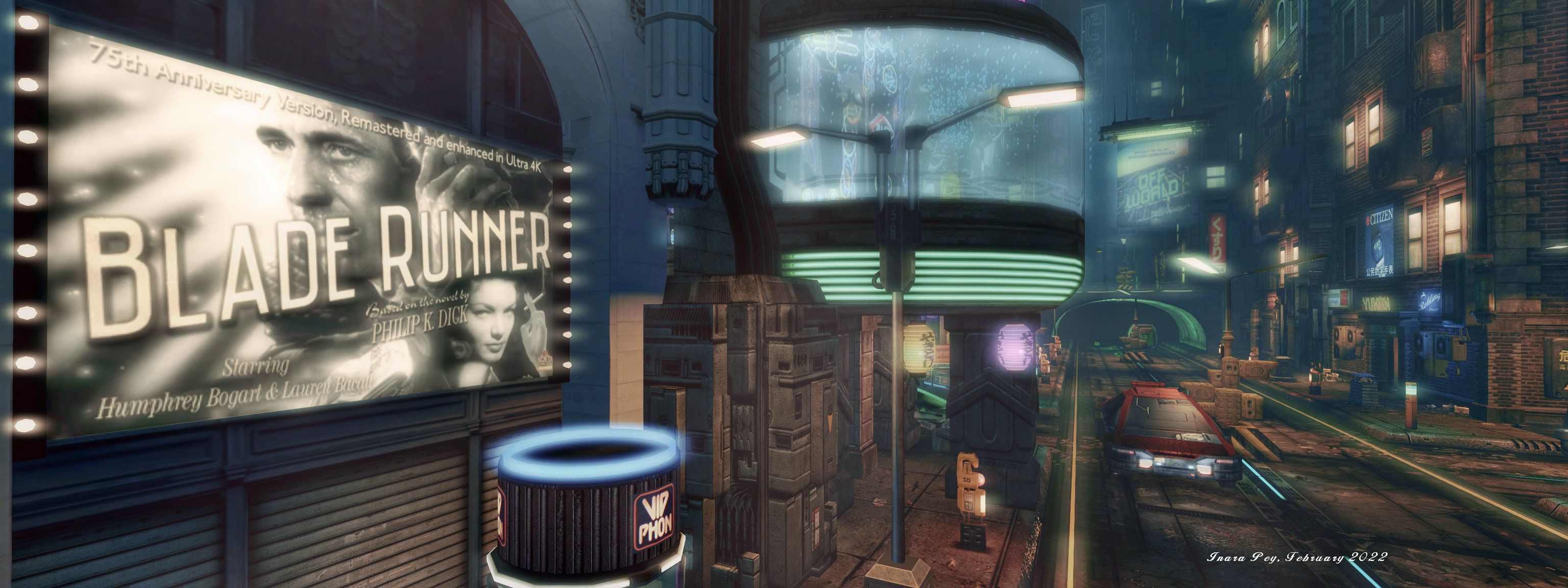
Blade Runner, February 2022
Hi there, I finally decided to do the sim I have been almost doing for the past 20 years, the original Blade Runner set. Hope you can get along to see it some time just opened it.

From Hera (Zee9)

These are the words that sent me skittering over to Hera’s Full region at the weekend, both as a confirmed fan of her work and because I am also a not only a sci-fi fan, but a great aficionado of Ridley Scott’s outstanding 1982 masterpiece, which has oft cropped up in my chats with Hera.

Blade Runner, February 2022 – “A new life awaits you in the off-world colonies. A chance to begin again…”

Surprisingly, I don’t actually have an awful lot to say about Blade Runner, located on the ground level of the region, where it replaces the Drune builds that have previously occupied the space; at least, not it terms of my usual style of travelogue piece. This is not because there is more that much to see – rather the reverse in fact; there is so much on offer here that I actually don’t want to spoil things too much for those who, like me, love Hera’s work and greatly enjoy the film. Because this is a setting where things – like the poster advertising the “75th Anniversary Version” are so superbly put together and the region so rich in detail, it absolutely deserves to have its secrets discovered, not merely written about.

That said, I will offer some pointers to things I feel you should keep an eye out for. It’s intentionally not everything, but it is hopefully enough to whet appetites and get people a-visiting. For example, within the familiar, canyon-like streets we have LCD advertising hoardings and bright neon glow over places of work and business along the busy streets in a manner that directly recalls the movie.  However, within them, there are subtle touches. Not only do the brighter ads for the Tyrell Corporation carry Eldon Tyrell’s words More Human than Human as a tagline, while the logo with them incorporates an owl’s head.

Blade Runner, February 2022

More particularly, spot the adverts for Tyrell’s Nexus 6 Pleasure Models and you might notice a distinctly Pris-like character, complete with eyes masked by black pigment as one of the images displayed by the ads.

Nor is Pris alone in being mentioned. Find your way to The Snake Pit, and you might discover a curtained door that provides access to Zhora Salome’s dressing room, complete with her snake awaiting her return. Elsewhere, Roy Batty gets a more direct reference – and quite rightly, given his richer and deeper interactions with Deckard – as his face is displayed on a police Wanted alert – but I’ll leave you to find that.

Blade Runner, February 2022 – “Queen to bishop six. Check.” ; “Knight takes queen. What’s on your mind, Sebastian? What are you thinking?”
As with the movie, this is a cityscape that is dominated by the great angular form of the Tyrell Building, before which great flame stacks periodically belch frame into the smoggy sky, whilst LAPD spinners periodically zip overhead, and cars and automated vehicles trundle along the wider streets, whilst the narrower throughways are home to a market stalls and corner shops that bring a city to life – and offer further reflections on the 1982 film – and other popular genres. Do be sure, for example, to allow the Globe News stand to fully rendered – there are some nice references to the genuine coverage the film gained on sci-fi and film magazines on its release.

Other touches worth looking out for is the advert for PKD Electric Animals, which includes their new line of sheep – it’s a clever reference to Philip K. Dick’s novel that served as an inspiration for the 1982 film. It’s also an advert that contains a further subtle reference that sits well here. It is to the 1979 song written by Gary Numan for his band, Tubeway Army (and a frequent staple of his concerts as solo artist) Are “Friends” Electric? Released in 1979, three years ahead of Blade Runner, it’s a song about androids – replicants – that are so human-like, they are indistinguishable from flesh and blood – and like the replicants of Dick’s novel (and the film), perform all sorts of menial and other tasks. Actually inspired by Do Androids Dream of Electric Sheep, the song offers something of the same underlying question: are androids real enough to be friends / companions?

Blade Runner, February 2022

There is so much more to be found within this setting – but as I noted above, I don’t want to give everything away, as this is a setting that you should immerse yourself within, although I will note that Deckard’s car, sitting in the rain but sans nosey police spinner loitering overhead, also awaits those who can find it; and do be sure not to miss the other interiors – a couple are hinted at in images here, and there’s another I’ll just introduce by saying, “Good evening Sebastian!”.

So with that in mind, I’m going to bring this piece to a close and strongly urge anyone who likes Blade Runner, sci-fi and / or Hera’s builds not to miss this. Twenty years in the making it may have been, but it is utterly mesmerising – and make sure you have local sounds enabled with visiting!

Blade Runner, February 2022 – “Do you like our owl?”
Blade Runner, February 2022 – “He say you under arrest, Mr. Deckard!” ; “You got the wrong guy, pal.”
Blade Runner, February 2022 – “Is this to be an empathy test? Capillary dilation of the so-called blush response? Fluctuation of the pupil. Involuntary dilation of the iris?”

SLurl Details

Sunday February 6th: Mole Day 2022 in Second Life

The great beacon tower of Pharos, on the east coast of Nautilus. built by Garden Mole, it is one of several builds within Nautilus designed to add to the mythology of the continent and its discovery by Magellan Linden

Sunday, February 6th, 2022, marks the annual Mole Day celebrations in Second Life, and all SL residents are invited to attend festivities at the Bay City Fairgrounds, North Channel.

First held in 2010, Mole Day honours the members of the Linden Department of Public Works (LDPW), affectionately known as the “Moles”, resident builders and scripters contracted by Linden Lab to work on a wide range of (predominantly) in-world projects.

Since their inception, the Moles have have been responsible for many of the larger mainland development projects – most notably Bellisseria and the Linden Homes, although they created many of the more famous sights in Nautilus as well as undertaking initial development of Zindra, the Adult continent, the futuristic-themed Horizons.

Within the Mainland, they also maintain all of the Linden infrastructure etc., and beyond that they also produce Premium membership and have built all of the games and other places accessible via the Portal Parks.

However, their very first project was developing Bay City itself – hence the City’s annual celebration honouring them.

Normally held on the same day as Groundhog Day in the United States, the event is now in its 12th year, and will take place at the Bay City Fairgrounds on February 6th commencing at 11:00 SLT. The event will feature DJ GoSpeed Racer of KONA stream followed by a live performance from Ve Joyy at 12:00 noon SLT.

About Bay City and the Bay City Alliance

Bay City is a mainland community, developed by Linden Lab and home to the Bay City Alliance. The Bay City Alliance was founded in 2008 to promote the Bay City regions of Second Life and provide a venue for Bay City Residents and other interested parties to socialize and network. It is now the largest group for Residents of Bay City.

Related Links

The lost city of Ravenport in Second Life

Ravenport Reclaimed, February 2022 – click any image for full size

Ravenport Reclaimed occupies half of a Full region with the additional private island Land Impact bonus. Designed by Raven Banrion (RavenStarr), it presents a city in decay, a place overcome by time and falling into collapse and nature reclaims it.

Post-apocalyptic region designs are not exactly uncommon in Second Life – I’ve covered more than a few in these pages – but Ravenport offers something that is just a little bit different. Exactly where it might be or what happened goes unmentioned; instead, it is left to the imaginations of those who visit to reach a conclusion as to what may have happened; all we are told is that it is a place that is “wiped out of human life”.

Ravenport Reclaimed, February 2022

These are words that can be interpreted a number of ways, from humans having been somehow eliminated from the city as a result of physical elimination in some way, through to the inhabitants having been forced to flee the city due to natural or other disaster. But whatever the cause, it is clear that human life departed the setting in a hurry and has been gone a while: Broken buildings and roads are well on the way to being lost amidst the returning greenery, vehicles have long since become rusting hulks and the harbour has been deserted for so long that the waters there are choked by vegetation, one of the remaining vessels within it listing to the point where it is no longer seaworthy, and another other fast becoming a home to vines and greenery and a home for waterfowl.

Greetings, survivor. If you are receiving this message, all human life in Ravenport is gone….

– The greeting given to visitors arriving at Ravenport

Ravenport Reclaimed, February 2022

The waterfowl are not the only wildlife to be found within the setting; while humans may appear to have deserted Ravenport, animals have not. They roam almost every street and road, their mix suggesting that they may have all once been gathered within a local zoo:  elephant and rhino from Africa mix with North American jaguar and black bear, while Australian kangaroo can also be found and seals occupy the docks, keeping away from the sharks in the water.

As deer, raccoon, squirrel and even turkey can also be found, together with the styling of the vehicles, there is a hint this might be a place somewhere in the North Americas – but again, I’ll leave that up to you to decide.

However, the animals are not alone in the city. Despite the landing point greeting not everyone has completely deserted Ravenport. Within the ruins of the city’s theatre lie signs that humans still gather on occasion and an attempt has been made to supply electrical power for a DJ’s deck and lighting – so someone appears to be prepared to party on from time to time. Outside of the theatre sits what might at first seem to be a hint as to what might have befallen the city to cause its desertion.

This comes in the form of a Fat Man nuclear bomb that has partially cratered itself directly outside the front of the theatre – although the fact it has not detonated indicates it is not itself responsible for the city’s condition. Nor, given the healthy presence of the wildlife and greenery, would it seem that a nuclear disaster has been directly responsible for the situation; so perhaps the “bomb” is merely an artistic statement.

Those exploring the city will find other possible explanations for the city being left to its own decay. The fence outside of one of the buildings, for example, has a biohazard warning hanging from it. Inside another building sits a figure in a hazmat, a bleak warning painted on the wall over it. These and other elements both add to the mystery of Ravenport and allow visitors add to their own stories around what may have happened here.

Ravenport Reclaimed, February 2022

Rich in detail and finished with a soundscape that reflects the wildlife that wait the cameras of photographers, Ravenport Reclaimed makes of an engaging photo-rich visit. My thanks to Shawn for the landmark.

SLurl Details

2022 CCUG and TPVD meetings week #5 summary

Carrowmore, January 2022 – blog post

The following notes were taken from:

  • My audio recording and chat log of the Content Creation User Group (CCUG) meeting held on Thursday, February 3rd 2022 at 13:00 SLT. These meetings are chaired by Vir Linden, and meeting dates can be obtained from the SL Public Calendar.
  • My audio recording and the Video recording by Pantera (embedded at the end of this piece) from the Third-Party Viewer Developer (TPVD) meeting on Friday, February 4th, 2022.

So this document forms a summary of the key topics discussed, and in the case of the TPVD meeting, timestamps to the relevant point of the video are included.

Available Viewers

[Video: 0:19-0:52 + notes from CCUG]

This list reflects the currently available official Second Life viewers.

  • Release viewer: version version 6.5.2.567427 – Mac Voice hotfix viewer, January 13 – no change.
  • Release channel cohorts (please see my notes on manually installing RC viewer versions if you wish to install any release candidate(s) yourself).
    • Maintenance RC viewer, version 6.5.3.567451, issued on January 20th, combining the Jenever and Koaliang Maintenance viewers.
    • The Tracy Integration RC viewer version 6.4.23.563771 (dated Friday, November 5) issued Tuesday, November 9.
  • Project viewers:
    • Performance Improvements project viewer version 6.6.0.567604, dated January 24.
    • Mesh Optimizer project viewer, version 6.5.2.566858, dated January 5, issued after January 10.
    • Performance Floater project viewer, version 6.4.23.562625, issued September 2.
    • Legacy Profiles viewer, version 6.4.11.550519, dated October 26, 2020.
    • Copy / Paste viewer, version 6.3.5.533365, dated December 9, 2019.

General Viewer Notes

  • The Maintenance J&K RC viewer is likely the next viewer to gain promotion as the de facto release viewer.
  • The Performance Improvements viewer is close to being ready for promotion to RC status, and is just pending some remaining bug fixes.
    • This viewer did have changes to alpha sorting for rigged attachment, but following reports of content breakage as a result of this change, which was more a technical change than a performance enhancement, it has now been reverted to expected alpha sorting behaviour to avoid the breakage issue. Instead, possible alternative approaches will be looked at in the future.
    • A future version of this viewer is to include a new UI element intended to help make adjustments to some of the high-impact graphics settings to help improve frame rates,
  • LL is also completing work to switch the viewer over to using Python 3.

Viewer Multi-Factor Authentication Support – TPVD

[Video: 0:53-23:00]

Background

  • In September 2021, Linden Lab introduced multi-factor authentication (MFA) utilising either a QA code + mobile device or a key number, for those pages of the SL website that provide access to users’ account information (see: Second Life Multi-Factor Authentication: the what and how, September 2021).
  • When introduced, it was indicated that over time, the use of MFA would be expanded and improved, and would eventually include the viewer as well.
  • Brad Linden is now working on implementing MFA for the viewer.

What This Means

  • The work has reached a point where LL is close to having a viewer with MFA support ready for initial testing (as defined by  see: SL Wiki: Login MFA), together with updates to the back-end log-in service to support it.
  • Viewer MFA will be based on users opting in to the capability via the secondlife.com dashboard, as described in the blog posted linked to above.
  • It is  recognised that TPVs will need time to integrate the necessary viewer-side code into their offerings, therefore:
    • There will be a grace period between the initial introduction of the code in the official viewer and a time when all viewers / clients access Second Life will be required to support MFA to allow users who have opted-in to MFA to continue logging-in to SL.
    • During this grace period, all users on a TPV will be able to access Second Life, regardless of whether or not they have opted into MFA.
    • After the grace period has expired, all TPVs will be expected to support MFA, and those users on them who have opted in to MFA will be required to authenticate themselves when using the viewer to log-in to Second Life (with the use 30-day period of valid authentication, as per secondlife.com MFA).
    • During the grace period, users on TPVs that switch to support MFA will likewise need to start authenticating themselves when logging-in to SL.
  • Again, this will only affect users who have opted into MFA (unless LL at some point decides all user must use MFA to access SL).
  • MFA on the viewer will be a blanket action – there will be no additional MFA authentication for actions such as buying Linden Dollars through the viewer.
  • Using MFA when logging-in to the viewer will not automatically also authenticate you on secondlife.com or vice-versa.

There was a broader discussion on providing alternative mechanisms by which users can opt-in and use MFA – such as e-mail – rather than relating on a mobile device and authenticator software. Such decisions fall outside the realm of the viewer development team, and so could not be answered directly (however LL have stated  additional / alternate methods of authentication will be added to the system at some point in the future).

In Brief

Content Creation Meeting

  • BUG-231731 “Script text quality and performance” prompted questions on how it might be implemented given it has been accepted. Vir pointed out that “Accepted” does not necessarily mean it a Feature Request will be implemented forthwith, and as such, it will be raised for discussion once it has reached a point where LL is considering working on it.
  • BUG-229205 “Re-enable PRIM_CAST_SHADOWS” came up for discussion, it is believed that the viewer-side code for it has been deprecated / removed, and the server also no longer recognises the function.
    • Runitai Linden suggested it is something that should be re-enabled on the grounds that it is “something that most graphics engines let you do.”
    • However, any final decision will be subject to further internal discussions within LL.
  • Request: allow seated avatars to temporarily have a physics shape of none if explicitly set by script (potential use-case: an in-world game uses tiny vehicles in a scaled environment to simulate a larger playing field, but as the drivers are normal-sized avatars, they cause collisions between one another, impairing gameplay; disabling the avatar physics would  in theory prevent this, although it is not clear if such a change would be recognised by the simulator, where it is believed the expectation of avatar physics is  assumed throughout the code).
    • The discussion encapsulated requests such as BUG-5538, the need for an overhaul of the camera control system & better LSL access to same; better joystick control options, and better support for alternative input types.
    • The latter point in turn led to a discussion on wider HID support and even the potential for MIDI (Musical Instrument Digital Interface) support (having been a means to provide remote control and synchronisation prior to HID design becoming the “standard”) as a means to transport and synchronise joystick inputs from the viewer to the simulator in a generic, open manner.
    • All of this was spitballing, rather than the formulation of an actual project.

TPV Developer Meeting

  • [Video 26:10-53:10] Animation Override Discussion – TPVD
    • This follows-on from the week #3 TPVD meeting.
    • Essentially what is being sought is a solution similar to the Firestorm AO (but without the apparent overheads) that effectively allows viewer-side replacement of animation states sent by the server with local animations, avoiding the need for scripted HUDS / attachments.
    • Much of the discussion at this meeting is clarifying the original request for Vir Linden’s benefit, although the consensus is that official a cap replacement for llSetAnimationOverride and allowing TPVs to implement their own viewer-side AO UI elements would be a good start.
    • Once this has been done, then discussion can turn to the more complex issue of adding further animation states.
    • A Cap and viewer-side controls will not fully eliminate scripted AOs (particularly in the case of non-human AO walks, sits stands, for example), but this shouldn’t negate the provisioning of a Cap.
    • Please refer to the video for the discussion – much of which is in text chat.

Second Life and the Metaverse: the Wall Street Journal

Philip Rosedale in Remember Second Life? It’s Now Taking On Big Tech’s Metaverse. Credit: The Wall Street Journal

If there is one thing that can certainly be said concerning the news that Philip Rosedale has “returned to Second Life” is that over the last few weeks it has certainly generated a lot of interest from the media.

I’ve already covered articles on Rosedale, Second Life and his views on “the metaverse” from the likes of Protocol (see here)¹, and VentureBeat  / GamesBeat, c|net, and The Wall Street Journal (see here)² – admittedly with some speculation on my part on the case of the latter. More recently Wired and others have also covered SL, Rosedale and “the Metaverse”, and he has been interviewed by CNN, CNBC (the latter of which I’ve yet to summarise), and most recently, by The Wall Street Journal once more.

The latter takes the form of a video segment – embedded below – that features Rosedale taking about Second Life, its users and “the metaverse”, whilst comparing and contrasting SL with plans voiced by the likes of Facebook / Meta and Microsoft and touching on the Lab’s hopes for SL – including further hints at the direction in which the company is leaning in terms of upping the platform’s appal to a broader audience.

Running to 20 seconds short of 6 minutes, the video is actually a concise and honest look at SL, and comes complete with a careful underlining of the age of some of the in-world footage used – a refreshing touch given that so often we are confronted with “archival” images / footage of the platform that get presented without any cage context, and so can leave people thinking they are looking at SL as it appears today.

Starting with Zuckerberg enthusiastically stating how people will all “work, learn, play, shop” in “the metaverse”, the piece quickly reminds viewers that for Second Life, all of that promise is very much a case of “already there and doing all of that, thank you!”. It then offers a fairly accurate recap of SL’s history in terms of early attractiveness, user engagement, and gradual (if somewhat low-key overall) resurfacing of interest (which predates all the current “metaverse” hype by around 24 months). As such, it neatly packages:

  • The the history of SL and its longevity.
  • The broad attractiveness people have found with the platform – notably the appeal of content creation and the power of the economy SL has forged.
  • A frank, thumbnail look at some of the issues those coming into the platform face in trying to understand it (the IU, understanding avatar operation & customisation, finding others (particularly those of a like mind) with whom to interact, etc.
  • Slightly conversely with the above, it also underscores the fact that while complex to understand, SL’s avatar  system is still incredibly powerful and well beyond anything the likes of Meta are considering.
  • The reiteration of the idea that virtual worlds down actually need VR or other headsets for engagement, and any focus on such hardware will, for a foreseeable future at least, remain a hurdle to potential engagement rather than a benefit
  • The openness in allowing some doubt about all the current hype around “the metaverse” to be expressed.
  • The underlining of LL’s approach to basic aspects of their platform in order to (hopefully) generate better user take-up and retention (e.g. improving performance, developing mobile support, improving (/simplifying) avatar user and the viewer’s UI).

The video also neatly encapsulates some of the problems “the metaverse” faces that appear to be outside of the thinking of Meta, etc. One of these is clearly stated by Rosedale: getting the vast majority of people simply comfortable with using avatars for tmany of their interactions. Like it or not, this is a stumbling block, and one Rosedale is correct in point out. Were it not, then after nigh-on 20 years, it would not be unfair to assume SL’s user base would likely be somewhat larger than its current 1 million active monthly users.

That said, this is also where the video is apparently a little too glib. In making the comparison between SL’s and Meta’s monthly active users (3.5 billion for the latter across its platforms), there is a suggestion that Meta has a big head start – but that’s hardly the case. If anything, I’d suggest the Meta has made its life that much harder compared to LL. Not only do they have to convince that 3.5 billion active user base of the need to swap away from doing much of what they do “in (first) person” – so to speak – to doing it with an avatar, they’ve also got to convince them to do so with a headset strapped to their faces. Given that currently, they probably have around 10 million headset users out of that 3.5 billion, they clearly have a huge mountain of their own to climb to get the rest to invest in headsets, even with a cash pot of up to US $10 billion to spend in doing so (which I assume includes money directly related to further headset development, etc.).

There are some wider holes in the piece that could be picked at – such as what the likes of Microsoft and Meta really mean by “interoperability” and the “movement of assets”, and whether, beyond some perfunctory basics they’ll really go down that path (after all, walled gardens are the best way to hold on to an audience – and their money); but at the end of the day this isn’t a piece on the metaverse per se. It’s about Second Life and its continuing relevance in the world today.


Footnotes

  1. Second Life’s founder doesn’t believe in VR, by Janko Roettgers and Nick Statt – Protocol,
  2. Philip Rosedale’s High Fidelity cuts deal with Second Life maker Linden Lab – Dean Takahashi, VentureBeat/GamesBeatSecond Life Founder Returns to Take On the Metaverse – Meghan Bobrowsky, Wall Street Journal (via Archive to avoid paywall); Second Life founder returns to revamp his original metaverse – Scott Stein, c|net