Strange worlds, spirits and creatures

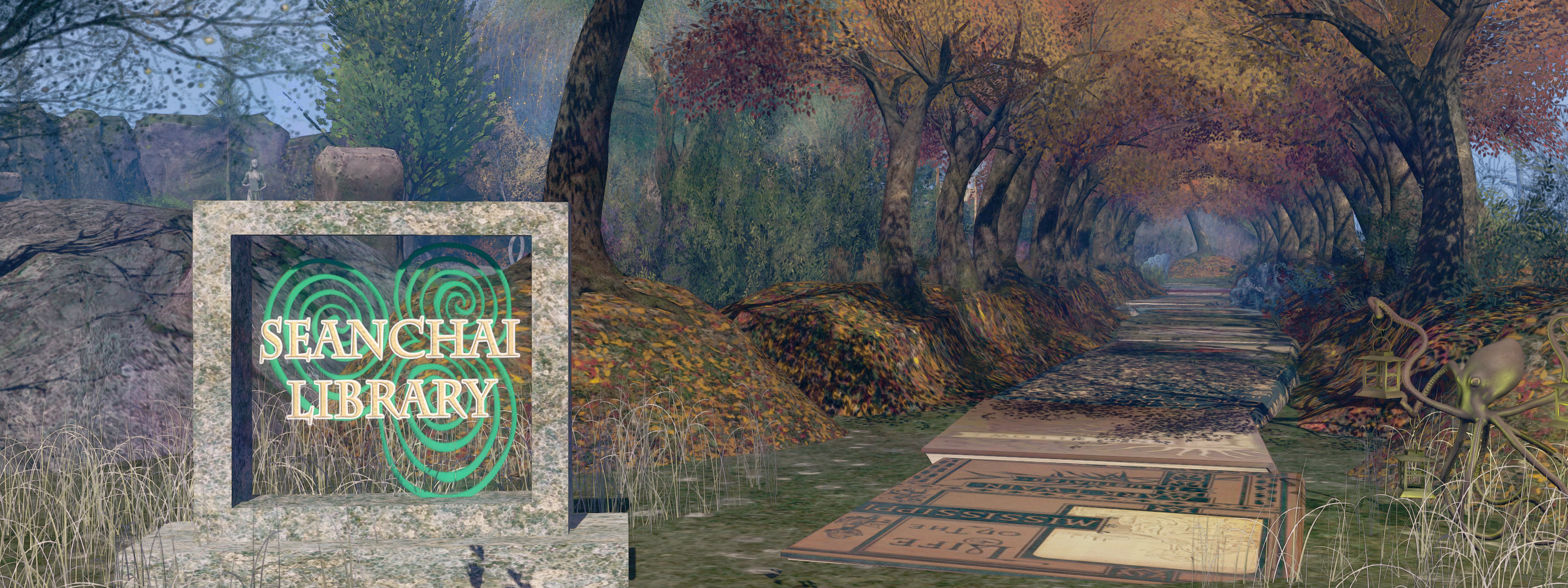
Seanchai Library

It’s time to highlight another week of storytelling in Voice by the staff and volunteers at the Seanchai Library. As always, all times SLT, and events are held at the Library’s home in Nowhereville, unless otherwise indicated. Note that the schedule below may be subject to change during the week, please refer to the Seanchai Library website for the latest information through the week.

Monday, November 2nd, 19:00: The Dark Bright Water

Gyro Muggins reads Patricia Wrightson’s second novel charting the life of Wirrun of the Inlanders.

First encountered in The Ice Is Coming, when Wirrun set out on a quest to overcome the rise of the ancient enemy of Australia, the ice-bearded Ninya, the young janitor now has a reputation as a Hero among the Inlanders (Wrightson’s fantasy view of the Australian Aboriginals). It’s not a title he appreciates; he would much rather just get back to his janitorial work.

But the spirits of the land are restless: Yunggamurra, a river spirit is lost, so uses her siren-like powers of song to draw to herself those who might might take her home. Her singing come to Wirrun’s ears, and those of an elderly aboriginal emissary, and he realises he must journey to the very heartlands of Australia to better understand what he is feeling.

This he does, with the old emissary and his friend Ularra. Once there, he discovers that a storm is indeed rising within the domain of the spirits, and he is uniquely placed to both find Yunggamurra and prevent the coming storm. And so his new adventure begins.

Tuesday, November 3rd:

12:00 Noon: Russell Eponym, Live in the Glen

Music, poetry, and stories in a popular weekly session at Ceiluradh Glen.

19:00: The Princess Bride: It’s a Miracle

With Caledonia Skytower at Ceiluradh Glen.

Wednesday, November 4th, 19:00: Nine Princes in Amber

Carl Corey wakes in a medical clinic, with little to no knowledge of who he is or how he got there. Fearing he is being over-medicated and kept against his wishes, he overpowers staff and discovers his stay is being paid for by his sister, one Evelyn Flaumel, whose address is on the hospital’s records.

Fleeing the clinic, he makes his way to his sister’s home. Here, with the aid of a pack of tarot cards and a confession from his sister, he learns that his name is actually Corwin (and she is Flora), and they are two of 14 siblings – nine male and five female.

One of those brothers, Random, arrives, pursued by strange, vicious creatures, that force Corwin to join Random into  fighting them to the death – during which Corwin discovers he has super-human strength.

After the fight, Random reveals more truths to Corwin – notably that he and his siblings are of royal descent from a planet called Amber, a parallel world to Earth from which he has been cast into exile.

Random reveals that their father, king Oberon, has vanished, and the throne is therefore open, and persuades Corwin in a quest to claim it. However, to do so, they must travel through the realms of Corwin’s brothers and sisters in order to reach Amber, and the journey reveals to Corwin his family’s ruthless and Machiavellian nature – a nature he shares -, and that the path to the throne is a route of force and betrayal.

Join Corwyn Allen as he reads the first volume in Roger Zelazny’s Chronicles of Amber series.

Thursday, November 5th,

19:00 Bernard Evslin’s Monsters and Mythology

 Shandon presents another remarkable tale from ancient Greece in Amycus, Part 1. Also in Kitely – take the teleport from the main Seanchai World grid.kitely.com:8002:SEANCHAI.

21:00 Seanchai Late Night

Finn Zeddmore presents contemporary science fiction and fantasy from such on-line sources as Light Speed, Escape Pod, and Clarkesworld magazines.

2020 viewer release summaries week #44

Logos representative only and should not be seen as an endorsement / preference / recommendation

Updates for the week ending Sunday, November 1st

This summary is generally published every Monday, and is a list of SL viewer / client releases (official and TPV) made during the previous week. When reading it, please note:

  • It is based on my Current Viewer Releases Page, a list of all Second Life viewers and clients that are in popular use (and of which I am aware), and which are recognised as adhering to the TPV Policy. This page includes comprehensive links to download pages, blog notes, release notes, etc., as well as links to any / all reviews of specific viewers / clients made within this blog.
  • By its nature, this summary presented here will always be in arrears, please refer to the Current Viewer Release Page for more up-to-date information.
  • Note that for purposes of length, TPV test viewers, preview / beta viewers / nightly builds are generally not recorded in these summaries.

Official LL Viewers

  • Current release viewer version 6.4.10.549686, formerly the Mesh Uploader RC, promoted on October 14 – No change.
  • Release channel cohorts:
    • Cachaça Maintenance RC viewer, version 6.4.11.551139, issued October 27th.
  • Project viewers:
    • The Legacy Profiles project viewer updated to version 6.4.11.550519 on October 26th.
    • The Jellydolls project viewer updated to version 6.4.11.551213 on November 2nd (cleared for update October 29th).

LL Viewer Resources

Third-party Viewers

V6-style

  • No updates.

V1-style

Mobile / Other Clients

  • No updates.

Additional TPV Resources

Related Links

Midnight in Paris in Second Life

Midnight in Paris, November 2020 – click any image for full size

A  year ago, we visited Somewhere Else BKLYN, a region designed by Littlesquaw and ToXxicShadow and intended primarily for Second Life photography (see Somewhere Else in Second Life).  Now Littlesquaw is back with a another take of a city setting with Midnight in Paris. Once again, it is a region offered as a photogenic setting that presents numerous opportunities for avatar photography – and for those who were in the BKLYN group, that same group is used for rezzing rights in this build.

As the name suggests, the region presents a view of Paris at night – a length of the Seine, in fact, with its familiar bankside roads on either side and steps descending to public walks just above the river’s waters.  A barge is chugging its way along the river, passing under one of the arched bridges, while town houses and business places stand to attention along the roads on either side.

Midnight in Paris, November 2020

The majority of the buildings at little more than façades, although a small bistro towards the middle of the north bank of the river offers an interior setting alongside a cobbled courtyard, beyond which lies a small park.

This may all sound simple – and in a sense, it is – but there is beauty (and care) in this apparent simplicity. The beauty is in the night-time setting, the use of lighting (you really should have the viewer’s Advanced lighting Model active  – Preferences → Graphics → Advanced Lighting Model).

Midnight in Paris, November 2020

The care comes from things like the inclusion of static NPCs that add a sense of human presence along the streets, the use of weather to offer a sense of change: rain is falling still on the south bank of the river, whilst on the north, some the the streets still have puddles from the recently-passed shower, whilst here and there cobblestone glisten in  the wake of its passage.

Further life is added by the presence of one or two little side streets of the kind that can so often be found when exploring a city like Paris; streets that carry you away from the familiar cosmopolitan bustle and into places where family businesses can still be found.

Midnight in Paris, November 2020

Quite where this scene might be in Paris isn’t important. While the Eiffel Tower forms a backdrop to the setting, whether or not Midnight in Paris is actually based on a part of the city simply isn’t important: the atmosphere created within the region is more than enough to carry you there – and have given those who have visited the inspiration to offer their own interpretations of Parisian life via the region’s Flickr group.

SLurl Details

Space Sunday: water on the the Moon; asteroids & comets

The Stratospheric Observatory for Infrared Astronomy (SOFIA), a joint US / German programme, Credit: NASA

Earlier in October, NASA teased the world with news of a special announcement concerning the Moon, using social media to announce the fact … they would be making an announcement on Monday, October 26th.

The announcement of the announcement led to a lot of speculation (and a lot of ribbing at NASA’s expense) with some correctly identifying the fact that the news would have something to do with the Stratospheric Observatory for Infrared Astronomy (SOFIA), the world’s largest flying telescope. This is a joint NASA / DLR (German space agency) venture that flies a German-built 2.5m diameter reflecting telescope aboard a short-bodied 747 SP operated by NASA.

Flying at 12 km above the ground, and so well above the worst of the distorting effect of the Earth’s atmosphere and capable of 10-hour observation sorties, SOFIA is almost as capable as space-based telescopes of a similar nature (having around 85% of the infra-red capability of a similarly-sized space telescope), whilst offering fair easier and lower-priced maintenance, upgrade and general operational costs. In addition, the range of the 747 aircraft means that SOFIA can operate over almost any location on Earth and so be available for almost any observational requirements than fall without the telescope’s capabilities.

The German-built telescope on the Sofia aircraft during flight tests. The “spots” around and on the open telescope bay door are airflow indicators to help with monitoring air passing over the open door. Credit: NASA

When finally made public, the announcement – which was billed as being related to NASA’s current plans to return humans to the Moon, Project Artemis -, proved to be that SOFIA has detected water molecules on the sunlit surfaces of the Moon.

Whilst an important discovery, marking a further increase in the presence of water on the Moon (which we’ve known about since 2009), it is important to offer a measure of context to the discovery: this is about water molecules bound within the regolith (surface material) of the Moon, not actual water ice, as was confirmed in 2018 for many of the permanently shadowed and very cold craters of the Moon’s south polar regions.

In particular, SOFIA detected the infra-red signature for water molecules within the crater Clavius (perhaps most famous for being the location of the lunar administrative base in 2001: A Space Odyssey).  Located in the southern highlands at 58.4°S 14.4°W, Clavius is one of the oldest formations on the lunar surface, believed to have formed some 4 billion years ago; it is some 230 km across and some 3.5 km deep.

Clavius crater as seen via the Johannes Kepler Observatory, Linz, Austria, 2004. North is towards the top of this image. Credit: H. Raab

That water molecules may be widely present in lunar regolith had been long suspected. However, previous estimates as to how much might be present had been hampered by the fact that previous studies could not clear differentiate between the presence of water molecules (H2O) and hydroxyl (OH). During extended observations of Clavius, utilising  a special instrument, the Faint Object infraRed CAmera for the SOFIA Telescope (FORCAST), the airborne observatory was able to detect water molecules at around 100 to 400 parts per million in a cubic metre of regolith.

To put this in proportion, this means that SOFIA detected the equivalent of one third of a litre of water trapped in a cubic metre of lunar surface material – which is actually a lot.  If the SoFIA findings hold true for all of the surface material within the sunlit parts of the Moon, it means there a potentially a lot of water to be had;  but whether or not it is actually accessible or have any significant bearing on human activities on the Moon is open to debate. Certainly, it is unlikely to have any significant impact on America’s Project Artemis, despite claims otherwise.

Simply put, the water molecules detected within Clavius are most likely bound in glass beads that resulted from micrometeoroid impacts. As such, it is nowhere near as potentially accessible as the water ice in the south polar region craters, and it is going to need relatively intensive processing in order to be properly extracted and turned into usable water – and the kind of heavy engineering required to achieve this at scale isn’t going to be available for use on the Moon any time soon, and may not even been cost-effective even when it is.

Clavius crater as seen by NASA’s Lunar Reconnaissance Orbiter (launched in 2009 and still operational). Note that is this image, north is at the bottom. Credit: NASA

Nevertheless, the discovery is important for our understanding of the Moon and our longer-term exploration of the lunar surface. It might also mean a new lease of life for SOFIA. whilst not mentioned in the release, NASA had sought to quietly terminate the 10-year-old telescope in 2021, citing it’s “lack of scientific output”.

Continue reading “Space Sunday: water on the the Moon; asteroids & comets”

Emotions in art in Second Life

Michel Bechir Gallery: Emotions – Lynx Luga

Currently on display at the Michel Bechir Gallery is a ensemble exhibition featuring five Second Life photographer-artists, offering images under the common theme of Emotions. The participating artists are AngeloDiabolico, Mya Audebarn, Max Seagate, Robyn35, and Lynx Luga, with four of the artists on display within the gallery building, and one – AngeloDiabolico – on the courtyard outside.

Given the title of the exhibition, the majority of the images presented focus on avatar studies – but within them, there are also some unexpected pieces that add a twist to the theme, whilst others offer a more narrative slant to the theme.

The Michel Bechir Gallery: Emotions – AngeloDiabolico

Take Angelo’s pieces for example; several have a powerful fantasy theme running through them that provide a rich narrative that frames their focus, bringing life and depth to the characters through the suggestion of emotion rather than a direct focusing on the subject. Just look at An Angel Without Wings as singular example: there is a story here just waiting for the imagination to open; one of beauty, fallen angels, regret, loss, loneliness and more, transmitted from the title of the piece through the setting and use of colour to focus down on the central character in such a way the the depth of emotion she is feeling is unmistakable, despite the fact we cannot see her face.

By her own admission, Robyn35 is new to the world of Second life photography and still finding her way; however, her work already has a balance and focus that makes it worthy of exhibition. Located on the upper floor of the gallery, she presents a set of images that might be seen as “traditional” avatar studies: minimal or no background, close-in, often soft focus on the subject, etc. However, in doing so, Robyn demonstrates the ability to transmit emotions through her work in a single frame without the need for us to necessarily click any of them to read the title.

Michel Bechir Gallery: Emotions – Robyn35

On the lower floor, Mya (for the most part) follows this technique, but with a focus on the facial expression to convey emotion, whilst also using a sense of motion in some of her pieces to give an alternative expression of emotion – freedom, happiness, reflection. The balance of portrait and broader study giving her selection a richness of expression.

Max Seagate also offers a combination of solo images and those using a sense of motion to convey their emotions. He also joins Angelo in presenting several pieces that appear to be moments of broader narrative, in which the captured moment is but a single frame in which the emotional power of that broader picture is focused.

Michel Bechir Gallery: Emotions – Mya Audebarn

However,and without wishing to appear biased – all of the art in this exhibition is rich in content and its ability to hold the eye – I admit to finding the pieces presented by Lyna Luga within the entrance hall of the gallery particularly compelling.

Among these are the more “traditional” avatar studies, presented here as paintings or in soft focus; there is also the use of motion to transmit emotion. But this is a selection that also includes inanimate objects to generate an emotional response.  Some of these use poetry to aid their framing – but there is one, Silent Courtyard, that appears sans avatars and words or anything one might reasonably expect to generate a sense of emotion; yet it is for me the most emotionally charged of all the images within this exhibit.

Michel Bechir Gallery: Emotions – Max Seagate

With five artists drawn together by theme, Emotions will (I gather) remain in place for around another week or so – so be sure to catch it.

SLurl Details