Logos representative only and should not be seen as an endorsement / preference / recommendation
Updates for the week ending Sunday, October 18th
This summary is generally published every Monday, and is a list of SL viewer / client releases (official and TPV) made during the previous week. When reading it, please note:
It is based on my Current Viewer Releases Page, a list of all Second Life viewers and clients that are in popular use (and of which I am aware), and which are recognised as adhering to the TPV Policy. This page includes comprehensive links to download pages, blog notes, release notes, etc., as well as links to any / all reviews of specific viewers / clients made within this blog.
By its nature, this summary presented here will always be in arrears, please refer to the Current Viewer Release Page for more up-to-date information.
Note that for purposes of length, TPV test viewers, preview / beta viewers / nightly builds are generally not recorded in these summaries.
Official LL Viewers
Current release viewer version 6.4.10.549686, formerly the Mesh Uploader RC released October t and promoted on October 14 – NEW.
Solus, October 2020 – click any image for full size
Solus is a Homestead region held by Vita Camino that she recently opened to the public as a place to visit and appreciate and where they can also see her mesh and ground textures in use.
For those who may be feeling a little over-exposed to Halloween and all its ways – even before we get to it – this is a region that can offer some relief (although there are still touches of the season to be found). Within the region, visitors will find an autumnal, rustic setting within its lowlands areas whilst its highlands present a more winter-like setting and a promise of the end-of-year season to close. All of which makes for a rich setting to explore and photograph.
Solus, October 2020
The landing point sits on the lowlands alongside what at first might appear to the a ribbon lake, but is in fact an inlet that meanders its way deep into the landscape. A dirt track curls around its innermost extent, the landing point sitting on the grass between track and water. To the east, the road, occupied here by an old pick-up truck, rises up the first part of the region’s highlands, turning south and passing an old stone farmhouse built into the hill as it does so.
Passing a wall of rock, the road quickly – and frighteningly, if you’re contemplating driving up or down it – steepens, passing from the greens and golds of autumn below to the depths of winter on the hilltops. Here fir trees stand in rows and hoar frosted tress stand over a frozen pond, and a Christmas tree shop is already open for business. However, someone appears to have opted for taking a sapling from the copse of fir trees , placing it into the back over their pick-up truck as it sits on the road.
Solus, October 2020
A sign by the truck promises a camp site along the flat tops of the hills, but after passing around the fir trees, the road drops back down to the the east side of the region and into the autumnal setting once more. Here old telegraph poles march along the roadside and geese wander along it, as it comes to an end in a broad area of flat land at the water’s edge.
Here the land is occupied by a couple of buildings: a cottage for rent and an old industrial unit that may also be a place that could become available for rent, although at the time of our visit, it was standing empty and unmarked. The cottage has been extended with decks serving both its lower and upper floors, connected by wooden stairs. These decks offer a view across the water to far side of the bay – but if you want to reach it, you’ll need re-trace your steps back around the region.
Solus, October 2020
When investigated, these western lowlands reveal they are actually a tongue of land sitting between two inlets cutting their way into the landscape from the north, the far side of this second body of water marked by the highland plateau. Small places of business sit on the bank of the water (one of which is home to the rental kiosk for payments), while at the end of the road stands a large barn. This forms Vita’s texture store, a wooden board walk winding around the side of it to lead to a houseboat at the water’s edge – again, whether this is to be offered for rent or not wasn’t clear at the time of our visit.
For those who do like their touches of Halloween, the region does offer one or two; pumpkins and jack-o’-lanterns can be found here and there, the largest two of which stand guard over the entrance of what might at first appear to be a misty-wrapped graveyard. However, these two lanterns are hardly likely to cause anyone any fright, their demented grins awash with humour.
Solus, October 2020
Another board walk winds through the mist beyond the two lanterns, but aside from a single, static Gothic vampress, there are no graves here. Instead, the path leads the way to an old ruin, now a witch’s hideaway with a warning outside. Inside, however, barring the oversized spider’s webs, it offers a cosy retreat.
Throughout the region are lots of little details – chickens and geese helping to give a sense of presence to the farm, squirrels going after nuts, foxes awaiting discovery -, while a figure at the local gas station adds a further sense of life to the setting. For those who fancy tarrying a while, a small barn close to the store offers a cosy place for doing so.
Solus, October 2020
All told, a delightful place to visit and explore – and for those who need them – to possibly obtain a new selection of landscaping textures.
October currently sees three expeditions in progress at Club LA and Gallery, curated by Fuyuko Amano (Wintergeist), although I believe two will be closing at the end of the month. Between them, they offer three very different displays of art and perspectives, making all three an engaging visit.
The ground-level exhibitions both opened on October 3rd, and so many have a limited time left in their runs. They feature the work of Kapaan and Blues Rocker (BluesrockerResident) respectively.
Kapaan presents art that often carries a narrative theme, usually with a fantasy / dark fantasy element to it – and such is the case with several on the pieces here as they cast what might called Scenes from the Seed, presented in primal tones and featuring the character of Orobas (the Orobas, in human form?) and a glowing, seed-like orb.
Accompanying these is a set of more colourful avatar studies and a trio of landscape images. these again have treads of connection running through them, the colour red and umbrellas in the case of a couple of the landscapes, and the manner in which the avatar studies are mounted.
Club LA and Gallery: Blues Rocker
Across the hall, Blues Rocker presents an evocative set of images rich in colour, each standing on its own and strikingly unique when compared to the rest. Again, each has a story within it, hinted at by its title and ready to jump into the mind on viewing each piece in relation to that title. These are richly imaginative works, that reflect Blues’ philosophy when dealing with Second Life and his art.
I much prefer shooting out on location in the multitude of amazing sims which populate SL than in a studio, as I feel I get much better results that way. Since starting seriously taking photographs in SL, I have broadened my horizons in what wonders this virtual world has to offer. Really, the only limits are those of the imagination.
Blues Rocker
Club LA and Gallery: David Silence
The most recent of the three, having opened on Sunday, October 18th, is Spectrum by David Silence (JemapelSilence). Reached via a teleport station outside of the ground-level gallery space, this is also the most intriguing of the three, offering what might be said to be a display of personal introspection woven into other apparent contradictions – such as the title of the exhibition being a word that tends to first suggest colours, whilst the images themselves are entirely monochrome.
Of course, “spectrum” can be used in other contexts as well, such as “running the full spectrum of emotions” – and it is in this context that David uses the word, as he explains in Spectrum’s introductory notes. He combines it with that unique sense of self-awareness when we can perceive ourselves simultaneously in two ways: both from within, as we listen to that inner voice that can question our actions, motivations, emotional state, etc., and from without, as if we are projecting ourselves into the body of another and witnessing our actions / state of mind through their eyes.
The result is a series of images that might be subtitled Conversations and Observations with Myself. They comprise two figures – one dressed, one naked – in various locations, clearly conversing and as if seen by someone else. This external view manifests the idea of projection beyond ourselves, but it would b a mistake to consider the figures as individuals. Rather, they are one in the same: the dressed figure representing the externalisation of how we would like to be seen by others, and the naked representing out inner self, freed from the need to clothe thoughts and emotions. Thus we have a series of images depicting our relationship with ourselves, and the full spectrum of thought and feelings that can come with it.
Club LA and Gallery: David Silence
Three excellent excellent expeditions from three engaging artists.
An artist’s impression of NASA’s OSIRIS-REx above the asteroid Bennu,with Earth added in the background for dramatic effect. Credit: NASA Goddard
After a period of delay, NASA’s Origins, Spectral Interpretation, Resource Identification, Security, Regolith Explorer (OSIRIS-REx) is due to attempt the collection of a 60 gram (2.1 oz) sample from the surface of 101955 Bennu, a carbonaceous near-Earth asteroid, on Tuesday, October 20th.
Originally scheduled for August 2020, the attempt to gather the sample requires the space craft to slowly descend to within “touching” distance of the asteroid using a robotic arm. If successful, the sample gathering will open the door for OSISRIS-REx to complete the remainder of its mission before making its way back to Earth where the sample can be analysed.
Launched in September 2016, OSIRIS-REx is one of two such asteroid sample return missions currently in progress, the other being Japan’s Haybusha 2 mission (the original Hayabusha mission also returned samples from an asteroid – but they only amounted to around 1 milligram of material).
Having been launched well ahead of OSIRIS-REx, Hayabusha 2 is actually on its way back to Earth from asteroid 162173 Ryugu, with which it rendezvoused in June 2018. It spent 18 months surveying the asteroid, depositing four micro-rovers on its surface before gathering samples blown off of the asteroid by the force of a kinetic impactor (think bullet), allowing it to collect a mix of surface and sub-surface material. Currently, Hayabusha 2 will deliver its cargo back to Earth during a fly-by on December 6th, 2020, after which it may be tasked with a further sample return mission.
Image sequence showing the rotation of Bennu, captured by OSIRIS-REx at a distance of around 80 km. Credit: NASA Goddard
OSIRIS-REx reached it’s target, Bennu, at the very end of December 2018 and has spent most of the intervening time studying the asteroid in detail. Both Bennu and Ryugu are of interest to scientists for a number of reasons: they are both part of a class of asteroids that are believed to have been around since the formation of the solar system, and so they could help us learn more about that period.
Both are also in the Apollo asteroid group, meaning they routinely cross Earth’s orbit, and thus present a potential collision risk, and at 1 km diameter for Ryugu and just under 1/2 a km for Bennu, an impact from either would not be a Good Thing for Earth. So, another reason for sampling them is to determine their composition (and by extension, allow us to draw conclusions about the composition of other large Apollo asteroids) that may help make a determination of how to deal with them should that threat of impact become real (in fact, there is a chance that Bennu in particular might impact Earth between 2175 and 2199).
Finally, samples from both might offer clues as to how life-forming materials reached the surface of Earth.
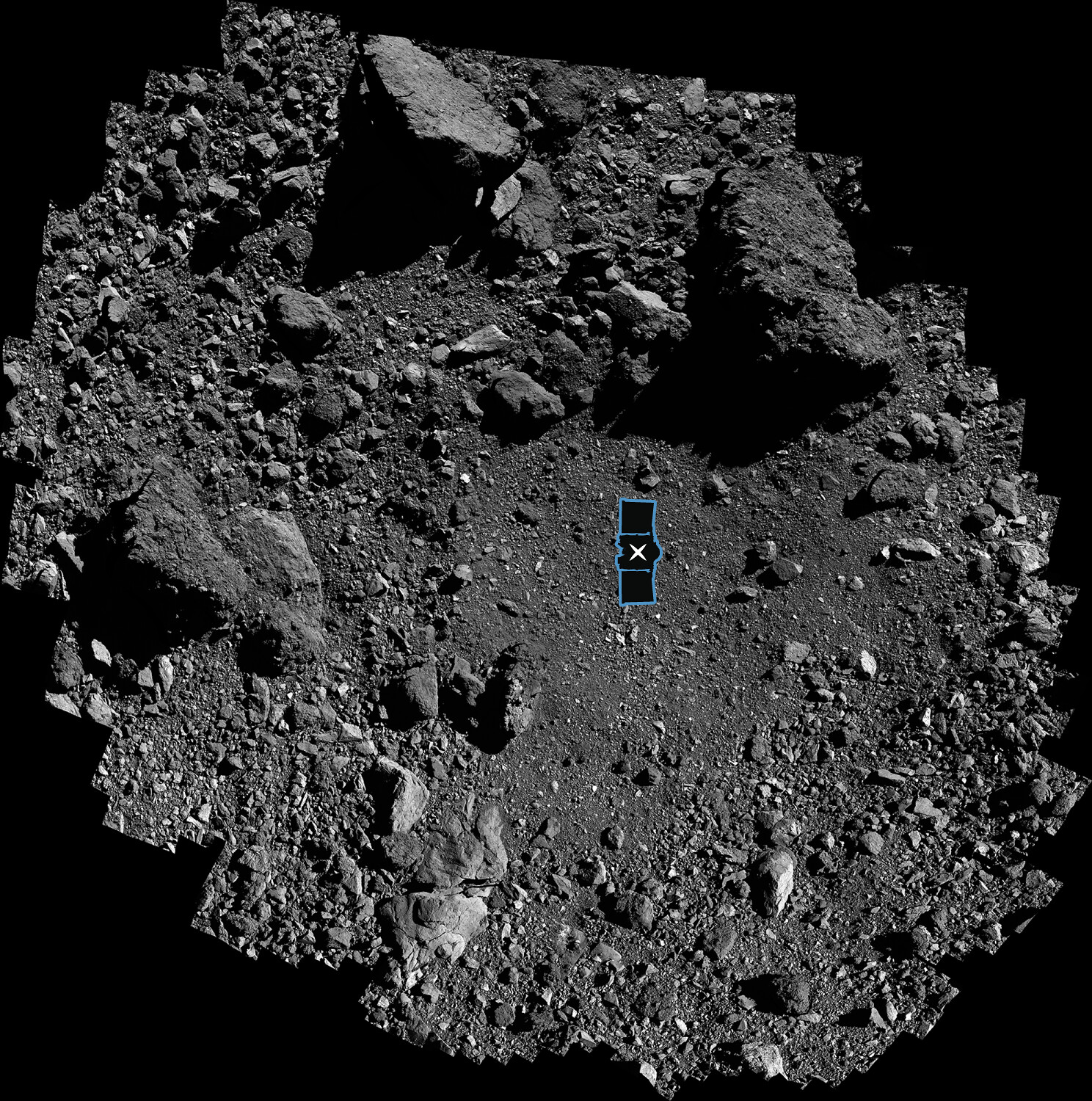
Bennu has proven particularly intriguing for scientists. For one thing, it has proven to be entirely unlike anything that had been anticipated; rather than being relative smooth, with crater pits and sand-like regolith (surface material), Bennu revealed it is a boulder-strewn place with rocks in places comparable to mountains relative to its size, many of them placed so closely together, any attempt to gather samples near them would like result in a loss of the vehicle. This required a more extensive survey to determine potential sample sites, with five initially being identified, before these were narrowed to two, the primary, Nightingale, and a back-up.
This image, captured by OSIRIS-REx shows the Nightingale sample gathering crater surrounded by large boulders. The silhouette of the spacecraft (which is about the size of a van – excluding the solar panels and has a mass of just over 2 tonnes) added for comparison. Credit: NASA Goddard
The asteroid also demonstrated it can emit plumes of material from within itself when in the “warm” part of its 1.2 year orbit around the Sun. However, one of the most surprising discoveries was the identification of six bright boulders on the asteroid’s surface which, when subjected to spectroscopic analysis, revealed themselves to be of the same materials as boulders on Vesta, the second-largest asteroid in the solar system, surveyed by the NASA / ESA Dawn mission.
It’s believed that the presence of these rocks indicates that Bennu started life as part of a larger body – an asteroid or planetesimal – within the asteroid belt beyond Mars, where it was in collision with a fragment of Vesta, depositing material from the latter on its surface. That event, or another similar collision, led to a “catastrophic disruption” within Bennu’s parent, creating Bennu itself and sending it on its way into the inner solar system to be caught in an orbit much closer to the Sun.
The asteroid has also revealed itself to be particularly rich in carbon-bearing material, which can tell us how much water it may have contained (and how much might still be present as sub-surface ice). What is particularly interesting here is that many of the boulders on Bennu contain mineral veins composed of carbonate – which on Earth often precipitates from hydrothermal systems that contain both water and carbon dioxide. Some of these rocks are located around the Nightingale sample recovery area. The presence of such carbonate strongly suggests that Bennu’s parent body, whether asteroid or small planetary body,was likely hydrothermally active. This has in turn given rise to the prospect that any sample returned by OSIRIS-REx might contain organic material.
My name is Jessica Lyon. My goal during my time with the Emerald Project, was always to give the users what they want. That goal has never and will never change. I’m very happy to announce, it continues…
A few days ago, I assembled a team of developers to work on a new viewer. Some who were originally Emerald developers, some who were not. All are respected reputable residents in the Second Life Community. The goal was simple, to provide users with what they want and do it transparently.
I’m am very proud to announce the launch of the Phoenix Viewer.
Jessica Lyon, September 3rd, 2010
With those words, printed in her personal blog, Jessica Lyon announced the arrival of the Phoenix viewer, and the birth of what would become Second Life’s most popular third party viewer.
It marked a new beginning for a number of people – Jessica among them – who came together out of the ashes of the Emerald viewer to try to continue the work started by that viewer before one or two wombats (the term my father endearingly uses to denote “complete idiots”) who opted to trash the innovative work started in that viewer for the sake of petty stupidity. Emerald hadn’t been the first third-party viewer on the block, but it had become one of the most innovative, both exposing viewer capabilities hidden the the vagaries of the viewer’s debug settings, and in developing various viewer-side only capabilities, such as multi-attachments (more than one attachment on the same attach point).
With Phoenix, Jessica and the team around her sought to carry on the good work started with Emerald whilst leaving the stupidity well behind them, embracing the closer working ties between the Lab and TPVs that would come to grow out of the Emerald debacle with the rise of the Third-party viewer policy and an unfolding of greater co-operation between TPVs and the Lab.
Why history might suggest otherwise, Phoenix itself had a relatively short active lifespan – by the time it arrived, the Lab had launched the viewer 2.0 UI, and by the time Phoenix reached its first anniversary on September 3rd, 2011, the Phoenix team had already launched their own version of the viewer using the new UI code base – Firestorm – which was destined to become the focal point of the team’s work, although they tried to keep Phoenix, with its Viewer 1.2x UI, going for as long as they could.
Nevertheless, in just its first year, Phoenix attracted a large following, partially due to things like the multi-attachment option (even if it did make those using it appear as if the were walking around with a tail of attachments trailing out of their rear ends to those on other viewers), and this trend continued as Firestorm ramped-up and continued with the innovative approach taken to capabilities, both in exposing those in the viewer, and through the adoption of others (such as William Weaver’s Phototools).
As noted, as the time passed, Firestorm developed an ever-closer working relationship with the Lab, routinely making code contributions to help benefit the latter, and offering proposals for specific improvements, such as an official implementation of a hover height slider capability. Now, to be fair, Firestorm have never been alone in making code contributions to the Lab, but they have been one of the most consistent in doing so, as the visualisation below shows.
This video from Firestorm’s Pantera Północy shows the flow of code and contributions from LL to Firestorm and Firestorm to LL over a 10-year period
They’ve also dared to push the boundaries of viewer capabilities from time-to-time, trying to respond to user requests. One of the most notable examples of this came in 2014, when – under the guise of an April Fools joke – the Firestorm team presented their proof-of-concept Dynamic User Interface that allowed UI elements to be pulled out of the main viewer window and displayed on secondary monitors (see: Firestorm Dynamic User Interface (DUI): it’s a real prototype), the hope being it might result in a collaborative effort among viewer coders to make the idea a reality. Sadly, that particular idea died a silent death, but setbacks like it have never stopped the Firestorm team from working with the Lab to offer viewer improvements – the most recent being the updates in the mesh uploader, which were promoted as this Lab’s de facto release viewer, and which incorporate contributions from Firestorm.
Firestorm has always sought to support the community as well – its in-world groups routinely share information with users, Firestorm is a part of the Lab’s Community Gateway Programme seeking to bring new users into Second Life, and so on.
Firestorm has two special gifts for those attending the 10th anniversary party on October 18th
All of which means that over the last decade, the Phoenix Firestorm Project has been a truly unique an beneficial collaboration within Second Life – and is likely set to remain so in the future.
The viewer’s tenth anniversary officially came on September 3rd, 2020. however, on October 18th, from 1:00 noon SLT through until 15:00 SLT, the Firestorm team are holding a birthday party, with special gifts for those attending and some special live performers. So, grab a taxi below, and head on over.
Happy 10th anniversary, Firestorm!
The following notes are taken from the TPV Developer meeting held on Friday, October 16th, 2020. These meetings are generally held every other week, unless otherwise noted in any given summary. The embedded video is provided to Pantera – my thanks to her for recording and providing it. Time stamps are included with the notes will open the video at the point(s) where a specific topic is discussed. Note these summaries are not intended to be a full reporting on all topics discussed, but focus on those items that are more directly user-facing.
Another exceptionally brief meeting, with some discussion in chat, so please refer to the video as well.
As per my CCUG meeting notes, the Mesh Uploader RC was promoted this week to de facto release status – refer to the release notes (link below) for details of the cosmetic and informational changes made to the uploader (which are in part based on contributions by Beq Janus of the Firestorm team). This leaves the current official viewer release list as follows:
Current release viewer version 6.4.10.549686, formerly the Mesh Uploader RC released October t and promoted on October 14 – NEW.
Release channel cohorts:
Cachaça Maintenance RC viewer, version 6.4.10.549752, issued October 1.
Project viewers:
Project Jelly project viewer (Jellydoll updates), version 6.4.10.549690, October 1.
Custom Key Mappings project viewer, version 6.4.5.544079, June 30.
Copy / Paste viewer, version 6.3.5.533365, December 9, 2019.
Project Muscadine (Animesh follow-on) project viewer, version 6.4.0.532999, November 22, 2019.
Legacy Profiles viewer, version 6.3.2.530836, September 17, 2019. Covers the re-integration of Viewer Profiles.
360 Snapshot project viewer, version 6.2.4.529111, July 16, 2019.
General Viewer Notes
As per this week’s CCUG meeting, Vir is hopeful that the Legacy Profiles project viewer may be able to move forward soon using a workaround to get it past the current blocker of needing some web-side updates.
The Custom Key Mappings project viewer is being considered from promotion to RC status with its next update.
There is an upcoming RC viewer featuring some UI changes – possibly including the update to give HUD items in inventory their own inventory icon, as discussed by Steeltoe Linden in the CCUG week #40 meeting. Thus might be appearing in the next week or so.
The proposal UI change to distinguish HUD items from other objects in inventory.Left: how things are now, with HUDs using the same cube icon as other objects. Right: the proposed new HUD cog icon.
[5:24-6:54] There have been some issues with viewer documentation not appearing on the relevant web pages, leading to concerns that such documentation might be “going away”.
The problem has actually been caused by the mechanism used to generate the information not having been updated for some time (and also not even using current information), so when it was migrated to AWS services, it “fell apart”.
Rather than try to fix the issue, the decision has been made so that once uplift has been completed, the mechanism will be replaced with an easier to maintain process. However, it does mean that for the time being, some viewer related documentation may not be available.
In Brief
[9:20-10:00] BUG-228679: Media-on-a-Prim doesn’t register keystrokes correctly on Mac – unfortunately, no progress to report.
[12:12-13:40] A couple of TPVs have been holding off making a formal release of the Environment Enhancement Project (EEP) updates beyond their current beta releases in case LL make further EEP update releases like the recent Love Me Render #4 viewer release. However, the advice from the Lab to these TPVs is:
To consider the high-priority EEP fixes as being “done”, as the Graphics team is now focused on priority long-term architecture work (including moving the viewer beyond OpenGL).
That future EEP fixes, when made, will form a part of the regular Maintenance RC viewer releases, rather than having any dedicated RC viewer updates.
Some TPVs have reported significant performance / FPS drop-off with EEP (around 15%). However, the Lab is not seeing anything close to this with the official viewer.
Unless there are detailed reports filed on the issue – using the official release viewer – that provide information on where / when / how the issue is being witnessed (e.g. the kind of test carried out, where in-world, the hardware configuration and viewer settings used, the results obtained, etc.), that allow LL to reproduce the problems, they do not see what can be done by way of investigation / fixes.
It was pointed out that comparable testing on the official viewer is difficult due to the limited amount of video memory available (512 MB compared to a minimum of 1 GB on most TPVs), which also affects performance, and so might skew results / how results are seen (e.g. are they EEP or are they due to texture load issues?).
Vir indicated that the amount of assigned texture memory is something the Lab will be looking at in the future.





 Inara Pey: Living in a Modemworld