Space Sunday: SpaceX and a rapid round-up

Starship SN7 rises briefly through a cloud of super-cold nitrogen gas after the base of the tank ruptured during a deliberate over-pressurisation teat, June 23rd. Credit: LabPadre

SpaceX has had a busy week. Following the loss of the Starship prototype SN4, the company has been pushing ahead with the construction of prototypes SN5 and SN6 – one of which is likely to complete the first flight tests for the vehicle.

These prototypes look a little odd to some, resembling little more than steel cylinders. This is because SpaceX is currently focused purely on the vertical ascent / decent capabilities of the vehicle, and for this they only need the section of the hull that contains the fuel tanks and the raptor motors. Experience in flying the smaller Starhopper vehicle demonstrated there is no need to include the vehicle’s upper sections or the dynamic flight surfaces – although these will be added as the test flights become more ambitious and broader in scope.

Starships SN5 and SN6 under construction at the SpaceX Boca Chica Midbay building: Credit: SpaceX

Also following the destruction of the SN4 prototype, the company started work on the SN7 vehicle. This caused some speculation as to where it might fit in the test vehicle series. Might it be the start of a prototype that does go on to include the said upper sections and flight surfaces? Was it being built in case SN5 or SN6 went the way of SN4 and SN3?

As it turned out, SN7 was constructed specifically for further tests on tank pressurisation. On June 15th, 2020 the tank, mounted on a test stand was filled with liquid nitrogen (used in testing because it mimics the super-cold temperatures of the propellants the tanks will eventually contain, and so exposes the tank to the same temperature stresses, but if the tank ruptures, it will not explode) to its maximum pressure. It resulted in a slight leak developing, which was repaired. Then, on June 23rd, the tank was once more filled with liquid nitrogen – but this time to a pressure well beyond it would have to face when in use during a launch.

With nitrogen gas still roiling on the ground, Zeus, the robot dog (arrowed) goes in to check the area around the wrecked SN7 tank. Credit: LabPadre

The results were spectacular: an initial rupture occurs in the lower half of the tank, instantly expand into a tear along its base seam that released the liquid nitrogen in such bulk and pressure that it instantly vaporised en masse, venting with a force that lifted tank and test stand sideways off the ground. Immediately after the incident, SpaceX deployed their newest team member, Zeus.

A robot “dog” developed by Boston Dynamics (which they generically call “Spot”), Zeus is being used by SpaceX to assess potentially hazardous situations around the Boca Chica test site – in this case, the ground conditions following exposure to so much liquid nitrogen that took time to completely boil off. In typical SpaceX humour, the company has even erected a large Snoopy-style dog house on the grounds that’s allegedly the robot dog’s home.

And aerial view: the remnants of SN7 can be seen on their side, the test stand attached. The grey area “below” it is the concrete base on which it stood. A second test stand sits “above” the wreck. Credit: RGV Aerial Photography

One of the reasons for taking the test beyond limits was to check the steel used in SN7’s construction. Earlier versions of the Starship prototypes had been built with 301 stainless steel, but the company has opted to switch to the stronger 304L, and the degree to which the tank stood up to the test is being seen as indicative that the 304L is structurally a better choice.

Also during the week, NASA announced that the Crew Dragon currently docked with the International Space Station will likely return to Earth at the start of August 2020, with its crew of Robert Behnken and Douglas Hurley. Its return will pave the way for the first “operational” crew Dragon launch, which will carry astronauts Michael Hopkins, Victor Glover, Shannon Walker (commander) and Soichi Noguchi to the ISS at the end of August or early September.

Starship prototype SN5 being raised on to its test stand. In the foreground is the Spacehopper. Credit: BocaChicaGal

In a separate announcement, the agency further indicated that in a change to their requirements, they will in future allow SpaceX to make use of re-used Falcon 9 first stages in Crew Dragon launches. Previously, the agency had specified that each crewed mission must take place using a new Crew Dragon and new Falcon 9 launcher. The change came after a second Falcon 9 first stage successfully completed its fifth launch and landing.

Continue reading “Space Sunday: SpaceX and a rapid round-up”

Coalition Island: looking at the US military’s use of Second Life

Coalition Island – June 2020

In late 2008, the US Army made the headlines in a number of on-line periodicals such as Wired, when it announced the Army Training and Doctrine Command (TRADOC) was opening a “recruitment island” in Second Life, hoping to tap into the “4 million” users of the platform (yes, this was the era of hype about SL) into signing-up through a mixture of promotion and tchotchkes.

While that announcement was met with sniggers by some of the press reporting on it, it actually masked the fact that the US military had been engaged in evaluating Second Life as a platform for modelling, simulation and training (MS&T) activities for more than a year.

This work was centred on a group of regions called MiLands – Military Lands – which at their height (2009-2010) were made up of around 30 regions, split between the four major branches of the US military: Air Force, Navy, Army and Marine Corps. Such was the US military presence, Linden Lab assigned Scott Linden to manage the regions and liaise with the US Department of Defense in its use of SL.

The MiLand Meeting Room, home of the MiLand Charter

Within those regions, Coalition Island, established (2009), was created to offer a public point of access to the US Military’s use of second Life. Today, it remains as a piece of Second Life’s early history – although it could in all honestly do with a little TLC as parts of it have not weathered the passage of time too well.

At its heart is a large pentagonal area – the symbolism here fairly obvious! On four of its sides, this presents photographs of each of the four military branches mentioned above Brownstone paths radiate each to lead to informational displays on how each branches was using SL – although both the Army and Air Force displays look more recruitment oriented, and the US Marine Corps is now conspicuous in its absence. The US Coastguard also gets a passing nod, with a small inshore patrol RHIB moored to one side of the island.

The fifth side of the pentagon comprises a broad set of steps once used for presentations (and now somewhat disconcertingly inhabited by three disembodied heads). At the top of these is the island’s former greeting / conference / meeting centre, the upper floor of which contains the Second Life US Military Coalition Charter, covering the aims and use of the former MiLands regions.

Coalition Island: the Team Orlando information display

Close to main conference centre is a display by Team Orlando, a collaborative alliance of U.S. military organisations working in modelling, simulation and training using a number of platforms including – back in 2009-2010 – Second Life.

While I was unaware of Team Orlando’s use of Second Life, thanks to Dr. Douglas Maxwell (Maccus McCullough in SL, and also the founder of he in-world group RL United States Military in SL), I had originally become aware of attempts by the US military to use Second Life as an MS&T platform, back in 2011.

As a civilian contractor, Dr. Maxwell was employed at the Navy’s Virtual Reality laboratories in Washington DC, and in 2008 he was asked to head-up the work in establishing a 12-region campus in Second Life to be used by the Navy Undersea Warfare Centre (NUWC) for training and simulations.

It is a computationally steerable persistent simulation. The capabilities in here are tremendous: in-situ scripting, terrain deformation in real-time, every object is composable, not static. We got the idea that if we could increase the fidelity of the physics in here, it could actually be very useful.

Dr. Douglas Maxwell discussing NUWC’s use of SL in 2008

Coalition Island: US Navy NAVSEA display for the Virtual Navy Undersea Warfare Centre (vNUWC)

Maxwell’s involvement with the military use of Second Life expanded in 2009 when he became the Science and Technology Manager at the US Army’s Simulations Training and Technology Centre (STTC), also looking to make use of Second Life. This came at a time when Linden Lab was engaged in the (ultimately ill-fated for a variety of reasons) development of the “standalone” (or perhaps more accurately, the “behind your firewall”) Second life Enterprise (SLE) product, and Maxwell and his team were steered towards SLE as a potential solution to their needs.

In fact, Maxwell’s team found SLE to be highly conducive to their work thanks to a greater freedom of control over the simulator software and capabilities than could be achieved with the “public” SL product. This allowed them to develop a number of feature-rich training simulations to help train troops in advance of their deployment to Afghanistan.

Nor was the STTC alone in the use of SLE – the US Navy invested in it, at one point filing a US government FBO request for the purchase of up to 70 SLE support licences for the product, worth in the region of an initial US $3.5 million, had it been approved.

Coalition Island: the US Air Force information display

But before that came to pass, Linden Lab opted to discontinue the development of Second Life Enterprise, thus ending US military interest in the product. For Douglas Maxwell and the STTC, this meant taking the lessons they had learnt and applying them to building a simulation environment using OpenSimulator (see: MOSES: the US Army’s OpenSim exercise).

Whether or not the ending of SLE development was also the cause of other branches of the US military stepping back from experimenting with Second Life, I cannot in all honestly say. Today, as far as I’m aware, the US military has little or no official involvement in Second Life. However, Coalition Island today stands window on a time, as short-lived in the scheme of things though it might have been, when Second Life was being looked at seriously as a platform for training and simulation, and so it remains as an integral part of the platform’s history.

SLurl Details

Tales of murder, mystery, intrigue and tragedy in Second Life

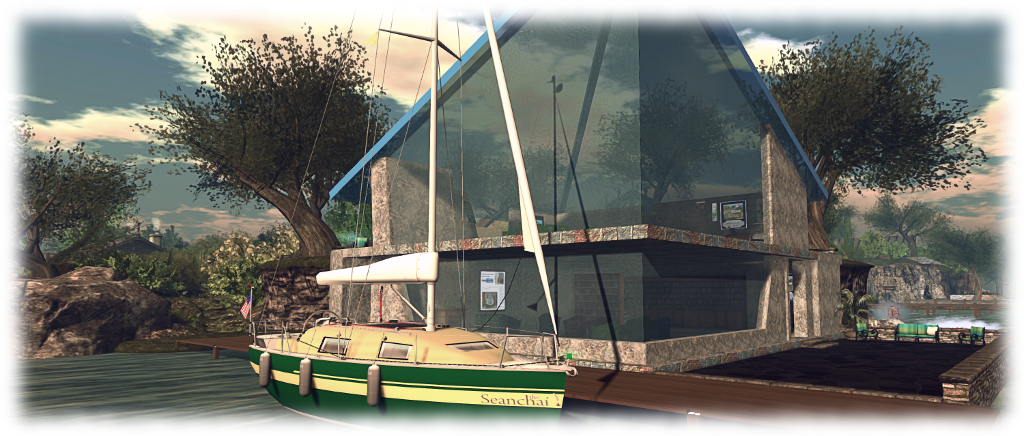
Seanchai Library

It’s time to highlight another week of storytelling in Voice by the staff and volunteers at the Seanchai Library. As always, all times SLT, and events are held at the Library’s home, unless otherwise indicated. Note that the schedule below may be subject to change during the week, please refer to the Seanchai Library website for the latest information through the week.

Sunday, June 28th: 13:30: Tea-Time with Miss Marple

Anyone who murdered Colonel Protheroe,’ declared the parson, brandishing a carving knife above a joint of roast beef, ‘would be doing the world at large a favour!’ It was a careless remark for a man of the cloth. And one which was to come back and haunt the clergyman just a few hours later – when the colonel was found shot dead in the clergyman’s study. But as Miss Marple soon discovers, the whole village seems to have had a motive to kill Colonel Protheroe.

Tea-Time with Miss Marple

Seanchai Library continues a 6-week run featuring Agatha Christie’s Miss Jane Marple, starting with The Murder at the Vicarage, which marked her first appearance in print.

Monday, June 29th, 19:00: Spock’s World

Gyro Muggins reads Diane Duane’s take on a classic figure from science fiction.

In the 23rd Century…

On the planet Vulcan, a crisis of unprecedented proportion has caused the convocation of the planet’s ruling council, and led to Starfleet ordering the U.S.S. Enterprise to the planet in the hope that its first officer, and Vulcan’s most famous son, can help overcome the issues the planet faces.

As Commander Spock, his father, Sarek, and Captain James T. Kirk struggle to preserve Vulcan’s future, the planet’s innermost secrets are laid open, as is its people’s long climb to rise above their savage pre-history, merciless tribal warfare, medieval-like court intrigue to  develop and adhere to o’thia, the ruling ethic of logic, and to reach out into space.

For Spock, the situation means he is torn between his duty to Starfleet and the unbreakable ties that bind him to Vulcan. Confronted by his own internal conflicts, he must quell them and prevent his world – and possibly the entire United Federation of Planets – from being ripped apart.

Tuesday, June 30th

12:00 Noon: Russell Eponym, Live in the Glen

Music, poetry, and stories in a popular weekly session at Ceiluradh Glen.

19:00: The Bridge of San Luis Rey

With Willow Moonfire.

On Friday noon, July the twentieth, 1714, the finest bridge in all Peru broke and precipitated five travellers into the gulf below.

Thus begins Thorton Wilder’s second, and 1928 Pulitzer Prize winning novel. Influenced in part by Wilder’s own conversations with his deeply religious father, and inspired by Prosper Mérimée’s one-act act play, Le Carrosse du Saint-Sacrement, Thorton described the novel as a means to pose the question, “Is there a direction and meaning in lives beyond the individual’s own will?”

The bridge of the novel’s title and opening is a fictional Inca rope bridge. Its collapse is witnessed by a Franciscan friar, himself about to cross over it. A deeply pious man, Brother Juniper finds his faith challenged by the tragedy, and as a result embarks upon a “mission” to prove that it was divine will rather than chance that led to the deaths of those who fell with the bridge.

Over the course of six years, he compiles a huge book on the lives of those who perished, much of it obtained through interviews with those who knew them, in an attempt to to show that the beginning and end of the lives of those lost in the tragedy might be a a window into the will of God, and that the beginning and end of every life is in accordance with God’s plan for the individual.

Thus, within his book, he records the lives of those killed, as presented in succeeding chapters of the novel, mapping all that led them to their fate. The novel itself weaves a story through time, from the opening tragedy, then back to the lives of those who perished, then forward to the book’s reception by the church, then back once more to the events that immediately followed the tragedy and before Brother Juniper embarked on his quest.

Through this, we not only witness the lives of those lost, but also Brother Juniper’s own fate as a result of his efforts – a fate itself foretold within his book, and which again leaves one pondering the question Wilder set in writing the novel: is there indeed direction in our lives beyond our own will – and if so, is it rooted in the divine, or humanity’s own attitudes of a given time?

Wednesday, July 1st, 19:00: The Phryne Fisher Mysteries

Corwyn Allen brings us stories about Kerry Greenwood’s Australian heroine of the 1920s, possibly made popular to a globe audience through the Australian Broadcasting Corporation’s series, Miss Fisher’s Murder Mysteries.

Phryne Fisher is rich, aristocratic and far too intelligent to be content as a flapper in the Jazz Age. She collects men, fast cars and designer dresses. she flies, dances, shoots and has a strong bohemian outlook on life. But no matter how delicious the distractions, Phryne never takes her eyes off her main goal in life: bringing down villains.

Thursday, July 2nd,

19:00: Kolchak: the Night Stalker Chronicles

Shandon Loring presents Barrens, an adventure by Chuck Dixon. Also in Kitely – grid.kitely.com:8002:SEANCHAI).

21:00: Seanchai Late Night

Contemporary Sci-Fi-Fantasy with Finn Zeddmore, featuring stories from Escape PodLight Speed, and Clarkesworld and  other sources.

The art of space in Second Life

Spindrift Art Gallery

As is undoubtedly obvious to regular readers, I’m a bit of a space fan – astronomy, space flight, science fiction – but I have to confess that until recently, I’d never actually written about the Spindrift Space Gallery in Second Life.  In fact, until I was talking to Pooky Amsterdam about the special edition of The 1st Question event honouring Paradox Olbers (see: The 1st Question in Second Life (with Ebbe Altberg)), the gallery had completely fallen off my radar – so I thought it time I returned for another visit.

The gallery was established by Paradox in (I believe) 2007, and features the work of artists from the Intentional Association of Astronomical Artists (IAAA), including pieces by Kara Szathmáry, the IAAA’s Vice Prresident and CFO-Treasurer.

Spindrift Art Gallery

As the IAAA notes, art has always held a special place in the history of exploration. Artists often accompanied explorers on their journeys, providing paintings and sketches that would later enthral audience on their intrepid return. Some actually financed their own expeditions to “far-away” lands: south America, the Middle East, the Orient – specifically to paint those distant “worlds” and present them to patrons and audiences. In the 1870s, American artist Frederic Edwin Church perhaps became one of the first “space artists” of the modern era when he went to the Arctic regions to specifically paint the northern aurora as well as the icebergs of the Arctic Sea.

That tradition of art accompanying exploration has very much been a part of the space age. While artists cannot physically travel into the solar system or outer space, they can offer images of the Final Frontier, bringing us images of the fantastic – interplanetary space ships, future civilisations, alien worlds and so on, as well as realistic portrayals of the possibilities of planetary exploration, the worlds of our solar system and those we’ve detected around other stars but have yet to see through our own eyes or those of our robot emissaries. And of course, art has also given life to the imaginings of science fiction authors.

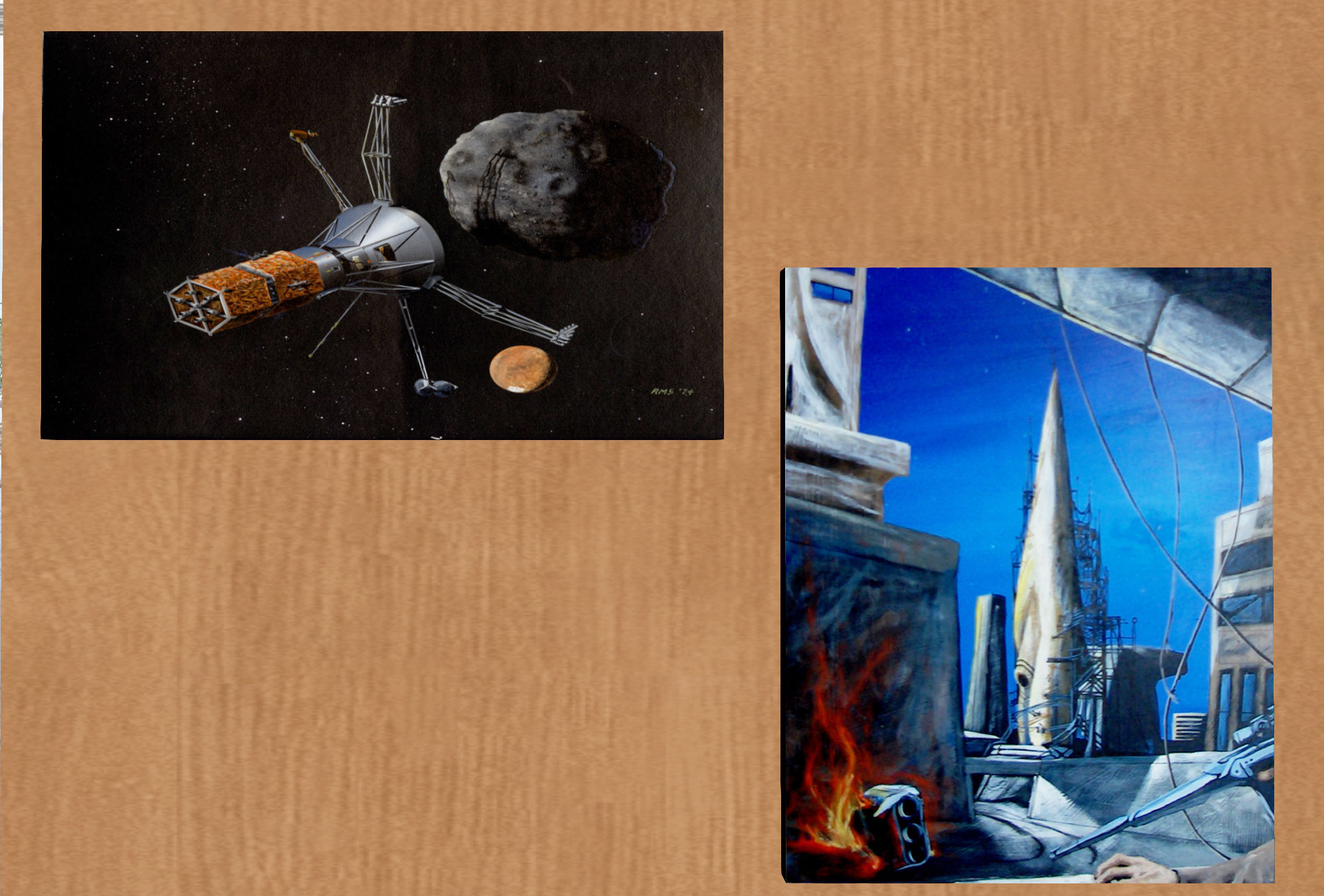
Spindrift Art Gallery: Rick Sternbach

All of this is reflected at the Spindrift Space Gallery. It features images by George Richard, Ron Miller, the inimitable Rick Sternbach, perhaps most famous for his work in connection with the Star Trek franchise from The Next Generation through Star Trek Voyager, in which his designs, images and conceptual art helped shape our view of the 24th century.

Also featured is the art of the aforementioned Kara Szathmáry, with a stunning series of pieces that reflect our unique relationship with the cosmos that has existed throughout history: stars that helped us navigate the oceans (Arrival), played a role in beliefs and cycles of life and even romance (Grandfather’s Spirit – Rolling Thunder, If Not for You), and that our voyages into space are, at their heart a very human undertaking: inspirational, emotional and, for families left behind, worrisome (In Pursuit of Paradise, Bon Voyage).

Spindrift Art Gallery: Kara Szathmáry

An exhibition of work by Steve Hobbs  presents marvellous images of our solar system and explorations within it: Huygens descending through Titan’s atmosphere, Japan’s Hayabusa spacecraft at asteroid 25143 Itokawa, Voyager 2 at Uranus and Neptune, the Russian Luna 16 sample return mission and more, as well as views of of the planets and moons of the solar system. Another panel provides a tribute to the writings of Sir Arthur C. Clarke, including a rather Robert Redford like interpretation of Alvin, the protagonist of Against the Fall of Night.

From science fiction to science fact by way of astronomy the Spindrift Space Gallery offer a unique, static exhibition of space art and a little slice of SL history.

Spindrift Art Gallery: Rick Sternbach

SLurl Details

SL17B: Meet the Moles of Second Life

via Linden Lab

On Friday, June 26th, 2020 at the SL17B celebrations, the final of five Meet the Lindens sessions was held, this one featuring Patch Linden and the Moles of the Linden Department of Public Works (LDPW).

Unlike previous summaries in this series, this does not provide a breakdown of all topics covered. Instead it is structured follows:

Core information about the LDPW and the Moles is given below – who they are, what they do, how to apply to become a Mole, etc.

  • This information is drawn from both the session previous interview with the Moles and information from the SL wiki.
  • This information is supported by the Links to the Video section of the table of contents, right.
Table of Contents

This is followed by a short summary of the question (and their answers) likely to be of interest to readers. These are supported by the links under General Audience Questions section of the table of contents, right. For all of the questions asked in the session, please refer to the official video, embedded at the end of this article.

The Moles

Who or What are the Moles?

  • Officially called the Linden Department of Public Works (LDPW)
  • They are residents from all over the world hired by Linden Lab as independent contractors to undertake specific tasks.
  • The core element of work they undertake is specifically geared towards enhancing the Mainland, as noted in the official LDPW wiki page, although they actually do a lot more than this.
  • The LDPW initially formed in 2008, and so is now in its twelfth year. They are managed by Derrick Linden, the Product Operations Manager for Second Life, together with a team of Linden Lab staffers including Guy Linden, Madori Linden and Kona Linden.
  • Notable major projects carried out by the Moles include:
    • The infrastructure within Nautilus City.
    • The development of Bay City.
    • The Linden Homes continent of Bellisseria (including all topography, flora, infrastructure and housing).
    • The facilities for events like Shop & Hop, SL16B and SL17B, ton hall events, the turn-key regions available for businesses, starter avatars, etc.
    • The Lab provided games such as Linden Realms, Paleoquest, Horizons and the grid-wide Tyrah and the Curse of the Magical Glytches – all accessible via the Portal Parks.
  • They also provide support / input for / to technical projects (e.g. Project Bento and the avatar skeleton extension), and work with marketing, QA and other LL teams.
  • In keeping with their name, Moles were originally given a mole avatar, complete with hard hat. However, over the years, most have moved to having a more individual and personal look.
  • As well as being paid for the work they do, Moles also receive and allowance from the Lab, which is primarily intended to go towards the cost of uploads (texture, animations, mesh objects, etc)., but which can also be put towards developing their individual looks.
  • [Video: 29:58-33:54] Current project focus comprises:
    • Bellisseria / Linden Homes – including four more Homes themes, and next two of which will be “a bit of a departure” from what has so far been seen.
    • SL17B / LL-led events for 2020.
    • A Halloween refresh.
    • End-of-year events.
    • A number of “big media events”.
  • [Video: 39:49-40:52] Due to the Linden Homes work, the LDPW has expanded from 20 to 30.

How to Become a Mole

  • Positions in the LDPW are open to application by residents who believe they are qualified to work in the team, and the team may also approach specific residents and ask if they would consider joining them.
  • Applications are made by dropping a résumé (note card or email) of qualifications / experience (including links SLurls, Flickr, You Tube, etc.) to Derrick Linden (derrick.linden-at-lindenlab.com) or to Patch Linden (patch.linden-at-lindenlab.com).
  • Applicants have to go through a former interview process.
  • Successful applicants get to pretty much choose their hours of work – providing agreed tasks are completed on time.
  • As they are from around the world, this can allow some projects to move forward on almost a round-the-clock basis.
  • Those who are more fully-rounded in skill sets  – content creation, scripting, etc., – are encouraged to apply, but LL will also take on specialists.
  • Motivated, outgoing, communicative people with a passion for SL and willing to self-teach themselves new skill sets are particularly considered.

Selected Questions and Answers

Please use the links to the video in the table of contents to hear full responses to them.

  • Will the SSPE areas around the Log Homes ever be completed?  – Already working on it.
  • Will water regions connect all the continents? – Not all, but where in makes sense, hopefully.
  • Will the Bellisseria railway extend into the “older” region in the continent? – No. the tracks need to be part of the infrastructure built into region, they are not suited to being retro-fitted.
  • Could the trees in Bellisseria be swapped for trees with lower LI, and the LI given to residents? – No, because a) the content the Moles build is in accordance with best practices for things like LOD, etc., and b) Land Impact really doesn’t work is a way that the question implies.
  • Will there be commercial areas in Bellisseria? – It had been intended too release Victorian Commercial as well as the Victorian themed homes (e.g. Millbank, intended to be an open market space), but this was de-prioritised in favour of more homes.
  • Why not convert abandoned Mainland for use with Linden Homes? – The way the Linden Homes regions are set-up doesn’t easily lend itself to use on the Mainland.
  • What about an underground Bellisseria theme? – has been considered along with other ideas. However, there are technical complexities to this – creating the terrain, dealing with the physics, etc., – which are considered to be currently prohibitive.
  • Will there be Trailers and Campers on 1024 sq m parcels, as once stated? Unlikely. The 512m parcels for Trailers and Campers were selected to give Premium members who had already used some of their free tier on a Mainland parcel the option of also trying a Linden Home. Also, the Campers and Trailers don’t scale well on 1024 sq m.

Catch the rest of the session in the video below.

The 1st Question in Second Life (with Ebbe Altberg)

The First Question

Pooky Amsterdam alerted me to the return of The 1st Question, a fast paced science themed show that will be taking place at Scilands on Sunday, June 28th, at 12:00 noon SLT.

Creator, founder and host of the show, Pooky is staging the event in honour of Paradox Oblers (aka Bruce ‘Spike’ MacPhee in the physical world), who sadly passed away in 2019, and it features some special guests – including the Lab’s own Ebbe Altberg.

For those unfamiliar with Paradox, he was owner/manager of the Spindrift island Space Gallery where he was also a curator for the Intentional Association of Astronomical Artists art wing, a SciLands science Senator and Council member, an International Spaceflight Museum planner & head of operations, a NASA SL CoLab manager, and a MICA Advisory Council member. He was a long-time member of the New England Science Fiction Association and the founder of the small press company Paratime Press.

Bruce “Spike” MacPhee

In Second Life, he helped to establish SciLands, a region for educators, scientists and science related people. It was a safe space where universities and government agencies could set up shop. It did much to establish Second Life as a resource for learning, discussion, the promotion of science, thinking, and the sharing of ideas.

Memory works like a small film, and we can “roll” that film before our minds eye by pressing play on that moment … My memory of the day I met Paradox Olbers runs like that. There he was, standing outside the large virtual conference auditorium with some other people I interacted with.

Arthur C. Clarke had just died and we both spoke of being affected by his writings and sad he was gone … Paradox asked me if I wanted to see something cool; I said yes, so he disappeared in a cloud of orange smoke and soon a prompt to take a teleport to him appeared on my screen. And with an instinctual trust, I took it.

Then we were in a large dome shaped building, and a large man creature elf was playing the most illusory sounds with electronics and flutes. We sat and watched, and Paradox noted he wished he could get more people interested in SL. I said, “Well, I have an idea…” and so The 1st Question was born as a weekly show.

Hearing of his passing only recently, I must make the steps back to Second Life to remember and embrace Paradox’s memory here.

– Pooky Amsterdam, recalling Paradox Oblers

For the special edition of The 1st Question Ebbe Altberg will be joining contestants Troy McLuhan, Jimbo Perhaps (who also has a platform over Scilands where visitors can witness a to-scale model of the solar system and Larry Niven’s Ringworld),, and Korii Tiger. The show is being called The Guru edition, to mark Paradox’s role as a mentor and guru to many.

The game is science-focused, as noted, and offers the tag line If you have an answer – We have a question. It comprises four rounds:

  • Yay Me or Nay Me – 16 questions – are they the truth or not?
  • You’re So Elemental – with which element in the periodic table do each of the four contestants identify?
  • Word-Up – everyone has words they’ve made up at some point (mine are usually made up right after I’ve stubbed my toe on something or broken a finger nail…). Each of the four panellists is asked to reveal one of theirs, and the audience votes for their favourite.
  • Your Inner Geek – a quick fire, on-the-buzzer round of questions on recent science in the news, or scholarly discovery and work, or heroes of science. He who buzzes first – and gets the right answer – gets the point. But he who buzzes before the question has been fully asked and gets the answer wrong, gets locked out of answering again until the entire question has been asked.

The winner is the contestant earning the most points, and those watching can play along with the question-and-answer rounds for themselves.

With the Tiny Marauders on-hand to bring opening craziness to the mix and music from guest musical director Cypress Rosewood and Pooky and Hydra asking with questions, The 1st Question is a fun event and a fitting way to recall Paradox, who loved science and enjoyed the show and having fun. So why not hop along to the theatre or overflow gallery, or catch it via a You Tube live stream.

With thanks to Pooky Amsterdam.

SLurl Details