
On Saturday, May 30th, 2020 the United States successfully launched astronauts into orbit from American soil for the first time since July 8th, 2011. It came after an initial attempt on May 27th, 2020 had to be scrubbed (called off) due to adverse weather conditions putting the launch vehicle at risk of a possible electrical strike.
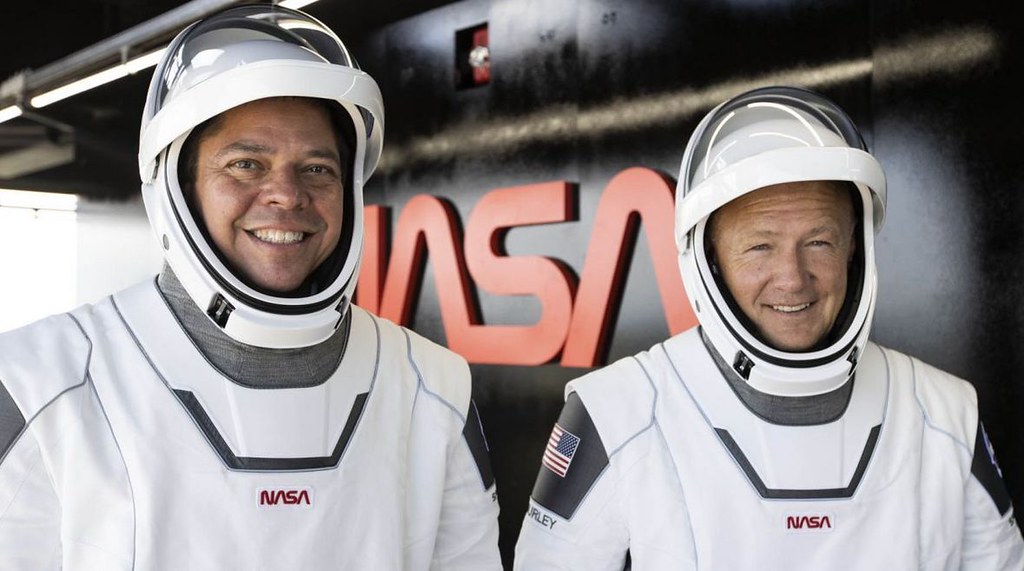
As I noted in my previous Space Sunday piece, the primary goal of the mission is to confirm the SpaceX Crew Dragon vehicle is ready to commence operations ferrying crew to and from the International Space Station. Intended to fly up to four crew at a time on such missions, for this final test flight, Crew Dragon lifted-off with only two crew aboard: NASA veterans Robert L. Behnken (flight pilot) and Douglas G. Hurley (commander).
Weather was also a concern in the run-up to the May 30th launch, with NASA putting a chance of lift-off at 50/50 through to less than an hour ahead of the launch time. However, after a burst of rain in the area of Kennedy Space Centre as the Falcon 9 launch vehicle was being prepared for lift-off, the weather situation both around the Florida Cape and downrange of the launch site and along the track of the vehicle’s line of ascent, cleared sufficiently for the launch to go ahead.
The entire launch, from the astronauts suit-up in the crew room at Kennedy Space Centre, through lift-off, ascent to orbit, on-orbit operations and the rendezvous and docking with the International Space Station some 19 hours after launch, was covered entirely live through NASA TV and SpaceX on You Tube and other channels. This coverage made it one of the mos-watched launches of a space vehicle despite the limitations of travel in place due to the SARS-CoV-2 pandemic, with 1.5 million people watching the SpaceX relay of the NASA feed alone.

Following their arrival at the launch pad some 2+ hours ahead of the the launch, the astronauts – known as “the Dads” to the SpaceX team – travelled to the top of the launch tower prior to ingressing into the Crew Dragon vehicle and performing a series of pre-flight checks both before and after the crew hatch was closed-out by the fight support crew.
At around an hour prior to launch and with the flight support crew clear of the tower, the access arm was rotated clear and fuelling of the Falcon 9’s first and second stage tanks commenced as the weather clearance was given. Unlike Apollo and the shuttle, the SpaceX vehicles go through fuelling as a last stage of ground operations to minimise the amount of fuel venting / topping-up that is required as the super-cold liquid propellants start to slowly warm despite insulation and cooling.

A crucial aspect of the Demo-2 launch was that orbital mechanics demanded the vehicle had to lift-off precisely on time – there could be no “holds” that delayed it beyond the appointed lift-off time. Were launch to be delayed, even by a few minutes, the Crew Dragon would reach orbit at the wrong point related to the ISS, and so and rendezvous would be much harder, if not impossible, given what needed to be achieved in the flight ahead of reaching the space station.
So, at 19:22:45 UTC, precisely on schedule, the nine motors of the Falcon 9’s first stage igniting, lifting the black-and-white rocket and capsule vehicle smoothly off the pad. This marked a further first for the mission: not only was it the first US crewed mission into space undertaken from US soil bult and operated by a private company, the entire launch process was run by SpaceX and not by NASA’s Mission Operations Control Room (MOCR – or “moe-kerr”) at the Johnson Space Centre (JSC), although the latter were obviously looking over SpaceX’s shoulder and monitoring things, with the ISS Fly Operations Centre fully “in the loop”.

Ascent to orbit lasted some 8 minutes – although to all those watching, it probably seemed a lot quicker. Powering the vehicle through the denser part of the atmosphere, the Falcon’s first stage reached MECO (main engine cut-off) just over 2 minutes after launch. Separating, this continued along a ballistic trajectory, flicking itself around to deploy vanes to help with its descent back though the atmosphere so it might make a landing on the autonomous drone ship Of Course I Still Love You.
Camera footage from the first stage, transmitted as the Falcon’s second stage continued to boost the Crew Dragon vehicle to orbit, showed it orienting itself using its attitude thrusters, prior to three of the Raptor engines firing to slow it down and cushion it as it dropped back into denser atmosphere. From here, it dropped smoothly back towards the drone ship, the deployed vanes holding it upright. Unfortunately, video footage was lost prior to touch-down, but moments later, the feed resumed, showing the stage sitting on the ship’s deck as high above, the Falcon’s second stage reached SECO – Second (Stage) Engine Cut-off, and shortly after, the Dragon separated from it.

 Inara Pey: Living in a Modemworld