September 2019 marks Linden Lab’s 20th anniversary – something I’ve commented on previously in the pages. It’s a milestone event for any company in the technology sector, where things can be here today, gone tomorrow. Nevertheless, the Lab have played things fairly low-key thus far, up to and including a there most recent blog post, issues on Tuesday, September 24th entitled What’s Next for Linden Lab?
While the title might be suggestive of being a commentary on the company’s past and future, it actually takes a general look at Second Life and Sansar, offering a consideration of changes to both platforms which users may or may not be aware of – and for Second Life, gives a small glimpse of things to come.
Perhaps of more interest to user,s it also provides a mini-update on the migration to the cloud:
We have been hard at work moving the services that bring you Second Life from our existing data center to cloud hosting. Our goal is to make almost all of it seem invisible to you; in general we won’t announce that a service has been moved until it’s been working in the cloud for a while. Some things already qualify, though: Your inventory data has been in the cloud for quite some time, and the maps website moved a little while ago. We have several more things that your viewer uses that are being tested internally now, so expect more updates in the next couple of months. We are very excited about the new product possibilities that cloud hosting will enable.
Note, again, that this does not mean any regions or their underlying simulators have been moved to the cloud: currently, these are still being operated from within the Lab’s own facilities.
Another element mentioned in passing is the upcoming Second Life Blogger Network. This is something I’ve played a small role in helping the Lab to formulate ideas, and I’m interested in seeing it launched and how members of the blogging community respond to it.
For those with an interest or curiosity in Sansar, the press release perhaps offers meatier reading than the blog post, covering at it does the most recent updates to the platform: Avatar 2.0, the Nexus, the introduction of the Experience Points (XP) system, and the initial development of the Sansar “backstory”. All of these I’ve looked at in Sansar: R36 – Avatar 2.0 the Nexus, the Codex and more, and will doubtless be looking at again.
In particular the press release provides information on the new partnerships Linden Lab has entered into with regards to Sansar. These encompass include Dutch record label Spinnin’ Records, and a venture with Japanese kawaii (cute) brand-leader Sanrio alongside clothing brand Levis®. Also included is an outline of various live events Sansar will be hosting a series of live events through until the end of September to mark its “re-imagining”.
To coincide with the Sansar announcement, the Lab also issued a new promotional video for the platform. I’m not entirely sure it works, but the tag line – Your World Is Waiting – has a faint echo of a certain other tag line people may recall.
Returning to the blog post in closing, it makes no direct reference to the Lab’s anniversary, as noted above. However, given it is September, I’d like to offer all at Linden Lab congratulations on company’s 20th birthday; I’ve enjoyed being around for 13 of them, and I look forward to a good many more!
According to a piece published in Yahoo Finance on Monday, September 23rd, a complaint has been filed against Linden Research Inc., (Linden Lab) alleging patent infringement.
The report quotes a news wire release from Worlds Inc, claiming Linden Lab and its Second Life product have infringed on a Worlds Inc patient System and Method for Enabling Users to Interact in a Virtual Space – US 7,181,690.
The complaint is the latest in a series of actions relating a set of patents filed by Worlds Inc (also known as Worlds.com Inc and Worlds Online and which I’ll refer to simply as “Worlds” for the most part below), the others being US 8,082,501, US 7,493,558 and US 7,945,856, as cited on the company’s home page.
Together, the patents relate to technologies and methods, Worlds state, to “provide a highly scalable architecture for three-dimensional graphical multi-user interactive virtual world systems”, as seen in Massive Multiplayer Online games (MMOs) and virtual spaces. These technologies and methods particularly relate to the use of avatars, means of communication between “rooms” (disparate spaces) etc. They were filed and granted in 2007 – well after the Second Life was established – but they relate to an initial filing made by Worlds, in 1995, which they argue stands as the priority date when considering the patents.
Thom Kidrin, CEO of Worlds Inc.
The history relating to Worlds Inc and these patents dates all the way back to 2008. It was then that the company challenged against South Korean games an MMO developer NCSoft. At the time, World’s CEO, Thom Kidrin, stated the case would be the first of many such cases, asserting that his company would “absolutely” seek financial recompense from any companies they perceived as infringing on their patents – including Activision Blizzard and Linden Lab.
Ultimately, the NCSoft case reached a confidential out of court settlement in April 2010. However, in 2012, Worlds Inc. set their sights on Activision Blizzard in what has become a convoluted case.
Responding to the complaint by Worlds, Activision Blizzard initially argued that the claim of infringement was invalid, as the technologies to which their patents referred had appeared in public prior to any patient filing. However, Worlds claimed the priority dates for their patents had been incorrectly recorded by the US Trademark and Patents Office (USTPO).
Activision’s position appeared to be upheld in a March 13th, 2014 summary ruling by U.S. District Judge Denise Casper, prompting some to repeat the view that Worlds Inc a patient troll, a view first raised at the start of the Activision case.
However, judge Casper also upheld a claim by Worlds that filing irregularities at the USTPO had resulted in their priority date being incorrect, and gave the company leave to seek a correction from the USTPO. This resulted in the priority dates for the patents being revised to an earlier time frame, and Activision opted not to challenge the revision by way of an inter partes review (IPR), allowing Worlds to re-file their claim of infringement in October 2014.
Around this time as well, Worlds also mounted a challenge against games developer Bungie. In response, Bungie filed three counter-IPRs with the patent office, claiming various parts of the Worlds patents were invalid.
Worlds sought to have the Bungie IPRs discounted on the technicality that they failed to state that Activision shares a publisher/developer relationship with Bungie. However, the USTPO didn’t agree with Worlds and in 2015, ruled in Bungie’s favour – and so Worlds took their complaint over Bungie’s IPR filing to the US Federal Circuit Appeals Court, seeking to overturn the USTPO’s ruling. In September 2018, the court heard the case and issued a ruling in favour of Worlds position, and ordered the USTPO to undertake a further IPR. Which, unless I’ve missed something in digging through assorted legal sites and papers, is where matters more-or-less stand today.
Quite where the complaint against Linden Lab will go is unclear. I’ve contacted them on the matter to ascertain if they are aware of the complaint, but have yet to receive a response – and frankly, I actually don’t expect them to do more than perhaps confirm their awareness; for obvious reasons, it can be unwise for a company to openly comment too much on legal matters. However, in the past, some observers have suggested it is Worlds Inc., who could face an uphill battle in their claims. Ben Duranske, author of Virtual Law: Navigating the Legal Landscape of Virtual Worlds, for example, has previously proposed that there is a wealth of “prior art” that could be brought to bear against them; others have also noted that there is also a wealth of documented history surrounding SL’s development that could be used to challenge claims of infringement.
But, as is often the way in these matters, it is likely things will only unfold slowly over time, so it may be a while before there is any sense of motion one way or with other. In the meantime, should I received a reply from Linden Lab, I will update this article, and I’ll also attempt to keep an eye on this issue in the future.
With thanks to Cube Republic for the pointer to the Yahoo piece.
Logos representative only and should not be seen as an endorsement / preference / recommendation
Updates for the week ending Sunday, September 22nd
This summary is generally published every Monday, and is a list of SL viewer / client releases (official and TPV) made during the previous week. When reading it, please note:
It is based on my Current Viewer Releases Page, a list of all Second Life viewers and clients that are in popular use (and of which I am aware), and which are recognised as adhering to the TPV Policy. This page includes comprehensive links to download pages, blog notes, release notes, etc., as well as links to any / all reviews of specific viewers / clients made within this blog.
By its nature, this summary presented here will always be in arrears, please refer to the Current Viewer Release Page for more up-to-date information.
Note that for purposes of length, TPV test viewers, preview / beta viewers / nightly builds are generally not recorded in these summaries.
Official LL Viewers
Current Release version 6.3.1.530559, formerly the Umeshu Maintenance RC viewer, dated, September 5th – No change.
Release channel cohorts:
Vinsanto RC viewer, version 6.3.2.530962, released on September 17th.
Ordered Shutdown RC viewer, version 6.3.2.530901 released on September 16th.
Project viewers:
Legacy Profiles viewer, version 6.3.2.530836 updated on September 17th. Covers the re-integration of Viewer Profiles.
DiXmiX Gallery, September 2019 – part of the revamped The Atom section of the gallery
DiXmiX Gallery, curated by Dixmix Source, is celebrating its third anniversary in September 2019, with a triple exhibition by Maloe Vansant, Del May and Key Monk, and with something of a revamp of the gallery’s spaces.
Since its inception, DiXmiX has been a consistent venue for art from the avant-garde to the traditional landscape, although the emphasis has perhaps leant towards avatar studies and portraiture. I’ve covered the gallery in these pages since its inception – (admittedly missing a few exhibitions over the last 36 months), and it has been a fascinating journey from then until now, witnessing the richness of art on display, both 2D and 3D, and also the gallery’s evolution with the guiding support of Megan Prumier.
DiXmiX Gallery, September 2019 – Del May
For its first exhibition in September 2016, DiXmiX offered colour and monochrome images by Grazia Horwitz, Ariel Brearly (via Dixmix Source’s personal collection of her work), Ziki Questi, and also from the portfolios of Megan and Dixmix. This mix of monochrome and colour art is again on offer in the three exhibitions marking this third anniversary – although the content of the art is very different from that first exhibition, and the three sets offer rich contrast between one another.
Occupying the Grey Gallery, adjacent to the main entrance, Del May presents a set of thirteen avatar studies that are startling in their content, encompassing a form of surrealism that is exceptionally captivating. These are pieces that demand the attention of the heart and emotions rather than the intellect, each piece singularly unique and with its own sense of potential and narrative.
DiXmiX Gallery, September 2019 – Maloe Vansant
One the upper level’s White Gallery, Maloe Vansant presents a dozen studies in her familiar evocative and provocative style. One of the aspects of Maloe’s work I find appealing is her ability to offer pieces that might be regarded as voyeuristic or NSFW or edging on the taboo/ fetishistic, but which are ultimately introspective / reflective, or which convey an ideal, a provocation to thought, rather than seeking a more basic (hormonal?) reaction. This is very much the case here, with each piece presented intoxicating in its composition, tone and message.
For me, Key Monk’s work, displayed in the lower level Black Gallery, offers a new volume in the school of photography brought to my attention by Melusina Parkin. Rather than provide a broad canvas for his pieces, Key focuses on a single element in scene, using it, something with soft focus or considered depth of field, to present a window into what might be a much more extensive story that only requires our own imaginations to bring to life. And even when the image itself is more expansive – as with #3, there is still the feeling that we are witnessing one small part of a bigger story, and thus we are drawn into each piece to weave our own narrative around it.
DiXmiX Gallery, September 2019 – Key Monk
Congrats to Dixmix and Megan on the occasion of the gallery’s third anniversary – looking forward to the next three years!
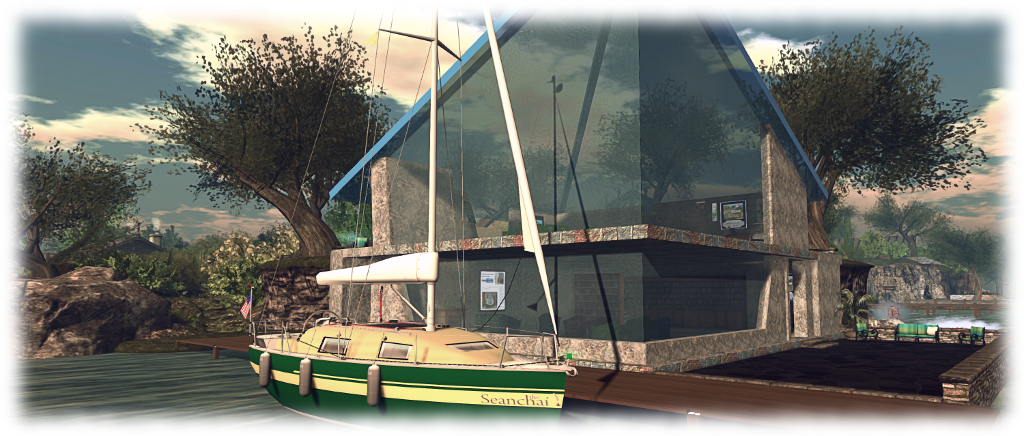
It’s time to highlight another week of storytelling in Voice by the staff and volunteers at the Seanchai Library. As always, all times SLT, and events are held at the Library’s home at Holly Kai Park, unless otherwise indicated.
Monday, September 23rd 19:00: Moonheart
Gyro Muggins reads Charles de Lint’s 1994 novel.
When Sara and Jamie discovered the seemingly ordinary artefacts, they sensed the pull of a dim and distant place. A world of mists and forests, of ancient magic, mythical beings, ageless bards – and restless evil.
Now, with their friends and enemies alike–Blue, the biker; Keiran, the folk musician; the Inspector from the RCMP; and the mysterious Tom Hengyr; Sara and Jamie are drawn into this enchanted land through the portals of Tamson House, that sprawling downtown edifice that straddles two worlds.
Sweeping from ancient Wales to the streets of Ottawa today, Moonheart will entrance you with its tale of this world and the other one at the very edge of sight and the unforgettable people caught up in the affairs of both. A tale of music, and motorcycles, and fey folk beyond the shadows of the moon. A tale of true magic; the tale of Moonheart.
Tuesday, September 24th 19:00: The Spooky Classics
Halloween is approaching and for the next few weeks, Caledonia Skytower will be reading ghostly stories from some of the classics of the genre. Each week features a different author associated with tales of the macabre, Gothic, or just plain spooky. This week: Charles Dickens
Wednesday, September 25th: 19:00 Anne of Green Gables
As soon as Anne Shirley arrives at the white farmhouse called Green Gables, she is sure she wants to stay forever. The problem is, the owners of Green Gables, Matthew and Marilla Cuthbert wanted a boy to help Matthew with household chores; so at first it seems as if she will be returned to the orphanage from whence she came.
However, Anne is determined to stay, trying hard not to get into trouble or speaking out of turn, and the Cuthberts come to realise she is someone blessed with an enormous imagination. The latter is especially noticed by the quietly-spoken Matthew, who persuades his sister that young Anne should stay.
Thus we are drawn into Anne’s life and world as she settles into her first real home. Over the course of a five year period from her arrival in Bolingbroke at age 11 through until her move to Queen’s Academy at the age of 16, where she earns a university scholarship, we follow Anne’s adventures and ups and down within the close-knit community, making friends (and sometime enemies whom she is perhaps too stubborn to admit she’s long since forgiven for perceived wrongs) and her domestic trails and tribulations. The later, when tragedy strikes, we follow her back to Bollingbroke, where she indeed becomes Anne of Green Gables, and her story is left open.
Join Faerie Maven-Pralou as she reads L.M. Montgomery’s 1908 classic (and first of a series).
Thursday, September 26th 19:00 The Dead Travel Fast
“Tonight my bravehearts, we begin our seasonal ventures abroad into exploring the obscure, exhuming Gothic tales, and more seasonal delights!”
With Shandon Loring, also in Kitely – teleport from the main Seanchai World grid.kitely.com:8002:SEANCHAI.
A new study suggests that less that one billion years ago, Venus had liquid water on its surface and atmospheric conditions similar to Earth’s. Credit: NASA
We’re familiar with the idea that Venus is a very hostile place: it has a thick, carbon-dioxide atmosphere mixed with other deadly gases that is so dense, it would instantly crush you were you to step onto the planet’s surface unprotected, and hot enough to boil you in the same moment as well as burn your skin away due to the presence of sulphuric acid. But for a long time, due to its enveloping clouds, it was believed that Venus could be a tropical paradise – a place of warm seas, lakes and rain forests, kept warm by the Sun whilst also protected from the worst of the heat by those thick clouds.
Now, according to a new study presented on September 20th, 2019 at the Joint Meeting of the European Planetary Science Congress (EPSC-DPS),that view of Venus as a warm, wet – and potentially habitable world. What’s more, but for a potentially massive cataclysmic event / chain of events, Venus might have remained that way through to modern times. The study comes from a team at the NASA Goddard Institute for Space Science (GISS), led by Michael Way and Anthony Del Genio.
The studies uses data gathered by two key NASA missions to Venus: the Pioneer Venus orbiter mission (1978-1992), and the Pioneer Venus Multiprobe mission (1978). The latter delivered four probes into the Venusian atmosphere, none of which were expected to survive impact with the planet’s surface, but instead sought to send their findings to Earth as they descended – although as it turned out, one did survive impact and continued to transmit data on surface conditions for more than an hour.
As oceans on Venus might have appeared. Credit: ittiz
That data was coupled with a 3-D general solar circulation model that accounts for the increase in radiation as the Sun has warmed up over its lifetime and models used to define Earth’s early conditions, enabling the GISS time to develop five simulations to try to determine how surface Venus may have developed happened over time – and all five models produced very similar outcomes.
In essence, the models suggest that around 4 billion years ago, and following a period of rapid cooling after its formation, Venus likely had a primordial atmosphere rich in carbon dioxide, and with liquid water present on the surface. Over a period of around 2 billion years, much of the carbon dioxide settled in a similar manner seen on Earth, becoming subsurface carbonate looked in the planet’s crust. In the process, a nitrogen-rich atmosphere would have been left behind, again potentially not that different to Earth’s.
By about 715 million years ago – and allowing for the planet having a sufficient rotation period (16 Earth days or slower) – conditions would have reached a point where a stable temperature regime ranging between 20°C (68 °F) and 50°C (122 °F) could be maintained, with the models indicating that the planet could have oceans and / or seas and / or lakes varying in depth from about 10 m (30 ft) to a maximum of about 310 m (1000 ft), generating sufficient cloud coverage combined with the planet’s rotation to deflect enough sunlight and prevent the atmosphere from overheating. Further, had nothing further happened, these conditions could have more-or-less survived through to current times.
So what happened? That has yet to be fully determined, but the suggestion is that a series of connected global events came together in what might be regarded as a single cataclysmic re-surfacing of the planet. This is somewhat supported by data gathered by the Magellan probe (1988-1994). The GISS team suggest that this caused a massive outflow of the CO2 previously trapped in the subsurface rock that in turn caused a runaway greenhouse effect that resulted in the hothouse we know today, where the average surface temperature is 462°C (864°F).
The surface of Venus called Phoebe Regio, as imaged by the Soviet era Venera 13, 1981-1983
Something happened on Venus where a huge amount of gas was released into the atmosphere and couldn’t be re-absorbed by the rocks. On Earth we have some examples of large-scale outgassing, for instance the creation of the Siberian Traps 500 million years ago which is linked to a mass extinction, but nothing on this scale. It completely transformed Venus.
– Michael Way – GISS Venus study joint lead
There are questions that still need to be answered before the models can be shown to be correct, which the GISS team acknowledge by stating further orbital study of Venus is needed. However, if the study’s findings can be shown to be reasonably correct, it could have relevance in the study of exoplanets.
Until now, it has been believed that planets with an atmosphere occupying a similar orbit around their host star would, like Venus, be subject to tremendous atmospheric heating, preventing liquid water or habitable conditions to exist on their surfaces. However, the GISS models now suggest that subject to certain boxes being ticked, such planets occupying the so-called “Venus zone” around their parent stars could have liquid water present – and might actually be amenable to life.
Artemis and the Moon: Political Football
America is trying to return humans to the Moon by 2024 via a programme called Artemis. It’s an effort that requires funding, clear thinking, co-ordination and agreement. Right now, it would appear as if few of these are proving to be the case.
On the one hand, things do appear to be moving forward. According to a presentation on September 11th, the Lunar Orbital Gateway Platform (LOP-G) is on track. Both the Power and Propulsion Element (PPE -due for launch in 2022) and the Habitation and Logistics Outpost (HALO – due for launched in 2023), as the two core elements of the initial Gateway – remain on track. Even so, doubts have been sewn concerning its relevance, as I’ll come back to in a moment.
An artist’s impression of an unpiloted commercial lander leaving a scaled-back LOP-G for a descent to the surface of the Moon ahead of a 2024 human return to the lunar surface. The LOP-G is the unit on the right, comprising a habitation module and docking ports unit, an on the far right, a power and propulsion unit. In the left foreground is an Orion crewed vehicle. Credit: NASA
Elsewhere, the programme is far from smooth in its progress. On September 11th, the US House of Representative issued a draft continuing resolution (CR) on the 2020 federal budget that provides no additional funding for NASA’s lunar ambitions – a result NASA Administrator Jim Bridenstine stated would be “devastating” to the development of the Artemis lunar lander.
Then at a hearing of the space subcommittee of the U.S. House of Representatives’ Science, Space and Technology Committee on September 18th, NASA’s acting associate administrator for human exploration and operations, Ken Bowersox (himself an ex-astronaut) came under heavy questioning on whether NASA really could achieve a successful human return to the Moon by 2024. His reply wasn’t entirely reassuring, “I wouldn’t bet my oldest child’s upcoming birthday present or anything like that.” He went on:
We’re going to do our best to make it. But, like I said, what’s important is that we launch when we’re ready, that we have a successful mission when it launches.
I’m not going to sit here and tell you that, just arbitrarily, we’re going to make. We have to have a lot of things come together to make it happen. We have to get our funding, we have to balance our resources with our requirements, and then we’ve got to execute it really well. And so, there’s a lot of risk to making the date, but we want to try to do it.
– NASA acting associate administrator for human exploration, Ken Bowersox, September 18th, 2019
In particular, there are concerns surrounding NASA’s new Space Launch System rocket – vital to the effort. This is been plagued by issues to the point where Bridenstine suggested a critical test for the vehicle’s core stage and rocket engines, called the “green run” could be skipped in favour of “other means” of testing – an idea ultimately dropped after considerable push-back from within NASA and safety bodies. As it is, SLS will not be in a position to undertake all of the missions required to return humans to the surface of the Moon – such as delivering hardware to the halo orbit around the Moon that will be used by LOP-G, and so NASA has indicated it would be willing to use commercial vehicles such as the SpaceX Falcon Heavy for a number of cargo flights.

 Another element mentioned in passing is the upcoming Second Life Blogger Network. This is something I’ve played a small role in helping the Lab to formulate ideas, and I’m interested in seeing it launched and how members of the blogging community respond to it.







 Inara Pey: Living in a Modemworld