Angelika Corral and SheldonBR, curators of DaphneArts, have something of an affinity with the work of Edgar Allen Poe. In 2017 they hosted an exhibition of art marking 208th anniversary of his birth, and they have also produced works of their own focused on Poe, notably Dream Within A Dream, based on Poe’s poem A Dream Within A Dream, and a static installation modelled on Fall of the House of Usher.
Dream Within A Dream formed the leaping-off point for a series of immersive installations they have produced (and which has most recently encompassed the works of John Donne – see No man is an island). Now, and with an official public opening on September 2nd, 2019, they have returned once more to Poe, with a new immersive installation Annabel Lee, based on Poe’s poem of the same name.
Annabel Lee was the last poem Poe composed; it explores the themes of death, love and the hereafter – all common these for Poe – wrapped within a “ballad” about the death of a beautiful woman. Within it, the narrator recounts his love for the woman – Annabel Lee – which began many years ago in a “kingdom by the sea”. He believes their love was so intense, the angels themselves became envious to the extent they caused her death. Nevertheless, he believes that the love they shared was so deep, neither angels nor the grave can constrain it, and that their souls remain entwined. And so it is, each night he dreams of her, as he lies beside her tomb.
DaphneArts: Annabel Lee
Like so many of Poe’s poems, Annabel Lee is complex as much as it is dark. There is something of an autobiographical element to it, another facet oft present in Poe’s work. He himself fell in love with his cousin, Virginia Clemm, and in the words of the poem – “she was a child” – being just thirteen when Poe married her, and she died just two years prior to the poem being written. Thus there is an element that in writing about the loss of “Annabel Lee”, Poe is perhaps drawing on personal experience.
In keeping with these immersive environments designed by Sheldon and Angelika, a visit commences in a sky box, where visitors are given an interactive HUD as a temporary attachment, and which should be accepted (it will be automatically be attached, and should detach on leaving – if not, just click the Stop button, when displayed). The skybox also includes instructions on setting your viewer’s environment (if you are using Firestorm, then the local windlight should apply via that viewer’s parcel windlight support). Once the viewer is set in accordance with the recommendations, visitors are free to take the teleport board to the ground level and the installation itself.
DaphneArts: Annabel Lee
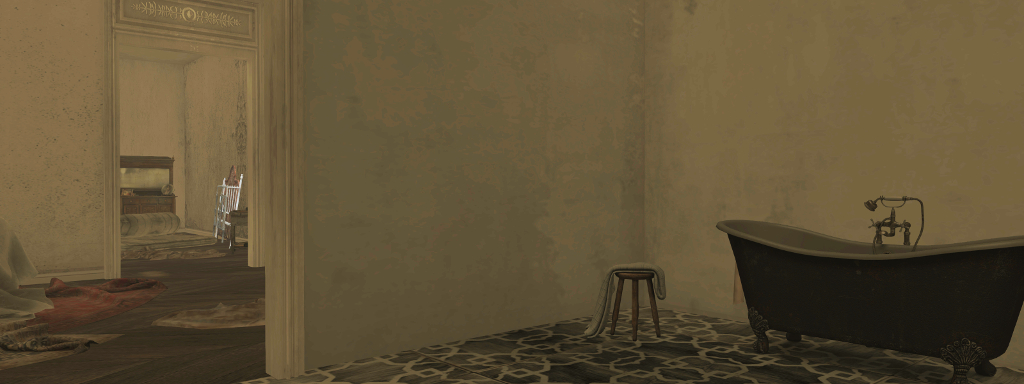
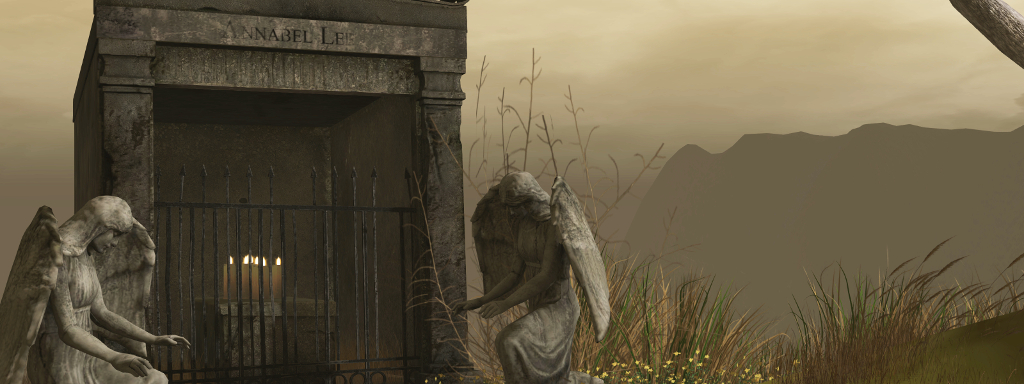
The ground level presents the poem through what Sheldon and Angelika call “Magical Realism” – the use of sounds, visuals and the spoken word (in this case, Angelika reading the poem) – to evoke a sense that the visitor is immersed within its unfolding story. It’s a technique that might also be described as “immersive literary allegory”: a visual setting that both directly frames the telling of the poem’s story (the “kingdom by the sea”) and the passing of Annabel Lee (shown through the presence of her tomb), whilst also offering cues to the deep story of love and loss.
This latter aspect is shown through the use of elements such as the candles (a clear symbol associated with death) and the path they mark (representing the path we follow through life to its eventual end, which is in turn symbolised by the tomb), and by the house. The latter (perhaps best explored after hearing the poem throughout), shows signs of past habitation with rooms and furniture slowly mouldering. However, these are themselves more broadly representative of the memories of love and life shared but which have come to an end; the memories we fight to hold on to after the passing of a loved one, but which inevitably age and fade with the passing of time.
DaphneArts: Annabel Lee
So it is that this is a deeply atmospheric and evocative setting; one that should be experienced rather than described. It sets Annabel Lee, the poem, almost as fairytale without in any way destroying or distorting the emotional span of the original.
Logos representative only and should not be seen as an endorsement / preference / recommendation
Updates for the week ending Sunday, September 1st
This summary is generally published every Monday, and is a list of SL viewer / client releases (official and TPV) made during the previous week. When reading it, please note:
It is based on my Current Viewer Releases Page, a list of all Second Life viewers and clients that are in popular use (and of which I am aware), and which are recognised as adhering to the TPV Policy. This page includes comprehensive links to download pages, blog notes, release notes, etc., as well as links to any / all reviews of specific viewers / clients made within this blog.
By its nature, this summary presented here will always be in arrears, please refer to the Current Viewer Release Page for more up-to-date information.
Note that for purposes of length, TPV test viewers, preview / beta viewers / nightly builds are generally not recorded in these summaries.
Official LL Viewers
Current Release version 6.3.0.530115, formerly the Bakes on Mesh RC viewer, promoted August 26th – NEW.
Release channel cohorts:
UmeshuMaintenance RC viewer updated to version 6.3.1.530411, on August 27th.
The “Flying Water Tank”, aka “R2D2’s Dad”, otherwise know as the Starhopper – rises to 120m (500ft) during its second major test flight, August 27th, 2019. Credit: SpaceX
SpaceX successfully flew their Starhopper vehicle – designed to prove the viability of their upcoming Starship space vehicle – on August 27th, in its most complex test flight to date.
The Starhopper craft, dubbed “the flying water tank” on account it both lacks its conical nose (damaged beyond repair during a storm at the start of the year) and the fact it was fabricated for SpaceX by a company that specialises in building water tanks, lifted off from a pad at SpaceX’s test site in Boca Chica, Texas, rising vertically to a height of 150 metres (488 ft) before translating to horizontal flight to crab across to another pad at the test facility and then descended under power to touch down once more.
While the flight lasted less than a minute, it has, according to Musk, paved the way for two dramatic follow-up flights. As well as the Starhopper vehicle, SpaceX is currently building two full-size Starship prototypes – “Mk 1” is being built at Boca Chica, with “MK 2” under construction in Florida. It appears that the “Mk 1” vehicle will be used for the 20km flight.
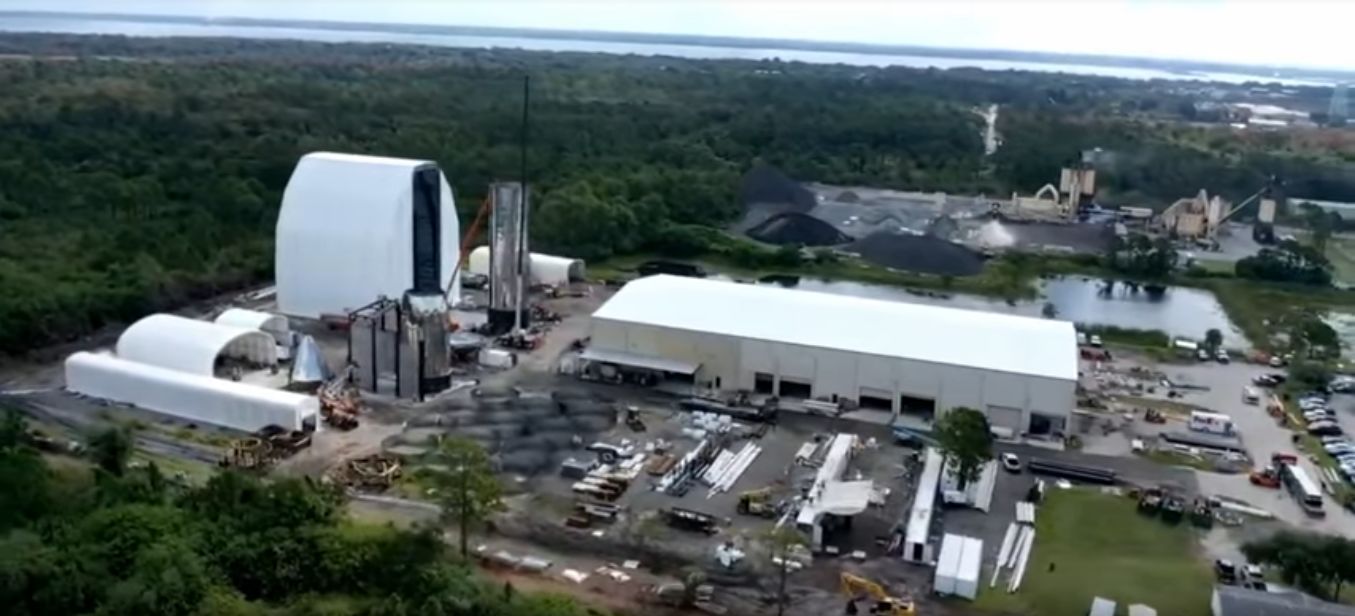
Starship Mk 2 on the left of the image, standing upright and with additional elements nearby, under construction in Cocoa, Florida. Credit: SpaceX
Musk’s announcement of a potential attempt to reach orbital altitude drew questions on whether SpaceX plan to use their Super Heavy – essentially the “first stage” for Starship launches – with one of the Starship prototypes, or just make the attempt with the Starship on its own. In the past, Musk has indicated that a fuelled but unladen Starship should have the power to achieve orbit, but that would presumably be using all six of an operational Starship’s Raptor engines. By comparison, the Starhopper has a single Raptor motor and the Starship Mk 1 and Mk 2 craft will have 3 Raptors – at least initially.
As it stands, the “first generation” of Starship / Super Heavy is designed to be 9m (29 ft) in diameter and stand around 118m (390 ft) tall on the launch pad. Super Heavy is to be powered by 31 Raptor engines and the 48m tall Starship by 6 Raptors. Together, SpaceX stated that they will be capable of lifting around 100 tonnes of payload to orbit, with Starship capable of reaching the Moon or Mars with that payload or up to 100 crew and passengers.
All of that is pretty mind-boggling. If possible, it will make Starship / Super Heavy the most powerful launch system ever built in terms of thrust. But SpaceX is apparently going to go beyond that. Following the Starhopper test, and responding to a question, Musk indicated that a “next generation” craft based on Starship / Super Heavy could follow in “several years”. While planning a follow-up to Starship / Super Heavy is not surprising, the scale of the follow-up version is: in a further tweet, Musk suggested it will be 18m (60 ft) in diameter – twice that of Starship / Super Heavy.
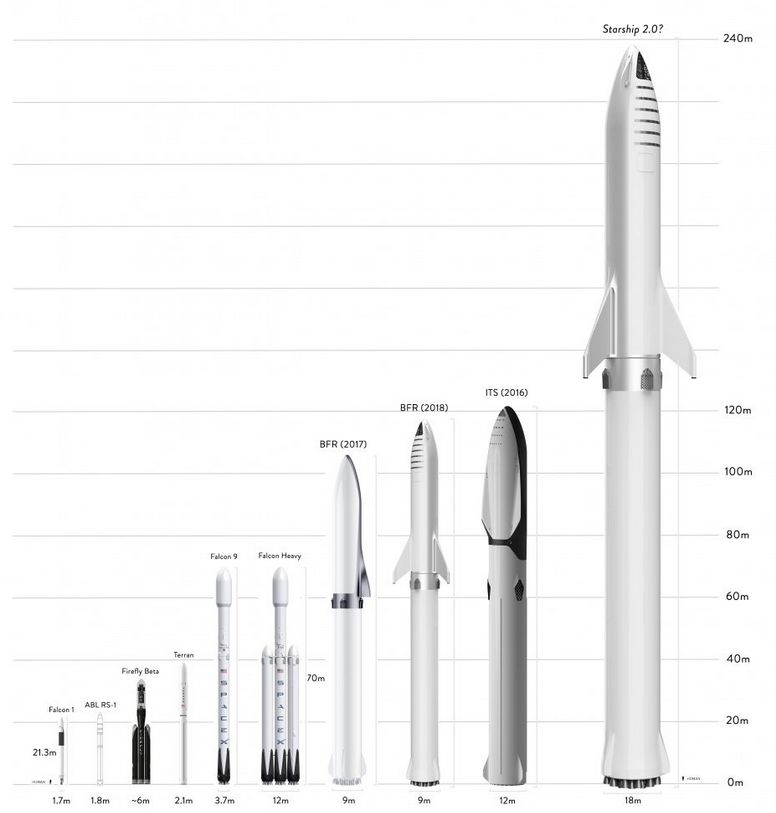
Mathematics tells us that doubling the diameter of a circle quadruples its area. This means that if the current ratio of dimensions for Starship / Super Heavy is retained, the “next generation” version would stand 230 m (780 ft) tall and have eight times both the surface area and propellant tank volume of the current Starship / Super Heavy. All of which leads to a fuelled launch mass of around 40,000 tonnes. All of which is, frankly, entering the realm of idiocy; as I’ve previously (and subjectively) opined, it’s hard to see a launch vehicle with a 100-tonne payload mass being commercially viable unless the launch costs are such that it can turn a profit lifting around 5-10 tonne to orbit for the majority of its flights. As such, a vehicle twice the size (even if possible) has little to no chance, outside of highly specialised (and limited) launch roles.
An artist’s impression of a future “next generation” Starship / Super Heavy launch combination compared to SpaceX’s current family of launch vehicles, the current (2018) and previous (2016 and 2017) BFR designs. This assumes the “next generation” vehicle will have Musk’s stated 18m diameter and retain the same proportions as the current Starship / Super Heavy combination. Credit: Teslerati.
At such a size and mass, the new vehicle would require 100 Raptor motors just to get off the pad – or a system of engines several times more powerful. Take the noise and vibration issues this would introduce to the system, and I’ll say that it just isn’t going to happen. In the meantime, Musk is promising a public update on the status of Starship / Super Heavy on September 28th, 2019.
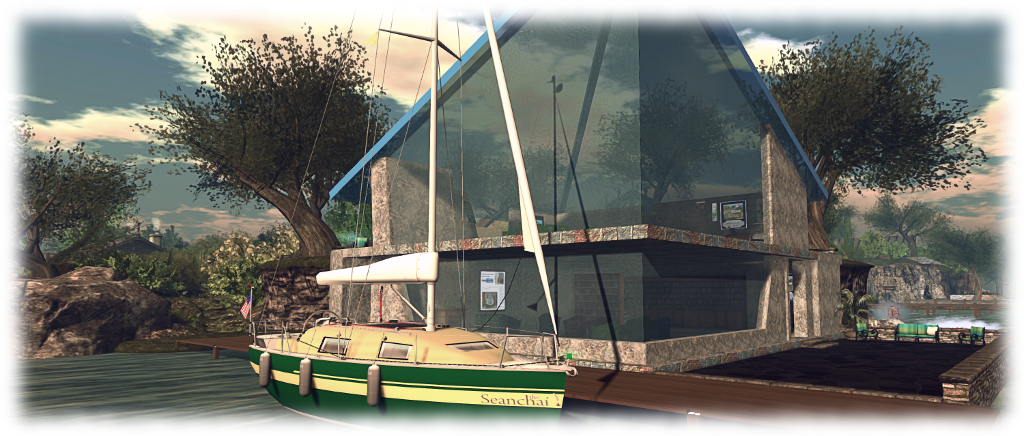
It’s time to highlight another week of storytelling in Voice by the staff and volunteers at the Seanchai Library. As always, all times SLT, and events are held at the Library’s home at Holly Kai Park, unless otherwise indicated.
Sunday, September 1st
13:30: Tea Time with Jeeves
Just for summer, Seanchai Library takes a dive into the world of Reginald Jeeves, a well-educated, intelligent valets of indeterminate age who is employed by the amiable young man-about-town, Bertie Wooster, whom Jeeves routinely has to benignly rescue from the consequences of his idiocy.
Created by author, humorist, and lyricist (working with Guy Bolton and Jerome Kern) Pelham Grenville Wodehouse (October 1881 – February 1975), Jeeves and Wooster are perhaps his most iconic characters, their adventures eventually growing to 35 short stories and 11 novels, the majority of which are first-person narrated from the perspective of Bertie Wooster.
This week comes the fourth part of The Inimitable Jeeves.
A semi-novel published in the UK and the United States in 1923, The Inimitable Jeeves brings together 11 previously published stories structured as “chapters” rather than appearing as individual stories, giving the volume the appearance of being a novel something initially enhanced in early editions, which split the first five and final story into two chapters apiece, giving the impression the book was 18 chapters long (later editions reversed this, each story being just a single chapter for 11 in total).
The stories also add to the novel-like feel, as they each focused variously on a small group of characters throughout including Bertie’s Aunt Agatha, his somewhat inept friend Bingo, and his cousins Claude and Eustace, brought together with Jeeves and Wooster in some familiar Wodehouse themes.
Join Da5id Abbot, Kayden Oconnell, and Caledonia Skytower as they read this delightful series at Ceiliuradh Glen.
18:30 Tilly and the Bookwanderers
Eleven year-old Tilly has lived above her grandparent’s bookshop ever since her mother disappeared shortly after she was born. Like the rest of her family, Tilly loves nothing more than to escape into the pages of her favourite stories.
One day Tilly realises that classic children’s characters are appearing in the shop through the magic of `book wandering’ – crossing over from the page into real life.
With the help of Anne of Green Gables and Alice in Wonderland. Tilly is determined to solve the mystery of what happened to her mother all those years ago, so she bravely steps into the unknown, unsure of what adventure lies ahead and what dangers she may face.
Join Caledonia Skytower at the Golden Horseshoe to find out more!
Monday, September 2nd 19:00: Arthur C. Clarke’s Rendezvous with Rama
Gyro Muggins reads one of the greatest science fiction novels of human first contact with alien intelligence.
In 2131, a fast-moving object of extremely large size is detected beyond the orbit of Jupiter travelling on a course that will see it pass through the inner solar system to swing around the Sun, before heading out into space. An automated probe launched from Mars reveals the object to be a perfect cylinder, 50 km long and 20in diameter rotating regularly along its long axis and clearly artificial in nature.
The deep space survey vessel Endeavour, her crew untrained for first contact scenarios, is the only vessel that can intercept the cylinder as it uses the Sun’s gravity well to accelerate and bend its path onto a new trajectory. After a high-speed chase, the Endeavour reaches the cylinder – christened Rama by those who first identified it – and finds one of the end caps has curious triple chamber airlock systems within it. Through one of them, the crew gains access to the object.
What they find within stuns them: the cylinder is hollow, a 50x16km “tube” the inner surface of which forms a circular world of three parts: a large plain, with six city-like groups of structures scattered around it, a central band of frozen water the crew call the Cylindrical Sea with a single long, thin island (which they dub “New York” due to its superficial similarity to Manhattan island). Beyond the sea lies a landscape of split into cubes and squares, dominated by a group of massive cones extending inward along the cylinder’s long axis from southern end cap.
Initially in darkness and frigid when the Endeavour’s crew enter, the cylinder gradually comes to life, revealing its strange alien nature, where everything appears to be done in triplicate (or multiples thereof). And then, as tensions among the human civilisations across the solar system rise, the “Ramans” appear.
Tuesday, September 3rd 19:00: Chitty Chitty Bang Bang
So, you think you know the story because of the film? Well, guess again! Disney’s famous 1968 film can best be described as being loosely based on the children’s story by Ian Flemming, the creator of James Bond.
Flemming’s last novel, Chitty Chitty Bang Bang was published posthumously, and initially in three volumes, two months after his death in August 1964. He took his inspiration for the titular car from a series of post-War World I aero-engined racing cars called “Chitty Bang Bang”. They were built by Count Louis Zborowski at Higham Park, in Kent, England, and one of them, the “Higham Special” went on to take the land speed record in 1926 with a speed in excess of 170 mph, after it had been purchased by racing driver J.G. Parry-Thomas specifically for that purpose.
In the book, the car is a Paragon Panther, a powerful 1920s touring car that is restored by Commander Caractacus Pott. At first the car is just that – a powerful 4-seater tourer Pott uses to transport himself and his wife and children around. But then the car starts to exhibit a “personality” and abilities beyond those of any normal motor vehicle. Some of these will be familiar to those who have seen the film, but where the latter options to introduce jealous barons and a wicked Child Catcher, the book offers a more down-to-Earth but equally engaging series of adventures of Commander Pott and his family.
Join Caledonia Skytower to discover the real Chitty Chitty Bang Bang!
Wednesday, September 4th: Anne of Green Gables
As soon as Anne Shirley arrives at the white farmhouse called Green Gables, she is sure she wants to stay forever. The problem is, the owners of Green Gables, Matthew and Marilla Cuthbert wanted a boy to help Matthew with household chores; so at first it seems as if she will be returned to the orphanage from whence she came.
However, Anne is determined to stay, trying hard not to get into trouble or speaking out of turn, and the Cuthberts come to realise she is someone blessed with an enormous imagination. The latter is especially noticed by the quietly-spoken Matthew, who persuades his sister that young Anne should stay.
Thus we are drawn into Anne’s life and world as she settles into her first real home. Over the course of a five year period from her arrival in Bolingbroke at age 11 through until her move to Queen’s Academy at the age of 16, where she earns a university scholarship, we follow Anne’s adventures and ups and down within the close-knit community, making friends (and sometime enemies whom she is perhaps too stubborn to admit she’s long since forgiven for perceived wrongs) and her domestic trails and tribulations. The later, when tragedy strikes, we follow her back to Bollingbroke, where she indeed becomes Anne of Green Gables, and her story is left open.
Join Faerie Maven-Pralou as she reads L.M. Montgomery’s 1908 classic (and first of a series).
Thursday, September 5th
19:00: The Blue Salt Road
An earthly nourris sits and sings And aye she sings, “Ba lilly wean, Little ken I my bairn’s father, Far less the land that he staps in.
– Child Ballad, no. 113
So begins a stunning tale of love, loss and revenge, against a powerful backdrop of adventure on the high seas, and drama on the land. The Blue Salt Road balances passion and loss, love and violence and draws on nature and folklore to weave a stunning modern mythology around a nameless, wild young man.
Passion drew him to a new world, and trickery has kept him there – without his memories, separated from his own people. But as he finds his way in this dangerous new way of life, so he learns that his notions of home, and your people, might not be as fixed as he believed.
With Shandon Loring, also Also in Kitely – teleport from the main Seanchai World grid.kitely.com:8002:SEANCHAI.
21:00: Seanchai Late Night
Contemporary sci-fi fantasy from on-line sources such as Lightspeed, Escape Pod, and Clarkesworld with Finn Zeddmore
Summerland, August 2019 – click any image for full size
Late in August we visited – on the recommendation of Miro Collas – Iniquity Constantine’s Homestead region of Summerland. At the time of our visit, Ini described the region as “an idyllic garden where the spirit may rest and rejuvenate,” offering a mix of “pagan, ritual, mythology, mythic … magic, runes, druid, nature, elemental, [and] familiars” in its elements.
These elements are apparent as soon as visitors arrive in the region: the landing point sits within a barn converted into a Wiccan / pagan centre where psychic readings are on offer, and the trappings of Wiccan and magical supplies and symbols are much in evidence.
Summerland, August 2019
Outside, a deck extends over coastal waters under a late summer sky as seagulls wheel around in search of a fishy meal. The deck offers place to sit and appreciate the view across the rest of the region and the surrounding (off-sim) hills. This view reveals that the region forms a semi-circle of small islands that form a horseshoe around what is – given the foaming waters – a shallow bay sitting over a broad shelf of rock.
One its western end, this horseshoe bay is watched over by the tall red finger of a lighthouse; at its eastern extent, it is mirrored by a set of horseshoe waterfalls that tumble from the cliffs of the highest island in the curved chain. It is these falls, visible through the haze that draw visitors around the side of the landing point barn to where a wooden bridge offers the way to the next island in the series.
Summerland, August 2019
Here lie the first ruins with pagan / druid elements: ancient statues, a broken henge of shaped stones around a hewn alter and reach via a stone arch. Beyond it, a second bridge connects to the tall island, the exploration of which can be split into two parts. Just across the bridge, a set of stone steps climb up the grassy shoulder of the island, while just to the left, through a gap in a broken wooden fence, a ladder offers the first part of a way down to where a shingle beach sits at the base of the island, presenting a path to a little beach house sitting on another deck built out over the waters.
At the top of the stone steps, the upper plateau of the island presents a hazy mix of the pastoral and the pagan / ancient. Horses graze on the long grass, shaded by the island’s woodlands, trees that help hide and disguise the ruins scattered beneath their boughs. These take several forms, including those of a chapel and a much more recent glass-and-metal pavilion that has been turned into a place of meditation.
Summerland, August 2019
A path winds across the grassy table of the island, offering a means to see most of the sights whilst pointing the way to where a rocky route drops down to another bridge and also an almost-cave or cavern. As well as providing a means to reach the last two islands in the chain, the low-lying grassy headland provides the means to reach a modern and comfortable orangery – a further place for visitors to sit and rest during a visit to the region.
The two remaining islands offer a further mix of trees, ruins and places to sit and rest or in meditation, all within the region’s sound scape that is, perhaps a little too dominated by the thunder of waterfalls. There is also a little roughness to some of the landscaping with floating bushes and candles here and there, together with some slight alpha issues (sadly common and often unavoidable when combining foliage and off-sim elements), but nothing that excessively gets in the way of appreciating the beauty of the setting, and which certainly don’t interfere with opportunities for photography. Images captured may be shared through the region’s Flickr group.






 Inara Pey: Living in a Modemworld