
During the celebrations marking the 50th anniversary of the Apollo 11 mission in July, came a note of sadness: the passing of Chris Kraft.
This is a name that may not be familiar to some, but Christopher C. Kraft, Jr., was one of the most influential figures of NASA’s pioneering early years of America’s human space flight, who joined the agency from its forebear, the National Advisory Committee for Aeronautics (NACA).
Born in Virginia in February 1924, to Bavarian immigrants, Kraft began his studies at Virginia Polytechnic Institute and State University (Virginia Tech) studying aeronautical engineering. During this time he applied to join the US Navy, but was rejected due to an injury to his right hand that occurred during childhood. He graduated in December 1944 with a Bachelor of Science degree.
On graduation, he applied to both the Chance Vought aircraft company and NACA. On arrival at the former on his first day of work, he was told that he could not be hired without his birth certificate, which he had not brought with him. Annoyed, he returned home and accepted the offer from NACA instead.
At NACA he was assigned to the flight research division, working under Robert Gilruth, who was to become his mentor. Most of Kraft’s work was theoretical – although it did lead him to be the original discoverer of wingtip vortices causing the majority of turbulence behind an aircraft. While he enjoyed it, he also found it taxing to the point of considering leaving, when the NACA was subsumed by NASA.

Gilruth then invited Kraft to join a new project he was heading – the Space Task Group – charged with putting a man in orbit. As a result, Kraft became one of the original thirty-five engineers to be assigned to Project Mercury. In his new role, he was assigned to the flight operations division at NASA, charged with determining how the Mercury missions would be managed and operated from the ground. He was reporting in to Chuck Matthews, who essentially passed off the division’s requirements to Kraft in a throwaway comment:
Chris, you come up with a basic mission plan. You know, the bottom-line stuff on how we fly a man from a launch pad into space and back again. It would be good if you kept him alive.
Kraft realised that just like test pilots, whom he had supported through the X-1 flight programmes, astronauts would need a system of communications and support back on Earth during critical phases of the mission. He also knew they would also require a ground-based tracking system and instrumentation for the telemetry of data from the spacecraft. Through this, he came up with the idea of a single control centre to monitor and operate missions in real-time; a concept never before tried.
I saw a team of highly skilled engineers, each one an expert on a different piece of the Mercury capsule. We’d have a flow of accurate telemetry data so the experts could monitor their systems, see and even predict problems, and pass along instructions to the astronaut.
– Chris Kraft, Flight: My Life in Mission Control, 2001
Within this structure, Kraft particularly identified the need for a single individual who would have overall control and coordination over the flight centre engineers, and make the real-time decisions about the conduct of the mission. He called that role the Flight Director, and nominated himself as the man for the role.
The first iteration of the mission control concept was the Mercury Control Centre at Cape Canaveral. During this time, Kraft continued to define and refine the role of the flight director, gaining the singular title Flight as a mark of respect, although his own stubbornness that could make him something of a controversial figure in the eyes of management – but not enough to prevent him being awarded the NASA Outstanding Leadership Medal on the recommendation of the NASA Administrator, and awarded by President John F. Kennedy.
During Mercury, Kraft selected and trained three engineers to become the first generation of flight directors with him: Glynn Lunney, John Hodge and man who also grew into a legend as he followed Kraft, Gene Kranz. As the more intensive Gemini missions took place, Kraft took on a new role: head of mission operations, but remained entirely hands-on with the flight director programme, continuing to select and train other flight directors and continuing a flight director in his own right.

Mid-way through the Gemini programme, Kraft was asked to oversee the design and implementation of the brand-new mission control centre that would form a part of the new Manned Spacecraft Centre, near Houston, Texas (now the Johnson Space Centre), which would become the nerve centre for all of NASA’s human spaceflight operations.
Kraft, Lunney and Kranz worked directly on the requirements for the new mission control centre, located at Building 30 at the new space centre, liaising with contractors and determining the design of the two primary Mission Operations Control Rooms (each referred to as MOCR, or “moe-ker”).
By the mid-1960s, Kraft was made Director of Flight Operations, and closely involved in planning the Apollo programme. He joined with Gilruth, now the head of the Manned Spacecraft Centre and possibly the most powerful man in NASA next to the agency’s administrator, George Low, the manager of the Apollo Spacecraft Programme Office and Donald Kent “Deke” Slayton, the head of the Astronaut Office, to take on an entirely unofficial, but essential role:
The four of us … had become an unofficial committee that got together often in Bob’s [Gilruth’s] office to discuss problems, plans and off-the-wall ideas. Not much happened in Gemini or Apollo that didn’t either originate with us or with our input.
– Chris Kraft, Flight: My Life in Mission Control, 2001

In 1969, Kraft officially became Gilruth’s deputy in running the Manned Spacecraft Centre, and succeeded him as overall facility director in January 1972. He remained in that role past his due retirement in 1980, remaining firmly embedded in the space shuttle programme. However, his stubborn and outspoken nature in matters relating to that programme brought him into conflict with NASA Administrator James M. Beggs and others, and he suddenly announced his belated retirement at the end of 1982.
Kraft indirectly returned to the shuttle programme in 1994, when he was appointed chairman of an independent review committee with the remit to investigate ways in which NASA could make that programme more cost effective. His report, published in February 1995, recommended NASA’s should outsource shuttle operations to a single private contractor.

More contentiously, it was sharply critical of the post-Challenger accident safety regime at NASA, claiming it was “duplicative and expensive”, while claiming the shuttle had become “a mature and reliable system”.
NASA’s own Aerospace Safety Advisory Panel responded that, “the assumption that the Space Shuttle systems are now ‘mature’ smacks of a complacency which may lead to serious mishaps.” Nonetheless, responsibility for shuttle operations was turned over to United Space Alliance.
In 2003, the investigation into the Columbia accident, directly cited the recommendations made by Kraft’s committee as potentially contributing to that accident, by encouraging NASA to view the shuttle as an operational, rather than experimental vehicle and distracting attention from continuing engineering anomalies. In typical form, Kraft defended his report, insisting the space shuttle was “the safest space vehicle ever built”.
Kraft received numerous awards throughout his career, and in on April 4th, 2011, he was guest of honour at a ceremony at Johnson Space Centre’s Building 30 Mission Control Centre when it was renamed the Christopher C. Kraft, Jr., Mission Control Centre, in recognition of the facility’s 50 years managing US human space flight, and Kraft’s unique place in both NASA’s and the building’s histories.
Christopher Kraft passed away on July 22nd, 2019 at the age of 95 and leaving his wife of 69 years, Betty Anne, and son and daughter Gordon and Kristi-Anne, and their families.
TESS Finds an Earth-Sized World That Might Be Habitable
NASA’s Transiting Exoplanet Survey Satellite (TESS), a mission designed to comb the heavens for exoplanets, has just completed the first year of its initial mission to scan the entire sky around us, and data from that year’s worth of observations is now being published.
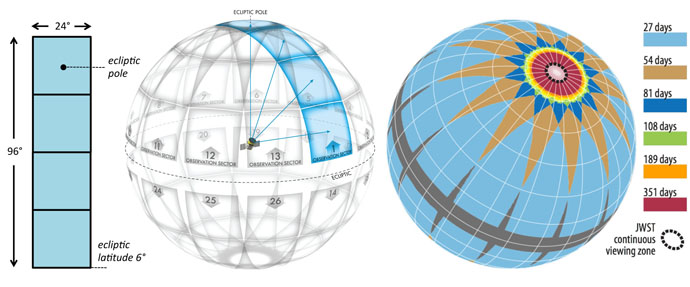
For this first phase of its mission, TESS is paying particular attention to the 200,000 brightest stars around us in the hope of detecting planetary bodies orbiting them, by using the transit method of observation – looking for dips in their brightness of stars that might indicate the passage of a planet around them.
One of the stars surveyed by TESS is called GJ 357 (Gliese 357), a red dwarf star 31 light years from Earth in the constellation of Hydra. It has now been confirmed that it has three “super-Earth” (solid planets with a mass up to 10 times that of our own Earth) it orbit, marking it as the first super-Earth exoplanet system to be found by TESS. And what’s more, one of them might be habitable.

The nearest of these planets to its parent, GJ 357 b, is only 22% larger than Earth and orbit its star every 3.9 days. This puts it 11 times closer to its star than Mercury is to our Sun. Allowing for GJ 357’s much cooler temperatures, GJ 357 b has a likely surface temperature on its sunward side of 254°C (490ºF), assuming it does not have an atmosphere.
Next out is GJ 357 c, is at least 3.4 times more massive than Earth. It orbits its parent every 9.1 terrestrial days and has a likely surface temperature, sans atmosphere, of 127ºC (260ºF). Both planets are most probably tidally locked to their parent, meaning they always have the same side facing the star.
However, GJ 357 d, the third planet in the family is around 6.1 Earth masses and obits it parent once every 55.7 terrestrial days. Because Gliese 357 is such a comparatively cool star, GJ 357 d is within its habitable zone. Without any atmosphere, the surface temperature would be -55°C (-67°F). But if the planet does have an atmosphere, then liquid water could exist on its surface, and it could potentially harbour life.
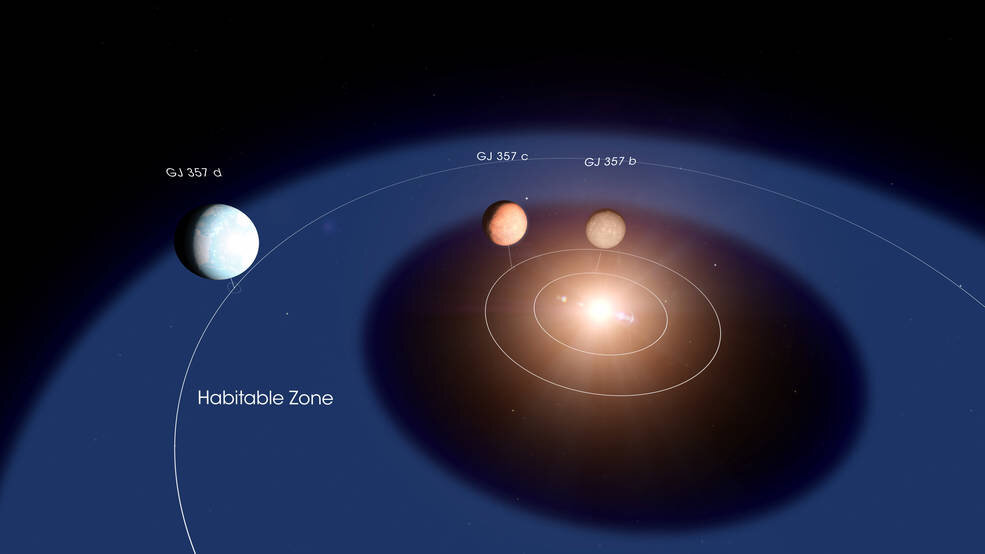
We don’t yet know for sure if GJ 357 d does have an atmosphere, as thus far its presence has only been determined via the radial velocity method (looking at the slight wobble in the star’s motions caused by the tiny gravitational tugs of planets orbiting it). Until it can be directly observed via a transit, then no confirmation of any atmosphere can be made. Further, even if we can confirm it has an atmosphere, it is likely that GJ 357 d is also tidally locked to its parent, which would likely give rise to potentially extreme weather conditions.
However, the team studying the TESS data is building computer models on the likely nature of any atmosphere and it is hoped that one or more telescopes on Earth will be able to catch the planet as it transits between them and its parent star.
Two Unique Views of the Orion Ascent Abort Test
On July 2nd, NASA carried out an uncrewed test of the launch abort system (LAS) for the Orion Multi Purpose Crew Vehicle, as a part of preparations for the capsule’s upcoming entry into crewed launches top of the new Space Launch System rocket.
I reported on the test at the start of July (see Space Sunday: rockets, exoplanets and alien oceans), which saw an Orion test article launched atop the motor stage of an MX Peacekeeper ICBM (called the Minotaur), but a couple of videos have been released showing the test from two unique perspectives.
The first offers a brief overview of the test, followed by video footage shot from the ground and a chase aircraft. It clearly shows the abort system engines firing to pull the capsule clear, and the attitude motors being used to flip the LAS and capsule over before the jettison motors fire to pull the LAS away from the capsule, allowing the Orion to fall free. As no parachutes were included in the test (which would be the case in an actual launch), the capsule is traced as it falls back to the ocean, the video just missing the ejection of the flight data recorders that were recovered to allow engineers to gather critical data about the flight.
The second video – set to music – shows the extraordinary view of the flight from a camera inside the connecting ring between the Minotaur motor stage and the capsule / LAS. Seven seconds into the video, the LAS motors fire, hauling the LAS + capsule clear, and the plume of the motors rising into the sky ahead of the Minotaur can be seen. A small motor keeps the Minotaur stable for the camera as it continues to rise ballistically, before it finally tumbles over just as the LAS fires its attitude motors and rolls out of sight. Played back in slow motion, the film then follows the Minotaur on it journey back down, the plume of its ascent (and that of the LAS rising from it) still visible, until it strikes the ocean at the 3:49 point.

 Inara Pey: Living in a Modemworld