Abandoned Abandale in Second Life

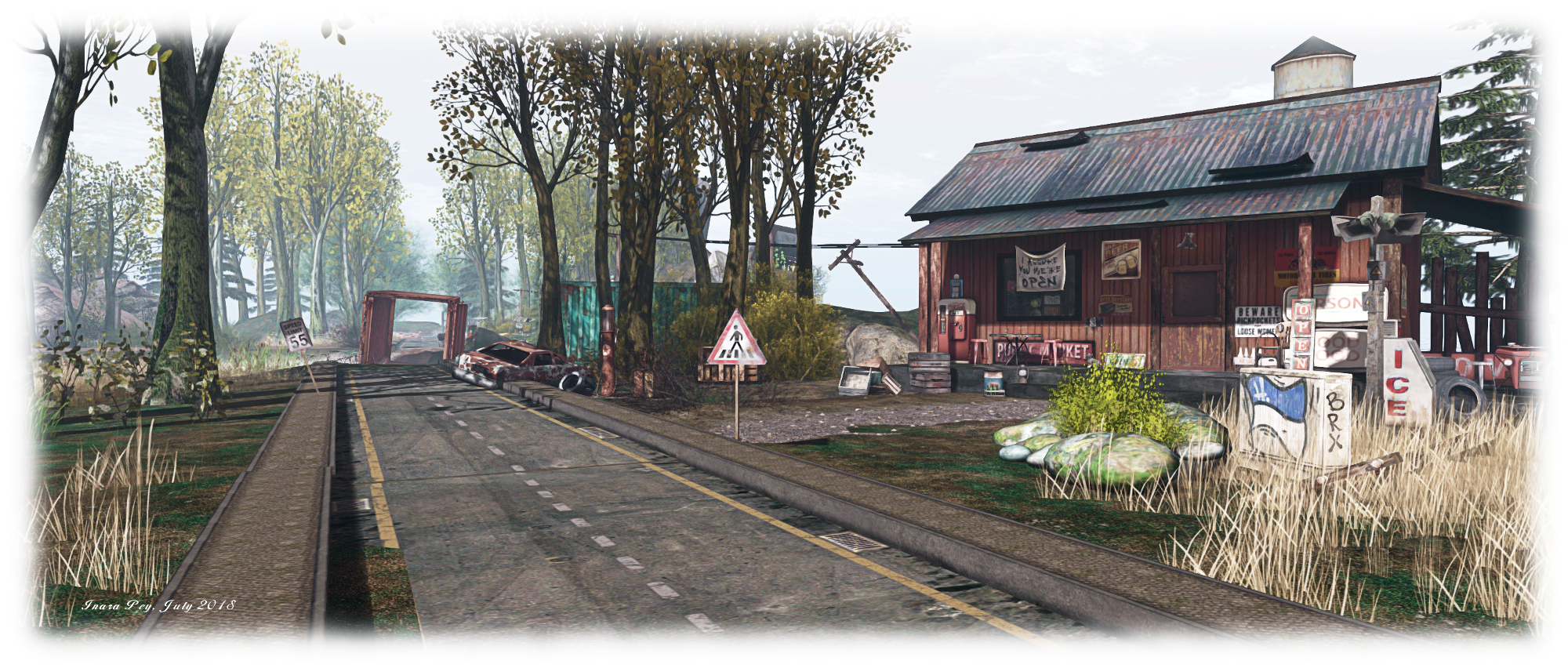
Abandale; Inara Pey, July 2018, on FlickrAbandale – click any image for full size

Update: Abandale has closed. The SLurls in this article have therefore been removed.

Somewhere, along some coastal road, perhaps hidden under the shade of trees or easily missed as it tries to compete with the stunning ocean vista on the other side of the road, an ageing, fading sign points the way down a turn off and is stencilled with a single word, fading with age: Abandale.

Take the turn, and the road gradually becomes more and more decrepit until, just as the idea of turning back and forgetting curiosity’s call, it arrives at a narrow stretch of coastline caught between sea and undulated shoulders of rock. Here sits a place where the black top finally gives up, and an old cargo container offers itself as a makeshift bridge spanning a narrow finger of water, the original crossing perhaps only a ford. It is the setting for the remnants of Abandale, a little town lost from civilisation and forgotten by time.
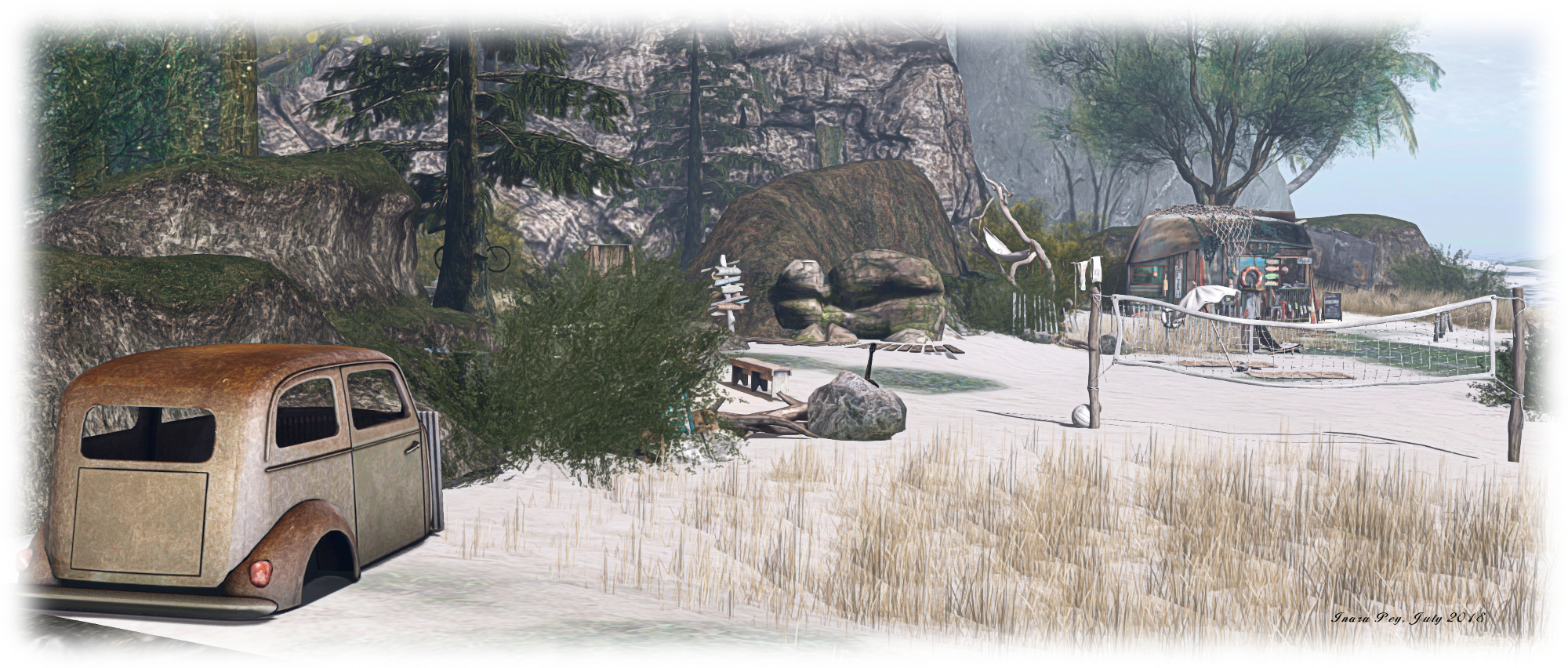
Abandale; Inara Pey, July 2018, on FlickrAbandale

There’s not much here to commend itself to visitors seeking comfort – all that’s left of the motel which may once have  stood at the town’s edge is the entranceway and the front office. Whether the rest was demolished or fell prey to a violent storm – the place stands almost on the edge of the land – is hard to say.

Beyond a curtain of trees from this, and reached by a wooden board walk, sits the ruins of a large building. But it doesn’t appear to be part of the motel; its general shape and the large gates sitting to one side suggest it was once a house, possibly part of a farm, going by the broken windmill and barn close by.
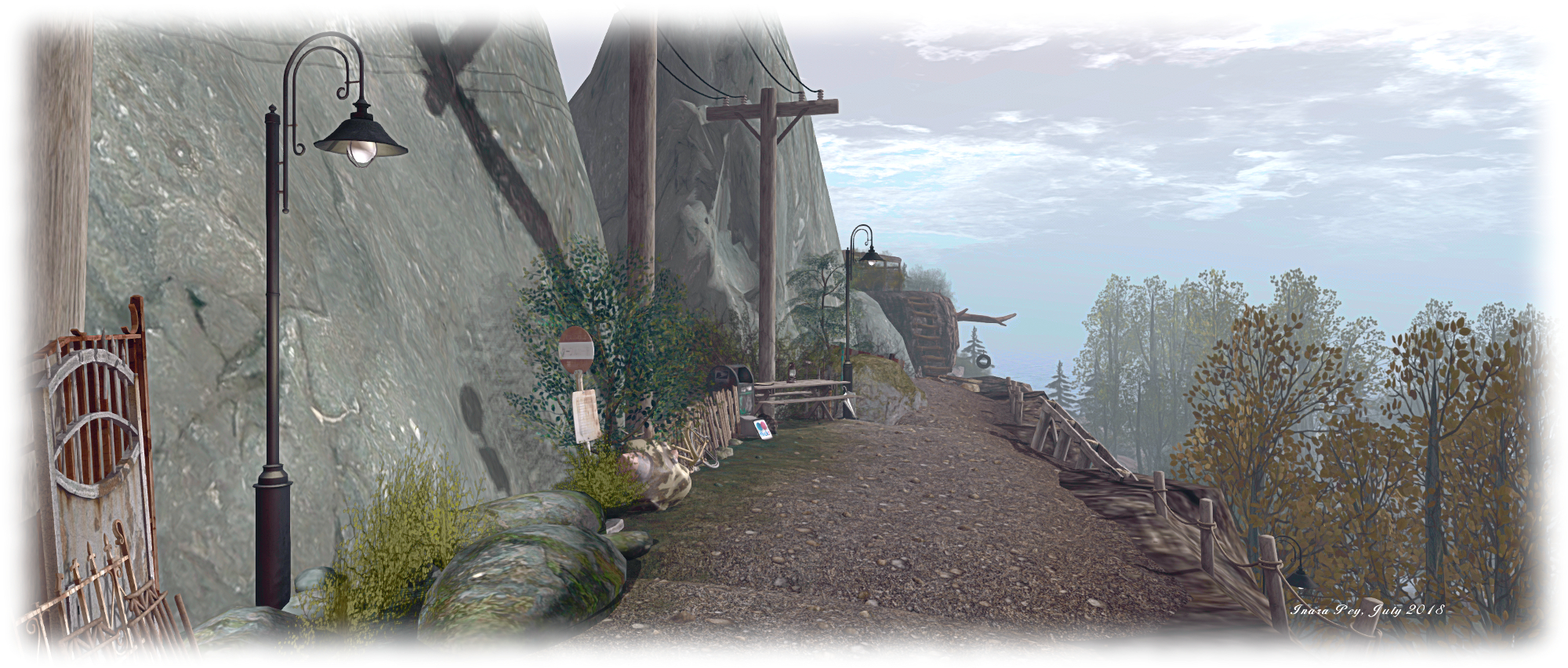
Abandale; Inara Pey, July 2018, on FlickrAbandale

The town’s bar, however, does survive intact. It faces the ruins of the house across what’s left of the main road, but the sign confirming it is open for business may not carry quite the assurance the proprietor likely hopes. Certainly, the detritus of other human habitation before it doesn’t offer a comforting invitation.

Across the narrow channel of water the intrepid explorer can find more signs of former habitation: a long abandoned and broken little fun fair shaded from the sun by a tower of rock, the ruin of an old chapel sitting on the other side of the road and reached via an old track. A second track offers passage up to the hills to where a run-down cabin sits.
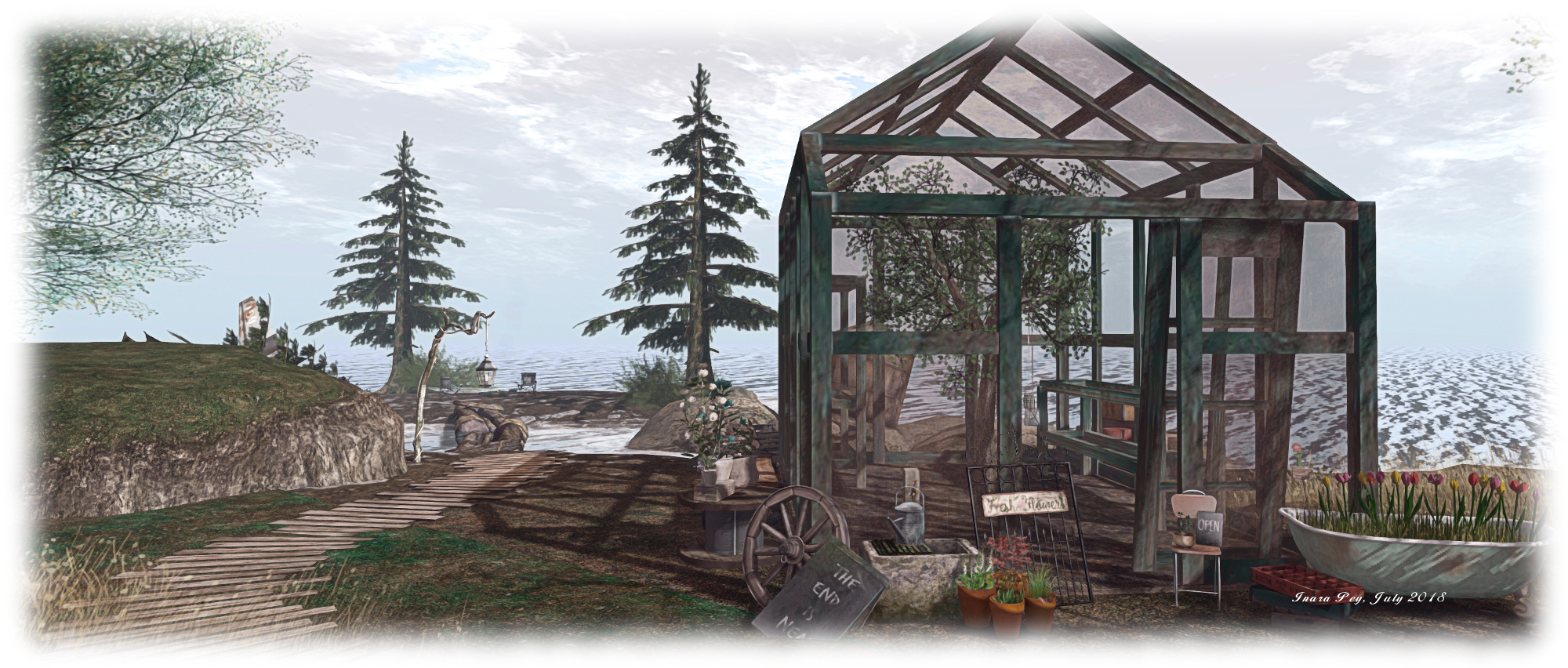
Abandale; Inara Pey, July 2018, on FlickrAbandale

To the west of this, down on the coast, sits a beaches – perhaps the one place that offers an almost pleasant greeting for those who find it; certainly, someone has opted to set-up camp close by and avail themselves of the bar and volleyball. Perhaps whoever it is owners the rather pristine motorbike parked outside the old town’s garage, and they’ve found what’s left of Abandale a cosy enough place to rest from their own travels…

Designed by Dominique Redfield, Abandale occupies half a Homestead region and offers SL visitors something just that little bit different. Poetic licence on how to reach it aside, a visit begins up on the hills marking the parcel’s southern boundary, a switch back path offering a way down to the ruins of the house mentioned above, as a well as presenting a short walk along the cliff-tops to a high placed little wooden snug.
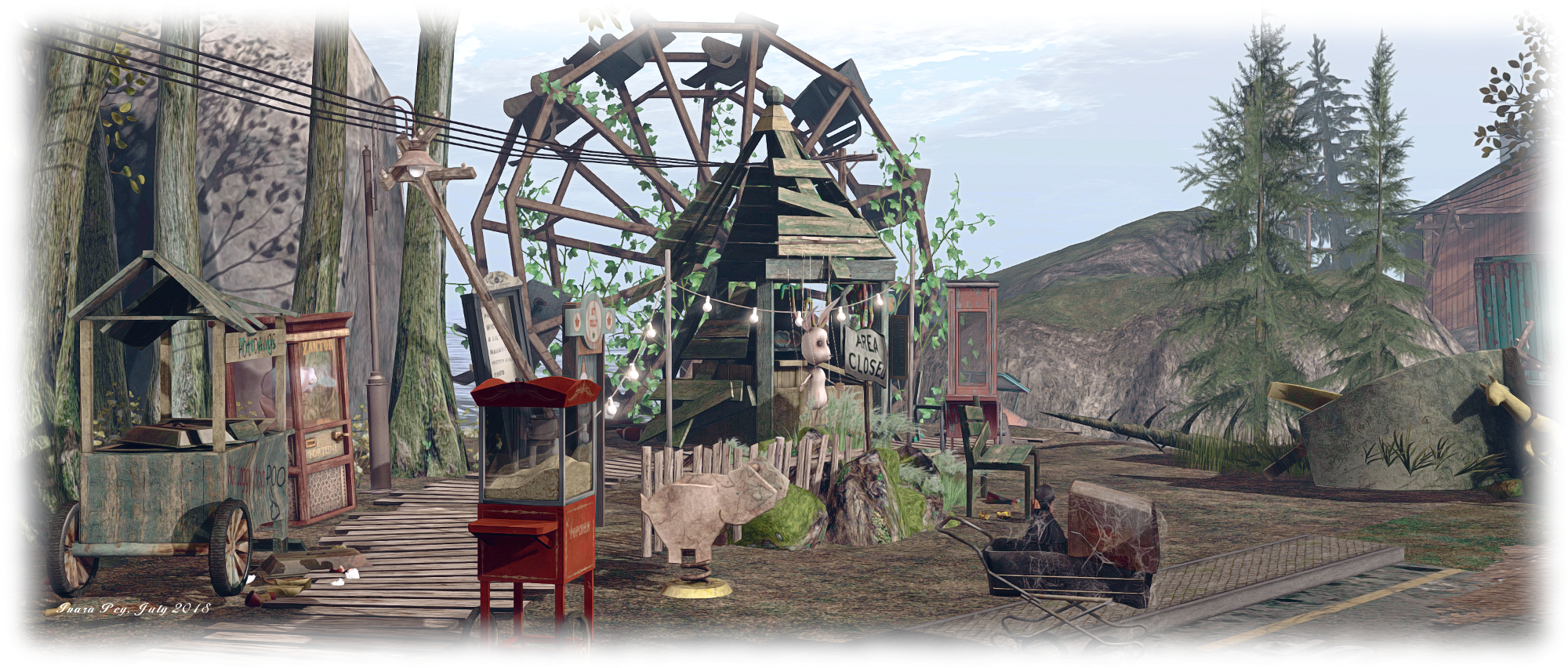
Abandale; Inara Pey, July 2018, on FlickrAbandale

There is a ramshackle, ageing charm to Abandale, with plenty of room to explore and for photography. True, some of the landscaping is a little rough (I’d personally have avoided laying the dirt tracks up the slope to the cabin, or at least worked the land a little more to help blend the edges of the track more with the rocks and shrubs), but there’s nothing here to really spoil the time spent in visiting it.

For those who enjoy atmospheric settings for their photography and who enjoy experimenting with their windlight settings to define a desired result, Abandale offers plenty of scope (and has its own Flickr group). Similarly, those looking for places to sit and relax in a “country grunge” type of setting, will find plenty of such places here as well, from the beaches to the aforementioned cliff-top shelter.

Abandale; Inara Pey, July 2018, on FlickrAbandale

Looking at the new private region and L$ fees

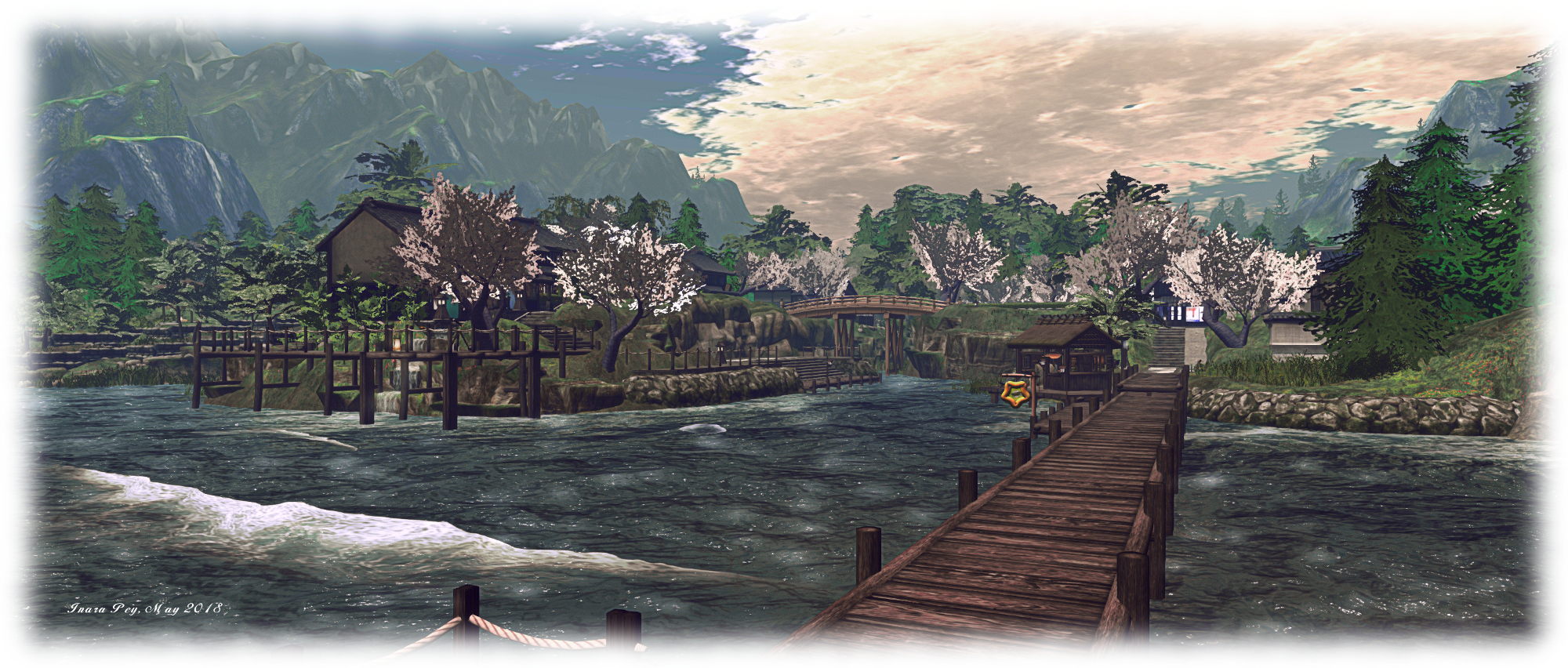
Village of Ahiru; Inara Pey, May 2018, on FlickrPrivate region set-up fees and monthly tier rates are reduced from July 2nd, 2018, together with an increase in L$ purchase fees. Picture:  Village of Ahiru (blog post)

A major goal at the Lab is to “re-balance” the Second Life economy – shifting the onus of their revenue generation away from a heavy reliance on virtual land leasing to distribute it more broadly across all fronts  – land, Premium subscriptions, transaction fees, Marketplace fees, etc. Over the last few years we’ve seen some of this in action:

  • In April 2016, increases were made to all transaction processing fees and Linden Dollar processing fees (raising the latter by 30% to US $0.40 per L$ purchase).
  • In June 2017 increases were made to the maximum fee for processing credit transactions was raised to US $25, and the fee charged per L$ purchase was raised to US $0.60.
  • In November 2017, increases were made to L$ purchase fees (to US $0.99 per transaction) and to fees charged for transferring money via PayPal or Skill from the start of 2018, raising both to 2.5% with no maximum limit on the application of the fee.

Some of these increases were couched as being in part to meet the costs involved in the Lab handling the transactions and ensuring all proper fiscal and legal requirements for money handling are properly met. Doubtless, this was the case – the Lab has invested heavily in matters of compliance. However, it’s also not unfair to say that once the initial expense in performing this work has been recouped, these fee increases enable the Lab to both cover the cost of transaction handling and generate some revenue through such transactions (however modest on the individual transaction it might be).

On the other side of the scale, we’ve seen efforts to make virtual land more attractive – notably through the region buy-down offer of April-September 2016, and more recently the changes to Mainland pricing.

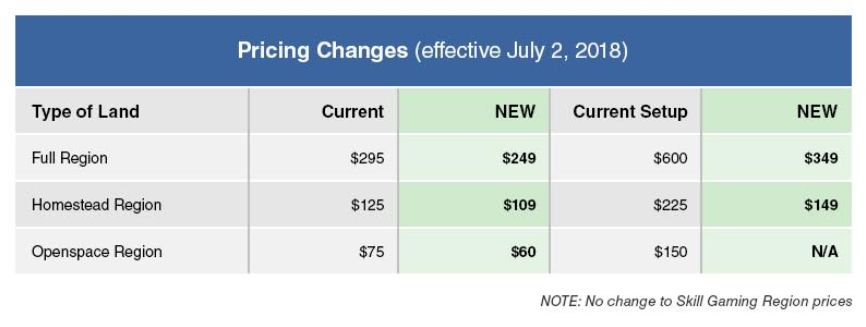
On July 2nd, 2018, the most ambitious change to private region pricing in Second Life came into effect: a reduction of 15% in private region maintenance fees (tier) for all current region types and reductions in the set-up fees for Full and Homestead regions (new OpenSpace (“water”) regions no longer being offered as a product from July 2nd, 2018).

These changes – it should be noted – come with a further increase in Linden Dollar purchase fees, which increase to US $1.49 per transaction.

New Private region pricing structure. Note that as from July 2nd, 2018, new OpenSpace regions will no longer be available as a product, and Linden Dollar purchase fees increase to US $1.49 per transaction

It’s fair to say that any change of this kind, be it in land pricing or transaction fees, can generate heated feedback (witness this forum thread on the 2017 increases). The changes to private region fees have been no exception, with views being expressed via in-world groups, within assorted forums (such as SLU) and even in blog comments. Some have been upset over the L$ transaction fee increase; others  – notably those in the virtual land rental business  – have been upset by the change no extending to grandfathered regions; others apparently don’t see the move as “enough”, protesting that the tier rate should be cut to US $195 (or similar). And there has been a fair amount of reaction to the L$ purchase fee increase.

Obviously, time will reveal the outcome of these changes, but as is my want, I’d pass comment on a few things.

When it comes to the land rental business, it is hard to see why the exclusion of  grandfathered regions is being taken so negatively. For one thing, these are already below the new tier rates, as the Lab states. Further, it is now 18 months since the buy-down offer closed. This should have been enough time to recover the up-front cost of converting regions to grandfathered status (US $600 / Full; US $180 / Homestead), and now leave rental companies in a position to enjoy a modest increase in income from such regions whilst also offering customers using them a degree of lower rent.

Which is pretty much also the opportunity they have with this tier reduction. Frankly, 15% is unlikely to have people leaping in droves to buy Full regions directly from the Lab. But what it might do is once again increase people’s desire to have Homestead regions as private homes. Given that these remain tied to holding at least one Full region, it’s not unfair to say that should it happen, land rental companies can only benefit. And even if the private land market remains relatively flat, such businesses should still be able to lower their rental rates to attract new customers without damaging their existing margins.

So it really is hard to see why some in the land rental business are so put out by grandfathered regions being excluded, or to claim they get “none” of the benefits of this fee reduction.

When it comes to the increase in Linden Dollar transaction fees (which with this increase will have rise by 198.4% since April 2016), the impact will perhaps be harder to gauge, simply because people can offset at least some of the impact by adjusting the amounts of Linden Dollars they purchase in a single pass. Just how much of an offset can be achieved depends on a range of factors – the amount of L$ someone buys in a single pass, how easily they might be able to consolidate purchases, etc. – but this doesn’t deny the fact it is precisely what people have been doing as a result of past increases.

Even so, it will in interesting to see what, if any, impact this has on actual spending in SL – although I suspect that changes to fees elsewhere that have been hinted at (such as with the Marketplace) might have more of a visible impact, if and when they come into effect.

There will always be positives and negatives to just about anything the Lab does. However, “the tier is too damned high!” has long been a mantra within Second Life and while it is “only” a 15% reduction in tier, this is a positive step towards addressing this mantra when it comes to private regions fees (and it’s not unreasonable to assume there might yet be more in the future – although they are unlikely to be even close to appearing over the horizon at this point in time). Similarly, while people are likely to continue to be put out by it, the increase in to the L$ transaction fee is a relatively “fair” move, as it spreads at least some of the burden of revenue generation for the Lab across a much broader section of the SL user base.

2018 viewer release summaries, week #26

Logos representative only and should not be seen as an endorsement / preference / recommendation

Updates for the week ending Sunday, July 1st

This summary is generally published on every Monday, and is a list of SL viewer / client releases (official and TPV) made during the previous week. When reading it, please note:

  • It is based on my Current Viewer Releases Page, a list of all Second Life viewers and clients that are in popular use (and of which I am aware), and which are recognised as adhering to the TPV Policy. This page includes comprehensive links to download pages, blog notes, release notes, etc., as well as links to any / all reviews of specific viewers / clients made within this blog.
  • By its nature, this summary presented here will always be in arrears, please refer to the Current Viewer Release Page for more up-to-date information.
  • Note that test viewers, preview / beta viewers / nightly builds are not recorded in these summaries.

Official LL Viewers

  • Current Release version 5.1.6.516459 and dated June 15th, promoted June 21st – formerly the Pálinka Maintenance Release Candidate – No Change
  • Release channel cohorts (please see my notes on manually installing RC viewer versions if you wish to install any release candidate(s) yourself):
    • No updates.
  • Project viewers:
    • Animesh project viewer updated to version 6.0.0.516979 on June 25th.

LL Viewer Resources

Third-party Viewers

V5-style

V1-style

Mobile / Other Clients

  • No updates.

Additional TPV Resources

Related Links

Space Sunday: asteroids, telescopes and dust

Credit: Mopic/Shutterstock

Saturday, June 30th marked International Asteroid Day, a global event involving researchers, astronomy groups, space agencies and more talking about asteroids  – and the risk some of them present to Earth.

Since 2013, and the Chelyabinsk event which saw a meteor  roughly 20 metres across, caught on film as it broke up high over the Russian town, the tabloid media has seemingly been obsessed with reporting meteors about to collide Earth and wreak havoc.

Fortunately, the vast majority of the estimated 10 million objects which have orbits passing close to Earth – referred to as NEOs, for Near Earth Objects, are unlikely to actually strike our atmosphere or are of a small enough size not to pose a significant threat if they did, despite all the screaming of the tabloids.

A map showing the frequency of small asteroids entering Earth’s atmosphere between 1994 and 2013. The dot sizes are proportional to the optical radiated energy of impacts measured in billions of Joules (GJ) of energy. A total of 556 events are recorded on the map, representing objects ranging in size from 1m to 20m. Credit: NASA’s Near Earth Object (NEO) programme

Which is not to say NEOs don’t pose a potential threat. Not all of the 10 million objects with orbits passing close to, or intersecting, the orbit of Earth have been properly mapped. Take 2018 LA (ZLAF9B2), for example. As I reported at the start of June, this asteroid, some 2 metres across, was only identified a handful of hours before it slammed into Earth’s upper atmosphere over Botswana at approximately 17,000 kilometres per second, to be caught on film as it burnt up. The energetic force of the accompanying explosion has been estimated to have been in the region of 0.3 to 0.5 kilotons (300 to 500 tonnes of TNT).

To offer a couple of quick comparisons with this event:

  • The 2013 Chelyabinsk superbolide (roughly 10 times the size of 2018 LA (ZLAF9B2) disintegrated at an altitude of around at 29.7 km at a velocity between 60,000-69,000 km/h, producing an energy release equivalent to 400-500 kilotons (400,000-500,000 tonnes of TNT). This was enough to blow out windows and send 1,491 people to hospital with injuries, including several dozen temporarily blinded by the flash of the explosion. The first 32 seconds of the video below convey something of the force of that event.

  • In June 1908 a cometary fragment estimated between 60 and 190 metres cross disintegrated some 5 to 10 km above Tunguska, Siberia. This generated an estimated downward explosive force of between 3 to 5 megatons and an overall force of somewhere between 10 to 15 megatons (again for comparison, all the bombs dropped by allied forces in World War 2 amounted to around 3.4 megatons of combined explosive force). This is believed to have generated a shock wave measuring 5.0 on the Richter scale, flattening an estimated 80 million trees covering an area of 2,150 square kilometres. Were it to occur today, such an event would devastate a large city.

There are two sobering points with these two events. The first is that astronomers estimate only about one-third (1600) of objects the size of the Tunguska event meteoroid which might be among that 10 million NEOs have so far been mapped. The second is that many NEOs can remain “hidden” from our view. the Chelyabinsk superbolide, for example passed unseen as the Sun completely obscured its approach to Earth.

There have been several proposals for trying to deal with the potential risk of a PHA – Potentially Hazardous Asteroid – impact over the years. One currently in development is the NASA / Applied Physics Laboratory (APL) Double Asteroid Redirection Test (DART) mission intended to demonstrate the kinetic effects of crashing an impactor spacecraft into an asteroid for planetary defence purposes.

The target for this mission is rather interesting. DART will be launched on an intercept with 65803 Didymos, an asteroid around 750 metres across – but this will not be the vehicle’s target. That honour goes to a much smaller asteroid – around 170 metres across (so in the size range of the Tunguska object) – orbiting 65803 Didymos and informally referred to as “Didymoon”.

Originally, DART was to be a part of a joint NASA/APL and European Space Agency effort, with ESA supplying a vehicle called the Asteroid Intercept Mission (AIM). This would have been launched ahead of DART on a trajectory that would place it in orbit around the 65803 Didymos / “Didymoon” pairing, allowing it to track / guide DART to its target and record the entire impact and its aftermath.

AIM never received funding, leaving the NASA/APL mission, which is currently scheduled for launch in 2021 and will intercept “Didymoon” in 2022. However, in the last few weeks, ESA has announced a revised mission to 65803 Didymos called Hera. Like AIM, it is designed to orbit the asteroid and is moon, and a call has been made to combine it with DART under a new joint mission called Asteroid Impact and Deflection Assessment (AIDA).

This would require DART to be delayed for a number of years to give ESA time to obtain approval for Hera and design, build and launch the craft – so the intercept would not take place until 2026. While this is a delay, it would mean that scientists would be able to better characterise “Didymoon” ahead of DART’s arrival, and witness the impact and its aftermath in real-time.

The original DART / AIM mission – to study the use of kinetic vehicles to divert an asteroid – now potentially superseded by the DART / Hera mission. Credit: NASA / APL / ESA

It’s not clear whether or not DART will be delayed. If it isn’t, then it has been proposed DART carries a camera equipped cubesat similar to those AIM would have used in support of its mission. This could then be separated from DART ahead of the impact so it could image the event as it flies by “Didymoon”. The Hera mission would then arrive a few years after the impact and assess the outcome, including imaging the impact crater on the asteroid and changes to its orbit and its rotation, which can help scientists determine how efficient the impact was in transferring its energy into “Didymoon”.

Continue reading “Space Sunday: asteroids, telescopes and dust”

Murders, mystery and myths in Second Life

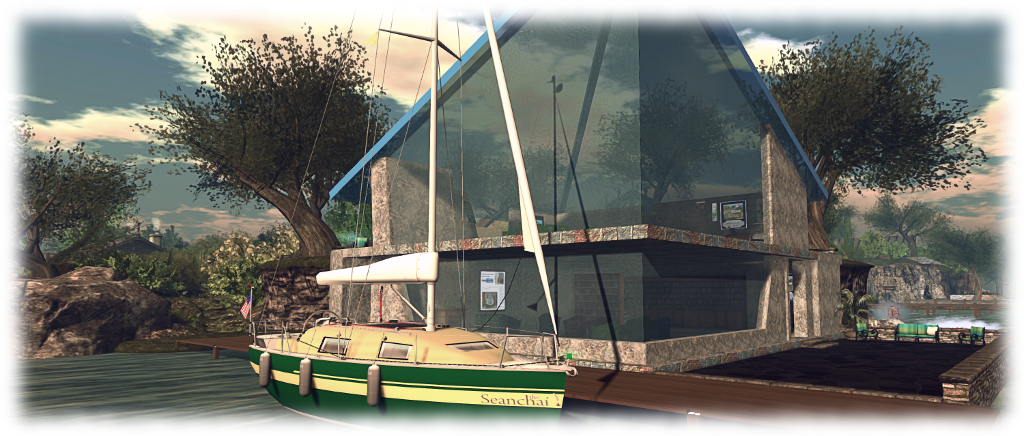
Seanchai Library

It’s time to highlight another week of storytelling in Voice by the staff and volunteers at the Seanchai Library. As always, all times SLT, and events are held at the Library’s home at Holly Kai Park, unless otherwise indicated.

Sunday, July 1st 13:30: Tea-Time at Baker Street

Caledonia Skytower, Kayden OConnell and Corwyn Allen continue with a Seanchai favourite: Tea-time at Baker Street. This time they are going right back to the roots of the legend, and the case which first introduced the world to Doctor John Watson and the renowned Consulting Detective, Mr. Sherlock Holmes.

study-in-scarletA Study in Scarlet was written in 1886 as a full-length novel by Sir Arthur Conan Doyle and published the following year. It is actually one of only four novel-length stories Conan Doyle penned about Holmes and Watson in the original canon (the remaining 56 tales of their adventures are all short stories). As it was the first time the two had appeared in print, part of the story was used to establish each of them, and how they met.

It is 1887, and Doctor John Watson, invalided out of the British Army after being wounded in the Battle of Maiwand during the Second Anglo-Afghan War (1878-1880), has returned to London where he is seeking accommodation. After bumping into an old friend, Watson finds himself being taken to St. Bart’s Hospital, where he is introduced to a stranger carrying out a laboratory experiment. On shaking Watson’s hand, Sherlock Holmes immediately perceives that he has recently returned from Afghanistan, and thus Watson first experiences Holmes’ remarkable deductive abilities – although quite how Holmes came to his conclusion remains a mystery. After a short conversation, he agrees to join Holmes in moving into a flat (apartment) at 221B Baker Street, where they’ll split the rent.

In the story, it is actually several weeks before Watson learns of Holmes’ rather unusual chosen profession. When told, he remains initially dubious until Holmes gives a practical demonstration of his powers of observation and deduction, using a messenger from Scotland Yard as his subject. The messenger has come with a request for Holmes’ assistance; Holmes is at first reluctant to heed the call, but Watson urges him otherwise. So it is that they set out on their first adventure together, one involving poison, a double murder in London and a bitter tale of love, loss and revenge from America.

Join Seanchai for a special 90-minute reading of the final instalment of A Study In Scarlet.

Monday, July 2nd 19:00: Protector

Phssthpok the Pak had been travelling for most of his thirty-two thousand years. His mission: save, develop, and protect the group of Pak breeders sent out into space some two and a half million years previously.

Brennan was a Belter, the product of a fiercely independent, somewhat anarchic society living in, on, and around an outer asteroid belt. The Belters were rebels, one and all, and Brennan was a smuggler. The Belt worlds had been tracking the Pak ship for days — Brennan figured to meet that ship first…

He was never seen again. At least not by those alive at the time.

Join Gyro Muggins as he reads Larry Niven’s engaging tale of humanity’s past – and future.

Tuesday, July 3rd 1900: Walt Longmire

Join Kayden OConnell as he reads more from Craig Johnson’s tales of Sheriff Walt Longmire.

Wednesday, July 4th: No Session.

It’s Independence Day in the United States and Seanchai will be at home celebrating with friends and family.

Thursday, July 5th 19:00: Monsters and Myths  – Procrustes

With Shandon Loring. Also presented in Kitely (hop://grid.kitely.com:8002/Seanchai/144/129/29).

Coming Soon!

July 8th: Tea-Time on the Orient Express

Seanchai Library and friends embark on a literary journey through one of Agatha Christie’s most notable adventures:  Murder on the Orient Express.

Ride aboard the greatest train journey of them all!

Wednesday July 11th: 11:00: Fireside Tales

A new series in a new Seanchai setting – more on this and the Orient Express next week!


Please check with the Seanchai Library’s blog for updates and for additions or changes to the week’s schedule.

The current charity is Feed a Smile.