Second Life: major private region pricing restructure announced

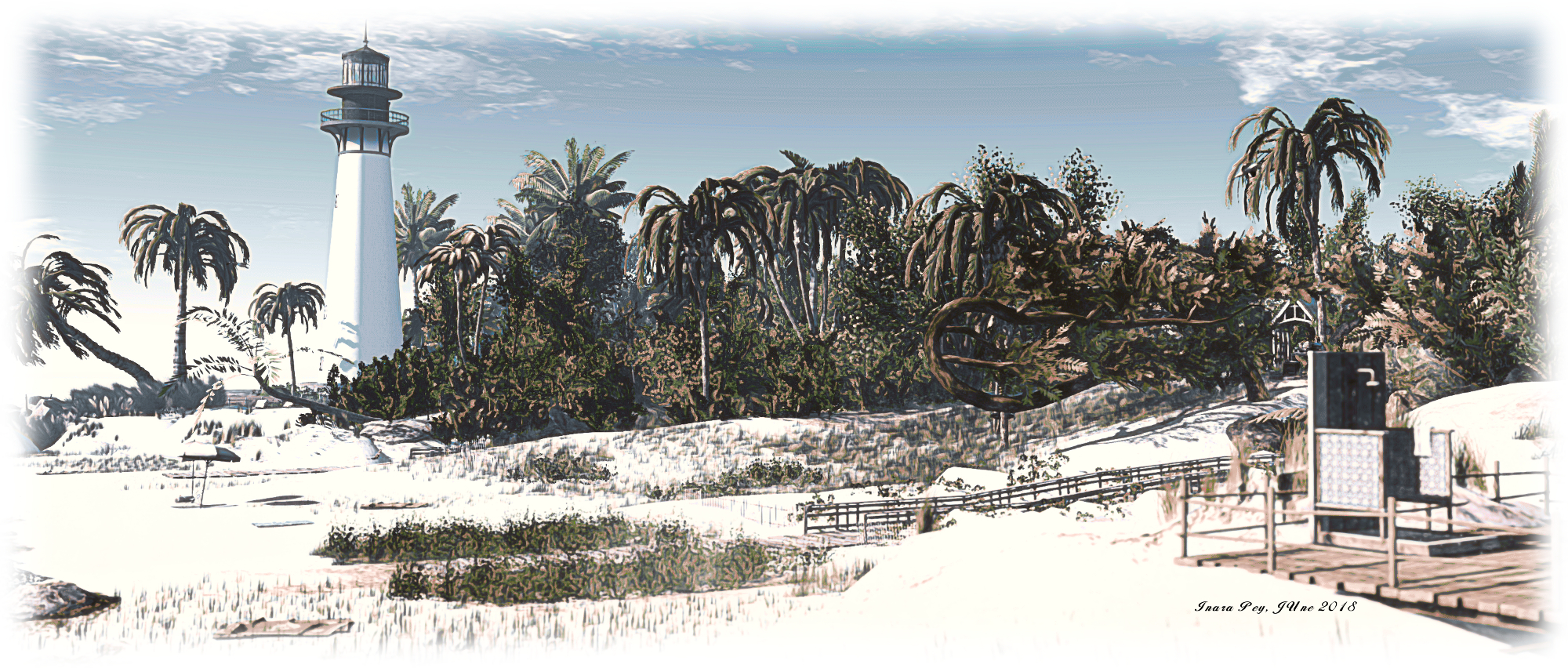
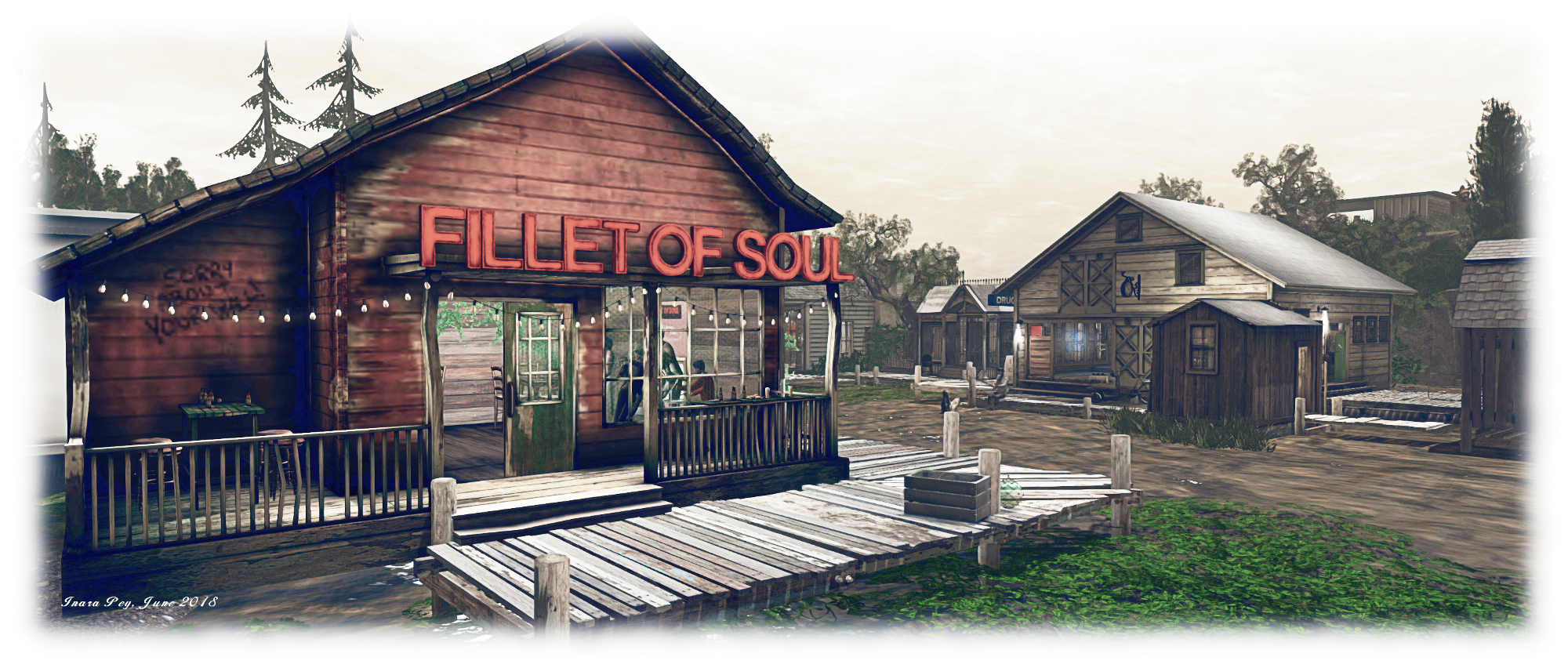
Private region set-up fees and monthly tier rates will be reduced from July 2nd, 2018 – see below (region pictured: Isle of Mayblog post

Updated to include a quote from Ebbe Altberg

On Wednesday, June 20th, while speaking at the Meet the Lindens event, Linden Lab, and a a part of the SL15B celebrations, CEO Ebbe Altberg made a major announcement concerning private region maintenance fees (aka tier).

I’ve been saying for quite a while now that I think the balance between what it cost to have land versus what it costs to transact or buy and sell in the economy is a little off-kilter. Land is quite expensive but selling things in the world is quite cheap, comparatively speaking. So I a basically fell we have fairly high real estate taes but very low consumption tax. so we’re trying to adjust this so that it’s better. That was part of the Mainland price reduction, and today I can also announce we’re going to lower the cost of private estates!

Ebbe Altberg, Linden Lab CEO speaking at SL15B during his Meet The Lindens session.

As from July 2nd, 2018, private region tier will be reduced by 15% for full and Homestead regions. In addition, the one-time set-up fee applicable to Full and Homestead regions is being reduced.

This means that after July 2nd, 2018, private region set-up fees and monthly tier rate will be as follows:
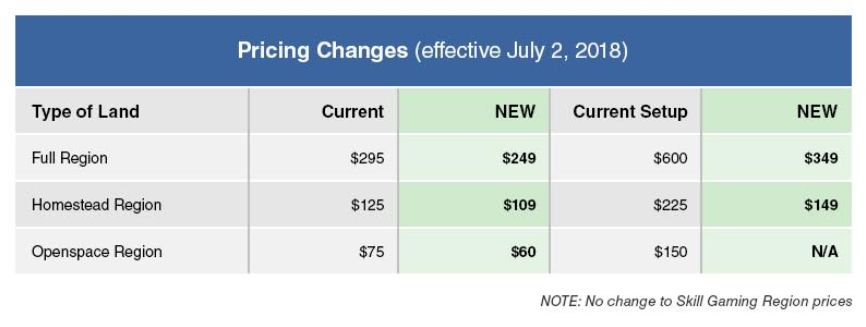
New Private region pricing structure. Note that as from July 2nd, 2018, new OpenSpace regions will not longer be available as a product (see below for more). Table courtesy of Linden Lab. Remember set-up fees include the first month’s tier

There are some caveats to this restructuring:

  • Skill Gaming regions are not included in this restructuring.
  • This reduction does not include grandfathered  / “bought down” regions as they are already priced well below these new rates.
  • From July 2nd, the OpenSpace (“water”) class of region will no longer be offered as a product – however, existing OpenSpace regions already in use on the grid will continue to be supported, and will be subject to the tier discount.
  • Education/Nonprofit (EDU/NP) discounted full islands will be re-priced to maintain their 50% discount off the regularly priced full islands, with the new  tier rate of US $124.50 applying at the start of that island’s next invoiced billing term.

Linden Dollar Purchase Fee Increase

As noted above, Ebbe has previously indicated (see here for example), Linden Lab is attempting to re-balance how the company generates revenue through the Second Life platform to help reduce region tier pricing. This is being done by increases in fees charged elsewhere within the service.

Thus to help offset the revenue loss resulting from this reduction in private region fees, Ebbe also announced that the cost to buy Linden Dollars will be increasing to US $1.49 per transaction (compared to the current rate of US $0.99 cents per transaction).

Feedback

Over the last few years we’ve seen genuine efforts on the Lab’s part to try to ease the burden of tier for region holders.

  • In 2016, there was the region buy-down offer, which allowed private region holders to grandfather their regions for a one-time fee. This reduced the monthly cost of Full regions to US $195, and Homestead region to US $95.
    •   As noted above, these regions are excluded from the 15% tier-rate reduction.
  • In March of 2018, the Lab  reduced monthly mainland fees by 10%, while also doubling the amount of tier-free land available to Premium members (from 512 sq metres to 1024 sq metres).
  • (Note I’m excluding the 2011 Land Sale from this list, as it was a long time ago, and something of a different strategy compared to trying to lower tier costs.)

Both of these moves were very positively received by users, and given that requests to reduce tier have long been made, I’ve little doubt this announcement will be equally well-received.

One thing it should do is confirm the Lab is committed to trying to improve Second Life for users – not only in technical terms, but also in making the platform’s revenue generation something that is more evenly spread among all users.

Tyche’s tweet on the relative fall-off in region losses between 2018 and 2017

Even so, this is a bold move, and one that can only be taken to mean that recent moves to pivot some of the revenue generation away from land (e.g. through the transaction fee increases (March 2016, June 2017 and November 2017), possibly coupled with more recent uptake of premium user subscriptions, has given the Lab confidence that they can reasonably offset revenue loss from the tier reduction through other channels.

Certainly, it shows how far things have come since 2013, when it was hard to see any tier reduction not hurting the Lab’s bottom unless alternative revenue sources could be reliably built-up.

With Tyche Shepherd of Grid Survey fame reporting that the rate of decline in private regions continues to ease, it will be interesting to see how this announcement affects the overall interest among those wishing to acquire land of their own, either directly through the Lab or through any of the major land realtor operations in Second Life.

In the meantime, you can read the full text of the Lab’s announcement here.

My thanks to Xiola and Brett Linden for their assistance with this article.


SL Pride 2018: a Second Life community event

Courtesy of SL Pride

I’m a little late in getting to this – so my apologies to the organisers.

SL Pride, the event celebrating diversity and focusing on Second Life’s LGBTQ community is currently in progress in-world. Featuring shopping, art, music and dancing, the event will remain open through until 23:00 SLT on Sunday, June 24th, 2018.

The theme for this year’s event is This Is Me, This is Us, a celebration of community, and also of solidarity – at least one of the billboards in the region includes a display commemorating those from the LGBTQ community who lost their lives in the 2016 Pulse nightclub shooting.

SL Pride 2018 shopping, art and entertainment area

A full schedule of entertainment is available on the event website, as a full list of sponsors and participating merchants.   Note that while the entertainment schedule opens in List view, for ease of reference, you can change it to a Day view via the drop-down at the top right of the schedule page.

In addition, the website also supports a Get Social option, which allows people to interact with one another. Those joining it can create extended profiles, upload profile pictures, join an activity stream (similar to Facebook), connect with friends, private message one another, and so on. Click the Get Social! in the website’s menu bar to get started.

SL Pride 2018: park

For 2018, SL Pride is raising money for The Trevor Project. Founded in the United States by Peggy Rajski, Randy Stone and James Lecesne, the creators of the 1994 short film Trevor, the stated goals of the project are to provide crisis intervention and suicide prevention services for Lesbian, Gay, Bisexual, Transgender, and Questioning  young people ages 13–24, as well as to offer guidance and resources to parents and educators in order to foster safe, accepting, and inclusive environments for all youth, at home and at school.

The Trevor Project offers a number of services, including:

  • The Trevor Lifeline – the only nationwide, around-the-clock crisis and suicide prevention helpline for LGBTQ youth in America.
  • Ask Trevor – an on-line non-time-sensitive question-and-answer resource for young people with questions surrounding sexual orientation and gender identity.
  • TrevorChat – a free, confidential, live and secure on-line messaging service.
  • TrevorSpace – an on-line social networking community for LGBTQ+ youth ages 13 through 24.
  • Lifeguard Workshop Programme – a school workshop programme using a structured, age-appropriate curriculum to address topics around sexuality, gender identity, the impacts of language and behaviour, and what it means for young people to feel different.
  • The Youth Advisory Council – a liaison between youth nationwide in the United States and the project on issues surrounding suicide, sexuality and gender identity.
  • The Palette Fund Internship Programme – providing five internships for young LGBTQ people at the Project’s Los Angeles and New York City offices.

Donations to the Trevor Project can be made via the kiosks located around the SL Pride region.

SLurl and Links

2018 SL UG updates #25/1: Simulator User Group meeting – Animesh

Cape Florida Lighthouse and Park; Inara Pey, June 2018, on FlickrCape Florida Lighthouse and Parkblog post

The majority of the following notes come from the Simulator User Group meeting of Tuesday, June 19th, 2018.

Sever Deployments

As always, please refer to the server deployment thread for the latest information.

  • On Tuesday, June 19th, the Main (SLS) channel was updated with server maintenance package 18#18.06.06.516064, previously deployed to the RC channels. This release comprises:
    • Additional work to support localised Abuse Report categories.
    • Improvements to object updates as part of ongoing performance improvements.
    • Removal of the logging of a trivial message.
    • Internal fixes.
  • On Wednesday, June 20th, the release candidate channels should be updated as follows:
    • LeTigre and Magnum should receive server maintenance package 18#18.06.14.516450, comprising internal fixes and logging improvements.
    • BlueSteel should received server release 18#18.06.14.516474, containing server-side support for Animesh.

Animesh Deployment

The deployment of Animesh support to the BlueSteel release candidate channel marks the first phase in testing Animesh on the Main grid. For those not up-to-speed with Animesh, the goal of this project is to provide a means of animating rigged mesh objects using the avatar skeleton, in whole or in part, to provide things like independently moveable pets / creatures, and animated scenery features via scripted animation. It involves both viewer and server-side changes.

The viewer updates required to see / use Animesh are currently only available in a project viewer, and are still undergoing update and improvement. As such, this initial deployment of Animesh should be regarded as experimental, and may see further viewer / server-side changes. TPVs are – as usual with project viewers – encouraged not to adopt the viewer code for Animesh until it reaches release candidate status.

So Animesh will be enabled on BlueSteel. You have to be running the Animesh project viewer and be in one of those regions. Server support for animesh involves adding a new message and some new LSL functions. [The] viewer will go through the usual cycle of RC viewer and then release, [and I] don’t know exact timing yet. We have a content creators meeting on Thursdays. Talking about it today because it’s about to go to part of Agni.

Since it will now be possible to have Animesh content on Agni, that also means you can try to rez it in non-Animesh regions. If you do that, (a) content won’t look right because the server won’t be sending you the appropriate messages, and (b) you’ll get script errors because the region doesn’t like the new LSL calls.

Vir Linden discussing Animesh at the Simulator UG meeting, Tuesday, June 19th.

At the time of writing the Animesh project viewer was at version 5.1.6.516525, dated June 18th, 2018.

As well as TPVs being asked not to adopt the current Animesh viewer code, content creators are being encouraged not to start marketing / selling Animesh items at this point in time.

For the sake of customers, it’s probably NOT a good idea to start offering any products that are no-mod or such on the marketplace. I know there will be really cool things available soon, but with the limited servers and viewers and confusion that will cause, please wait a bit.

Simon Linden on selling Animesh content

Animesh Resources

You can find further information on Animesh via the following resources.

Furthermore, I provide regular updates on the Animesh project via my Content Creation User Group updates, so you can keep up with Animesh development through these.

SL Viewer

The Animesh viewer updates to version 5.1.6.516525, on June 18th. Otherwise the remaining viewers in the current SL pipelines were, at the time of writing, as follows:

  • Current Release version 5.1.5.515811, dated May 31, promoted June 1 – formerly the Love Me Render Release Candidate – No Change.
  • Release channel cohorts (please see my notes on manually installing RC viewer versions if you wish to install any release candidate(s) yourself):
    • Pálinka Maintenance RC viewer, 5.1.6.516459, dated June 15.
    • 32-bit Windows Unloop RC viewer, version 5.1.6.515965, dated June 5 – specifically for 32-bit Windows users caught in the 64-bit install loop (see here for more). Otherwise, the viewer is functionally identical to release version 5.1.5.515811.
  • Project viewers:
  • Linux Spur viewer, version 5.0.9.329906, dated November 17, 2017 and promoted to release status 29 November – offered pending a Linux version of the Alex Ivy viewer code.
  • Obsolete platform viewer, version 3.7.28.300847, May 8, 2015 – provided for users on Windows XP and OS X versions below 10.7. This viewer will remain available for as long as reasonable, but will not be updated with new features or bug fixes.

Environment Enhancement Project

This is a set of environmental enhancements, including:

  • The ability to define the environment (sky, sun, moon, clouds, water settings) at the parcel level.
  • New environment asset types (Sky, Water, Days – the latter comprising multiple Sky and Water) that can be stored in inventory and traded through the Marketplace / exchanged with others.
  • Experience-based environment functions
  • An extended day cycle (e.g a 24/7 cycle) and extended environmental parameters.
  • There are no EEP parameters for manipulating the SL wind.

This work involves simulator and viewer changes, and includes some infrastructure updates.  The latter include a new build of the inventory service in order to handle the new windlight assets. At the SUG meeting, Oz indicated this build in now with the Lab’s QA team.

Also, as well as supporting the new EEP, the simulator will provide the old style settings values in the same way it does now for any viewer that lacks support for the new windlight settings objects.

Cloud Move

Not a lot to report, other than Oz indicated there have been some early experiments with placing some some inventory databases  – those supporting Lab staff avatars – into the cloud, and things seem to be working. No end users have heir inventory in the cloud as yet, but when – in time – things do start to expand to include user-related data, it should be completely transparent, with users unable to tell if their inventory is being managed on the back-end by hadrware at the Lab’s data centre or via cloud-based infrastructure.

A SL15B video message from Ebbe Altberg

Courtesy of Linden Lab

On Tuesday, June 19th, the Lab continued their blog posts about SL15B with the publication of a short video interview / message from Linden Lab CEO, Ebbe Altberg, talking about Second Life, its longevity and more (embedded below).

Ebbe has been discussing Second Life  – and Sansar – a lot over the last few weeks with various media sources, and the blog post on the video also includes a link to a chat he recently had with Games Wisdom (June 15th).

In May, Ebbe sat down with Saffia Widdershins of Designing Worlds for a lengthy chat on all things Second Life and Sansar, and he’ll be doing so again on Wednesday, June 20th, as a part of the Meet The Lindens Series of events. You can catch him at the SL15B auditorium at 14:00 SLT.

In the meantime, if you want to catch-up with Ebbe’s Designing World chat, you can do so via the video, or if you prefer, via my transcript of the conversation, which provides a linked breakdown of topics discussed, as will as Ebbe’s comments and thoughts.

I’ll have coverage of the SL15B Meet The Lindens events available in this pages in due course.

A touch of Live and Let Die in Second Life

San Monique; Inara Pey, June 2018, on FlickrSan Monique – click any image for full size

Update: San Monique has closed. SLurls have therefore been removed from this article.

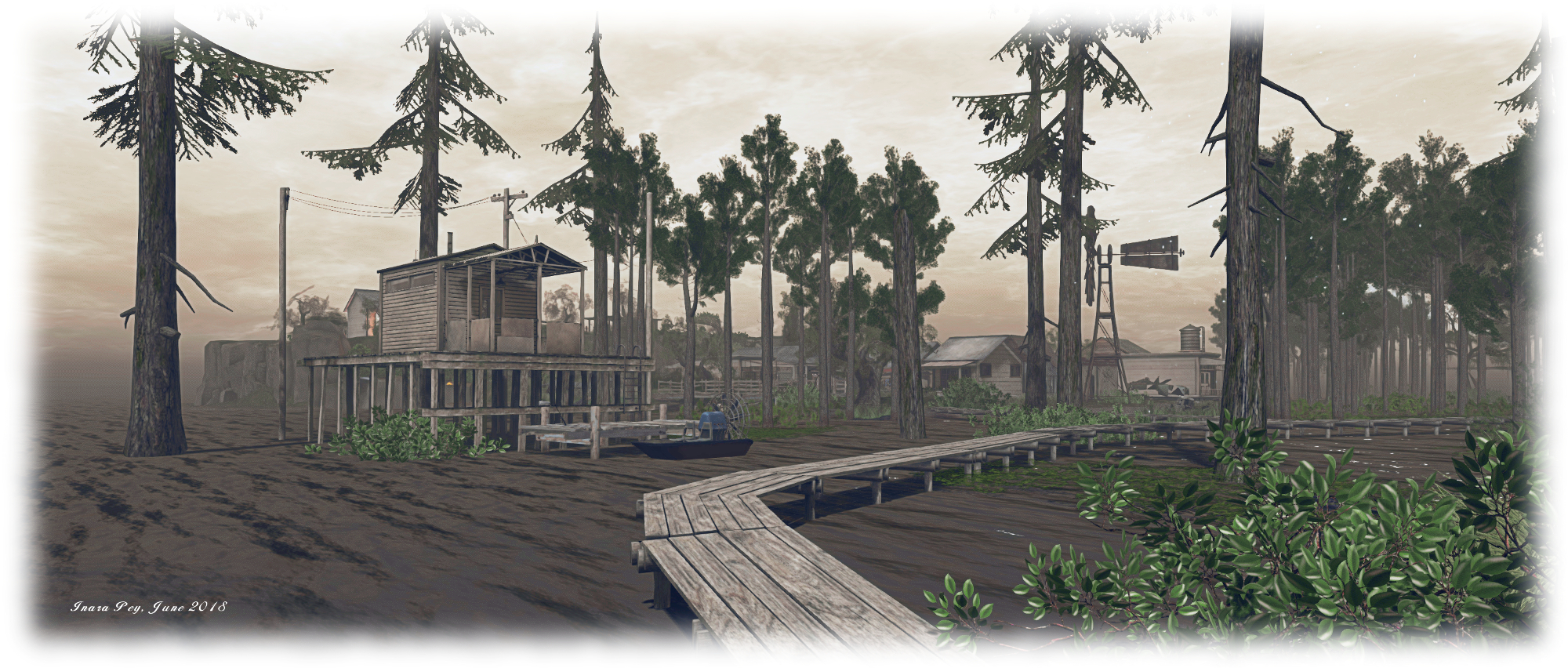
“I’m not really a big Bond fan, just that film and the locations in it,” Zakk Lusch informed me ahead of the official opening of San Monique, his latest region design, developed with They Wray DoneAway (They Ellisson). The region takes as its inspiration the first Roger Moore film in the Bond franchise, Live And Let Die (1973), to which Zakk alludes in his comment. He continues, “I just thought I would be fun to try a create something like this, as Bayou type region can be a challenge to find stuff to use. There are loads of little fun things as you look around.”

These little things include Zakk and They themselves who, for the opening, had adopted looks taken from the film – think Baron Samedi and you’ll get the picture – but there are more to be found when exploring this homestead region. However, it would be a mistake to consider it a representation of any single aspect of the film. As noted, the region is very much inspired by Live and Let Die, and thus is an amalgam of interpretations of settings, themes and ideas from the film.

San Monique; Inara Pey, June 2018, on FlickrSan Monique

An example of this is the region’s name and look. While the name may come from the fictional the Caribbean island-nation of the film, the overall look is very much that of the bayou region of Louisiana, – and the Bayou Des Allemands featured in a boat chase during the film.

Visits begin in the south, where one of only two upland area rise from the waters of the region. A flat-topped table of rock, this is home to the welcome area and landing point, a paved footpath and steps leading down to the lowlands of the region. It is along this path the another motif for the film can be found in the form of the fortune teller’s booth, echoing Solitaire’s harnessing of the Obeah to discern the future.

The second upland area is a small knuckle of a hill on which is perched a small wooden chapel. Within and around this are further echoes of the film – notably the coffin and the snakes and the Samedi-like skull and top hat sitting on a grave.

San Monique; Inara Pey, June 2018, on FlickrSan Monique

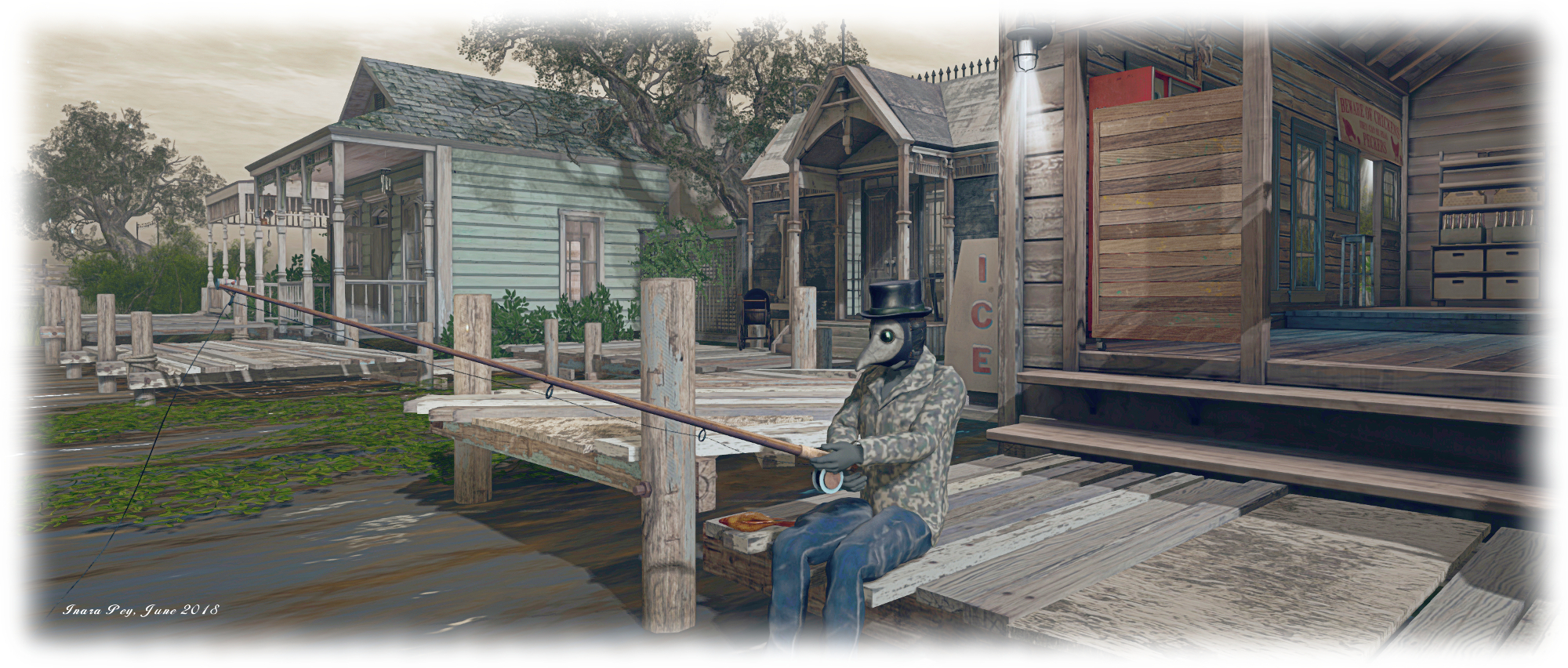
The rest of the region is given over to a bayou-style hamlet: wooden buildings fronted by board walks built out over the water. Here again are more references to the film – a tarot reader’s sign, the mask worn by the chap fishing off of one of the board walks, and – if you walk out and around the buildings – a small club taking its name from Mr. Big’s chain of eateries – the Fillet of Soul.

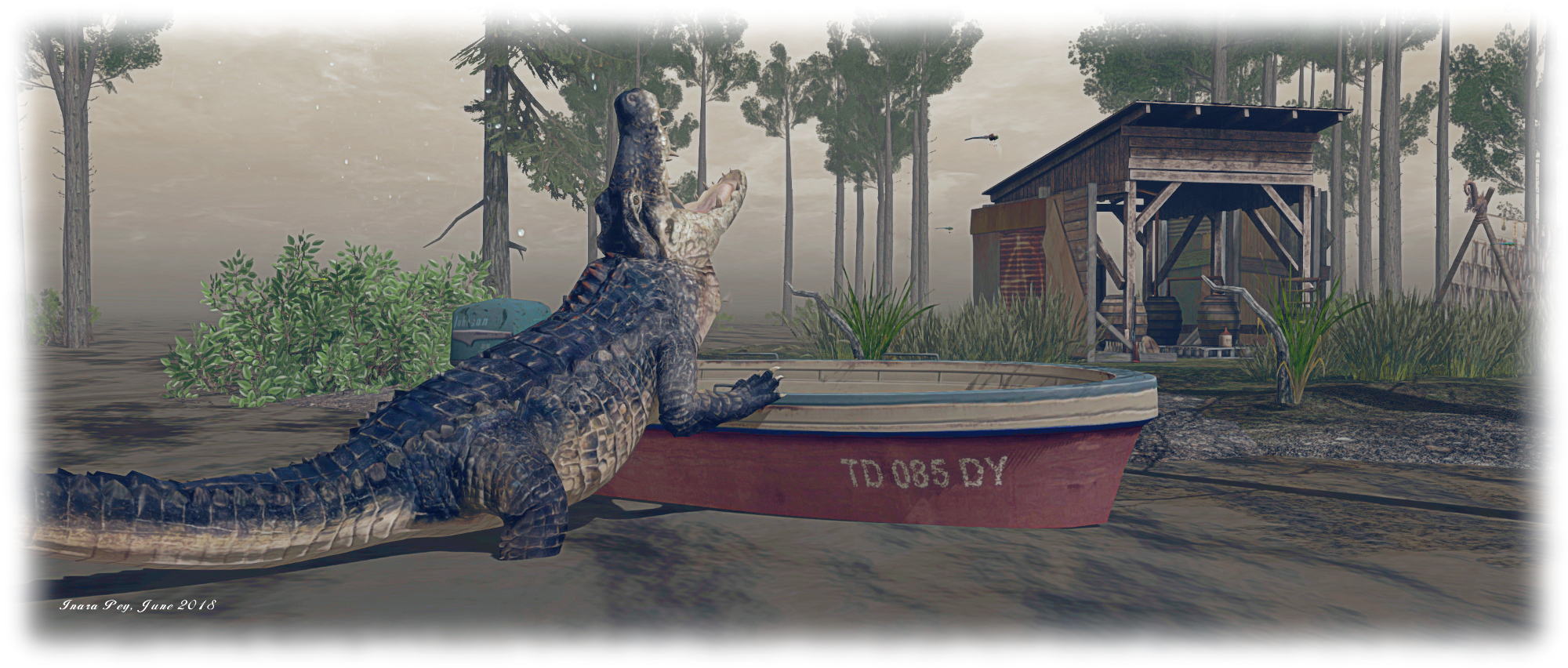
Given this is a bayou setting, the presence of crocodiles shouldn’t be that surprising. But even these echo the film – remember the crocodile farm on the island of San Monique? Thus even the reptiles offer a cinematic link to Bond’s 1973 adventures.

San Monique; Inara Pey, June 2018, on FlickrSan Monique

That said, there are some motifs from Live And Let Die that might be considered “missing” – no poppy fields, for example. But again, this is a Bayou setting, and not a reproduction of San Monique. So instead, it offers more a bayou look and feel: broad walks wind over the shallow waters, crocodiles lurk, an airboat awaits its owner – there’s even an illicit still hidden in a shed out on an island shoal among the bayou’s trees.

All of this makes San Monique a visit of a different kind; those who enjoy Roger Moore’s first outing as the eponymous British secret agent will likely enjoy discovering all the little nods to the film. Those who enjoy visiting, exploring and photographing regions in Second Life will find San Monique an engaging visit – and photos taken in the region can be submitted to its associated Flickr group.

San Monique; Inara Pey, June 2018, on FlickrSan Monique

As always, should you enjoy a visit, please consider making a donation at the landing point to help with the region’s continued presence. I’d like to extend thanks from Caitlyn and I to Zakk and They for the invitation to visit San Monique.

SLurl Details

  • San Monique (Tumbleweed, rated: Moderate)

Salt: an immersive arts degustation in Second Life

Salt

Salt is an immersive arts degustation. I’ve quite deliberately misappropriated the term ‘degustation’ [the careful, appreciative tasting of various foods, generally taken in good company] as this imparted itself as an ideal transition, because each segment-course is a unique work of its own volition.

Eliza Weirwight, discussing Salt

Salt is the title of the immersive installation by Eliza Weirwight, which formally opened over the weekend of June 16th and 17th, 2018. In terms of her non-commercial work, Eliza is perhaps best known for developing installations that reflect issues that concern her. This was certainly the case when I first encountered her work through her 2013 piece 35 Elephants, which you can read about in my article here.

This embodiment of matters that concern and / or have influenced Eliza are very much at the heart of Salt which, as Eliza notes in her introduction (quoted above), stands not as a single installation per se, but as a collection of scenes or elements or vignettes – call them what you will – which stand as pieces in and of themselves, but which all are drawn together via subtle threads of thought and outlook.

I will say from the top that this is not an easy installation to interpret. There is a deep layering of themes, whether they are in support of LGBTQ rights or statements speaking out against violence or inequality. In particular, there is a strong commentary on matter such as the objectification of women, gender-based violence, sexual predation, discrimination, hatred and on the state of “western” society as a whole which some may well find discomfiting. But so too is the installation richly emotive and evocative.

Salt

To define Salt, it is necessary to provide a little background information: while it is itself a new installation in and of itself, Salt has been a work gestating in thought and ideas for some time, as Eliza explains:

I was asked to produce a piece for One Billion Rising [Fourth Position]. It was eight little segments addressing things that were concerning to me … Some of the topics had such gravity, I refused to see them as disposable, and I had this idea bouncing around my head for a few years that I want to do this big thing, so I’ve woven a lot of that original work into Salt, because just about everything in this work matters to me. Some of it is my stories, and some of it is other people’s stories

Eliza Weirwight, discussing the origins of Salt

The “other people’s” stories Eliza references encompasses all those who have faced prejudice and / or hatred of any kind, be it based on gender, race, colour, sexual orientation or sexual predation. Within some of these issues she has drawn directly on the lives of others – notably Marilyn Monroe and  Phan Thi Kim Phuc; within others, she has drawn upon the work of artist of all genres – painters, writers, poets, musicians, to add flavour (depth) to the framing of the subjects represented by them. These influencers include – but are not limited to – David Bowie, Andy Warhol, M.C. Escher, Edgar Degas, William Blake, Maya Angelou, Pablo Neruda, and Norman Rockwell.

Salt: A take on Jane Elliott’s Blue Eyes–Brown Eyes. Sit on the chairs, and also note the comment on the wall from Jane Elliott in relation to the exhibit

The way these influencers are used is both intricate and subtle. For example, the very design of the structure housing Salt is mathematically precise in it use of shapes, whilst also offering something a challenge to the eye. Thus through it, we catch a glimpse of Eliza’s own appreciation for Escher’s work and the way in which it has captivated her thinking over the years. Elsewhere within the installation, Blake’s masterpiece The Tyger sits with a section related to violence, and thus its complex questioning on the nature of the creative force behind a creature as deadly as tiger becomes transformed into troubling questions on the subject of violence and those who would so willingly visit it upon others, becoming a further provocative motif within the section in which it sits.

Some of these references are delicately nuanced. The row of soup tins in Campbell’s Soup brand colours might initially appear to be “just” a homage to Andy Warhol. However the labels on these cans offer a statement on the ease with which bigotry and vitriol can be espoused on the basis of other people’s sexuality. Given Warhol’s own sexual orientation and attitudes prevalent in “respectable” society towards male homosexuality throughout most of his life, there is a deeper poignancy contained within this piece than might first be apparent.

Salt: Marilyn Monroe – objectification and self-harm

While the vignettes and scenes within Salt do, as noted, stand individually, so too can they complement each other, adding a further richness of narrative to taste and consider. Take, as another example, the exceptionally poignant section on Marilyn Monroe. Framed around an excerpt of six-page letter she wrote to the psychiatrist who would find her dead a year later, it cannot fail to evoke sympathy at the depth of personal suffering individuals can experience as we reflect of Monroe’s own life and suffering and the price that can be paid as a result of societal expectations.

But there is also a broader narrative here as well. Within the section, there are two images – Monroe examining a small sculpture of Petite Danseuse de Quatorze Ans by Edgar Degas – a man famous for his paintings of ballet dancers, and second of Monroe practising ballet. Both images offer a visual link back to the preceding section (in which a representation of Petite Danseuse de Quatorze can be found), although there is more at work thematically between the two sections.

As the quotes from likes of Vanity Fair and The Guardian accompanying the representation of Petite Danseuse de Quatorze Ans note, the manner in which Degas presented ballet dancers can often contain an almost misogynistic delight in portraying the pain and suffering inherent in their craft, somewhat objectifying them. Elsewhere in his art there can be a sense of male sexual predation. Thus, given that a lot of Monroe’s own suffering was a direct result of the objectification she faced, together sexual predation, the placing these two elements together within Salt intertwines the two, presenting visitors with a much more intense sense of narrative shared by both.

Continue reading “Salt: an immersive arts degustation in Second Life”