Cherishville, designed by Lam Erin, currently sporting a winter setting, has been openedfor around two weeks for visitors to enjoy and photograph. Sharing a Homestead region with a private residence, Cherishville forms an L-shaped parcel running along the north and east sides of the region, which is surrounded by tall, snow-covered mountains but separated from them by frozen water.
There is no enforced landing point – although one has been set; as this delivers visitors on a snow-clad hill, I’ve offered an alternative land mark which – unless the landing point is enforced – will deliver you to the little parade of establishments on the east side of the region. It’s a charming, almost period setting, vehicles from the 1930s sitting on a snow-covered road, a steam train rolling slowly towards the local station.
Looking at this little parade, with its cafés and shops, I couldn’t help but be put in mind of Frank Capra’s It’s a Wonderful Life – particularly when seeing the setting in black-and-white – to the point where I wouldn’t have been surprised to see James Stewart as George Bailey running along the little street shouting, “Mary! Mary!” In colour, the setting is cleverly themed, with red, white and green window frames, gables and roof-tops matching the colours of the season.
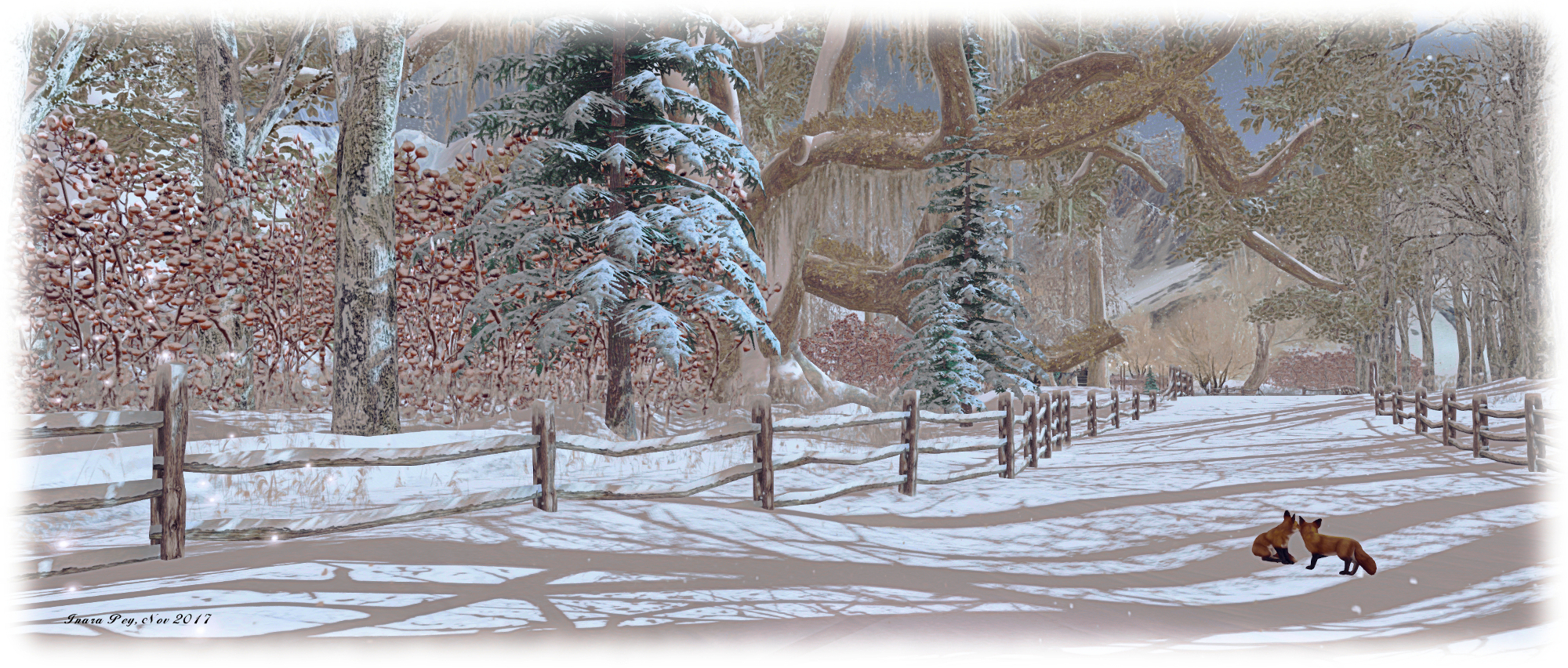
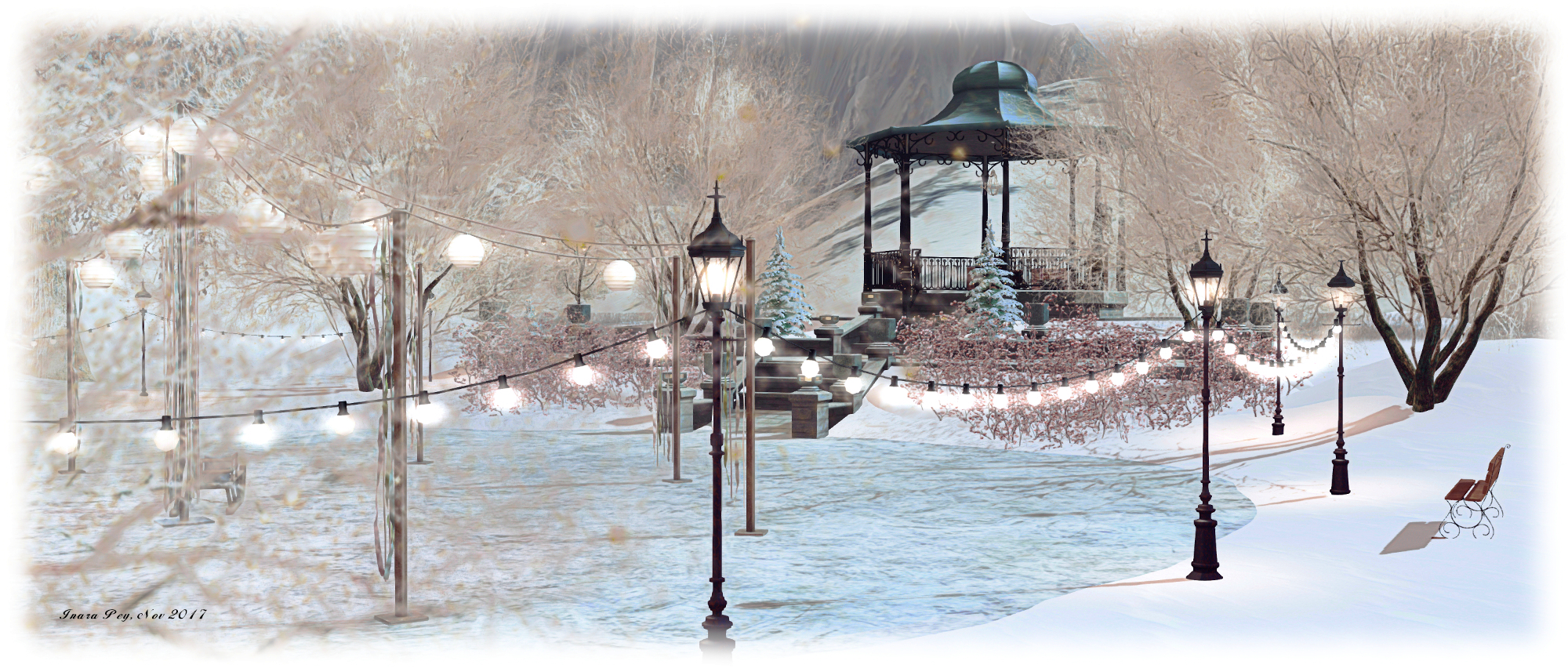
Follow the road northwards and the buildings give way to a country road, bordered by fences on either side. Here the land is blanketed in deeper snow, trees frosted and white, dog roses offering clouds of red colour between tree trunks. A pick-up truck – of a later period than the vehicles at the village – sits on the road, which leads the way to a frozen pond. Here, skates can be obtained from a sign board. But when skating, do mind the lantern posts set out across the ice! Steps on the far side of the pond offer a way up to a band stands converted into an open-sided snug, comfortable armchairs ranged before a roaring fire.
The land above and behind the little row of shops – reached via a set of snowy steps rising from a pair of gabled gates or via snow-covered slopes – presents a broad open area, again deep in snow, with just a sprinkling of silver birch trees and pale bushes. A delightful little bar sits to one side, offering mulled wine and other hot drinks.
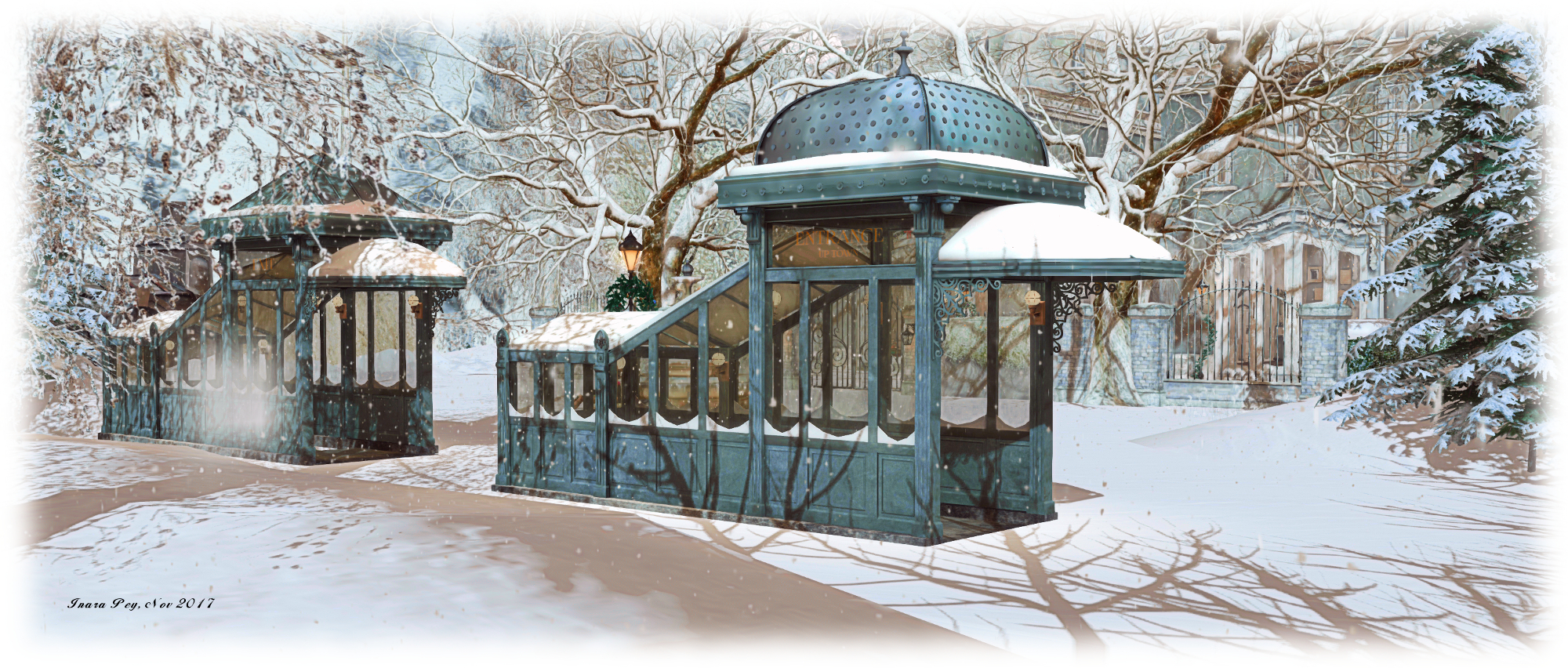
Further steps climb up to a further small plateau, where sits a house with – rather surprisingly – the entrance and exit to / from a subway station. The house is perhaps a little rough around the edges, however, it is furnished in something of a shabby-chic manner, a look which fits well with the aged look of the interior décor. Open to the public, one half of the house offers a small photo studio awaiting use – and it’s not the only place suited to photography. The little hamlet, the bandstand, the train – all offer backdrops for photographers to take avatar-centric shots, while the landscape itself invites photography. Those who do take pictures are asked to consider submitting to the Cherishville Flickr group.
Word is already spreading about Cherishville – and I’d like to thank both Shakespeare and Stavros Gracemount for alerting me to it being open so Caitlyn and I could visit – as such, it is proving popular with visitors. However, given it is only open to the public for a brief period, a visit sooner rather than later is recommended.
Just as a final point, a line of hills towards the middle of the region, running west to east and north to south to form another L, separate Cherishville from the private parcel on the region. This is protected by a security orb to maintain the owner’s privacy, so should you opt to visit, it would perhaps be best to treat the hills as the boundary without climbing them, and help the neighbours keep their privacy.
An artist’s impression of 1I/2017 U1 (or `Oumuamua), which was first seen by the Pan-STARRS 1 telescope in Hawaii on October 19th, 2017, and subsequently studied by a number of telescopes around the world, including the VLT of the European Southern Observatory (ESO) Credit: ESO / M. Kornmesser
On October 30th, 2017 I wrote about the extra-solar body which had crossed the orbit of Earth after swinging around the Sun during a rapid flight into and back out of the solar system. The object, originally designated A/2017 U1 and then as 1I/2017 U1 (the “1I” indicating it is the first positively identified interstellar object we’ve observed in 2017), was initially spotted on October 18th in Hawaii by the Pan-STARRS 1 telescope. Since then it has been closely tracked by astronomer around the world. What is particularly interesting about it is that Sun-orbiting eccentricity of between 0 (a circular orbit), and 1 (a parabolic orbit). Anything above 1 would tend to point to an object being entirely extra-solar in origin. A/2017 U1 has an orbital eccentricity of 1.2.
Since that time, the object has been under intense study, as has been reported in the media, and is proving to be most unusual. Now dubbed `Oumuamua, roughly translated as “scout” (ou being Hawaiian for “reach out for” and mua meaning “first, in advance of” – which is repeated for emphasis). At first thought to be a comet on account of initial observations, it was reclassified as an asteroid following more details observations.
In particular, observations made using the Very Large Telescope (VLT), operated by the European Southern Observatory (ESO) at the Paranal Observatory in Chile revealed the object to be cigar-shaped, rather than being a more rounded shape, as had been expected. Overall, it is estimated to be around 400 metres (1312 ft) in length, and approximately 40-50 metres (130-162.5 ft) in height and width. It is tumbling .
Using the VLT, ESO were able to accurately measure the brightness, colour and orbit of the asteroid and refine measurements of its trajectory as it leaves the solar system at a stunning 95,000 km/h (59,000 mph). These have revealed that `Oumuamua varies dramatically in terms of brightness (by a factor of ten) as it spins on its axis every 7.3 hours. As Karen Meech of the Institute for Astronomy in Hawaii explained in an ESO press release, this was both surprising and highly significant:
This unusually large variation in brightness means that the object is highly elongated: about ten times as long as it is wide, with a complex, convoluted shape. We also found that it has a dark red colour, similar to objects in the outer Solar System, and confirmed that it is completely inert, without the faintest hint of dust around it.
These observations also allowed Dr. Meech and her team to constrain `Oumuamua’s composition and basic properties. Essentially, the asteroid is now believed to be a dense and rocky asteroid with a high metal content and little in the way of water ice. It’s dark and reddened surface is also an indication of tholins, which are the result of organic molecules (like methane) being irradiated by cosmic rays for millions of years.
The measurements confirmed that the asteroid came to us from the general vicinity of Vega in the Constellation of Lyra, and has taken around 300,000 years to reach the solar system, which it has been passing through for the last 20,000. However, whether it originated around Vega is still being debated. Some of those observing the object believe it could have been wandering the interstellar void for 45 million years, having originally been ejected from a stellar system in the Carina–Columba association, which had once been far more aligned with the constellation of Lyra, relative to the solar system.
Passing through most of the solar system at a speed of around 80.0oo km/h (58,000 mph), the asteroid gradually accelerated under the Sun’s gravity so that it reached a velocity of 315,700 km/h (196,000 mph) at perihelion – the point closest to the Sun, which it reached on September 17th, 2017. Since then, the object has been heading away from the Sun and decelerating, again under the influence of gravity, passing the orbit of Earth in October. It will pass Jupiter’s orbit in May 2018, Saturn’s orbit in January 2019, and Neptune’s orbit in 2022, passing onwards through the solar system. It will be another 20,000 years before the object re-enters the interstellar medium.
Even it is of extra-solar origin, `Oumuamua is seen as being of significant import for our understanding of the formation of other solar systems. If nothing else, a study of the asteroid as it continues onward and outward from the Sun could potentially teach us a lot about its origins and the likely conditions within the system where it was born.
To this end, there have been numerous calls for the development of one or more missions to investigate the asteroid, some of which, such as Project Lyra, are already being mapped out. However, planning such a mission is one thing – actually pulling it off is quite another. `Oumuamua is currently travelling at 95,000 km/h (59,375 mph) – a velocity it will now more-or-less maintain.That is equivalent to 5.5 AU (Astronomical Units – the average distance from Earth to the Sun) per year, or 26 metres (84.5 ft) per second – what is technically referred to as its hyperbolic excess velocity.
Project Lyra points to NASA’s Space Launch System rocket (left and centre) and the SpaceX Interplanetary System launcher (aka the BFR, right), as possible launch vehicle for a mission to intercept an extra-solar body. Credit: SpaceX
No space vehicle launched from Earth has been able to attain that kind of velocity – even the fastest human-made objects in space, Voyager 1, and the fastest space probe at launch, New Horizons, are both only managing around two-thirds of that velocity. So just getting to a point where we can launch a vehicle capable on eventually matching the speed of the asteroid is a major challenge – without the worry of getting it to a speed where it might eventually catch with `Oumuamua at a speed which would allow it sufficient time to gather data on the rock as it flies by, rather than shooting right on past it at such a speed, it has next to no time to gather data of significant value. Nevertheless, the proponents of Project Lyra are going so far as to suggest a mission might rendezvous with `Oumuamua and gather samples for on-board analysis.
Of course, the asteroid will be travelling through the outer solar system – and by that I mean the Kuiper Belt outwards to, and through, the Oort cloud – for thousands of years; it’s not just going to vanish in a decade or so. So this does give some leeway. An encounter with `Oumuamua within the Kuiper Belt for example (say, 50-200 AU from Earth) wouldn’t need to be launched for another 5-10 years. This could potentially allow for the use of an upcoming launch vehicle, such as NASA’s Space Launch System rocket or even SpaceX’s gigantic Interplanetary Transport System launcher, the BFR.
However, looking towards an encounter that far from earth still means that the probe would have to achieve a hyperbolic excess velocity of up to 76 metres (247 ft) per second – or half as much again as the asteroid’s velocity – again calling into question the effectiveness of a mission in gathering and returning data. Certainly, at those kinds of speeds, an actual rendezvous with `Oumuamua to gather a sample would be out of the question.
An alternative approach might be more “slow and steady” approach using solar sail technology – such as that being developed with projects such as the Breakthrough Initiatives’ Starshot. This might allow a vehicle propelled by an earth-based array of lasers to eventually catch the asteroid, and with a rate of steady acceleration, overhaul it at a rate at which data can be gathered in earnest. However, such technology is in its infancy; thus the chances of such a mission being used for catching `Oumuamua are perhaps slim. However, development of the technology and a mission for intercepting an extra-solar object in the future a distinct possibility – particularly as it is now estimated at least one extra-solar object passes through the solar system a year.
Whether intended to study `Oumuamua or one of these other interstellar wanderers, any such mission – using rockets, ion drive propulsion, solar sail technologies -, if pursued, could led to technological breakthroughs as well as scientific rewards. As the project authors note:
As 1I/‘Oumuamua is the nearest macroscopic sample of interstellar material, likely with an isotopic signature distinct from any other object in our solar system, the scientific returns from sampling the object are hard to understate. Detailed study of interstellar materials at interstellar distances are likely decades away, even if Breakthrough Initiatives’ Project Starshot, for example, is vigorously pursued. Hence, an interesting question is if there is a way to exploit this unique opportunity by sending a spacecraft to 1I/‘Oumuamua to make observations at close range.
[A] mission to the object will stretch the boundary of what is technologically possible today. A mission using conventional chemical propulsion system would be feasible using a Jupiter flyby to gravity-assist into a close encounter with the Sun. Given the right materials, solar sail technology or laser sails could be used… Future work within Project Lyra will focus on analysing the different mission concepts and technology options in more detail and to down select 2 – 3 promising concepts for further development.
It’s time to highlight another week of storytelling in Voice by the staff and volunteers at the Seanchai Library. As always, all times SLT, and events are held at the Library’s home at Holly Kai Park, unless otherwise indicated.
Sunday, November 26th, 13:30: Tea-Time with Dickens
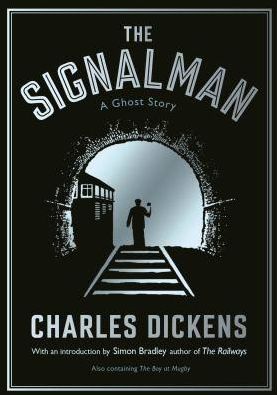
With the opening of The Dickens Project (see my preview here), Bryn Taleweaver, Kayden Oconnell and Caledonia Skytower present two items from the works of Charles Dickens: The Signal-Man and selections from Oliver Twist.
First published as part of the Mugby Junction collection in 1866, The Signal-Man had its roots in a an actual event of the time, the Clayton Tunnel railway crash of 1861. This is used as the source for a series of tragic events which take place in, or near a railway tunnel overseen by a lonely signalman, who is visited by a stranger – the story’s narrator.
This first event, related by the signalman to the visitor, is followed by a second, both of them – so the signalman insists – preceded by the appearance of a ghost. His visitor is sceptical of the whole idea that ghosts are somehow involved, and believes the signalman is stressed and needs rest. However, on his third visit to the cutting at the mouth of the tunnel, he discovers something which perhaps alters his belief in ghosts and premonitions…
Few can be unfamiliar with Oliver Twist, the story of an orphan boy, who runs away from the workhouse only to be taken in by a den of thieves. Whilst perhaps now better known through film and stage play, when first published in serial form between 1837 and 1839, this story shocked readers with its portrayal of childhood innocence beset by evil, and its depiction of the exploitation of children, be it in the workhouse or on the city’s streets. With its rich gathering of characters – Fagin, the artful Dodger, the menacing Bill Sikes and the prostitute Nancy – Oliver Twist was a new kind of fiction, combining elements of Gothic romance and melodrama with a scathing indictment of a cruel society, all pervaded by an unforgettable sense of threat and mystery.
Join Seanchai Library at the Christmas Past Docks at The Dickens Project– look for the teleport panel at the main Landing Point.
Monday, November 27th 19:00: The Alien Dark
Gyro Muggins reads Diana G. Gallagher’s one science-fiction novel.
Out of the darkness of interstellar space…
The ahsin bey, a race of catlike beings determined to expand their territory, launch six vessels into deep space to search for an uninhabited world suitable for colonization.
Tahl d’jehn commands the Dan tahlni on a decades long mission to explore the Chai-te system. Studies show that Chai-te’s planets are rich in the resource the ahsin bey need, but will their signal reach their home world in time to launch the colony ship. And what is Tahl to make of the startling discovery of a dead civilization on Chai-te Three?
Tuesday, November 28th, 19:00: Stories of Inspiration
Caledonia Skytower reads selections by Isaac Bashevis Singer, the Polish-born Jewish writer in Yiddish, who was awarded the 1978 Nobel Prize in Literature.
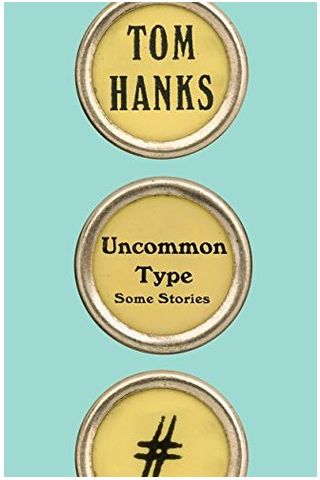
Wednesday, November 29th, 19:00: Tom Hanks’ Uncommon Type
He is regarded as one of the most talented actors of modern times. However, he is also a talented writer of short stories. In Uncommon Type, he presents 17 stories heart-warming stories, including:
The tale of a gentle Eastern European immigrant arriving in New York City after his family and his life have been torn apart by his country’s civil war.
The story of the man who loves 10-pin bowling – to the point where he cannot help but bowl the perfect game, time after time, bringing him to the attention of a sporting TV network
an account of an eccentric billionaire and his faithful executive assistant venture into America looking for acquisitions and discover a down and out motel, romance, and a bit of real life.
Will any of these form part of an evening of selections from Hanks’ book? Join Kayden Oconnell and find out! Also presented in Kitely (hop://grid.kitely.com:8002/Seanchai/144/129/29).
Thursday, November 30th 19:00: In Time for Christmas
At a time when interest in the Christmas holiday was waning, Charles Dickens wrote A Christmas Carol and inspired the world. But now, history is changing, and the book is never written. When the Council for Temporal Studies asks time travelers Simon and Elizabeth Cross to “save Christmas,” they think he’s joking. But it’s anything but a laughing matter. Simon and Elizabeth must go back to 1843 London and convince Dickens to write his endearing story, or the Christmas holiday we all know and love will cease to be–forever.
With Shandon Loring. Also presented in Kitely (hop://grid.kitely.com:8002/Seanchai/108/609/1528).
The Dickens Project
Now in its fifth year, Seanchai Library presents The Dickens Project for Christmas 2017, now open through until December 30th.
Celebrating the work of one of the masters of 19th Century literature, whose humanistic voice continues to be a relevant one in our everyday culture.
Featuring a period setting, performance art, music and – of course – readings from A Christmas Carol, Dickens’ seminal tale for the time of year – and for all of us. Programme schedule.
Please check with the Seanchai Library’s blog for updates and for additions or changes to the week’s schedule.
The featured charity for August and September is Little Kids Rock, transforming lives by restoring, expanding, and innovating music education in schools.
Respect is the title selected for the 2017 2LEI art recognition of the International Day for the Elimination of Violence Against Women, marked on November 25th. Open now through until the end of 2017, this is one of the most involved art installations I’ve visited in Second Life, presenting the work of some 71 visual and music artists either directly or in supporting roles, with no fewer than fifteen primary art display areas.
While marking International Day for the Elimination of Violence Against Women, the subject for the installation casts a wider net for Respect – including as it does respect for women, children, individuals, sexual orientation, race, self, and those around us. This makes for a very involved series of installations which requires time – possibly over more than one visit – to fully take in and appreciate. To help with this there is a range of events scheduled through the rest of the year, details of which can be found at the 2Lei blog.
With so many displays and levels, coupled with the quality of art on display, a comprehensive review of the installation would be extremely long-winded; similarly, picking individual elements for consideration is equally difficult. What can be said is that there is a rich mix of individual focus on the broader topics noted above, some of which are deeply thought-provoking, others are visually impressive while other may appear to come at their subject from a slightly unexpected angle and one or two, frankly, might confuse or perhaps seem more a generalisation than a focus.
The ground level features the works of fifteen artists, with 2D and 3D pieces ranged around a watery setting under a bright sun, together with the landing point, presentation theatre and teleport boards for reaching the fourteen sky platforms for the installation. Artists on this level include Rebeca Bashly, Dido Haas, Mistero Hifeng, Desy Magic, Ciottolina Xue, to name just a few.
The teleport kiosks provide access to 14 sky platforms, each one featuring the work of an individual arts or a collaborative team. These are – in order of ascent through the levels: Theda Tammas, JadeYu Fhang, Pale Illusion, Laug Indigo and Stardove Spirit, Aneli Abeyanti, Patrick Moya, Nino Vichan, Daco Monday, Black Label Exhibitions Corner, Nevereux, Pol Jarvinen, TerraMerhyem, Red Bikcin and Mona Byte.
Each level is of a fixed size, which the artists have been able to use as they choose, arranged so that visitors arrive on one platform (with teleport options for returning to the ground), move through the display area and out to a second teleport options for returning to the ground or continuing up to the next level. As with the ground level, there are small 2Lei boxes alongside the artist name boards which will offer a folder with the artist’s biography and – perhaps – an outline / description of the work they are displaying.
As noted, there is a lot to see here – and I admit that in viewing the sky platforms, I was particularly drawn to Nino Vichan’s installation, and the Black Label Exhibitions Corner piece. The latter, largely focusing on GlitterPrincess Destiny’s images. This is perhaps the most involved, and shows a considerable amount of expression on the subjects in an environment that is semi-interactive, requires exploration and offers a lot to see.
In all, a thought-provoking series of exhibits, rich in interpretation and presentation.
Paranormal Investigation is an experience by Abramelin Wolfe – of SL Abranimations fame – built specifically for the Sansar’s Scariest competition, which concluded in October. It was judged runner-up up in that competition – and deservedly so.
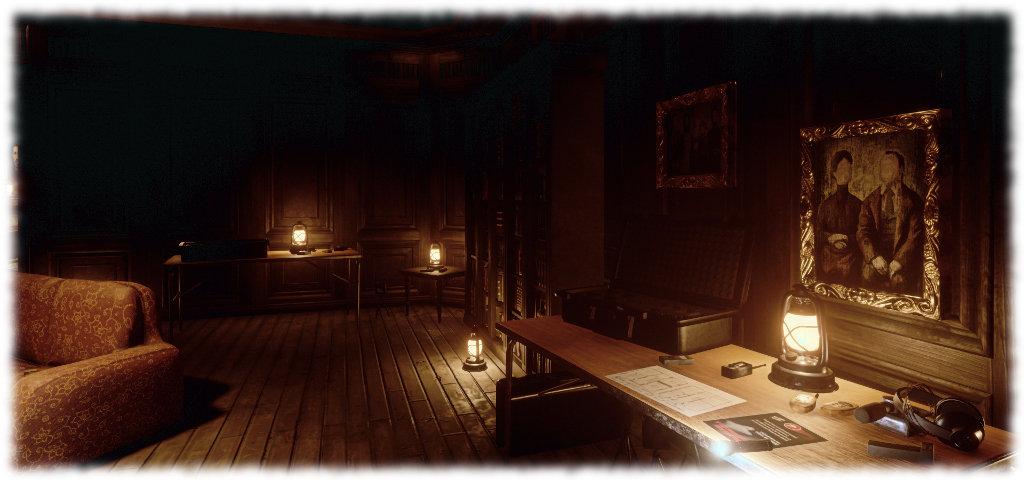
Given it was built for Halloween, this is – in lighting terms – a dark experience in which visitors are invited to join ghost hunters exploring a haunted house. As one might expect from such a place, the main lights are out – presumably to help spot spectres. However, lanterns have been placed out along floors and hallways to help illuminate the way, although it can seem a little dark for those in desktop mode.
A visit starts in the lounge of the house, where the ghost catchers have obviously set-up a base of operations, a case of equipment on the floor, and a table against one wall where a record of their work is being kept. This is worth getting a look at, as it includes a floor plan of the house (try first-person (F3) if in desktop or, if you’re handy with the movement keys and the mouse, freecam (F4) over to this and zoom in – use the – and + to reduce / increase the zoom speed). Easy to fix the in mind, the plan helps with explorations as you move on through the house.
This is perhaps the quietest room in the house, and offers a doorway through to a study where the first hints of paranormal happenings are going on – books float through the air, a Ouija board is being kept busy by something. The books are worth watching; they don’t randomly fly around, rather, they are carefully removed from their place in the bookshelves, float around and are then returned to their resting place, as if removed and replaced with deliberate intent.
At the back of the house and across the hall from the lounge are the kitchen and dining room respectively, where more signs of odd goings-on can be found, as can the first indication of a ghostly presence. More apparitions can be found upstairs – including a skeleton seemingly determined to keep in trim. However, the biggest delight in this experience is to be found up in the attic, where the Thing That Goes Bump In The Night clearly has an interest other than haunting!
What makes this experience a delight is the attention to detail. There are various nods to paranormal investigations – the use of the term “ghost catchers” puts one in mind of the Ghost Hunters TV series; in the bedroom there’s both a jumping bed and a revolving head a-laThe Exorcist, while elsewhere bodies float or appear as you explore. Again, if you are handy with freecamming in Desktop Mode, you might want to zoom into the bookcases in the lounge and study and check the titles of the book spines, such is the care poured into this design.
With a little interaction possible (chairs can be moved around), a good use of trigger volumes to generate things like the appearance of the floating body and localised sounds, Paranormal Investigation makes for a fun visit for those still looking for a bit of a spooky experience.
In July I was able to break the news that the University of Western Australia would be retaining a presence in Second Life, and that in recognition of this, was launching a special UWA machinima challenge, Art of the Artists, sponsored by LaPiscean Liberty of SLArtist and Singh Albatros and The Writers Centre, Singapore. On offer is a combined prize pool of L$350,000, including two special prizes.
The closing date from entries is December 31st, 2017, and videos for the competition are being hosted at the SLArtist website. Given there is just over a month to go before submissions close, I thought I’d take a look at some of the entries to date – with no personal preference implied – and run through a reminder of the main elements of the contest. However, as the SLArtist website utilises raw tags (which are considered a no-no by Automattic on WordPress.com hosted blogs), I’m embedding the videos as uploaded by the artists to YouTube.
Isabelle Cheren’s Before The World Was Made, featuring the work of artists Noke Yuitza, Otcoc Resident & Phillysmaybe Resident, Peli Dieterle, Igor Ballyhoo, and Rosie Dimanovic
In short, entrants may choose individual pieces of art or a collection around which to weave a story. However, the art must be a relatively significant part of the story, and not merely something glimpsed in passing, and films to be considered for any of the prizes must not be any longer than 8 minutes in duration (longer films can be submitted but will not be eligible for any of the prizes).
Selected art for a film may be filmed in its current location. however, films do not need to be restricted to these locations, as long as the art is the focus of the story being told. Entrants may contact artists about filming their works in other locations and / or collaborating with them on a film.
The prizes run from L$75,000 for the first prize, through to five prizes of L$7,000 each for the films judged in 6th through 10th positions. In Addition, there are two special prizes:
L$50,000 UWA Art of the Artists Special Prize: this will be awarded by Jayjay Zifanwe on behalf of the University of Western Australia
L$50,000 The Merlion Special Prize: this will be awarded by Singh Albatros on behalf of The Writer’s Centre, Singapore to the film which – in the view of the judge – best represents the The Merlion, the national personification of Singapore.
The 10 main prize winners will be selected by a selected panel of judges. Details of the full panel will be available on the UWA website soon. Each of the special prize winners will be judged independently to the judging panel, and as such, may be eligible for a prize in the general classification as well.
Art which can be used in films submitted to the Challenge can be found in the following locations:
The UWA Main Gallery – the primary exhibition space for art at UWA, including entrants to the most recent challenge, Transformations, which is expected to remain up at least through the end of this year.
The UWA Main region – this is the home of the iconic Winthrop Hall clock tower, Somerville outdoor cinema, the Moreton Bay Figs, and Sunken Garden. Some of the art from the UWA regions which will be closing will be relocated to platforms above this region. The relocation work is expected to be completed by the end of July 2017.
The Merlion – celebrating Singapore’s iconic Merlion sculpture, the full-sized version is hosted by the Monash University in Second Life. The smaller version at te UWA offers information on Merlion Portal Project concerning cultural, literary and artistic significance of the Merlion. It also provides a landmark to the full size installation.
Gerhard Helmut’s 3rd Eye Open. Artworks featured are “The Pineal Gland” by artist Ub Yifu, “He Holds Her Heart” by LunaEnigma – Luna Cobain, “Skeleton” by JointVenture Resident and “The Merlion” by Rebecca Bashly.
Additional Requirements:
Completed films should be uploaded, preferably YouTube or Vimeo, and a link to the film sent to Jayjay Zifanwe and LaPiscean Liberty.
Entries should acknowledge all art featured and acknowledge / have the authorisation for any music used.
Rights to all films should be held by the creator, but by entering the challenge permission is given for films to be shown on the UWA Blog, the Slartist Website and to be played on UWA lands.
The ten winners of the general prizes will be adjudicated by a panel of 5 judges. The special prize winners will be selected by Jayjay Zifanwe (UWA Special Prize) and Singh Albatros (The Writer’s Centre prize).
If you have questions, want to discuss anything, or add to the prize pool, please contact Jayjay Zifanwe.
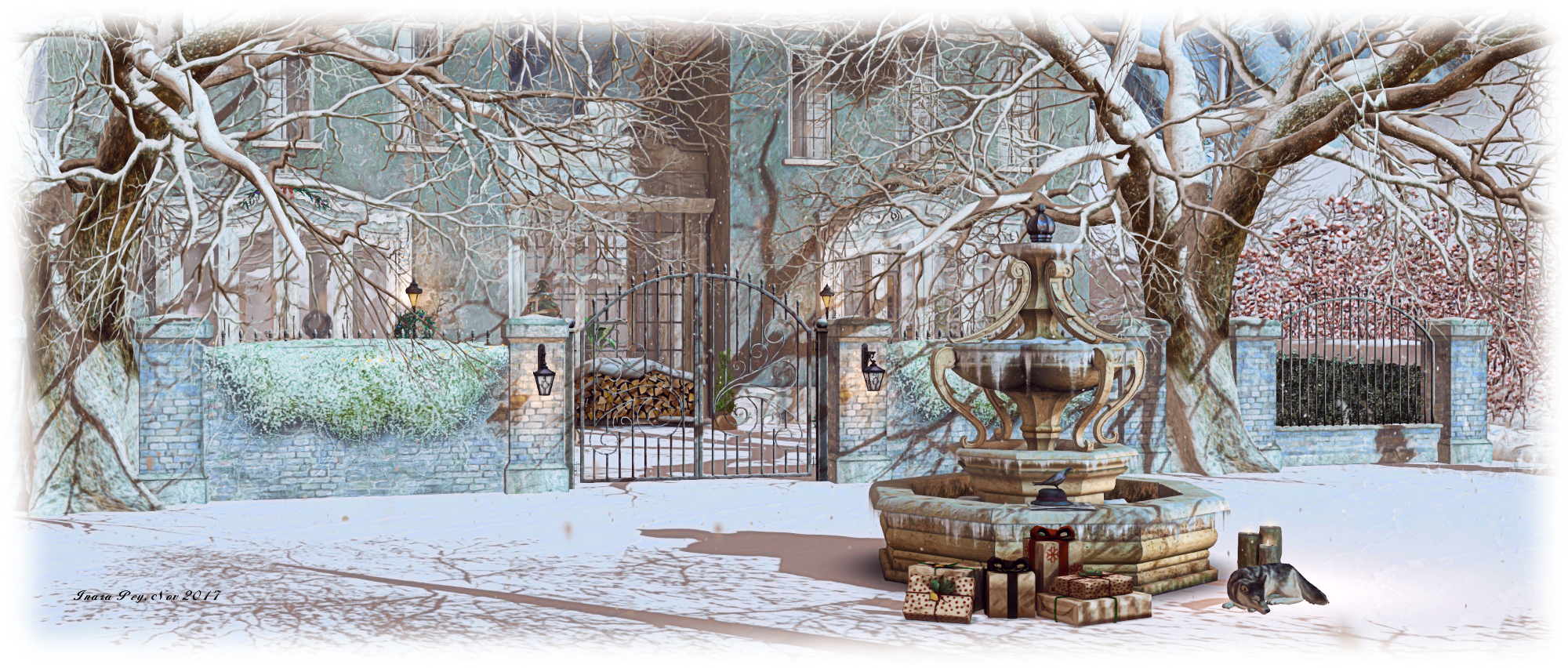 Cherishville – click any image for full size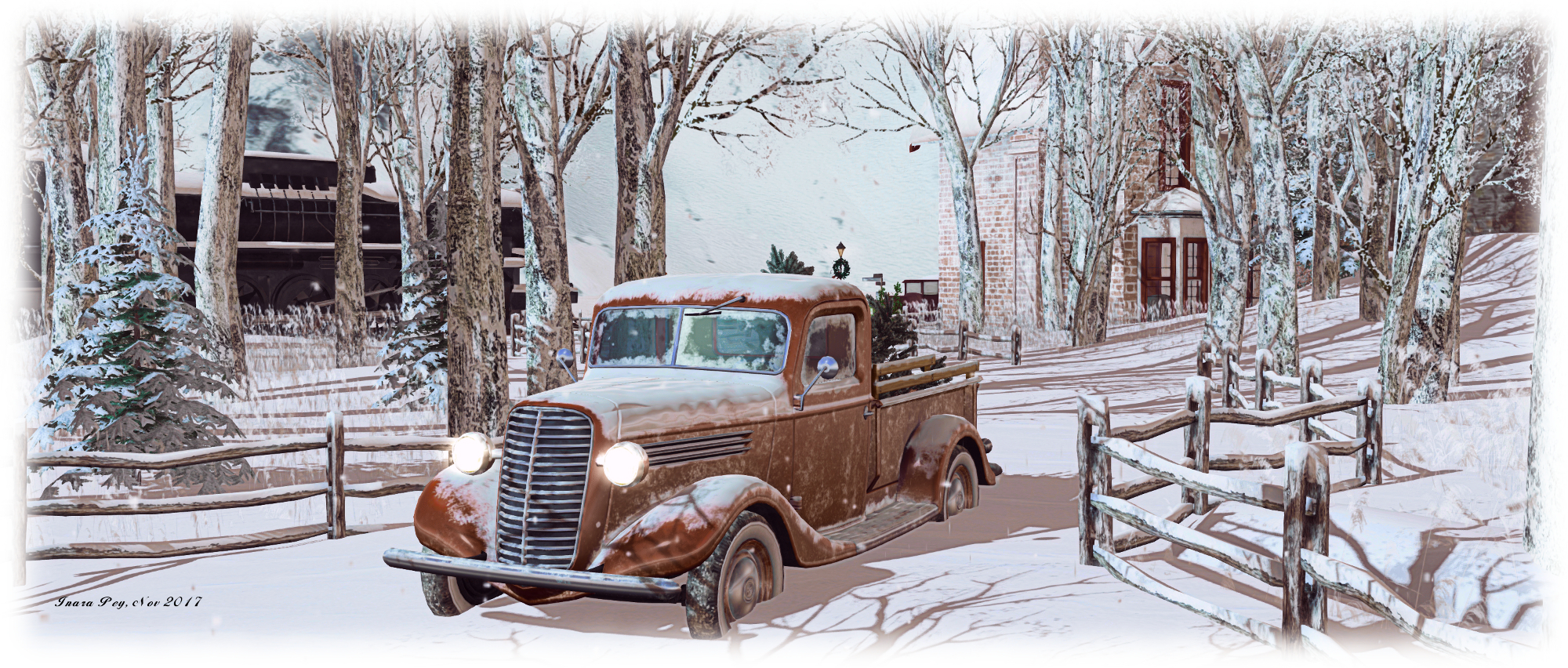







 Inara Pey: Living in a Modemworld