The Zen Garden in Sansar is one of the experience produced by the Lab’s Sansar Studios team, and has been one of the more frequented locations, visitor-wise. One of the reasons for this has possibly been because the Zen Garden has opportunities for interaction with things within the scene – particularly for those using VR headsets and controllers.
A visit begins on the upper level of a large artificial structure floating in the sky. The top of this – split into two levels – comprises a rectangular (non-accessible) building, a swimming pool, a games area and, on the lower level, an observation ring surrounding the sunken zen garden of the scene’s title. Steps connect the two main outdoor levels and provide access up to the building, where a set of stairs zig-zag their way up the side, almost like a fire escape, providing access to and from the roof.
The games on the greensward in front of the building are playable by those with VR headsets, although those in Desktop mode might try their feet at kicking around one of the large beach balls. However, it may not be these or the immediate surroundings which hold the new arrival’s attention; this structure is far from alone in the sky. It is orbited by a number of rocky islands, some near, some seemingly far. These are home to a variety of building, from blocky buildings similar to the towers and buildings resembling mosques or orthodox churches, topped by minarets and spires. Others are simply the home of trees and little else. Around and between all of them, smaller rocks tumble or rotate along their own orbits.
The sky is also occupied by two vehicles – sky taxis, if you will. One buzzes like an industrious bee from rocky island to rocky island, apparently carrying passengers back and forth. Alas, it doesn’t come to the central structure, so there is no real opportunity to go island hopping. The second vehicle follows a more leisurely path, gently flying around the main structure, carefully descending to hover near the swimming pool once per circuit, giving people an opportunity to climb aboard and take a ride. This is surprisingly smooth – if a little disconcerting as the vehicle turns beneath you and you remain solid as a rock, staring in the same direction unless you opt to move. It’s also a little one-dimensional: a single circuit on the taxi is enough to suffice.
The Zen Garden is designed to be reached in two ways: via one of the two staircases which curve down through the rock into which the garden has been built, or via an open-topped elevator located to one side of the structure surrounding the garden. Those adept at teleporting could attempt a “jump” down to the floor area of the “foyer” cavern just to the front of the garden, if they are so minded – but a walk down the stairs is just as easy.
The garden, sitting in a circular well open to the sky, is a simple, elegant affair. Surrounded by a curtain of bamboo, it is open to the sky above while descending in three tiers from the cavern it faces. The lowest of these is water-filled, the two above it covered in raked sand. Floating above the innermost tier is a series of disks, with lotus leaves floating around them, which seem to form a path leading up to a mysterious red door sitting slightly ajar upon a rock.
The door beckons invitingly. Is it a portal to another place? I’m sure many have attempted to climb or teleport up the floating disks to reach it (or simply teleported directly up onto its rock). But sadly, the promise is an empty one. No gateway to another scene awaits; perhaps in the future, this may change.
Another promise which will hopefully be fulfilled within this scene (as well as elsewhere in Sansar) is the ability to sit down. Zen Garden offers a lot of seating – out in the sun, in rocky corners or in the shade of the building or at the bar – but sadly, the ability to sit isn’t something that has as yet been granted to avatars – although it will be coming.
Bumping into Papp, Tina and Gin (that’s me in the white) at Sansar’s Zen Garden
Zen Garden is perhaps one of the easier places to start with when first joining Sansar. There is enough to see and (potentially) do to keep the novice moderately occupied and gain familiarity with their preferred mode of using Sansar, by it VR or Desktop.
Now open at Solo Arte, curated by Melania (MelaniaBis), is Hope, an exhibition of sculptures and art by CioTToLiNa Xue.
CioTToLiNa is an extraordinary artist, working primarily in 3D sculpture, although she also produces unique 2D art as well. She is entirely self-taught since joining Second Life, and I’ve long admired her work, having first encountered it at Art on Roofs in 2015, where she has a few pieces placed out as a part of the gallery’s setting, rather than directly on display. I was immediately captivated by her work, and when invited to present a full sim installation at LEA that year, I knew I wanted CioTToLiNa – despite her own shyness – to share the opportunity with me, and worked to include a number of her pieces into that build (see: Impressions: a personal view of Second Life).
Since that time, CioTToLiNa has clearly grown in confidence as an artist, producing ever more complex pieces which are not only beautiful and highly collectible (we have a number in the gardens of our island home), but also reflect her own interests / concerns for the world, and how we relate as a species one to another and the world around us. So it is that she has produced pieces focusing on women’s rights, the environment, LGBTQ rights, racism and more, as well as pieces which reflect things like a love of music, thoughts on love and relationships, and so on.
With Hope, CioTToLiNa has selected some 24 of her pieces – three of them 2D art, the rest sculptures – which are displayed around the paths and canals of Solo Arte (itself a beautifully coordinated venue designed by Terrygold) and within one of the gallery buildings. These present many of the facets of her work and concerns, with several marvellously scaled up to fit the spaces within which they sit, offering a perfect opportunity for her work to be properly appreciated.
These are evocative pieces, both in presentation and in naming. Many directly represent an emotion, reaction of desire – such as Tenacia (Tenacity),Pace (Peace – using the CND symbol), Il Desiderio (The Desire) and Escapology. Others are more layered in meaning, such as Babele (Babel), which carries within it assorted cultural references as well as reflections on relationships and the entire male / female dynamic.
What is particularly fascinating to me is the way other artistic influences on CioTToLiNa’s art have been incorporated with her work. For example, and as noted above, I first came across her work at Art on Roofs, which at the time was exhibiting Mistero Hifeng’s work. He also as a unique and evocative approach to sculpture in Second Life, and often moves within the same artistic circles as CioTToLiNa. Little wonder then, that one or two motfis that he perhaps pioneered in SL sculpture are reflected in some of the pieces included in Hope – such as with Donna Spremuta (Juicy Woman) and Salvezza (Salvation). However, in doing so, CioTToLiNa is by no means copying his approach: she is incorporating techniques into her work whilst producing something equally as unique and attention-holding.
Hope is another superb exhibition at Solo Arte featuring a marvellous talent. It is a delight to visit and I have no hesitation in recommending you hop over and spend time wandering the canal side paths and gardens of Solo Arte to admire CioTToLiNa’s work.
As always, please refer to the server release thread for updates and the latest news.
On Tuesday, September 12th, 2017, the Main (SLS) channel was updated with the same server maintenance package,17#17.09.01.508236, as deployed to the BlueSteel and LeTigre RCs in week #36. It is described as comprising internal fixes.
On Wednesday, September 13th, the RC channels should be updated as follows:
LeTigre and Magnum should receive a new server maintenance package, 17#17.09.08.508350 containing some internal HTTP fixes, described by Rider Linden as being, “pretty deep in the internals mostly having to do with how the server handles callbacks. [They] mostly have to do with an issues on the response event. There was a rare case that could cause a crash.”
BlueSteel (and the smaller Cake RC) should receive a new server maintenance package, 17#17.09.08.508343, comprising some internal simulator changes.
Week #36 Region Return Issues
Following the RC deployments on Wednesday, September 6th, a number of regions across the grid experienced widespread object returns, resulting multiple forum threads (see here for an example). While some of the reports pointed a finger at the Magnum RC deployment as the cause, issues were also experienced on regions on other simulator channels as well.
The returns were triggered by objects within the affected regions having their physics shapes changed. This resulted in many objects undergoing an increase in their LI, prompting the returns as they exceed region / parcel allowances (see BUG-134270, and BUG-134271) and also meant that some objects which remained in-world, or which were placed out again by their owners could not longer be navigated by avatars (e.g. doorways appeared to be invisibly blocked, stairways couldn’t be climbed).
Commenting on the issue during the Simulator User Group meeting on Tuesday, September 12th, Oz Linden stated:
The problem is pretty well understood, and we’re working on it… it’s actually been around for a long time, but some bad luck has triggered it a couple of times lately it’s a timing thing, and the window where it can happen is narrow … It can happen on any restart, but only if there are other simultaneous back-end problems; fortunately, those are usually rare – or rather, they had some root causes in common.
We do have a change in progress that we think will prevent that kind of large-scale returns … or at least that particular way of triggering them.
One of the critiques in this situation has been the apparent lack of response to the issue by the Lab – and it is one that could have perhaps benefited from a blog post or a response through one of the forum threads to the effect that the matter had been noted and the underlying cause being looked into. Responding to similar criticism made during the SUG meeting, Oz also said, “Actually, I just came from a meeting in which we were discussing how to respond more quickly to things like that on the forums.” Hopefully, the discussions will result in more positive responses to major issues raised through the forums in future.
Week #36 Outage
Week #36 also saw a further significant outage with Second Life services involving the platform, log-in services and so on. So far, there has been no definitive explanation as to what happened, but hopefully a post-mortem blog post will be forthcoming from April Linden or one of the Ops team in the near future.
SL Viewer
On Monday, September 11th, the Maintenance RC viewer updated to version 5.0.8.328951.
The Wolfpack RC updated on Tuesday, September 12th to version 5.0.8.328990. This viewer is functionally identical to the release viewer, but includes additional back-end logging “to help catch some squirrelly issues”.
The rest of the official viewer pipeline remains unchanged from the end of week #36:
Current Release version 5.0.7.328060, dated August 9, promoted August 23 – formerly the Maintenance RC
Release channel cohorts:
Alex Ivy 64-bit viewer, version 5.1.0.508209, dated September 5
Voice RC viewer, version 5.0.8.328552, dated September 1
Obsolete platform viewer version 3.7.28.300847, dated May 8, 2015 – provided for users on Windows XP and OS X versions below 10.7.
Environment Enhancement Project
Rider Linden has recently been pulled away from the Environment Enhancements Project (EEP, aka “Windlight updates”). However, he notes that he is making progress on the viewer side of things. Commenting on his current work with the project, Rider said:
The changes I’m making right now are adding some new classes that can handle the .settings assets. I’m wiring them into the environment on the viewer side. I’m trying to clean up the entire environment manager and the location that the windlight parameters are used/calculated/stored as I go (currently it is spread across about 1/2 a dozen source files for skys alone.).”
He also noted that he has yet to start on the scripted support for EEP, and it is likely that both the new Windlight assets and a project viewer will appear before the new scripting capabilities make their appearance. Quite when the assets and viewer will appear isn’t certain, and Oz Linden noted that there is a certain amount of infrastructure work to be done in connection with EEP.
In Brief
There has been some criticism of the server release notes being somewhat vague (e.g. “internal fixes”), the reason given for this is that the Lab prefers to be obscure about some changes rather than offering potential clues on possible griefing vectors / fixes for griefing vectors.
The keen-eyed may have noticed that the number of server release packages has changed, from ##.##.##.3##### to ##.##.##.5#####. The “5” signifies the package has been built on the Lab’s new simulator build system, with the increase made to avoid possible collisions between build versions.
Having opened in August 2017, Rosy Highwater’s Gentle Breezes is the perfect antidote to inclement weather and the approach of winter – or if you’re in the southern hemisphere, the perfect promise of summer – and a chance to wander carefree, simply enjoying the freedom to be.
A Homestead region, it has been laid out with an eye for detail, and love of nature. From the sandy beaches up through the wooded hills, everything is pretty much perfect for setting the mind at ease and encouraging feet (and camera lens!) to roam. It’s a place for the photographer, the romantically inclined and those seeking escape for life’s weight.
Surrounded by rolling hills and peaks which rise from sandy shores, the region presents itself as a small isle sitting in a channel between two larger islands. It is close enough to one of the latter to suggest that once upon a time, they may have been joined but overtime, the sea has had its way, cutting a path between them. Taken as a whole, the isle and hills around it – as high as some are – give the impression they may have all at some point in distant pre-history been the ring wall for the caldera of an ocean volcano which once pushed its head above the surrounding seas only to fall extinct and, over the aeons, have those seas erode away the weaker point of the crater walls, flooding the space within.
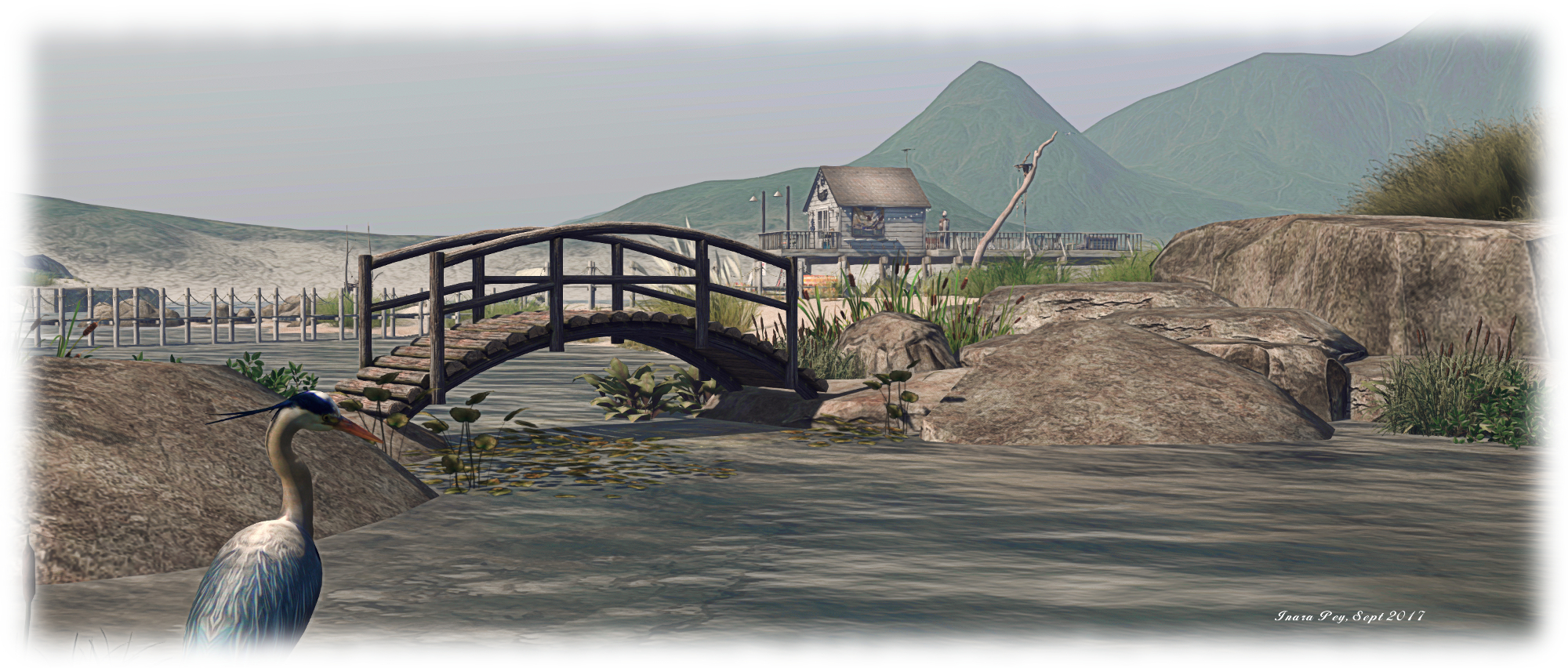
Visitors arrive towards the centre of the region, on the beach forming the lower part of the island, and which faces out to the west and south. Behind this, the hills of the island form a gentle curve from the east around to the north, casting rocky shoulders down to the sands below. The beach is split into three by channels running outwards from where water tumbles from the rocks of the hills, and it is on the central tongue of sand between the two channels that visitors initial land.
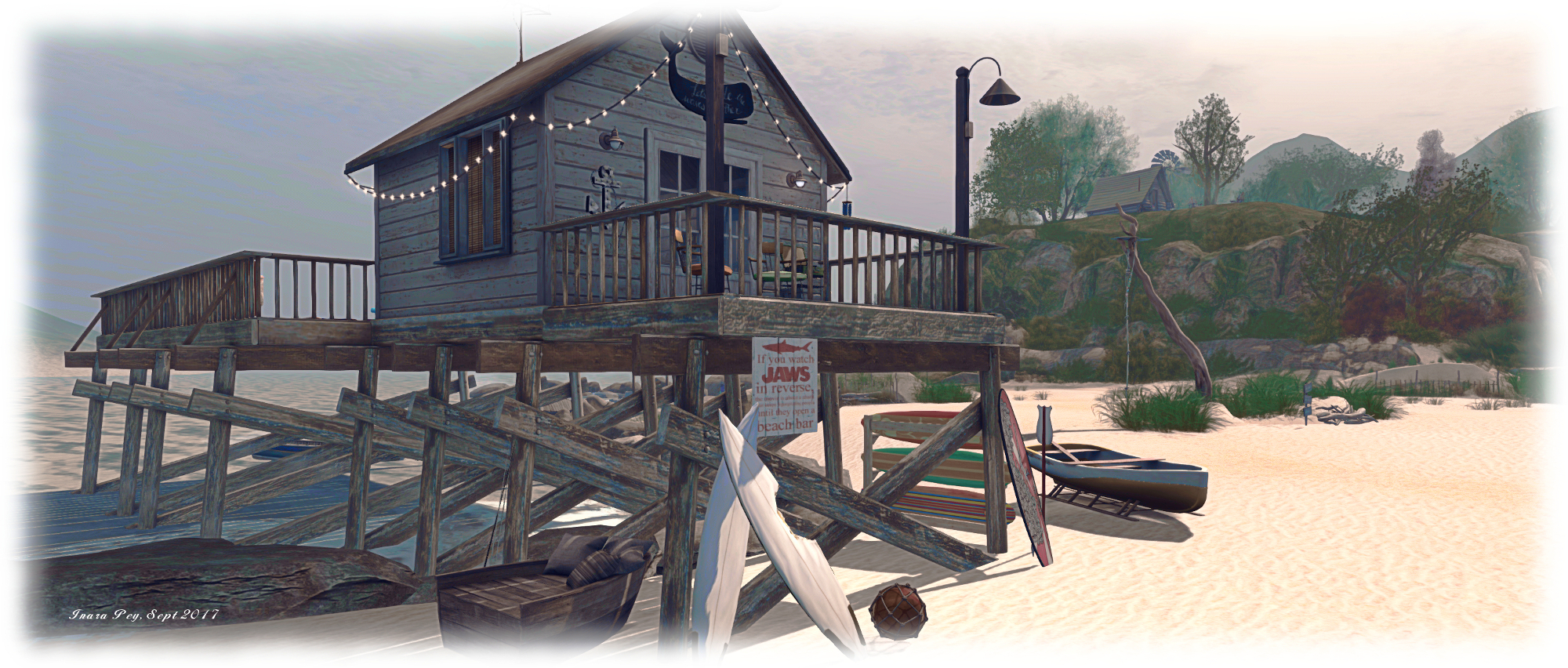
With waves lapping against it, the beach here offers an arc of places to sit and cuddle or chat looking out over the waters of the bay. Two wooden walkways reaching out over the waters separating it from the sands to the north and south. The latter is as big as the middle tongue of sand, and is home to a pier-top beach hut built over the waters, offering the active a little exercise in scrambling up to it it’s flat deck. Those preferring a more relaxed time can sit as watch from the rowing boat moored by the pier, or from the other cuddle and seating points scattered across the beach.
A path marked by wooden boards offers a way up the slope of the hills, leading to the first of the cottages and cabins which share the upper reaches of the island with trees and flowers. As it does so, the path passes between great slabs of rock reaching out from the hills like a protective wall, the sand within their arms gently giving way to grass, while a wind-bent tree offers a modest amount of shade to an old rowing boat converted into a lover’s lounger beneath its bent back.
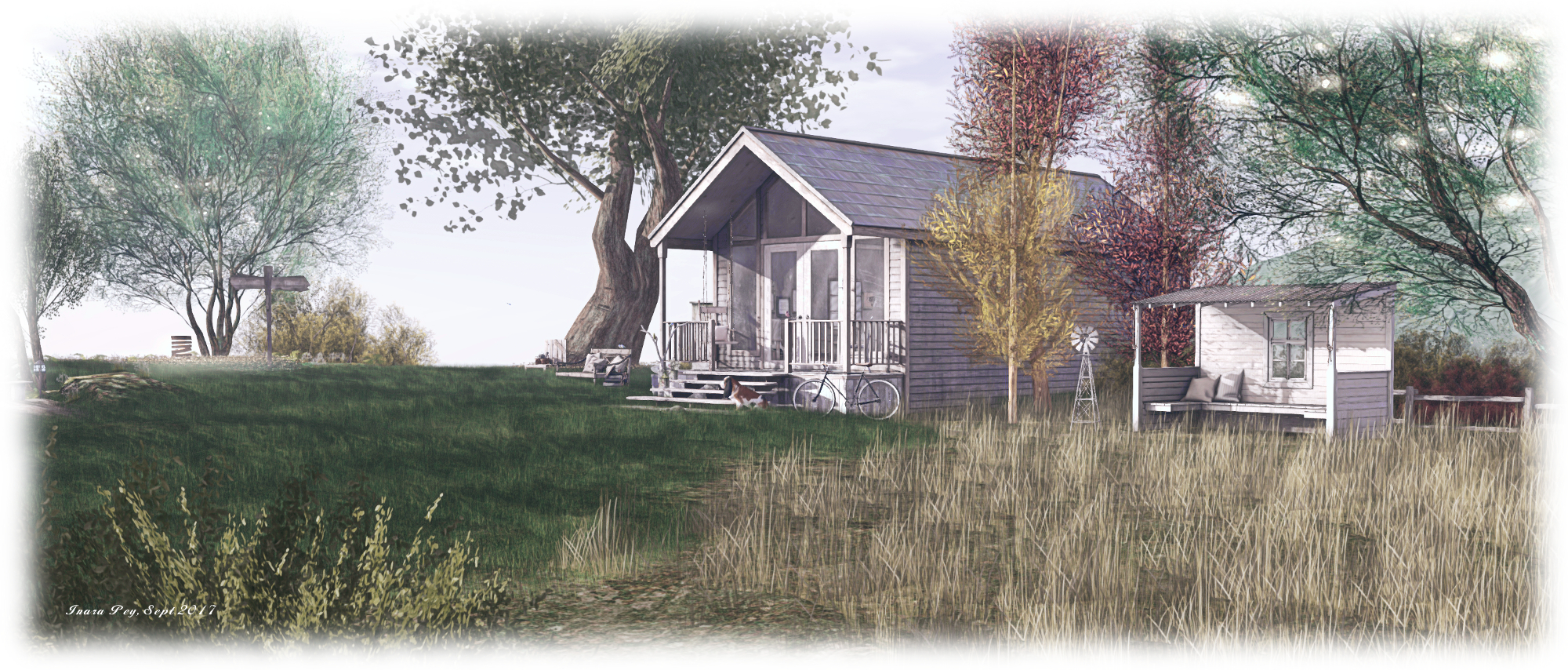
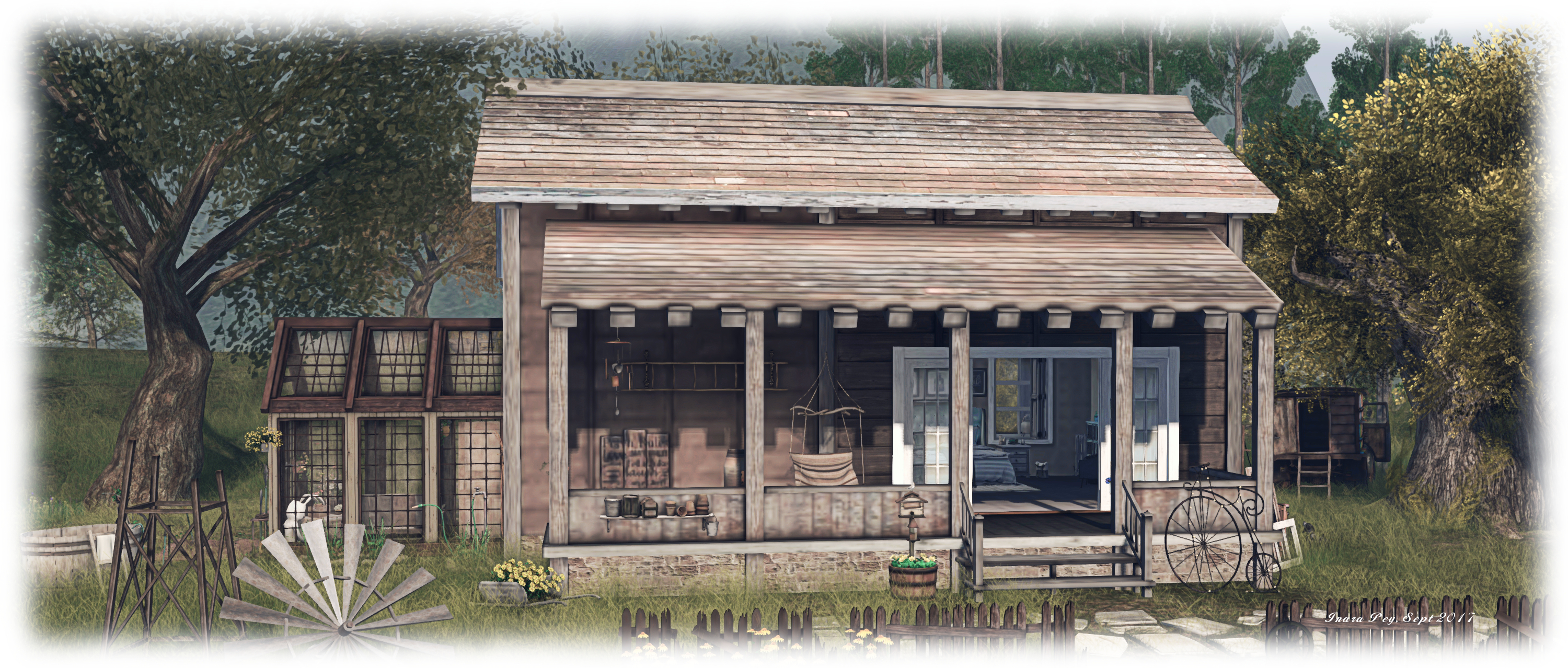
The cabin at the top of the hill is cosily furnished and offers a taste of a simple life – bees for fresh honey, and an outdoor bath. A footpath runs southwards from the cabin, under an arch and to a lookout point overlooking the larger of the island’s two waterfalls and the hidden delight of a hot tub nestled at the foot of the cliffs. On the hill beyond the falls sit two more cabins, each simply furnished. More sitting and cuddle spots can be found spread between and around them, both in the open and under the shade of trees, while a second hot tub overlooks the southern end of the island.
The easiest way to reach the northern end of the island is over the board walk from the middle tongue of beach. This gives access to a set of wooden stairs which climb the cliffs to a brightly-painted beach house offering a grand view out over the island. A pair of wind turbines stand sentinel-like behind the beach house, and further away through the long grass, stone steps offer a way down to the foot of the smaller of the two waterfalls, and a raft floating gently on the water there.
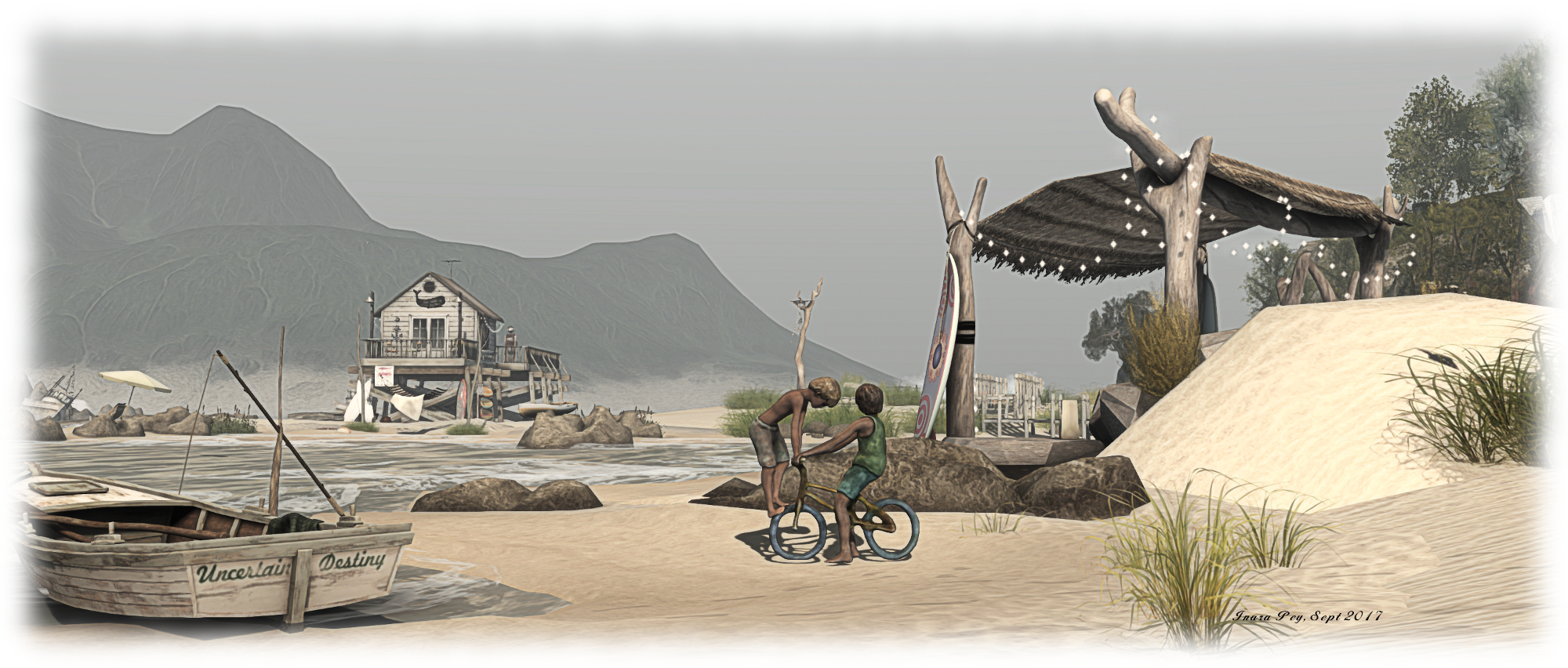
Gentle Breezes is truly a beautiful location – even now I’ve only just scratched the surface of all the details awaiting discovery – keep an eye out, for example for Rosy’s use of a sculpture by Silas Merlin to represent children playing on the beach. The setting is completely by a perfectly balanced ambient sound scape and for those so minded, a nicely considered chill-out music stream.
But there is also something more here as well. With its rugged hills, gentle beaches and offshore lighthouse, Gentle Breeze offers a remind of Rosy’s equally stunning Black Basalt Beach, which was open from 2013 through 2016, and about which I wrote in August 2013. For those of us who recall the latter, Gentle Breeze further offers a wonderful sense of memory whilst very much remaining its own landscape.
With thanks, once again, to Shakespeare and Max for the tip-off.
Logos representative only and should not be seen as an endorsement / preference / recommendation
Updates for the week ending Sunday, September 10th
This summary is published every Monday, and is a list of SL viewer / client releases (official and TPV) made during the previous week. When reading it, please note:
It is based on my Current Viewer Releases Page, a list of all Second Life viewers and clients that are in popular use (and of which I am aware), and which are recognised as adhering to the TPV Policy. This page includes comprehensive links to download pages, blog notes, release notes, etc., as well as links to any / all reviews of specific viewers / clients made within this blog
By its nature, this summary presented here will always be in arrears, please refer to the Current Viewer Release Page for more up-to-date information.
Official LL Viewers
Current Release version 5.0.7.328060, dated August 9th, promoted August 23rd – No change
Wolfpack RC viewer 5.0.8.328879, released September 8th – this viewer is functionally identical to the release viewer, but including additional back-end logging “to help catch some squirrelly issues.”
The Alex Ivy 64- bit viewer updated to version 5.1.0.508209 on September 5th.
An artist’s impression of the Cassini spacecraft entering the upper reaches of Saturn’s atmosphere, high above the cloud tops, and breaking / burning up against the backdrop of the planet’s rings. Credit: NASA
On Friday, September 15th, 2017, just one month short of the 20th anniversary of its launch, the NASA/ Italian Space Agency (ASI) space probe Cassini will plunge into the upper reaches of Saturn’s atmosphere, bringing to a close the momentous NASA / ASI / European Space Agency Cassini-Huygens mission.
It will be a bitter-sweet moment for many the world over – most of all the vast international team who devoted up to fourteen years of their time on the mission – even before it launched. The Cassini vehicle has not only revealed so much about Saturn, its myriad moons, the rich complexities of the gas giant’s ring system- it has also helped inform us on the potential for life to exist elsewhere in the solar system and has even helped test Einstein’s work. It has also over the years returned some of the most stunning and evocative images of other worlds we have yet witnessed. Many of these images have been gathered together by National Geographic and have been put together in a superb interactive web presentation on the mission by Nadia Drake and Brian Jacobs.
A computer model of the hundreds of orbits Cassini has made around Saturn over the years (excluding the more recent orbits of the Grand Finale). Credit: Drake / Jacobs / National Geographic
In all seventeen countries have been directly involved in the conception, design, construction and operation of the Cassini-Huygens mission, both in terms of the Cassini orbiter and the HuygensTitan lander and the science instruments they carry. NASA carries primary responsibility for the orbiter’s design and construction, with the Italian Space Agency providing the all-important, dual-purpose high-gain radio antenna and its associated communications equipment, together with the low-gain communications suite which would provide continuous communications with Earth through the mission. ASI also incorporated a compact radar system in to the high-gain antenna systems, allowing it to function as a synthetic-aperture radar, a radar altimeter, a radiometer, and provide the visible channel portion of the VMS spectrometer package carried by the probe.
ESA was responsible for the Huygens lander, with France designing the vehicle itself, with the descent parachute system provided by Martin-Baker of America, while the science and communications packages were supplied by several European countries and the United States.
Cassini-Huygens stored within the payload fairing of an Atlas 4B rocket on the pad of Launch Complex 40, Canaveral Air Force Station, October 12th, 1997, 3 days ahead of its launch. Credit: NASA
The mission was named for the Italian-French astronomer Giovanni Domenico Cassini, who first observed the divisions within Saturn’s rings system (and after whom one of the divisions is also named) as well as for of the planet’s moons, and Christiaan Huygens, the Dutch mathematician, physicist and astronomer, who first observed Titan, Saturn’s largest moon.
Work actually commenced on the mission in the 1980s, the goal being to develop a mission which could determine the three-dimensional structure and dynamic behaviour of Saturn’s ring system, investigate Saturn’s atmosphere and magnetosphere, determine the composition and likely structure of Saturn’s moons, including the nature and origin of the dark material on Iapetus‘s leading hemisphere, and, in conjunction with the Huygens lander, characterise Titan’s atmosphere, including the variability of the cloud haze, and characterise the moon’s surface at a regional level.
Initially, the mission was funded for a 10-year period from late 1997 through mid-2008, which included a journey of seven years to reach Saturn. The voyage took so long because at the time of launch, there was no launch vehicle combination capable of sending Cassini directly to Saturn. Instead, it completed a mini-tour of the inner solar system; six months after launch, Cassini flew by Venus, using the planet’s gravity to accelerate it into a wide elliptical orbit. A second encounter in June 2000 again accelerated the spacecraft, slinging it on to a further gravity-assist flyby of Earth in August 2000, which in turn accelerated it and bent it onto an trans-Jovian flight path.
In late 2000, Cassini reached the vicinity of Jupiter, making its closest approach to the planet on December 30th of that year. As well as using Jupiter’s gravity to sling it onwards to its final destination, Cassini used the encounter to study Jupiter and its faint system of rings. In all some 26,000 images of Jupiter, its moons and its rings were taken during the 6-month period of the flyby (October 2000 – March 2001). Cassini’s science suite was powered-up for the flyby, and resulted in some significant discoveries concerning Jupiter’s turbulent atmosphere, including breaking a long-held view. Jupiter’s banded atmosphere comprises a series of alternate bands of darker and lighter zones, in part caused by Jupiter’s rapid rotation. It had also been thought that the lighter bands were the result of the atmosphere rising upwards, giving rise to lighter cloud formations, before circulating downwards once more.
The cratered moon Tethys slips behind Saturn’s largest moon, Titan, as seen by Cassini on November 26th, 2009. Credit: NASA/JPL / Space Science Institute
However, Cassini revealed the dark bands were peppered with individual storm cells of upwelling bright-white clouds too small to see from Earth, suggesting the vertical circulation of Jupiter’s atmosphere to be far more uniform than thought. The probe’s findings also showed that Jupiter’s thin and dusty rings to be made up from small, irregularly shaped particles, most likely created by ejacta from micrometeorites impacting the Jovian moons.
Cassini reached Saturn in 2004, officially entering orbit around the planet on July 1st of the year. Prior to doing so, the vehicle was part of a test of Einstein’s theory of general relativity. This states that any massive object like the Sun causes space-time to curve, causing a beam of light or any other form of electromagnetic radiation that passes close to it to travel farther (the Shapiro time delay). In 2003, with the Sun coming between Earth and Cassini, scientists on Earth measured the frequency shift in radio signals being received from the spacecraft. Similar experiments had been carried out with the Voyager and Viking missions, but Cassini provided for much more refined measurements to be taken, and firmly validated Einstein’s theory.
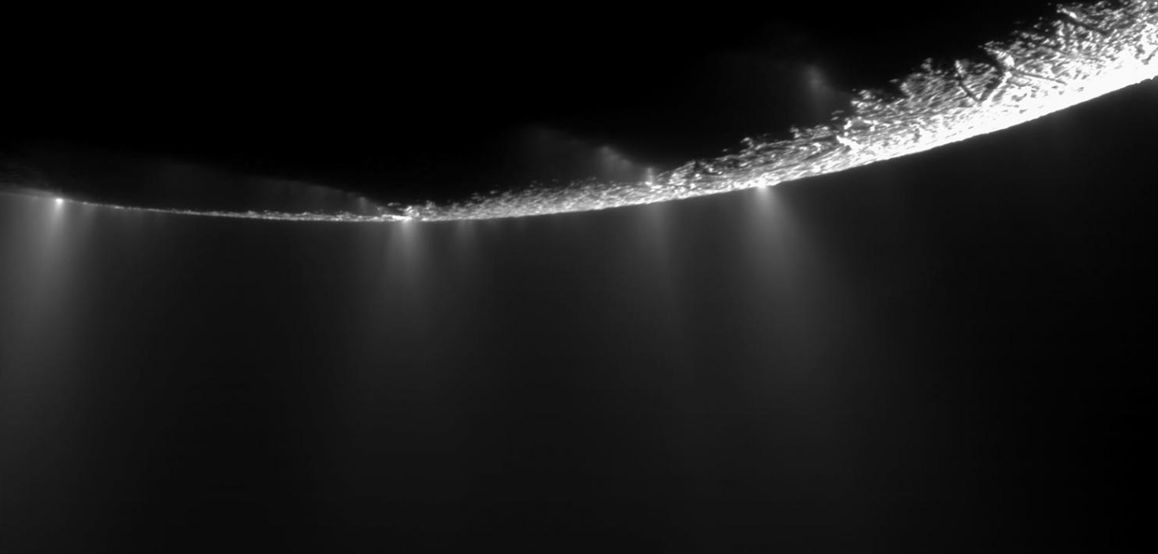
A geyser sprays water ice and vapour from the south polar region of Saturn’s moon Enceladus. Cassini’s first hint of this plume came during the spacecraft’s first close flyby of the icy moon on February 17, 2005. Credit: NASA/JPL / Space Science Institute
Cassini‘s primary mission at Saturn commenced as it approached the planet for orbital insertion. Although the orbiter was capable of functioning – all things being equal – through until around 2017, this primary mission was scheduled to last just 3 years and 261 days, ending in mid-2008. This was sufficient time for the primary goals of the mission to be achieved, but Cassini was always designed to achieve so much more. With this in mind, the programme was granted two funding extensions. The first, called the Equinox Mission, funded the project through until the end of 2010, and gave a particular focus on Titan (15 flybys) Saturn’s ice-covered moon Enceladus, thought two of the locations in the Saturnian system where life might have taken hold.
The second extension, granted funding in 2010 to the tune of around US $60 million a year, is referred to as the Solstice mission (as it would end a few months past Saturn’s summer solstice). It guaranteed that, avoiding any spacecraft failures, the mission would continue through to the point where Cassini’s manoeuvring propellants would be practically depleted. This phase of the mission allowed for a more extended study of Saturn, its rings and moons. It meant Cassini could witness never before seen seasonal changes in the planet’s atmosphere and study. It also meant Cassini could study Saturn’s atmosphere and magnetosphere at exactly the same time as NASA Juno mission studied Jupiter’s atmosphere and magnetosphere, allowing a direct comparison of the two. Finally, the extension would carry the mission through its 5-month “grand finale”, probing the region between Saturn and its complex ring system.





 Inara Pey: Living in a Modemworld