As always, please refer to the server release thread for updates and the latest news.
There was no deployment / restart on the Main (SLS) channel on Tuesday, September 18th, leaving that channel running on 17#17.09.01.508236.
On Wednesday, September 19th, the RC channels should be updated as follows:
BlueSteel and LeTigre should receive a new server maintenance package, 17#17.09.14.508549, comprising improvements to address some problems that could degrade simulator performance in rare cases.
Magnum should receive a new server maintenance package, 17#17.09.14.508533, containing a fix for BUG-100505 “llGetEnv (“agent_limit”) is returning an empty string in Magnum, LeTigre and Blue Steel regions.”
Commenting on the RC releases at the Simulator User Group meeting on Tuesday, September 19th, Simon Linden said:
[we] have two very similar RCs out tomorrow, the later version just has one extra bug fix in it … which will either be really good or bad … we’ll see 🙂 … it involves an underlying library update … usually that’s all good [but] sometimes subtle changes cause all sorts of breakage. So far it looks good to us … but that’s what shipping updates is all about, I guess.
On a positive note, with these updates and some still in the pipeline, I think we’re making good progress against some of the bigger crash issues we recently had with system outages.
SL Viewer
On Tuesday, September 19th, the Maintenance RC updated to version 5.0.8.329065. The rest of the viewer pipeline remains unchanged from the end of week #37:
Current Release version 5.0.7.328060, dated August 9, promoted August 23rd – formerly the Maintenance RC
Release channel cohorts:
Wolfpack RC viewer,version 5.0.8.328990, dated September 12th – this viewer is functionally identical to the release viewer, but includes additional back-end logging “to help catch some squirrelly issues”
Alex Ivy 64-bit viewer, version 5.1.0.508209, dated September 5th
Voice RC viewer, version 5.0.8.328552, dated September 1st
Obsolete platform viewer version 3.7.28.300847, dated May 8th, 2015 – provided for users on Windows XP and OS X versions below 10.7. This viewer will remain available for as long as reasonable, but will not be updated with new features or bug fixes.
Other Items
AO / Animation Priorities
Over the past 3 weeks or so, some people have noticed changes to apparent AO / animation behaviours which appear to mimic priority conflicts. A typical example is someone sitting on an AVSitter item and finding after a few seconds that there AO suddenly overrides the sitter’s animation, forcing them to disable their AO where previously they did not, or someone joining a dance HUD / system and finding their AO overrides the dance animation, causing them to stand, again forcing them to turn off their AO, where previously the two played together nicely.
The problem seems to be more common with those wearing AO HUDs. In most cases I’ve heard about, there has been a claim of no user change to the AO system (i.e. using a new or updated AO) or in the furniture or dance system animations / scripts.
It has been suggested that a fix for BUG-11501 might be responsible, although there seems to be some confusion over the status of the fix for this bug.
Coffee Island is a beautifully atmospheric homestead region designed by Dandy Warhlol (terry Fotherington) and Belle des Champs (Bridget Genna). It forms the latest iteration of BarDeco, the music venue and club (see here for more), carrying the name BarDeco & Kekeland – and it is truly an atmospheric place.
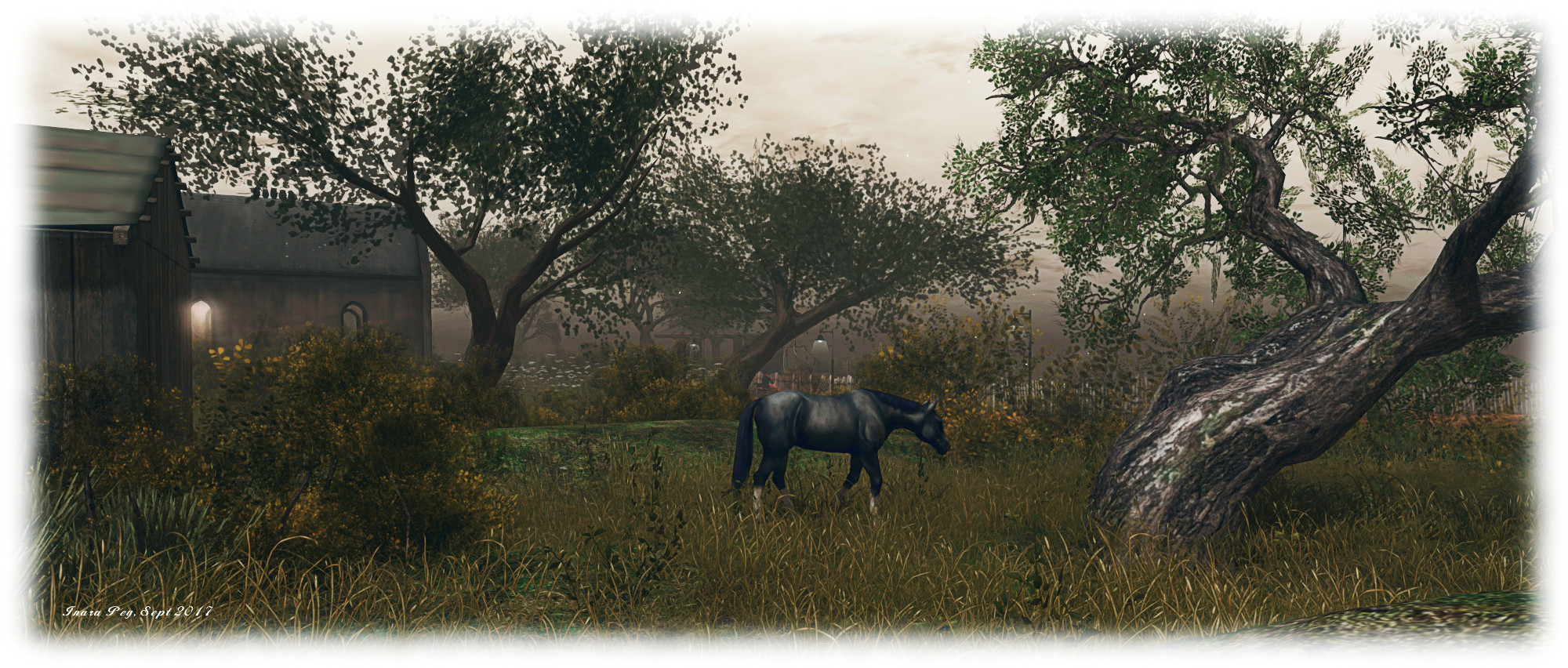
Split into three – a primary, sheer-sided island flanked by two smaller isles, one of which has been left to nature – the region sits shrouded in a gathering twilight through which wisps and ripples of mist are creeping. Visitors arrive on a dusty track on the main island, the slender form of an old chapel rising from the end of the track. In the other direction, the path curls south to follow the line of the cliffs, before turning west to cut across the island and again turning at the westward cliffs to turn again to follow them northwards.
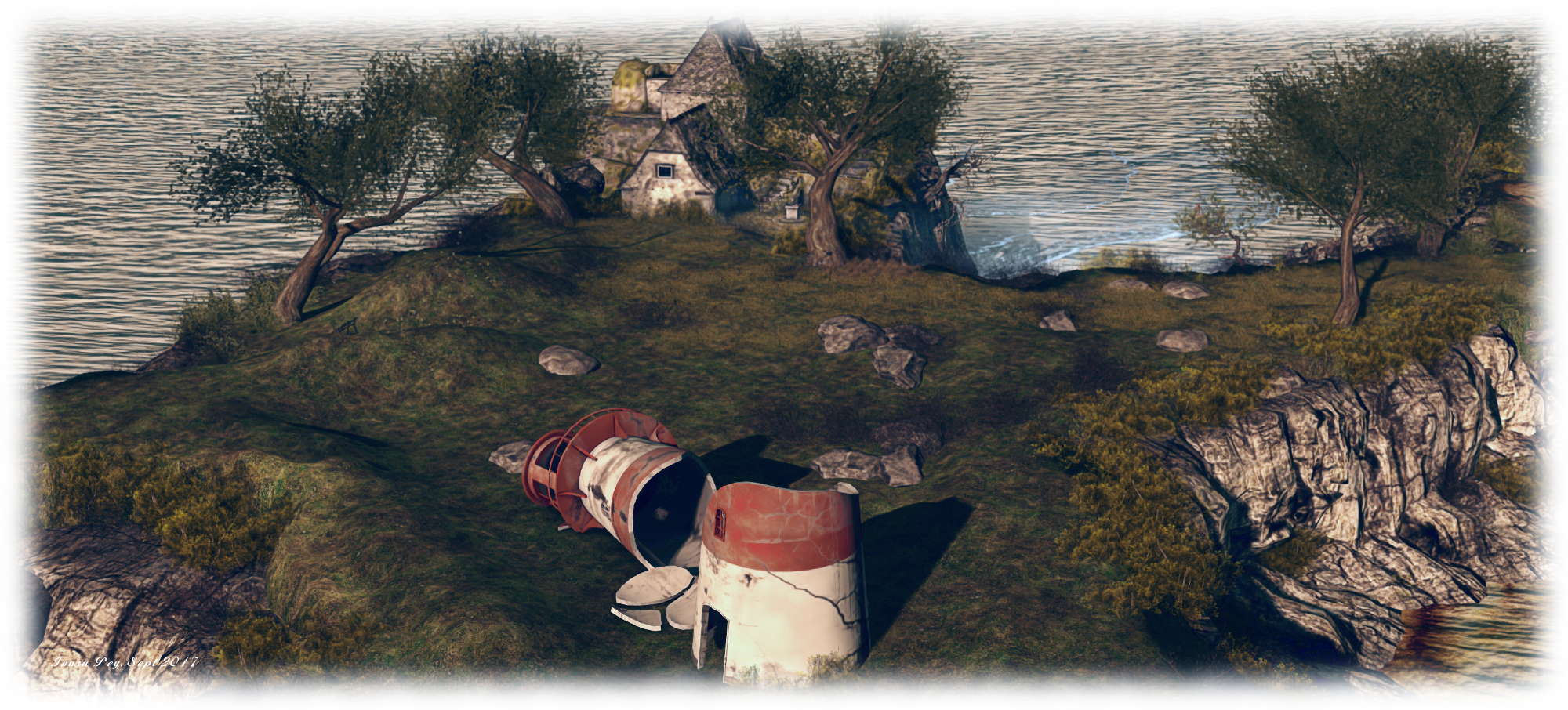
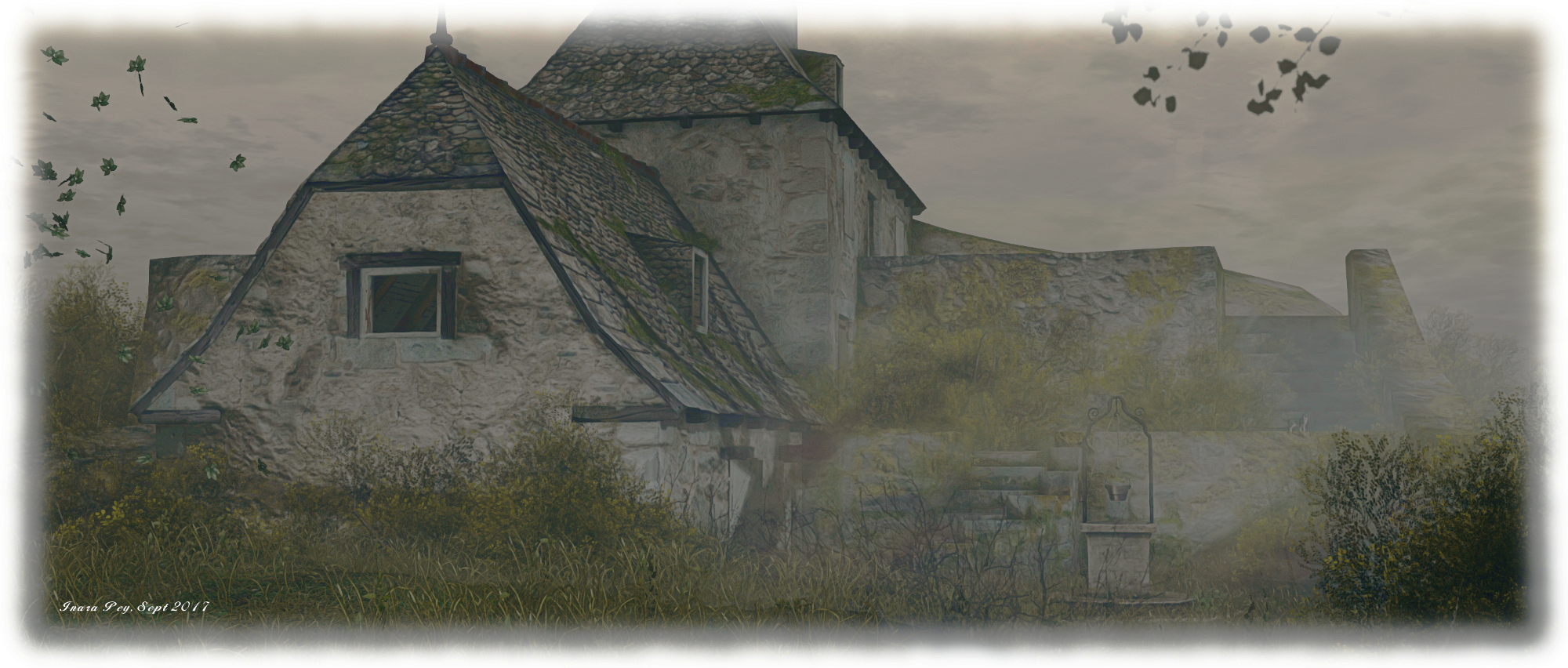
South of this track a narrow neck leads to the south side of the island, a bulbous headland where a broken carcass of an old lighthouse sits. This seems to point accusingly towards the shadowy bulk of a ruined farmhouse sitting hunched against a rocky shoulder, gathering the mist about itself forebodingly. A sandy bay sits below the ruined house, but even this has its own warning – the wreck of a trawler lays against the foot of the cliffs.
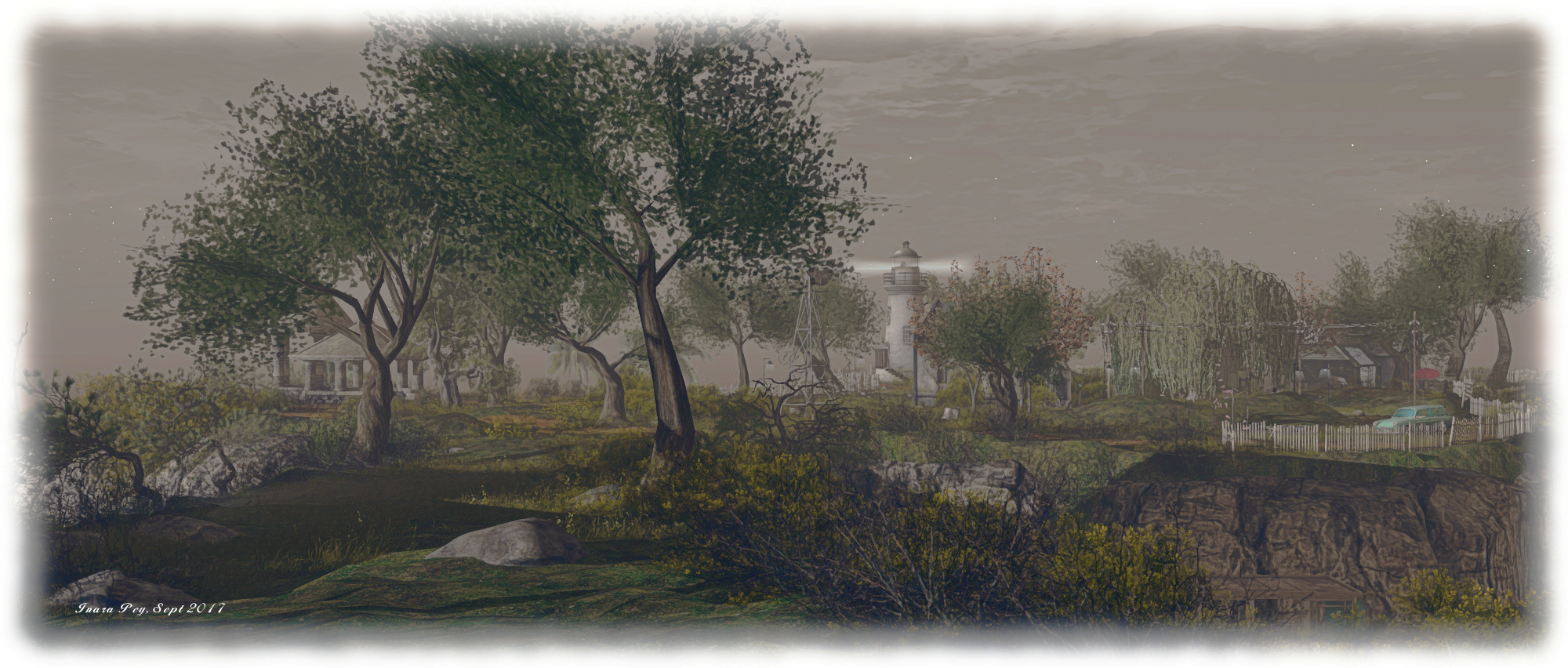
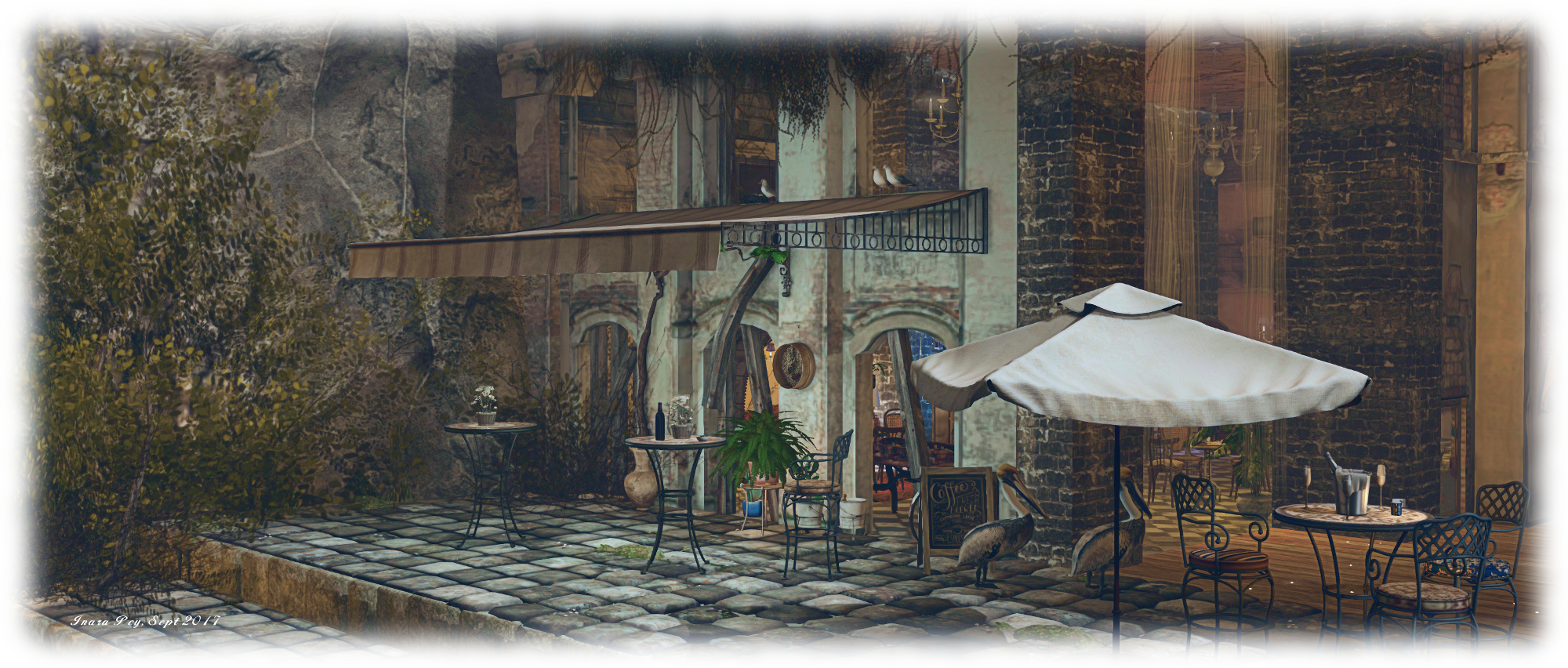
To replace the fallen lighthouse, a new one stands above the cliffs in the north-west corner of the island, looking westward out over the low hump of one of the accompanying islands while also casting an eye over the beach, which starts against the northern cliffs and runs round much of the east side of the island. An old bridge, in need of some repair reaches out over sand and sea from the beach, almost reaching the sands of the second of the smaller islands, which is home to a little coffee shop sitting on its rugged shoulders.
The main islands’ curving beach is reached via a switch back path which descends from the northern end of the track circling the island. And old warehouse, filled with an artist’s bric-a-brac sits overlooking the path down to the beach, a barbed wire fence discouraging the local sheep from wandering too close. This warehouse / studio brings visitors almost full circle, standing as it does a short distance from the chapel and the landing point. But this is far from all there is to be discovered here.
Walk along the path to the chapel, and you’ll find that it is not all it appears to be. Just inside the doorway, and surrounded on three sides by undergrowth which almost looks like it is trying to take over the place, is a set of steps leading down. Follow these, and you’ll find the club mentioned in the region’s description.
This is, quite frankly, beautifully done, with tall pillars of brick supporting a high ceiling, a frontage of old, weathered buildings offering a view out over a terrace and secluded bay. The bar offers a homely if roughshod welcome while a dance area sit at the foot of the steps leading down from the chapel. Two side rooms off of this offer a taste of shoddy-chic where patrons can relax. Almost entirely invisible from the ground above, with atmosphere added by the passing trawler off-shore passing ghost-like in the haze, the club area is an exquisite outpouring of imaginative design.
In fact, the entire region is an exquisite design. While the default environment settings add considerable atmosphere – as used in fur of the images here – the land really does lend itself to a wide range of windlight settings and different times of day, making it perfect for photographers. There are also several spots for sitting and passing the time – not just in the bar, but up along the path running around the islands and over at the coffee-house, making it the kind of place people may want to sit and enjoy, even if they don’t fancy mingling with those down in the club.
Tyrah and the Curse of the Magical Glyches – bonus region portals
On Monday, September 18th, 2017, Linden Lab announced the launch of their latest Experience Key based game for Second Life users to enjoy. Entitled Tyrah and the Curse of the Magical Glytches, it is something of a departure from previous games such as Linden Realms, PaleoQuest and the Horizons adventure. Not only is it grid-wide in nature (the first time Second Life experiences have been used on a grid-wide basis), it will in time also allow parcel holders to host the game on their land if they so wish – possibly attracting traffic to their locations.
I was able to see and try the game ahead of its launch, and thought I’d offer an overview and some feedback, as well as take the opportunity to ask a few questions of Dee and Patch Linden about the game and the reasoning behind it.
Tyrah and the Curse of the Magical Glytches is a combination hunt, capture game and first-person shooter. It builds on elements seen in previous games from the Lab, but is far broader in scope. There are two basic aims of the game:
Capture mischievous Glytches as they wander SL and perhaps gain gems from them, and / or an immediate prize of a Glytch – which might be a shoulder / head pet, held pet, or follower (all of which can be traded between users) or even complete avatars.
Collect coloured gems – which can be redeemed for weapons upgrades, and/ or access into the game’s bonus regions and / or prizes
A video outlines the game’s back story. I’m not going to say much on this other than, “alas, poor Magellan, I knew him, Horatio. A fellow of infinite drinking ability and most assured desire for food…” – or something (with apologies to W. Shakespeare, Esq).
Hartyshire
Game-play Essentials
There are several aspects to playing the game, which are covered in another video; but for those who prefer to read things, I’ve outlined them below.
Hartyshire
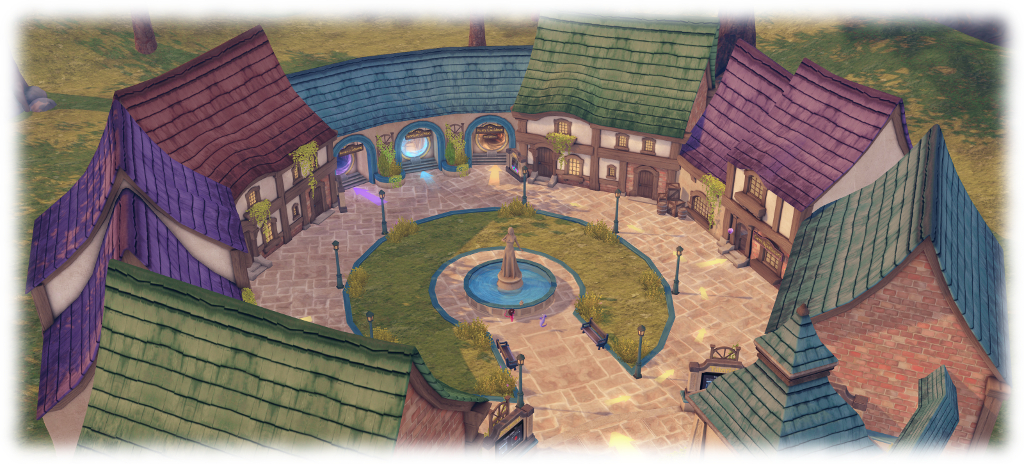
Hartyshire is the heart of the game. Reached via the Portal Park, it is the place where people can learn more through the aforementioned videos, and where players obtain their Glytch Starter Kit, can upgrade their weapons, claim prizes or – gem and weapons upgrades allowing – access the special bonus regions. There is also a range of free gifts for visitors, whether or not they join the game. There are three important areas in Hartyshire:
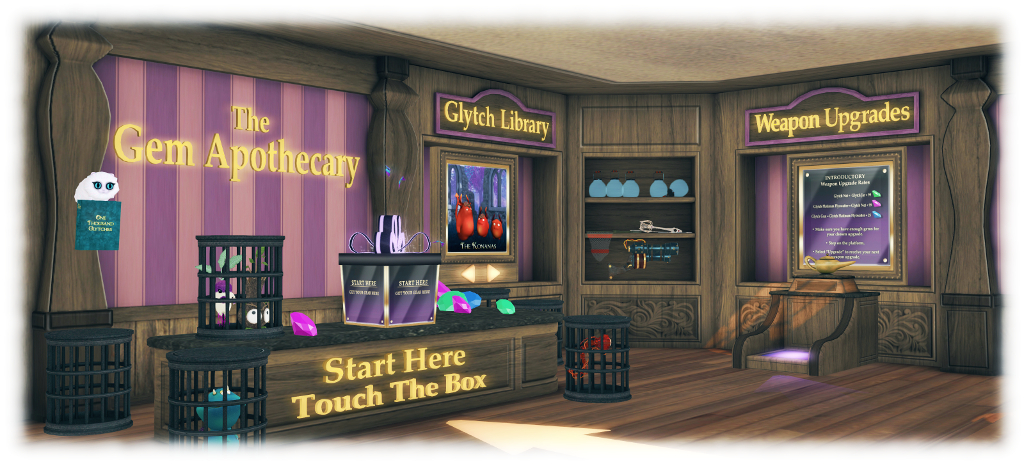
The Gem Apothecary is where players can:
Obtain a game Starter Kit: with everything needed to start playing: a note card of instructions, the game HUD (see below) and a jar – your first Glytch catching weapon. The kit is delivered as a folder to your Inventory.
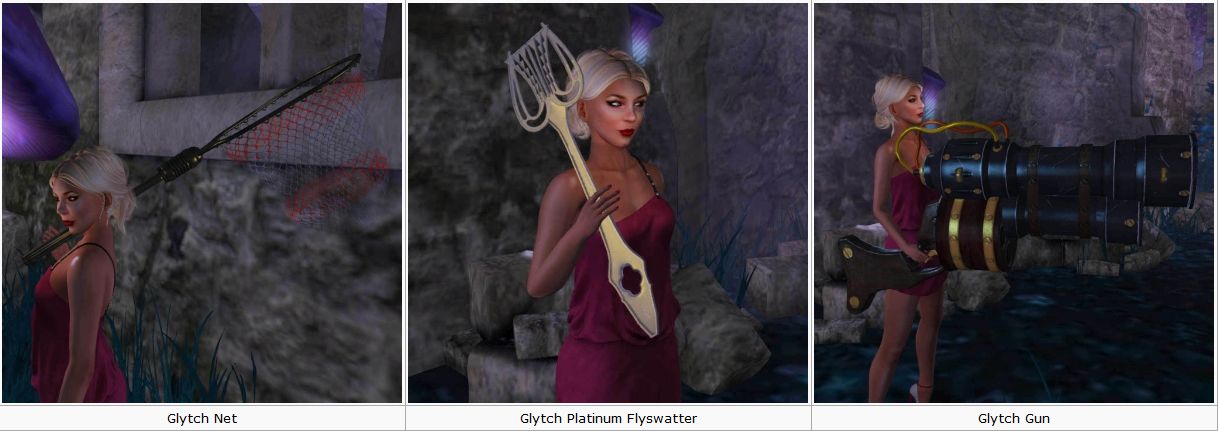
Upgrade their Glytch catching weapon: use gems given by Glytches to upgrade from jar through swatter and net to gun. Each weapon improves the chances of catching Glytches. Replacement weapons can also be obtained here.
Claim Gem Lottery Prizes: contains prizes from the Lab’s previous games, split into three groups – Common, Rare and Epic, corresponding to the three gem colours – Green, Pink and Blue. Prizes in each category can be obtained by redeeming the required gems of each colour.
Inside the Gem Apothecary – start kit, weapons upgrades and “captured” Glytches
The Gift Shop is where visitors to Hartyshire can collect game-related free gifts and hatch their SL14B gift egg to gain their first Glytch.
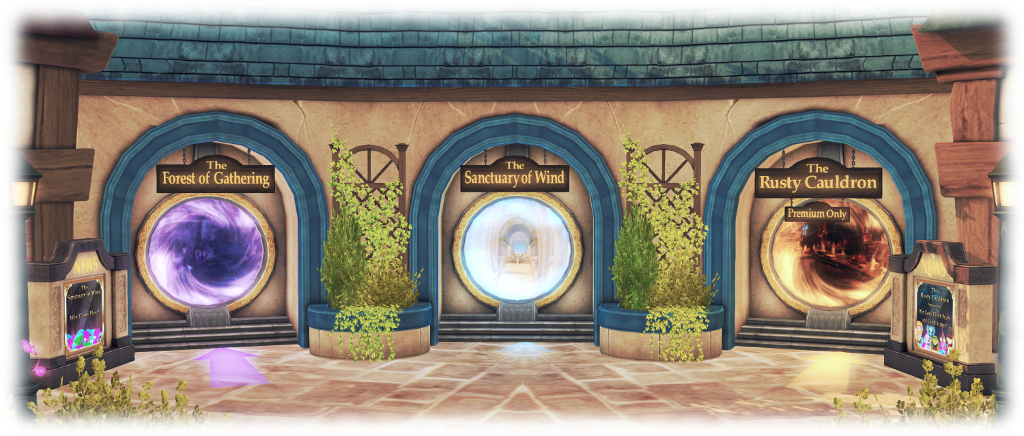
The Bonus Region teleport portals – of which, more below.
The Glytch catching weapon upgrades. Credit: Linden Lab
The HUD
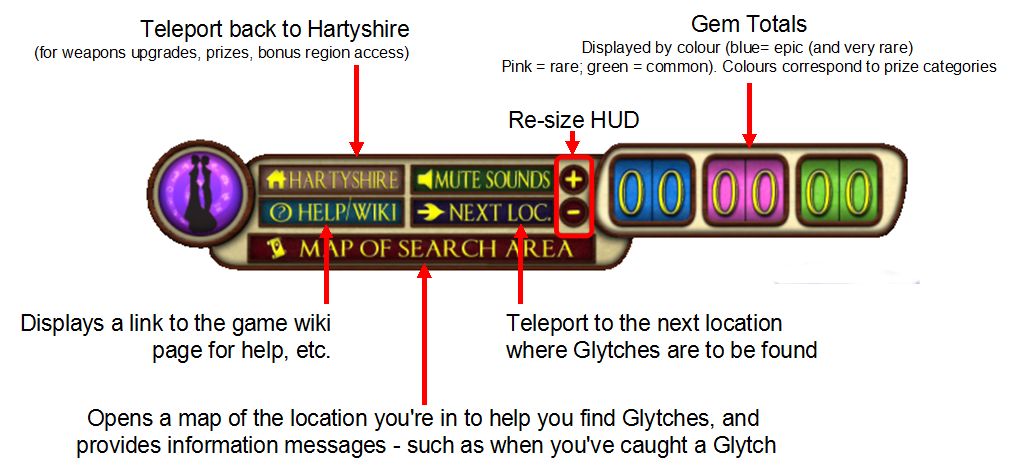
To play the game, players must wear the game HUD. Removing this at any time stops all game-play, saving the player’s current status (e.g. gems taken, current weapon upgrade, etc). Players can re-join the game at any time simply by wearing the HUD once more; there is no need to return to Hartyshire in order to do so. The Glytch catching weapon can also be worn, although the game will also function without it.
The main game HUD
With the HUD worn, players click the Next Loc(ation) button to teleport to a location where they can hunt Glytches. On arrival, the Map can be opened to see where the Glytches are. A maximum of five Glytches can be caught per location, after which players should use Next Loc to move to another location to continue the hunt.
At the moment, Glytches can only be found on assorted Linden / LDPW regions and parcels. In the future, residents will be able to apply for their land to be added to the game – of which more anon.
Glytches
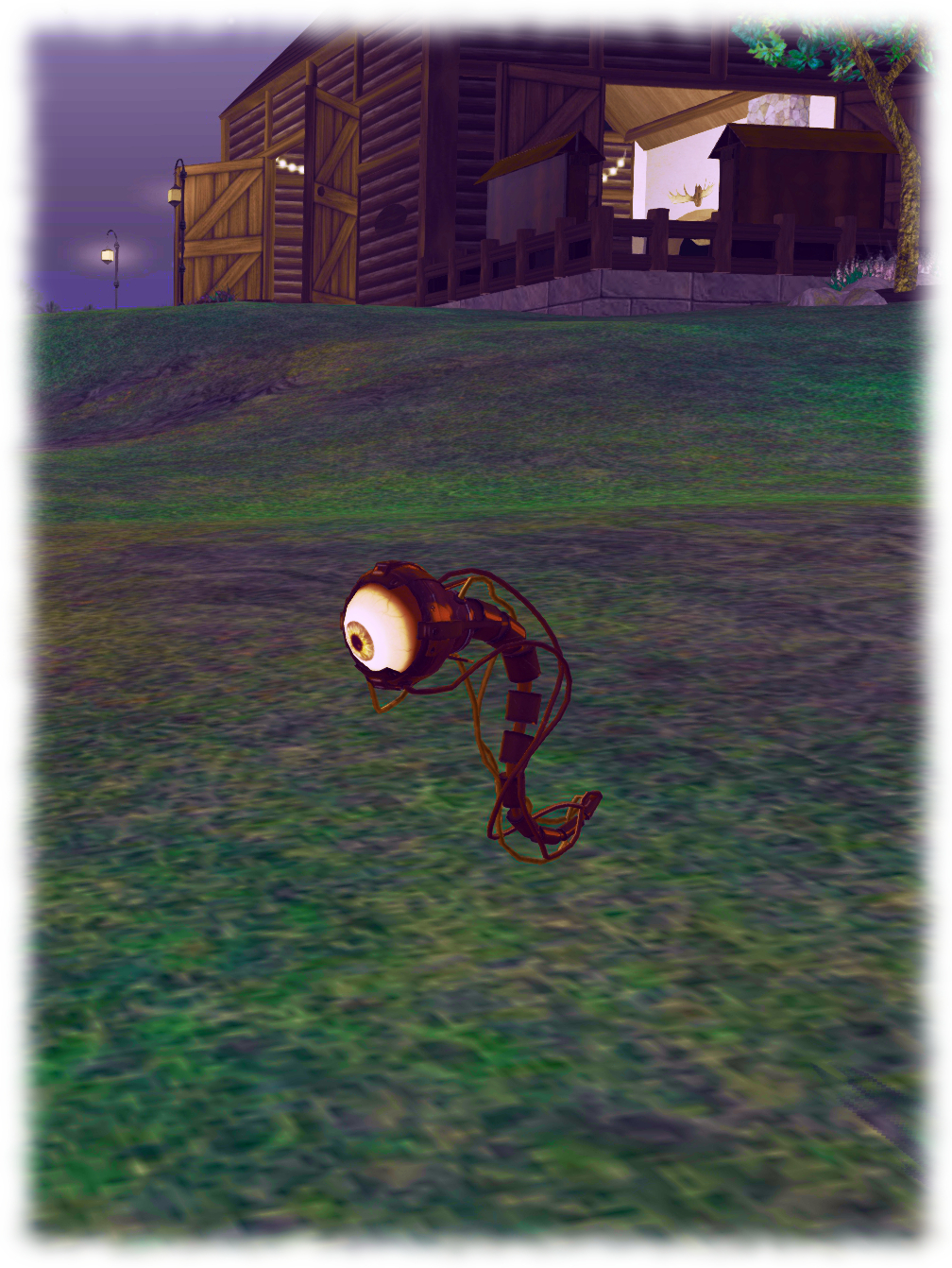
A Glytch in the wild – is worth more in your cage
Glytches can be hunted in either first- or third-person view, but must be captured in first-person (Mouselook) view by clicking on them with the left mouse button. Note the range at which a Glytch can be caught varies with the weapon being used, and not all captures will be successful.
A failure to catch a Glytch can result in it casting a spell on the hunter. They’ll also use spells if startled or to protect one another. Spells vary from silly dances to anvils dropping on heads, but they will allow the Glytch to escape by de-rezzing (another will rez nearby).
A successful capture will result in a cage appearing around the Glytch and a message displayed on the game HUD. The Glytch may also offer you a reward. This might be gems or it might be a Glytch prize – or both.
Note that when a glitch prize is given, players must switch to third-person view (ESC) and Accept the Glytch via the notification displayed in the top right of the viewer window. Failure to do so may result in the prize being lost. If the notification collapses before it is clicked on, it can be re-opened via the Notifications tray.
To help keep the game fresh, new Glytches will be added over time A wiki-based Glytchopedia will also be published in due course, listing all the Glytches.
Logos representative only and should not be seen as an endorsement / preference / recommendation
Updates for the week ending Sunday, September 17th
This summary is published every Monday, and is a list of SL viewer / client releases (official and TPV) made during the previous week. When reading it, please note:
It is based on my Current Viewer Releases Page, a list of all Second Life viewers and clients that are in popular use (and of which I am aware), and which are recognised as adhering to the TPV Policy. This page includes comprehensive links to download pages, blog notes, release notes, etc., as well as links to any / all reviews of specific viewers / clients made within this blog
By its nature, this summary presented here will always be in arrears, please refer to the Current Viewer Release Page for more up-to-date information.
Official LL Viewers
Current Release version 5.0.7.328060, dated August 9th, promoted August 23rd – No change
Wolfpack RC viewer updated to version 5.0.8.328990, September 12th – this viewer is functionally identical to the release viewer, but including additional back-end logging “to help catch some squirrelly issues.”
Maintenance RC viewer, version 5.0.8.328951, released on September 11th.
The third Spoonful of Sugar festival, opened its doors on Saturday, September 16th, 2017 and will run through until Sunday October 1st, bringing together fashion, home and garden and breedable designers and creators together with DJs and live performers to help raise money for Médecins Sans Frontières (MSF).
Also known as Doctors Without Borders, MSF was founded in Paris, France in 1971 as a non-profit, self-governed medical humanitarian organisation delivering emergency aid to people affected by armed conflict, epidemics, natural disasters and exclusion from healthcare around the globe, based on need, irrespective of race, religion, gender or political affiliation. Since that time, MSF has grown to a movement of 24 associations, bound together as MSF International, based in Switzerland. Thousands of health professionals, logistical and administrative staff – most of whom are hired locally – work on programmes in some 70 countries worldwide. See the video at the end of this article for more on MSF.
Established by Ever Courtois and Angelique Wickentower, Spoonful of Sugar (SOS) aims to raise money for MSF as a part of the organisation’s Vital Pact Campaign. Highlights of the autumn 2017 event include:
Four SOS Shopping regions featuring more than 150 stores selling clothes, hair, jewellery and home and garden items.
A gacha orchard.
An events area.
Auctions and raffles.
The SOS Home Giveaway Raffle – the chance to win a fully furnished home in the SOS silent auction.
Spoonful of Sugar: the Home Giveaway raffle prize
A full shopper’s guide is available, and participating creators have items on sale via special SOS vendors, with between 50% and 100% of proceeds of sales being donated to SOS. The entertainment guide provides details of who is providing the music and when, at the entertainment barn on the main Spoonful of Sugar region.
The Home Giveaway raffle features the grand prize of an Imbrie Farmhouse and Gazebo by *Funky*Junk* and furnished by the Spoonful of Sugar sponsors. Tickets are L$100, and details of all raffle prizes can be found here. The house can be seen a short distance away from the Spoonful of Sugar information point.
September 14th, 2017. One of the final images captured by Cassini as it approaches Saturn for the last time, with mysterious Enceladus visible beyond the limb of the planet. The thin blue haze seen in the picture is the atmosphere above Saturn’s cloud tops, where the spacecraft finally disintegrated. Credit: NASA/JPL / Space Science Institute
At 12:55 UT (13:55 BST, 08:55 EST, 05:55 PDT) the very last signal was received from the NASA / ESA Cassini spacecraft as it entered the upper reaches of Saturn’s atmosphere before disintegrating and burning-up. It was received 83 by NASA’s ground station near Canberra, Australia, 83 minutes after being transmitted – by which time the probe had already been destroyed.
At mission control, at the Jet Propulsion Laboratory, operated jointly by NASA and Caltech in Pasadena, California, it was an emotional moment. For many, the mission had been a part of their daily lives for nigh-on 20 years.
“The signal from the spacecraft is gone and, within the next 45 seconds, so will be the spacecraft,” Cassini programme manager Earl Maize announced, his voice catching, to the team gathered in mission control. “I’m going to call this the end of mission.” He then turned to Spacecraft Operations Team manager Julie Webster and hugged her, before giving Linda Spilker, the Cassini Project Scientist a hug as well. That loss of signal came within 30 seconds of the time predicted ahead of Cassini’s final dive.
Cassini Project Manager Earl Maize (centre left) and Spacecraft Operations Team Manager Julie Webster embrace after the Cassini spacecraft plunged into Saturn, Friday, September. 15, 2017. Credit: NASA / Joel Kowsky
As I reported last week, The Cassini-Huygens mission has been an incredible voyage of discovery, revealing so much about Saturn, its rings and retinue of moons, including hints on the evolution of life itself and revealing how moons Titan and Eceladus may have all the right conditions to support basic life while Tethys could – like Enceladus – have a liquid water ocean under its ice.
Cassini’s final approach commenced on September 11th, as it started back towards Saturn having made a final pass between the planet and its rings and looping away from both the week before. Passing by Titan, and once more using the moon’s gravity to push it into the correct trajectory, the probe headed back for its final encounter with Saturn. The Titan fly-by presented a last opportunity to image and study the moon before Cassini’s imaging system was focused on Saturn for the first part of the final approach. Imaging Saturn ended on Thursday, September 14th as the vehicle re-oriented itself to gather as much data on its brief passage into the upper reaches of Saturn’s atmosphere.
Time line of the final plunge. Credit: NASA
As I’ve previously noted in my Cassini mission updates, the primary reason for sending the probe into Saturn’s atmosphere was because it had exhausted almost all of its on-board fuel supplies used to orient itself and to adjust its flight through the Saturnian system, and the mission team didn’t want to leave the probe tumbling around Saturn’s moons where it might one day impact one of them and contaminate it with both Earthly microbes which may be dormant inside the vehicle, and which radioactive debris from its electrical power generators.
However, an alternative would have been to use the last of the vehicle’s fuel to boost it away from Saturn and out into space, but the scientific return promised by a final plunge into the planet was too good to refuse. “Saturn was so compelling, so exciting, and the mission we finally came up with was so rich scientifically that we just couldn’t — we had to finish up at Saturn, not some place else.” Earl Maize stated during a press conference after the probe’s fiery end.
There are currently no planned missions that will follow Cassini-Huygens to Saturn, although there are proposals to send missions to Titan. However, while the active part of the mission has come to an end, it’s not an end of the mission’s science.
“We have collected this treasure trove of data, so we have decades of additional work ahead of us,” Linda Spilker, the Cassini Mission Scientist said. “With this fire hose of data coming back basically every day, we have only been able to skim the cream off the top of the best images and data. But imagine how many new discoveries we haven’t made yet! The search for a more complete understanding of the Saturn system continues, and we leave that legacy to those who come after, as we dream of future missions to continue the exploration we began.”
As a closing note – for now – it’s not often that a space mission gains an official music video; but Cassini-Huygen has been a major inspiration for many over the past two decades, it has earned not one, but three official music videos which form a suite of music by three composes: Iniziare (Italian: “to start” by Sleeping At Last, aka Ryan O’Neal), Kanna (Icelandic: “Explore” by Sarah Schachner) and Amaiera (“end” or “stop” by Joseph Trapanese). I’ve embedded the first part below.
SpaceX Launch X-37B
On Thursday, September 7th, a SpaceX Falcon 9 booster launched the US Air Force X-37B secret mini-shuttle into orbit ahead of the Florida coast being hit by hurricane Irma. It marked the 13th Falcon 9 launch of 2017, and the fifth flight overall for the X-37B.
The USAF’s X-37B Orbital Test Vehicle (OTV) on the runway at Kennedy Space Centre, May 7th, 2017, at the end of the 717-day OTV-4 mission, being “safed” by a Boeing team in protective suits to guard against harmful fumes and gases given off by the vehicle. Credit: USAF
OTv-5 (Orbital Test Vehicle flight 5) saw the automated spaceplane placed into a higher inclination orbit than previous missions – thus expanding the vehicle’s flight envelope. However, in keeping with previous missions, the USAF has remained mostly silent on the mission’s objectives or its intended duration, revealing only that one experiment flying is the Advanced Structurally Embedded Thermal Spreader II (ASETS-II), which will measure the performance of an oscillating heat pipe.
Previous OTV missions have been long-duration flights, with the maiden flight in 2010 lasting 224 days and 9 hours, which each mission lasting longer than the last, with the last mission completed, OTV-4, totalling 717 days and 20 hours in orbit. The flights have, up until now, alternated between the two known X-37B vehicles, so although it has not been confirmed, it is believed this mission is being carried out by the first X-37B to fly in space.
The SpaceX Falcon 9 first stage descends to a safe landing at Cape Canaveral Air Force Station after sending the X-37B OTV on its way to orbit on September 7th, 2017. Credit: Ken Kremer
The launch took place from Kennedy Space Centre’s Launch pad 39A, which SpaceX has leased from the US space agency and refurbished to handle Falcon 9 and Falcon Heavy launches – and which is now liable to be the pad from which the company’s massive ITS super-heavy rocket will depart when it enters operations in the 2020s. After separating from the upper stage and its cargo, the Falcon 9 first stage performed a “burn-back” manoeuvre and flew back to SpaceX’s dedicated Landing Zone-1 (LZ-1) at Cape Canaveral Air Force Station alongside Kennedy Space Centre, offering spectators a superb view of the landing.



 Inara Pey: Living in a Modemworld