On Tuesday, April 26th, Linden Lab announced the opening of applications for creators wishing to access their next generation virtual experiences platform, “Project Sansar”.
The press release on the announcement reads in part:
New Platform Enables User-Created Social VR Experiences
SAN FRANCISCO – April 26, 2016 –Linden Lab®, the creators of Second Life®, today announced that applications have opened for an upcoming “Creator Preview” for Project SansarTM, the new platform for user-created social VR experiences. Interested 3D content creators can now apply at ProjectSansar.com and accepted applicants will begin to receive invitations later this summer.
Slated for general availability at the end of 2016, Project Sansar will democratize virtual reality as a creative medium. It will empower people to easily create, share, and ultimately monetize their own interactive social experiences that can be enjoyed in VR with head-mounted displays like the Oculus Rift and HTC Vive, as well as via PCs and, later, mobile devices. The platform enables professional-level quality and performance with exceptional visual fidelity, 3D audio, and physics simulation, while also solving the complex engineering challenges that have previously limited creating and publishing social VR experiences to just sophisticated professionals.
While not entirely VR HMD centric, Project Sansar is being built to leverage the anticipated market for VR HMD-focused social and other experiences
It has been previously indicated by the Lab’s CEO, Ebbe Altberg that access to the new platform will initally be creator-focused, with priority given to those who have ideas / projects which can help Linden Lab further develop and enhance the platform in terms of its initial target audiences, and who are willing to give feedback and provide input to the Lab on exactly how the platform might be improved. This is very much reflected in the on-line application form, not only within its title, but also in the information being sought, focusing on potential market sector reach (e.g. education, commerce, design and architecture, fashion, games, media, health, etc.), and on tools used by applicants for content creation.
Those who are seeking a “sneak peek at Project Sansar will have to continue to wait; however the is an option within the creator sign-up for non-creators to subscribe to receive information updates on the platform by e-mail from the Lab.
Alchemy viewer updated to version 4.0.0.37561 (Beta) on April 16th. This is another progressive update, containing a lot of under-the-hood improvements and fixes – notably around rendering – and a new visible update in the form of a client-side animation override capability, modelled after the one most popularity seen in Firestorm.
The update also sees a Linux 64-bit release as well, although going by the comments following the release notes blog post, there appear to be log-in issues associated with the Linux version.
This, and the previous “beta” release are intended to get the team’s own updates in front of users ahead of some major updates which will be forthcoming as Alchemy (as with all other viewers) merge with some significant releases coming down the pipe from Linden Lab (including the Avatar Complexity capabilities and – eventually – the Project Bento updates).
As the AO update is the most visible change with this release, and given I am not a regular Alchemy user (although I find it possibly the best viewer for video capture), the rest of this article focuses on the AO aspect of the update.
The client-side animation override (AO), is intended to replace he need for HUD-based scripted animation overrides, instead driving animations – walks-sits-standing poses, etc – directly through the viewer, thus freeing-up simulator resources. Using one does require a little work in setting-up (but so can HUD-based systems), but you can run multiple animation sets directly from the viewer.
Essentially, the AO system comprises three parts:
The animations you wish to use, which you will need to copy / move from any associated HUD system to your inventory – placing them in a folder within your Animations system folder is often a good way to do this
A configuration note card defining the animation you wish to use. Like configuration note cards found in many ZHAO -based animation overrides (so simply using the note card found within your scripted AO system should work OK), this defines animations by type: stand, walk, sit, etc (you can also manually create an animation set if no configuration note card is available)
The viewer UI elements.
To use the client-side AO, you’ll need to have the animations you wish to used stored within your inventory (not within another AO system) (l), and a suitable note card defining the animations you wish to use with the AO (r)
Once you have done this, you’re ready to set-up the client-side AO system. You can access the AO floater in one of two ways:
By adding the AO button to your viewer toolbar and then clicking on it to open the AO floater
By hovering the mouse over the AO icon at the top right of your screen to display a minimised AO floater.
The latter is actually the easiest, given the way Alchemy have implemented to AO system. Assuming you take this approach, click on the spanner icon in the minimised AO floater to expand it.
The client-side AO floater – minimised (l) and expanded (r)
Now, simply drag and drop the configured animation note card from your inventory to the AO floater. This will cause Alchemy to configure the AO system ready for use, and result in a list of your animations appearing in the floater. At the same time, a set of links will be created in the Animation Override folder in your inventory – do not delete these!
Alternatively, if you don’t have a configuration note card for an animation set, click the + button on the AO system floater, type in a name for your animation set, then drag and drop all of the animations you want to use in the set from your inventory into the AO system floater.
The AO floater with the loaded animation set (l) and the associated links in the Animation Overrides folder in your inventory (r)
Lab Chat is the name of the public Q&A series aimed at providing Second Life users with the opportunity to have their questions put to Lab management and personnel.
The first two sessions in the series took place in November 2015 and January 2016 respectively, with guest Ebbe Altberg, CEO of Linden Lab. Each event covered both Second Life and Project Sansar and saw Ebbe respond to questions selected from those put forward to a forum thread ahead of each event.
For those who missed the first two shows, you can catch up with them through my transcripts, which include audio from the events and are available below:
The third in the series has now been officially announced, and will once again feature Ebbe Altberg, who will this time be joined by Oz and Troy Linden. The 1-hour event will once again take place at the Linden Endowment for the Arts Theatre, on Friday, May 6th, starting at 10:30 SLT.
About the Guests
Oz Linden – Director of Second Life Engineering
Oz Linden is the Director of Second Life Engineering at Linden Lab, and is perhaps most noted for his involvement with viewer development, including contributions from the open-source community and TPVs. He oversees almost all aspects of the technical development of Second Life, both viewer and server, and works closely with his engineers and developers to ensure Second Life continues to be enhanced.
Troy Linden is a Senior Producer of Second Life at the Lab, and has been involved in bringing numerous high-profile projects within SL to fruition, and is currently engaged in Project Bento, the project to greatly extend the second Life avatar skeleton, which Oz’s team is currently working on together with members of the SL content creation community.
Both Oz and Troy will be at the Lab chat session to directly answer questions on Project Bento, the SL development process and roadmap and on Second Life features, while Ebbe will doubtless cover any questions related to Project Sansar, if they arise (! 🙂 ).
Present Your Questions
The Lab is inviting questions on these topics to be submitted to the official forum thread, no later than Friday, April 29th, 2016. A selection of questions will then be drawn from those submitted and put to Ebbe, Oz and Troy during the recording of the show and before the live audience at the theatre.
In difference to the first two Lab Chat events, the May 6th session will be recorded as audio only. I also hope to be at the event, and will have a full transcript of proceedings available through these pages (with audio extracts) as soon as possible after the show has finished recording.
And to help with Project Bento, here’s the Drax Files World Makers segment introducing the project.
Reader Evelyn Held recently sent me a note card about New Caelestium, “a realistic medieval lifestyle sim with a touch of fantasy”, which celebrated its re-opening on Saturday, April 23rd. I’d actually written about the original Caelstivm (Caelestium) back in March 2014, but had lost rack of it in the intervening years; so intrigued by Evelyn’s note, I hopped over to take a look.
The location of the original Caelestium was, so far as I can remember, unspecified; not so with the new build, which is described as, “a Celtic Isle with Scottish roots, a realistic medieval lifestyle sim with a touch of fantasy”, and I have to say that, as with the original, it is something of an eclectic mix of elements.
Those arriving at the region receive a back story note card, together with the rules of the region and some additional notes on this being a “lifestyle” role-play environment – meaning that visitors are encouraged to wear appropriate clothing and adopt a fitting behaviour and language for a medieval period setting, although as the region encompasses fantasy elements, “dragons, elves, faes, gnomes and other fantasy fellows” are also welcome.
New Caelestium can be broadly divided into four areas: the medieval town and docks, which takes up the largest portion of the region, the jousting area, transported here from the original Caelestium, a coastal area with period manor house, and the fantasy area, dominated by a gigantic tree of life, and over which hovers a set of floating islands.
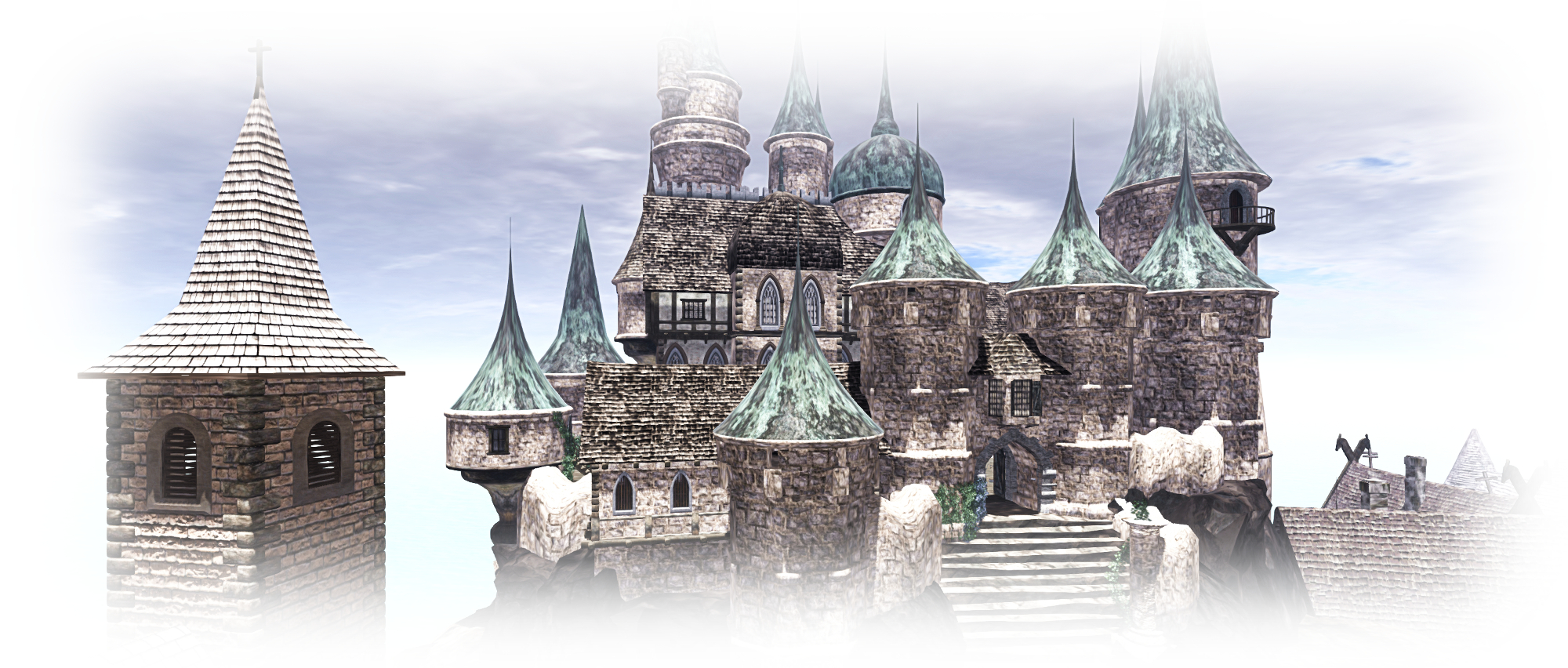
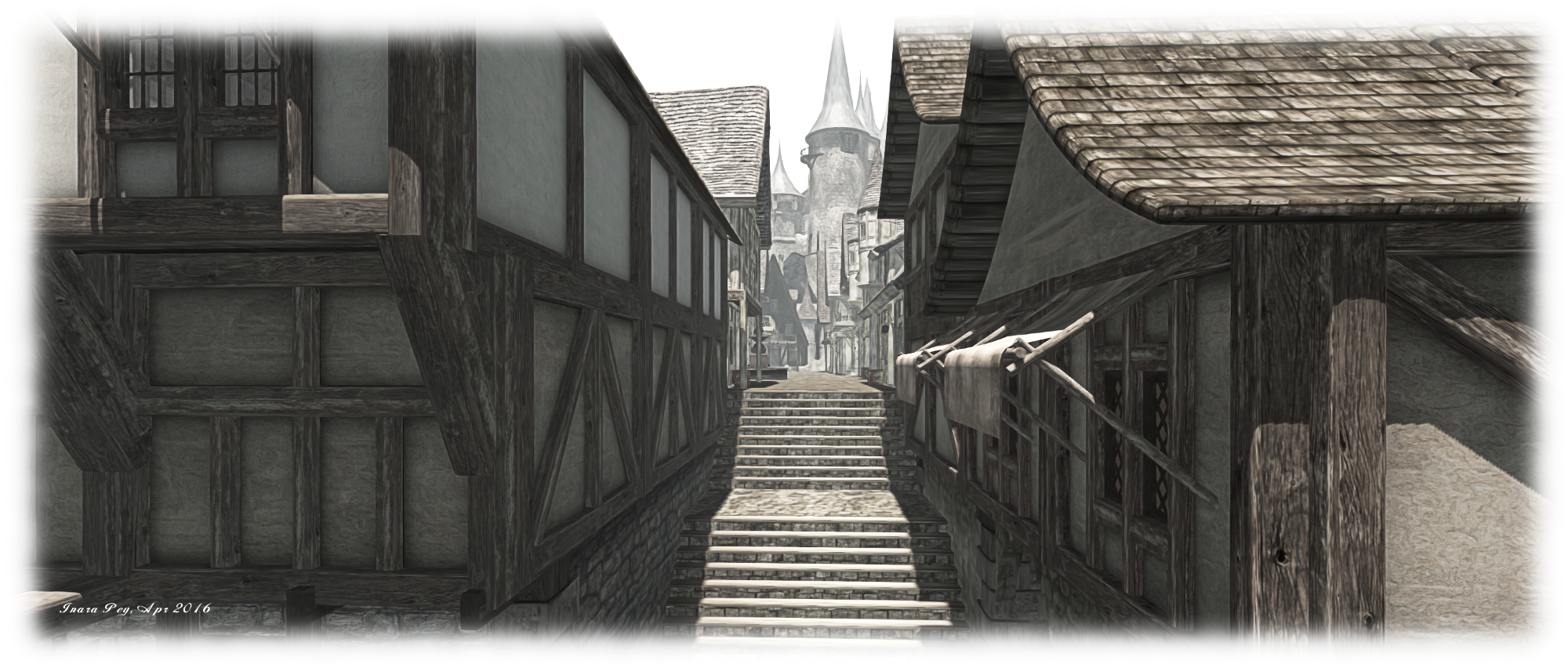
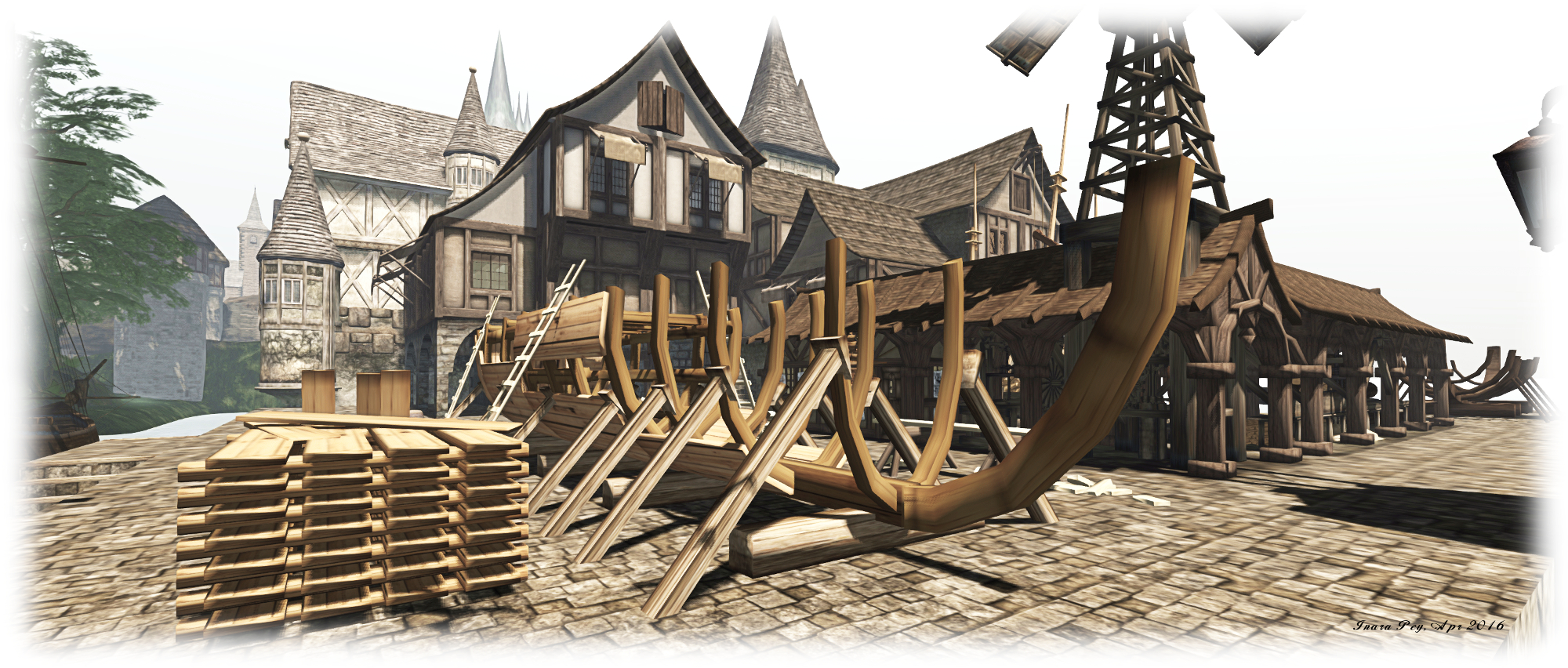
The town and docks are mindful of the original Caelestium, although the quays are a lot busier, several of Lia Woodget’s unmistakable ships being tied-up alongside. The town forms an L-shape, and is dominated by a great castle sitting atop a rocky crag in its corner. Beneath this, a long street points the way to the docks in one direction, whilst the other arm of the L holds the market square and shops, beyond which lies the jousting lists.
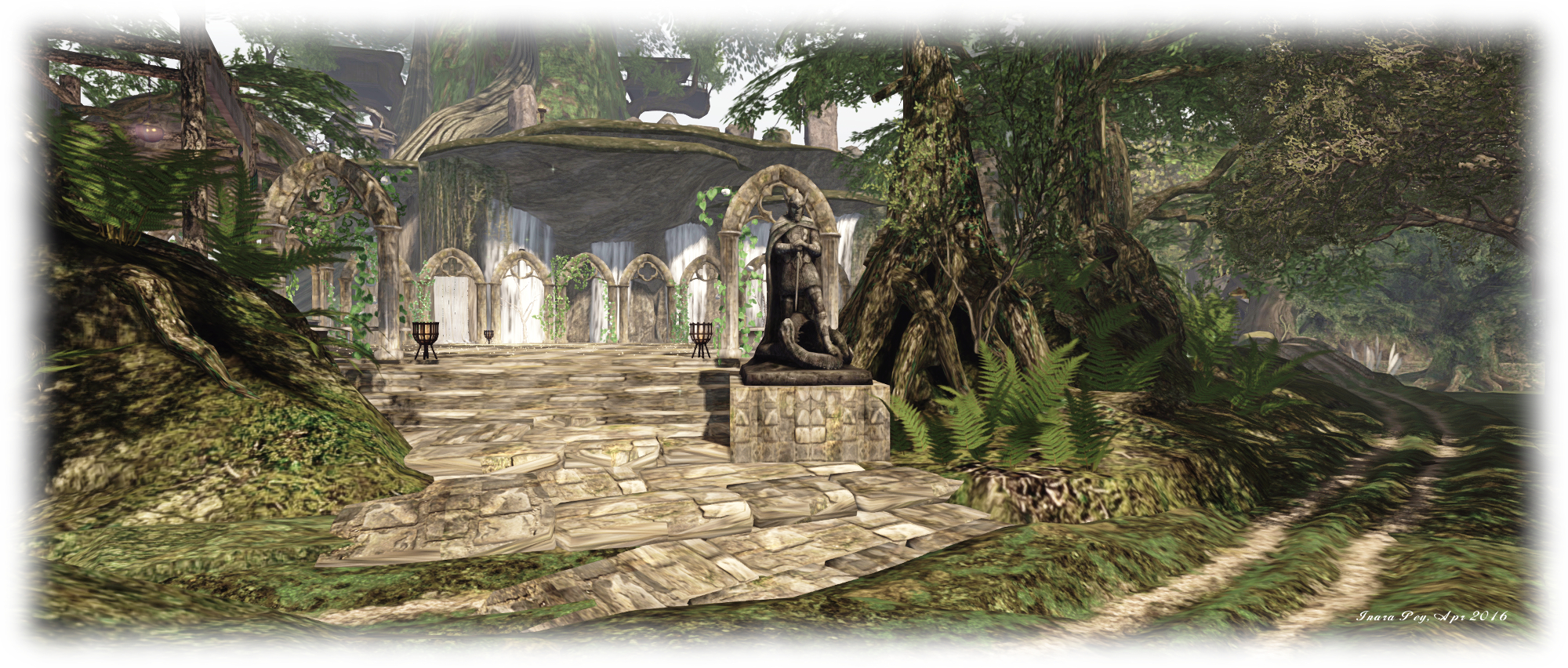
The fantasy / fae area of the region lies separated from the town by narrow ribbons of water crossed here and there by bridges and rutted cart tracks. Here can be found paths to wander, and fae homes to rent (human houses can be rented in the town), while waterfalls tumble from narrow shoulders of rock, and the aforementioned enormous tree of life rises into the sky. It is on the south side of the region, and under lee of these rocky shoulders and the shadow of the great tree, that the coastal area can be found, trees surrounding a ribbon of beach and hiding the manor house from prying eyes.
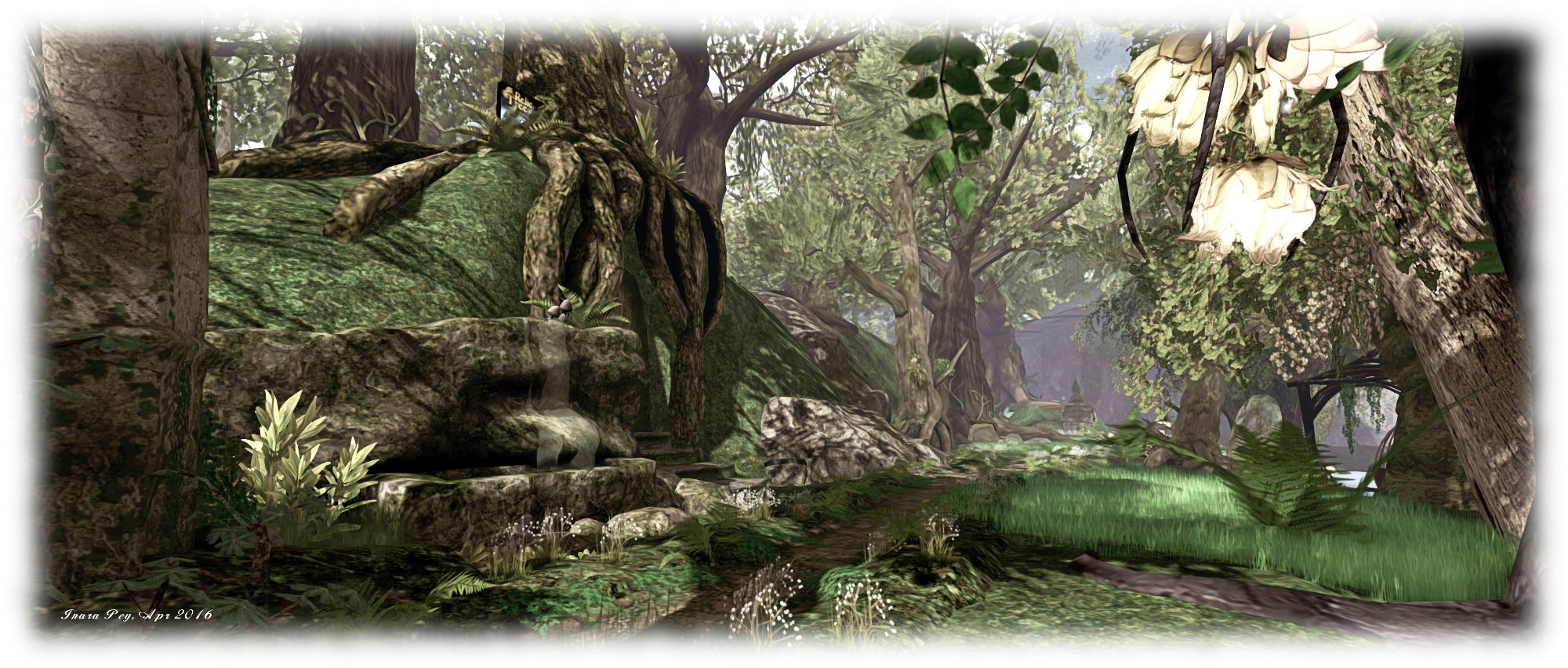
Photogenically, the region has a lot to offer, as I hope at least some of the images here demonstrate. There is also a lot to see when exploring, however, I’m not entirely sure how well it all works.
As I noted in my review of the original Caelestium, that region was also very much a place of two halves – medieval and fantasy – but the overall landscaping was such that the two elements naturally blended together as a single, contiguous landscape through which visitors and players could ebb and flow. That sense of continuity feels a little lost within New Caelestium; rather than existing as parts of a whole, the medieval and fantasy aspects of the region came across to me as vying with one another for space and attention.
Nevertheless, if you are interested in fantasy or medieval role-play, or are looking for a medieval environment ripe for photographs, Caelestium is certainly more than worth a visit.
This summary is published every Monday, and is a list of SL viewer / client releases (official and TPV) made during the previous week. When reading it, please note:
It is based on my Current Viewer Releases Page, a list of all Second Life viewers and clients that are in popular use (and of which I am aware), and which are recognised as adhering to the TPV Policy. This page includes comprehensive links to download pages, blog notes, release notes, etc., as well as links to any / all reviews of specific viewers / clients made within this blog
By its nature, this summary presented here will always be in arrears, please refer to the Current Viewer Release Page for more up-to-date information.
Official LL Viewers
Current Release version: 4.0.3.312816 (dated March 23) – no change
China’s space station, as it should look in 2022 (credit: China Manned Space Engineering)
China has confirmed a series of ambitious new goals for its growing space endeavours, starting with the launch later this year of a new orbital facility, and progressing through 2018 with the launch of the core module for a large-scale space station, and which includes further mission to the Moon and to Mars.
The first orbital facility launched by China, Tiangong-1 (“Heavenly Palace-1”), was launched in 2011. Referred to as a “space station”, the unit was more a demonstration test-bed for orbital rendezvous and docking capabilities. While it was visited by two crews in 2012 and 2013, neither stayed longer than 14 days, and sinc 2013, Tiangong-1 has operated autonomously, although it has suffered a series of telemetry failures in that time.
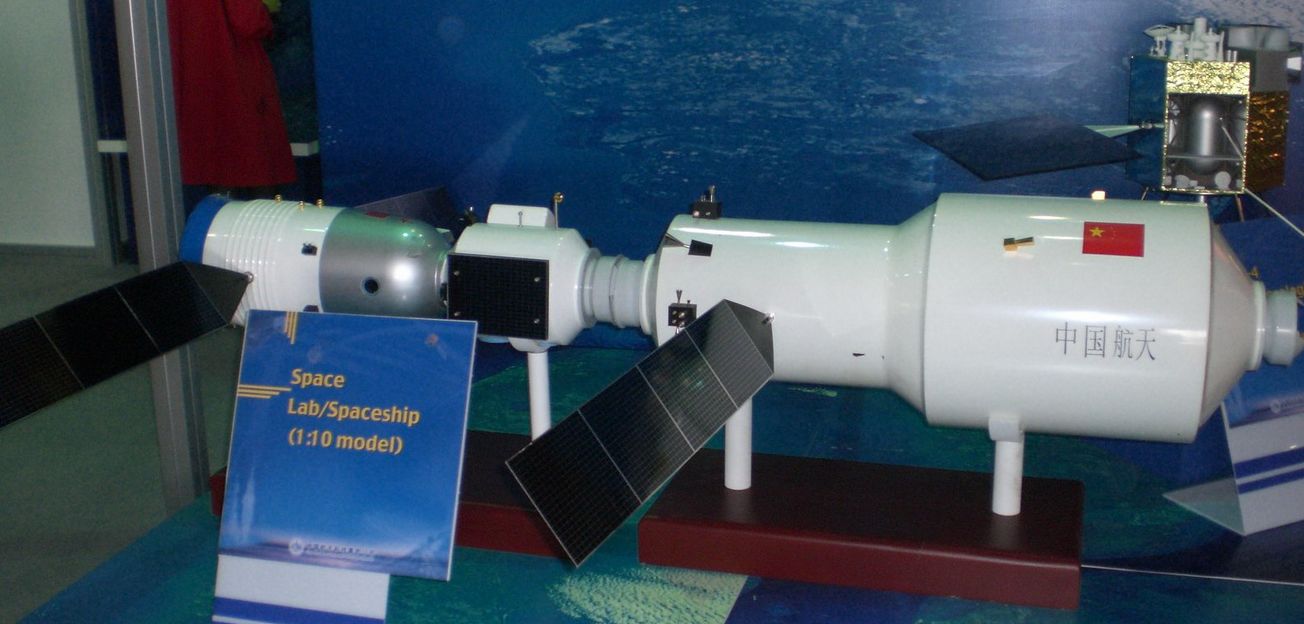
A model of Tiangong-2, which will be 14.4 metres (47 ft) in length, 4.2 metres (14 ft) in diameter and mass 20 tonnes – almost 3 times the mass of the Tiangong-1 unit, seen docked with a crewed Shenzhou (“Divine Craft”) orbital vehicle on the left (Credit: unknown originating source)
Tiangong-2 will be launched later in 2016, and is designed to build on the experiences gained with the original facility, helping to pave the way for China’s first “genuine” space station. In particular, Tiangong-2 will provide an experiments bay, improved living facilities for longer-during stays, and allow China to verify key technologies such as propellant refuelling while in orbit, and undertake fully automated docking activities using uncrewed vehicles, when the nation’s first automated resupply vehicle, Tianzhou-1 (“Heavenly Vessel-1”) docks with the facility in 2017.
Tiangong-2 will be followed, in 2018 by the launch of the larger Tianhe-1 (“Sky River-1”) unit, which will form the core module for China’s first dedicated space station. Over the four years from 2018, this will grow with the addition of up to three other pressurised modules, together with a docked “Hubble-class” space telescope. It be supported and maintained by automated re-supply mission from Earth using the Tianzhou, and provide living and working space for up to 6 crew,
A prototype model of the proposed Mars rover China plans to launch in 2020 as part of a 3-phase mission involved an orbiter / carrier vehicle, a static lander and the rover (credit: China National Space Administration)
Nor does it end there. At the end of March, I wrote about China’s aggressive approach to Mars exploration.
As a part of the series of announcements made by the Chinese authorities in the run-up to their first national Space Day on April 24th, 2016 – being the anniversary of the launch of China’s first satellite, Dongfanghong-1 (‘The East is Red’) – it was confirmed that the planned orbiter / rover mission to the red planet will be launched in 2020.
The rover element of the mission will build on experience gained during the deployment and operation of the Yutu vehicle on the Moon in 2013, and will be used to investigate the planet’s soil, atmosphere, environment, and look for traces of water.
As part of the preparations for this mission – although it is also a mission in its own right – China plans to land the its Chang’e-4 (“Moon Goddess”) probe, on the far side of the Moon in 2017, an operation which will be carried out fully autonomously of Earthside intervention.
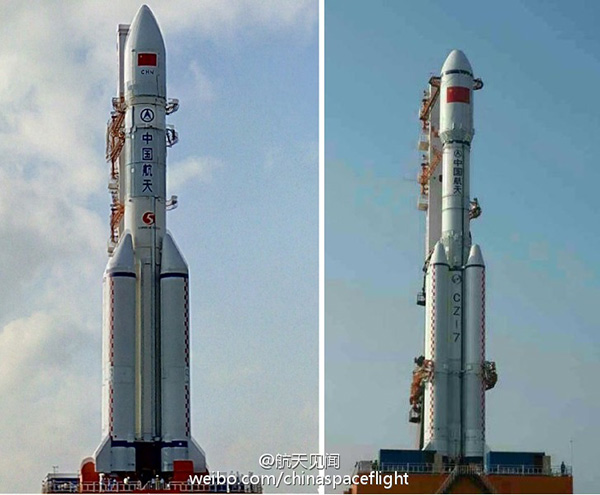
To ensure all this happens, China is developing two new launch vehicle – the Long March 5 and the Long March 7. The Long March 5 will form the backbone of China’s space activities, offering a family of 6 launch vehicle variants, the largest of which will be capable of placing up to 25 tonnes in low Earth orbit (LEO), 14 tonnes in geosynchronous transfer orbit (GTO) for missions to the Moon, Mars or elsewhere, putting it in the same class of launch vehicles as America’s Atlas V and Delta IV launchers, and the commercial SpaceX Falcon 9 launcher.
Using non-toxic and pollution-free propellant, the 60-metre-long vehicle has a core diameter of 5 metres, and will be equipped with four strap-on booster 3.5 metres in diameter, Long March 5 is the first of China’s launch vehicles to specifically designed for both cargo / satellite launches and crewed mission launches. The maiden flight of the vehicle is expected to be the Chang’e-4 mission to the far side of the Moon.
China’s Long March 5 (l) and Long March 7 (r) next generation launch vehicles (credit: Sina Weibo)
The Long March 7 vehicle will be slightly smaller, capable of lifting 13.5 tonnes to LEO, although this will be enhanced over time to allow the vehicle to lift up to 20 tonnes to LEO. It will form the launch vehicle for the Tianzhou resupply missions to Tiangong-2 and Tianhe-1, and over time will be uprated to crewed launch vehicle status. It is slightly smaller than the Long March 5, with a height of 53 metres, a core diameter of 3.35 metres, and used 4 2.25 metre diameter liquid-fuelled strap-on boosters. The first launch of a Long March 7 vehicle is expected later in 2016, when it lifts Tianzhou-1 for a rendezvous with Tiangong-2.




 Inara Pey: Living in a Modemworld