Updated, October 7th: AMD and Nividia have released drivers which should hopefully address this issue. See the comment from Lee McKay (below), and my article here.
In August, Microsoft issued their Windows 10 Anniversary Update, which result in some problems for users around the world, notable with the operating system locking-up or freezing (see this Reddit thread as an example).
As a result of the issues, Microsoft issued a series of hotfixes and updates, culminating in a Cumulative Update KB3176938.
However, since its release on August 31st, 2016, KB3176938 has given rise to renewed Windows 10 / OpenGL issues which are impacting a number of games – and also impacting Second Life.
Whirly Fizzle has raised a JIRA on the problems – BUG-37795 (based on a Firestorm filing by Vicky Aura (FIRE-20034). The issue is intermittent, but when encountered, results in exceptionally low FPS rates (on the order of 1 or 2 fps). The issue tended to occur when moving focus away from Second Life to another running application, and then switching back. Whirly reports that on some systems this problem is intermittent but on other systems it will reproduce after the viewer has lost focus for the first time in a session.
The issue has also been raised on the Microsoft forums by Firestorm developer Ansariel Hiller – but do note, the issues is not related just to the use of Firestorm, other SL viewers can be affected.
Currently, if you are a Windows 10 user and being hampered by this issue, the only known workaround is to uninstall KB3176938. Again, as Whirly points out in the JIRA, How To Geek provides instructions on how to do this – and please refer to the comment from Torric below, when doing so.
Again, please note this is not a Second Life problem, it is an issue within Windows 10 affecting assorted applications and games using OpenGL.
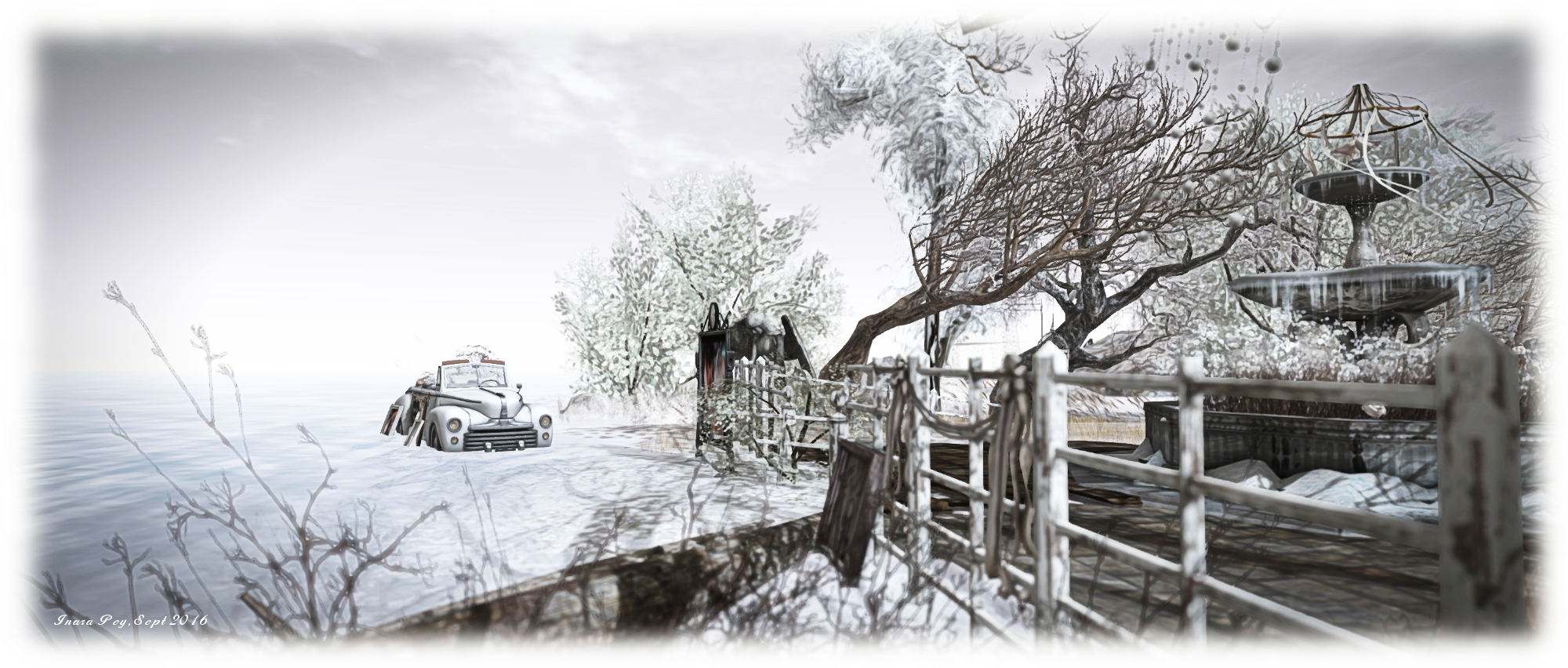
Vintage Romance, designed by Britain Leigh Knave (Britain Knave), her partner, Marcus Knave (Marcus688) and Nïc Bour (NicBor), is a place almost literally caught in time, a reflection of the moment at which the coming together of two hearts in love is forever frozen in Timeless Love.
At first glance a near-monochrome, frosted world, Vintage Romance presents visitors with a land of rocky islets sitting over freezing waters and beneath cloud-laden skies. Trees stand with boughs glistening in hoar-frost and wooden bridges span the cold, still waters. However, despite the cold look, this is a place with much to attract the eye and the camera and offers a romantic warmth.
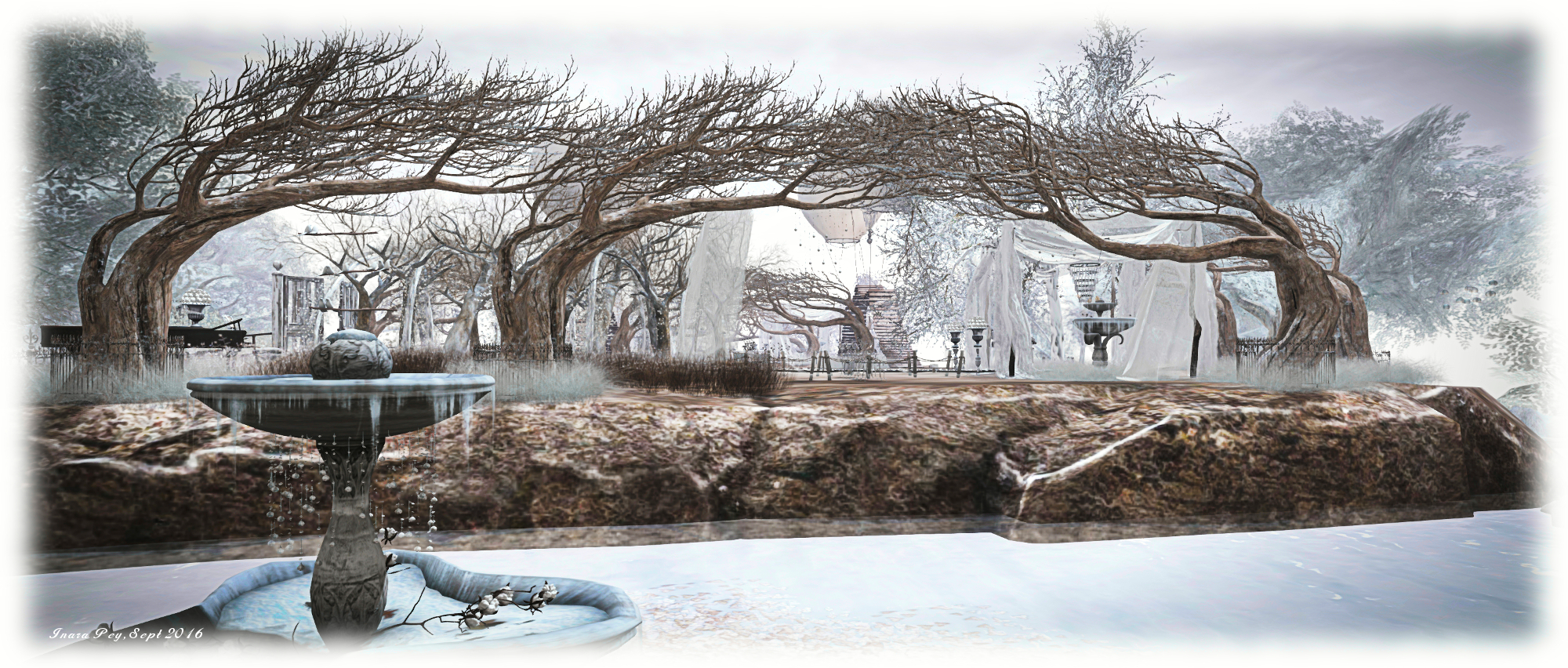
The region has a distinctly west-east orientation, offering something of a narrative around the idea of love and marriage. Visitors arrive on the west side, where the bride’s limousine is parked. From here, the route points eastwards, passing a frozen fountain and under arches of frosted boughs to a small table on which sit bouquets, candles, what might be an order of ceremony book, a camera and photos of a newly wed couple.
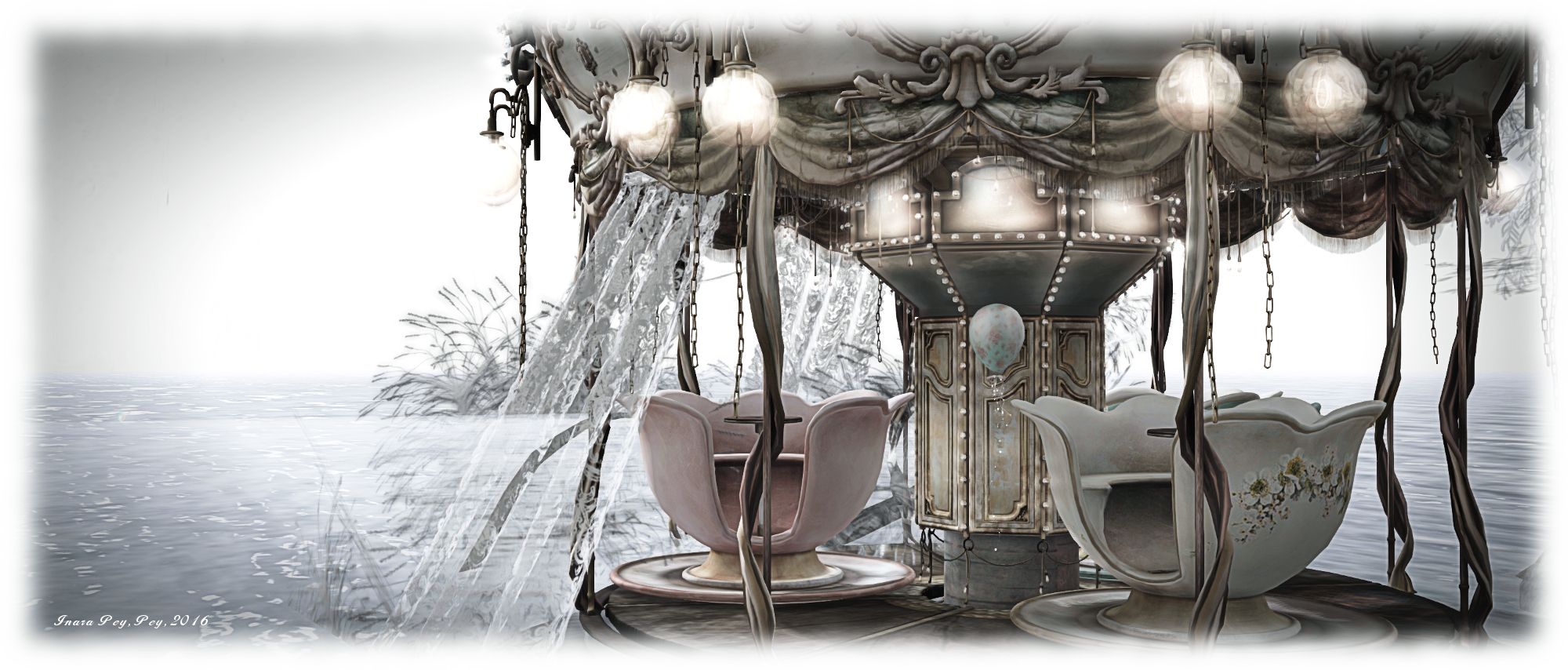
Beyond this little tableau, reminding us of the wedding act, the path splits, leftward, across a wooden bridge, lies a reception area with set ready for music, guests and dancing, and completed by a place of honour for the bride and groom. Meanwhile, the remaining path, also spanning the waters on a trestle bridge, leads to the place where the wedding ceremony itself is held.
Open to the sky, wooden doors guard the entrance, a further arched tunnel of trees beyond leading to guest seating and the altar. More trees, trunks bent as with time, line either side of this rocky place, standing as sentinels watching over proceedings – or perhaps as the columns of nature’s church, delicate net curtains draped from their boughs.
Linking these two – place of ceremony and place of celebration – are further wooden bridges suspended beneath white balloons, the waters between the two islets and the suspending bridges home to Mistero Hifeng’s che ci importa del mondo (we care about the world), a very visual expression of love and cherishing another.
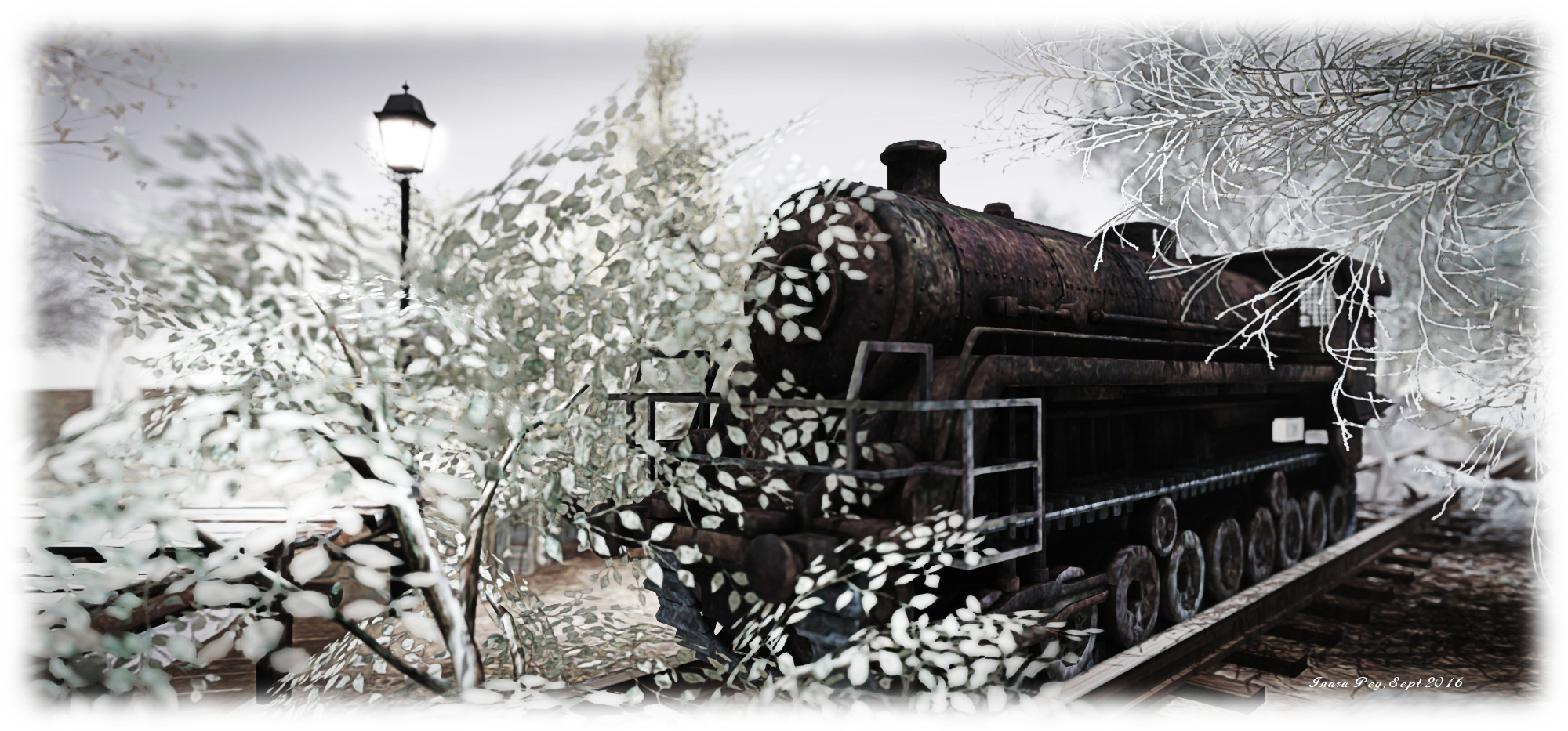
Around these major locations there is much more to be seen. A (tracked) steam train sits to one side of the region, the cab plushly arranged, a “just married” sign hanging from its safety rail, all suggestive of happy couples heading off to honeymoons in romantic locations (in this case, Paris). Also to be found are places to sit and vignettes telling other aspects of that special day.
Whether you’re a romantic at heart or looking for a location just that little bit different from other places you may have visited, whether for photographs or simply to enjoy, Vintage Romance has much to offer visitors. Those who do visit and take photos are asked to share them in the Vintage romance Flickr group.
Now open at The Dirty Grind is an exhibition by John Brianna (Johnannes1977 Resident) entitled The Mask Collection. While it may at first seem to be a modest collection of nine images, it is nevertheless a nuanced, eye-catching display, mixing the physical and the virtual which challenges us to consider what may or may not lie behind the mask we may wear at any given time.
The images, seven of which can be found within the main room at Dirty Grind Theatre and the remaining two in the foyer area, feature studies of both avatars and people wearing a variety of masquerade and other masks. All have been marvellous finished is style suggesting they are either either painted or drawn, and such is the skill with which this has been achieved, I leave it to you to decide for yourselves which are taken from Second Life and which from the physical world.
“I wanted a collection that fits the theme of the Dirty Grind,” John told me as we discussed the display. “And to reflect the idea that we can wear masks in Second Life which can both conceal and reveal.”
The idea that we all wear masks, whether in the virtual realm or the physical, is an old one, subject to many debates and discussions on the nature of self, identity and how we project ourselves in different circumstances. Within Second Life, such debates can often become far more philosophical, simply because we have a much greater freedom to project an appearance through an avatar, or to play a role within an environment without revealing much of ourselves beyond that role. Or equally, through the very act of “concealing” ourselves within an avatar /role, we can gain the security which allows us to project far more of our personality and nature among strangers and acquaintances than we would were we in the physical world.
It’s an engrossing subject, but truth to tell, even without being drawn into such philosophical ruminations, this is a superb exhibition which should be seen to be appreciated. The images – as noted above, and which are offered for sale at L$400 each – are exquisitely produced; each one has a unique look and style, coupled with a very individual use of texture and colour, which makes it instantly captivating, drawing the visitor into it.
The Mask Collection will remain at The Dirty Grind through until the end of September 2016 – not to be missed.
This summary is published every Monday, and is a list of SL viewer / client releases (official and TPV) made during the previous week. When reading it, please note:
It is based on my Current Viewer Releases Page, a list of all Second Life viewers and clients that are in popular use (and of which I am aware), and which are recognised as adhering to the TPV Policy. This page includes comprehensive links to download pages, blog notes, release notes, etc., as well as links to any / all reviews of specific viewers / clients made within this blog
By its nature, this summary presented here will always be in arrears, please refer to the Current Viewer Release Page for more up-to-date information.
Official LL Viewers
Current Release version: 4.0.7.318301 (dated dated August 8), promoted August 11 – formerly the Maintenance RC viewer download page, release notes
Visual Outfit Browser viewer updated to version 4.0.8.319143 on August 30th – ability to preview images of outfits in the Appearance floater (download and release notes)
Restrained Love Viewer updated to version version 2.9.20 on September 5th – parity with RLVa (release notes)
V1-style
Cool VL viewer Stable branch updated to version 1.26.18.22 and the Experimental branch updated to version 1.26.19.24, both on September 3rd (release notes)
Captured at a distance of 78,000 km (48,000 mi) from Jupiter by JunoCam, this image reveals the pale bluish region of Jupiter’s north polar region, speckled by hurricane-like cloud formations. Credit: NASA/JPL / SwRI / MSSS
NASA’s Juno spacecraft has continued to return data and images from its second pass around Jupiter on August 27th, 2016. Images in visible and infra-red light have been received as a part of the data – together with the sound of Jupiter’s “voice”.
Of particular interest are the images of Jupiter’s north pole – which has never been seen by human eyes, and is revealed as being vastly different to the rest of the planet, together with detailed images of the planet’s south pole, only previously briefly seen by the Cassini mission in 2008, whilst en route to Saturn.
“First glimpse of Jupiter’s north pole, and it looks like nothing we have seen or imagined before,” said the Juno mission’s principal investigator Scott Bolton on the release of the most recently received images and data on Friday, September 2nd.
An enhanced view of the north polar hurricane-like clouds images by Juno on August 27th, 2016, together with the blue tingle of the polar atmosphere. Credit: NASA/JPL / SwRI / MSSS
“It’s bluer in colour up there than other parts of the planet, and there are a lot of storms. There is no sign of the latitudinal bands or zone and belts that we are used to—this image is hardly recognisable as Jupiter. We’re seeing signs that the clouds have shadows, possibly indicating that the clouds are at a higher altitude than other features.”
All of Juno’s science instruments were active during the flyby,gathering some 6 Mb of data, images and sounds, which was transmitted back to Earth over a period of a day and a half once the space vehicle had moved away from Jupiter once more. Among this data were images from the Italian-built Jovian Infra-red Auroral Mapper (JIRAM), which returned the first ever close-up infra-red images of Jupiter’s massive aurora.
A mosaic of three infra-red images of Jupiter’s southern aurora taken some 4 hours after the closest point of the flyby. The images were captured by the Jovian Infra-red Auroral Mapper (JIRAM) camera aboard Juno at wavelengths ranging from 3.3 to 3.6 microns — the wavelengths of light emitted by excited hydrogen ions. Credit: NASA/JPL / SwRI / IAPS
“JIRAM is getting under Jupiter’s skin, giving us our first infra-red close-ups of the planet,” said Alberto Adriani, JIRAM co-investigator from Istituto di Astrofisica e Planetologia Spaziali, Rome. “These views of Jupiter’s north and south poles are revealing warm and hot spots that have never been seen before.
“No other instruments, both from Earth or space, have been able to see the southern aurora,” he continued. “Now, with JIRAM, we see that it appears to be very bright and well-structured. The high level of detail in the images will tell us more about the aurora’s morphology and dynamics.”
Juno doesn’t only have eyes, it has ears as well. We’ve known for a long time that Jupiter can be quite “vocal”, and the flyby allowed Juno’s Radio/Plasma Wave Experiment (WAVE) to capture the sound of the planet’s aurorae.
“Jupiter is talking to us in a way only gas-giant worlds can,” said Bill Kurth, co-investigator for WAVE. “We detected the signature emissions of the energetic particles that generate the massive auroras which encircle Jupiter’s north pole. These emissions are the strongest in the solar system. Now we are going to try to figure out where the electrons come from that are generating them.”
Juno is now heading back away from Jupiter on the second of its “long” orbits of the planet. On October 19th, the spacecraft will once again skim over Jupiter’s cloud tops, where it will perform a further braking manoeuvre to reduce its orbital period around the planet to just 14 days.
Did ET Call Us? Mostly Likely Not
The end of August saw various media outlets a-buzz with news about Russian scientists having detected a “strong” radio signal from deep space, with muttering and speculations about aliens, despite cautionary notes from assorted space-related outlets and organisations.
The signal was actually detected in May 2015 by the RATAN-600 radio telescope in Zelenchukskaya, south-western Russia. At the time, the telescope was conducting a survey of astronomical objects in the framework of the SETI (Search for Extraterrestrial Intelligence) programme. It seemed to come from the general direction of the star HD 164595, a star around 95 light years away which is very similar to our own Sun but about 1.5 billion years older, and known to have at least one planet – a gas giant roughly the mass of Neptune – orbiting it.
News about it reached a wider audience in August when a member of the team behind the survey decided to e-mail data on it to colleagues asking for thoughts on what it might be, and suggesting the region of the sky containing HD 164595 should be monitored for further indications of the signal and possible causes.
The RATAN-600 radio telescope. Credit: Russian Academy of Sciences
This request was picked up by science and technology writer Paul Gilster, who blogged about it on his website Centauri Dreams. While Gilster clearly stated there was no evidence of the signal being the work of an extra-terrestrial civilisation, he did couch his post in terms of the power requirements and possible technological status of such a civilisation were the signal to prove to be artificial in nature.
The information was also received by the SETI Institute in California. Their senior astronomer, Seth Shostak, estimated that if transmitting in all directions, the signal would require energy on the order of 10^20 watts – or more energy than the Earth receives from the Sun – making the originating species a Type II civilisation on the Kardashev scale. If directed solely towards Earth, Shostak estimated the energy requirement would “only” be around 10^13 watts – roughly equivalent to all of the energy used by humanity here on Earth, putting the aliens at a Type I civilisation on the Kardashev scale – that is, equal to or slightly more advanced than we are.
In the first half of 2015, speculation circulated that the name of the Lab’s new virtual experiences platform might be “Sansar” or “Project Sansar”, after two trademark registrations were spotted. When asked, the Lab would only comment than “Project Sansar” was a temporary name, and that a number of options were being considered (and there was at least one other trademark filing at the same time which seemed to support this statement).
However, on August 31st, in a press release marking the distribution of the first invitations for people to join the platform’s Creator Preview, Linden Lab indirectly confirmed the official name of their new virtual experiences / social VR platform is indeed Sansar™.
As the news of the name circulated, there were various group chat comments questioning the meaning and relevance of the name. While there is no reason for any product’s name to have a definitive meaning, in this instance, there do seem to be likely connotations.
Sansar (TM) Screen Shot, Linden Lab, August 2016, on Flickr
Back when the Lab was poking at possible names for Second Life, one option they considered was “Sansara” (later used as the name of the first mainland continent). This was said to be a variation on the Sanskrit word Samsāra, meaning “wandering” or “world”, associated with cyclic, circuitous change.
The interesting point here is that the Maxgyan dictionary / lexicon offers sansar (also sansaar in Jainism) as an alternative for Samsāra, and defines its potential meanings as “earth”, “world” or “universe” (with “cosmos” cited as a possible alternative to the latter), depending on the context.
Given that Sansar™ is intended to host many different virtual spaces, “universe” might be taken as a good “fit” when looking for a meaning in the platform’s name. Similarly, the idea of cyclical, circuitous change appears to be reflected in the platform’s logo, with its three segments suggestive of movement (/change).
Sansar (TM) Screen Shot, Linden Lab, August 2016, on Flickr
Of course, other meanings of “sansar” could be offered (such as an”icy Iranian wind”, for example), but it seems reasonable to look no further than those derived from Hinduism / Jainism. There is a certain “fit”, as noted above, and the Lab has turned to Hindu nomenclature before. As most of us are aware, the Lab’s two publicly accessible SL grids are named for Rigvedic deities – Agni, god of fire, and Aditi, the mother of gods.
But even accepting this as a possible derivation for the platform’s name, it might be argued that the Lab should have gone for something more “obvious”. Well, possibly. But then again, it is fair to say that at this point in time, those being drawn to Sansar are doing so by way of the Lab or through media reports on it, and so already have some idea of what it is about. This will also likely be true when Sansar opens it doors to the public (although by that time, the website will hopefully be a lot more dynamic and informative as well). Thus, having a name which “reflects” the platform’s intent perhaps isn’t so major a consideration.
For my part, if the platform’s name is intended to have a meaning, I admit to being drawn to it being “universe”. As noted above, it, fits the idea of an environment hosting many, many virtual spaces of many different sizes, some of which exist independently of the rest, others of which are “stitched together” to form – dare I say – “constellations” of linked spaces. Of course, being a “space fan”, I could also be a tad biased 🙂 .
 Updated, October 7th: AMD and Nividia have released drivers which should hopefully address this issue. See the comment from Lee McKay (below), and my article here.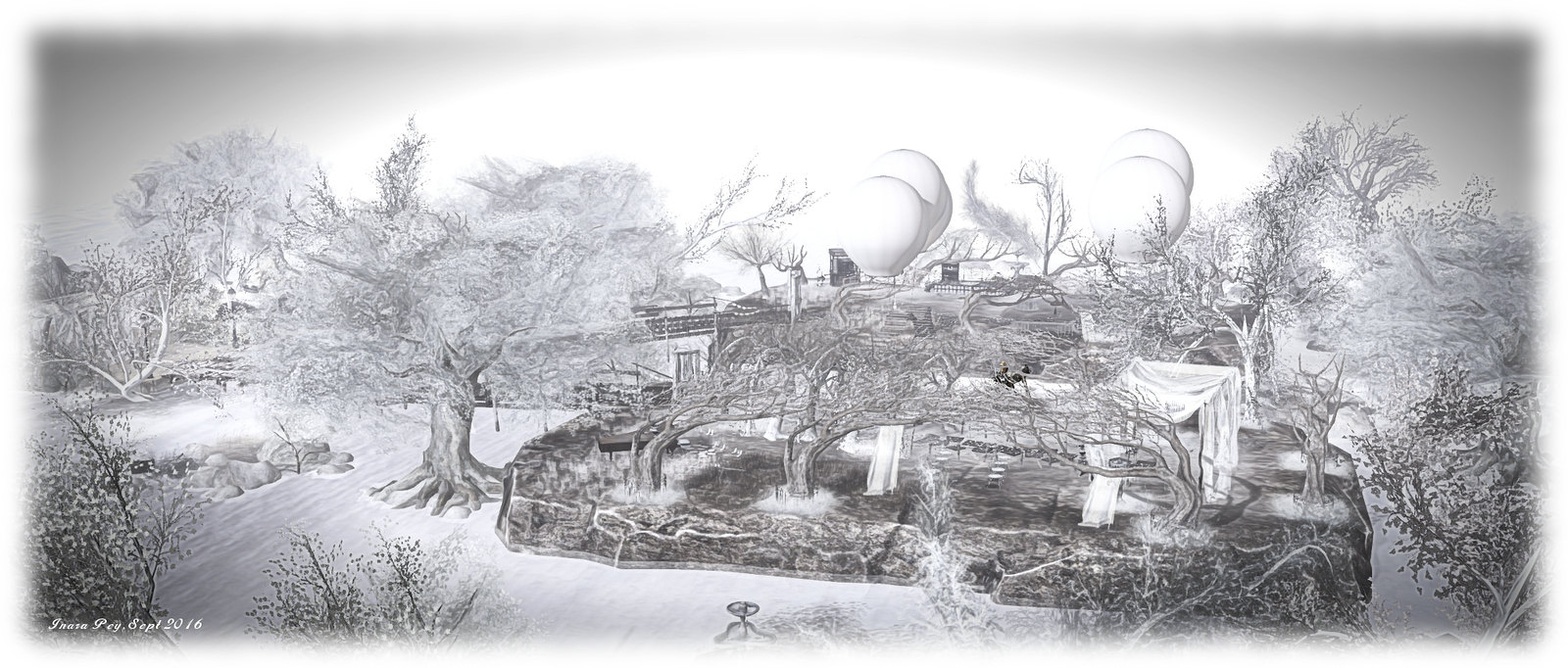


 Inara Pey: Living in a Modemworld