A walk in the wilderness in Second Life

Cooper Creek Wilderness; Inara Pey, July 2015, on FlickrCooper Creek Wilderness, July 2015 (Flickr) – click any image for full size

I first came across Cooper Creek Wilderness while flying around the estates to the south and east of Blake Sea without any intent or purpose in mind. A part of the Sailors Cove South estate, the wilderness caught my attention due to its proximity to the Sailors Cove South (SCS) airfield, which has a fairly tight little runway for getting in and out of (unless you have a seaplane and can make use of the nearby open waters), making it an interesting place to practice short landings.

Also accessible by boat, the wilderness forms a part of the estate’s protected lands, and offers visitors trails to walk, wildlife to see and places to simply sit and ponder. My most recent visit came after taking my helicopter for a flight; the intention had been to head over to Second Norway, but somewhere along the way I decided to turn south to see if any land down that way might be up for sale, so I quite naturally found my way to the SCS airfield on Frasier Island.
Cooper Creek Wilderness; Inara Pey, July 2015, on FlickrCooper Creek Wilderness, July 2015 (Flickr)

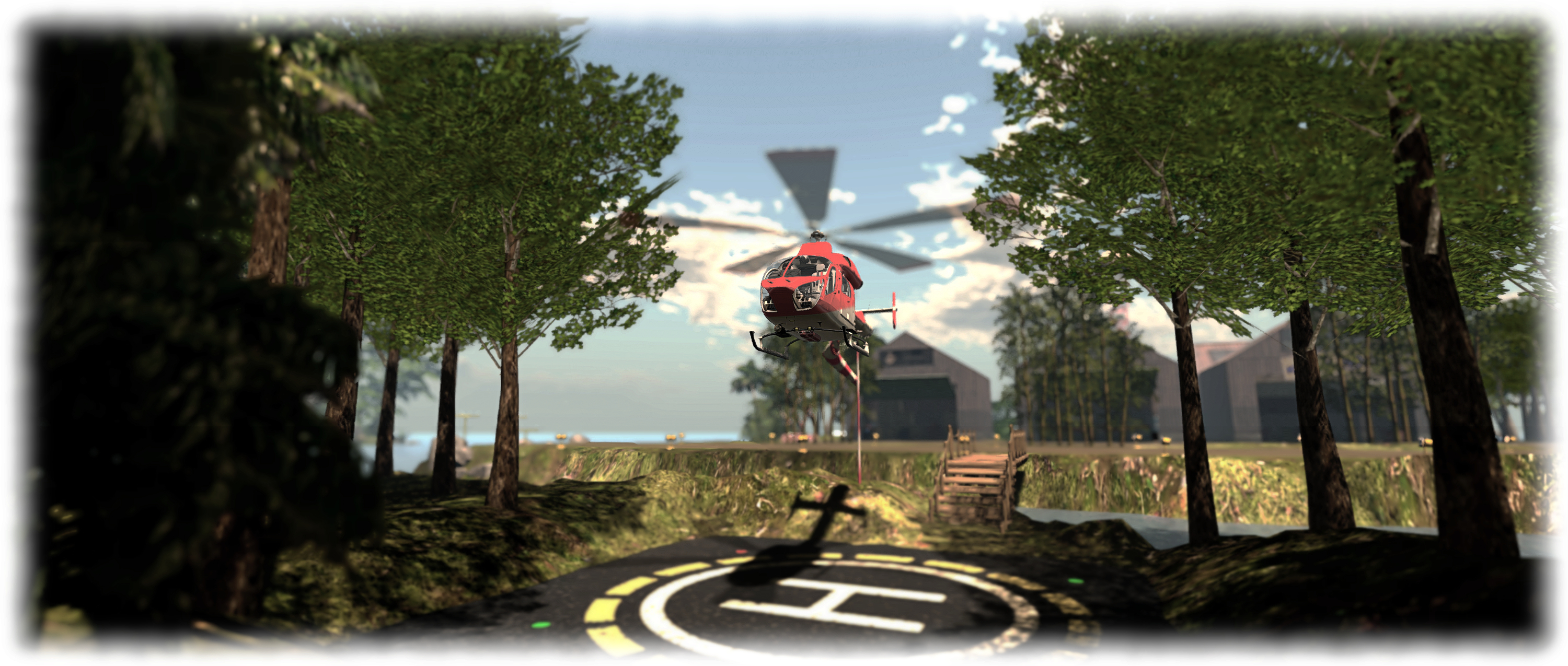
As well as having a very small runway, the SCS airfield also offers a bit of a challenge for landing at the helipad, surrounded as it is on three sides by tall trees, with the airfield windsock located on the remaining side (see the picture above of me manoeuvring my MD900 for a landing).

If you opt to sail to the wilderness, the best way once you reach the Sailors Cover estates is to make your way to  Sailors Cove South, cross Thorton Peak on the west side, and then head across Rio Plantano before turning north along the Cerrado coastal area and thus to the Cooper Creek Wilderness moorings.

As I’d flown down to SCS, I opted to make my way to the little quay  on the west side of the airfield on the banks of the river behind the airfield. Here visitors can find a rezzing station for one or two person kayaks  (with a tiny option available as well), which can then be used to head  northwards through the river channels to the wilderness, making for a nice little journey in itself. There are also a couple of kayak rezzers up in the wilderness park as well, making getting back easy, should you hop out of your boat (causing it to de-rez after about 10 seconds).
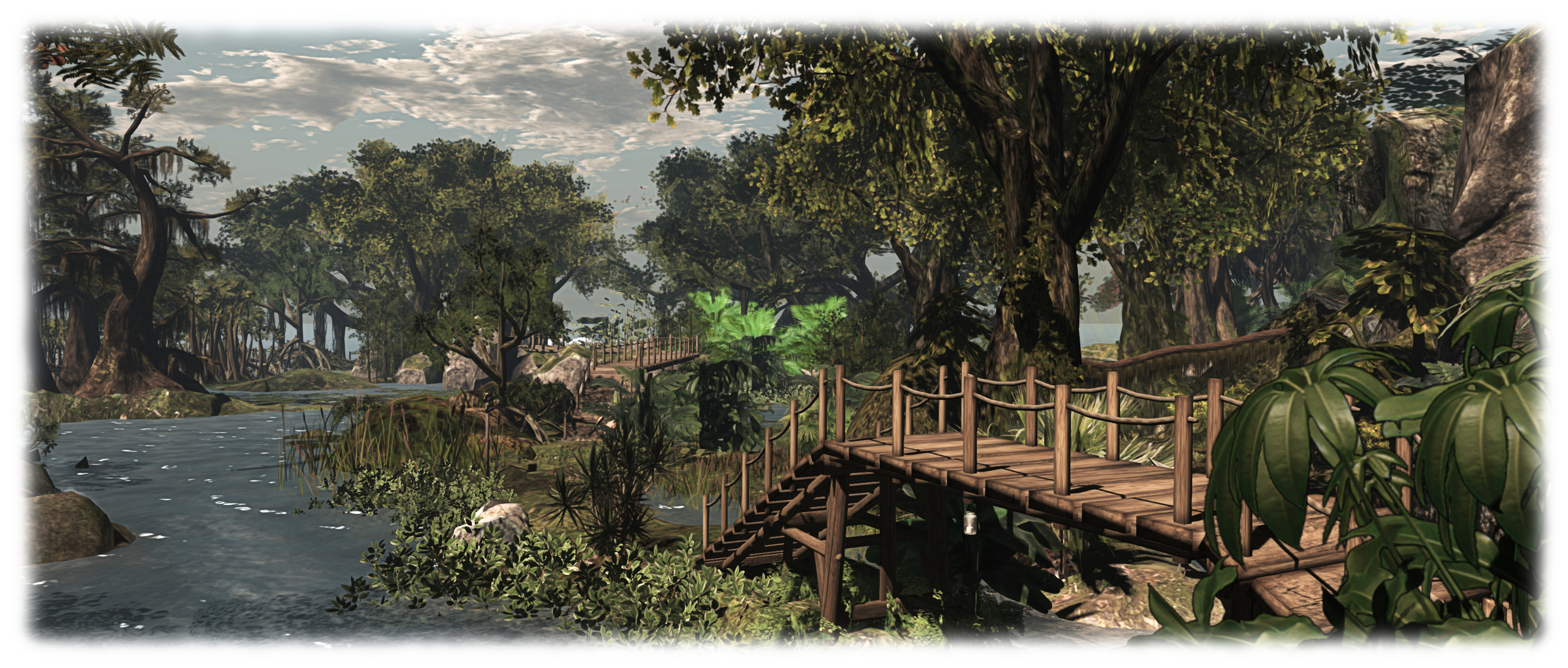
Cooper Creek Wilderness; Inara Pey, July 2015, on FlickrCooper Creek Wilderness, July 2015 (Flickr)

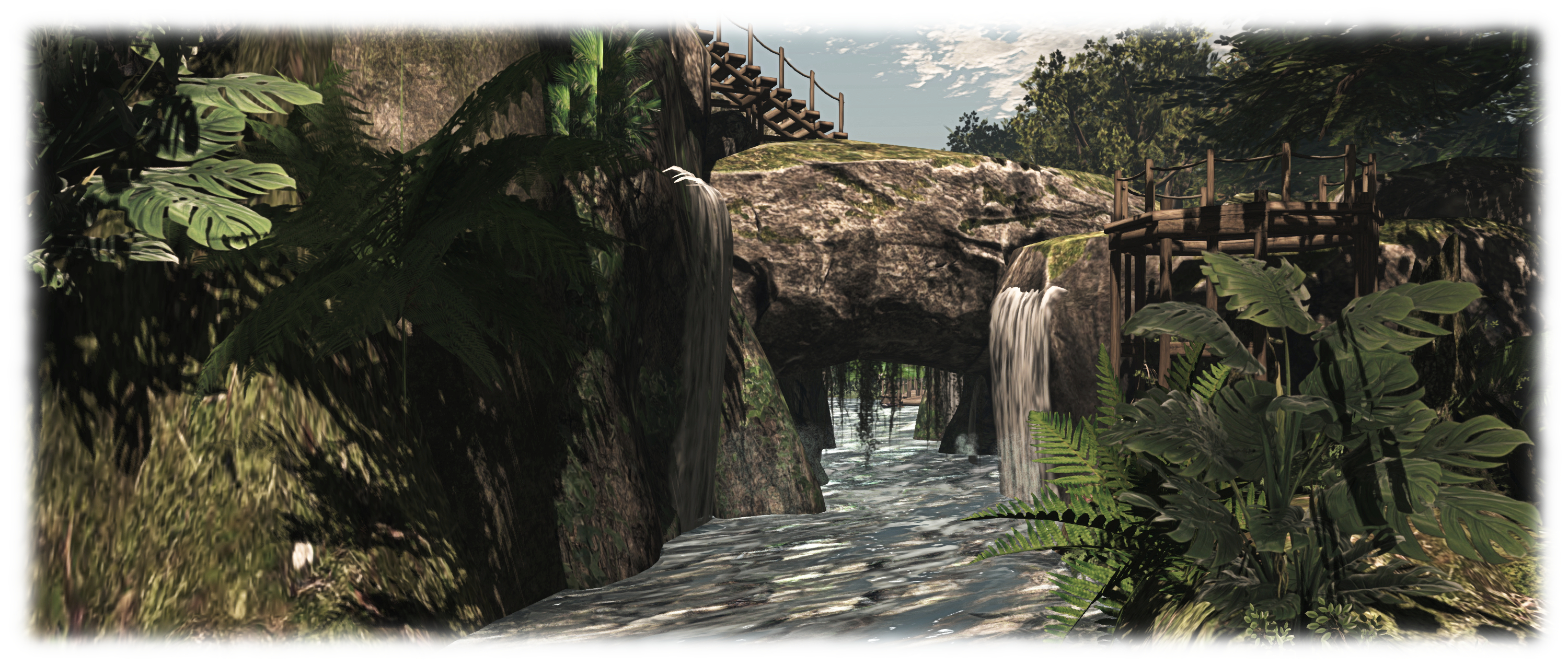
The park offers a series of walks, as noted, which wind over trails, cross bridges (either with steps for those on foot or ramps for those on horseback). There are also clearings where you can sit and rest, a butterfly house,  climbs with zip lines waiting at the top, and a wooden walk through a mangrove swamp (watch out for the alligator!) which has wicker chairs hanging over the waters for those wanting to simply sit and let time drift by. Travel far enough north and you’ll find a swan boat rezzer you can use to paddle your way back along the waterways if you have left your kayak behind,

While Cerrado to the south is largely given over to residential parcels (so do keep people’s privacy in mind if travelling in that direction), the waterways flowing through these regions – Cooper Creek Wilderness, Cerrado and Frasier Island do make for interesting and relaxing exploration via kayak, and there are numerous photo opportunities to be found along the way.
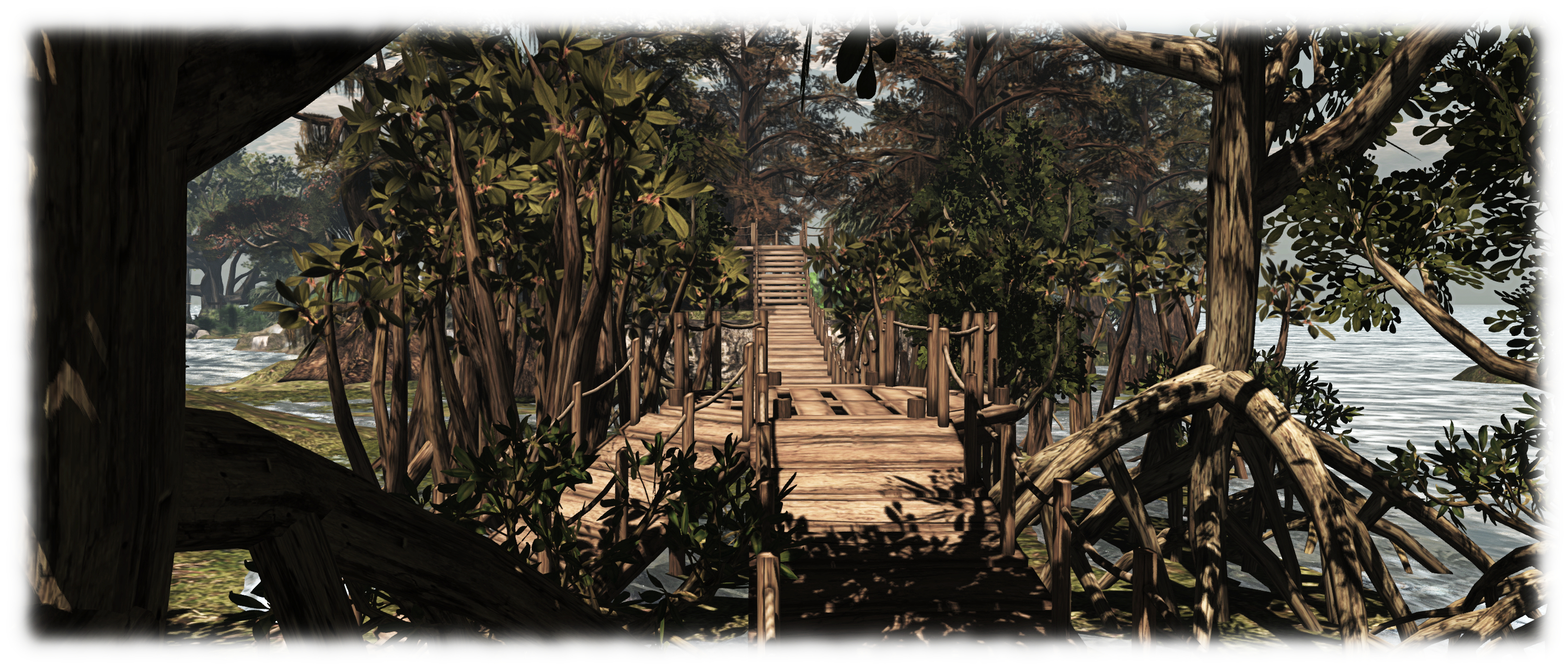
Cooper Creek Wilderness; Inara Pey, July 2015, on FlickrCooper Creek Wilderness, July 2015 (Flickr)

For those seeking somewhere a little different to explore, I can recommend Cooper Creek Wilderness; whether you hop there directly or make it a part of a longer outing by air or water, it makes for a pleasing destination. Just don’t be surprised if you come across me curled up in one of the hanging wicker chairs as you wander the trails and wooden walks!

SLurl Details

2015 viewer release summaries: week 27

Updates for the week ending: Sunday, July 5th, 2015

This summary is published every Monday, and is a list of SL viewer / client releases (official and TPV) made during the previous week. When reading it, please note:

  • It is based on my Current Viewer Releases Page, a list of all Second Life viewers and clients that are in popular use (and of which I am aware), and which are recognised as adhering to the TPV Policy. This page includes comprehensive links to download pages, blog notes, release notes, etc., as well as links to any / all reviews of specific viewers / clients made within this blog
  • By its nature, this summary presented here will always be in arrears, please refer to the Current Viewer Release Page for more up-to-date information.

Official LL Viewers

  • Current Release version: 3.8.0.302622, June 30 – formerly the Experience RC viewer providing support for viewing and managing Experiences and for contributing content for Experiences download page, release notes
  • Release channel cohorts (See my notes on manually installing RC viewer versions if you wish to install any release candidate(s) yourself):
    • Attachment fixes RC viewer (Project Big Bird) updated to version 3.8.1.303130 on July 2nd – core updates: a number of fixes for various attachment issues (download and release notes)
  • Project viewers:
    • No updates.

LL Viewer Resources

Third-party Viewers

V3-style

V1-style

  • Cool VL Viewer Stable branch updated to version 1.26.12.49, and the Experimental branch to version 1.26.13.18, both on July 4th (release notes).

Mobile / Other Clients

  • No updates.

Additional TPV Resources

Related Links


UKanDo and Black Dragon get Experience Tools

Both UKanDo and Black Dragon have recently incorporated the Lab’s Experience tools, following their were promotion to release status in the official viewer on June 30th, 2015.

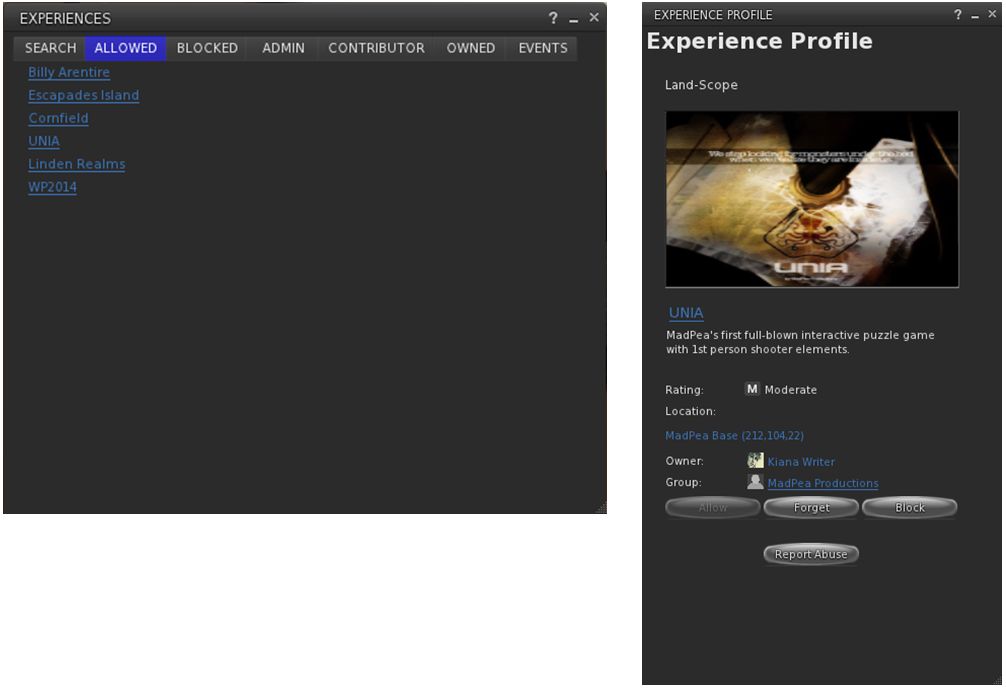
UKanDo arrived with Experience Tools on Thursday, July 2nd, with the release of version 3.8.0.28122. As with the official viewer, this adds the Experiences floater access to the ME menu, and also has the Region / Estate and About Land panel also updated with their respective Experiences tabs.

The Experiences floater and an Experience Profile as they appear in UKanDo with the default skin. The viewer also includes the Region / Estate and the About Land Experience Tools updates as well

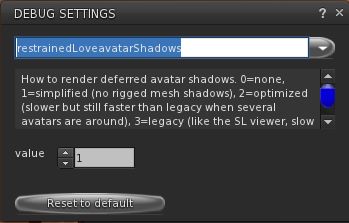
In addition, as a part of this release, UKanDo updates to RLV 2.9.12, with the NaCl / Marine Kelley avatar shadow rendering updates for rigged mesh – see my article of RLV 2.9.12, available here.

UKanDo 3.8.0 also includes Marine Kelley's RLV 2.9.12 update, with the avatar shadow rendering debug setting to help with rendering performance when running with shadows enabled and surrounded by avatars using mesh bodies & other rigged mesh attachments
UKanDo 3.8.0 also includes Marine Kelley’s RLV 2.9.12 update, with the avatar shadow rendering debug setting to help with rendering performance when running with shadows enabled and surrounded by avatars using mesh bodies & other rigged mesh attachments

Black Dragon release 2.4.3.5 sees the Experiences floater added to Dragon > Edit menu. As with UKanDo, it also adds the Experiences tabs to the Region / Estate and About Land Floaters.

This release, which arrived on July 4th after a couple of hiccups with versions 2.4.3.3 and 2.4.3.4, also includes Niran’s July 3rd update, which focused on a complete RLVa update, as per the release notes for that version.

I’ve not had an opportunity to extensively drive either of these viewers; my time is a little squeezed at the moment, and I’m struggling to clear a backlog of work and bits. So, consider this more a heads-up than any attempt at a review.

Related Links

Space Sunday: Mars rocks, Ceres glitters, Pluto beckons

CuriosityOperations on and around Mars are resuming following the June 2015 conjunction, which saw Mars and Earth on opposite sides of the Sun, a time which makes reliable two-way communications hard-to-impossible due to the Sun’s interference, so vehicles operating on and around the Red Planet are placed in autonomous modes of relatively safe operations.

For the NASA rovers, Opportunity and Curiosity, this meant parking and waiting for reliable communications to be restored. However, now that Mars has once again emerged from “behind” the Sun, Curiosity is preparing to study the confluence of at least two different types of rock formation on the slopes of “Mount Sharp”.

As noted in my recent Curiosity updates, the Mars Science Laboratory (MSL) had been attempting to reach such a confluence, dubbed “Logan Pass”, but the terrain leading to that location proved more difficult from had been hoped. As a result, the rover was redirected towards another point leading up to higher elevations dubbed “Marias Pass”, and a small valley where the rock formations meet.

A mosaic showing the contact layers near the location dubbed “Marias Pass” on “Mount Sharp”. In the foreground is pale mudstome, similar to that studied by Curiosity at “Pahrump Hills” in 2014. Overlaying this stratigraphically is sandstone that the rover team calls the “Stimson unit.” The images used in this mosaic were captured by Curiosity’s left Mastcam on May 25th, 2015 (Sol 995 of the rover’s surface mission). The colour has been approximately white-balanced to resemble how the scene would appear under daytime lighting conditions on Earth.

The two types of rock are a pale mudstone, similar in appearance to the bedrock studied at “Pahump Hills”; the other is a darker, finely bedded sandstone sitting above the Pahrump-like mudstone, which has been dubbed the “Stimson unit”. In addition, the valley also has a sandstone with grains of differing shapes and colour which the science team wish to examine in more detail as well, having already identified a potential target within it they’ve named “Big Arm”.

“On Mars as on Earth, each layer of a sedimentary rock tells a story about the environment in which it was formed and modified,” NASA spokesman Guy Webster said during a status update on the mission which explained the science team’s interest in the area. “Contacts between adjacent layers hold particular interest as sites where changes in environmental conditions may be studied. Some contacts show smooth transitions; others are abrupt.”

Curiosity is expected to spend the next few weeks examining the rock formations before resuming its trek up the side of “Mount Sharp”.

Dawn Over Ceres

Dawn mission patch (NASA / JPL)

On Monday, June 30th, The joint ESA / NASA Dawn deep space mission completed the second of its orbital mapping phases of Ceres, which it has been carrying out since May at a distance of some 4,400 kilometres (2,700 miles).

During July, the spacecraft will engage in a series of gentle manoeuvres that will allow it to reduce its orbit to 1,450 kilometres (900 miles), ready to start a further surface mapping and investigation mission in early August.

Ceres has revealed it has a much more varied landscape that Vesta, its slightly smaller “sister” protoplanet, which the Dawn spacecraft studied over a prior if 14 months in 2011/12, prior to reaching Ceres in March 2015. One particular point of interest on the latter is a grouping of bright surface features located within a crater some 90 kilometres (55 miles) across.

The most recent images returned be Dawn of these spots reveals they are more numerous than had first been thought, with the largest approximately 9 km (6 miles) across.  It is believed these bright spots are the result of ice or salt, although other causes may be possible; spectra of the region should reveal far more as the spacecraft reduces its orbit.

A closer view of the bright areas inside a crater on Ceres, captured by the European imaging systems aboard the Dawn mission on June 9th, 2015 (credit: NASA/JPL-Caltech/UCLA/MPS/DLR/IDA)

In addition to the bright spots, the latest images also show a pyramid-like mountain with steep slopes rising to a height of about 5 km (3 miles) from a relatively flat area on Ceres, which has also provoked scientific interest. Ceres is also richly cratered, like Vesta; however, unlike Vesta, many more of the craters on Ceres have central peaks associated with them, evidence of their formation being the result of surface impacts. Images have also revealed evidence of other activities on the rocky, barren surface: slumps, landslides and lava-like flows, all indicative of Ceres perhaps having been somewhat more active in its formative years than Vesta.

Continue reading “Space Sunday: Mars rocks, Ceres glitters, Pluto beckons”

The Drax Files Radio Hour: giving it the HiFi!

radio-hourOne of the big use-cases is going to be kids maybe doing an extra, like instead of doing their homework in the normal way in the evening, they go on-line where they join a study group where they join a teacher..

So opens segment #75 of the with some thoughts from Philip Rosedale, co-founder of Second Life, and more particularly now the CEO of start-up virtual worlds company, High Fidelity.

At just over 89 minutes in length, this is a special show, exploring High Fidelity from the inside, so to speak, complete with conversations with Mr. Rosedale, Ryan Karpf (HiFi’s co-founder and ex-Linden), Chris Collins and Ozan Serim, while David Rowe (perhaps more familiarly known to SL users as Strachan Ofarrel creator of the Oculus Rift compatible CtrlAltStudio viewer), who has been working with the HiFi team, becoming a guest host for the segment.

Since its founding, High Fidelity has made remarkable strides in developing its next generation, open-source virtual world environment, both technically and financially. Since April 2013, the company has undergone three rounds of funding, attracting around US $16 million, most of which has come from True Ventures, Google Ventures and, most recently, Paul Allan’s Vulcan Capital (which also participated in the October 2014 US $542 million investment round for Magic Leap). In addition, HiFi has attracted a number of high-profile advisers, including VR veteran Tony Parisi and, most recently, professors Ken Perlin and Jeremy Bailenson.

As well as Philip Rosedale, Drax talks with Chris Collins (l), Ryan Kampf and Ozan Serim from high Fidelity
As well as Philip Rosedale, Drax talks with Chris Collins (l), Ryan Karpf and Ozan Serim from high Fidelity

The interviews themselves are quite wide-ranging. With Dave Rowe, (known in HiFi as CtrlAltDavid) the open-source nature of the platform is explored, from the ability to download and run your owner HiFi server (aka “Stack Manager“) and client (aka “Interface“), through to the concept of the worklist, which allows contributors to bid for work on offer and get paid based on results.In Dave’s case, this has led him to working on various aspects of the platform such as integrating Leap Motion capabilities to improving eye tracking within HiFi’s avatars, so they track the movements of other avatars, just as our own eyes track other people’s facial and other movements as they interact with us.

In terms of general looks, the avatars – which have in the past been critiqued for being “cartoony” (despite it is still very early days for HiFi) –  are still very much under development. In particular, Ozan Serim has been working to raise –  and no pun intended here – the overall fidelity of the avatars in terms of looks and capabilities. He’s well-placed to do so, being an ex-Pixar animator.

One of the problems here is that the more real in appearance and capabilities they get, the closer the avatars come to the Uncanny Valley, which has led HiFi and Ozan to look at a number of avatar styles, from those which are very human in appearance through to those that are more “cartoonish” in looks.

A 2014 video showing Ozan’s work in improving the rigging around a more “realistic” HiFi avatar to more actually reflect mouth forms and facial movement when singing. High Fidelity now use Faceshift for real-time facial expression capture, rigging and animation, using either 3D or standard webcams

In discussing the Uncanny Valley, and particularly people’s reactions to avatars that are somewhat less-than-real (and we can include SL avatars in this, given their inability to naturally reflect facial expressions), Ozan raises the interesting question of whether people who critique the look of such avatars actually want to have a “realistic” looking avatar, or whether it is more a case of people wanting an avatar look that is appealing to their aesthetics which they can they identify with.

This is and interesting train of thought, as it is certainly true that – limitations of the avatar skeleton aside – most of us in Second Life are probably more driven to develop our avatars to a point where they have a personal aesthetic appeal, rather than in wanted them to be specifically “more realistic”.

Currently, HiFi is leaning towards a somewhat stylised avatar as seen in Team Fortress 2, which is allowing them to develop a natural-looking avatar look that doesn’t come too close to the Uncanny Valley. They use Adobe Maximo as their avatar creation tool, which Ozan views as a capable workflow package, but which may have some creative limitations. However, as an open-source environment, HiFi does offer the potential for someone to script in “in-world” character modelling tools, or at least to offer upload capabilities for avatar model generated in tools such as Blender. Avatars can also, if wanted, by uploaded as a complete package with all required / defined animations, such as walks, etc, included.

Chris Collins has very much become the voice of High Fidelity on You Tube, producing a wide range of videos demonstrating features of the platform, together with short tutorial pieces. The video above is one of his, demonstrating how to code interactive 3D content, using the Planky game as an example

While Ozan and his team work on avatar animations and rigging using real-time capture, Ryan Karpf reveals that by default, an avatar’s facial expressions are driven via the audio more than by direct capture: the mouth movement, for example, comprises 3 positions based on the audio, while a rising of voice or tone can result in the avatar’s eyebrows rising and falling. Ryan also touches on the Uncanny Valley issue of people’s increasingly discomfiture the closer avatars become to looking “photo-realistic”.

In talking to Chris Collins, an ex-Linden Lab alumni who headed the former SL Enterprise division, who now wears a number of hats at HiFi, Drax discusses how HiFi deals with the ever-changing face of the emerging VR hardware market, where headsets, input, tracking, and so on, is in something of a state of flux. Chris points out that while open-source, HiFi does have a set of strict coding standards and licensing, and offer external libraries to help support third-party SDK integration.

One of the powerful elements of High Fidelity is the ability you to have full agency over your environment, if you so wish; using the Stack Manager, you can create your own server / world / space, and control who might access it.  The scripting tools similarly allow users to download and tweak elements – such as walking animations, a basic avatar appearance, etc., quickly and easily.

Continue reading “The Drax Files Radio Hour: giving it the HiFi!”

Undone in Second Life

Udone - Berg Gallery
Undone – Berg Gallery

Opening on Sunday, July 5th at Kate Bergdorf’s Berg by Nordan Art gallery, located overhead of her home region, Nordan om Jorden, is an exhibition of images by Harbor Galaxy.

Running through July, August and September, the exhibition is called Undone, which is described as, “An examination of the physical loosening of restraints:  collapse, contemplation, release, surrender.” On display are nine nude studies of the female form, the majority either seated or reclined, set against minimal backgrounds which serve to drawn one’s eyes directly to the figure on display – and I do use the term “display” deliberately here. While most of the poses are natural enough, it is clear that they have been carefully set in order to emphasise the various aspects of the exhibit’s subtitle: collapse, contemplation, release, etc.

Not that there is anything wrong with the images being so poised in their execution – that is after all the case for any life study. Here, however, the posing draws us deeper into each image, encouraged to consider just what it is being contemplated or what the collapse signifies and so on. Some of the pieces also seem to have a subtle, layered context as well, offering more than one potential interpretation, which becomes clearer as one re-examines them.

Undone - Berg Gallery
Undone – Berg Gallery

The artist behind Harbor says of her work:

Through Harbor and the creative possibilities of SL, I have been able to explore my own creative impulses and give form to the pictures that have been swirling around in my head for years now.

I do want to add that I see my pieces as a collaborative work, dependent upon the countless creative energies of others like myself here in SL  and I am grateful and in awe of those energies.

Quite who or what the creative energies are isn’t entirely clear, which is a little regretful. Does the reference mean the models featured in the pieces? Comments and support from others? The influence other artists may have had on Harbor’s work? All of the above? It’s an enigmatic and intriguing statement; just as this is an intriguing and intimate exhibition.

Undone - Berg Gallery
Undone – Berg Gallery

Nudes may not be to everyone’s liking, but this is an exhibit worth seeing, one very well suited to the warm intimacy of Kate’s gallery space. As noted above, it will be running through July – September.

SLurl Details