Art and artistry at SL12B: a personal selection

Piz-3_001
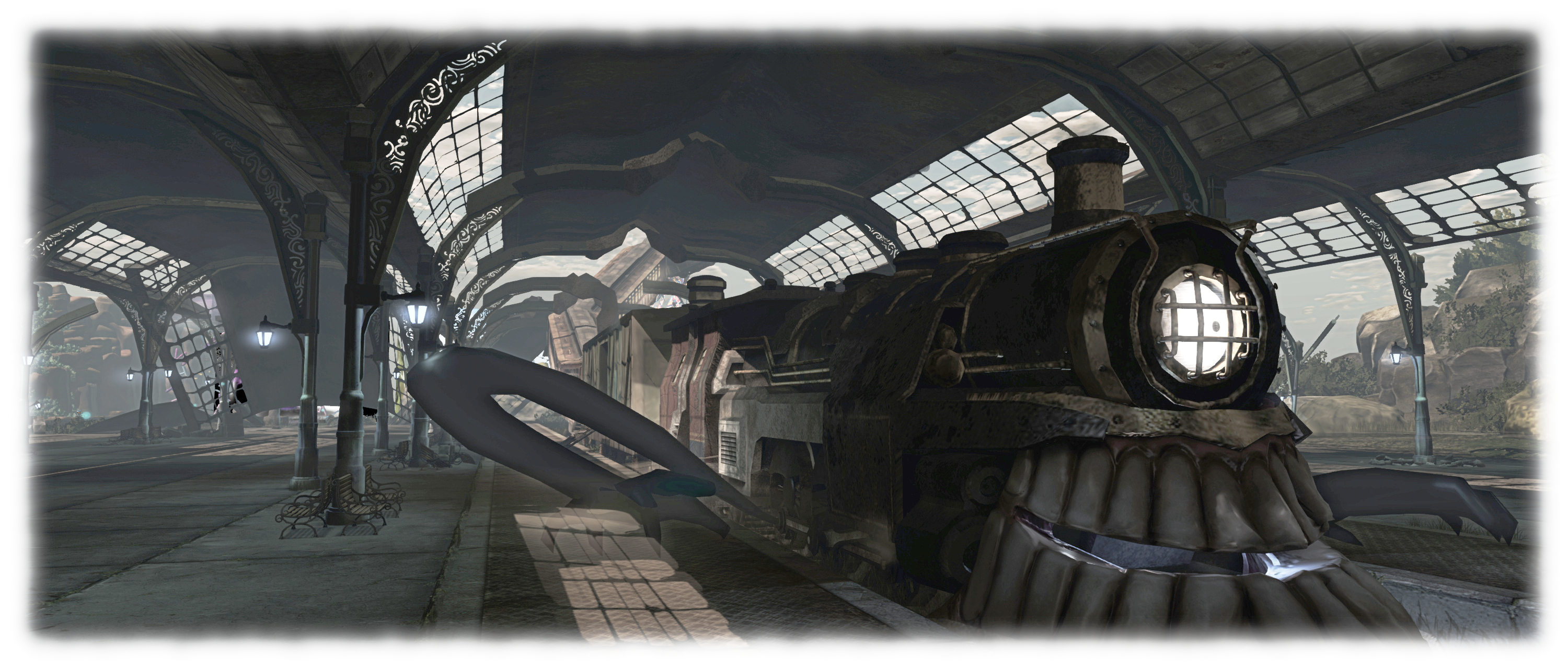
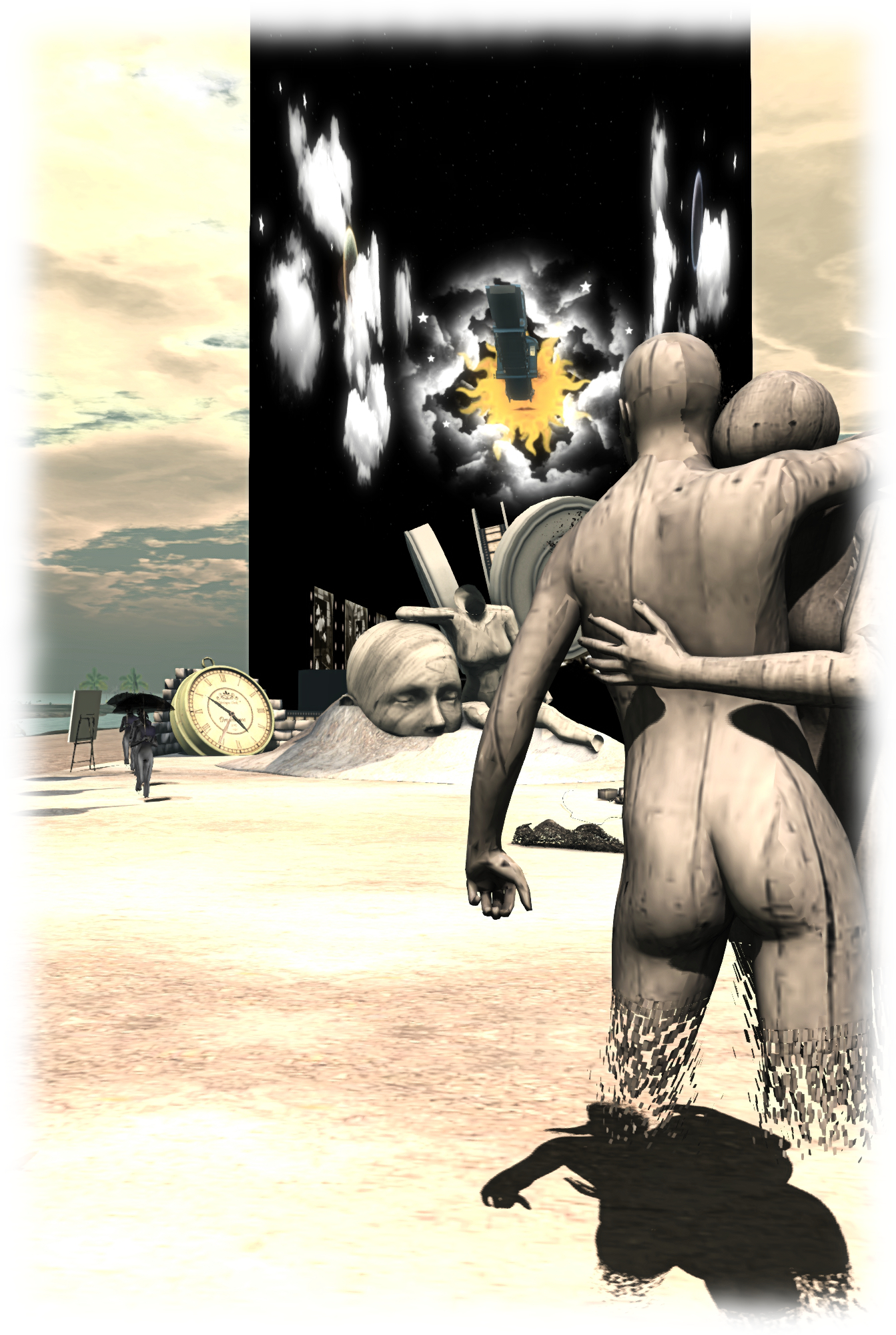
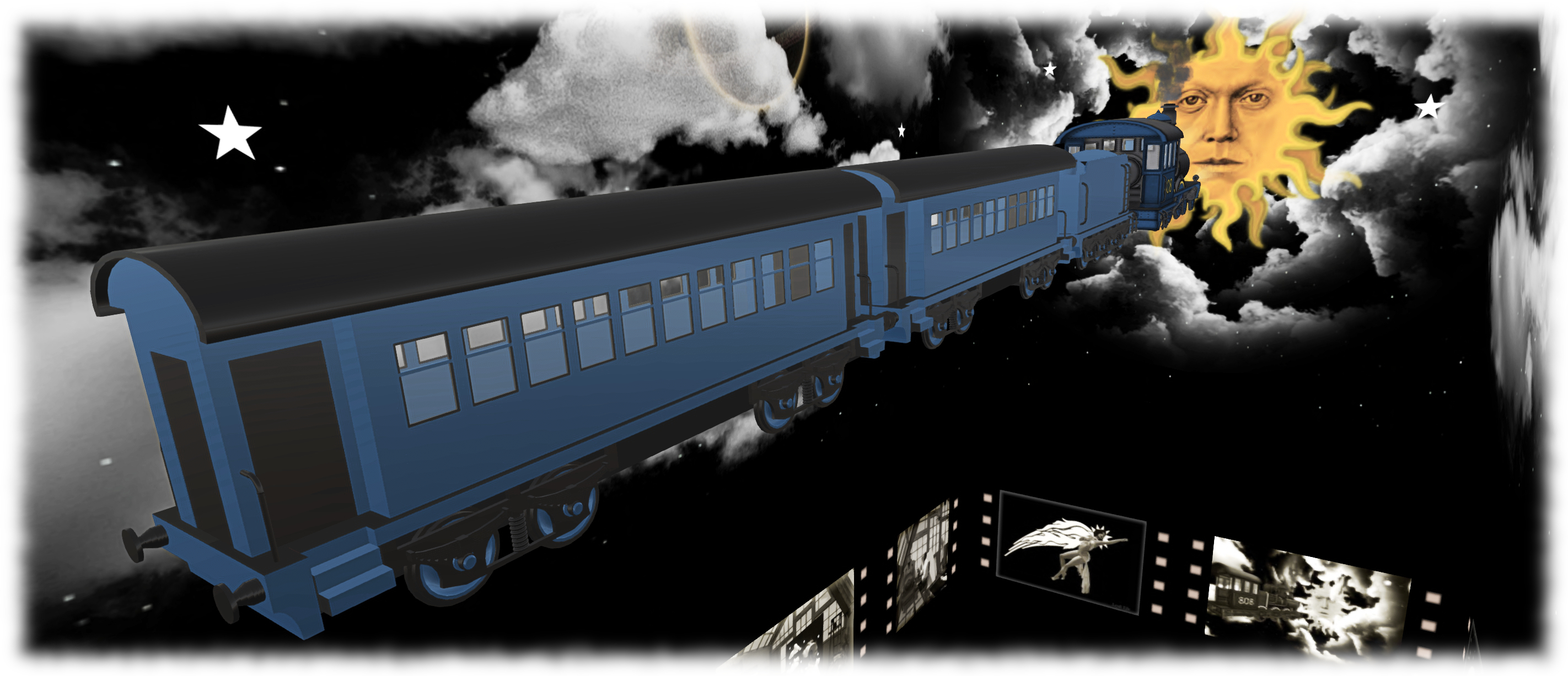
David DuCasse celebrates the work of visionary and dreamer, Georges Méliès

Art is always well represented at SLB events, and 2015 is no exception; there are a lot of art focused parcels scattered throughout the celebratory regions, as well as those which have been judged by the organisers to be worthy of special recognition.

It’s fair to say that the event can offer a great introduction to the many and varied forms of artistic expression that can be found within Second Life, and such is the range of art on display throughout SL12B, I’m not going to attempt to cover everything; rather what I offer here are some of the parcels that I’ve particularly enjoyed visiting this year, and why.

Loki Eliot – Childhood Dreams

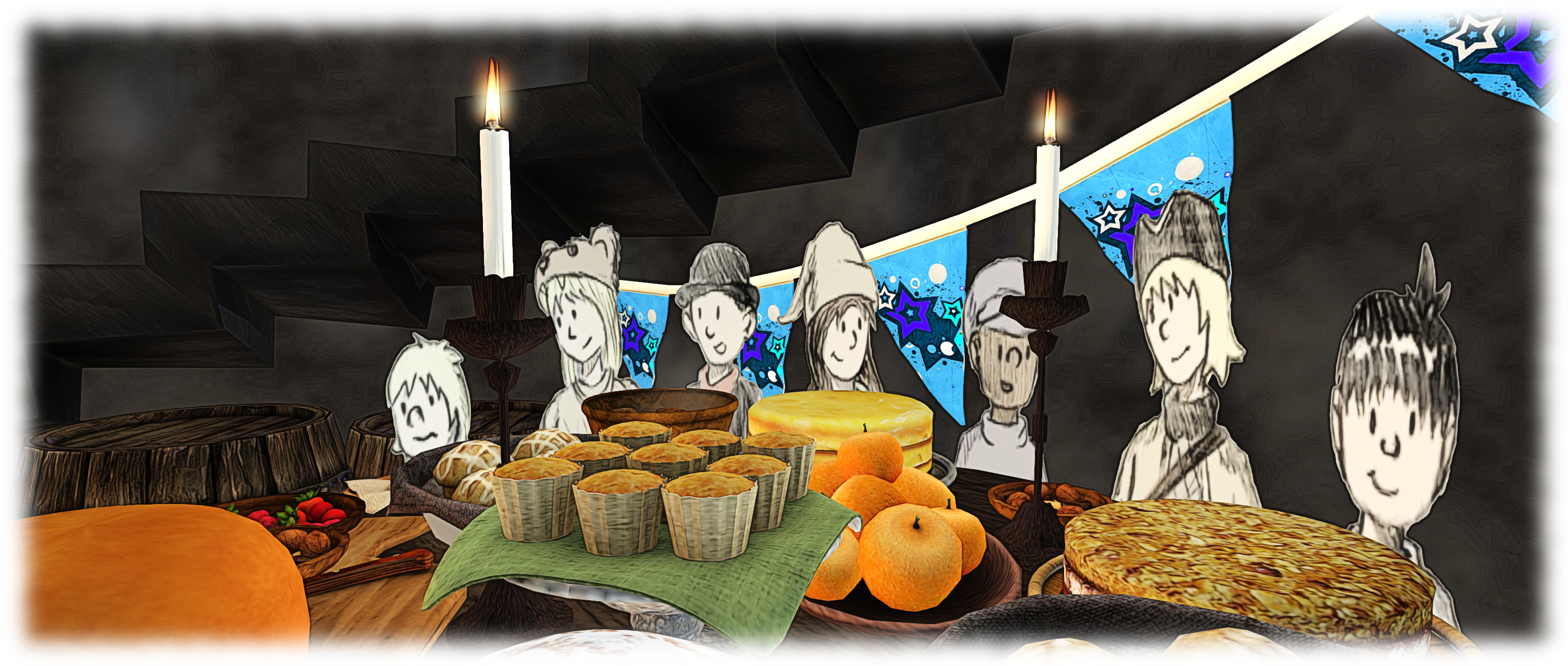
Digital mischief maker Loki Eliot is one of Second Life’s great creative talents – his magnificent cake stage from SL11BCC remains one of the stand-out build from 2014, while his SL10BCC Behemoth will long stand in people’s memory, combining originality, mesh, storytelling and metaphor into one of the most entertaining visits of the 2013 celebrations.
Loki Eliot - Childhood Dreams
Loki Eliot – Childhood Dreams

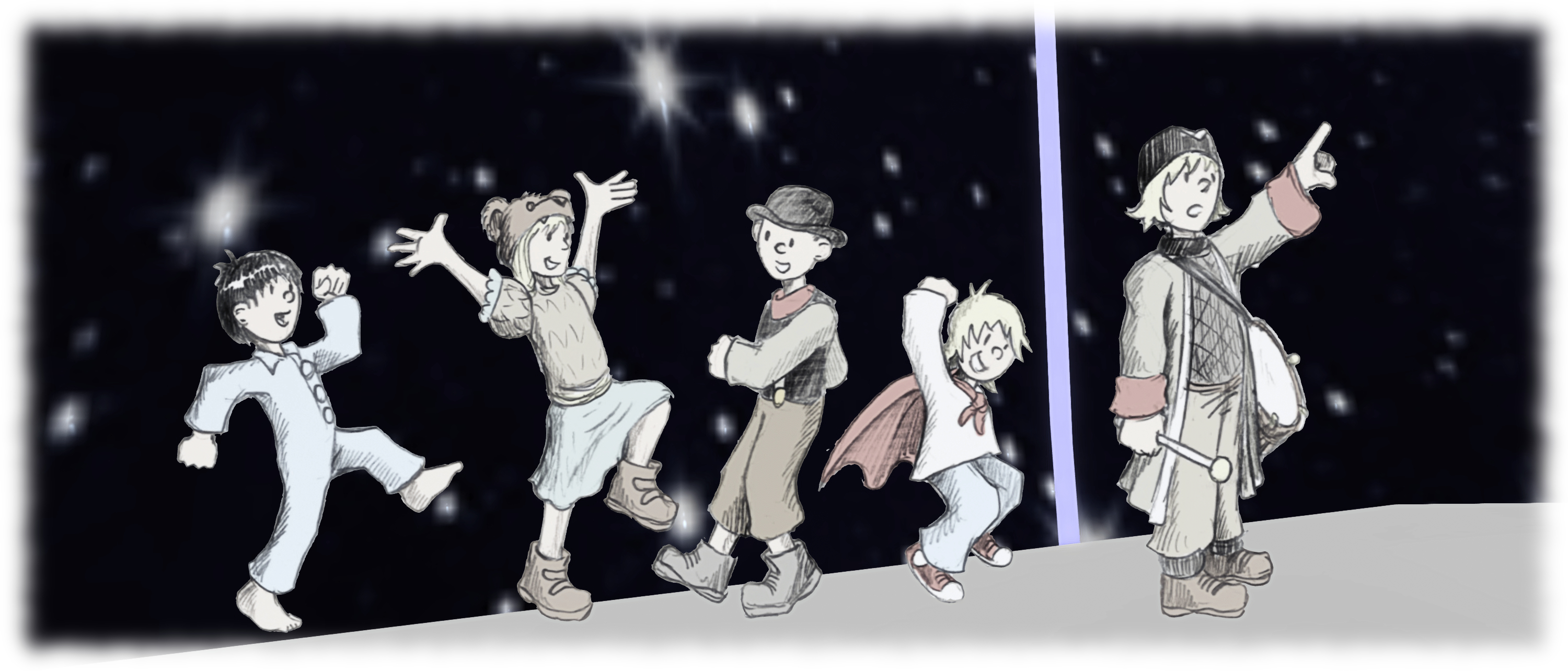
This year, he uses the forthcoming Experience Keys to take people on a journey; a story combining drawings, mesh constructions, voice and imagination to demonstrate the freedom Second Life gives people to rediscover the joys of childhood and childhood dreams, and show just why child avatars are so popular within the platform.
Loki Eliot - Childhood Dreams
Loki Eliot – Childhood Dreams

He does so with a beautiful story visitors are invited to travel through and share; a story without  the need to couch anything in matters of unhappy childhoods or metaphor or anything else; but which rather shows the unbridled joy of escape that can be found, of sharing something which – for whatever reason may have been lost or denied at an earlier age. In doing so, he also blows away the fog of misconception surrounding people’s self-expression through child avatars and offers a gentle, engaging challenge to those who persist in looking upon other who use child avatars with doubt and suspicion. This is a brilliant and captivating piece, and one that should not be overlooked by anyone visiting SL12BCC.

Juliana Lethdetter – Second Life Maps

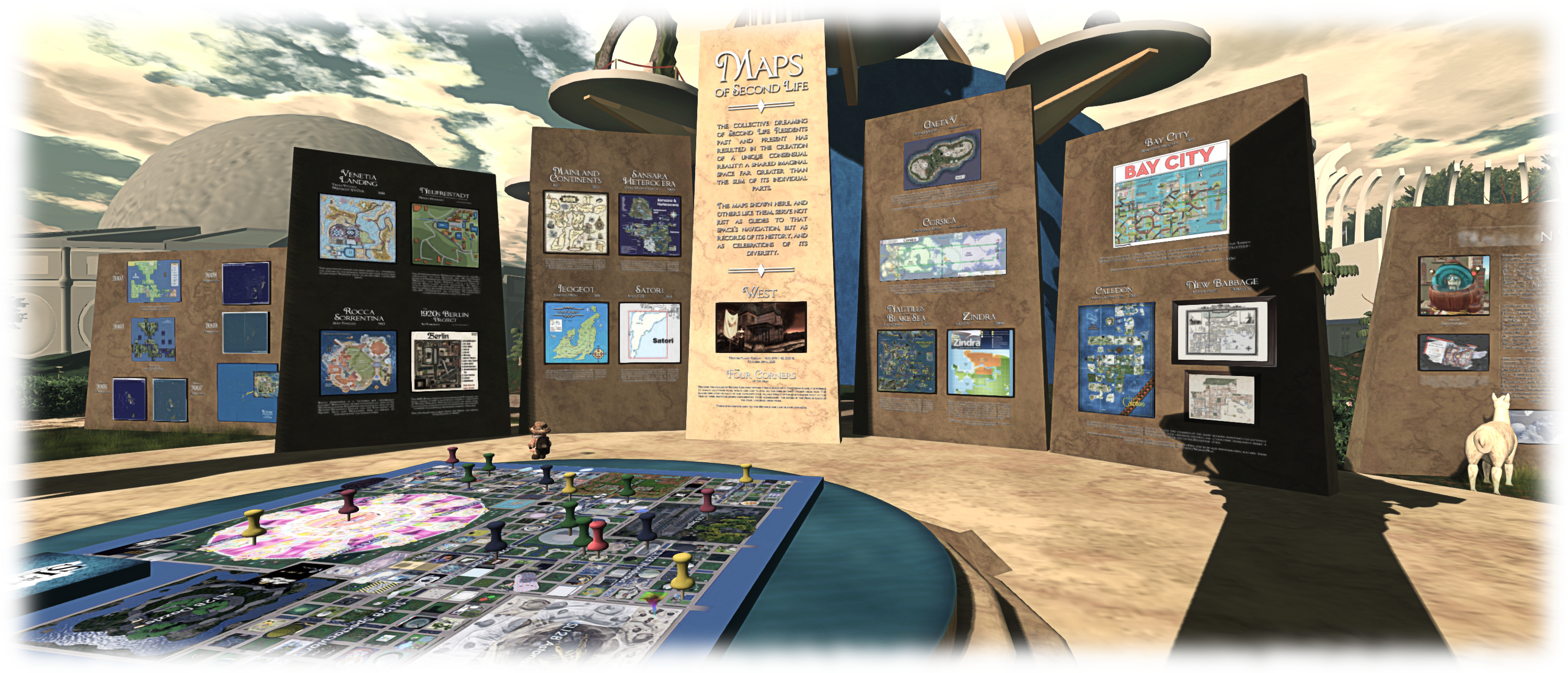
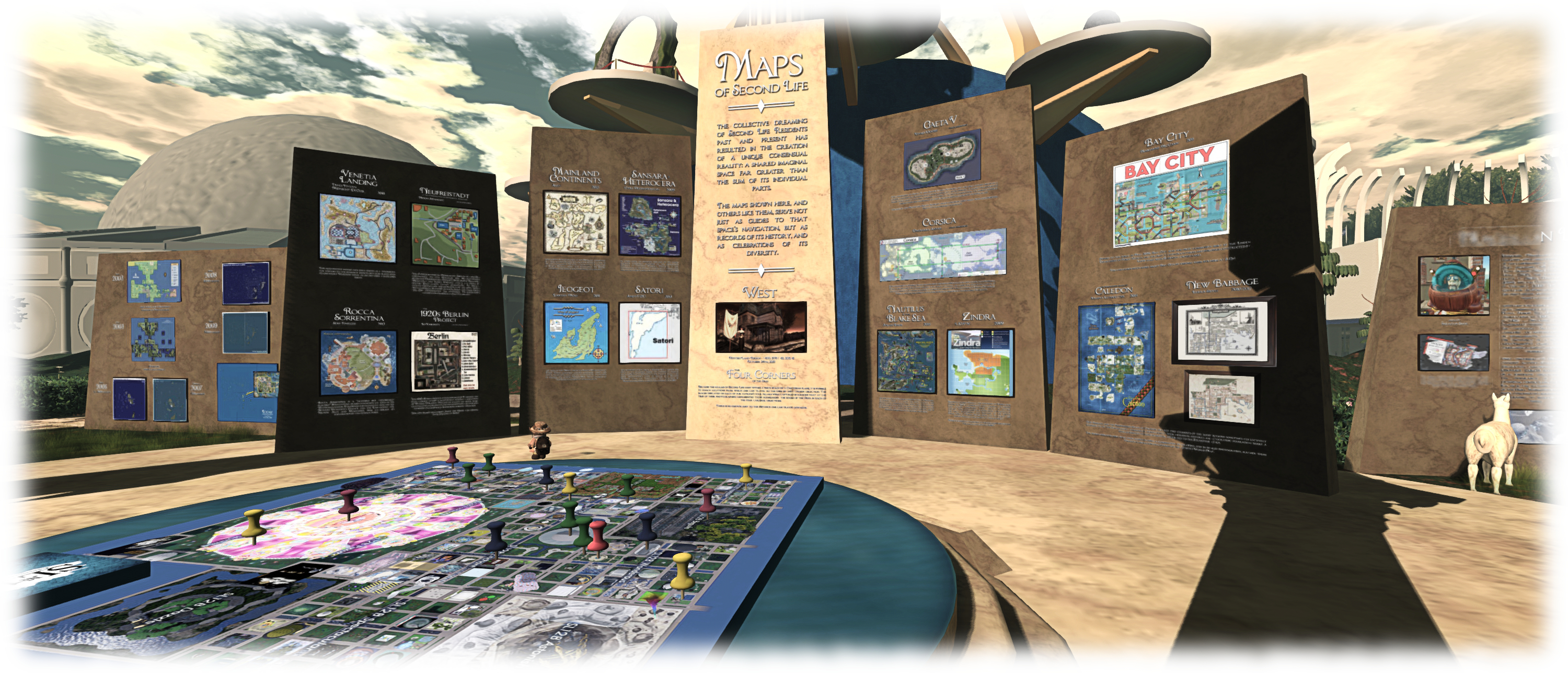
I first visited Juliana’s marvellous collection of Second Life Maps back in 2012 (you can read about that visit here). For anyone remotely interested in Second Life’s history, it is a must-see destination (and one overdue for an update visit for this blog!). So it was with delight that I found her display at SL12B enjoying a prominent position just across the road from the main auditorium building.
Juliana Lethdetter - Second Life Maps
Juliana Lethdetter – Second Life Maps

In many respects, the idea that Second Life is a world is actually an illusion; while we can cross the mainland continents, and in some cases travel between continents and some estates, it simply is not possible to travel the entire “world” without resorting to the use of of the teleport – even, at times, for the simple act of visiting a neighbouring region.

But, the fact is that the illusion is a consensual one; we all freely engage in it; and through it, we gain more of a sense of place within Second life than might otherwise be the case. The rich diversity of maps which have been created over the years, both by the Lab and by residents, is both testament to the power of this consensual illusion, and a means of really understanding just how vast and diverse this digital realm really is – as Juliana beautifully reminds us:

 The collective dreaming of Second Life Residents past and present
has resulted in the creation of a unique consensual reality:
a shared imaginal space far greater than the sum of its individual parts.

Ziki Questi – Matter and Memory

When it comes to SL photography, I wish I had just an ounce of the talent Ziki Questi consistently displays in her work. She has a eye for subject, composition, depth of field, colour, and framing that always has me in awe.
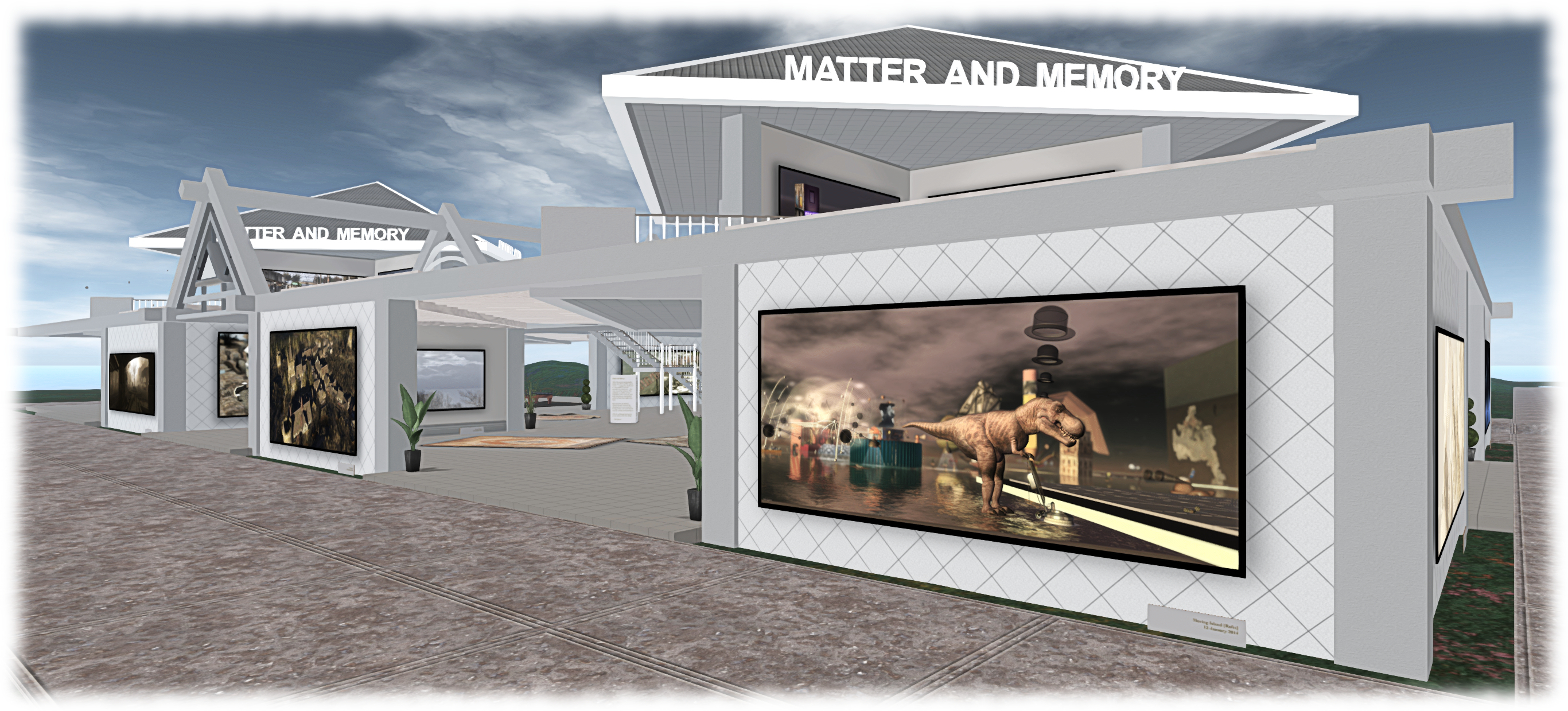
Ast-5_001
Ziki Questi – Matter and Memory

Matter and Memory presents a series of Ziki’s images captured from around Second Life between 2011 and 2015, which range from landscapes through unique takes on art installations through to the “not possible in real life” category, where the builds and creations to be found in Second Life far outstrip anything to be imagined or created in the physical world.
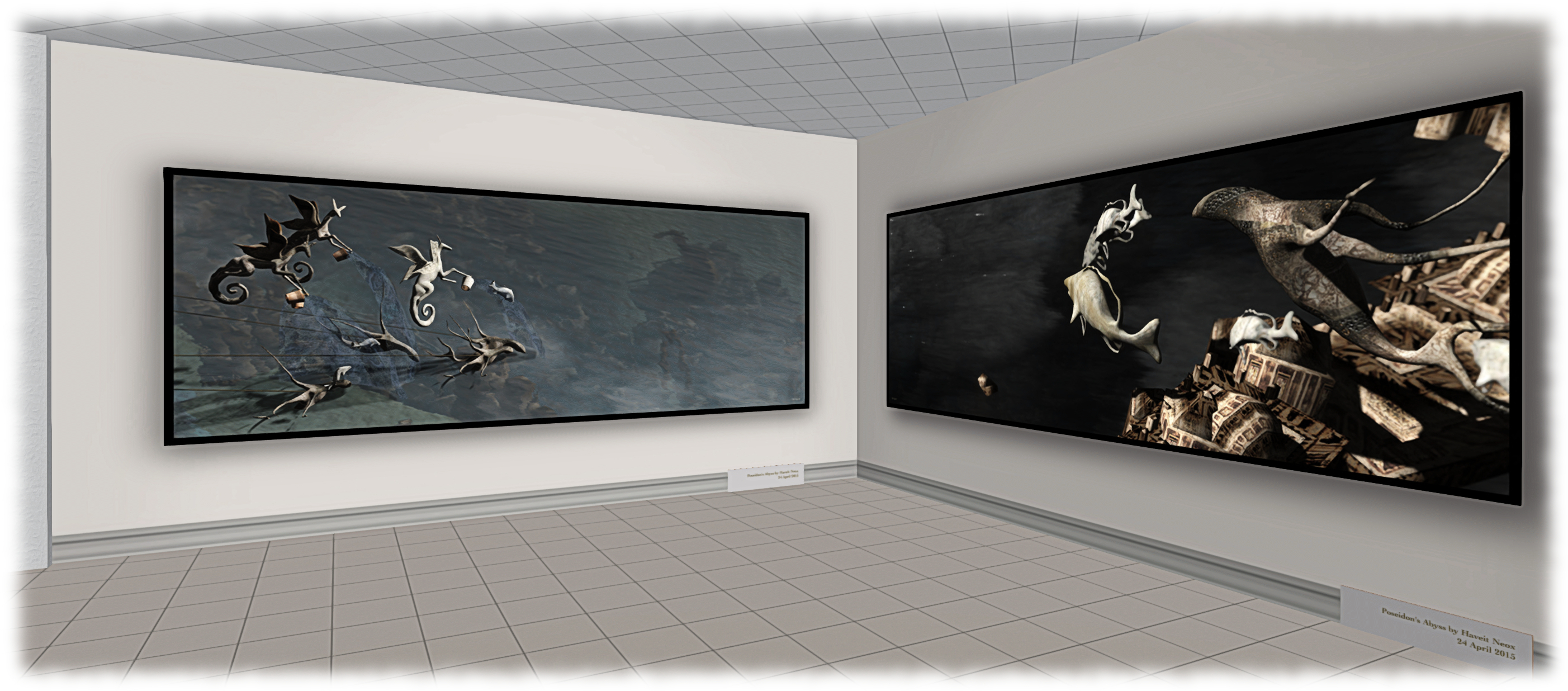
Ast-4_001
Ziki Questi – Matter and Memory

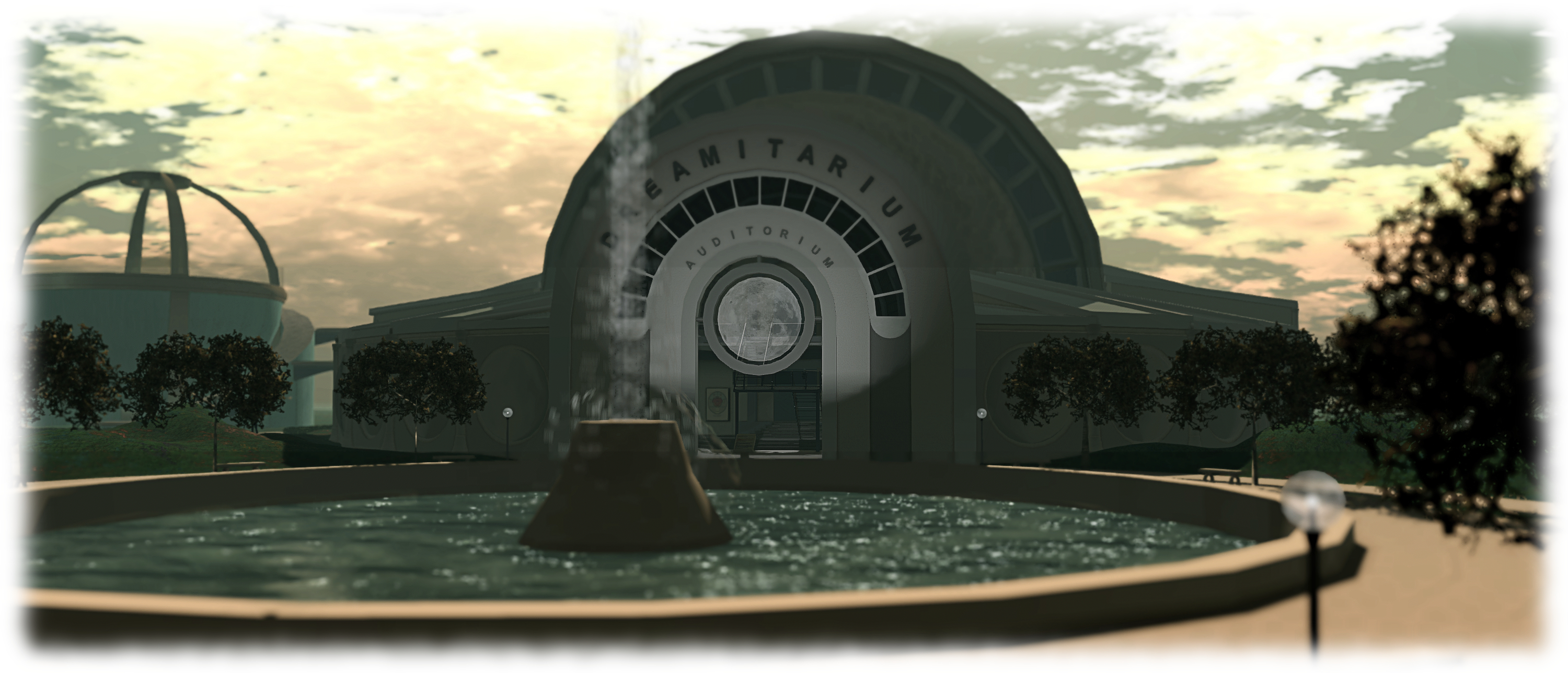
The images displayed represent regions past and present, offering something of a glimpse of Second Life’s history through the lens of an exceptional photographer, all of which are shown in what is, for me, one of the most visually appealing pavilions in SL12B, designed Anthony (ADudeNamed Anthony).

Continue reading “Art and artistry at SL12B: a personal selection”

Windlight: a new magazine for art in Second Life

WindlightWindlight is the the title of a new arts magazine for Second Life which will be launching in July 2015.

Founded by John (Johannes1977 Resident), himself a SL photographer and also RFL of SL activist, Windlight brings together a talented team to cover art in all its forms in SL with monthly news, reviews, articles, interviews, commentary and more.

A joint venture with AviChoice Productions, organisers of the the Avi Choice Awards and publishers of Avi Choice Magazine, Windlight’s goal is to cover the Second Life art scene and to support  artists, photographers, galleries, and art-related events. The first issue will feature artist Bryn Oh, and photographer Skip Staheli alongside Sasun Steinbeck, Nikki Mathieson and more.

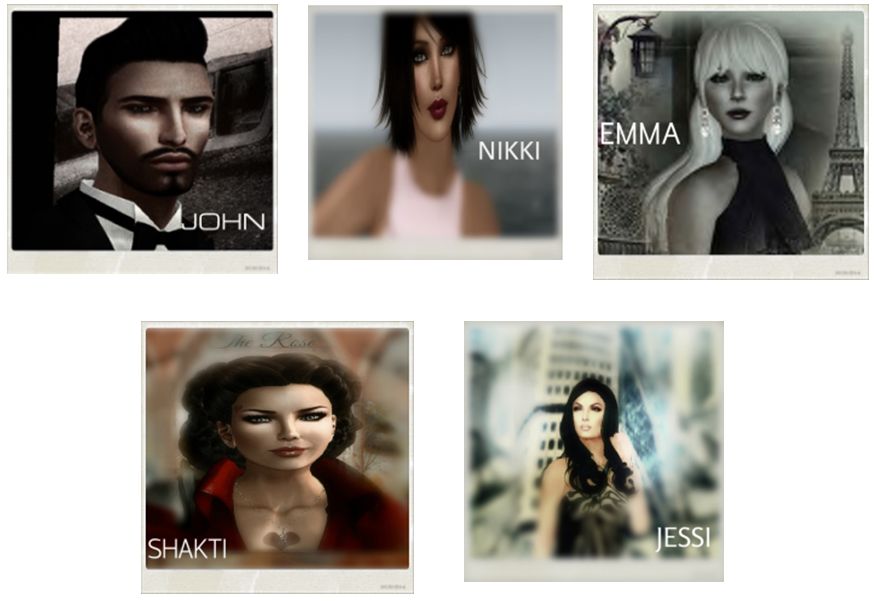
When I call the team behind the magazine talented, I’m not exaggerating. Joining John, who is the magazine’s co-publisher and editor as well is its founder, are: Nikki Mathieson, owner of Avi Choice Productions and Windlight’s co-publisher, Jessi2009 Warrhol, the magazine’s Marketing Manager, together with contributing writers Emma Portilo and Shakti Adored.

Windlight brings together a talented team: John (Johannes1977 Resident), Founder, Publisher & Editor In Chief; Nikki Mathieson, Co-Publisher & Owner of Avi Choice Productions; Jessii2009 Warrhol, Marketing; Emma Portilo, Featured Contributor and Shakti Adored, Featured Contributor

The Windlight Magazine Art Gallery Fellowship Programme

As a part of the magazine’s desire to help promote and support artists and photographers, Windlight is launching the Windlight Magazine Art Gallery Fellowship Programme. this offers those accepted into it with gallery space free of charge for a period of 30 days.

Applications are now being taken for the first round of awards, so if you are interested, do make sure to check the application guidelines and complete the application form.

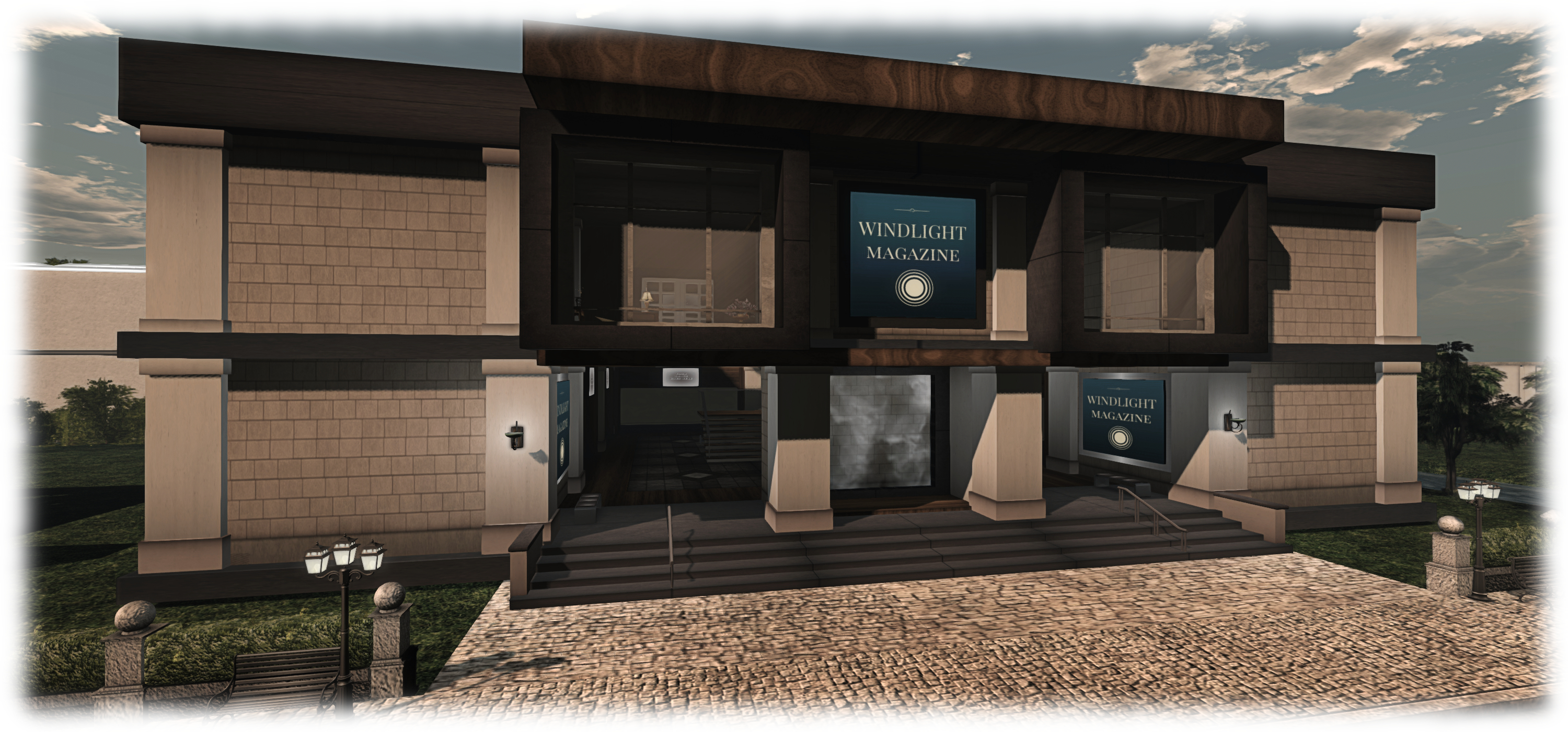
The Windlight Gallery will provide free space to artists under the Windlight Fellowship Programme

Commenting on the magazine as we discussed the upcoming first edition, John said, “In establishing Windlight, we hope to provide a means by which the rich, incredible diversity of art within Second Life can be more broadly enjoyed and appreciated, by both Second Life users and, hopefully, an audience beyond the platform as well.”

As someone who genuinely appreciates art within Second Life, that’s a vision I can fully support, and I am both honoured proud to say that I’ll be joining Windlight from August 2015 as a contributing writer. I’m really looking forward to the opportunity; joining the team will not only allow me to extend my friendship with John and Jessi, both of whom I’ve come to know by way of Relay for Life; but will also further increase my own understanding of, and appreciation for, art in general.

So – keep your eyes out for Windlight this July!

The Second Life Music Fest

L12B Community Celebration; Inara Pey, June 2015, on FlickrSL12B: Ixtlan Stage – Cube Republic, June 2015 (Flickr)

To mark SL12B, Linden Lab announced in May that they’d be holding a live Music Festival, and went on to hold auditions for artists and groups at Feed A Smile’s Lavender Fields.

On Wednesday, June 24th, the Lab announced the official dates and schedule for the Festival (although the keen-eyed would have already noted it on the SL12BCC event schedule, where the line-up has been available as well).

The event will take place at Cube Republic’s excellent Ixtlan Stage over the course of Friday, June 26th and Saturday June 27th.

The full line-up for the event reads as follows – all times SLT:

Friday, June 26th
Saturday, June 27th
11:00: Alazarin Mondrian 20:00: Mavenn Resident
11:30: The Pink Vampire 20:30: Oblee
Noon: Tamra Hayden 21:00: Collin Martin
12:30: Effinjay 21:30: Taunter Goodnight
13:00: Amforte Clarity 22:00: Donn DeVore
13:30: Isabella Rumsford 22:30: Zak Claxton
14:00: Tempio Breil 23:00: LuvofMusic
14:30: Phoenix J 23:30: Ren Enberg & Quai Franklin

The line-up has been selected to represent a broad cross-section of live music in Second Life, and the auditions proved popular among musicians and residents in the audience alike.

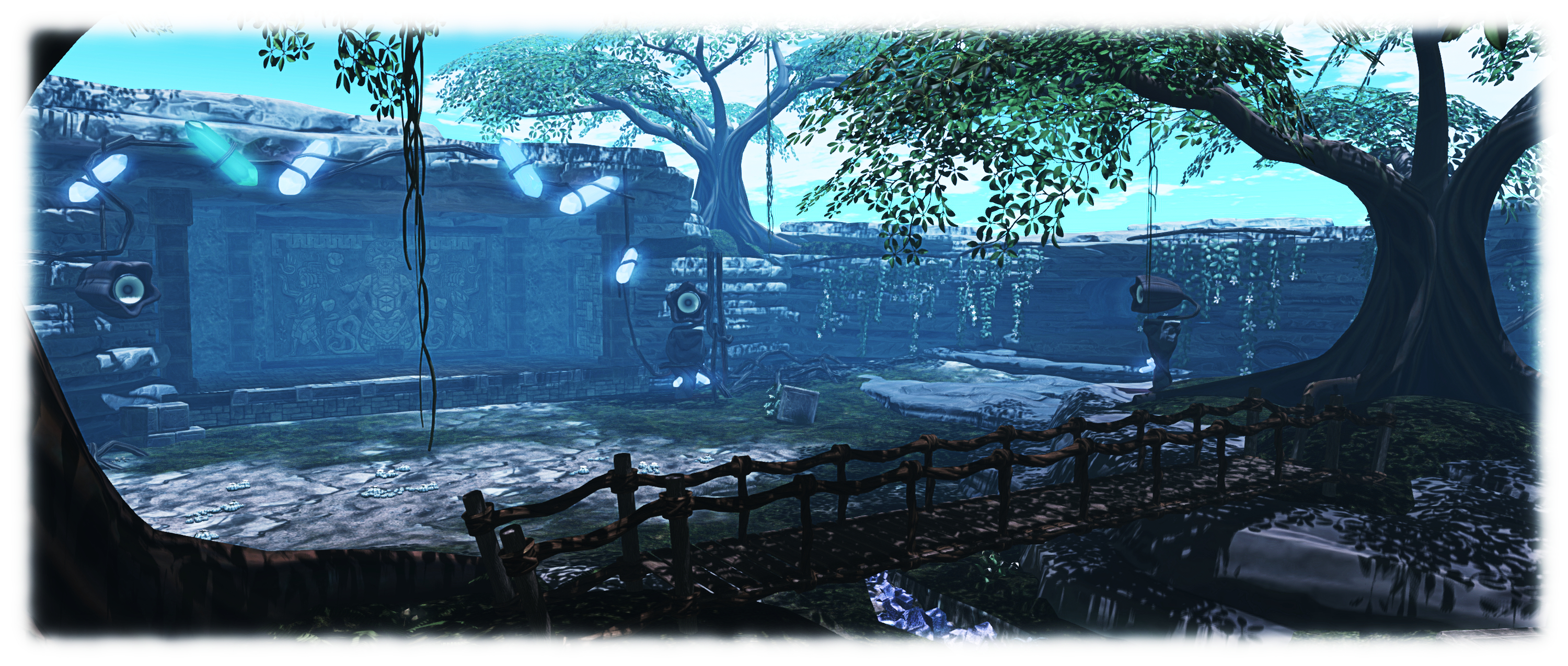
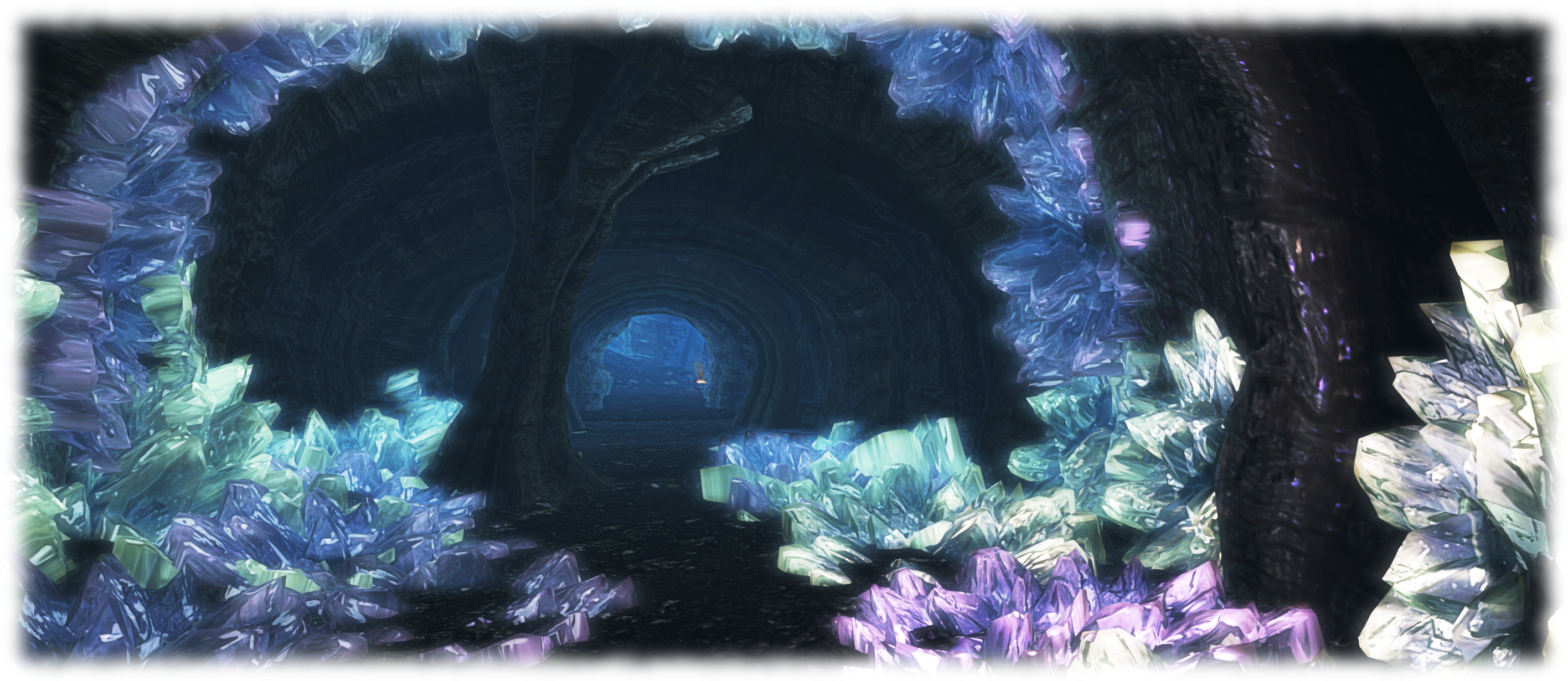
As well as hearing great music, the festival offers a further opportunity for exploring the Ixtlan stage build. Cube’s design really is amazing, and time taken to enter the caverns and walk through them really is highly recommended.

Ixtlan Stage - Cube Republic
SL12B: Ixtlan Stage – Cube Republic, June 2015

Happy Anniversary, Second Life!

L12B Community Celebration; Inara Pey, June 2015, on FlickrSL12B Welcome area by Walton F. Wainwright (Faust Steamer), June 2015 (Flickr)

We all call it a birthday, but the reality is that June 23rd actually marks an anniversary: that of the public opening of Second Life  in 2003 to anyone wishing to come aboard and find out what it is all about.

Second Life was actually “born” some time before that. Depending on your point-of-view it could be said that its “real” birthday was either March 2002, as Linden World morphed into a very alpha Second Life, or perhaps October 2002, when the closed beta started; or even April 2003, when the open beta launched.

Nevertheless, whether birthday or anniversary, reaching 12 years of public access is a remarkable achievement by anyone’s standards when it comes to what is essentially an IT platform, and the fact is that Second Life – despite the doom and gloom and dire predictions that frequently pour forth as to its future – is still in pretty robust health and remains a source of enjoyment to so many, is something that should be celebrated.

SL12B Community Celebration; Inara Pey, June 2015, on FlickrSL12B Wondrous: Juliana Lethdetter’s Second Life Maps, June 2015 (Flickr)

Over the span of years, we’ve seen Second Life grow from humble origins to become one of the longest running and, arguably, one of the most successful virtual world environments yet created. Yes, the total number of active users may never have got much beyond the one million mark, but in some ways this hardly matters. The fact is that Second Life has become a strong, vibrant set of intertwined communities and groups; a place where creativity can be freely expressed almost howsoever we can imagine.

It allows people from all over the world to congregate, to share in experiences and activities and one another’s lives; it is a place where friendships – even relationships – can form between those who otherwise would never meet, much less spend time together. Through it, many have found an outlet for their digital creative talents, while others have found an audience for their singing and song writing, and others have found it a means of incredible artistic expression.

SL12B Community Celebration; Inara Pey, June 2015, on Flickr
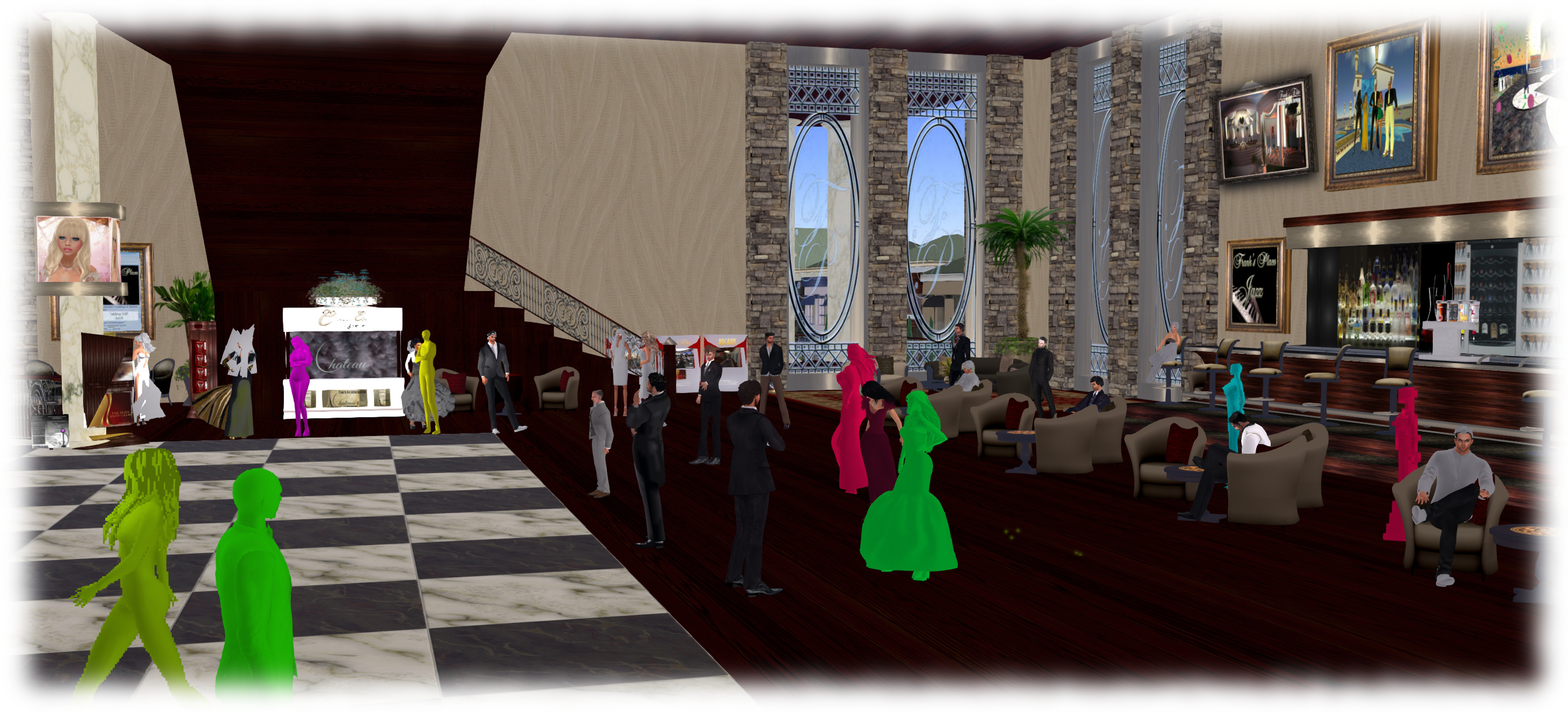
SL12B Pizzazz: Mistero Hifeng with David DuCasse / leydi Yifu beyond, June 2015 (Flickr)

And throughout that time, the platform has continued to evolve, to meet the ever more complicated and broad ranging demands we place upon it. Thus, over the years we’ve seen the arrival of private regions, of better and more capable scripting capabilities, visual enhancements such as windlight and materials, support for different means of content creation – notably mesh, and so on. And it has remained a highly successful means for many to generate an income of their own.

What’s more, all of this has been done – particularly over the last five years – with little or no major upset to people’s ability to access a world we expect to be ready and waiting for us at any given minute of the day, 24 hours a day, 7 days a week.

When you think about it, this is a level of availability that is quite stunning, and which many other services are hard pushed to provide. Even more so when you consider the overwhelming complexity of Second Life. Not just the simulators, and their need to support a wealth of content we, the collective residents, can between us pretty much change at will; but all the additional (and all-too-often ignored) back-end systems that must always be available non-stop in order for us to be able talk, share, buy, wear, render, and so on.

Of course there have been lows as well as highs over the years. Some of these have been over-exaggerated with the passage of time, others do speak of missteps along the way. There have been the inevitable upsets and times when the Lab and residents have seemed pretty much at odds with one another. But that’s to be expected where people feel passionately about something, and into which they have poured so much of their time, effort and talent.

L12B Community Celebration; Inara Pey, June 2015, on FlickrSL12B Dreamitarium by Anthony (ADudeNamed Anthony), June 2015 (Flickr)

Perhaps the worst period in SL’s long history came in 2008/09, when it did seem there was a prevailing desire within some of those running the company to see the platform turned away from the open, creative and collaborative platform which has marked its success, and into something altogether more business-oriented in outlook and use.  That year also marked the whole OpenSpace / Homestead region situation which caused considerable bad feeling, and which could be said to have gone on to have repercussions through the period 2010-2013.

But when taken as a whole, low points such as these are really in the minority. By-and-large, Second life has been for all of us who continue to engage in it, a positive and rewarding  experience. After all, if it were otherwise, would we actually still be here? And that goes for the staff at the Lab as well, all of whom, I think it fair to say, are as enthusiastic for, and engaged with, the platform as any resident, even if we don’t often get to see it directly. After all, were they not, why should they keep working at the Lab?

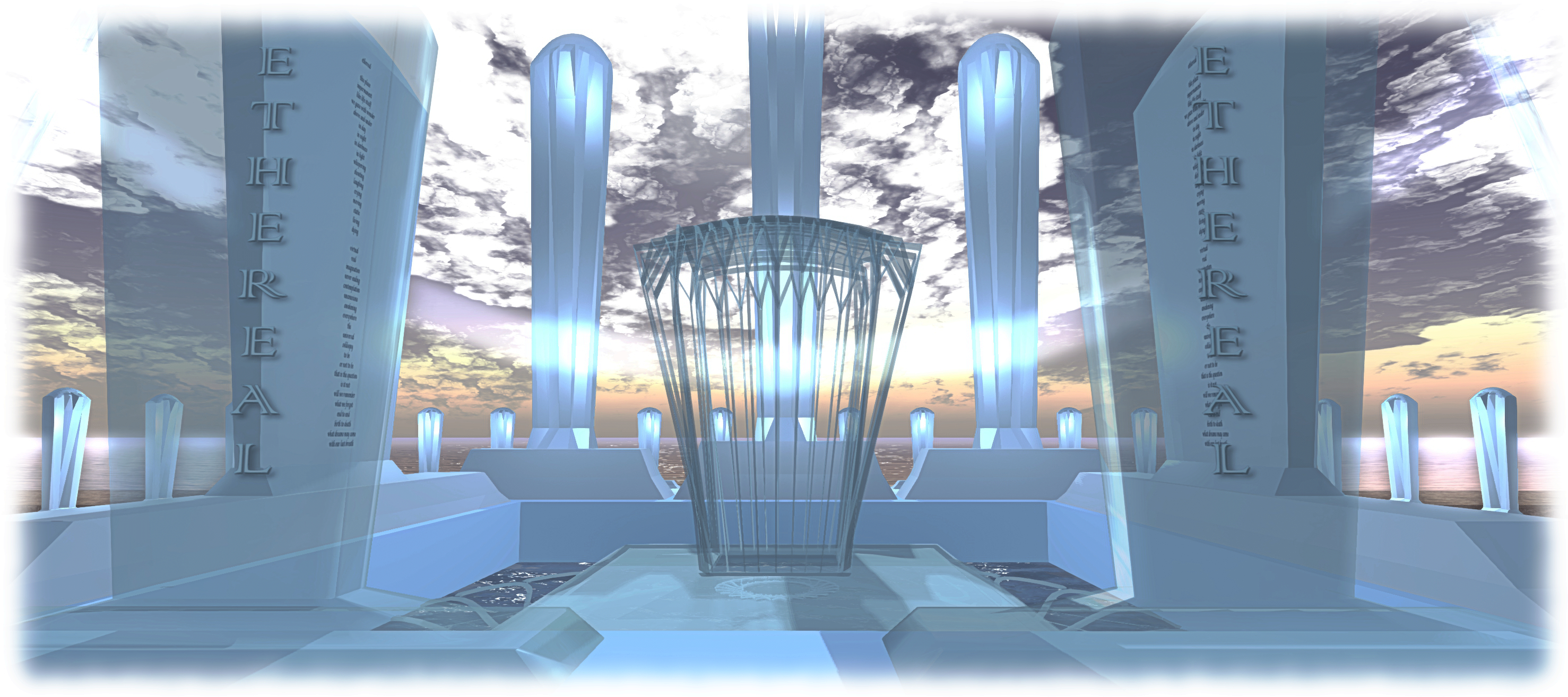
L12B Community Celebration; Inara Pey, June 2015, on FlickrSL12B Electrify: Pixel Sideways’ Ethereal, June 2015 (Flickr)

Second Life has been – and remains a quite remarkable adventure; one that obviously retains a huge amount of appeal for all of us who come to it, often on a daily basis. It’s a place where a part of us, no matter how small, does find fulfilment and enjoyment. Hence why it is right that we do celebrate just what a technical and social feat Second life really is, and what it means to all of us.

And when you think about it, while 12 years a a long time, it still means Second Life has yet to enter its teens, so there is plenty of promise of life to come – and with it, dreams aplenty to share.

Happy Anniversary, Second Life – and here’s to many more!

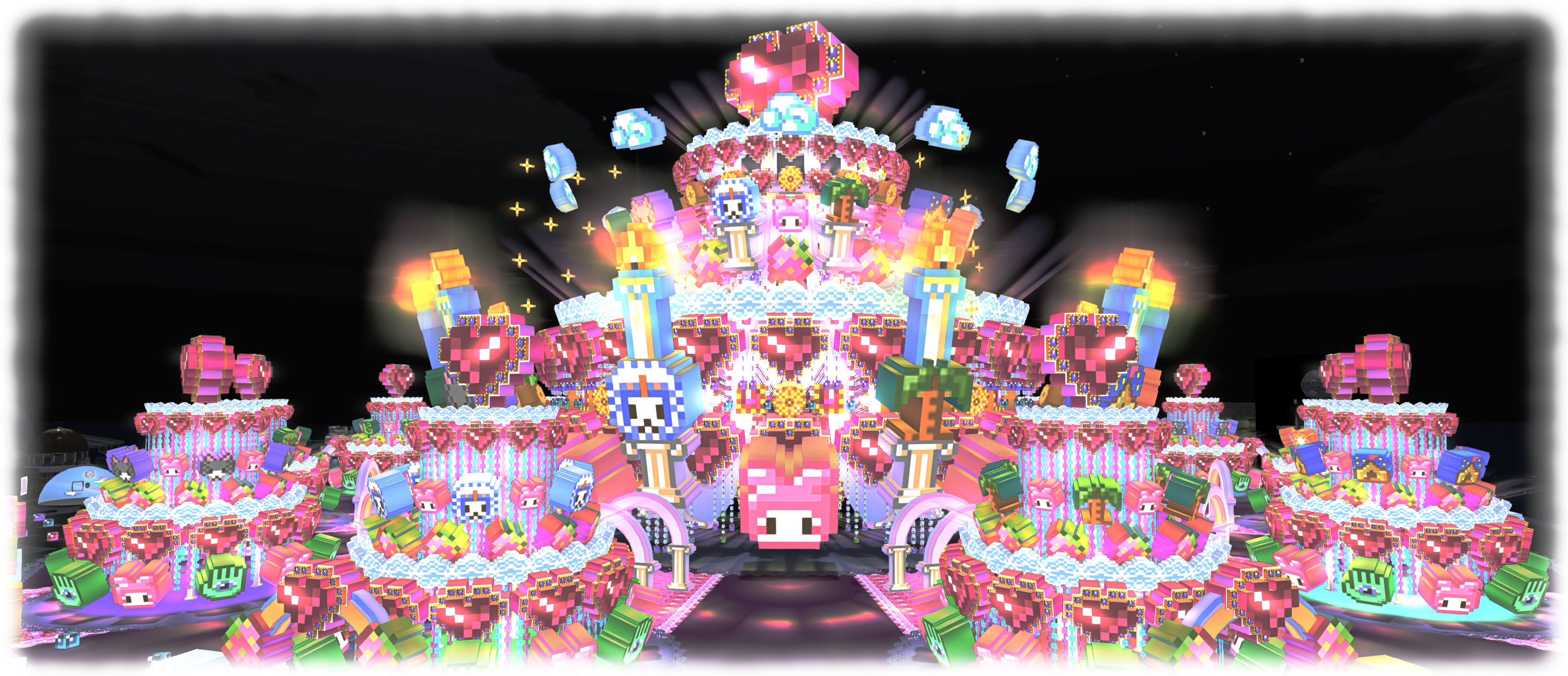
SL12B Community Celebration; Inara Pey, June 2015, on FlickrThe Cake Stage – Miktaki Slade, June 2015 (Flickr)

Additional Information

Early looks: Avatar Complexity and Graphics Presets

secondlifeTwo new options which will be appearing in the official viewer in the near future, and which have been mentioned in this blog a number of times over the past few months are Avatar Complexity and the ability to create, save and restore graphics presets. Both are intended to provide options by which users can better tune the viewer and its settings to suit their needs and circumstances.

I’ve had the opportunity to look at both in a development viewer from the Lab, and what follows is an overview of how things may appear when both capabilities are released for general use. However, please keep in mind that things are sill very much a work-in-progress at the moment and aspects of either / both may well change between now and any functionality appearing in any public version of the viewer.

Avatar Complexity

As avatars can often be the single biggest impact on the viewer in terms of rendering, particularly in crowded places, so  Avatar Complexity adds a new slider to the viewer which can be used to set a level above which avatars requiring a lot of processing will appear as a solid colour – the most popular term used to describe them being Jelly Babies after the sweet (candy) of the same name – greatly reducing the load placed on a system compared to having to render them in detail, so improving performance.

Avatar complexity is intended to help those who may hit performance issues as a result of their GPU struggling to render complex (hight render cost) avatars, by rendering such avatars as solid colours.

The intent with the capability is to allow people to adjust the setting according to circumstance, so that when in a crowded area with lots of avatars, the setting can be dialled down and more of those avatars which are harder to render become solid colours, while in quieter areas, the setting and can dialled back up, allowing more avatars to be seen in full detail.

Avatar Complexity is intended to sit alongside the avatar imposters functionality (Max # of non-impostors in the official viewer), allowing both to be used as required to produce more optimal performance in crowded or busy places.

By default, Avatar Complexity is set to No Limit, meaning all avatars in your field of view will fully render. As the slider is moved, it will list a render weight value, which is a revision of the RenderAutoMute function within the viewer previously used to help calculate the more familiar Avatar Draw /  Render Weight. The latter, viewed via Advanced > Performance Tools, has also been renamed to Show Avatar Complexity Information for consistency, with the displayed information updated.

The Avatar Complexity slider in Preferences > Graphics > Advanced Graphics Preferences (l) and the new format of information displayed when Advanced > Performance Tools > Show Avatar Complexity Information is enabled (r)
The Avatar Complexity slider in Preferences > Graphics > Advanced Graphics Preferences (l) and the new format of information displayed when Advanced > Performance Tools > Show Avatar Complexity Information is enabled (r) – click for full size

Graphics Presets

The initial work on Graphics Presets was undertaken by open source contributor Jonathan Yap (see STORM-2082) to provide a means by which users can save and restore different sets of graphics settings within the viewer. The idea being that users can then switch between different presets according to circumstance to help with viewer performance.

So, for example, one preset might have all the performance hitting items – shadows, projectors, etc., – turned on / up for times when the overall quality and depth of detail in a scene is important (such as when taking photos). Another might have these more taxing capabilities turned down / off to ease the processing load on a computer during more general activities. A third might be established for “in door” uses, with things like draw distance and the level of detail for external items (the sky, trees, terrain, reflections, etc.) all turned down, again easing the processing load.

Like Avatar Complexity, Graphics Presets is still undergoing development internally with the Lab, and so what is presented here may be subject to change.

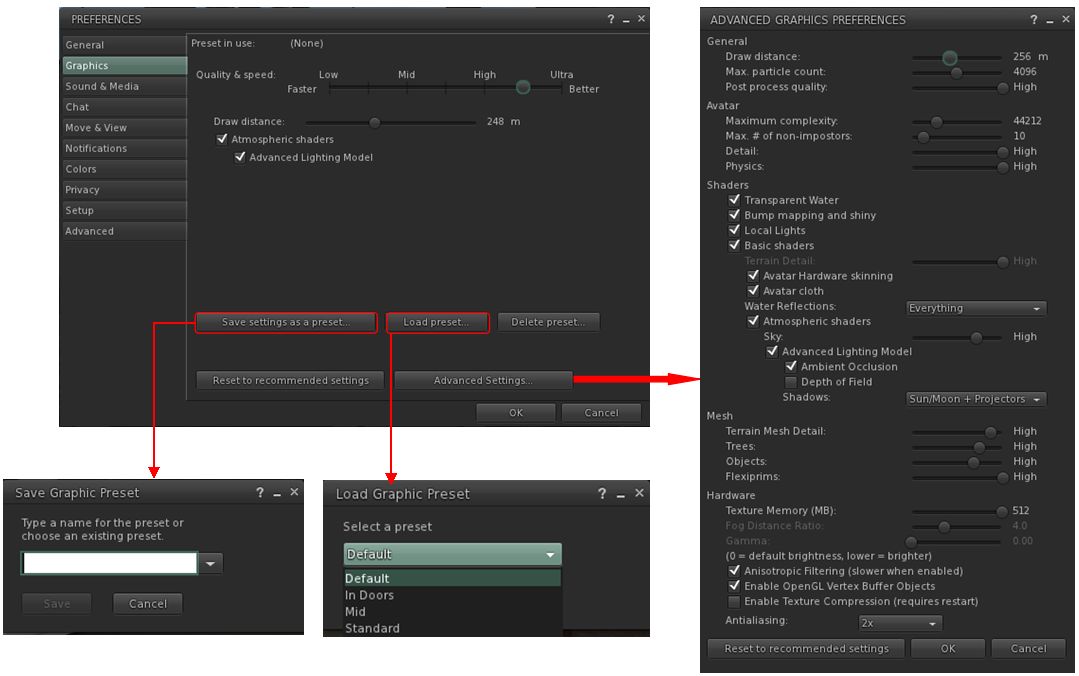
Perhaps the most significant change this brings to the viewer is the introduction of a new Advance Graphics Preferences floater (shown below right). This is designed to display all of the options than a user can set and save within a graphics preset without having to either scroll through options (an earlier iteration of the design did use a scroll bar, but they didn’t meet with favourable reactions during testing), or having to switch between different sub tabs.

The new graphics profile options - the Advanced Graphics floater (as it is at present), and the options for saving / restoring profiles from within Preferences.
The new graphics presets options – the Advanced Graphics floater (as it is at present), and the options for saving / restoring profiles from within Preferences – click for full size

Continue reading “Early looks: Avatar Complexity and Graphics Presets”

Artistic timbres in second Life


Slayton Drake: A Palette of Timbres, Cape Able Art Gallery
Slatan Dryke: A Palette of Timbres, Cape Able Art Gallery

Saturday, June 20th saw the opening of a new exhibition featuring the art of Second Life photographer and sculptor, Slatan Dryke.

A Palette of Timbres, hosted at Virtual Ability’s Cape Able Art Gallery, presents 27 images captured by Slatan together with a number of his still and animated sculptures. As might be taken from the title of the exhibition, each of the images on display features strong tonal colours which mark them as much as – if not more so – than their subject matter.

Slayton Drake: A Palette of Timbres, Cape Able Art Gallery
Slatan Dryke: A Palette of Timbres, Cape Able Art Gallery

The result is a series of pictures, many of them of familiar places across Second Life, presented in the most striking of ways, where the choice of colour both projects a sense of texture and tone of mood – much as musical timbre is used to describe the deeper sense of tone and quality evidenced in the sound of music – light, dark, warm, bright, cool, and so on.

Of course, we’re all familiar with seeing colour in art, responding to its use and the way in which the artist makes use of his or her palette; but within several of the pieces here, there is the deliberate over-emphasis of certain colours and shades to present the subject matter in such a way as to almost give it a voice, a sound; perhaps even a harmony. Thus, the observer is offered a glimpse into the world of psychoacoustics which is in many respects, entirely in keeping with the place in which the exhibition is being hosted.

Which is also not to say that one needs to be deeply immersed in the theory of timbre and sound or the use of colour in order to appreciate the pieces on display. Slatan has a fine eye for composition – as fine a composer’s ear for music, one might be tempted to say –  and his images are exquisite in their detail and beauty, which makes them tempting additions for any collection or home.

Should you be interested in owning a copy of any of the pieces displayed, please keep in mind that Virtual Ability is a non-profit 501(c)3 organisation, and is prevented from allowing third parties such as artists from selling directly on their regions; so please contact Slatan directly.

Slayton Drake: A Palette of Timbres, Cape Able Art Gallery
Slatan Dryke: A Palette of Timbres, Cape Able Art Gallery

While visiting Cape Able, do make sure you visit the resource centre there, and learn more about Virtual Ability’s work with the hearing impaired, including their Deaf Chat Coffee house – see iSke’s comments following this article on the work there. Also be sure to visit the Fenimore Art Museum, which is currently hosting an exhibition of the work of American artist and illustrator, Maxfield Parrish.

SLurl Details