
ESA’s Philae lander, which as I reported a week ago, resumed contact with Earth via its “Parent”, Rosetta, after seven months in hibernation, continues to return data to Earth from comet 67P/Churyumov–Gerasimenko (67P/C-G) as it continues towards the Sun.
Friday, June 19th, marked the latest transmission from Philae, which is about the size of a domestic washing machine, bringing the total of communications with mission control in Germany to 3 since the lander managed to re-establish its link with Rosetta.
Communications are sporadic because it is still not entirely clear where Philae is sitting on the comet, having bounced across the surface following its initial touch-down in November 2014. This, and Rosetta’s science-focused orbit around the comet means that there can be extended periods of several days between the times when both spacecraft and lander are suitably aligned to allow communications to take place.
The Friday communication lasted 19 minutes, and allowed the lander to return a further 185 packets of data to Earth. The data gave additional confirmation that Philae is in good health and in an environment which means it should be quite comfortable for a good while – thus increasing the chances of it resuming its science activities.
“Among other things, we have received updated status information,” Michael Maibaum, a systems engineer at the DLR Lander Control Centre in Cologne, reported following the Friday contact. “At present, the lander is operating at a temperature of zero degrees Celsius, which means that the battery is now warm enough to store energy. This means that Philae will also be able to work during the comet’s night, regardless of solar illumination.”
The three communications so far received mean that the mission team now have sufficient data to be able to more accurately position Rosetta so that it can continue with its primary science mission while being better placed to improve radio visibility between it and the lander’s estimated location. The first set of commands for the spacecraft to start adjusting its orbit were uploaded on Wednesday, June 17th, and and further set of instructions were uploaded on Saturday, June 20th. The aim is to close the distance between Rosetta and the comet to 177 kilometres within an orbit that will allow the orbiter to be above Philae’s horizon more regularly than is currently the case.
Pluto’s Gentle Fade In
NASA’s New Horizons mission to the Pluto-Charon system is now less than a month from its point of closest approach, which will occur on July 14th, 2015. As the fast-moving spacecraft closes on the two planetoids, the images it is returning to Earth of Pluto are starting to show tantalising splotches of dark across the planetoid’s surface, the first hints of landforms.

The pictures are still nowhere near being as clear as they should be in the days immediately prior to and following the point of closest approach, but they are still nevertheless interesting; in April 2015, New Horizons images what appears to be a polar ice cap on Pluto, so scientists are curious to what else might be revealed.
At the time of closest approach, New Horizons should be within 10,000 kilometres (6,200 miles) of Pluto and around 27,000 kilometres (17,000 miles) of Charon. The fly-by of Pluto should allow the main telescope camera system on the vehicle to take selected high-resolution images of Pluto at a scale of 50 metres / pixel. It is hoped that the average resolution of daylight images captured of Pluto will be around 1.6 km (1 mile) resolution, and will allow the composition of 4-colour maps of the surface.
From around 3.2 days before closest approach, long-range imaging will be used to map both worlds to a resolution of around 40 kilometres (25 miles). New Horizons will also attempt to gather data on the nature of any atmosphere present on Pluto and seek evidence of any cryovolcanism which might be occurring or surface feature changes which might be attributable to snowfall or similar.
Titan: Even More In Common

There are only two places in our solar system known of have rainfall, rivers and oceans, as well as a thick atmosphere, rocky ground and plate tectonics. They are Earth and Saturn’s huge moon, Titan. Now the joint ESA / NASA Cassini mission has revealed Titan shares something else with Earth: polar “winds” that suck gasses out of its atmosphere and into space.
Titan’s atmosphere has around a 50% higher surface pressure than Earth’s, and is comprised mainly of nitrogen and methane, and is rich in hydrocarbons, which also exist in lakes, reivers and seas on the surface of the planet.
Several years ago Cassini, which has been orbiting in orbit around Saturn for over a decade, revealed that around seven tonnes of hydrocarbons and nitriles were being lost every day from the upper layers of Titan’s atmosphere, but the mechanism causing the loss remained unknown until CAPS, the instrument which first recorded the loss recorded the “wind” in action.
Essentially, sunlight striking the upper layers of Titan’s atmosphere ejects negatively charged electrons out of the hydrocarbon and nitrile molecules resting there. These electrons are then drawn away along Saturn’s magnetic field, generating their own electrical field strong enough to “pull” the positively charged particles left behind by the formation of the original electrons out of the atmosphere along with them.
On Earth, this process charges particles in the atmosphere and draws them up along the planet’s magnetic field, where they can escape at the poles, and the same thing is happening on Titan. The discovery has lead to speculation that similar processes might be at work on Mars and Venus.

Titan’s seas occur predominantly in the polar regions and often have river networks flowing into them, just as we have here on Earth. They can reach up to several hundred kilometres across and are thought to be several hundred metres deep in places. Spread around and between these are dozens and dozen of smaller lakes, none of which appear to be fed by river systems, but instead seem to be the result of rainfall flooding depressions in otherwise flat areas of land.
While these seas, rivers and lakes have been identified as being liquid hydrocarbons, precisely how and why the lakes should form, even allowing for the fact that hydrocarbon rain does fall in the northern and southern extreme of the planet during their respective summer periods, has remained something of a mystery until recently.
Here on Earth we have what are called karstic landforms – landscapes created by the erosion of dissolvable minerals such as limestone and gypsum, as ground water and rainfall percolate through rocks bearing them. The loss of these minerals, over time, results in depressions, and sinkholes, which then fill with rainwater. It appears that much the same process is at work on Titan, although operating over much longer time scales than seen here on Earth, and with very different mineral / chemical / climatic regimes.
NASA’s Commercial Crew Programme Takes a Kick
NASA’s FY 2016 budget has been undergoing review this month, with both the House of Representatives and now the Senate Appropriations Committee making changes to how they believe the requested US $18 billion should be used by the space agency.
Most recently, the Senate has removed some US $350 million from the Commercial Crew Transportation Capability (CCtCap), the partnership between NASA and chosen commercial operators Boeing and SpaceX to provide launch vehicles capable of transferring up to 6 people to and from US soil and the International Space Station from 2017 onwards.
The cut mirrors a similar $250 million cut to the programme motioned by the House of Representatives. Both proposals call for much of the money taken from CCtCap to be pivoted into NASA’s Space Launch System (SLS) intended to allow the agency to undertake human missions to the Moon and beyond from around 2021 onwards. However, both the proposed cuts to CCtCap and the calls to pivot the money into SLS are not without certain ironies.
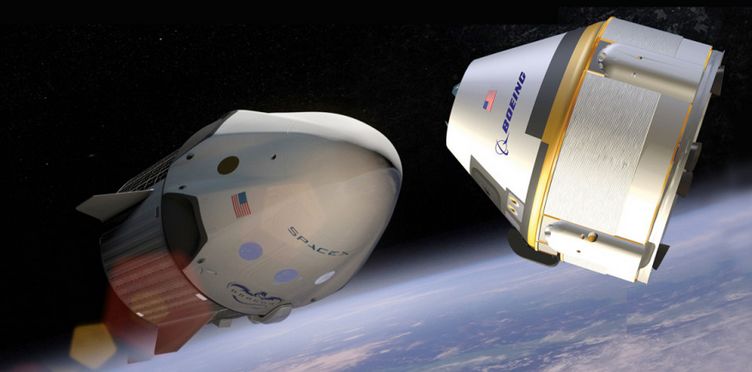
The first is that a transferral of funding from CCtCap to SLS in 2016 will not actually benefit the latter; its pace is constrained not by fiscal limitations, but by technical requirements. Another is that CCtCap was cut due to NASA attempting to react realistically to rumours coming out of Capitol Hill that the budget would indeed be cut. These rumours caused NASA to re-evaluate some of the project times scales on the basis of if the budget were indeed cut. However, both the House and Senate pointed to NASA’s re-evaluation as being indicative the programme was behind schedule, thus justifying the cut.
While the budget has yet to be formally agreed by all parties concerned – including the White House, which has threatened to veto any amendments offered up by Capitol Hill – should the CCtCap budget be reduced, it could result in the US space agency having to purchase additional Soyuz seats from Russia in order to get personnel to and from the ISS in 2017 / 2018. In a further ironic twist, the Senate Appropriations Committee has suggested that NASA can make up the CCtCap budget shortfall by – wait for it – diverting funds from the 2016 budget allocation required to purchase Soyuz seats and into CCtCap.

 Inara Pey: Living in a Modemworld