The group gathers for selfies at the Meauxle Bureaux fountain during the Wednesday, March 25th meet-up with Linden Lab folk
Linden Lab has resumed the habit of social get-togethers with SL users. It’s a welcome move, and the events tend to be very popular. Since getting things rolling again, the Lab has selected the venue – which so far has been “Mole Town”, aka Meauxle Bureaux (see my report on the last gathering).
However, for the next get-together, they’re looking to do things differently. In a blog post published on Friday, May 8th, Xiola Linden is asking for venue ideas from residents. The post reads in full:
It’s just about in-world meetup time, and since we’re in the habit of sharing some of our favourite spots from the Destination Guide, this weekend, we wanted to flip the script and find out from you what spot you think is one of the best to visit for our next in-world meetup.
Share your recommendations in this forum thread – links to Destination Guide entry or SLURLS are best – and we’ll pick one to have our next in-world meetup.
The next meetup is planned for Thursday, May 14th at 1 PM SLT, so get your recommendations in soon!
As always, if you have a region or location that you would like to show off – be sure to share it, and we always love to see pics of your adventures on the Official Second Life Flickr page.
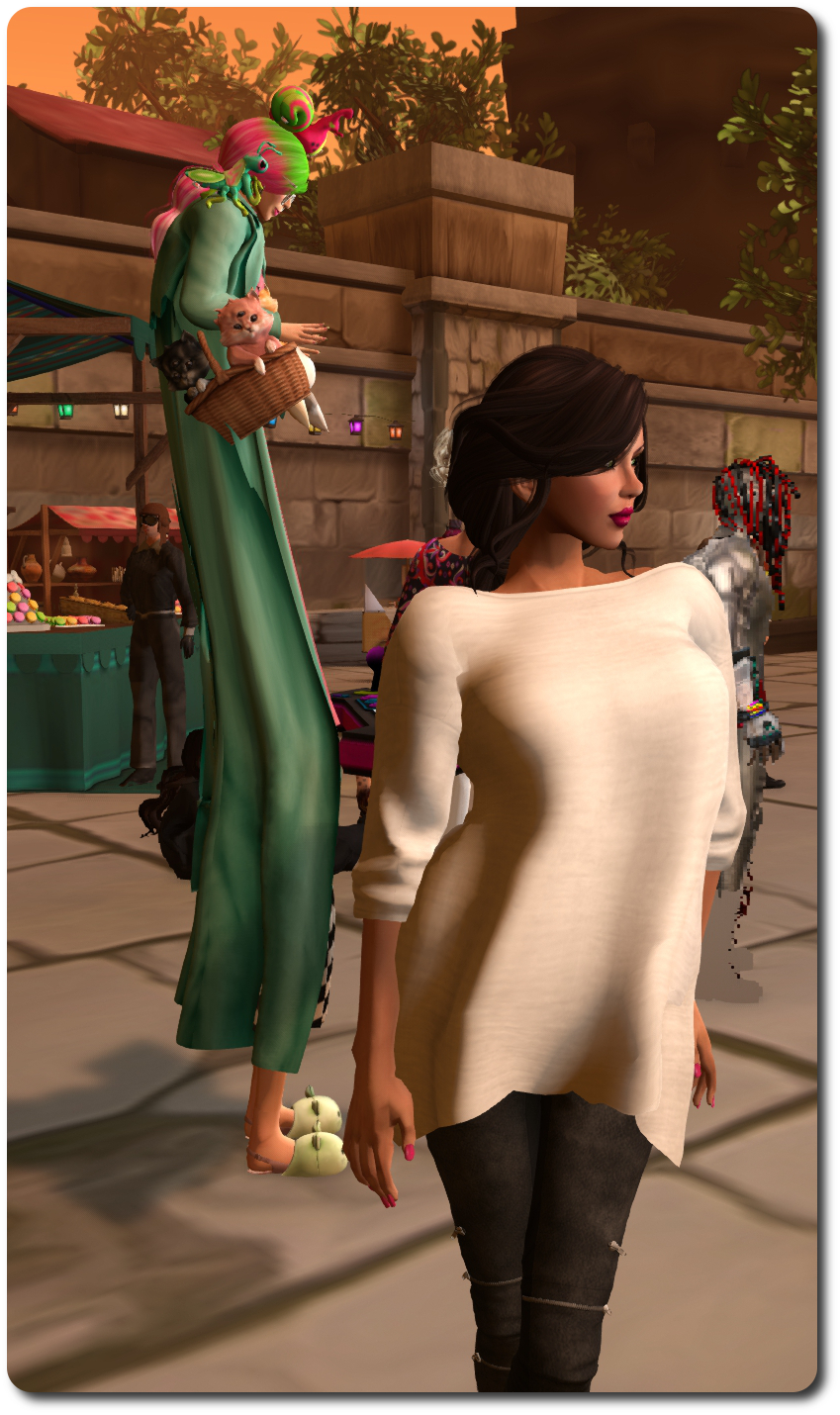
A chic Alexa Linden and a very tall Torley at the last gathering
While there are no guidelines on what might be considered acceptable, any venue put forward should probably be rated Moderate at best, or General. Ideally, it should also have plenty of space for people to mingle – so it’s probably best not to suggest your back garden (unless your back garden happens to be an entire region, of course!).
There can be upwards of 50-60 people wanting to attend, so full regions are really the best, and those which offer things to do – dancing, music, a bit of exploring – might well be appreciated. And do keep in mind the potential impact having an army of Lindens and residents might have on the regular users of any venue, should they all suddenly turn up!
Of course – if you do have a great venue of your own to offer which could fit the bill, this could be an ideal time to drop its name and SLurl into the forum thread.
As Xiola points out, the next meet-up is scheduled for Thursday, May 14th, at 13:00 SLT – that’s just a week away, and the Lab will need a little time to select a place and get the word out – so if you’re going to make a suggestion, best to get it in sooner rather than later!
Second Life has been enjoying something of a positive resurgence in the media in recent months, and with May now passing us by, and June and SL’s 12th anniversary sitting just over the horizon, it is inevitable that there will be more media coverage forthcoming on SL as the Lab’s media team crank things up.
Eric Grundhauser: touring Second Life with Ziki Questi
One of the first out of the gate in this regard is an article in Altas Obscura, which describes itself as the definitive guide to the world’s wondrous and curious places. Penned by Eric Grundhauser, Forgotten Wonders of the Digital World offers a positive insight on SL with a novel twist.
Rather than asking a few questions of the Lab or relying on images grabbed from Flickr and cobbled together with a little staggering around in-world, Eric Grundhauser is, with the assistance of the Lab, able to gain none other than Ziki Questi, photographer and blogger (together with her partner Kinn), to act as his guide to all that is, and can be found, in-world.
The result is an engaging and informed piece which neatly encapsulates SL’s history, presents an assured view of the platform devoid of the usual clichés and asides, and which focuses on the rich tapestry of content which can be found in-world – role-play, art, personal spaces, with even the broader uses of the platform touched upon, such as the US Army’s use of SL (and OpenSim) to help service personnel deal with PTSD. What’s more, with some of the images supplied by Ziki, the article looks good as well (Mr. Grundhauser’s own snaps aren’t too bad, and kudos to him for taking them, rather than seeking to raid an archive from 2008 or so!).
Ziki and I are a lot alike in terms of taste, so for me it was good to see Roche, A Petrovsky Flux and Haveit Neox’s City Inside Out referenced in the article, with Insilico, Kowloon and The Far Away – which Ziki herself rescued from oblivion and now curates – also getting a mention (and photographs).
Roche, a favourite of mine, and featured in the Atlas Obscura article
Such is the impact of his time in Second Life exploring with Ziki and Kinn, Mr. Grundhauser willingly re-evaluates his thinking about the world, while remaining open and honest:
To be honest, when I decided to delve into Second Life, I half-expected to find a dying world of outsiders and bronies gleefully recreating pornographic impossibilities. But that simply doesn’t seem to be true. What I found, and mind you, I was only able to visit a strikingly miniscule portion of the available spaces, was that Second Life is still a fascinating and vital world that is constantly changing and pushing the boundaries of what a virtual space can be…
More telling I think, is the somewhat widespread perception that Second Life is no longer an active digital playground. The Grid is still a vital and evolving space that hundreds of thousands of users create and evolve each day.
Nor is “the sex thing” shied away from – kudos again to Ziki for being open on that subject as well, and the fact that – just as in the physical world and the Internet as a whole – there is an awful lot of it in SL. But as Eric Grundhauser demonstrates very ably – with or without established guides – just because there is a lot of sex in-world, it doesn’t bean it’s the be-all and end-all of the platform. As he notes when describing the diversity of activities and those using SL:
Doctors, universities, hobbyists, sci-fi fans, artists, and inexplicable curiosities can all be found operating in SL, by those willing to look.
Well done to him for making the effort to delve into SL and spend time exploring and getting to know at least a couple of residents, rather than simply taking the hoary old trail of slapping a few outdated headlines (and images) together in an attempt to underline a preconception.
“agent_limit”- get the maximum number of avatars normally allowed on the region (teleport home, and login to last location, are allowed to exceed this).
“estate_name”- returns the name of the estate (e,g, “mainland”, “Linden Homes”, “My Happy Estate”, etc. )
“region_cpu_ratio”- returns the number of regions per CPU for this region type (i.e. “1” or “4”)
“region_product_name” – returns the type of region this is: “Estate / Full Region”, “Mainland / Homestead”, “Estate / Openspace”, “Estate / Full Region – Skill Gaming” etc.
“region_product_sku” – returns the region’s product number as a string
“region_start_time” – returns the time the region was last (re)started, in llGetUnixTime format
“simulator_hostname” – returns the simhost running this region. Same as llGetSimulatorHostname but without the script delay.
There were no planned RC deployments or restarts for Wednesday, May 6th.
Group Chat Failures
There are been a number of odd group chat issues recently, such as those outlined in see BUG-9130. Simon Linden has been investigating the issues, and gave his findings at the Simulator User Group meeting on Tuesday, May 5th, “Basically the chat server gets stuck with bad info about where the avatar is. The normal ways that would get corrected aren’t working right … but trying to log off and back in, or leave and re-join the group might fix it.”
When asked if a re-start of the affected chat servers could clear the problem, he replied, “possibly … except one of the features of the chat servers is that they try to save everything and re-load it when they come back up. That way everyone isn’t kicked out of all their group chats when it restarts. I’d have to check but I think they may save the bad info about [the affect avatar]. ”
Group chat messages are routed to you via the region you are in at the time the message is sent. However, if you have moved to another region during the conversation, the region will tell the group chat service you are no longer there, and the service then performs a look-up to locate you so that the messages can again be sent to you via the region simulator. “In this case, Simon explained the current issue, “it’s failing with a different error due to a change in the grid configuration, and not handling it correctly.”
With the cause of the issue now identified, the Lab hopes to get an update out to the chat servers to fix the problem very soon.
Attachment Failures
As has been noted in these updates, the Lab currently has a series of viewer-side fixes for problems relating to attachment issues (items detaching on region crossing / teleporting, items showing as attached when detached or vice versa, etc.) which are at project viewer status (“Project Big Bird”) and will be progress through the viewer channels in due course.
In addition to the viewer fixes, there are are some server-side issues with attachments the Lab is investigating. In particular, the Lab has identified that requests for multiple simultaneous attachments at or near the upper limit (38) to be attached at the same time will invariably overload the pipe, although why this is the case still has yet to be determined.
Experience Keys / Tools
Work continues with the back-end of Experience Keys / Tools, and Simon Linden has most recently been working on the key values database for the system (which can be used to store information relating to users who have been / are engaged in an experience, such as their progress, items they may have collected / attached, etc.). Given the anticipated popularity of Experiences, and the fact that people have already identified other potential uses for the key value database, the Lab is trying to ensure it is robust enough to handle and and all uses it might be put to – and can deal with the potential of poorly-written scripts persistently polling / updating it more than is strictly required without necessarily impacting its performance.
Other Items
Agent Updates, Draw Distance and SL Performance
In discussing the group chat issues during the Simulator User Group meeting, the conversation turned to the matter of agents and child agents. While the region you are operating in has the main connection to your avatar (your agent), it may also be sending information to avatars on other regions, and you may also be receiving updates from surrounding regions.
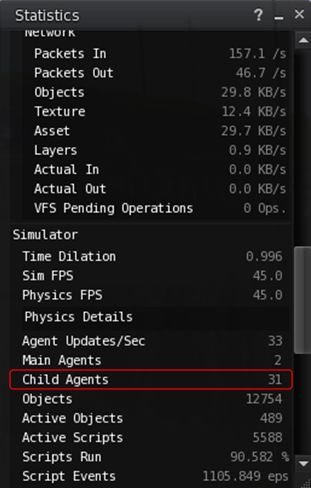
The status panel (CTRL-SHIFT-1) reveals how many child updates the region you are in is sending elsewhere (31 in this case). some of these might be unavoidable, others might simply be down to people 3 or 4 regions away with ridiculously high draw distances
Simon explained things thus, “while you’re here, you’re also talking to the region next door; it will send you updates about what happens over there … it has a camera for you and knows what you can see, and sends you updates but it doesn’t run your scripts, for example.”
This tracking of what is going on in other regions is determined by an avatar’s draw distance and the direction in which they are looking, and the “camera” Simon referred to in his description is known as a “child agent”.
Child agents help with a number of tasks – the such as allowing you to see what is going on in a neighbouring region, as Simon mentioned, and also assisting with aspects of region crossings.
Obviously, there will be child agent updates going on between neighbouring regions as a matter of course. But when you have an abnormally high draw distance, the chances are that you are having an additional impact not only on the regions immediately adjacent to the one your in, but every region that falls within draw distance / view, as you are forcing them to send you updates as well, and you are forcing the region you are in to work that much harder to pass those updates to you.
Hence why it’s a good idea to keep your draw distance down to a reasonable level (say 256 metres or lower) for as much as you can. You’re not only helping improve your own experience (however powerful your own computer might be) – you’re showing courtesy to those active in the regions around you and who might also be affected by the region they are in having to take time serving data you may not need to your viewer.
Facebook recently implemented changes to the API which Linden Lab (among others) use to allow snapshots to be uploaded to Facebook from the viewer via the SL Share capability.
In response to this, as as I noted in my TPV Developer Meeting report on April 11th, the Lab made changes to SL Share itself to comply with Facebook’s update. These don’t involve and functional changes to SL Share or the way you go about uploading snaps, etc, to Facebook, and it had been hoped that the whole process of changing from the “old” to the “new” API would be completely transparent to SL users.
Unfortunately, Facebook seem to be lagging behind in actually migrating applications using the API to the updated version, and as a result have indicated that some of the applications (like SL Share) might encounter some disruptions as the switch-over occurs.
Because of this, Linden Lab have issued a warning to those using SL Share for Facebook uploads that there might be temporary problems with the service. The notice, which came in the form of a technology blog post, reads in part:
This means that when using SLShare (updating status, photo uploads, and check-ins from the Viewer) you may experience some temporary problems. Please be assured that we are aware of this and any issues you encounter should be resolved once the migration period is complete.
Thank you for your patience!
Note that potential problems might occur with any viewer using the SL Share capability to upload to Facebook, and not just the official viewer. So if you are using a TPV with the capability, please keep this in mind.
The SL Share to Facebook allows you to upload images, provide status updates, etc., directly to your Facebook account – and has proven very popular among the large numbers of SL users who are willing to connect their SL and Facebook accounts
For those unfamiliar with the Facebook upload capability, it can be accessed either via a dedicated menu / toolbar option in those viewers supporting it, or via the unified snapshot floater (again, in those viewers supporting it). It allows those with a Facebook account to send updates on where they are in SL and what they’re doing, upload snapshots, complete with pre-processing filters. There’s also a Friends tab in the Facebook floater, but this hasn’t been defined in the Lab’s Knowledge Base article on the capability, as I don’t use Facebook, I’ve not been able to confirm it’s use. I assume its a method of connecting to other SL friends you have who also use Facebook.
On Wednesday, May 6th, Oculus VR confirmed the consumer version of their headset will commencing shipping in the first quarter of 2016, with pre-ordering due to start later in 2015.
The news broke via a press release from Oculus VR, and Tweets from Oculus VR, Palmer Luckey, and the company’s Vice President of Product Nate Mitchell (shown on the right).
The announcement ends months of speculation on when the consumer version of the headset might be available, with many originally predicting it would be ready for Christmas 2014 and then Christmas 2015. Despite such speculation, Oculus VR has always carefully avoided mentioning any approximate idea release dates. As I reported in these pages, even as recently as November 2014, Oculus VR Brendan Iribe was playing down any idea of any (then) near-term release of the headset:
We want to get it right. We really do. We’ve gone out there and we’ve set this bar and said, “we are going to get it right, and we’re not going to ship until we get it right” … We’re getting very close … We want it to be a beautiful product; there’s no reason it can’t be a beautiful product … so we still have a way to go, and we’re still working on a number of things, but we’re getting much closer. We like to say it’s months, not necessarily years, away [but] it’s many months, not a few months.
Click for full size
That something might be afoot by way of announcements was initially hinted at in a May 5th Tweet in which Palmer Luckey commented I love it when a plan comes together!
This brought an inevitable run of replies, many seeing it as a hint about the Oculus CV1 (as the consumer version of the headset has sometimes been referred to), including the humorous response seen on the right regarding the headset’s form factor.
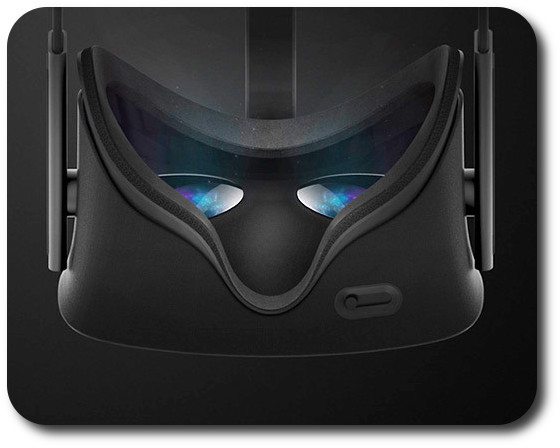
Details of the headset are rather scant in the announcement and the images a little on the dark side (I’ve lightened the contrast on them below), with the release merely stating:
The Oculus Rift builds on the presence, immersion, and comfort of the Crescent Bay prototype with an improved tracking system that supports both seated and standing experiences, as well as a highly refined industrial design, and updated ergonomics for a more natural fit.
No details on pricing or quite when in 2015 people will be able to start pre-ordering the headset, and there are certainly no details on the technical aspects of the headset. However, one potentially interesting aspect of the announcement has already sparked some speculation, as it refers to the upcoming release as, “a fully-integrated hardware/software tech stack designed specifically for virtual reality”. This has prompted Techcrunch to comment:
There’s no mention of a third-party computer necessary to power the Rift, which previous Oculus developer kits required. That means the Rift might ship with a game console-esque device to handle computing for the headset. An all-in-one box could make virtual reality much more accessible to consumers, especially those who don’t own a high-grade gaming PC.
A front view of the Oculus consumer version (courtesy of Oculus VR)
In terms of specification, the announcement was equally enigmatic, stating, “we’ll be revealing the details around hardware, software, input, and many of our unannounced made-for-VR games and experiences coming to the Rift”, with the last part of this statement leading Techcrunch to also speculate whether Oculus VR might also announce a line of in-house developed games to go with the launch.
Given the backgrounds of many of those involved in the company, such an idea might not be wild speculation. As it is, it is already known that Oculus VR is helping to develop immersive movie experiences. Furthermore, in February 2015 it was confirmed that Facebook is developing VR apps, with Chief Product Officer Chris Cox saying that experiences as varied as flying a fighter jet to sitting in a Mongolian yurt would serve as inspiration, and describing the technology as “sending a fuller picture … You’ll do it, Beyoncé will do it”. Ergo, Oculus VR-branded games are not beyond the realm of possibly.
What the announcement does more-or-less mean is that unless something unexpected happens, the Oculus Rift will definitely be available after HTC / Valve have started shipping their own Vive headset, which looks set to hit the market around the same time as Samsung’s (Oculus-enabled) Gear VR2, towards the end of 2015.
A view from under the Oculus consumer version (courtesy of Oculus VR)
While there has been a lot of hype about the possible demand for what is effectively a first generation headset from Oculus VR, there have also been some notes of caution sounded in some quarters. As gamesindustry.biz notes, Ben Schachter, a Macquarie Research analyst wrote to Facebook investors, stating:
While there is not yet any info on pricing or available units, we expect relatively small number of units and think that the initial device will be supply constrained. We think that the early versions of the device will be more about showing what is possible from gaming and other entertainment genres, and build demand for later versions of the device.
Mr. Schachter isn’t alone. While price may no longer be a limiting factor in obtaining a headset, Jacki Morie, herself a VR pioneer (and whose work has been featured in this blog a number of times) recently warned that care should be taken in how the potential for VR is promoted, in particular pointing to things like an Oculus VR sponsored art contest as a means to send out completely the wrong message about VR to a wider mass market audience and potentially damaging the technology’s credibility as a useful tool.
I actually doubt the wheels will seriously come off the cart with VR this time around, bad marketing campaigns and the like notwithstanding, although Jacki clearly has a point about getting the right message out there in the first place. However, I do tend to think that Mr. Schachter’s comment about the build-up of demand is well put. VR will profoundly alter many ways of doing things for all of us in time; but the the speculation and hype that will not follow Oculus VR’s announcement aside, it’s still going to be a few years or so before we see VR as being as ubiquitous a piece of technology in our daily lives as we do the mobile ‘phone today.
Now open at The Living Room, the art and music space curated and managed by Owl Dragonash and Daallee, is the latest exhibition of Molly Bloom’s remarkable 3D art.
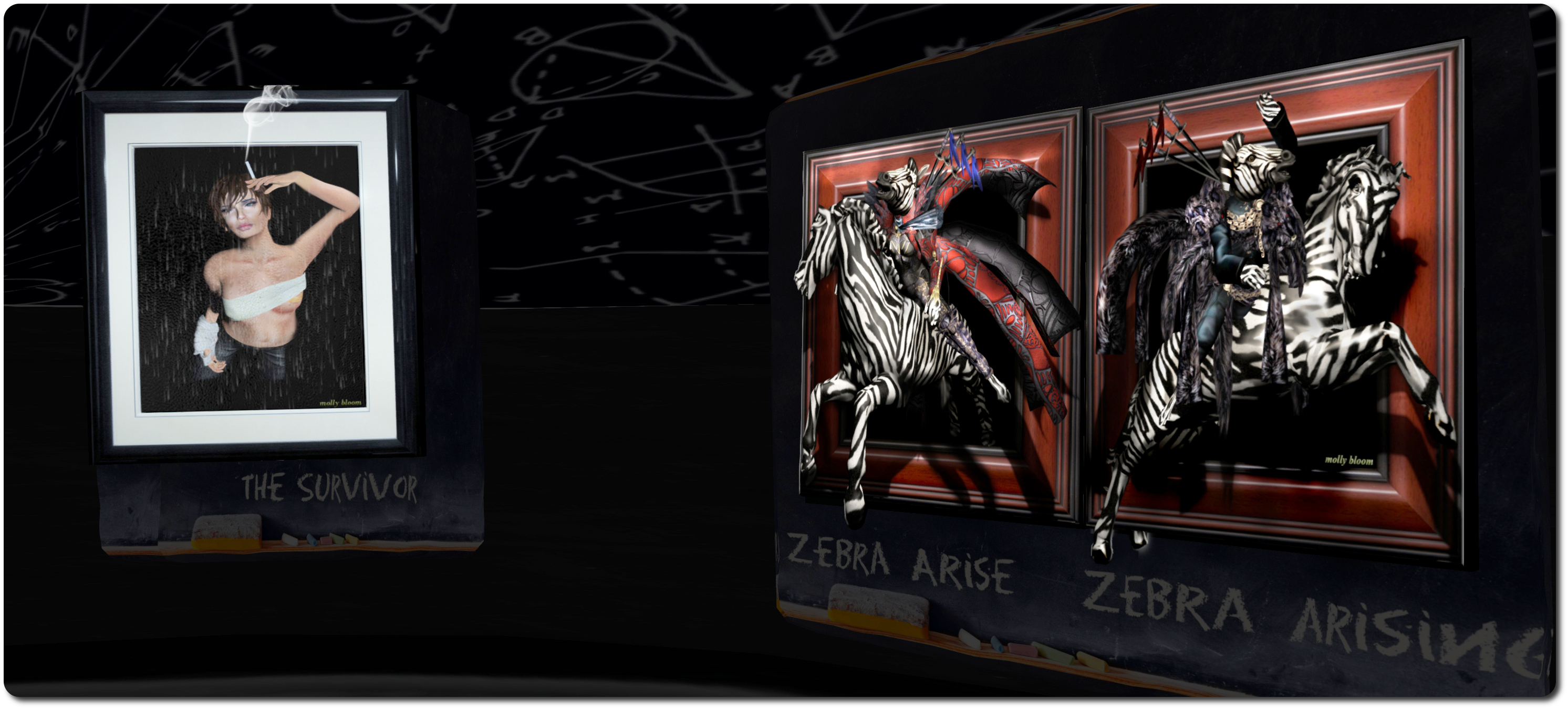
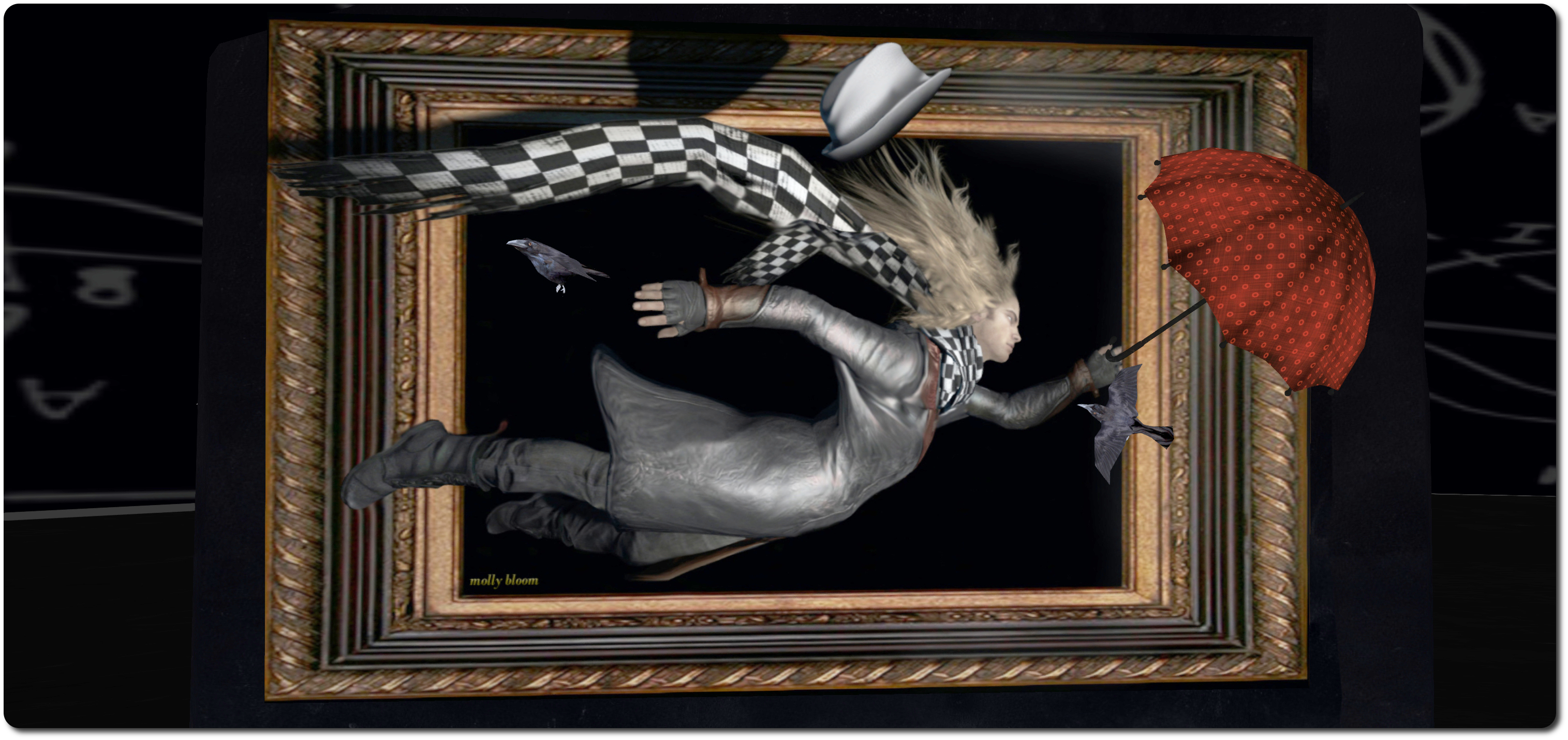
Created entirely within Second Life, with minimal additional post-processing, Molly’s work is beautifully intriguing because with it, she plays with our perception of depth. For Brain-Gasm, The Living Room’s gallery space has been dressed as a schoolroom, which Molly uses to frame an invitation for people to share in her special moments of creation.
“Brain-gasms come from everywhere, a visual, a smell, the sound of a song or an emotion. Sometimes the effect is fleeting, and sometimes you find yourself with the overwhelming need to express,” Molly notes in discussing the exhibit. “Creativity flows, and not just in the traditional arts, but maybe cooking an extraordinary meal, creating an astounding business deal, or the perfect computer program. If you are lucky to have a fulfilling outlet, your expression becomes tangible.
“Often an artist expresses themselves in a much deeper raw form than the onlooker can even understand, drawing you into their ‘gasm’,” she continues, “trying to turn you on as much as they were. Each and every gasm is not only a personal learning experience but also invites onlookers to learn about the artist.”
The pieces represent a mix of individual and paired works (Molly often creates duet and triple pieces); and I was delighted to see Cops and Robbers among those selected for this exhibition. This captivated me when I first saw it in 2014, and it was the springboard for my appreciation of her work. Also at Brain-Gasm, I was strongly drawn to Political Prisoner (below, left), and the deeply compelling The Survivor (seen in the image at the top of this piece).
As I’ve said in the past, and will doubtless say so again in the future, Molly Bloom is one of the most engaging and engrossing artists working in the photographic medium in Second Life. If you’ve not seen her work before, Brain-Gasm offers you the chance for an introduction, and shouldn’t be missed.







 Inara Pey: Living in a Modemworld