On Tuesday April 29th, the Main channel received the server maintenance project that was on the Magnum RC in week 17, comprising a fix for BUG-5533 and a crash mode fix.
On Wednesday April 30th, the Magnum RC had the server-side Sunshine / AIS v3 code re-enabled (this code requires the use of the Sunshine RC viewer), and all three RCs were updated with the bug fixes deployed to the Main channel.
SL Viewer
There have been no updates to the RC viewers in the release channel during week 18 and no further releases, either RC or project viewers, so the SL viewer releases remain as per the last update to my Current Viewer Releases page.
Group Chat Optimisation
Simon Linden dancing at a Server Beta User Group meeting
The code Simon Linden has been working on to improve group chat was deployed to a single group chat server, where it has been running for all groups starting with group_id “b”. Commenting on the work at the Server Beta meeting on Thursday May 1st, Maestro Linden said:
Simon’s been looking at the performance of that group chat server, and it seems to be running fine. So there are plans to update the rest of the group chat servers to the new version early next week. We won’t go so far as to say that group chat has been totally fixed, though – Simon has identified some other changes which could improve performance further.
A recent fix was made to IM sessions to correct the issue where it is possible to see “typing…” in an IM window when the other person isn’t actually typing (see STORM-1975), and questions were raised on whether this fix might be adding a load to group chat sessions, as the viewer-side code appeared to send the message during group chat sessions as well as person-to-person IMs. However, both Simon and Maestro Linden indicated that the notifications are simply ignored by the chat servers during a group chat session, so no additional load is created, although Maestro admitted it would be nice if the viewer didn’t send meaningless messages.
Aside from the back-end load, the biggest issue which occurs in group chat is when someone using it changes regions. When this happens, the chat service has to figure out where you are.
“The region you are on, your viewer and the back-end database all know where you are, and keep updated very fast. The chat servers, however, aren’t kept in perfect sync because that would be very hard to do with 50000+ people moving around who are all in 42 groups,” Simon said, in explaining the problem. He added, “It [the chat service] doesn’t track missing messages … but if it can’t send one to your agent, it then has to ask where you really are and then it sends there,” all of which takes time, delaying the receipt of group chat messages.
In describing the changes made, Simon concluded:
The new code we have out now is a bit more efficient, but more importantly it has more metrics and it showed me that the performance problems are in a few other areas … it turns out the updates to keep the list of people in the group chat updated are really significant. It gets worse, of course, in large groups – more people coming and going, and more people who need the updates.
Group Ban Lists
It appears a server-side deployment of the code require to manage the new group ban list functionality is drawing close. There is still work to be done viewer-side, but recent testing on Aditi resulted in a number of JIRAs being filed, and the associated server bugs have been stomped on by Baker Linden, with help from the likes of Caleb Linden.
Friday May 2nd, 2014, marks an important step in Seanchai Library’s virtual development, as it will see the Library’s new venture on Kitely, the on-demand grid, open its gates in a special preview event.
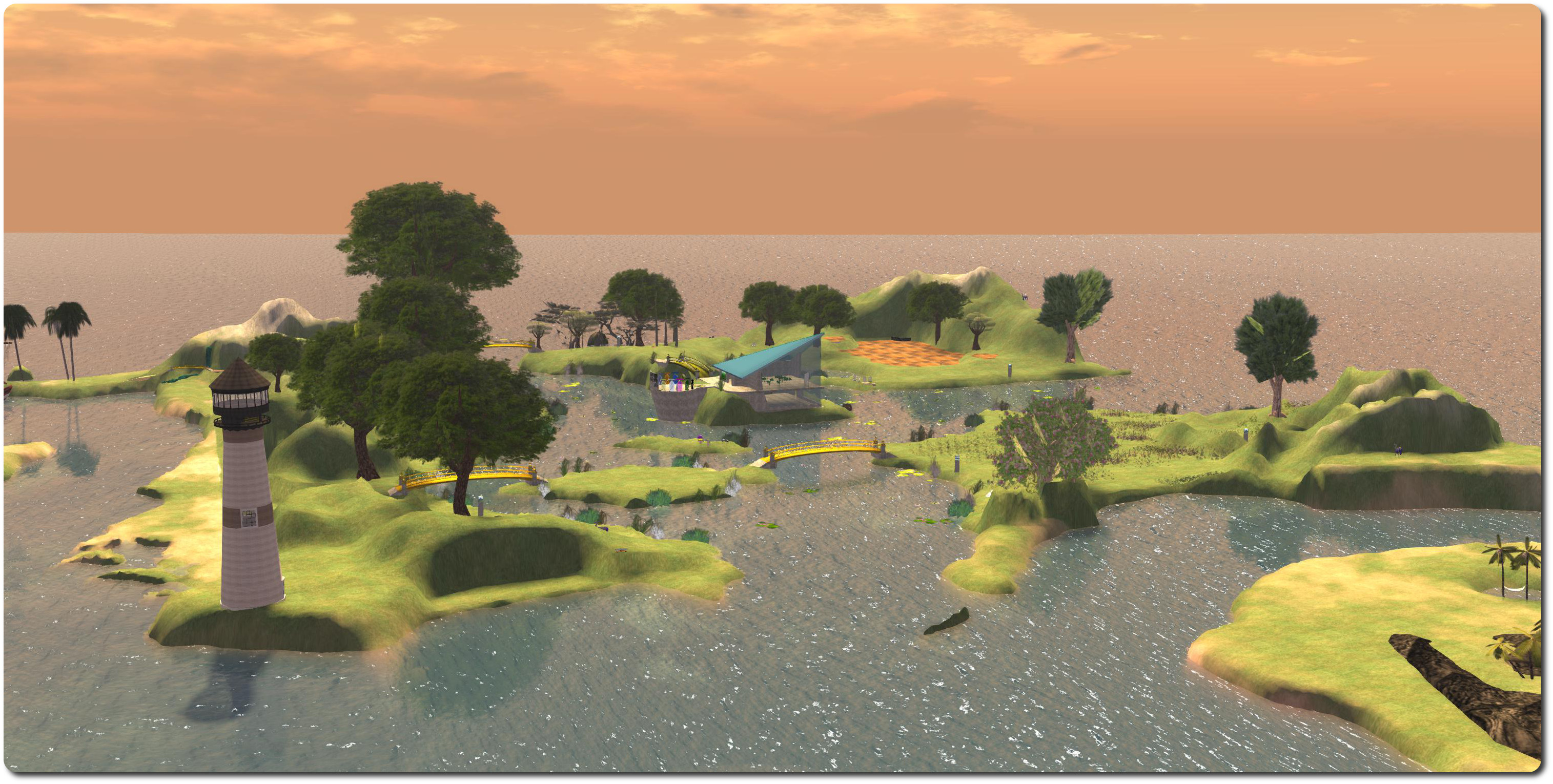
Seanchai Library’s presence on Kitely is extensive, comprising a 4-region Kitely megaregion, which offers a number of different story telling environments, and no fewer than eight individual regions – “worlds” in Kitely parlance – offering their own unique environs for stories and – perhaps – a little more.
The main 4-region world, Seanchai, forms the hub of the Library’s presence in Kitely, and is home to the main reading room and the teleport hub linking it to the other region “worlds”. It is also divided into a number of individual areas where events can be run simultaneously, including the Campfire Ring, Ghostly Pirate Bay, Undersea Discovery, Volcano Island, Celtic Castle Ruins and more.
The Seanchai Library teleport portals, Kitely
The teleport hub, which also acts as the region’s landing point, features a circle of ten stone portals, one of which is currently inactive and another leads to the Kitely Welcome Centre. Walking up to one of the remaining, labelled, portals will transfer you to the named region. Note that if the region is not already in use, you may see a warning pop-up on your screen. This is because Kitely worlds are “on demand”, and only exist when there are avatars present (the rest of the time they are safely stored). Should you find this is the case, you’ll be automatically teleported to your selected world once it has started – which should only take a few seconds.
The eight individual storytelling worlds are: Beachworld, Celticworld, Octoberworld, Spaceworld, Swampworld, Waterworld, Westworld and Winterworld – and the names pretty much sum up their individual themes!
Each world offers a unique environment for stories and events, and they include freebie areas where visitors and patrons can dress to look the part if they wish. Exploration of the regions is encouraged, and some offer the means to host multiple story telling activities at once.
“The ship rose out of the mist, her sails tattered and torn….” the
To mark the opening of Seanchai Library’s presence in Kitely, the preview event will start at 18:30 SLT (PDT) on Friday May 2nd. This will comprise a guided tour of the estate, and will be followed by ghost stories around the campfire, starting at around 19:00 SLT. This will feature tales from a host of masters of the macabre, including Stephen King, Guy de Maupassant, Ramsey Campbell, and Tony Richards, and by literary greats like Ambrose Bierce, Washington Irving, Sir Water Scott, and J Sheridan Le Fanu.
So does this mean Seanchai Library is leaving Second Life? No. Rather, they are expanding into new areas and new opportunities. So why not hop over to Kitely and join them? It’s pretty easy, even if you’ve never visited another grid.
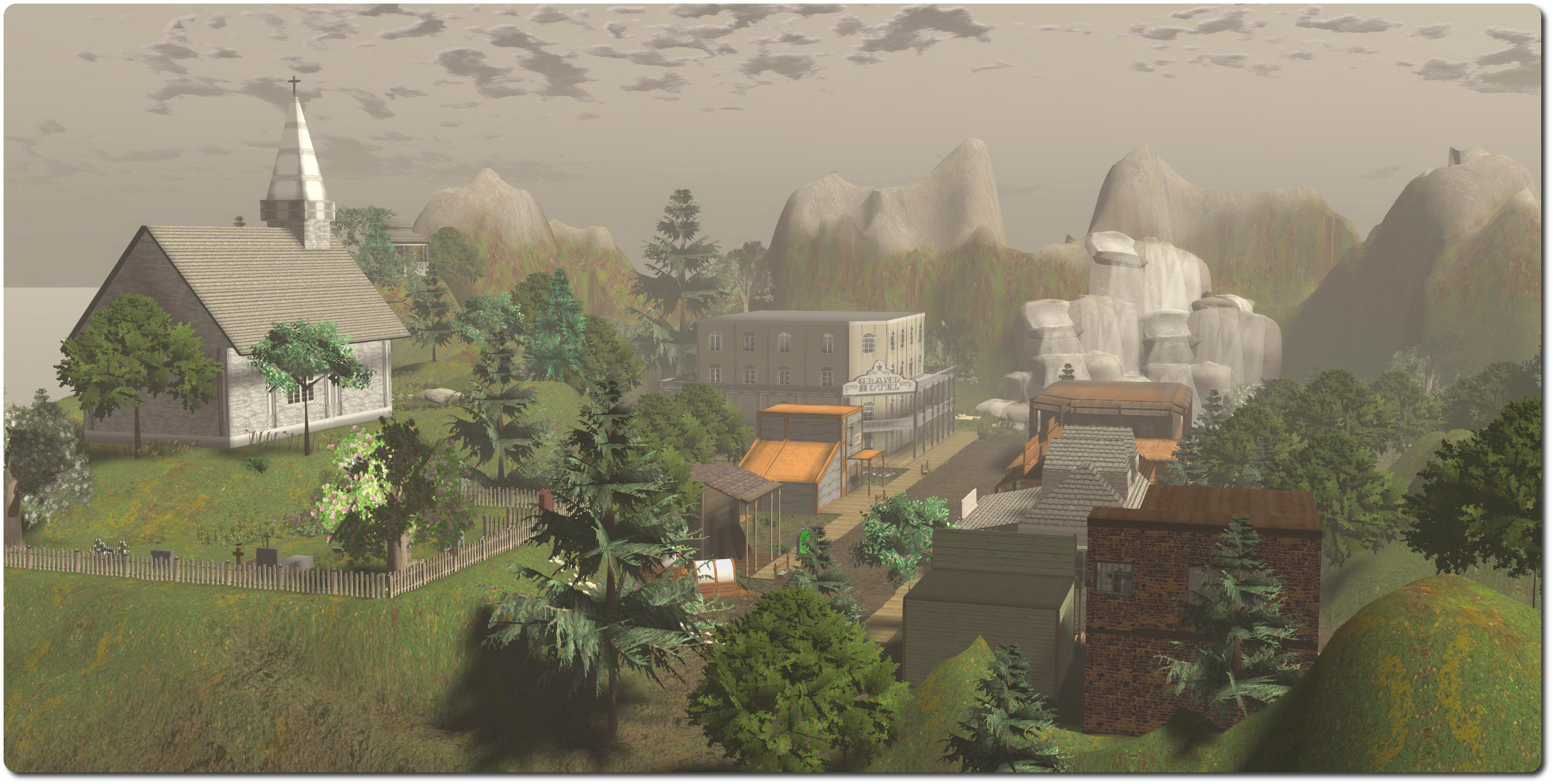
“The town was small, but the hotel big, so I decided to mosey on down, heading for the stables and a chance to give my horse a rest before looking to see if the beds in that hotel were as grand as the place looked from the outside…” Seanchai Westworld, Kitely
Getting Started with Kitely
You can register a free account with Kitely via their website. This will give you access to Kitely, and a free region of your own – please make sure you read Kitely’s notes on membership options and the costs involved in visiting worlds if you intend to either develop your own region or explore more of Kitely.
The Seanchai worlds are all fixed-price, so access to them is open to all. Once you have created your account, you’ll need a viewer capable of accessing OpenSim grids – Kitely recommend Firestorm as their preferred viewer. When you have installed a suitable viewer (if required), you can reach the Seanchai region by:
Either visiting the Seanchai Library page on the Kitely website and clicking the Enter World button
Or starting your viewer, selecting Kitely from the grid manager (if available) and setting the log-in region to Seanchai
Again, note that if the Seanchai region is not already running, you may be initially logged-in to a Kitely teleport station. You should only be there a few seconds before being automatically teleported to Seanchai.
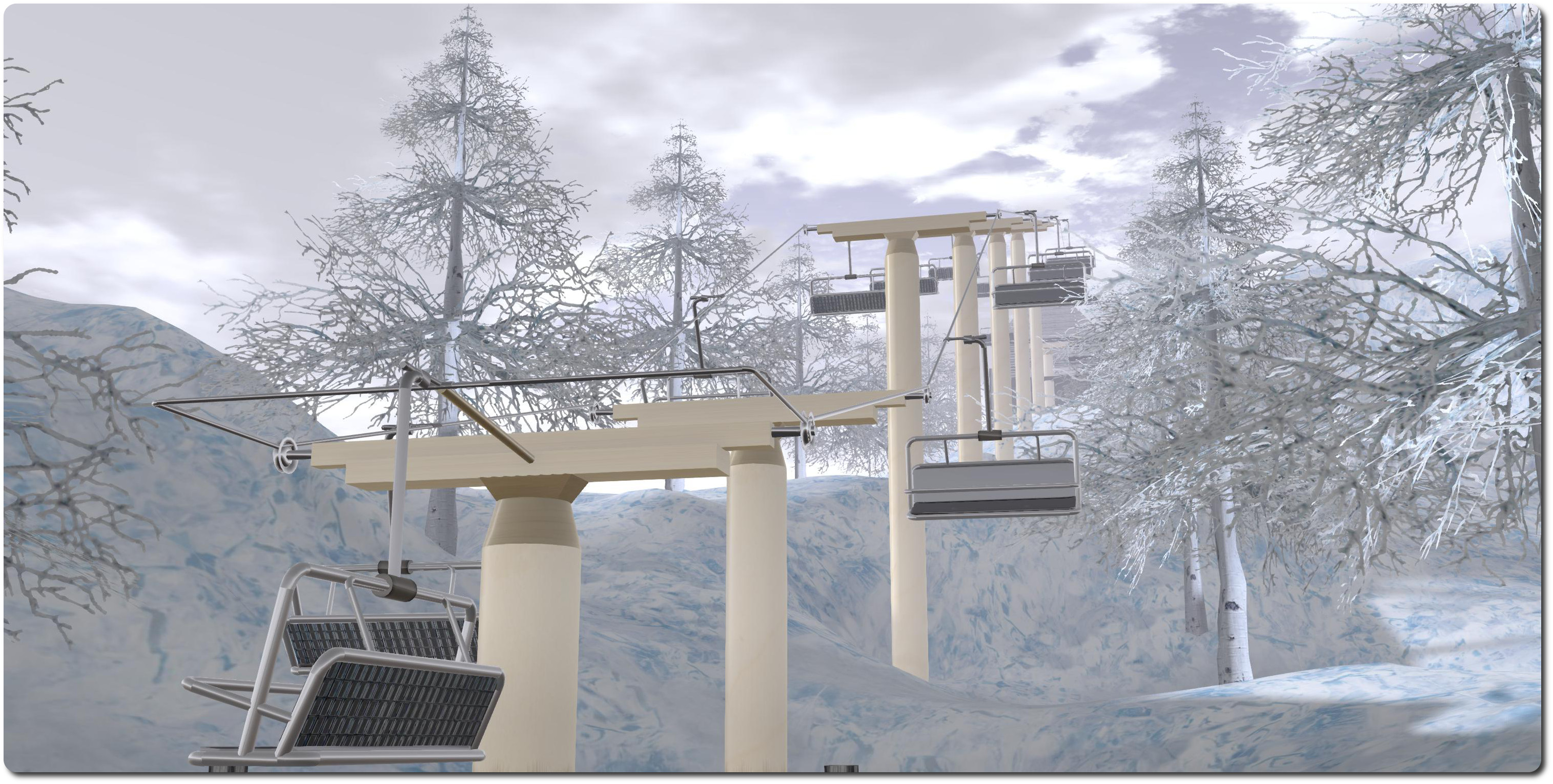
“We took the ski lift up to the peak for a final run down the slopes before retiring to lodge for hot drinks by a blazing fire and a tale or two from out hosts…” Seanchai Winterworld, Kitely
This project began as a self guided spiritual learning path but quickly became an all-encompassing Journey of Ascending To A Higher Place with each individual choosing how they want to perceive the experience and to what degree of Complexity and learning they choose. Life is a continuous journey of choices, represented by the many choices provided for you at many levels.
So states Tansee in her opening remarks about her new exhibition at LEA16 on Sunday May 4th.
Ascension is further described as “a celebration of colour, sight, sound and spirit”, and presents a series of themes and ideals in the form of an exploratory journey. This starts at an underwater landing point, where you can take a note card on the installation (recommended). Seven tunnels, each a particular colour intended to represent a specific chakra, all lead to an undersea environment which can be explored before selecting one of seven ropes and climbing up to the Ascension island.
Here one can take one of seven further tunnels, each leading out to an encircling garden which is divided into seven areas, each representing a state / mood reflective of one’s state of self (“I Know”, “I Do”, “I Feel”, etc.). Here, different activities are presented to be shared and enjoyed, with each area having a slide show present thoughts on self and one’s being.
The circular nature of the garden, complete with path leading the way between each of the seven areas, represents the endless infinity of birth and rebirth. The areas bordering the path are intended as places where people can seek refuge, relaxation, renewal and a sense of spiritual growth.
As well as providing access to the garden, the central Ascension island offers visitors a very literal journey of ascension, flying up through a series of chakra spheres, each one offering the opportunity to learn about the chakra in question, and the emotional states associated with it. Each sphere provides a place of rest and meditation, so one’s journey need not be rushed. For those who prefer, teleport boards offer a means of moving up and down between the spheres – although I recommend flying, as it’s easy to miss things along the way when teleporting.
At the very top of the installation is a MerKaBa, a vehicle of Ascension, which it is believed can be activated by certain principles in meditation. These involve breathing changes, and mind, heart, and body changes that alter the way a person perceives the reality. A fully activated MerKaBa field enables you to turn your body into a ball of light and bring it with you as you travel between worlds on different spiritual planes.
Towards the back (north side) of the installation is the International Mountain of Peace, a place where visitors are invited to use a series of direct input boards to leave their own thoughts with the world on matters of wisdom, love, hope, peace and more, either signed or anonymously.
As well as representing a spiritual journey and an encouragement for us all to celebrate joy, compassion and understanding, and carry these ideals into the world at large, the Ascension also represents a personal journey undertaken by Tansee herself, who notes, “When I began this project in December, I was not sure what a script did, had no idea what a particle was, and did not really know how to form a group. What a Beautiful Challenge it has been! This opportunity was a facing of fears for me personally. I wanted to prove to myself that despite my personal challenges, determination and success can and will prevail if you believe in yourself.”
To mark the opening of the installation, The Ascension will be hosting a special live performance. Sky Fires, will feature the work of Particle Tom and Lexi, with music by DJ Sunshine. The event will take place at 14:00 SLT on Sunday May 4th, on the Chromatic Atmospheres particle platform.
Things are starting to pick-up on Mars once more as Curiosity starts into a new round of science studies in the region dubbed “The Kimberley”. Having been surveying the region since its arrival there at the beginning of April, the rover was commanded to move to a sandstone slab scientists dubbed “Windjana” after a gorge in Western Australia, and is in keeping with giving notable landmarks in the area unofficial names lifted from that part of Australia.
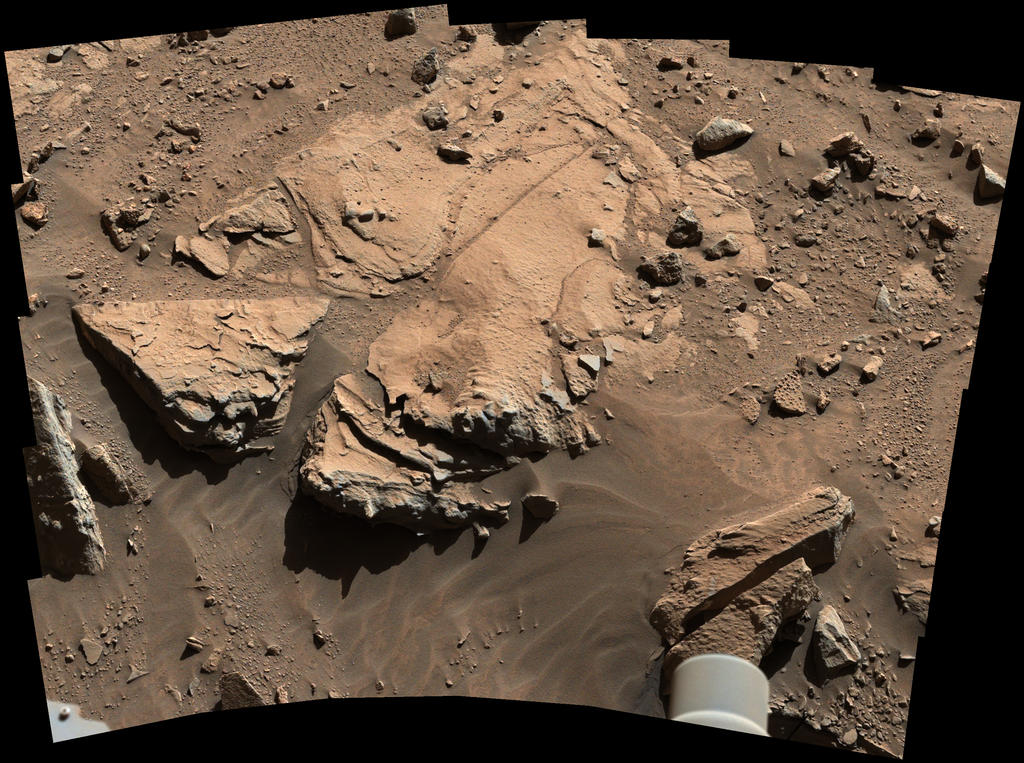
The slab lay a short distance roughly southwards from the rover’s position where the Mars Reconnaissance Orbiter (MRO) imaged it on April 11th, 2014. Following the initial selection of the slab as an area for further study, the rover was commanded to drive closer to it to enable further visual inspection. The slab is around 60 centimetres (2 feet) across, and was selected because it offered a good surface for drilling, and lay within what scientists call the “middle unit” because its location is intermediate between rocks that form buttes in the area and lower-lying rocks that show a pattern of striations.
A white-balanced image, calibrated, linearly scaled and brightened to present colours that resemble those that would be seen under daytime lighting conditions on Earth, of the rock dubbed “Windjana”. The image combines several exposures taken by the Mastcam’s left-eye camera during the 609th Martian day, or Sol, of the rover’s work on Mars (April 23rd PDT, 2014).
The sandstone rock in the area is of particular interest to mission scientists because it represents a somewhat different environment to that studied extensively by Curiosity during the time it spent in the “Yellowknife Bay” area, drilling and sampling mudstone rocks.
“We want to learn more about the wet process that turned sand deposits into sandstone here,” Curiosity’s lead Project Scientist, John Grotzinger, explained. “What was the composition of the fluids that bound the grains together? That aqueous chemistry is part of the habitability story we’re investigating.”
Understanding why some sandstones in the area are harder than others also could help explain major shapes of the landscape where Curiosity is working inside Gale Crater. Erosion-resistant sandstone forms a capping layer of mesas and buttes. It could even hold hints about why Gale Crater has a large layered mountain, dubbed “Mount Sharp” (officially called Aeolis Mons), at its centre.
Once the rover had positioned itself close to the rock, initial inspection operations were carried out, which included using the turret-mounted spectrometer on Curiosity’s robot arm as well as the mast-mounted ChemCham laser so that the rock could be properly analysed ahead of any drilling operation. These operations also included deploying the rover’s “wire brush” to clean an area of the rock’s surface, removing dust and debris to expose the rock itself, allowing for further examination and analysis.
Clean sweep: a “before and after” animation showing a patch of the sandstone rock dubbed “Windjana” scrubbed clean of surface deposits ready for further examination. The images used in the animation were taken by the turret-mounted Mars Hand Lens Imager (MAHLI) during the 612th Martian day, or Sol (April 26th PDT, 2014). The exposed area of grey rock measures some 6 centimetre (2.5 inches) across.
Before any sample drilling could occur, however, the rover would need to carry out a “mini-drilling” operation, much as it did at “Yellowknife Bay”. Such operations both confirm the drill’s readiness for sample gathering and confirm that the subject rock is a suitable target for drilling and gathering sample material.
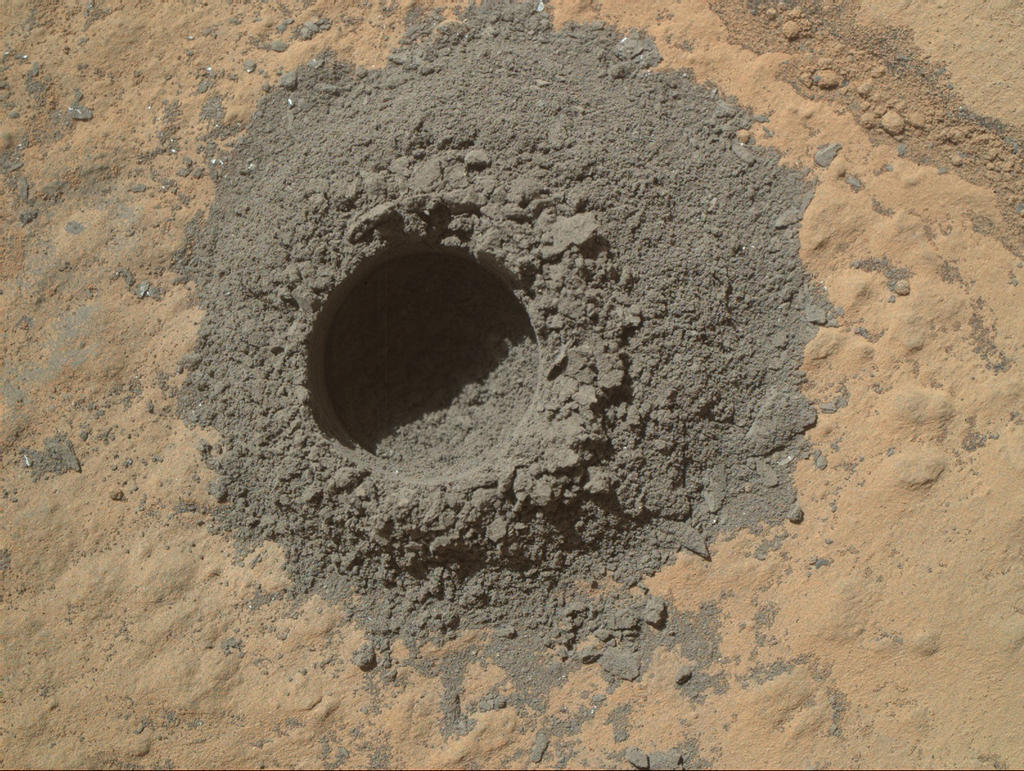
This “mini-drilling” operation took place on Tuesday, April 29th, cutting a hole around 2 centimetres (0.8 inch) deep into the rock. This allowed the science team to evaluate the interaction between the drill and this particular rock – an important factor given issues enountered due to vibration during the rover’s previous operations – and also for the tailings of powder rock created by the drilling operation to be examined for their suitability for collection by the drilling mechanism.
When collecting sample material, the rover’s hammering drill bores as deep as 6.4 centimetres (2.5 inches) into a target rock. As it does so, some of the tailings from the drilling operation are forced up into the drill bit itself, and delivered to one of two holding chambers (Chambers A and B in the diagram below) located in the head of the drill bit mechanism.
How the drill works: On the left, a view of the drill mechanism mounted on the rover’s turret, with the drill bit centre bottom. On the right a cutaway showing the sample collection mechanism in the drill bit
Once drilling is complete, the gathered samples are transferred to CHIMRA – the Collection and Handling for In-Situ Martian Rock Analysis system, also within the rover’s turret system, where the tailings are sifted and sorted ready for eventual transfer to the Curiosity’s on-board chemical laboratory systems, comprising the Chemical and Mineralogy (CheMin) and Sample Analysis at Mars (SAM) suites of instruments.
At the present time, the outcome of the analysis of the mini-drilling operation, and the suitable of “Windjana” as a sample-gathering point is unclear; however, it would appear likely that sample drilling operations will go ahead nearby as a result of this test.
An image from Curiosity’s Mars Hand Lens Imager (MAHLI) instrument shows the “mini-drilling” operation hole cut by the rover’s drill mechanism on Sol 615 (April 29th PDT, 2014). The hole is some 2 centimetres deep and 1.6 centimetres in diameter.
First Asteroid Image from the Surface of Mars
Curiosity racked-up another first on Sol 606 (April 20th), when the Mastcam captured the first image of asteroids taken from the surface of Mars. The image was combined with pictures captured the same night of the Martian Moons Phobos and Deimos, and the planets Jupiter and Saturn. Deimos, the outermost on the Martian moons, and which may have itself been an asteroid prior to wandering in Mars’ gravitational influence, appears at its correct location in the sky at the time the image of Ceres and Vista was captured. Phobos, Jupiter and Saturn, which were all imaged at different times, are shown as inset images on the left. All of the images form a part of ongoing astronomical work the rover has been performing periodically.
Ceres, with a diameter of about 950 kilometres (550 miles), is the largest object in the asteroid belt, large enough to be classified as a dwarf planet. Vesta is the third-largest object in the asteroid belt, about 563 kilometres (350 miles) wide. These two bodies are the destinations of NASA’s Dawn mission, which orbited Vesta in 2011 and 2012 and which is now on its way to begin orbiting Ceres in 2015.
A composite of images taken after nightfall on the 606th Sol (April 20, 2014, PDT) of Curiosity’s work on Mars, showing the asteroids Vesta and Ceres, and Mars’ outer moon, Deimos. The same night, the rover also captured images of Mars’ inner moon, Phobos, and the planets Jupiter and Saturn, shown in the inset images
The main image appears grainy, with Ceres, Vista and three stars appearing as streaks because it was captured over a 1-2 second exposure period. The graining on the image is the result of cosmic rays striking the camera detector is the image was captured. The images of Deimos, Phobos, Jupiter and Saturn were all captured over a much shorter 0.25-second exposure, thus rendering them as bright objects against a “clean” black background. Sunlight reflected by Deimos makes it appear overly large.
The interesting point (for those into astronomy) with the main image is that Vesta and Ceres would be naked-eye visible to anyone with average eyesight were they to be standing on the surface of Mars.
Fantasy Faire 2014 has opened its gates. This year, there are no fewer than 11 regions to explore (although at the time of writing, the Palace of Tears had yet to open to public access, and I encountered a considerable amount of lag on the neighbouring Fairelands Junction when trying to sneak a peek over the wall…
As always, there is a lot to see and explore, and I hope to be able to bring a round of updates as the week unfolds. For now, here’s a brief set of highlights, together with some sketches from my pad, grabbed as I explored the regions as a part of the bloggers’ preview.
Asperatus
Created by Beq Janus and sponsored by NeoVictoria (Asil Ares).
Asperatus, a mighty airship built by wealthy merchants and once both their home and seat of commerce. Now, in later years, the Asperatus sits as the mainstay of an unlikely floating colony, drawing power from the turbulent clouds over which it sits and providing a centre of trade as well as a floating home.
From my sketchbook: Asperatus: a floating place of commerce – just mind those whirling rotors …
As you explore the shops and stores, slung beneath great gasbags and wander the catwalks linking them, keep an eye out for strange goings-on, particularly from Monday May 5th onwards. For it is to Asperatus that a renegade aristocrat and an evil scientist will flee after wreaking havoc in the power centre of the NeoLondon Cathedral. Determined to bring them to justice, a group of NeoVictorians are hard on their heels (role-play to commence in NeoVictoria on Thursday May 1st, before transferring to Asperatus).
Blackwater Glenn
Created by Marcus Inkpen/ Sharni Azalee and sponsored by The Looking Glass
Blackwater Glenn, once a vibrant community, is now being slowly reclaimed by nature as swamplands slowly encroach onto the land and under the old buildings. But not all is in a state of decay as gorgeous flowers and mysterious plants emerge sporadically throughout the swamp and pathways of open water lead to the centerpiece, a giant blossoming tree. Tread the wooden walkways carefully and rest assured that the surviving buildings will not collapse on your head. Traders and merchants still thrive here, and there is the hope of rebirth hidden within.
“I sketched this while avoiding invites from pirates to enjoy a mug or two of grog at their little tavern deep in Blackwater Glenn …”
Be wary of the pirates, however. Forced ashore to seek the means to repair their damaged ship, they have set-up a tavern within the Glenn. You can be sure of a warm and friendly welcome there and enjoy a good mug of grog – but you might also find yourself leaving with your purse missing considerably more coin than you may have spent – if your purse doesn’t mysteriously leave your pocket first!
The Fairy Court
Created by Elicio Ember and sponsored by Cerridwen’s Cauldron.
The Fairy Court, a land of light and dark, of water and tree, where mystical folk offer greetings and wares. Here is a place to tarry and renew under the spreading boughs of the tree of light and dark, its entwined trunks reaching up into the heavens. Wander the pavilions and walkways, sample the water and the wares. Above all, to be at peace.
“I do not believe my pen in any way does justice to the fair pavilions of The Fairy Court…”
I confess to having a soft spot for Elicio’s works, which have never ceased to amaze me over the years, and this Fantasy Faire is no exception. Were I to be a creature of myth or fantasy, the Fairy Court is the place I’d call my home among the Fairelands.
Heavenslough
Created by Alrunia Ahn/ Eldowyn Inshan/ Sweetgwendoline Bailey and sponsored by Creators of Fantasy.
To set foot in Heavenslough is to set foot in another world, where the unexpected is to be expected. down under the leafy canopy, the forest is the home and playground for sprites and secretive fairy folks, where ancient stilt houses sit above the marshlands and platforms and houses sit amidst the leafy boughs of the titanic trees. Above all this, sit rocky plateaus rising into the heavens…
“The sun was kind to me as I sat upon a plateau ledge, sketching Heavenslough below me…”
Hope’s Horizon
Created by Jaimy Hancroft and sponsored by Dwarfins
Hope’s Horizon stands, like the fabled Minas Tirith, with its back to the sheer walls of a mountain, its streets winding up through stair and path to houses and stores which cling to the sheer rock, leading the visitor ever upward until at last the high plateau is reached. It is here, above the very clouds themselves, that the Citadel sits, together with the White Tree.
The climb up to the Citadel was long and tiring, but the Sun crowned the evening as a sketched…”
Jaimy Hancroft’s homage to Tolkien caught my imagination from the moment I first read about it, and it does not disappoint. The city is beautifully scaled to present a depth in keeping with the height of the build. The citadel on the mountain’s flat summit is the crowning piece, the echoes of Tolkien clear within the design, which also maintains its own individuality and the mark of Fantasy Faire.
I’ve been trying to keep an eye on High Fidelity of late, particularly since things like the SVVR meet-up in March and VWBPE 2014 in April, both of which featured presentations / talks by Philip Rosedale. However, I missed a recent blog post on the High Fidelity site, so my thanks to Nalates Urriah for giving a heads-up about it.
One of the things that has caused people some consternation with high Fidelity is that while there have been various demonstrations and some talk about it using distributed computing (a-la Seti@Home) as an operating model, more precise information on the architecture for High Fidelity has been lacking.
The official blog post, dated Thursday April 24th, goes some way towards rectifying this, by providing a high-level system diagram for High Fidelity and providing some additional notes on the various aspects of how it is hoped the system will work.
How High Fidelity will work – click for full size (courtesy of High Fidelity)
High Fidelity won’t, as they’ve previously made clear, be providing a virtual word per se. Rather, they are seeking to provide the software and protocols which will allow others to create virtual worlds and connect to one another, and the means for uses to connect to, and move between these worlds as they become available. The idea here is that by providing the means to create fully distributable virtual worlds, harnessing shared computing devices to scale their content and load, thus theoretically making a scalable, global virtual environment with shared resources through which users can travel.
The top section of the diagram denotes those services where High Fidelity hope to generate revenue.
The Nameserver allows virtual world domains to be uniquely identified if the owners wish (think DNS) – so that, as a totally hypothetical example, @secondlife could be registered to allow users to quickly discover and access Second Life. The registration service for virtual worlds is optional, rather than required. This service can also supply authentication mechanisms which can be used to both restrict access to a virtual world or allow users a particular virtual world to securely disclose chosen aspects of their identity.
The Digital Marketplace is fairly self-explanatory, allowing people to buy, sell and transfer digital goods to and from each other, and move these goods among different virtual worlds.
The Currency Server provides the wallet services and other API’s needed to allow people to quickly and easily share their computing devices as well as buy and sell digital goods using a cryptocurrency. Whether the latter will be a recognised cryptocurrency (such as Bitcoin) or something new, remains to be seen.
The Assignment Server, allows people to share their computers with each other to act as servers or as scripted interactive content. It monitors and analyses devices which are made available as servers in order to try to assign them suitable tasks – so that a mobile ‘phone offered as a server might be used to control a scripted agent such as a dog wandering around a virtual world, while a high-end PC might be assigned more intensive tasks. This Assignment Server will also oversee the transfer of cryptocurrency between users, so that those providing their systems to help run a world are compensated by those making use of their computing capabilities to run their world.
High Fidelity 2013 image (via Singularity Hub)
Another core aspect of the system, which has been covered in various commentaries on High Fidelity, is the use of voxels, and more particularly, the voxel server, which stores and serves the content that is found inside the virtual world. Voxels can be nested within one another, or averaged together, allowing for significant levels of detail to be achieved over distances than is otherwise possible. The voxel server allows elements within a world to be distributed across multiple servers, so for example, an apartment block in a cityscape could comprise apartments which are each running on their own server.
The Voxel Server, together with the remaining elements of the software (the Domain Server which sits at the heart of any virtual world using the software and protocols, the Audio Mixer, Avatar Mixer, Interactive Client, etc.), are available under the Apache 2.0 open-source licence, Further information on them can be found in the High Fidelity blog post, and they can be downloaded from High Fidelity by those who wish to play with them.
The post has drawn a fair number of comments and questions, and as Nalates points-out, they make further interesting reading – particularly Philip Rosedale’s replies (or where some questions are concerned, lack of a reply).









 Inara Pey: Living in a Modemworld