Update August 5th, 2013: The Faberge region has been redeveloped and Point of Derivation no longer appears to exist.
I had planned to write a follow-on to my post on the media myth that Second Life has “failed”. However, Honour McMillan has written on the matter far more succinctly and perceptively than I, so it is far better that I point you towards her wisdom on the matter, and turn my attention elsewhere.
Sort-of.

Exploring the grid is a mixture of three parts having some familiarity with a place – such as having seen it in passing while attending and event or visiting a store it holds; two parts recommendations from friends and one part pot luck – sticking your digital finger into the Destination Guide and seeing what it lands on.
Steering well clear of Grump-isms and comparisons between life and chocolates, it’s fair to say that even armed with the Destination Guide description, there are times when you zap to a region never actually quite sure as to what you’re going to find.

The Point of Derivation is a case in point. It appears in the Adventure and Fantasy category of the Destination Guide, where the text provided for its entry describes it as, “A dark forest-themed sim in which the last remnant ruins of a long abandoned theater are becoming slowly reclaimed by nature”, together with an evocative picture. There is reference to arena combat, dancing and walking with a loved one – which is all quite a mixed bag. But what does it all add up to? A post-apocalyptic place where people engage in Thunderdome-like combat? Zombies? A haunted lover’s walk? All of the above?
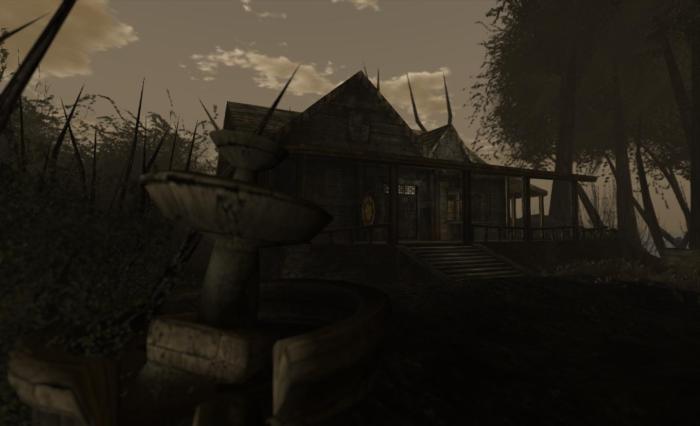
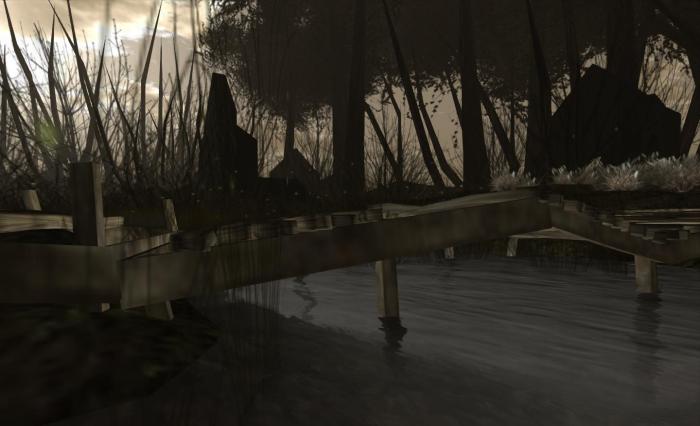
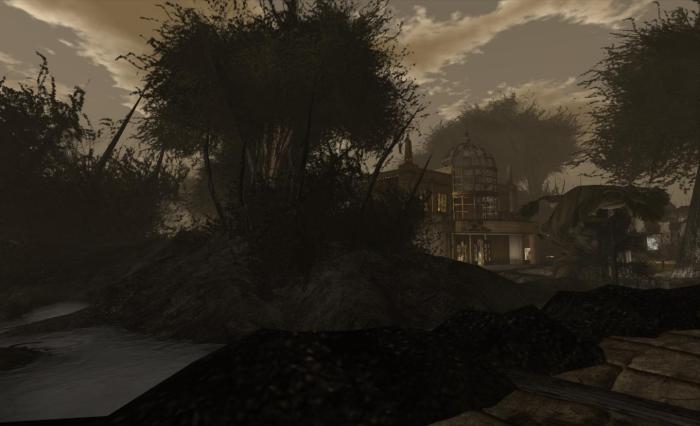
The reality is that The Point of Derivation is one of those wonderful regions which present a fabulously atmospheric environment which invites the imagination to go where it pleases, to make up stories, develop free-form role-play – to simply immersive oneself, either in exploring alone, or with a friend or friends. Yes, there is the opportunity for arena combat, there’s an opportunity to throw darts at a set of target on the other side of a stretch of water (if your thowing arm is up to it!); there is even a local scavenger hunt, with some eight prizes to locate and collect.

But the real power in The Point of Derivation is in nature of the region itself, the wonderful combination of landscape, builds and windlight which have been combined to create an environment and ambience which call out of the imagination and beg to be captured in role-play, photographs or machinima. This is enhanced by the fact that your arrival is not marked by notecards setting out theme, time, backstory or rules; there is just you and the environment – and an open invitation to dive in.

I love regions like this, free from the structure often required in more formal role-play environments, simply because of the freedom they present. Some – like the Point of Derivation – may give your mind a little nudge purely because of the environment and settings; others – such as Scribbled Hearts or Wanderstill – may softly welcome you with a simple invitation to enjoy whatever you find.

Rod Humble received a lot of grumbles when he started referring to Second Life as a “shared creative space” alongside the Lab’s newer products. Yet the fact is that in many respects, that’s precisely what Second Life is. An immersive environment in which we are free to create and share. And the sharing can take so many forms: through direct involvement in activities, or through the adoption or a character or role by which we interact with others, or through the sheer joy of collaborative creation, and so on.
The sharing can also be a lot more subtle – such as by simply taking time to explore someone else’s creation, taking photographs and showing them with friends or whomever. In this, and while the viewer is packed with powerful (if occasionally arcane) tools, perhaps the most powerful is the humble snapshot floater; it provides us with memories to both enjoy and to share.
However one goes about it, it is the ability to create and share and participate either directly or indirectly on one another’s creations and imaginations, which is perhaps the greatest ability Second Life gives us.
I started this post by stating I wasn’t going to talk about the “failure” or otherwise of Second Life. Well, I lied.
The fact is that, while LL may indeed have problems in fully understanding the platform, while SL does have warts and sores, it has provided us with an immersive environment in which we can dream, create, explore, and share. It has become, and continues to be, as Steve “Cubey Terra” Cavers so eloquently stated, “The mingling of a million dreams; a reflection of our collective imagination”. As long as this continues to be the case, then it is fair to say that for each of us, Second Life has enjoyed its own unique success.
With thanks to Steve Cavers for permission to use his words in this post.

 Inara Pey: Living in a Modemworld
I love Point of Derivation – it’s a fabulous place. 🙂
LikeLike
It is! Going to have to learn archery to hit those darned targets, tho…
LikeLike
“The mingling of a million dreams; a reflection of our collective imagination”. As long as this continues to be the case, then it is fair to say that for each of us, Second Life has enjoyed its own unique success.”
Exactly this!
LikeLike
This started as a review-with-a-story-excerpt, but after I read Steve’s wonderful description on Twitter, I couldn’t shake the imagery he had created in my head, or the fact that he had so eloqently encapsulated Second Life.
LikeLike
speaking of SL as a success or a failure just strikes me as so beside the point, because to me it remains foremost a PLACE. it exists – it’s sometimes gorgeous, sometimes a bit like a shopping mall built in an asylum, it’s usually fun, always anarchic, and ever changing. where would we locate either success or failure in terms of the whole of such a place?
let the journalists have their fun.
the rest of us have things to do and yes, things to SHARE.
great post Inara, i could not hit the damn targets either 🙂
LikeLike