There is earlier evidence for the presence of water on Mars, but this evidence — images of rocks containing ancient stream bed gravels — is the first of its kind. “Plenty of papers have been written about channels on Mars with many different hypotheses about the flows in them.” Deitrich commented at a NASA / JPL press conference held on September 27th, “This is the first time we’re actually seeing water-transported gravel on Mars. This is a transition from speculation about the size of stream bed material to direct observation of it.”
The rounded shape of some stones in the conglomerate indicates long-distance transport from above the rim, where a channel named Peace Vallis feeds into the alluvial fan. The abundance of channels in the fan between the rim and conglomerate suggests flows continued or repeated over a long time, not just once or for a few years.
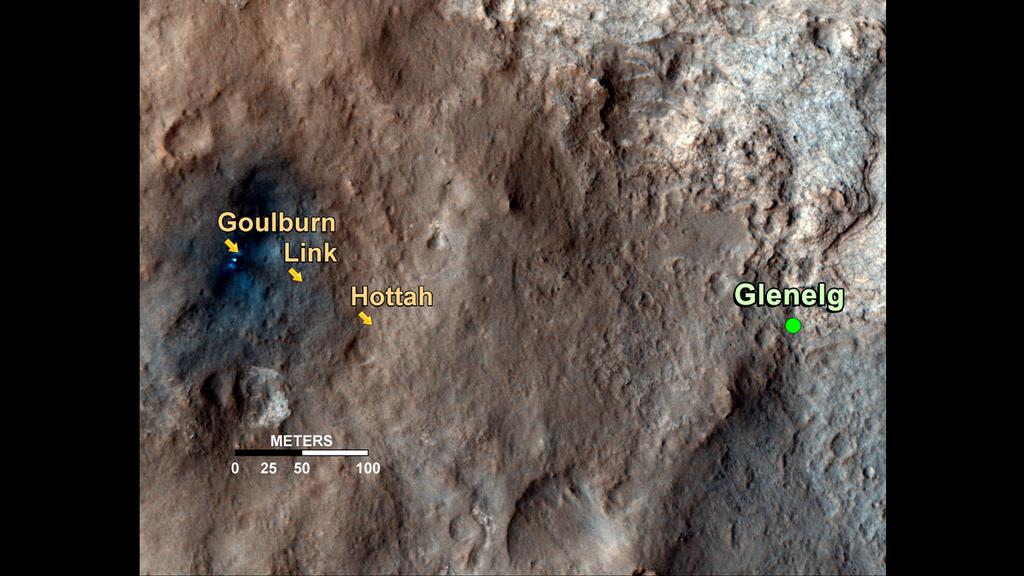
While the stream bed is the most direct evidence yet found for free-flowing water having existed on Mars, Curiosity had actually found geological evidence of water action early on in the mission – at Bradbury Landing in fact. During August, Curiosity examined one of the blast zones created by the Decent Stage rocket motors as it lowered the rover onto the surface of Mars in what was called the “skycrane manoeuvre”. The Goulburn Scour, as it was named by NASA, was imaged on Sol 13 (August 19th) in very high-resolution by 100mm Mastcam, and the images, returned some time after they’d been captured, revealed the presence of water-influenced conglomerates.

These images mark some of the most remarkable finds on Mars to date. While Gale Crater was chosen as a landing site for MSL because there was some evidence for surface water having once existed in the region, the mission team had not imagined that they’d be landing right on top of evidence for water action and the influence of fast-flowing water. While the science team is excited by these findings, the slopes of “Mount Sharp” remain the target destination for Curiosity during this primary phase of the mission. Clay and sulfate minerals detected there from orbit may be good preservers of carbon-based organic chemicals that are potential ingredients for life, and are thus seen as a more valuable science target.
“A long-flowing stream can be a habitable environment,” said John Grotzinger, MSL’s Project Scientist. “It is not our top choice as an environment for preservation of organics, though. We’re still going to Mount Sharp, but this is insurance that we have already found our first potentially habitable environment.”
Mission Trivia (sort-of)
As is inevitable on reaching celebrity status, Curiosity’s Twitter account has a parody account (@MarsCuroisity – note the spelling). Like the authentic account, it is used to make Tweets apparently originating fro the rover, but with a more humorous slant. The release of iOS 6 for the iPhone, complete with an error-ridden mapping application (which among other things, places Berlin in Antarctica) prompted the following Tweet from the parody account (with thanks to Innula Zenovka for the additional shoulder-tap):


 Inara Pey: Living in a Modemworld