On Thursday, September 25th, 2025 Linden Lab held a further Zoom Call with bloggers and content creators to and update on SL and respond to questions.
The following is summary of the meeting; however, as my aide mémoire audio recording of the meeting refused to play back in full post-meeting, some of the Q&A elements of meeting are absent.
Note that the order of topics does not necessarily reflect the order in which they were discussed.
New Option for Premium Plus Subscriptions
Due to be launched in October 2025, “Premium Plus, no Stipend” is a new option being added to Premium Plus to reduce the annual cost of this subscription level whilst retaining all of the “physical” benefits.
This option removes the Stipend and sign-up bonus from Premium Plus, reducing the annual cost by US $105.12 (+ any applicable taxes).
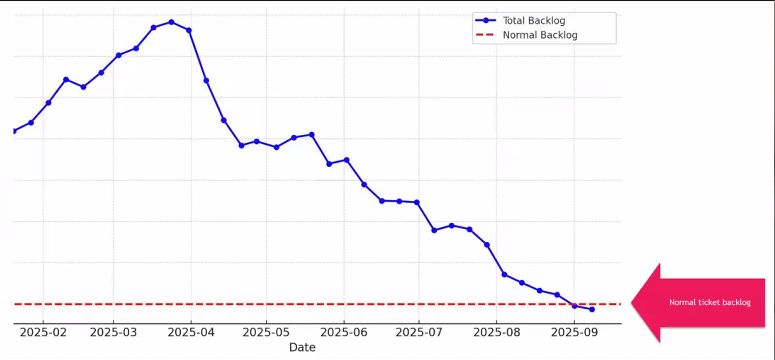
Backlog of tickets for support & trust and safety now down to “normal” levels.
Processes for helping users / responding to issues have been streamlined, and further staff have been recruited into the support and trust and safety teams.
The focus now is now maintaining the faster turn-around and keeping users satisfied with responses.
Support may be expanded in certain areas in the future – this is currently TBA.
The support ticket backlog as of September 2025
SL Viewer Summary
A note on the faster release cadence and the highlighting of new features – such as Inventory Favourites with the 2025.07 viewer release.
A note that the next release (2025.08) is focused on native Apple Silicon support, which should see a good performance boost for Mac users on that OS, particularly those on newer hardware.
SL Mobile, Project Zero and the New User Experience
Mobile and Zero: Incoming Users
The Lab estimates it is now able to get around 10x the people to try SL on mobile / Zero than had previously been the case.
This is allowing LL to try small, fast experiments with new users to help them get them started, such as with the on-going current focus on helping new users to dress / customise their avatar.
One of these is a new “helper” island where new users can go to for help (e.g. in dressing / customising their avatars, and Project Zero (viewer-in-a-browser). Zero is already geared for this.
The aim is to fully on-board new users ASAP to get them engaged.
Retention and Experiments
Despite the rise in initial engagement with new users trying SL via Mobile and Project Zero, overall retention of those users is still proving hard – the current figure is only around 7% of those coming into SL are actively being retained.
Some of the experiments mentioned in the meeting have involved dropping new users into established locations and hubs, rather than welcome hubs.
It was noted by meeting attendees that some of these experiments have not always gone well.
One cited example was the use of Ahern, which has become a hang-out for established users, many of whom have been witnessed as harassing and being abusive towards incoming new users.
Part of the problem here is that mentors were not aware of these switches / experiments, and so could not attend to provide support.
The use of Ahern in particular has now ceased as a result of this feedback.
It was further noted that LL are planning to involve mentors in future experiments.
The observation was made that established users who are already invested in the platform (as those at Ahern causing trouble appeared to be) and who spend time denigrating / insulting / trolling new users to the point of driving them away is somewhat self-defeating, in that it potentially damages SL’s ability to grow / remain viable as a product through the acquisition of new, engaged users.
User / Community Involvement
The question was asked if LL could offer incentives to those users (e.g. club owners) and communities able to demonstrate a track record of being able to attract new users and convert them into retained users.
Brad Oberwager offered a challenge – those who can develop and demonstrate a means of converting new users to retained users through their own means should contact the Lab to discuss ideas and possible incentives.
On Thursday, September 25th, 2025, Linden Lab hosted a further Zoom call with creators and bloggers to discuss a number of announcements and initiatives, one of which was a new Premium Plus subscription option. I’ll be summarising other aspects of the meeting in due course. This article focuses on the new subscription option – what it is, why it is being done, and when it can be expected.
What is It?
While Premium Plus has been been well-received, the cost of US $249 (annual billing plan) has been seen by many as being too expensive to justify.
To help overcome this, from October 2025, Linden Lab will be offering a “Premium Plus, No Stipend” option.
This subscription level will offer exactly what it suggests:
All of the “physical” benefits of Premium Plus (2048 sq metre Linden Home options etc.).
HOWEVER users signing-up to it will not receive either the one-off sign-up bonus (L$ 3,000) or the weekend stipend (L$650).
The new offering will retain the “Premium Plus” name for simplicity, and presented as an option within the Premium Plus subscription level.
By removing the sign-up bonus and stipend the new offering, when available, will cost US $11.99 per month / US $143.88 per annum (plus applicable local taxes) – a saving of US $105.12 on the annual cost of Premium Plus with stipend.
The upcoming new “Premium Plus, No Stipend” subscription option. Credit: Linden Lab
In addition, subscribers will be able to move between the subscription levels with immediate effect (e.g. Premium subscribers will be able to upgrade to “Premium Plus, No Stipend” without delay, and if they don’t like it, downgrade back to Premium or upgrade to “full” Premium Plus, and if a Premium Plus user opts to do without the stipend, they can switch over to “Premium Plus, No Stipend”).
Why is it Being Added?
As noted, it is primarily aimed at making Premium Plus more attractive to users who feel the current offering, even with the sign-up bonus and stipend, is still too expensive to justify.
The decision to remove the sign-up payment and stipend was made on two counts:
Those on both Premium and Premium Plus continue to purchase Linden Dollars regardless of their stipend.
Stipend payments further add to the supply of L$ in circulation, contributing to the on-going issues of a top-heavy supply of Linden Dollars impacting exchange rates, as has been previously discussed – see: Linden Dollar Exchange Rate and the Economy.
It is recognised the removal of the stipend will not appeal to everyone, hence why the current Premium Plus option will be remaining.
It is particularly hoped that the new option will encourage Premium subscribers who have previously expressed reluctance in upgrading to Premium Plus due to the cost to now consider doing so.
In a perfect world every premium subscriber would move to Premium Plus, No Stipend. Best for residents, best for creators. If that takes off, this is really good for residents and really good for creators, if people upgrade. If people downgrade, it is what it is; hopefully they don’t, but if they do, they do. But upgrading, that’s a win for the creators like no other, and its a win for the residents; we’re really giving a lot more for very little.
– Brad Oberwager, during the Zoom Call, September 25th, 2025
When Will it Launch?
If all goes according to plan, “Premium Plus, no Stipend” will launch in the first half of October 2025.
Formal announcements of its availability will be made when officially launched.
On Thursday, July 24th, Linden Lab held a Zoom Call with bloggers and content creators to provide a series of updates and take questions on a number of initiatives, changes and issues that have been the subject of recent discussion through forums such as the Zoom Calls, and recent announcements made through the likes of the Meet the Lindens sessions at the SL22B.
The following is an attempt to summarise the discussion and questions raised. Note that the order of topics does not necessarily reflect the order in which they were discussed..
Support: Status and Ticket Backlog
Most support issues have a 72-hour (3 business days) SLA for turnaround, with some priority items having a 12-hour or 24-hour (1 business day) turnaround SLA.
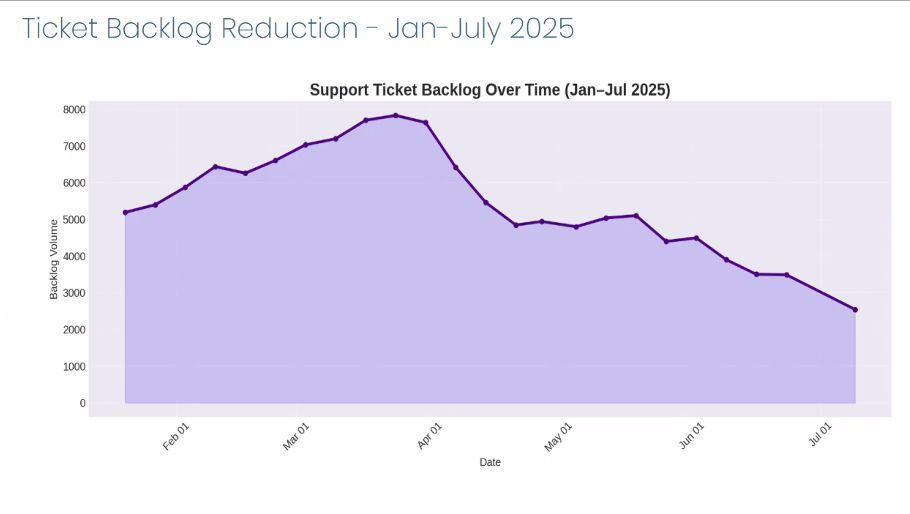
This includes carrying a “balance” forward of around 1000-1500 tickets
There has been a significant backlog of tickets due to things like the support reorganisation in late 2024, but the number of outstanding tickets is being brought down, per the graph below.
Graph supplied by Patch Linden showing the declining in the size of the support ticket backlog
In addition, and as Patch indicated at SL22B, weekend support hours have returned, so there is now 7-day a week support from 06:30 through 15:30 SLT.
In addition, new in-world support and Discord support options are in development and should be announced soon.
As anticipated, there were some issues with pay-outs for some immediately following the completion of the sale; however, the majority of these should now be sorted out.
Whether the sale will potentially increase / decrease the time taken to complete pay-outs depends on a number of factors:
When LL moved to offering real-time pay-outs, Second Life became the target for attempts at fraud by outside forces, and the Lab wasn’t quick enough to catch all cases.
Ergo, before moving back towards real-time pay-out, the Lab is now focused on the issue of account security at their end of things.
Additionally, LL is looking to Thunes to be able to offer more pay-out options to SL creators, some of which might also reduce the times taken to receive money.
However, time frames for introducing the latter are a matter for Thunes, not LL.
Linden Dollar Exchange Rate and the Economy
Concerns have be raised about the recent increases in the Linden Dollar exchange rate (roughly a 5% increase thus far over the course of 2025), with questions on whether the Lab will intervene / cap the increase, and whether the increases were due to user behaviour or system tweaks.
The LindeX operates entirely independently of Linden Lab on an open order book basis: anyone can participate in placing buy / sell orders, with matching engine determining which orders can be fully or partially filled. There is no direct intervention by the Lab.
One of the negatives of the open order book mechanism is that it is subject to the laws of supply and demand: if the supply of Linden Dollars exceeds the demand for them, the LindeX is going to move.
LindeX volumes, 2005-2025
Whilst the 5% increase thus far over the course of 2025 is concerning:
It is perhaps not excessive when seen in terms of the economic disruption going on in the world at large.
Across 20 years of history, the LindeX has actually been remarkably stable (see: LindeX Exchange: Market Data and click on the All option beneath the graphs at the top of the page), particularly when compared to more recent crypto-currencies – or even when compared to natural inflation in the real world.
In this latter respect, SL might be seen as a city which, for 20 years, has seen almost zero inflation.
Quantitatively, the LindeX should have been moving at a rate of around 2% a year, forcing creators to periodically adjust their prices. Had this happened, it would have become the norm, and no-one would have been alarmed at the current increases.
That this hasn’t happened is largely down to market sinks – actions that cause Linden Dollars to “disappear” from the LindeX.
This tends to happen when the Lab accepts L$ as a payment for something that does not have a real-world cost associated with it (so the Lab does not make money on the L$, nor does it lose money in providing the service for which the L$ payment is made). When this happens, it can cause the supply of Linden Dollars to be reduced, boosting demand.
In the years prior to the COVID pandemic (i.e. 2017-2020), the number of sinks had been decreasing, causing the LindeX to rise. However, during the pandemic, demand for L$ rose exponentially, reversing the trend completely. Since COVID the trend has reversed once more, with supply again outstripping demand and leading to the current volatility.
What Can Done?
The Lab could directly intervene and change how the LindeX operates, either by becoming a market maker, or pegging the market rate for L$.
Neither option is seen as optimal for various reasons (e.g. the perception that LL is now manipulating the market to their benefit; the potential for increased fees to be charged, etc.).
However, the market maker is an option the Lab could possibly experiment with alongside the open order book in the future.
Currently, two potential actions are in development at the Lab. These are focused on the supply side of things with the aim of alleviating some of the current upward trend. Neither option was specified in the meeting, but one is liable to be launched in the near future, while the other is more medium-term.
Longer-term, the solution is seen as redressing the supply and demand balance in favour of the latter. There are two primary ways of doing this:
Find the means to introduce more sinks into the market, so that L$ can be “taken out of circulation”.
Stimulating demand for L$ – most particularly through bringing more active users in to SL so they engage in the economy (see below for more on this), and through short-term promotions such as the April 2025 50-hour reduction in L$ buy fees.
In terms of providing more sinks for L$, the Lab is open to suggestions from the user community at large on how this might be achieved – however, a sink only works if it involves no base cost to Linden Lab. For example:
While paying for a subscription (Plus, Premium, Premium Plus) using L$ might some like a sink, subscriptions have a base cost for LL, which is covered by the revenue LL obtains through the fiat money subscription fee. So if L$ are used instead, that revenue is removed and in order to recover it, LL must sell the L$ back into the market, keeping them in circulation and eliminating the sink.
The above is also true to ideas such as allowing region holders to pay for multiple regions using L$.
Platform Growth Initiatives
This was both an update on the impact of Project Zero (the viewer in a browser) and SL Mobile in bringing-in new users – and how established users can help with this.
Both Project Zero (viewer in a browser) and SL Mobile, together with new on-boarding initiatives and advertising has seen a month-on-month grow in the number of people trying SL over the last three months.
This has resulted in a tenfold increase in the number of people trying out Second Life than has historically been the case.
However, this is only translating to around a twofold increase in the number of retained users (those logging-in to SL repeatedly over a 30-day period) – or approximately 1 in every 100 who try SL for the first time.
While the Lab is trying to improve on this by directing incoming new users to meaningful locations, they are seeking help from users and creators.
If creators (e.g. content creators, region holders, etc) / communities can create in-world locations specifically to engage with and encourage new users to become more involved in Second Life, LL is willing to work with those creators / communities to drive incoming traffic to those locations.
As a part of this, LL will also work closely with the creators on these new user experiences / flows to help understand what is working and what is not, where new users might be getting frustrated (and possibly leaving), how to address this, provide relevant stats on all of this, etc. The overall aim being to help iterate and build experiences and processes that result in more new users becoming more fully engaged in SL.
For the Lab, the focus is on trying help new users get to grips with the basics – how to dress and customise their avatars – rather than the more esoteric aspects of SL (e.g. managing land and / or Groups).
There are some general things existing users can do to help new users.
This could be as simple as engaging with them in conversation, to the likes of clubs and stores not blocking access to accounts under a certain number of days (30, 60, whatever).
Yes, the latter may mean having to deal with trolls / idiots, on throwaway accounts – but there are tools to help with this, and making new users feel more welcome as they hop around SL trying to find places they might enjoy (and spend L$) than making them feel utterly unwelcome.
Copyright and IP Infringements
A number of meetings with content creators earlier in 2025 raised the issues of copyright / IP infringement, content ripping, and similar (some based around the appearance of a viewer that had a focus on content ripping).
In response to the concerns, LL has been pro-active in trying to address the “top” problems with content theft, with those doing so receiving “more than nasty letters”, and as a result departing Second Life.
This was supported by the opening of a special support channel to respond directly to matters of content theft.
As a broad indicator of the change, the number of reports of content theft (not DCMA filings, which tend to remain constant) has fallen from around 300 per year to just 27 since the new measures were introduced earlier in 2025.
Content creators at the meeting largely agreed with the Lab’s point of view, confirming that some of the more notorious content thieves have not gone from SL, and the aforementioned content ripping viewer appears to now be blocked.
It is acknowledged that this likely does not eliminate all content ripping completely from SL, but should be taken as indicative that LL and their legal team are not prepared to be complacent on the matter.
Update: Linden Lab has now blogged on the change-over – see: A New Chapter: Tilia Joins Global Payments Leader Thunes, together with a FAQ. I have further updated this piece to include details on user data security, as given by Brad Oberwager in April 2024, as a result of being was on this subject.
On Thursday, 29th, 2025, Linden Lab Executive Chair Brad Oberwager and members of his team held a Zoom call with bloggers and creators to provide an update on the acquisition of Tilia.io, the all-in-one payments platform the Lab launched, and which handles payments processing, USD account balances, etc., for Second Life, to Singapore-based Thunes, based business-2-business (B2B) payments infrastructure firm.
The following is a summary of the core points of the discussion, some of which re-trod the subject of account security, as I’ve already covered in Linden Lab: keeping your Second Life account safe.
Acquisition and Change-Over
The acquisition is due to complete on Wednesday, June 4th, 2025.
On this date, there will a series of steps taken by both Linden Lab and Thunes to complete the change-over.
Perhaps most notably, Second Life web pages referencing Tilia Inc., will instead reference Thunes Financial Services LLC, and the Tilia website will be rebranded.
While there are chances of some hiccups given the back-end complexity of the change, these should be minimal, and the SL support teams will be ready to help any users who may experience issues.
In short: “Don’t Panic” when/if you see the changes happening.
What This Immediately Means to Users
For the majority of users, there should be no visible difference to the processes of buying L$ or cashing-out.
User Data Security: An important point to note with the acquisition of Tilia is that Second Life user data is not changing hands.
Tilia will have new owners and will be renamed, but the lock-down of Second Life user data resides in two places: Tilia (for financial information) and Second Life (actual user data).
As a financial services company, Thunes is required to keep financial data as secure as it currently is with Tilia, and the data will not be removed from the current Tilia systems and moved elsewhere.
There will be no changes in existing fees charged by the Lab for cashing-out or buying L$.
No-one needs to create an account with Thunes to keep buying L$ or cashing-out, etc.
There will be no change in how support issues relating to finances are handled: users will continue to deal with the Lab’s own billing support team. you will not have to deal with Thunes directly.
Linden Lab will continue to manage the LindeX, and nothing will be changing on this front.
However:
Following the change-over, users may be required to acknowledge the change via a check-box the first time they engage with the rebranded service.
Some users may have to re-submit information such as their credit card details or re-confirm a payment account as a result of the change-over.
What It Means Going Forward
Potentially more methods by which to receive payments from Second Life (e.g. to different accounts, through different services, etc.) or by which to purchase L$ – Thunes supports pay-outs across 130+ countries and 320+ payment methods globally.
It is possible that as new payment methods are added to Second Life, they may be subject to increased fees as a result of charges made by the payment method.
To aid in understanding of fees charged, the Lab will start to provide a breakdown: how much they are charging & how much of that due to the payment method. This is to allow users to decide whether they wish to use a newer payment method, which might offer certain advantages (e.g. faster processing), or not.
LL has a 5-year agreement with Thunes to prevent Thunes forcing increases on existing services provided to LL (although this obviously does not prevent LL making changes to fees should they need to).
Much better fraud controls and investigation, leveraging Thunes own capabilities as well as LL’s support team.
Benefits to Linden Lab
The company is no longer engaged in trying to operate and maintain what is essentially a fintech company, with all the costs involved therein.
Ability for management to focus solely on building and improving Second Life.
The payments team can be focused solely on Second Life, rather than having to also focus on regulatory requirements and deal with multiple payment services, etc., as these will now be the responsibility for Thunes to manage.
One of the things that we’re trying to do is making the Second Life financial transactions easier for creators and buyers. We’re doing more and more things to streamline systems, to give real-time payments … The bad news is that when you start to do these really good things for folks, you become a target, and bad people try really hard to take over other people’s accounts.
– Linden Lab Executive Chairman, Brad Oberwager, May 22nd, 2025.
These words formed comments by Linden Lab Executive Chairman Brad Oberwager during a Zoom call to bloggers and operators of large in-world Groups held on May 22nd, 2025. The call was held ahead of an official blog post on the matter of account security in the face of growing attempts by bad actors to try to take over people’s Second Life accounts and which has coincided with efforts to make it easier for users to process credit (cash-out) from SL (see: Your Account, Your World: Keep It Safe, published on May 23rd, 2025).
Whilst the official blog post should be read in and of itself, in keeping with the Lab’s request:
This article repeats the guidance given there, hopefully adding some additional context as provided / suggested during the Zoom call.
Offers a very brief summary / insight of some of the additional steps Linden Lab is taking in order to try to reduce the risks of accounts being compromised / taken over, and people losing money, beyond those mentioned in he official blog post.
Basic Account Security
Remember: your account name is public information. It is only your password that is protecting your account.
Never give out your password to anyone in SL, no matter how well you think you know them, or how helpful they appear to be; confidence tricking is part and parcel of the phisher’s social engineering toolset.
Do not use the same password across multiple accounts – including third-party sites you associate with your Second Life account (e.g. e-mail, Discord, etc.).
Phishers may not be “just” interested in your Second Life account; they many potentially have as much interest in where the account might lead – your e-mail contacts, other accounts you use, etc., – as they are in taking your L$.
Use a strong, unique password – at least 12 characters long, mixing upper and lower case, numbers and symbols.
Consider using a passphrase rather than a password: these can be harder to glean or guess.
Use LL’s Multi-Factor Authentication (MFA): yes, it’s not as perfect as it could be, and not everyone can use it. But if you can, please enable it. The added security far outweighs inconvenience of finding your account has been compromised and you are locked out of SL as a result while LL investigate.
Links and Downloads
Don’t click on links appearing in group chats, IMs, local chat, third-party sites used in association with SL (e.g. Discord, Flickr or similar) or which arrive unsolicited, and/or which offer you the chance to download a viewer, or go to a website for “special deals”, etc.
Similarly, be wary of ill-defined links within avatar profiles and check those that provide a URL (e.g. does a link apparently for the Marketplace actually give the correct URL, or does it have odd letters – “mmarketplace” instead of “marketplace”, for example).
Do not enter your account details on any website a link has directed you to, no matter how “official” looking. Remember, SL uses single sign-on, so you should not be asked for credentials if already logged-on.
Only download viewers from either the SL official viewer download page (e.g. by clicking the option on the right of your Account Dashboard), or by navigating yourself to the viewer’s website using the links within the Third-Party Viewer Directory. Never download a viewer via any other link (no matter how apparently trustworthy the source of the link).
Money
Never try to obtain Linden anywhere other than the LindeX or through the Buy L$ button in the viewer.
Don’t fall for offers of “discount” L$ purchased via external services such as Venmo or PayPal; these are scam activities and can result in you both losing money and access to your SL account.
Staying Alert and Taking Action
Staying Alert:
All of the above can happen at any time, so treat all offers of L$, unsolicited download suggestions / links, “promotional” offers for L$, etc., as suspicious, no matter who / where they come from.
Friends and acquaintances can have their account compromised just like anyone else – so just because you “know” the account sending you a link / offering to log-in to your account to “help” you with something, doesn’t what is being sent / suggested is safe.
As the old truism goes: if something sounds too good to be true (and involves anything to do with account access, money, etc.) – it probably is.
If your account is comprised:
Change your password, if you can still access your account, and if you have not done so (and can), enable MFA.
Accept the fact that the safest way to secure your information is for the Lab to lock your account for a time, and you may have to provide proof of identity before you regain control of it.
Do not revert any password set for your account by LL back to a previously used password. Remember, any previously-compromised password remains compromised even after your account has been reset.
I’ll give you an example of how trusting people are: someone gets their account taken over. We stop their account. They come back. We verify it’s them. We change their password to something complicated – because their password was “Potato1”. What do they do? The next day, they change it back to “Potato1”. And then they get their account taken over again.
– Linden Lab Executive Chairman, Brad Oberwager, May 22nd, 2025
What the Lab Is and Will be Doing
Linden Lab has been moving to address problems of account take-overs in a number of ways, some of which will are already in place or will be coming into use soon, as per the official blog post. In addition, further changes to help protect accounts are either in active development or are being considered. These include the following.
Additional Protections / Requirements When Processing Credit (Cashing Out)
Enforced MFA when processing credit (cashing-out) from Second Life. If you are a creator or similar, wanting to convert L$ to fiat currency and take it out of Second Life as real-time payments, you will be required to use MFA.
The same may be required for those buying “large sums” of L$.
Re-introducing delays in processing credit if:
The cashing-out account has seen a password change ahead of the process credit request.
The external receiving account has been changed or the pay-out method updated.
There has been an IP address change for the account logging-in (not clear on how dynamic IPs will be handed with this).
Investigating specific options for account safety and verification where cashing-out very large sums are concerned (the example was in terms of tens of thousands of dollars).
MFA and Secure Log-in Enhancements
Linden Lab is additionally looking to:
Enhancing the multi-factor authentication (MFA) toolset to make it easier for more people to use.
Possibly adding passkey support to MFA.
Implementing log-in from trusted services (e.g. Google).
However, it was noted that some of this work will take time to complete.
Additional Improvements
These are options LL is either engaged in implementing, or considering (note: this list is not exhaustive in terms of the Zoom discussion, but reflects those things indicated as being pursued / investigated):
URL Links in Group chats, IMs, etc.:
Currently being scoped for inclusion in the viewer: adding a pop-up warning highlighting the risks when a user clicks on a link in an IM, Group chat, etc. This is being done in preference to disabling all such links, as it has been recognised there are legitimate use-cases for providing URL links.
Under investigation: providing the means for Group owners (/officers?) to be able to remove links from their Group chats.
Log-in warning: possibly add a log-in warning to remind people not to give their passwords out, share their account etc., with a required action to remove it. However, this is not currently viewed as optimal, due to the level of irritation / upset it would cause.
Updating interactions with Tilia to ensure greater account security. More to come on this from the Lab / in this blog in the near future.
Conclusion
Account take-over is a real threat within Second Life. While LL is attempting to minimise the risk of user accounts being compromised and money being taken, we all have a responsibility to ensure we keep our credentials as secure as possible, and that we all take a common sense approach to minimising the risks of having our accounts compromised. As such, if you are not already doing so, please do take the recommendations in the first part of this article – and in the Lab’s own blog post – seriously, and act on them.
The viewer-in-a-browsers website, showing increased time limit (as of January 9th, 2025)
On December 23rd, 2024, I was able to sit down with Linden Lab co-owner and Executive Chair, Brad Oberwager and the company’s founder and now CTO, Philip Rosedale, to talk about a project the Lab are working on, and what it may mean for many users either already engaged in SL or who are joining the platform.
The gist of it is, starting at the very beginning of January, we’re going to start making Second Life available through a browser. We’ve had a team on it for a couple of months now, and we’re going to make the first demonstrative use of it at the start of January.
In fact, we’re taking advantage of a mix of different changes in the market and technology; we’re going to tie a bunch of different components together, but at the core of the offering that we’re going to start testing at the beginning of January is a streaming version of Second Life which is pixel-perfect, 1080p, you can’t tell you’re not using a desktop client, there’s no way you can perceive that you’re using it … and so it’s just like logging-in to Second Life [on a desktop viewer].
– Philip Rosedale, in conversation with me, December 23rd, 2024
This ability to stream Second Life through a browser is now available for testing – and if you wish to do so, you can do so free of charge for the next few days – simply hop down to the notes on how to do so at the end of this article.
However, the streaming test is one part of a broader strategy the Lab is taking in an attempt to make Second Life more accessible to both existing and incoming new users, and I want to focus here on that, and what we are likely to be seeing during 2025.
Of course, this is not the first time an attempt has been made to stream SL to users; there have been two commercial attempts to do so in the past with both SL Go, provided by OnLive between March 2014 and April 20151, and then via Bright Canopy, provided through the Frame application delivery service (now Dizzion) between 2015 and 20202. However, those services were at a time when streaming complex content was still relatively in its infancy, and their providers were subject to business and marketplace forces which ultimately led to their respective demise.
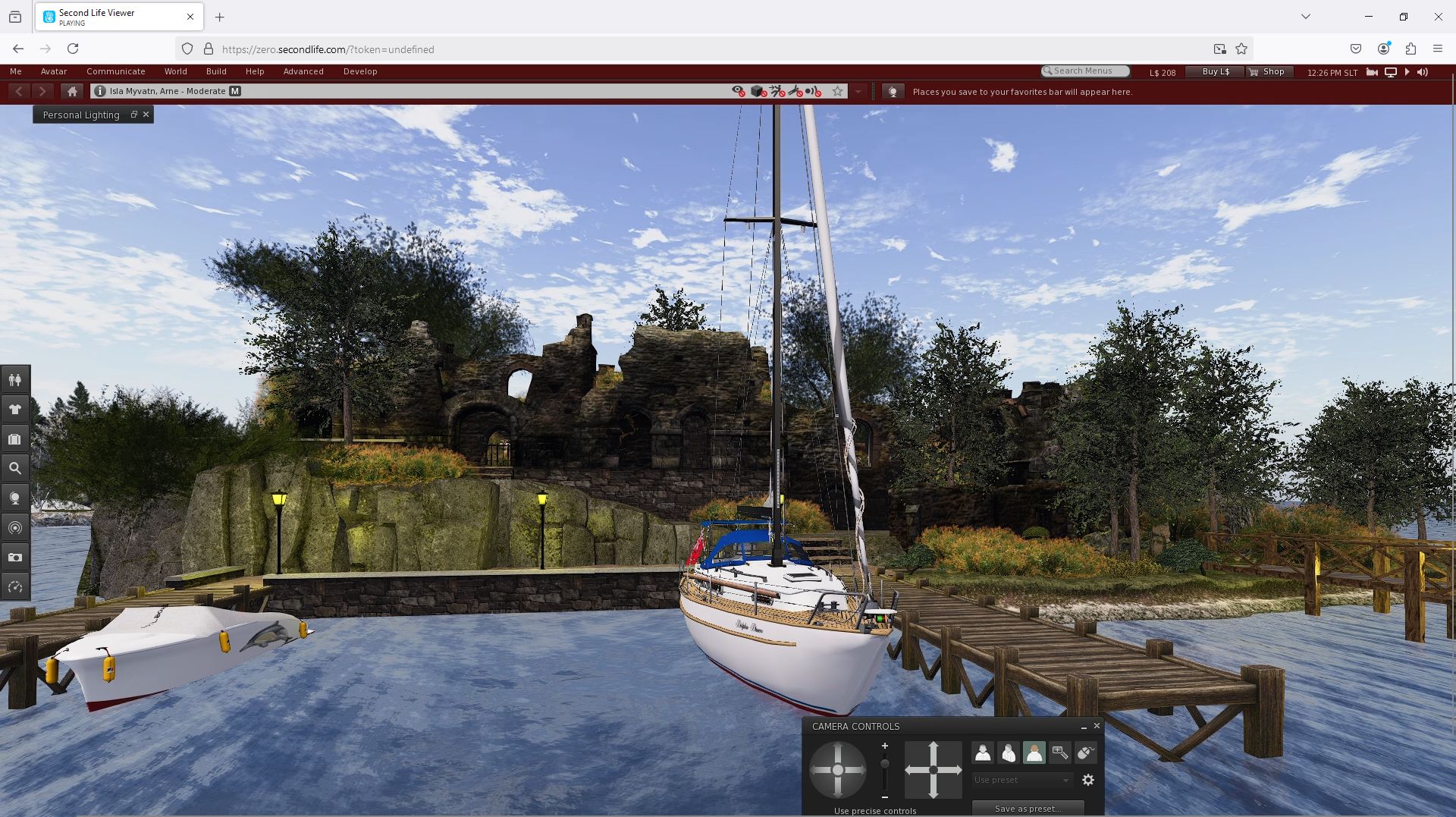
Second Life streamed via Firefox
For the Lab, the move towards browser-based accessibility to Second Life is based on addressing a number of long-term pain points in using the platform:
The fact that it continues to require fairly high-end computer hardware to experience it at its very best – and roughly 50% of the existing user base do not have such hardware at their disposal.
The fact that it requires a dedicated viewer to be downloaded and installed by new users as a part of the sign-up process.
The fact that the viewer has a sprawling and complex UI which can be both hard to master by new users.
Offering a browser-based / streaming solution can overcome these issues – and that is the point of what is being called Project Zero: to allow those on low-spec systems experience SL as if they were using a gaming rig with a high-end GPU, whilst offering incoming new users direct access to coming in-world via a URL within the sign-up workflow.
We’re [also] going to start A/B testing by letting a good chunk of the people that come in new to Second Life go through this new streaming system, as opposed to downloading the desktop. So we’ll be able to start to test that and quickly see how they compare. Our expectation is, barring any unforeseen problems, it’s going to be the case that a lot more people are going to be able to get into Second Life because they don’t need a high-end GPU or have to go and install some software.
– Philip Rosedale in conversation with me, December 23rd, 2024
But this is just the tip of the iceberg.
Project Zero: Evolutionary and Revolutionary
The initial offering of the viewer through a browser is just that: a baseline service which allows someone to go to a URL and launch an instance of the viewer and access Second Life. As such, it has limitations (which I note below for reference). However, Linden Lab intend to start iterating on the capability pretty rapidly, utilising the experience they’ve gained through other projects, to build on the browser experience and improve it – particularly in regards to the UI.
We’re going to re-do the interface completely, in the same way that we did with the Mobile client. We’re going to start by streaming the existing interface, but then very quickly – probably sometime in January – you’ll see us turning off the UI layers that are in the [browser] client and switch them out into a modern HTML / React style web UI on top of the viewer which should look and feel a little bit like what we’ve done with Mobile, where we’ve only been implementing the features we absolutely need, and then implementing them cleaner than they were before and in a way anybody coming into Second Life today, no matter what their age so just look at it and go, “oh yeah, that looks like a sensible UI.”
– Philip Rosedale, in conversation with me, December 23rd, 2024
Once these core elements of using SL are working within an overlay-style of presentation, the plan is to move on to the more challenging aspects of the UI and using SL – such as avatar customisation. And here things start to get revolutionary, as the Lab will be looking for input and assistance from content creators.
We’ll move upstream in terms of difficulty level towards the kinds of things that people need to do to get acclimated inside Second Life. We view the dressing problem to get the avatar to look the way you want to be the penultimate challenge here; that is the thing we need to get both greatly improved in its usability, and then moved on to an entirely new UI approach.
We’re going to do that UI design in partnership with others; we’re going to do things like put different default avatars in there which we’re going to build in partnership with content creators; we’re going to sit down with content creators who have complex things like HUDs and say, “OK, if we started from scratch, how would we make your experience perfect accessible to a new user?”, and do that co-design with them and rapidly push that into the pipeline of the actual code-base of this new viewer
– Philip Rosedale, in conversation with me, December 23rd, 2024
Second Life streaming through Firefox
Does This Mean The Viewer is Going Away?
No. The intent with streaming Second Life / Project Zero might be summed up as being about:
Trying to try to ensure a new user first experiences Second Life to in as friction-free and as friendly a way as possible before eventually graduating to more advanced Viewer options.
To give those on lower-specifications a cost-effective means of experiencing Second Life at its fullest, should the wish to do so.
The familiar viewer – official and TPVs – is not going away, and the Lab emphasises that is is not in any way downshifting any development of, or support for, its own and third party viewers. In fact, LL are open to talking to TPVs and adding them to the streaming capability as it is developed and enhanced.
The best way to thing of streaming and the installable viewer is that they compliment one another – although it is possible that some of the refactor of the UI could be ported back to the installable viewer, if they are seen as particularly beneficial.
Of Costs and Philosophy
As noted, the ability to stream SL through your viewer is at this point in time, both a test and is being offered free of charge. However, the elephant in the room is that like it or not, streaming something as complex as Second Life does cost money. As such, the need to cover those costs has to be considered – and here again, the Lab is trying to be flexible.
What we’re trying to build long-term, is a browser-based interaction with Second Life. Right now, it has to be streamed. That’s the technology to do it NOW and do it FAST, and we’re going to learn a lot. Clearly, streaming is expensive; so we’re looking at this as an investment in a way to build down the road.
But, Second Life is big, and people spend a lot of time in-world, so if we get charged on an hourly basis, we can’t get into a situation where we’re spending $100,000 a day. So yes, we’re going to explore all different ways. Right now, it’s free; we’ll probably explore “what if we give it away to Premium Plus? What if we come up with a subscription fee? What if we do it per hour? Would you get a better deal if it is a completely new [Second Life] subscription?” We’ll test all of that to figure out what the residents want; but to be clear, we’re not looking to make money on it.
– Brad Oberwager in conversation with me, December 23rd, 2024
There is also something of a value proposition here for those using lower-specification systems which are more than adequate for everything else they want to do on a computer, but would like to experience a smooth, more immersive Second Life: is paying a fee / subscription for streaming SL more preferable that the up-front cost of buying a new high-end computer just to enjoy SL’s full graphic fidelity? This is something of an imponderable – but it is one the Lab is looking at.
We recognise that today, some of the most trivial pay-as-you-go set-ups are just too expensive to just let everybody in Second Life on; but hopefully, between Brad and myself and the overall technologies changes, we’ll be able to drive that price down. So it’s kind-of tricky, because we can’t put ourselves out of business in the short-term, but we also know that we’ll be able to get the price down quickly.
– Philip Rosedale in conversation with me, December 23rd, 2024
Exactly where that price-point lands remains to be seen. In the meantime, the streaming option is now available to test.
Trying SL in a Browser
The updated Second Life web login-in screen
To try out the streaming version of the viewer for yourself:
If you have not logged-in to Second Life via the web for some time (e.g. to your dashboard at secondlife.com), you will be asked to log-in via the updated web log-in page.
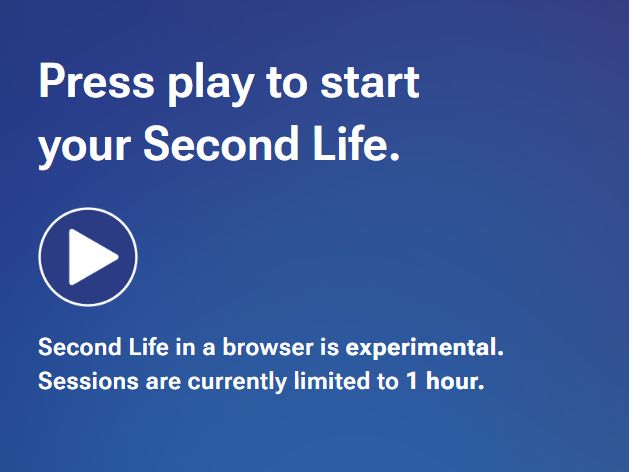
Read the notes on the Second Life in a Browser splash screen
Click the Play button.
The viewer should then launch through your browser (I tested on Chrome, Firefox, Opera and Edge with Windows, and all worked for me, Brave, Vivaldi and Gener8 did not).
Things to Note When Trying the Option
This is a free-to-try test, intended to offer LL a demonstration that they have the core capabilities working: the viewer is streamed smoothly, and overall performance (frame rates, etc.), is at least as good as seen when running Second Life on reasonably high specification computers.
As it is a test, there are limits on the number of users who can concurrently access the service – LL are hoping to support several thousand per day, but depending on demand, you may find you have to wait to try.
Individual sessions are limited to just one hour (as of January 9th, 2025), after which you will be disconnected.
There is no warning of any impending disconnection; you are simply logged-out of SL and pushed to the official viewer download page in your browser.
If you were testing something at the time of disconnect, you can start a new session. However, from my personal testing, I would recommend waiting a few minutes before doing so, rather than immediately trying to re-launch a viewer instance in your browser, as the log out process seems to lag behind redirecting you to the viewer download page.
In addition, whilst it is hoped that people will not repeatedly log-in to the service (so as to give as many as possible the opportunity to try it) please note:
The viewer is being streamed at a 1080p resolution. If your display does not support this, you may have to use you browser’s zoom and full screen options to display the viewer in its entirety, or use the browser scroll bars.
As the viewer is being streamed, there are limits on what can be done: personal preferences and settings are not saved; you cannot upload textures, etc., if you use MFA you will have to provide a token with each session. Further, Voice chat is not currently available.
However, all of the above will be changing as the service iterates.
Please do not create ALT accounts use multiple accounts when trying the streaming service, just keep it to one existing account when trying it.
Whilst it should be possible to access the streaming option on Tablet devices (subject to the notes above) it is not intended to be accessed via mobile devices like ‘phones, etc., with small screens: these remain the purview of SL Mobile.
If you do try the service out, please give feedback to help LL in the design process. For this first phase, we are most interested in finding any failure cases where you are unable to connect at all, and if so-minded, join the conversation in the designated forum post for this topic.
Personal Experience
I accessed Second Life via the browser option using a laptop with the following specifications: Intel Core i31.8 Ghz; Intel HD 4000 integrated graphics (up to 1.8 Gb shared memory); 8Gb DDR memory. Outside of the resolution issues referenced above (the screen was 1366×768 resolution). The experience was not too far off that of running a viewer on my primary PC (AMD 5800X 8-core processor with 16 Gb DDR4 and Nvidia RTX 3060 12Gb), and both PC and laptop using wired connections rather than wifi.

 Recap of the reason for the sale (completed in June, see: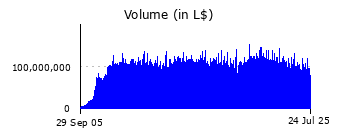



 Inara Pey: Living in a Modemworld