SL project updates 38/2: TPVD meeting, avatar and object rendering

Revenland: the castle and town
Revenland: the castle and town – blog post

The majority of the notes in this update are taken from the TPV Developer meeting held on Friday, September 23rd. The video of that meeting is embedded at the end of this update, and references to it are indicated through the use of time stamps in the paragraphs below. My thanks as always to North for recording and providing it.

This is not intended to be a transcript of the entire meeting, which featured discussions of some situations specific to individual region rather than SL as a whole. However, key discussion points have hopefully been highlighted.

Server Deployment

There was no update on the Main (SLS) channel on Tuesday, September 20th. On Wednesday, September 21st, all three RC channels should receive the same new server maintenance package, containing further “minor internal changes”.

SL Viewer

VLC and Project Bento RC Viewer Updates

On Tuesday, September 20th The VLC media plug-in viewer updated to version 4.1.1.319856, while the Project Bento RC viewer updated to version 5.0.0.319893 on Thursday, September 22nd. In both cases, the updates were primarily intended to bring the viewers to parity with the de facto release viewer code base.

It is hopes the VLC media plug-in viewer will be promoted to the de facto release status in week #39 (week commencing Monday, September 26th).

64-bit Versions

Clarifications was given at the TPV meeting that the 64-bit version of the official viewer will be Windows, Mac and Linux, with the 32-bit version of windows continuing, Mac and Linux moving purely to 64-bit. Active development of the 64-bit viewer is expected to resume in week #39, with the intention of getting the viewer out and available sooner rather than later.

Autobuild, Public Sources and Viewer Building

Part of the 64-bit viewer work involves viewer build infrastructure changes. These include updates to how public sources should be built and to the viewer Autobuild process. In particular, these updates allow the viewer library files to all be built using the same compiler switches regardless of build system. The wiki documentation for viewer builds will be updated to reflect these changes, and there may be a presentation on things at the next TPV Developer meeting. There is a separate file for controlling the compiler switches, so if TPVs and self-compilers wish to build their viewer with different compiler settings, they can swap this file with their own.

Viewer Blocking

As per the Lab’s recent blog post, all official viewer versions older than 4.0.5 have been blocked from accessing Second Life. Users on such viewers will be required to update their viewer to a more recent version. This has been done to encourage users to keep up with the numerous changes and improvements being made to the viewer.

That same blog post indicated that the Lab are discontinuing support for Windows Vista and for Mac OSX versions below 10.9. The Lab is doings its best to maintain back compatibility wherever it can, but where the underlying technology loses support, etc., then it is not possible for the Lab to continue maintaining support either (the more recent versions of CEF, for example, do not work on Windows Vista).

Crash Rates

The recent changes to the viewer code are said to be significantly reducing the crash rate for the official viewer, and it is hoped this will continue with further improvements to the code and through the coming availability of 64-bit versions of the viewer.

Maintenance RC

The next Maintenance RC viewer could be appearing in the early part of week #39.

Avatar and Object Rendering Investigations

[12:12] Vir Linden is starting to work on a new project (concurrent with Bento) involving digging into avatar and object rendering, and land impact. The work is due to an accumulation of issues raised concerning rendering costs by users, and the investigations at this point are focused on what might be improved and what cannot be (due to issues like backwards compatibility) .

This will involve taking “a bunch” of representative / problem cases, and try to take a set of carefully defined measurements of what the real impact is during rendering on a wide range of systems. It is hoped this will allow the Lab to adjust the formulas used to make a reasonable generalisation in the rendering cost of things, and whether or not objects are being reasonably accounted for in those calculations.  At this point in time, it is not a given that anything will chance – simply because it has been a long while since the Lab took a similar “deep dive” into rendering, but there is a “good possibility” changes will result from the investigations.

Avatar Rendering Calculations

[14:54] Avatar rendering calculations were expanded upon by Oz in terms of what happens now, and what the intent was behind things.

The viewer, providing it is using LL’s code unchanged, sends to the simulator a report on what it believes is the rendering cost of all the avatars it can “see” in a region.  The simulator then averages the reports from the various viewers, with heuristics to remove excessive values at either end of the scale, back to everyone in the region.

Right now, the viewer decides how to render each avatar it its view purely on its own per-avatar calculation, using the full dataset for each avatar. However, by using the average value calculated by the simulator, it should be possible for the viewer to start making decisions on whether or not to render avatars in a field of view based on that average (compared with its own Max Complexity setting), without having to wait for the full data on each avatar to be received. The viewer-side code to allow this has yet to be written and implemented, but may form a future project.

[18:34] The other aspect of avatar complexity calculations is that the viewer sends to the simulator a single bit of information for each avatar it can “see”, on whether or not the avatar is rendered as a Jelly Doll. The Simulator then counts how many viewers are reporting on each avatar, and how many of those are rendering that avatar as a Jelly Doll. This information fed back to that avatar roughly once a minute to generate the pop-up notification we see in the top right corner of the viewer window.

Due to the nature of the system, the updates can be delayed, or include out-of-date information. For example: data on avatars who have left a region isn’t immediately discarded by the viewer, but is held for a certain amount of time. Similarly, when changing outfits, you get an immediate update on your complexity (as it is a local calculation), but the number of those who are not rendering you fully is delayed by around 90 seconds while your updated appearance is sent to other viewers and they respond to the simulator with their information on whether they are rendering you fully or as a Jelly Doll, and the simulator feeds that information back to you.

Complexity Variances

[25:15] As noted in my Avatar Complexity updates, the complexity value assigned to an avatar can differ by up to 2K in value between those looking at the avatar. There are a number of reasons for this, including differences in the rendering capabilities of the systems viewing an avatar, and level of detail seen / distance. While it is not a high priority, the Lab is considering tuning how complexity is calculated (such as removing the LOD / distance factors from the calculations).

There are two significant bug reports for issues with the current viewer-side avatar complexity calculations:

  •  BUG-37642 – an avatars complexity value can double or triple following a teleport or relog without changing its outfit. This appears to be triggered by certain outfits / attachments.
  • BUG-37631 – wearing a rigged mesh with any amount of transparency applied to it results in a 4 times higher complexity value. This appears to be due to x4 multiplier used in the Mesh/Rendering Weight calculation for an alpha being applied to the entire avatar complexity calculation, rather than just the vertices using the transparency.

BUG-37692 – llRezObject() and llRezAtRoot()

[39:30]  BUG-37692 has been raised at a number of recent UG meetings, and is seen to be causing a wide range of issues, notably for weapon systems used in combat environments.  The Lab does not currently have a response for the issue, which will be looked at during the next triage period, on Monday, September 26th.

 

2016 SL project updates 36 (2): TPV Developer meeting

Yasminia; Inara Pey, September 2016, on Flickr Yasminiablog post

The majority of the notes in this update are taken from the TPV Developer meeting held on Friday, September 9th. The video of that meeting is embedded at the end of this update, and references to it are indicated through the use of time stamps in the paragraphs below. My thanks as always to North for recording and providing it.

This is not intended to be a transcript of the entire meeting, which featured discussions of some situations specific to individual region rather than SL as a whole. However, key discussion points have hopefully been highlighted.

Server Deployments

There was no main (SLS) channel deployment on Tuesday, September 6th.  On Wednesday, September 7th, all three RCs received the same new server maintenance package, defined as containing “minor internal logging changes” which may help with some of the problems occasionally seen with estate bans; at a minimum the Lab will be able to gather more information on them.

SL Viewer

VLC Media Plugin RC

[00:12] It is anticipated that this viewer (version 4.1.1.318504, dated August 15th at the time of writing) will be updated in the early part of week #37. The update had been expected in week #36, but bug fixing slowed progress. In addition, the new version of the viewer will include changes for exception handling in the viewer intended to ensure exceptions are better handled and recorded. These may not prevent crashes occurring, but should provide the Lab with better data on the exception throws and catches. Overall, they are describes as “fairly small, widespread changes” to the viewer code.

Visual Outfits Browser

[01:26]  The Visual Outfits Browser release candidate was further updated on Friday, September 9th, to version 4.0.8.319463,which should address some bugs, and the crash rate will be under observation with this update.

64-Bit Viewers

[03:08] Progressing continuing on the 64-bit Mac and Windows viewers, and the hope is that a project viewer will be arriving “soon”.

Project Bento

[01:26] My update on the most recent user group meeting is available, in which the viewer’s progress to RC in discussed. At the TPVD meeting, Oz indicated a hope the RC version of the viewer will be appearing some time in the next fortnight. This means that the Bento code will then be officially available for TPVs to adopt.

Windows 10 OpenGL Issue

[03:48] On September 6th, and following Whirly Fizzle’s pointer, I blogged about the Windows 10 / OpenGL issue which is affecting some Second Life users (as well as affecting a number of OpenGL games) – see also BUG-37795. Commenting on this at the TPVD meeting, Oz Linden said:

We are trying to work with Microsoft to find out what the genesis of that problem is … we didn’t do anything, so I’m not sure that we’re going to be able to fix it without help. The fact that it’s not just us that’s affected, is our best hope for getting a fix.

Voice Fixes

[04:50] The Voice changes mentioned in recent TPV Development meetings are not yet ready for release. There is at least one bug in handling Voice fade with distance which needs to be addressed by Vivox, which may take time for them to do. There is also no immediate push to deploy the new server-side Voice code currently on Aditi to the main grid. These changes don’t add any new features, being geared more for future changes to Voice than dealing with current problems, and as such may not be deployed until there is need for them.

New Family of LSL Functions

[07:27] A new family of LSL functions which it is hoped will please scripters. No details on what these are has been provided, pending final QA and testing via Aditi, so they may be appearing “real soon now”.  It is anticipated that an official blog post will mark the availability of the functions.

Other Items

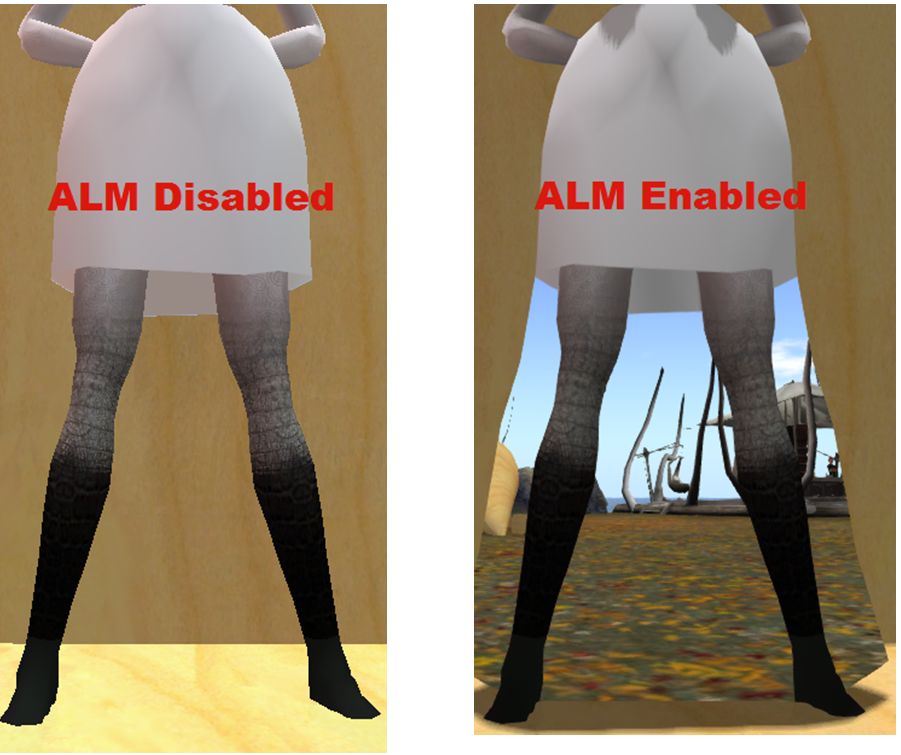
  • [13:10] Alpha Masking Issues: This is a long-standing issue whereby alpha masking “fails” when ALM isn’t enabled in the viewer, leading to unattractive visual issues – see BUG-4357 for details.  This is something which fell off of the Lab’s radar, but they will now see if they can assign someone to look at the problem.
Alpha masking failure on attachments under ALM
Alpha masking failure on attachments under ALM. Credit: Whirly Fizzle
  • [14:44] Increasing the number of allowed attachments: project Bento sees an increase in the number of allowed attachment points on the avatar skeleton. However, the maximum number of attachments which can be worn at any one time remains 38, as any higher number starts to impact performance and stability, particularly with region crossings
  • [20:34] Ghosted attachments on region crossings: there are a number of bug reports on this (e.g. BUG-7761), and more than one bug may be at work (one causing items to become ghosted another causing them to revert, etc) on a region crossing (physical or teleport), which may or may not be linked to wearing multiple individual attachments at the same attach point. The Lab will be making further efforts to investigate issues
  • [27:00] E-mail changes: the Lab is making a series of change to improve the handling of outgoing e-mails from their systems (e.g. off-line e-mails for IMs, etc). The first of this is improving how users verify their e-mail address, which will be followed by further improvements, including only sending e-mails to addresses which have been verified. These changes will again be blogged about when implemented
  • Suppressing Avatar Complexity Notifications: the Lab may be looking at an easier way to suppress the avatar complexity notifications displayed in the top right corner of the viewer window than by using a debug option.

2016 SL project updates 34 (2): TPV Developer meeting

Arranmore; Inara Pey, August 2016, on Flickr Arranmoreblog post

The majority of the notes in this update are taken from the TPV Developer meeting held on Friday, August 25th. The video of that meeting is embedded at the end of this update, and references to it are indicated through the use of time stamps in the paragraphs below. My thanks as always to North for recording and providing it.

This is not intended to be a transcript of the entire meeting, which featured discussions of some situations specific to individual region rather than SL as a whole. However, key discussion points have hopefully been highlighted.

Server Deployments

There were no scheduled deployments for week #34.

SL Viewer

Release Candidates

[00:15] Both of the current release candidates – the VLC Media Plugin replacement for Windows and the Visual Outfits Browser viewer, have elevated crash rates. Each is liable to receive a further RC update in week #35 (week commencing Monday, August 29th).

[00:53] There will be a new Maintenance RC viewer appearing as well.

64-bit Viewer

[00:58] Progress is being made on the 64-bit versions of the viewer, and these are expected to surface (Windows and Mac) as project viewer quite soon.

Bento Project Viewer

As noted in my Bento update #24, the Bento project viewer was issued in what is hoped will be the final project viewer iteration before it progressed to Release Candidate status. Version 5.0.0.318969, released on August 25th, includes the following updates among its changes:

  • The latest viewer updates body size less frequently (starting / stopping an animation) so vertical height repositioning should be less jarring.
  • During mesh upload, SLM files are by default not created and not used. This can still be overridden by changing the debug setting MeshImportUseSLM
  • The show bones display has been modified to use colors differently, distinguishing between joints that are skinned to, joints that have position overrides defined, and all other joints.
  • Animation of collision volumes has been fixed.

Voice Updates

[02:17] The voice updates are progressing, but is not expected to appear in a project viewer soon due to some remaining issues which need to be resolved.

[03:56] There are some server-side voice updates currently on Aditi undergoing test. When these will be moved to the main grid is subject to further discussions with Vivox, which are due to take place in the forthcoming week. When these updates are enabled on the main grid, they will be gird-wide.

[33:10] Oz offered a reminder that in-world / region issues are unlikely to be related to / cause Voice issues in the majority of cases where the latter are being experienced, as the only way the simulator and its host server are involved in voice is when a user is initially connecting to Voice (the simulator provides the channel addresses to the viewer). After this, all communications are between the viewer (via the SLVoice plugin and the Vivox voice servers.

[34:10] As a part of the ongoing work to better monitor and control Voice, the Lab will be introducing improved logging on exactly what the viewer is doing when connecting to Voice.

Exceptions Handling, etc

[02:44] As noted at the last TPV Developer meeting, the Lab is going to be making some source code changes, including a clean-up of asserts in the viewer and how exceptions are handled (the latter to try to prevent the viewer crashing as a result of encountering an exception), and further rendering pipeline clean-up. These will be showing up in a project viewer at some point in the not-too-distant future.

Accessing Crowded Regions & Increasing Max Number of Users Per Region

[08:30] Trying to access a crowded region for an event is often a matter of pot luck. when full, you have no real choice but to get re-trying via teleport or crossing  a region boundary. As a result, the Lab has frequently been asked to add some form of access queuing system to regions.

While a queuing system has been considered, the Lab feels it brings with it may questions around how it work to present an optimal solution for users. As such, while they are open to proposals for a queuing system, optimally, they’d rather work towards trying to increase the number of avatars regions can support. This is something also being looked at from time to time (see my May 27th, 2015 SL project update as an example), although there is no work actively being carried out on it right now.

Abuse Report Categories

[17:00] As indicated in my last TPV Developer meeting update, the Lab will be introducing a new region capability to handle abuse report categories. Once implemented, TPVs will be able to adopt the use of this capability, rather than having abuse categories held within the viewer, where they may get out-of-step with the categories supported by the Lab.

There is also a reminder in the meeting that abuse situations should be reported ASAP after the event, so that the Lab can refer to the related simulator logs during investigations, and that there is a L$10,000 bounty payable on SEC JIRAs which identify actual or potential abuse vectors  / exploits which the Lab can act upon to close.

AMD Graphics Issues

[26:10] Many users with AMD GPU (notably the RX400 series) have been experiencing glitches and “tears” appearing in their world view  – see BUG-20057 and FIRE-16829. User Hurana Ugajin reports she is having a dialogue with AMD on the issue, and a solution may be forthcoming soon. When / if available, a request has been to post it to the SL technology forum.

Region Resource Allocations

[36:19] A question is asked on whether it would be possible to allocate simulator resources (script usage, etc), on the same basis as object land impact – thus allowing resources to be assigned / capped by parcel size, etc.

The Lab does not believe this can be done without significant changes to SL, as a lot of the underpinning resources are not location-based (e.g. scripts are run on the basis of where they are). Instead, the Lab is focused more on penalising individuals for excessive use of resources (e.g. if you run a script which abuses resources in a region, all your active scripts are throttled, not just the offending script). Such abuses can also be AR’d by those noting them.

Other Items

Aditi Access

[04:42] Some users are apparently being told that in order to access Aditi, they require Payment Information On File (PIOF) and to have completed a tutorial. These are actually part of the requirements to be able to upload mesh. No special requirements are required to access the beta grid other than your user name and password.

There is , however a problem with new user accounts not showing up on Aditi when they should, and a request has to be passed to support to enabled them. This is down to changes in how the Lab is handling account data, which has left Aditi in a state of flux, but a fix for this is in the pipeline.

Account Management

[06:22] The account work mentioned above is part of ongoing back-end work the Lab is carrying out related to personal data is handled and stored even more securely, and help resolve some account management issues. One outcome of this will be a single change to a user’s password will be applied pretty much immediately to both Agni and Aditi.

Large Texture Over-Use

[43:40] A continuing problem in SL is the over-use of large (1024×1024) texture on every surface, no matter how small. While this is a bad content choice, it has been suggested that to discourage this, LL should consider charging differently for different texture sizes. This has been discussed by the Lab, with the admission that given the already low cost for uploads (L$10 per item), there is a certain lack of conviction that introducing a nominal fee scale based on image size will do much to discourage the practice.

Avatar Complexity Calculations

[48:18] As noted at the last TPV Developer meeting, the Lab will be carrying out further refinements in how Avatar Complexity is calculated. A suggestion put forward at this meeting is that as well as having a per avatar limit, if a scene-wide limit could be defined / set. This is viewed as an “interesting” idea.

2016 SL project updates 32 (2): TPVD meeting

Eclectica – Mysticablog post

The majority of the notes in this update are taken from the TPV Developer meeting held on Friday, August 12th. The video of that meeting is embedded at the end of this update, and references to it are indicated through the use of time stamps in the paragraphs below. My thanks as always to North for recording and providing it.

Server Deployment – Recap

There was only a Main (SLS) channel deployment this week. This saw the roll of the server maintenance package previously deployed to the three RC’s in week #31, on Tuesday, August 9th. This comprised internal fixes and an update to prevent BUG-37573.

SL Viewer

Release Viewer – Texture Handling Fixes

[0:35] The Maintenance RC viewer release on Monday, August 8th gained a rapid promotion to the de facto release viewer on Thursday, August 11th. Version 4.0.7.318301 (dated August 8th).

This viewer includes a number of fixes in the image pipeline (e.g. fixes for “bad” textures – those texture files which have invalid data in them). Also included is a fix to prevent the viewer crashing when you system runs out of main (not GPU) memory while  attempting to load a texture file. Instead, the viewer will substitute a plain grey texture. So, when you start to see grey everywhere instead of expected textures, it’s time to restart the viewer. This may be a pain to look at, but it is considered preferable to having the viewer crash at a potentially inconvenient moment.

[1:35] The Lab intends to move along similar lines for other issues within the viewer which can result in a hard crash, and also go through cleaning-up how exceptions are generated and caught by the viewer, and this work should be appearing in the next but one Maintenance RC update. The overall goal is to improve the image pipeline and some other points in the viewer where a relatively low-level thing results in the viewer crashing. Some of this work might also help prevent attempts to deliberately crash other viewers using textures.

In the meantime, issues have emerged affecting attachments and the Current Outfit Folder with this release – see BUG-37646 “Attachments get ghosted at login on 4.0.7.318301”; and BUG-37653 “Every time I delete Cache and Relog, my Saved Appearances do not load and I am left as a White Cloud in Second Life Viewer 4.0.7.318301”, for details.

Remaining Viewers in the Release Channel

[4:20] The VLC Media Plugin RC viewer, version 4.1.1.318152 dated July 28th at the time of writing, which contains the LibVLC-based replacement for QuickTime for Windows, is liable to be the next RC that will be promoted to release status.  A new RC version of this viewer, merged-up to the 4.0.7.318301 code, should appear in the release pipeline in week #33 (commencing Monday, August 15th).

[4:32] The plan remains to update the Mac version of the viewer to use VLC as a part of the 64-bit viewer development.

[6:10] The Visual Outfits Browser RC viewer, version 4.0.7.318263 dated August 1st at the time of writing, which allows users to preview images of outfits in the Appearance floater should be updated in week #33 following a merge with the 4.0.7.318301 code. This update will also include a further round of bug fixes for this project.

Project Bento

[7:35] A new project viewer is being readied, which includes bug fixes and which has been merged with the 4.0.7.318301 code. This should hopefully appear in week #33. See my Bento update 22 for more on the project.

Upcoming Viewers

[6:43] A new Maintenance viewer should appear in week #33. This will contain further fixes and improvements, although not the exception handling improvements referred to above.

[7:00] Work is expected to resume on the 64-bit versions of the official viewer in week #33.

SL Voice

[9:45] Work is progressing on Voice, with a further SL Voice plugin update expected from Vivox soon. Oz has been debugging an upcoming project / RC viewer with more Voice fixes – although this isn’t yet ready to be issued.

Avatar Complexity

It has been noted that Avatar Complexity values can fluctuate when seen from different systems, on average by around 5%. This is because it is next to impossible to come up with a single figure that s accurate across all systems, as the calculations have a degree of hardware dependency (GPU, rendering capabilities, etc),

However, the Lab will continue to tweak the calculations to try to make them as consistent as possible, but this will be a gradual process for reasons Oz discussed in the meeting, and which I’ve extracted in the audio file below

A couple of particular issues which have been reported for avatar complexity calculations are BUG-37631 “Rigged mesh with partially transparent texture on it have 4 times higher complexity”, and BUG-37642 “ACI randomly changes (often at login or following a TP)”.

Other Items

Memory Bloat Crashers

[8:50] With the arrival of Avatar Complexity, which provides protection against worn graphics crashers (just don’t set your Maximum Complexity slider to No Limit), it appears that inconsiderates in the virtual world are swapping to use attachments which cause memory bloat in order to crash viewers. There are, for example, attachments which can raise viewer memory to 4 Gb which immediately crasher 32-bit viewers, even if the offending avataris “Jelly Dolled”.

Oz has requested the Lab be supplied with examples, so they can start looking into the matter and hopefully come up with a fix.

Abuse Report Categories

[10:31] One of the possible issues for some Abuse Reports (ARs) appearing to go unanswered is that there are still viewers using the “old” AR categories, rather than the newer categories (as found in the official viewer). This is particularly true where users are still on versions of the viewer which do not have the revised list of AR categories.

To prevent this is the future, the Lab plan to make Abuse Report categories a capability handled by the simulator and downloaded to the viewer. This removes storing the categories in the viewer & having older viewer fail to reflect more recent category updates. It will also make it easier for the Lab to update AR categories to better meet users’ needs. A project viewer will be appearing at some point in the future supporting this new capability.

Also, within the official viewer, appending a snapshot to an AR is to become mandatory, rather than optional, to further help support identify issues and deal with them. Having a picture may not be relevant for all ARs, but for those where it could help in identifying issues, it ensures the picture is provided, rather than ignored.

SL project updates 16 28/2: TPVD meeting

Holly Kai Park: Art Hill - blog post
Holly Kai Park: Art Hill – blog post

The majority of the notes in this update are taken from the TPV Developer meeting held on Friday, July 15th. The video of that meeting is embedded at the end of this update, and references to it are indicated through the use of time stamps in the paragraphs below (note that there were some extended pauses in the meeting where there was no discussion, hence some of the time gaps evident between time stamps, where given). My thanks as always to North for recording and providing it.

Server Deployment – Recap

There was no deployment to the Main (SLS) channel on Tuesday, July 12th.

Wednesday July 13th saw a new server maintenance package deployed to all three RC channels comprising “minor internal changes”. One of these sees worn scripts capped at a count of 2500. Attempts to add attachments which take an avatar over this limit should result in the attachments failing to wear.

There is unlikely to be an RC deployment in week 29 (week commencing Monday, July 18th), although the current RC update should be deployed to the Main (SLS) channel.

SL Viewer

[01:04] The Bento project viewer updated to version 5.0.0.317597 on Thursday, July 14th. This viewer incorporates the changes to the head bones and sliders from the test viewer, and also includes an update for some inconsistencies in avatar height as viewed by self versus others. This is most likely the last iteration of this viewer, prior to it moving to release candidate status.

[00:34] The VLC Media Plugin viewer, version 4.0.6.316258 at the time of writing, should be promoted to release candidate status  “shortly”, pending the fix of a rendering bug.  This viewer had also had fixes for some of the media sound issues which were being experienced.

[02:03] The Visual Outfits Browser viewer, version 4.0.6.316422 dated July 1st at the time of writing, is also awaiting a final bug fix prior to being promoted to RC status.

64-bit Viewers

[02:44 and 18:33] A project version for the 64-bit versions of the official viewer should be appearing “pretty soon”. When these do arrive, the Lab plan to offer Windows in both 32-bit and 64-bit flavours going forward, and Mac as 64-bit only, pretty much as TPVs support 64-bit already do. IF there is a Linux build, then this will also be 64-bit only. The 64-bit versions will also include 64-bit updates to the Havoc sub-libraries as well.

Linux Support

[10:15] As a part of the discussion on SL Voice (see below), Oz re-interated that the Lab will not be directly supporting Linux, but remains willing to accept contributions from TPVs which do support that platform in order to keep the official Linux viewer up-to-date. This is essentially because the effort involved in maintaining a Linux flavour of the viewer when compared to the very small number of Linux users who actually make use of the Lab’s own viewer (overall, Linux users are thought to account for around 1% of the total active user base, many of whom use TPVs).

SL Voice

Voice on Linux

[03:50] Vivox has, for some time, focused updates for the SL Voice package on Windows and Mac, and have ignored Linux. Unfortunately, a recent update from Vivox changed how random handle values in the protocol between the SL Voice package and the viewer are generated, a change which effectively stopped Voice working on Linux (see BUG-20174).

Unfortunately, Vivox have no plans to update their support for Linux, so this is unlikely to be fixed. Some TPVs have therefore been reverting the SL Voice package for their Linux offerings to an early version. Commenting on this, Oz requested that they do not do this for other flavours of their viewers, and noted that even with Linux is not ideal, as the fix actually helps prevent “people subverting the security of your system in really unpleasant ways.” Rather, the suggested approach is for users to run the Windows viewer or the Windows SL Voice package on Linux using Wine.

Voice Support Updates

[07:12 and 13:05] The Lab is engaged in a programme with Vivox to update much of the Voice support. This will involve a new version of SL Voice “pretty soon”. This initial update should be backward compatible on Mac and Windows, allowing TPVs to adopt it, and will include a new codec which should improve the quality of voice for those using the update.

However, further down the road, this programme will include further improvements to Voice security and prevent it being abused, fixing a number of long-standing vulnerabilities. This programme will involve changes to SL Voice package, the viewer, the simulator and the Vivox servers, and due to their nature, they will not be backwards compatible, and viewers not incorporating them – including Linux flavours – will not be able to use Voice(again, running the Windows viewer / Windows SL Voice package under Wine is the suggested route forward for Linux users).

Because of this, the changes will be phased in over a period of time, starting with the viewer changes, and the announcement at the TPV meeting is essentially to put TPVs on notice of what will be happening over the next couple of quarters. Once the viewer  / SL Voice package updates have been adopted by TPVs, the necessary changes to the simulator software and to Vivox’s own servers will be introduced.

Voice Connection Issues

[23:19] BUG-20075 notes an uptick in voice connection failures. These have been noted by the Lab as well, and they are thought to be in part the result of a number of attacks directed at Vivox, which the company has been responding to. The hope is that new monitoring tools within the latest version of SL Voice may help identity further problem areas.

SL Project updates 16 26: Server, viewer TPVD Meeting

It All Starts With A Smile; Inara Pey, June 2016, on Flickr It All Starts With A Smileblog post

Some of the notes in this update are taken from the TPV Developer meeting held on Friday, July 1st. The video of that meeting is embedded at the end of this update, and references to it are indicated through the use of time stamps in the paragraphs below (note that there were some extended pauses in the meeting where there was no discussion, hence some of the time gaps evident between time stamps, where given). My thanks as always to North for recording and providing it.

Server Deployments – Recap

  • On Tuesday, June 28th, the Main (SLS) channel received the same server maintenance package previously deployed to the RC channels, comprising  minor internal changes and Tool Tip/Constant text fixes.
  • On Wednesday, June 29th, all three RC channels received the same new server maintenance package, comprising the following fixes:
    • BUG-11836  Increase max animation size – animation files up to  250Kb can now be uploaded
    • BUG-6035 (non-public) LSL email registration (for receiving email from outside the region) can break without automatic recovery.

Deployments for Week #27

There will only be one deployment in week #27 (commencing Monday, July 4th), this will be to the Main (SLS) channel, promoting the current RC channel package, which due to Monday being a holiday in the United States, will take place on Wednesday, July 6th, rather than Tuesday, July, 5th.

SL Viewer

The Bento project viewer updated to version 5.0.0.317134, on Thursday June 30th. This update includes small tweaks to the avatar skeleton file, but no structural changes, and provides fixes for:

  • SL-426 missing string for left pec, right pec attachments
  • SL-398 issues with system eyelashes
  • MAINT-6380 vertical flicker with some mesh avatars.

Visual Outfits Browser Project Viewer

[03:22] The Visual Outfits Browser (VOB) project viewer updated to version 4.0.6.316422 on July 1st. This could be the last iteration of the viewer as a project release prior to it being promoted to a release candidate status, which might be as early as week #27, pending the outcome of fixes for a couple of issues.

Oculus Rift Project Viewer

[04:19] A new Windows build for the Oculus Rift project viewer, version 4.1.0.317313 was released on July 1st (reported as being with the Labs QA team during the TPV Developer meeting) – see my update article for more.

It is expected that over the fullness of time, this viewer will progress through project and RC releases and be merged into the main viewer. The Lab currently has no plans to maintain it as a separate viewer channel.

Note that this viewer is still specific to the Oculus Rift. Support for the HTC Vive in Second Life is something the Lab “would like to be able to do”, but this viewer does not expressly support the Vive as well. If and / or when the Lab might offer Vive support in SL, and how far that support might go (e.g. will it include support for using the Vive’s room sensors with SL) is an open question at this point is time.

Inventory Messaging Viewer Promotion

[00:28] It appears the inventory messaging viewer, version 4.0.6.315555, is “almost certain” to be promoted to de facto release status on Tuesday, July 5th.

This viewer eliminates deprecated and unused UDP inventory messaging mechanisms from the viewer, replacing them with the current AIS mechanisms. The promotion of this viewer to de facto release status marking the start of a countdown towards the removal of the corresponding back-end support for these old UDP operations, which will most likely take place some time in Q4 of 2016 (final dates TBD at this time).

When it happens, it means than any viewers still reliant on the UDP mechanisms for inventory operations – such as the Lab’s Obsolete Platforms viewer (version 3.7.28.300847) will no longer work.

Maintenance RC Viewer

[03:02] The Maintenance RC viewer, version 4.0.6.316883 at the time of writing, is also doing well in its cohort, and is expected to be promoted “not to far” behind the messaging viewer – so most likely around mid-July, unless anything happens, given the Lab generally likes to leave 2 weeks between viewer promotions.

Project VLC Media Plugin Viewer

[36:23] It is hoped this project viewer (currently version 4.0.6.316258, dated June 15th) should move to release candidate status in week #27. Again, this will be for Windows only, replacing the QuickTime media plugin for the Windows viewer with one based on LibVLC. The Mac viewer will be updated to use LibVLC when the 64-bit version is released.

There have been some issues with this viewer recognising .MOV files in comparison with playing files in a web browser or a VLC client (see BUG-20024), It is believed that this is due to be down to the number of different .MOV formats the VLC plug-in in the viewer can recognise (.MOV essentially has multiple flavours) when compared to other means to play these files.

[44:56] In general terms, the Lab plan to make further media handling improvements with the 64-bit versions of the viewer, unless something significant comes up with diverts resources.

There have also been some questions over licensing of media in .MOV format, commenting on this, Oz said:

[39::08] We  believe our viewer is not going to be violating any licensing terms, and you [TPV developers] will have to make your own judgements about what your viewers are and are not allowed to do. I’m afraid Linden Lab cannot be in the position of providing advice on that.

64-Bit

[15:42] Work is continuing on the 64-bit versions of the Windows and Mac viewers., with Oz again re-iterating that when ready, the Lab will provide the Windows viewer in 32-bit and 64-bit flavours and the Mac versions as 64-bit only (as do most TPVs who support 64-bit). Linux will also be provided as 64-bit only, although this isn’t a focus for the first release of the 64-bit versions, unless the Lab receive suitable Linux contributions to help them along.

Continue reading “SL Project updates 16 26: Server, viewer TPVD Meeting”