
“The biggest problem with success is that it looks easy, especially for those of us who have nothing to do.” Thus spoke Jean-Jacques Dordain on Wednesday, November 12th, just moments after it had been confirmed that a tiny robot vehicle called Philae had safely landed on the surface of a comet half a billion kilometres away from Earth.
That simple statement offers a subtle message on the huge achievement this landing represents. The Rosetta / Philae mission is the story of a 6 billion kilometre journey across space which has taken a decade to achieve, and which has involved some 20 countries. Yet the adventure is in many ways only now starting.
The Rosetta mission actually started 21 years ago, in 1993 when it was approved as the European Space Agency’s first long-term science programme. The aim of the mission being to reach back in time to the very foundations of the solar system by rendezvousing with, and landing on, a comet as it travel through the solar system.
Comets hold enormous scientific interest because they are, as far as can be determined, the oldest, most primitive bodies in the Solar System, preserving the earliest record of material from the nebula out of which our Sun and planets were formed. While the planets have gone through chemical and (in the cases of places like Earth), environmental and geological change, comets have remained almost unchanged through the millennia. What’s more, they likely played an important role in the evolution of at least some of the planets. There is already substantial evidence that comets probably brought much of the water in today’s oceans – and they may even have provided the complex organic molecules that may have played a crucial role in the evolution of life here.
The target for ESA’s attention is comet 67P/Churyumov–Gerasimenko (aka 67P/C-G), an odd-shaped body comprising two “lobes” joined together one in what some in the media have at times referred to as the “rubber duck”. The larger of the two lobes measures some 4.1×3.2×1.3 kilometres in size (2.55×1.99×0.8 miles) and the smaller some 2.5×2.5×2 kilometres (1.6×1.6×1.2 miles). It is a “short period” comet, orbiting the Sun once every 6.4 years and most likely originating in the Kuiper belt, a disk of material from the early history of the solar system, orbiting the Sun at a distance of around 30-50 AU
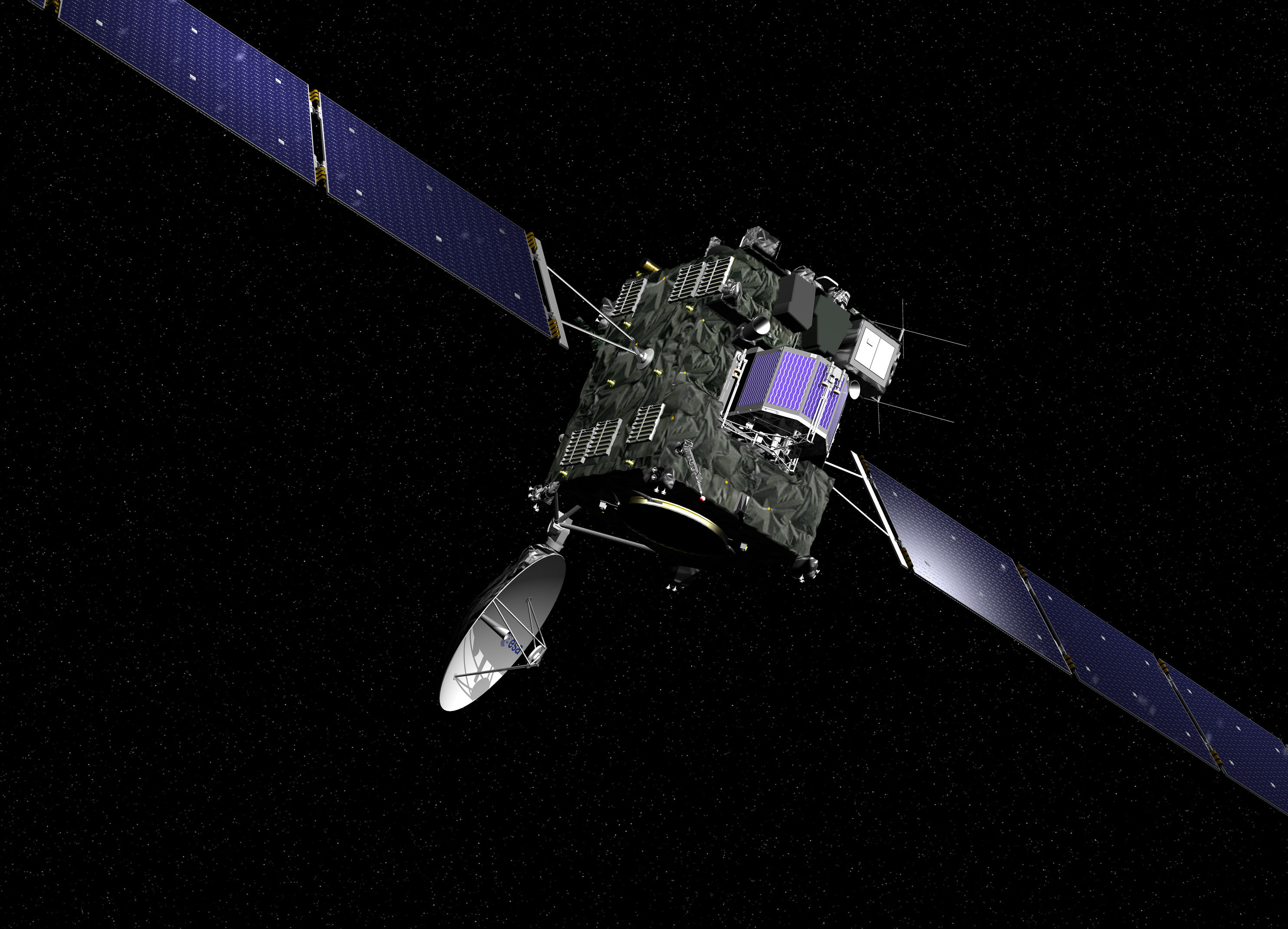
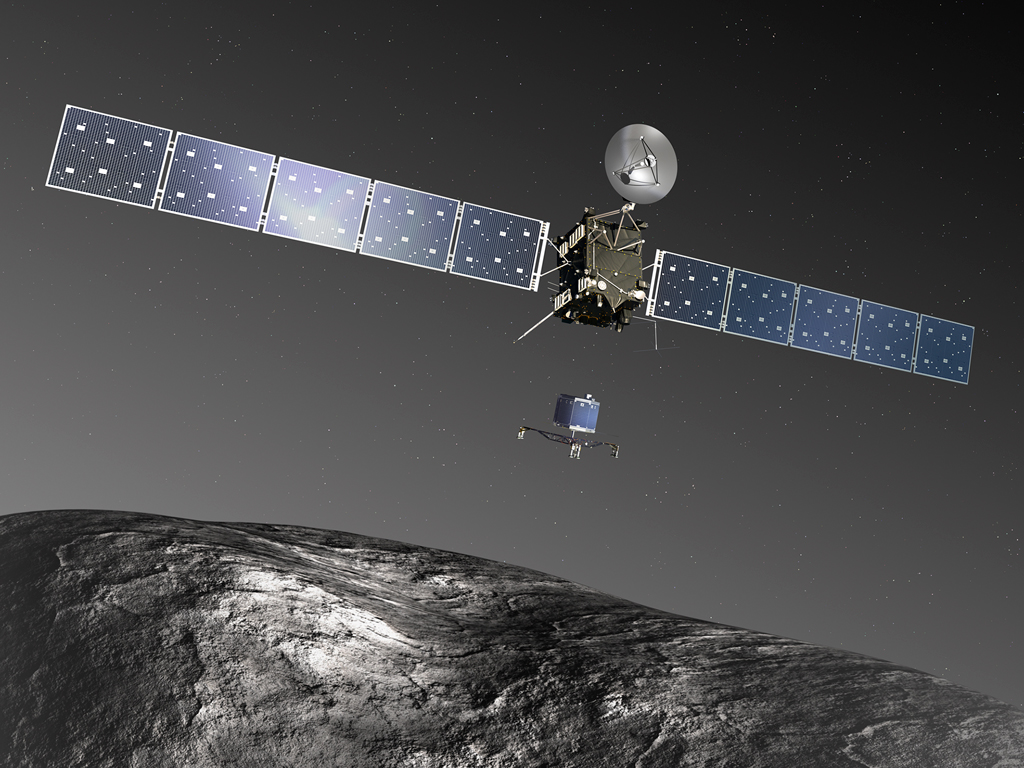
The primary spacecraft in the mission, Rosetta, arrived in the vicinity of 67P/C-G on August 6th, 2014 becoming the first vehicle in history to successfully enter orbit around a comet. The major reason the mission took so long to reach the comet, having been launched in 2004, is that despite having a relatively short orbital period, 67P/C-G is travelling very fast and accelerating as is falls deeper into the Sun’s gravity well heading for perihelion (it is currently travelling at 18 kilometres (11.25 miles) a second and can reach velocities of 34 kilometres a second as it swings around the Sun). As it is impossible to launch a space vehicle is these velocities, Rosetta was launched on a trajectory which allowed it to fly by Earth twice (2005 and the end of 2007) and Mars once (early 2007), using the gravity of both planets to accelerate it and (in the case of the 2nd Earth fly by), swinging it onto an orbit where it would “chase” and eventually catch the comet.

Following its safe arrival, Rosetta settled into an orbit of some 30 kilometres around the comet in September, and began looking for a suitable place where Philae might land – because until the craft actually arrived in orbit around 67P/C-G, no-one had any idea of what it’s surface might look like. On 15 September 2014, ESA announced a region on the “head” of the “duck” had been selected for the landing, christening it Agilkia in keeping with a contest to name the landing site.
Further observations of the comet were carried out throughout September and October as an overall part of Rosetta’s mission and to gain as much information on the landing site itself. At the same time the spacecraft started manoeuvring itself in closer to the comet, dropping its orbit to just 10 km, ready for Philae’s delivery.

The landing operations commenced around 09:05 UT on Wednesday, November 12th, when Philae detached from Rosetta and started on its long gentle descent. Immediately following the separation, and due to Rosetta’s orbit around the comet, contact was almost immediately lost with the lander, leading to a tense 2 hour wait before communications could be re-established. This happened on cue, with the lander reporting all was OK.
Landing on a comet is no easy task. The gravity is almost non-existent, and there was a very real risk that Philae could, if it struck the surface of 67P/C-G too fast, simply bounce off. Hence the lander’s long, slow drop from the Rosetta spacecraft which the ESA mission scientists dubbed “the seven hours of terror” in recognition of the famous “seven minutes of terror” which marked the arrival of NASA’s Mars Science Laboratory Curiosity on Mars.






 Inara Pey: Living in a Modemworld