Space Sunday: Mars visions, gateways and James Webb

Elon Musk has bold plans for building a permanent human presence on Mars. Credit: SpaceX

The 68th International Astronautical Congress (IAC) ran from September 25th to September 29th, 2017 in Adelaide, Australia, and brought forth a plethora of announcements, presentations and updates from all those involved in space exploration.

one of the more attention-grabbing announcements came – unsurprisingly – from Elon Musk and SpaceX. Already leading the way in private sector launches and launch vehicle reusability,  SpaceX has in many respects set the bar for the launch industry as a whole. Musk, meanwhile has raised eyebrows with his longer-term goals, which focus on human missions to Mars and – eventually – the colonisation of the Red Planet. At the September 2016 IAC, he laid the outlines for achieving these goals, and in 2017 he returned to the IAC to offer further updates and insights to the SpaceX approach.

Most surprisingly, given the company’s reliance on it for revenue generation, Musk indicated that he is prepared to phase out all Falcon 9 launch operations, including the yet-to-fly Falcon Heavy, at some point in the near future in order to focus the company on the development and operation of its Interplanetary Transport System (ITS), which Musk still likes to refer to as the BFR (for “Big F***ing Rocket” on account of its overwhelming size).

The updates ITS launcher, seen here in comparison to the Falcon 9 and Falcon Heavy, will be 106 metres tall, powered by 31 first stage engines (down from the original 42), and capable of lifting 150 tonnes to low Earth orbit. Credit: SpaceX

Fabrication of parts of the first ITS launcher – which is the linchpin for Musk’s Mars ambitions – has been in progress for some time, and SpaceX hope to start on the assembly of the first vehicle in the series in mid-to-late 2018. Musk is now so confident in the vehicle’s development status, he is hoping to have two of the launch vehicles ready to fly cargo missions to Mars during the 2022 launch opportunity – although he emphasised this time frame is “aspirational” rather than a fixed deadline.

This version of the ITS will be slightly scaled-down from the version announced last year, reducing the overall launch height and mass of the vehicle, and the number of main engines it will require – 31 instead of 42. The 2022 mission will have a two-fold purpose: deliver core components required for human operations on Mars to the surface of the planet; located subsurface water / water ice which could be extracted and used to generate oxygen which could be used within the atmosphere of a future base, and as an oxidizer in fuel used by vehicles making the return flight to Earth.
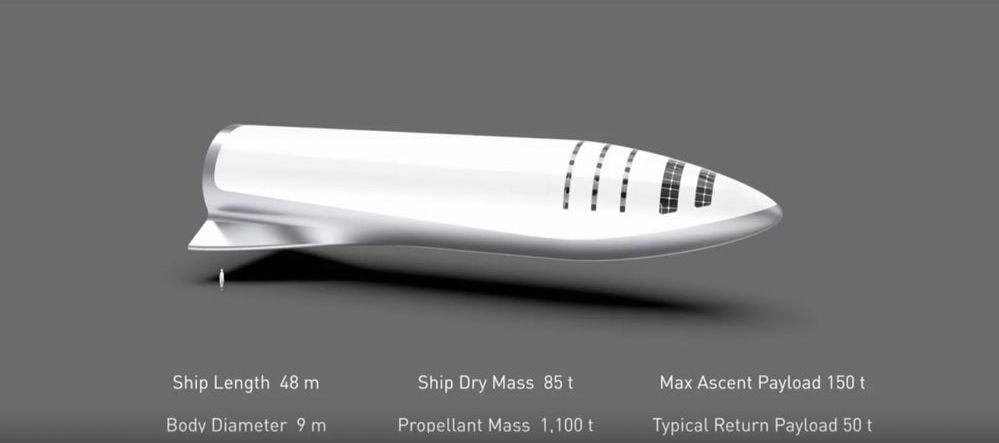
The upper stage of the ITS is an interplanetary craft powered by a mix of methane (CH4) and oxygen (both of which can be manufactured on Mars, allowing the craft to be re-fuelled there for return flights to Earth) and carrying either cargo in its upper section, or up to 100 passengers in 40 cabins and common crew spaces which offer living space in excess of the space found in an Airbus A380 airliner. Credit: SpaceX

According to Musk, should this mission proceed to plan, it will be followed in 2024 by four craft carrying a mix of equipment, supplies and crews to Mars to commence human exploration of the planet.

All of this is highly ambitious, technically and financially. On the technical front, there are significant issues to be addressed, most notably – but not limited to – that of the radiation threat posed by Galactic Cosmic Rays (GCRs). As I’ve pointed out in past Space Sunday articles on this subject, solar radiation – often seen as “the” radiation threat – can be managed relatively well, simply because it is generally low-energy radiation.
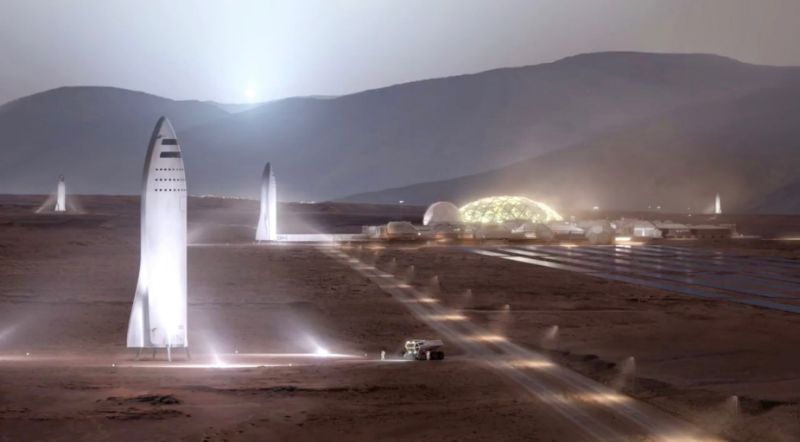
The ITS upper stage on the pad at Musk’s future Mars colony and awaiting refuelling / a return to Earth. Credit: SpaceX

GCRs, however, are high-energy particles which are much harder to deal with: and there is a lot of them in interplanetary space to deal with. Data from the Mars Science Laboratory’s flight to Mars in 2012 revealed that an unprotected astronaut on a similar flight would face the equivalent radiation dose as having a full-body CAT scan every 5-6 days for six months – definitely not a healthy proposition. There are technologies  being developed which can mitigate GCRs, such as such as hydrogenated boron nitride nanotubes (BNNTs), but these are still some way from being available for general use in spacecraft and spacesuit designs. Musk didn’t expand on how SpaceX plan to handle things like GCRs.

He was, however, more forthcoming on how SpaceX would finance the construction and operation of the ITS system. firstly, SpaceX will build up a “stock” of Falcon 9 units which could be used (and re-used) as launchers and components for Falcon Heavy launchers. Secondly, and once available, the revised ITS will be offered as a commercial launch vehicle capable of placing 100 tonnes into low Earth orbit and delivering objects to geostationary orbit or the moon; payloads could be single large items or multiple items. The plan is to use the stock of Falcon boosters through until customers have confidence in the ITS launcher (which will also be reusable) in order to switch over to using it, after which, all Falcon operations will be phased out.
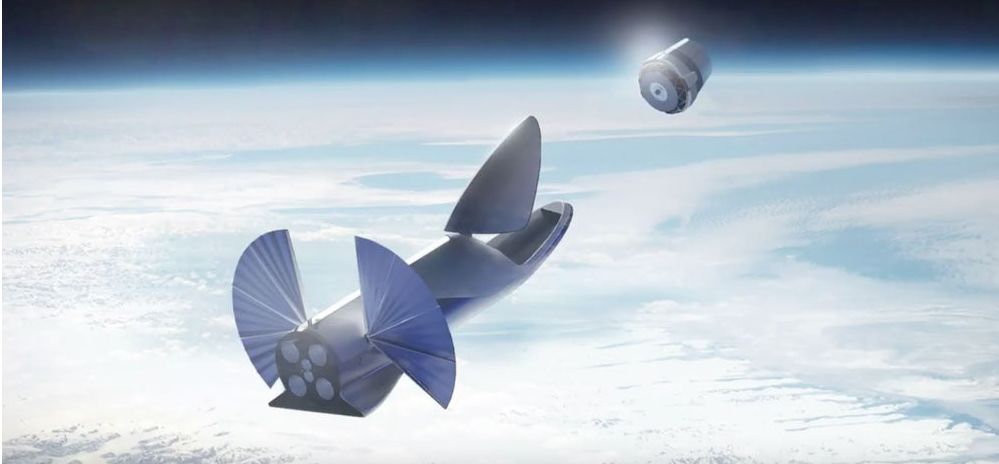
Musk plans to offer the ITS for launches to LEO, the space station, geostationary orbit and even to the Moon for cargo flights, etc. Shown here, an ITS upper stage with solar panels deployed, releases a large single payload into LEO. Credit: SpaceX

In addition, and with usual Musk showmanship, the entrepreneur indicated further revenue could be obtained by offering sub-orbital aerospace flights between major cities in record time. According to his calculations, he claimed that such flights could ferry customers between Bangkok and Dubai in just 27 minutes, or between Tokyo and Delhi in 30 minutes, using a smaller variant of the ITS.

Quite how these system would work or how the necessary support infrastructure needed to support launch / recovery / refurbishment operations around the globe would be financed was not made clear – nor was the potential cost of tickets.

Continue reading “Space Sunday: Mars visions, gateways and James Webb”

Space Sunday: rovers, robots, rockets and space stations

NASA’s Mars Science Laboratory rover Curiosity has begun the steep ascent of an iron-oxide-bearing ridge that’s grabbed scientists’ attention since before the mission arrived on Mars in 2012.

“Vera Rubin Ridge”, previously referred to as “Hematite Ridge”, stands prominently on the north-western flank of Mount Sharp, resisting erosion better than the less-steep portions of the mountain below and above it.

“We’re on the climb now, driving up a route where we can access the layers we’ve studied from below,” said Abigail Fraeman, a Curiosity science-team member. As we skirted around the base of the ridge this summer, we had the opportunity to observe the large vertical exposure of rock layers that make up the bottom part of the ridge. But even though steep cliffs are great for exposing the stratifications, they’re not so good for driving up.”

The ascent to the top of the ridge will take the rover through a 65 metre (213 ft) change in elevation, which is being achieved through a series of drives which started in early September 2017, and which will cover a distance of around 470 metres (1542 ft).

Vera Rubin Ridge mosaic of 70 images captured by Curiosity’s Mastcam telephoto lens on August 13th, 2017. The layering of the ridge can clearly be seen. Credit: NASA/JPL / MSSS

The ridge is of particular interest to scientists not only for its erosion resistant composition, but also because the rock of the ridge exhibits fine layering, with extensive bright veins of varying widths cutting through the layers. Orbital spectrometer observations have revealed the iron-oxide mineral hematite shows up more strongly at the ridge top than elsewhere on lower “Mount Sharp”, including locations where Curiosity has already found the mineral. It is hoped that a detailed study of the ridge will reveal why it has been so resistant to erosion and whether this is related to the high concentrations of hematite in the rock. Answering these questions could further reveal information on past environmental conditions within Gale Crater.

“The team is excited to be exploring Vera Rubin Ridge, as this hematite ridge has been a go-to target for Curiosity ever since Gale Crater was selected as the landing site,” said Michael Meyer, lead scientist of NASA’s Mars Exploration Programme at the agency’s Washington headquarters.

A monochrome image of “Vera Rubin Ridge” captured using the imager on Curiosity’s ChemCam instrument shows sedimentary layers and fracture-filling mineral deposits. ChemCam’s telescopic Remote Micro-Imager took the 10 component images of this scene on July 3rd, 2017, from a distance of about 377 feet. Credit: NASA/JPL / CNES / CNRS / LANL / IRAP / IAS / LPGN

Curiosity Project Scientist Ashwin Vasavada of JPL added, “Using data from orbiters and our own approach imaging, the team has chosen places to pause for more extensive studies on the way up, such as where the rock layers show changes in appearance or composition. But the campaign plan will evolve as we examine the rocks in detail. As always, it’s a mix of planning and discovery.”

In the meantime, and in the saw-sawing of evidence concerning the past habitability of Mars, a team from the Los Alamos National Laboratory (LANL) has discovered evidence of boron on Mars, adding weight to the pro-life side of the argument.

A key building block of modern life is ribonucleic acid (RNA), which requires the sugar ribose. Like all sugars, ribose is unstable and quickly dissolves in presence of liquid, particularly water. However, when boron is dissolved in water it becomes borate, which acts as would act as a stabilising agent of ribose, keeping the sugar together long enough so that RNA can form.

“Borates are one possible bridge from simple organic molecules to RNA,” Patrick Gasda, the lead author of the LANL paper outlining the discovery. “Without RNA, you have no life. We detected borates in a crater on Mars that’s 3.8 billion years old, younger than the likely formation of life on Earth.”

An artist’s impression of how the lake in Gale Crater may once have looked. The central “island” is the impact peak and humped formation of “Mount Sharp”. Credit: Kevin M. Gill

The mineral was detected by Curiosity’s ChemCam instrument, a joint development by LANL the French space agency, the National Center of Space Studies (CNES). It was found in veins of calcium sulphate minerals located in the Gale Crater, indicating it was present in Mars’ groundwater and was preserved with other minerals when the water dissolved, leaving behind rich mineral veins.

Curiosity has already confirmed that Gale Crater was home to a series of lakes, and the LANL findings add weight to the potential these lakes could have had life in them at a time when it would have experienced temperatures ranging from 0 to 60 ° C (32 to 140 °F) and had a pH level that would have been neutral-to-alkaline.

OSIRIS-REx Swings by Earth

Just over a year ago, on September 8th, 2016, NASA’s Origins, Spectral Interpretation, Resource Identification, Security – Regolith Explorer (OSIRIS-REx) lifted-off from Space Launch Complex 41 at Cape Canaveral Air Force Station, at the start of a journey which will carry it a total of 7.2 billion kilometres (4.5 billion miles) to gather samples from the surface of an asteroid and return them to Earth for study (see my previous reports here and here).

On September 22nd, 2017, the spacecraft returned to the vicinity of Earth – albeit it briefly –  to gain the gravity assisted speed boost it needs in order to complete its journey to the carbon rich asteroid Bennu, from which it will gather samples.

A graphic issued ahead of the OSIRIS-REx fly-be on Friday, September 22nd. Credit: NASA’s Goddard Space Flight Centre / University of Arizona

In making the flyby, the spacecraft came to within 17,000 km (11,000 mi) of Earth, approaching at a speed of around 30,400 km/h (19,000 mph) and passing over Australia and Antarctica, gaining a velocity boost of around  13,400 km/h (8,400 mph) as it accelerated back out into the solar system. The fly-by also curved the probe’s course onto an intercept trajectory with Bennu, which it will reach in October 2018. During the operation, OSIRIS-REx performed a science campaign, collecting images and data from Earth and the Moon, which also allowed the science team to check and calibrate the probe’s suite of science instruments.

Bennu is roughly 450 metres (1,614-ft) in diameter, and its solar orbit carries it across that of the Earth  every six years. It is carbon rich, which is of significant interest to scientists because carbonaceous material is a key element in organic molecules necessary for life, as well as being representative of matter from before the formation of Earth. Organic molecules, such as amino acids, have previously been found in meteorite and comet samples, indicating that some ingredients necessary for life can be naturally synthesised in outer space.

On reaching Bennu, OSIRIS REx will “fly” alongside the asteroid for some 12 months, surveying and studying it and imaging points of interest as possible candidates for a daring “touch and go” sample gathering mission, when it will collect between 60 and 2000 grams (2–70 ounces) of material. If all goes well, the probe will depart Bennu in March 2021, arriving back at Earth in September 2023, when the sample will be parachuted down for scientists to study.

A secondary reason for visiting Bennu is that, like many Near-Earth Asteroids (NEAs) there is a slim chance it might strike our planet towards the end of the 22nd Century. An analysis of the thermal absorption and emissions of the asteroid will allow scientists to better predict its future orbits and the real potential for such a collision, and could help determine the actual risk of other NEAs striking Earth.

Continue reading “Space Sunday: rovers, robots, rockets and space stations”

Space Sunday: the last goodbye, super-Earths and spaceplanes

September 14th, 2017. One of the final images captured by Cassini as it approaches Saturn for the last time, with mysterious Enceladus visible beyond the limb of the planet. The thin blue haze seen in the picture is the atmosphere above Saturn’s cloud tops, where the spacecraft finally disintegrated. Credit: NASA/JPL / Space Science Institute

At 12:55 UT (13:55 BST, 08:55 EST, 05:55 PDT) the very last signal was received from the NASA / ESA Cassini spacecraft as it entered the upper reaches of Saturn’s atmosphere before disintegrating and burning-up. It was received 83 by NASA’s ground station near Canberra, Australia, 83 minutes after being transmitted – by which time the probe had already been destroyed.

At mission control, at the Jet Propulsion Laboratory, operated jointly by NASA and Caltech in Pasadena, California, it was an emotional moment. For many, the mission had been a part of their daily lives for nigh-on 20 years.

“The signal from the spacecraft is gone and, within the next 45 seconds, so will be the spacecraft,” Cassini programme manager Earl Maize announced, his voice catching, to the team gathered in mission control. “I’m going to call this the end of mission.” He then turned to Spacecraft Operations Team manager Julie Webster and hugged her, before giving Linda Spilker, the Cassini Project Scientist a hug as well. That loss of signal came within 30 seconds of the time predicted ahead of Cassini’s final dive.

Cassini Project Manager Earl Maize (centre left) and Spacecraft Operations Team Manager Julie Webster embrace after the Cassini spacecraft plunged into Saturn, Friday, September. 15, 2017. Credit: NASA / Joel Kowsky

As I reported last week, The Cassini-Huygens mission has been an incredible voyage of discovery, revealing so much about Saturn, its rings and retinue of moons, including hints on the evolution of life itself and revealing how moons Titan and Eceladus may have all the right conditions to support basic life while Tethys could – like Enceladus – have a liquid water ocean under its ice.

Cassini’s final approach commenced on September 11th, as it started back towards Saturn having made a final pass between the planet and its rings and looping away from both the week before. Passing by Titan, and once more using the moon’s gravity to push it into the correct trajectory, the probe headed back for its final encounter with Saturn. The Titan fly-by presented a last opportunity to image and study the moon before Cassini’s imaging system was focused on Saturn for the first part of the final approach. Imaging Saturn ended on Thursday, September 14th as the vehicle re-oriented itself to gather as much data on its brief passage into the upper reaches of Saturn’s atmosphere.

Time line of the final plunge. Credit: NASA

As I’ve previously noted in my Cassini mission updates, the primary reason for sending the probe into Saturn’s atmosphere was because it had exhausted almost all of its on-board fuel supplies used to orient itself and to adjust its flight through the Saturnian system, and the mission team didn’t want to leave the probe tumbling around Saturn’s moons where it might one day impact one of them and contaminate it with both Earthly microbes which may be dormant inside the vehicle, and which radioactive debris from its electrical power generators.

However, an alternative would have been to use the last of the vehicle’s fuel to boost it away from Saturn and out into space, but the scientific return promised by a final plunge into the planet was too good to refuse. “Saturn was so compelling, so exciting, and the mission we finally came up with was so rich scientifically that we just couldn’t — we had to finish up at Saturn, not some place else.” Earl Maize stated during a press conference after the probe’s fiery end.

There are currently no planned missions that will follow Cassini-Huygens to Saturn, although there are proposals to send missions to Titan. However, while the active part of the mission has come to an end, it’s not an end of the mission’s science.

“We have collected this treasure trove of data, so we have decades of additional work ahead of us,” Linda Spilker, the Cassini Mission Scientist said. “With this fire hose of data coming back basically every day, we have only been able to skim the cream off the top of the best images and data. But imagine how many new discoveries we haven’t made yet! The search for a more complete understanding of the Saturn system continues, and we leave that legacy to those who come after, as we dream of future missions to continue the exploration we began.”

As a closing note – for now – it’s not often that a space mission gains an official music video; but Cassini-Huygen has been a major inspiration for many over the past two decades, it has earned not one, but three official music videos which form a suite of music by three composes: Iniziare (Italian: “to start” by Sleeping At Last, aka Ryan O’Neal), Kanna (Icelandic: “Explore” by Sarah Schachner) and Amaiera (“end” or “stop” by Joseph Trapanese). I’ve embedded the first part below.

SpaceX Launch X-37B

On Thursday, September 7th, a SpaceX Falcon 9 booster launched the US Air Force X-37B secret mini-shuttle into orbit ahead of the Florida coast being hit by hurricane Irma. It marked the 13th Falcon 9 launch of 2017, and the fifth flight overall for the X-37B.

The USAF’s X-37B Orbital Test Vehicle (OTV) on the runway at Kennedy Space Centre, May 7th, 2017, at the end of the 717-day OTV-4 mission, being “safed” by a Boeing team in protective suits to guard against harmful fumes and gases given off by the vehicle. Credit: USAF

OTv-5 (Orbital Test Vehicle flight 5) saw the automated spaceplane placed into a higher inclination orbit than previous missions – thus expanding the vehicle’s flight envelope. However, in keeping with previous missions, the USAF has remained mostly silent on the mission’s objectives or its intended duration, revealing only that one experiment flying is the Advanced Structurally Embedded Thermal Spreader II (ASETS-II), which will measure the performance of an oscillating heat pipe.

Previous OTV missions have been long-duration flights, with the maiden flight in 2010 lasting 224 days and 9 hours, which each mission lasting longer than the last, with the last mission completed, OTV-4,  totalling 717 days and 20 hours in orbit. The flights have, up until now, alternated between the two known X-37B vehicles, so although it has not been confirmed, it is believed this mission is being carried out by the first X-37B to fly in space.

The SpaceX Falcon 9 first stage descends to a safe landing at Cape Canaveral Air Force Station after sending the X-37B OTV on its way to orbit on September 7th, 2017. Credit: Ken Kremer

The launch took place from Kennedy Space Centre’s Launch pad 39A, which SpaceX has leased from the US space agency and refurbished to handle Falcon 9 and Falcon Heavy launches – and which is now liable to be the pad from which the company’s massive ITS super-heavy rocket will depart when it enters operations in the 2020s. After separating from the upper stage and its cargo, the Falcon 9 first stage performed a “burn-back” manoeuvre and flew back to SpaceX’s dedicated Landing Zone-1 (LZ-1) at Cape Canaveral Air Force Station alongside Kennedy Space Centre, offering spectators a superb view of the landing.

Continue reading “Space Sunday: the last goodbye, super-Earths and spaceplanes”

Space Sunday: Cassini – a journey’s end

An artist’s impression of the Cassini spacecraft entering the upper reaches of Saturn’s atmosphere, high above the cloud tops, and breaking / burning up against the backdrop of the planet’s rings. Credit: NASA

On Friday, September 15th, 2017, just one month short of the 20th anniversary of its launch, the NASA/ Italian Space Agency (ASI) space probe Cassini will plunge into the upper reaches of Saturn’s atmosphere, bringing to a close the momentous NASA / ASI / European Space Agency Cassini-Huygens mission.

It will be a bitter-sweet moment for many the world over – most of all the vast international team who devoted up to fourteen years of their time on the mission – even before it launched. The Cassini vehicle has not only revealed so much about Saturn, its myriad moons, the rich complexities of the gas giant’s ring system- it has also helped inform us on the potential for life to exist elsewhere in the solar system and has even helped test Einstein’s work. It has also over the years returned some of the most stunning and evocative images of other worlds we have yet witnessed. Many of these images have been gathered together by National Geographic and have been put together in a superb interactive web presentation on the mission by Nadia Drake and Brian Jacobs.

A computer model of the hundreds of orbits Cassini has made around Saturn over the years (excluding the more recent orbits of the Grand Finale). Credit: Drake / Jacobs / National Geographic

In all seventeen countries have been directly involved in the conception, design, construction and operation of the Cassini-Huygens mission, both in terms of the Cassini orbiter and the Huygens Titan lander and the science instruments they carry. NASA carries primary responsibility for the orbiter’s design and construction, with the Italian Space Agency providing the all-important, dual-purpose high-gain radio antenna and its associated communications equipment, together with the low-gain communications suite which would provide continuous communications with Earth through the mission. ASI also incorporated a compact radar system in to the high-gain antenna systems, allowing it to function as a synthetic-aperture radar, a radar altimeter, a radiometer, and provide the visible channel portion of the VMS spectrometer package carried by the probe.

ESA was responsible for the Huygens lander, with France designing the vehicle itself, with the descent parachute system provided by Martin-Baker of America, while the science and communications packages were supplied by several European countries and the United States.

Cassini-Huygens stored within the payload fairing of an Atlas 4B rocket on the pad of Launch Complex 40, Canaveral Air Force Station, October 12th, 1997, 3 days ahead of its launch. Credit: NASA

The mission was named for the Italian-French astronomer Giovanni Domenico Cassini, who first observed the divisions within Saturn’s rings system (and after whom one of the divisions is also named) as well as for of the planet’s moons, and  Christiaan Huygens, the Dutch mathematician, physicist and astronomer, who first observed Titan, Saturn’s largest moon.

Work actually commenced on the mission in the 1980s, the goal being to develop a mission which could determine the three-dimensional structure and dynamic behaviour of Saturn’s ring system, investigate Saturn’s atmosphere and magnetosphere, determine the composition and likely structure of Saturn’s moons, including the nature and origin of the dark material on Iapetus‘s leading hemisphere, and, in conjunction with the Huygens lander, characterise Titan’s atmosphere, including the variability of the cloud haze, and characterise the moon’s surface at a regional level.

Initially, the mission was funded for a 10-year period from late 1997 through mid-2008, which included a journey of seven years to reach Saturn. The voyage took so long because at the time of launch, there was no launch vehicle combination capable of sending Cassini directly to Saturn. Instead, it completed a mini-tour of the inner solar system; six months after launch, Cassini flew by Venus, using the planet’s gravity to accelerate it into a wide elliptical orbit. A second encounter in June 2000 again accelerated the spacecraft, slinging it on to a further gravity-assist flyby of Earth in August 2000, which in turn accelerated it and bent it onto an trans-Jovian flight path.

In late 2000, Cassini reached the vicinity of Jupiter, making its closest approach to the planet on December 30th of that year. As well as using Jupiter’s gravity to sling it onwards to its final destination, Cassini used the encounter to study Jupiter and its faint system of rings. In all some 26,000 images of Jupiter, its moons and its rings were taken during the 6-month period of the flyby (October 2000 – March 2001). Cassini’s science suite was powered-up for the flyby, and resulted in some significant discoveries concerning Jupiter’s turbulent atmosphere, including breaking a long-held view. Jupiter’s banded atmosphere comprises a series of alternate bands of darker and lighter zones, in part caused by Jupiter’s rapid rotation. It had also been thought that the lighter bands were the result of the atmosphere rising upwards, giving rise to lighter cloud formations, before circulating downwards once more.

The cratered moon Tethys slips behind Saturn’s largest moon, Titan, as seen by Cassini on November 26th, 2009. Credit: NASA/JPL / Space Science Institute

However, Cassini revealed the dark bands were peppered with individual storm cells of upwelling bright-white clouds too small to see from Earth, suggesting the vertical circulation of Jupiter’s atmosphere to be far more uniform than thought. The probe’s findings also showed that Jupiter’s thin and dusty rings to be made up from small, irregularly shaped particles, most likely created by ejacta from micrometeorites impacting the Jovian moons.

Cassini reached Saturn in 2004, officially entering orbit around the planet on July 1st of the year. Prior to doing so, the vehicle was part of a test of Einstein’s theory of general relativity. This states that any massive object like the Sun causes space-time to curve, causing a beam of light or any other form of electromagnetic radiation that passes close to it to travel farther (the Shapiro time delay). In 2003, with the Sun coming between Earth and Cassini, scientists on Earth measured the frequency shift in radio signals being received from the spacecraft. Similar experiments had been carried out with the Voyager and Viking missions, but Cassini provided for much more refined measurements to be taken, and firmly validated Einstein’s theory.

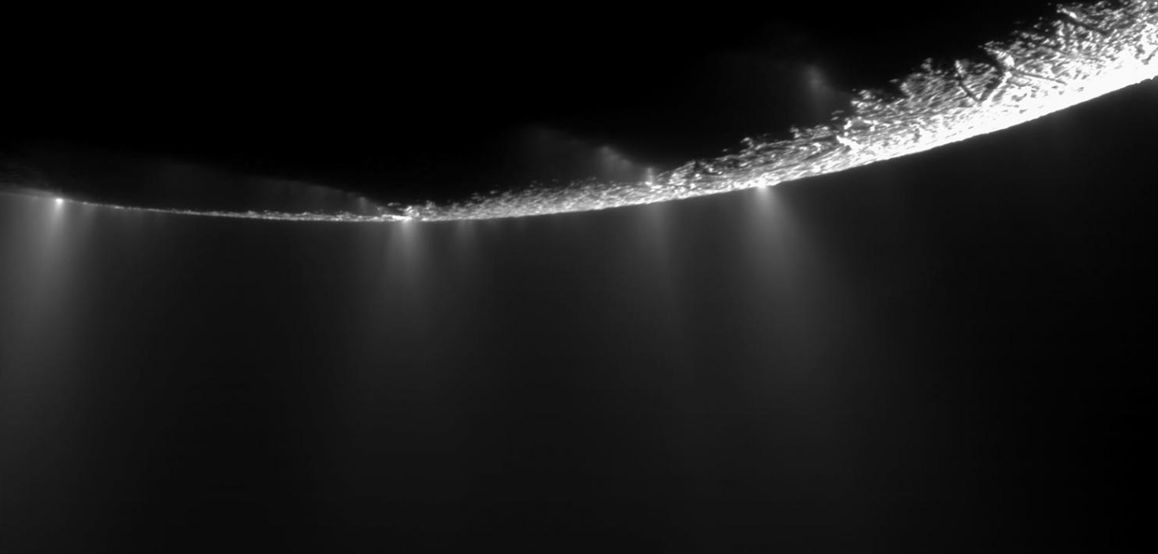
A geyser sprays water ice and vapour from the south polar region of Saturn’s moon Enceladus. Cassini’s first hint of this plume came during the spacecraft’s first close flyby of the icy moon on February 17, 2005. Credit: NASA/JPL / Space Science Institute

Cassini‘s primary mission at Saturn commenced as it approached the planet for orbital insertion. Although the orbiter was capable of functioning – all things being equal – through until around 2017, this primary mission was scheduled to last just 3 years and 261 days, ending in mid-2008. This was sufficient time for the primary goals of the mission to be achieved, but Cassini was always designed to achieve so much more. With this in mind, the programme was granted two funding extensions. The first, called the Equinox Mission, funded the project through until the end of 2010, and gave a particular focus on Titan (15 flybys) Saturn’s ice-covered moon Enceladus, thought two of the locations in the Saturnian system where life might have taken hold.

The second extension, granted funding in 2010 to the tune of around US $60 million a year, is referred to as the Solstice mission (as it would end a few months past Saturn’s summer solstice). It guaranteed that, avoiding any spacecraft failures, the mission would continue through to the point where Cassini’s manoeuvring propellants would be practically depleted. This phase of the mission allowed for a more extended study of Saturn, its rings and moons. It meant Cassini could witness never before seen seasonal changes in the planet’s atmosphere and study. It also meant Cassini could study Saturn’s atmosphere and magnetosphere at exactly the same time as NASA Juno mission studied Jupiter’s atmosphere and magnetosphere, allowing a direct comparison of the two. Finally, the extension would carry the mission through its 5-month “grand finale”, probing the region between Saturn and its complex ring system.

Continue reading “Space Sunday: Cassini – a journey’s end”

Space Sunday: water, spaceplanes and clockwork rovers

TRAPPIST-1 compared in size to our own Sun. Credit: NASA.

Since the February 2017 announcement on the discovery of seven rocky planets orbiting the nearby red dwarf star TRAPPIST-1, multiple studies have been conducted to ascertain whether any of the planets might harbour conditions suitable for life. The nature of their parent star would suggest this to be unlikely. However, an international team utilising the Hubble Space Telescope (HST) to study the TRAPPIST-1 system believe they’ve found evidence that some of the planets have the right conditions to allow liquid water to exist.

Vincent Bourrier, from the Observatoire de l’Université de Genève in Switzerland, and his team used the  Space Telescope Imaging Spectrograph (STIS) to study the amount of ultraviolet radiation each of the TRAPPIST-1 planets receives. If there were too much UV light, no water could survive on the surface because the water molecules would break up and escape through the top of the atmosphere as hydrogen and oxygen gas.

The team found that the inner planets in the system – TRAPPIST-1b and 1c – receive so much UV radiation from their sun, they may have lost more than 20 Earth-oceans worth of water in the course of their history, estimated to be between 5.4 and 9.8 billion years old. Thus, they are almost certainly devoid of water, and their surfaces are likely sterile. However, the findings also suggest the outer planets in the system – including the three within TRAPPIST-1’s habitable zone, may have lost less than three Earth-oceans’ worth of water throughout their history, and could possibly still possess liquid water, making them more amenable for life to rise.

As well as suggesting some of the TRAPPIST-1 planets may have liquid water present, the study has broader implications for the potential of other exoplanets harbouring life. Up to 70% of the stars in the Milky Way are believed to by M-class red dwarfs – and the majority of rocky exoplanets thus far found are orbiting such stars. So this study might indicate that many more of the exoplanets orbiting such stars could support liquid water and, perhaps, conditions suitable for life. However Bourrier and his colleagues emphasise that the study is not conclusive, and further research is needed to determine if any of the TRAPPIST-1 planets are actually watery.

SNC Prepares Dream Chaser for Glide Flight Testing and UN Mission

Sierra Nevada Corporation (SNC) carried out a “captive / carry” test of a Dreamer Chaser Cargo vehicle test article on August 31st, 2017. The flight, with the vehicle slung beneath a helicopter forms the first step towards the Dream Chaser Cargo carrying out glide flights and landings.

During the test, SNC collected data on the vehicle’s performance in flight, including operation of radar altimeters, air data probes and other systems that cannot be fully tested on the ground. The captive /  carry test followed a series of ground tests where the vehicle was towed behind a truck down a runway at speeds of up to 100 kph to ascertain its ground handling on landing.

The Dream Chaser Cargo test article is lifted aloft by helicopter in a captive/carry test. Credit: Sierra Nevada Corporation

SNC developed Dream Chaser to transport astronauts to and from the ISS. However, NASA selected capsule designs by SpaceX and Boeing. After a protest over the decision, filed with the U.S. Government Accountability Office, failed, SNC turned their attention to other potential uses for Dream Chaser.

One of these has been the development of a cargo variant to service the International Space Station (ISS) alongside existing resupply contractors,  Orbital ATK and SpaceX, and in 2016, NASA confirmed Dream Chaser Cargo has been selected to fly resupply missions to the ISS between 2019 and 2024.

On July 19th, 2017, it was announced that SNC had signed a contract with United Launch Alliance for the first two launches of these resupply missions, using the Atlas 5 552 launch vehicle. The first launch is scheduled for 2020 and the second in 2021, although NASA has yet to formally order any Dream Chaser flights.

A Dream Chaser Cargo vehicle will also be used in 2021 to launch the first United Nations mission into space. The United Nations Office of Outer Space Affairs (UNOOSA) said an agreement between them and SNC to fly the dedicated Dream Chaser mission is part of a broader effort by the office to increase access to space to emerging nations.

The mission will be open to all nations, but with a particular emphasis on those that don’t have the capabilities to fly their own experiments in space. UNOOSA are in the process of soliciting payload proposals with a goal of selecting payloads by early 2018 so that the winning countries have time to build them for a 2021 launch.

Unlike the majority of Dream Chaser Cargo missions, which will focused on ISS resupply work, the UNOOSA flight will see the vehicle placed in orbit around the Earth, and SNC have indicated the vehicle will be capable of operating freely in orbit for extended periods of time, should the UN desire a longer mission.

While billed as the UN’s first space mission, the Dream Chaser flight is part of UNOOSA’s Human Space Technology Initiative, launched in 2010 with the goal of providing developing countries the possibility to access space in microgravity conditions. Currently, the initiative includes two other major projects. The first is a cooperative project with the Japan Aerospace Exploration Agency (JAXA), designed to give developing nations the opportunity to launch cubesats from the ISS. Another programme, to be operated in cooperation with China’s space programme, will allow UN-backed missions to be flown aboard China’s space station, when it becomes operational in 2020.

Continue reading “Space Sunday: water, spaceplanes and clockwork rovers”

Space Sunday: Voyager at 40

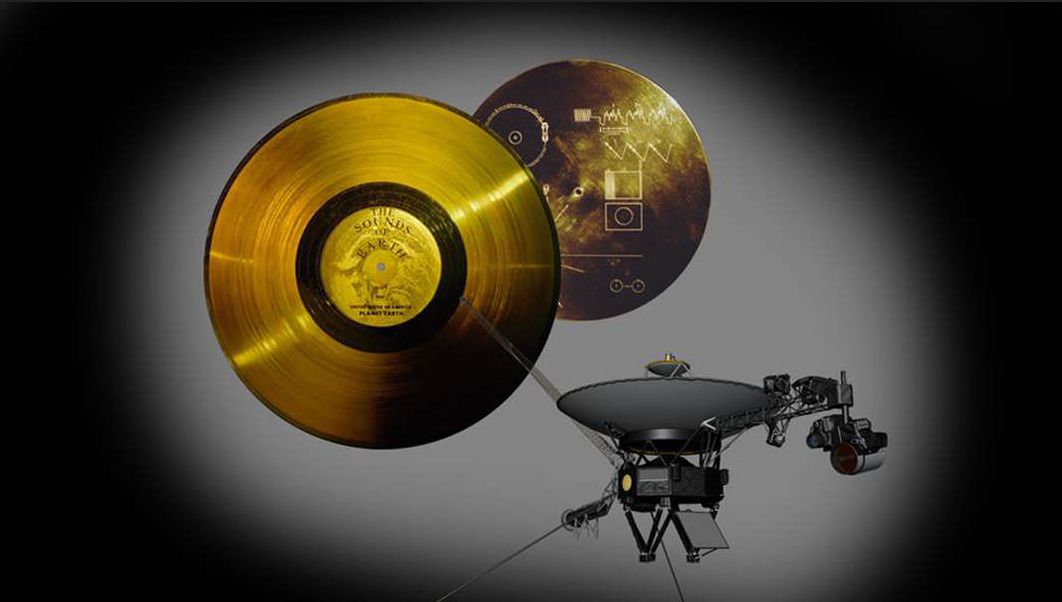
Voyager: 40 years on. Credit: NASA

August 20th 2017 marks the 40th anniversary of the launch of Voyager 2, which with its sister craft Voyager 1 (launched on September 5th, 1977) are humanity’s furthest-flown operational space vehicles, with Voyager 1 being the most distant human made object from Earth, at some 140 AU (AU= astronomical unit, the average distance between the Earth and the Sun; 140 AU equates to about 20.9 billion kilometres / 13 billion miles).

Despite being so far away from Earth, both craft are still sending data back to Earth as they fly through the interstellar medium in the far reaches of the solar system (the Pioneer 10 and Pioneer 11 craft which pre-date the Voyager programme by some 5 years, ceased transmissions to Earth in January 2003 and September 1995 respectively, although Pioneer 10 is the second most distant human made object from Earth after Voyager 1).

The Voyager programme stands as one of the most remarkable missions of early space exploration. Originally, the two vehicles were to be part of NASA’s Mariner programme, and were at first designated Mariner 11 and Mariner 12 respectively. The initial Mariner missions – 1 through 10 – were focused on studying the interplanetary medium and  Mars, Venus and Mercury (Mariner 10 being the first space vehicle to fly by two planets beyond Earth – Venus and Mercury – in 1974). Mariner 11 and Mariner 12 would have been an expansion of the programme, intended to perform flybys of Jupiter and Saturn.

A drawing of the Voyager vehicles. Credit: NASA/JPL (click for full size)

However, in the late 1960s Gary Flandro, an aerospace engineer at the Jet Propulsion Laboratory (JPL) in California noted that in the late 1970s, the outer planets would be entering a period of orbital alignment which occurs once every 175 years and which could be used to throw a series of probes out from Earth, which could then use the gravities of the worlds they encountered to “slingshot” them on to other targets. This led to the idea of a “Grand Tour” mission: sending pairs of probes which could use these gravity assists to fly by Jupiter, Saturn, Uranus, Neptune and Pluto in various combinations.

Funding limitations eventually brought an end to the “Grand Tour” idea, but the planetary alignment was too good an opportunity to miss, and so elements of the idea were folded into the Voyager Programme, which would utilise Mariner 11 and Mariner 12. However, as the mission scope required some significant changes to the vehicles from the basic Mariner design, they were re-designated as Voyager class craft.

(As an aside, the Mariner class is the longest-lived of NASA’s space probe designs; as well as the ten missions of the 1960s and 1970s which carried the design’s name,  the Mariner baseline vehicle – somewhat enlarged – was used for the Viking 1 and Viking 2 orbiter missions to Mars, and formed the basis of the Magellan probe (1989-1994)  to Venus and the Galileo vehicle (1989-2003) which explored Jupiter. And uprated and updated baseline Mariner vehicle, designated “Mariner Mark II”, formed the basis of the Cassini vehicle, now in the terminal phase of its 13-year study of Saturn and its moons.)

Each of the Voyager mission vehicles is powered by  three plutonium-238 MHW-RTG radioisotope thermoelectric generators (RTGs), which provided approximately 470 W at 30 volts DC when the spacecraft was launched. By 2011, both the decay of the plutonium and associated degradation of the thermocouples that convert heat into electricity has reduced this power output by some 57%, and is continuing at a rate of about 4 watts per year.

To compensate for the loss, various instruments on each of the vehicles have had to be turned off over the years. Voyager 2’s scan platform and the six instruments it supports, including the vehicle’s two camera systems, was powered-down in 1998. While the platform on Voyager 1 remains operational, all but one of the instruments it supports – the ultraviolet spectrometer (UVS) – have also been powered down. In addition, gyro operations ended in 2016 for Voyager 2 and will end in 2017 for Voyager 1. These allow(ed) the craft to rotate through 360 degrees six times per year to measure their own magnetic field, which could then be subtracted from the magnetometer science data to gain  accurate data on the magnetic fields of the space each vehicle is passing through.

However, despite the loss of capabilities, both Voyager 1 and Voyager 2 retain enough power to operate the instruments required for the current phase of their mission – measuring the interstellar medium and reporting findings back to Earth. This phase of the mission, officially called the Voyager Interstellar Mission, essentially commenced in 1989 as Voyager 2 completed its flyby of Neptune, when the missions as a whole was already into their 12th year.

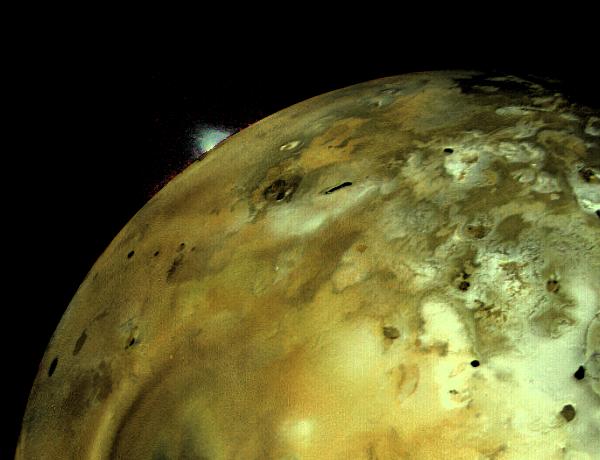
A plume rises 160 km (100 mi) above Loki Patera, the largest volcanic depression on Io, captured in March 1979 by Voyager 1. Credit: NASA/JPL

Voyager 2 was launched on August 20th, 1977. Of the two vehicles, it was tasked with the longer of the planned interplanetary missions, with the aim of flying by Jupiter, Saturn, Uranus and Neptune. However, the latter two were seen as “optional”, and dependent upon the success of Voyager 1.

This was because scientists wanted the opportunity to look at Saturn’s moon Titan. But doing so would mean the Voyager craft doing so would have to fly a trajectory which would leave it unable to use Saturn’s gravity to swing it on towards an encounter with Uranus. Instead, it would head directly towards interstellar space.

So it was decided that Voyager 1, which although launched after Voyager 2 would be able to travel faster, would attempt the Titan flyby. If it failed for any reason, Voyager 2 could be re-tasked to perform the fly-past, although that would also mean no encounters with Uranus or Neptune. In the end, Voyager 1 was successful, and Voyager 2 was free to complete its surveys of all four gas giants.

Along the way, both missions revolutionised our understanding of the gas giant planets and revealed much that hadn’t been expected, such as discovering the first active volcanoes beyond Earth, with nine eruptions imaged on Io as the vehicles swept past Jupiter. The Voyager missions were also the first to find evidence that Jupiter’s moon Europa might harbour a subsurface liquid water ocean and to return the first images of Jupiter’s tenuous and almost invisible ring system. Voyager 1 was responsible for the first detailed examination of Titan’s dense, nitrogen-rich atmosphere, and Voyager 2 for the discovery of giant ice geysers erupting on Neptune’s largest moon, Triton. In addition, both of the Voyager vehicles added to our catalogues of moons in orbit around Jupiter and Saturn, and probed the mysteries of both planet’s atmospheres, whilst Voyager 2 presented us with our first images of mysterious Uranus and Neptune – and thus far remains the only vehicle from Earth to have visited these two worlds.

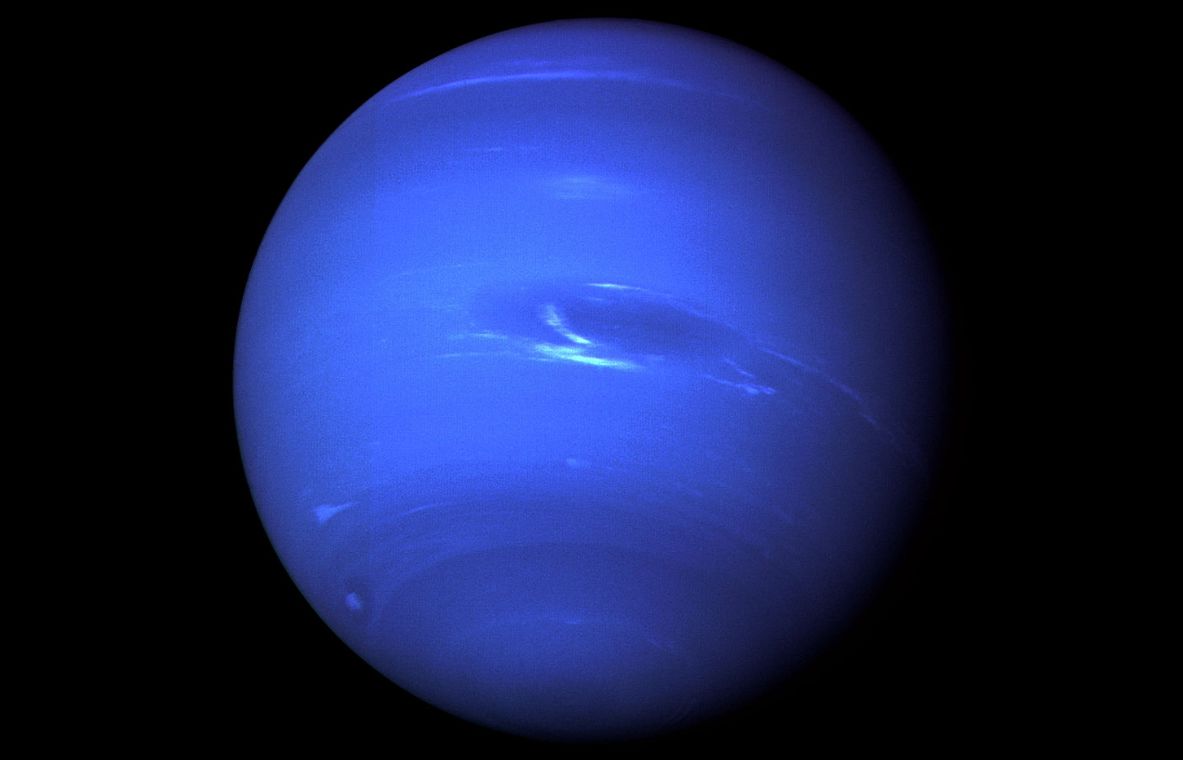
This is the last full planet image captured of Neptune. Taken by Voyager 2 on August 21st, 1989, from a distance of 7 million km (4.4. million mi). A true colour image white balanced to reveal the planet under typical Earth lighting conditions, it shows Neptune’s “Great Dark Spot” and surrounding streaks of lighter coloured clouds, all of which persisted through the period of Voyager 2’s flyby. More recent Hubble Space Telescope images suggest the “Great Dark Spot”, initially thought to be a possible cloud / storm formation, similar to Jupiter’s Great Red Spot, has vanished, leading to speculation that it may have actually been a “hole” in a  layer of Neptune’s layered clouds. Credit: NASA/JPL

The flyby of Neptune also sealed Voyager 2’s future. Scientists were keen to use the flyby of the planet to take a look at Triton, Neptune’s largest moon. However, because Triton’s orbit around Neptune is tilted significantly with respect to the plane of the ecliptic, Voyager 2’s course to Neptune  had to be adjusted by way of a gravitational assist from Uranus and a number of mid-course corrections both before and after that encounter, so that on Reaching Neptune, it would pass over the north pole, allowing it to bent “bent” down onto an intercept with Triton while the Moon was at  apoapsis – the point furthest from Neptune in its orbit – and well below the plane of the ecliptic. As a result, Voyager 2 passed over Triton’s north pole 24 hours after its closest approach to Neptune, its course now pointing it towards “southern” edge of the solar system.

Continue reading “Space Sunday: Voyager at 40”