NASA’s official Apollo 50th anniversary logo. Credit: NASA
This is the concluding part of a special Space Sunday series, celebrating the 50th anniversary of Apollo 11 landing on the Moon, and follows on directly from Part 2: “The Eagle Has Landed!”. To follow the full series, please click over to Part 1: Lift-off! We Have lift-off!”
Part 3: “Magnificent Desolation” And The Voyage Home
I had asked [Neil] before the mission launch several times what he was going to say on the occasion of this historic moment, setting foot on the lunar surface, and he always replied, “I’m a test pilot, I’ll probably just say how dusty it is or something like that. Don’t worry.” But he came back with his now famous [line]. The media immediately wanted to know if it was one small step for a man, or just man. There was a little bit of static, so it wasn’t entirely clear.
– Astronaut Bruce McCandless, Capsule Communicator (CapCom),
Mission Control Green Team
Whether or not Armstrong had said “a man” in his statement was to become a matter of debate in the decades that followed Apollo 11, almost overshadowing that first step itself. With the indefinite article included, his comment makes sense: he is clearly referring to himself (“one small step for a man”). Without it, “man” becomes more reflective of humanity as a whole, making his comment the equivalent of “That’s one small step for humanity. One giant leap for mankind”.
Such was the level of debate with one analysis of recording suggesting he said “a man”, another suggesting he didn’t, that not long before his death, Armstrong noted a little ruefully – and quite correctly:
I would hope that history would grant me leeway for dropping the syllable and understand that it was certainly intended, even if it wasn’t said – although it might actually have been.
– Neil Armstrong
A ghostly image from the broadcast TV footage – captured by the news agencies by having to re-film live footage received from the Moon and played on a special monitor. Credit: CBS News
But on the Moon, and unaware of the controversy that was even then brewing around his words, Armstrong collected a contingency sample of rock and surface material in case an unexpected issue required the EVA to be curtailed. Then he took the remote-control TV camera mounted on the Lunar Module to take a panoramic shot around the Eagle before setting it on a tripod a short distance from the LM to allow Mission Control to use it to record the EVA.
That camera is the reason why the Apollo 11 video footage looks ghostly. Its scan rate was incompatible with those used by US TV networks, so the live transmission had to be shown on special monitors with TV cameras set-up in front of them which then re-broadcast the images – with a significant loss of picture quality in the process. (It’s also worth notingthat while NASA recorded the footage onto magnetic tape, it was eventually lost through the agency’s policy of tape re-use.)
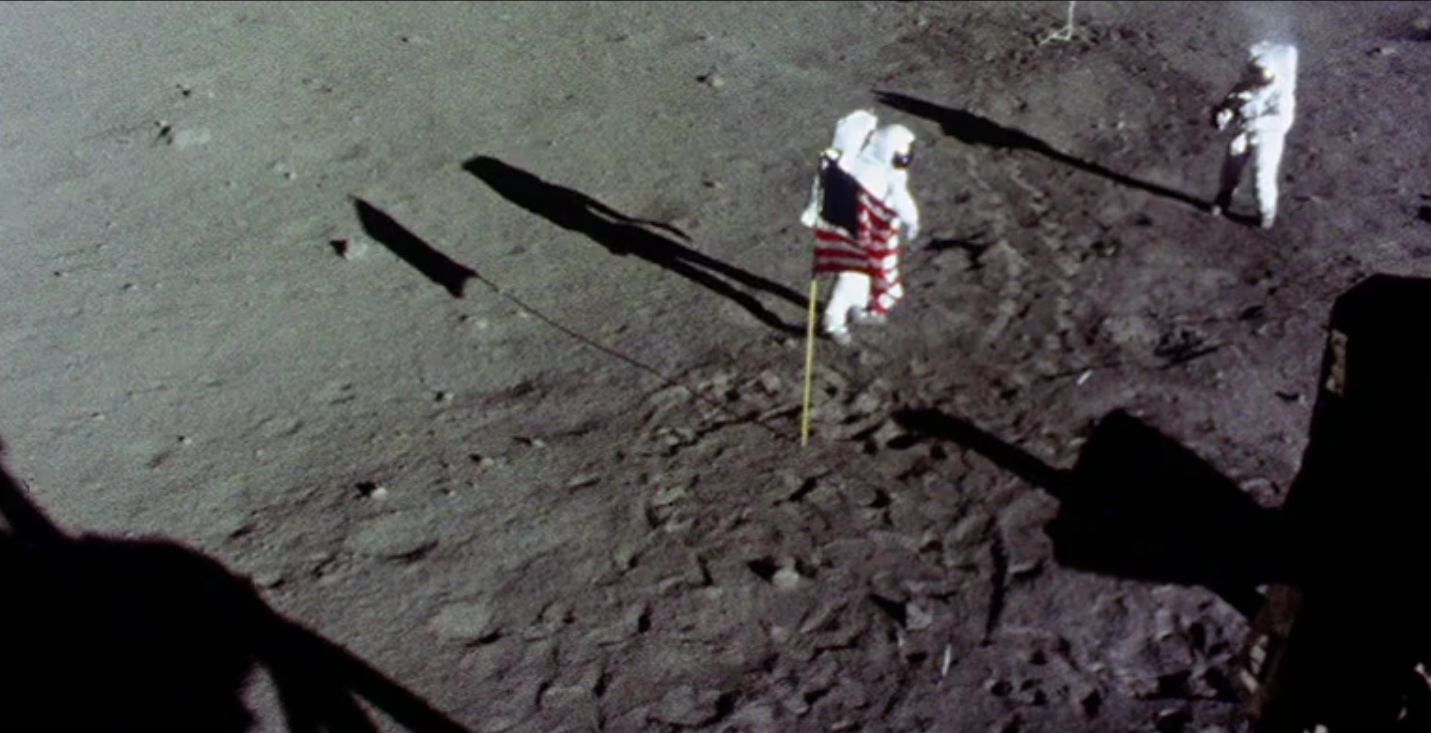
Shot from an automated camera aboard the Lunar Module, this shot shows Aldrin standing close to the US flag as Armstrong back away to take a photo of Aldrin saluting the flag. July 20th/21st, 1969. Credit: NASA
Aldrin set foot on the Moon 19 minutes after Armstrong with the words, “Beautiful view. Magnificent desolation.”
There was little time to appreciate it, however. The two men were on a tight schedule: because there was no empirical data on how well the portable life support system (PLSS) in the astronaut’s backpacks would perform on the Moon, it had been decided to limit this first (and only, for Apollo 11, which would spend less than a day on the Moon) EVA to just over 2 hours. Before that time expired, both men had to set-up the US flag, deploy the instruments of the EASEP, the Early Apollo Scientific Experiments Package, survey their location and collect and many rock and soil samples as they could manage.
The shot of Aldrin saluting the flag as taken by Armstrong, July 20th/21st, 1969. Credit: NASA
The flag (purchased from a Sears store) proved a little problematic. Its telescopic pole refused to go deep into the ground, leaving Aldrin fearing it would unceremoniously topple over while on camera. Nevertheless, he dutifully saluted it as a still-commissioned US military officer before taking up position in front of the TV camera to demonstrate various means of locomotion in the low gravity for the benefit of future crews.
While he was doing that we were all wondering what Neil was doing. Well, Neil was collecting this very fine and diverse group of rocks and soil. Not only did he get a very wide distribution, but he also thought the box looked a little empty, so at the last minute he filled it with just the dirt, so to speak, what we call the lunar regolith. That sample turned out to be the best, most comprehensive sample of lunar regolith that was ever taken on any of the Apollo missions.
– Harrison Schmitt, the only geologist-astronaut in the Apollo programme,
who served as both advisor to crews and as the Lunar Module pilot for Apollo 17
NASA’s official Apollo 50th anniversary logo. Credit: NASA
This is part 2 of a special Space Sunday series, celebrating the 50th anniversary of Apollo 11 landing on the Moon, and follows on directly from Part 1: “Lift-off! We Have Lift-off!” It was published on Saturday, July 20th, 2019, as a Space Sunday special to mark the actual date of that historic landing.
Part 2: “The Eagle Has landed”
Once the combined Command and Service Module (CSM) and Apollo Lunar Module (CM) were free of the Saturn V’s S-IVB stage, they were in constant sunlight, so to help better regulate their internal and external temperatures, the reaction control system on the CSM was used to set both vehicles spinning very gently along their longitudinal axis in what was called the “Apollo barbecue roll”.
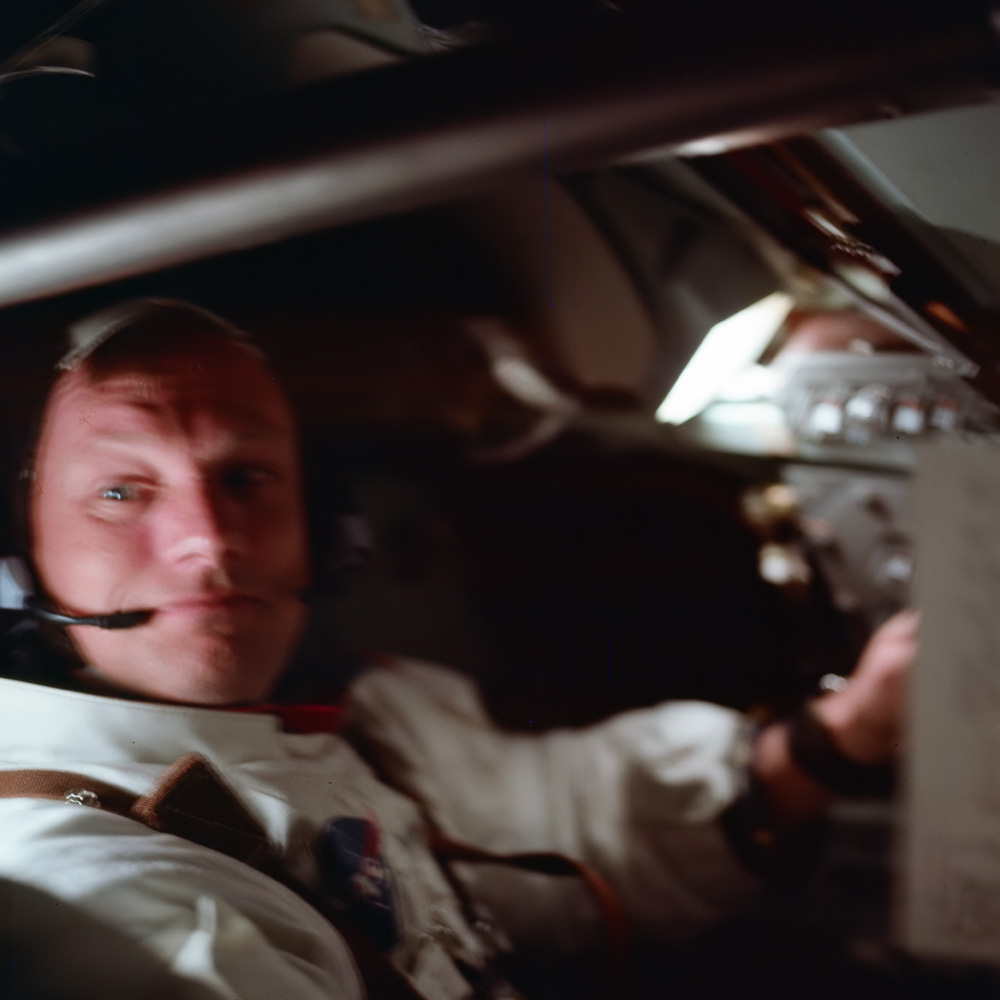
Michael Collins aboard the Apollo Command Module Columbia. Credit: NASA
During this “cruise phase” of the flight, the three men aboard Apollo 11 – Armstrong, Collins and Aldrin – had to perform a range of activities from keeping an eye on their spacecraft through to making broadcasts back to Earth. It was here that their curious relationship came a little to the fore.
While all three men got along very well, they were observed not to bond in the manner of other crews; all three were somewhat quiet men, with Collins and Aldrin particularly coming to refer to their relationships with one to the others as that of “amiable strangers”.
Which is not to say the three men didn’t get along; almost all of the on-board conversations were recorded by NASA, even if they weren’t broadcast, and these “off-air” conversations reveal the three men shared jokes – such as Aldrin and Collins gently teasing Armstrong about his “rookie” status in having clocked the fewest number of hours in space. However, when it came to talking for the benefit of the television audience, Mission Control sometimes had to coax words out of the crew.
The first time we saw the Moon up close, it was a magnificent spectacle. It was huge. The Sun was coming around it, cascading and making a golden halo and filled out entire window. [But] as impressive as the view was of this alien Moon seen up close was, it was nothing compared to the sight of the tiny Earth. The Earth was the main show. The Earth was it.
Apollo 11 reached the Moon on July 19th, 1969, after a single mid-course corrections using the single motor of the Service Module (out of 4 planned for the flight).
Edwin Aldrin in the Apollo 11 Lunar Module Eagle, photographed by Neil Armstrong. Credit: NASA
Now Collins again took the controls to gently pivot the vehicles around in their own length, so that single large motor was pointing forward along their line of flight. Then, at 17:21:50 UTC, as they passed around the Moon’s far side, the engine was fired in the first of two orbital insertion burns.
This first engine burn slowed the vehicles so they they were snagged by the Moon’s gravity and placed in an elliptical orbit. A second burn of the engine followed 4 hours and 22 minutes later, circularising the vehicle’s orbit in readiness for Armstrong and Aldrin to make their historic descent.
In all thirty orbits of the Moon were performed as the Lunar Module was prepared for its descent and landing. These orbits frequently passed over the Mare Tranquillitatis, a large basalt plain on the Moon selected as the location for the first manned landing by the United States as it appeared from orbital imaging as being relatively smooth, and had already seen a successful landing by the automated Surveyor 5 mission, which arrived on the Moon on September 11th, 1967.
Shortly after Apollo 11 dropped into orbit around the moon, Frank Borman got a message from the Soviet Union that said, “Congratulations on reaching lunar orbit. We have Luna 15 also in orbit around the moon and its orbital parameters are such and such. If it presents any problem, please advise and we will move it.” We didn’t need Luna 16 moved, but I thought it was a noble gesture in those days of the Cold War.
– Bruce McCandless, Capsule Communicator (CapCom),
Apollo 11 Mission Control Green Team
“The Eagle has wings” – Neil Armstrong’s announcement that the Apollo 11 Lunar Module was operating independently of the Command and Service Module, July 20th, 1969
At 12:52:00 UTC on July 20th, Aldrin and Armstrong entered Eagle, and began the final preparations for lunar descent, Five hours later, all was set and they undocked from the Command Module Columbia. With Michael Collins in the Command Module, Armstrong gently eased Eagle away from the CSM, then used its reaction control system to perform a slow pirouette. This allowed Collins to carry out a visual inspection of the LM, confirm its legs were deployed and that it was generally looked OK to make its decent.
For the first part of the decent, Eagle was effectively “face down” giving Armstrong and Aldrin a view of the Moon. Then the descent engine fired and the vehicle slowly moved to an upright position, and Armstrong voiced a slight concern.
We’re about a minute, maybe 2 minutes, into powered descent, face-down, and Neil says to me, and the Earth, “I think we’re gonna be a little long.” I said to myself, how in the world can he really, at this point, tell that we’re gonna be a little long? But sure enough, we were. I’ve learned that whenever Neil says anything, you’d better pay attention because there’s good meaning to it.
– Buzz Aldrin commenting on the Eagle’s descent to its landing
NASA’s official Apollo 50th anniversary logo. Credit: NASA
This week sees the 50th anniversary of the Apollo 11 lunar landing. To mark the event, this Space Sunday article and the next will look at that mission, and the three men who flew it.
Part 1: “Lift-of We Have Lift-off!”
On Wednesday, July 16th, 1969, at 13:31:51 UTC (9:31:51 EDT) five Rocketdyne F-1 at the base of Saturn V SA-506 came to life. Starting with the centre motor, then the opposing outboard pairs, the entire ignition sequence took 600 milliseconds. Held on the pad by four massive clamps, called hold-down arms, the five engines gradually built up thrust to 35,100 kN (7,891,000 lbf).
At precisely 13:32:00 UTC) (9:32:00 EDT) the huge hold-down-arms rocked back in a “soft release”, allowing the rocket, weighing almost 3,274 tons, to start its ascent, its acceleration slowed for the first half-second by a series of 8 pins connecting it to the pad to “reduce transient stresses resulting from abrupt disengagement of a vehicle from its launch stand”. When these pins dropped free from the base of the rocket, Apollo 11 was on its in a historic mission that would seen humans land on the Moon for the first time.
Saturn V SA-506, the Apollo 11 launch vehicle, is rolled out to Pad A at Launch Complex 39 at Kennedy Space Centre, May 20th, 1969
The two men destined to be the first to set foot on Earth’s natural satellite were Neil Alden Armstrong, just shy of his 39th birthday, and Edwin Eugene “Buzz” Aldrin Jr., who had turned 39 in January 1969, sat atop of the massive Saturn V rocket along with Command Module Pilot, Michael Collins, the youngest of the three (if only by a couple of months). Together, they formed only the second Apollo flight crew where all three men had previously flown in space (the first having been Apollo 10, the “dress rehearsal” mission for the Moon landing).
Armstrong, Aldrin and Collins were also perhaps the most technically competent trio on NASA’s astronaut roster at the time. All had served in the military – Armstrong in the US Navy, Aldrin and Collins in the US Air Force. Both Armstrong and Collins had also built up impressive résumés as test pilots, Armstrong as a civilian and Collins in the US Air Force.
In particular, Armstrong flew with the National Advisory Council for Aeronautics (NACA), NASA’s forebear, prior to being selected for the USAF/ NASA high-altitude X-15 research programme, (he flew the X-15 seven times between late 1960 and mid-1962) whilst simultaneously engaged by the USAF in their X-20 Dyna-Soar space plane project. Collins, meanwhile, took part in high-altitude flights, taking F-104 Starfighter jets to 27.7 km (90,000 ft) in order to experience the “weightless” environment of free-fall at the top of their parabolic flight arcs, helping him to achieve 3,000 hours in the cockpit.
An unusual portrait in black and white of Michael Collins, Edwin “Buzz” Aldrin and Neil Armstrong. Credit: NASA (this image was later colourised on numerous occasions by various artists)
As well as being aviators, Armstrong and Aldrin were also academics. Armstrong held a BSc in aeronautical engineering and an MSc in aerospace engineering, and Aldrin has a doctorate in astronautics. Aldrin particularly specialised in on-orbit rendezvous, which allowed him to work on Project Gemini as an engineer (and also earned him the nickname “Dr. Rendezvous” , not always meant kindly, by other astronauts).
Despite their qualifications, both Armstrong and Aldrin almost didn’t get selected for NASA’s astronaut programme: neither had the requisite military test pilot qualifications that were initially required. However, in 1962, NASA dropped the “military” element from the test pilot requirement, enabling Armstrong to apply for the Group 2 intake – although he almost missed the cut. his application arrived after the closing date, but fortunately Dick Day, a simulations engineer at NASA who have previously worked with Armstrong saw the application and made sure it was included.
Aldrin’s break came in 1963, when NASA further revised the requirements to test pilot OR 1,000 hours flying jets. This allowed he to re-apply (his first application having been turned-down due to his lack of test pilot experience), and he was invited to join the Group 3 intake alongside Michael Collins.
At 2 minutes 41 seconds into its flight, the S-IC first stage of Apollo 11 separates, four small separation motors pushing the upper stages way from it, prior to the S-II second stage main engines to ignite
A Saturn V launch is perhaps one of the most stunning sights to witness – and Apollo 11 was witnessed by around 1 million people in and around the Kennedy Space Centre. However, for the first part of their flight, the three men were pretty much passengers as the Saturn V rose into the sky.
For all their power, the five F-1 engines took 12 seconds to overcome the 100.6 m tall rocket’s mass and inertia and push it clear of the 120m tall Launch Umbilical Tower (LUT), angling it very slightly away from the tower in the process so to avoid the risk of any wind-driven contact between the two.
Immediately after clearing the tower, the rocket commenced its “roll”, a necessary manoeuvre in which the vehicle rolls around its vertical axis, allowing it to point itself along the line of flight it needs to achieve the required orbit. After that, things started to move quickly.
A minute after launch, the Saturn V was around 6.5 km (3.5 nautical miles) altitude and passing through the sound barrier. Twenty seconds later, it entered “Max Q”, the period of maximum dynamic pressure, placed on this frame as a result of it literally punching its way through the atmosphere.
At this point, the F-1 engines throttled back a little to prevent the vehicle shaking itself apart, but once through “Max Q” – a period of only a handful of seconds, they returned to full thrust, pushing the vehicle up to 62 km (42 mi) above the Earth, and taking only 2 minutes 41 second from launch to do so. At this point, and travelling at 9,960 km/h (6,164 mph), the huge first stage separated, the upper stages of the Saturn 5 pushed clear by a set of four separation motors.
From here, the four motors of the second stage took over. While the massive first stage coasted upwards behind it and then fell back to crash into the Atlantic ocean, the Second stage ran for 6 minutes, accelerating the rocket to 25,000 km/h (15,647 mph) and lifting it to an altitude of 175 km (109 mi).
With its fuel spent, the second stage separated, also to fall back to the Atlantic, while the single, re-usable engines of the all-important S-IVB stage took over. This stage initially ran for about 2.5 minutes, during which time it pushed Apollo 11 to a velocity of 27,900 km/h (17,432 mph), allowing it to assuming a near-circular orbit around the Earth averaging 184 km 98.9 na mi) before shutting down for the first time.
It was at this point that the three crew took a more pro-active role in the flight. For the next couple of hours, as they completed 1.5 orbits of the Earth, and in tandem with mission control, they confirmed their vehicles were ready to be committed for the flight to the Moon.
A diagram of the Saturn V Apollo launch vehicle.Credit: NASA
Interestingly, while mission commander, Armstrong had actually clocked less time in space than either Collins or Aldrin. However, he had the greatest experience in handling in-flight emergencies, having dealt with the first in-flight failure of a critical system during a US space mission.
Neil Armstrong photographed by Buzz Aldrin as the crew prepare for TLI – trans-lunar injection. Credit: NASA / E.E. Aldrin
This occurred during his flight flight into space on the Gemini 8 mission, alongside David R. Scott. This mission was intended to be the first test of an orbital docking between two vehicles – Gemini 8 and an automated Agena target vehicle. In all, Armstrong and Scott were expected to complete four such docking as a part of the mission objectives.
However, shortly after docking, the Gemini’s Orbit Attitude and Manoeuvring System (OAMS) has suffered a serious failure, and Armstrong ordered Scott to release the docking mechanism before before vehicle broke up. Once free of the Agena (which was later stabilised by ground control allowing it to be used by Gemini 10 with Michael Collins), Armstrong took the took the unorthodox step of shutting down the OAMS and using the Re-entry Control System (RCS) to regain control. While this worked, undoubtedly saving his and Scott’s lives, under mission regulations, they no option but to immediately perform and emergency return to Earth, curtailing the mission.
Back aboard Apollo 11, their checks complete, the crew received the all clear for the critical trans-lunar injection (TLI) burn. This started mid-way through the second orbit of Earth, as the S-IVB motor was restarted and fired for 5 minutes and 47 seconds, accelerating the vehicle to around 40,085 km/h (25,053 mph), and pushing it away from Earth and into an energy-efficient trajectory towards the Moon.
As Michael Collins carried out the transposition, docking and extraction manoeuvre, either Aldrin or Armstrong took this image of the Lunar Module (LM) sitting in the top of the Saturn V S-IVB stage, awaiting the Command and Service Module (CSM) to dock with it and gently pull it free of the upper stage. Credit: NASA
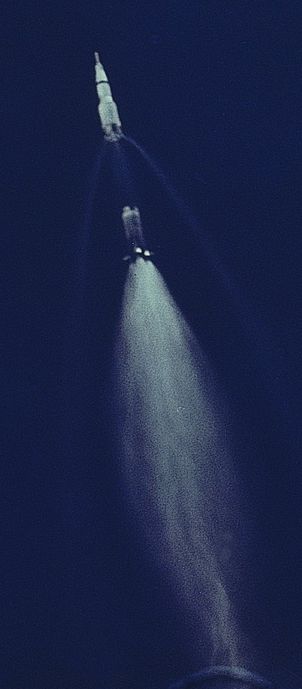
The Orion test article lifts-off from Space Launch Complex 46 at Cape Canaveral Air Force Station at the start of Ascent Abort-2, July 2nd 2019. Credit: NASA
NASA’s Orion Multi-Purpose Crew Vehicle passed a significant test on its way to its first crewed launch (due in 2022) on July 2nd, 2019, as it completed a flight test of the capsule’s launch abort system (LAS).
The LAS is a system designed to pull a crewed capsule clear of a malfunctioning rocket during an ascent to orbit, hopefully saving their lives in the process. As such, it is a significant system that must be tested and cleared for use before crewed flights can commence with a new launch vehicle.
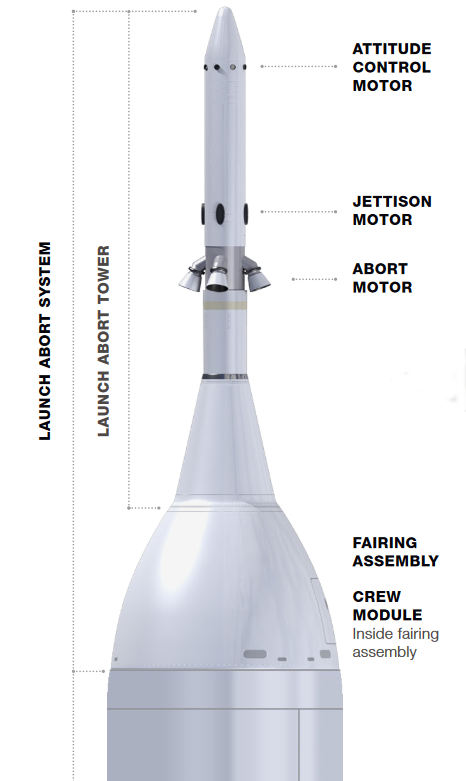
For the Space Launch System (SLS), NASA is following its traditional approach, with the LAS designed to “pull” a crew capsule clear of launch vehicle. It does this by placing a special fairing over the capsule that has a tower extending from its top, fitted with three motors. This has always been the traditional approach to US LAS systems – by contrast, Russian LAS systems generally sit below the capsule and are design to “push” it away from a malfunctioning rocket.
The Orion / SLS launch abort system (LAS). Credit: NASA
The July 2nd test – called the Ascent Abort-2 (AA-2) mission – was a critical test flight, designed to test the LAS at the point in an ascent to orbit when the Orion / SLS combination will be subjected to the highest aerodynamic stresses – the so-called period of “Max-Q” – that occurs during a rapid ascent into space.
To achieve this, NASA mounted an Orion structural test article – basically an Orion capsule sans its flight systems – contained within a LAS fairing onto the motor stage of an MX Peacekeeper ICBM, and launched it into the Florida skies in a early morning ascent designed to last some 55 seconds.
In that time, the rocket was expected to reach an altitude of 9.5 kilometres (31,000 ft) and a speed of Mach 1.3, at which point the abort sequence would trigger.
As it turned out, the MX rocket motor ran “hot”, accelerating a little faster than anticipated, so reaching its assigned separation altitude 5 seconds early. Nevertheless, the abort sequence initiated correctly, and the powerful abort motors on the LAS fired, generating 181,400 kg of thrust, hauling the Orion free of the ascent motor unit.
Once a clear separation from the still ascending motor stage had been achieved, the attitude control motors at the very top of the LAS fired, flipping it and Orion over. The middle jettison motor then fired, separating the LAS from the Orion.
During an actual abort sequence, the Orion would then re-orient itself so it would be falling heat shield first, allowing its parachutes to be deployed in preparation for a splashdown. However, for the AA-2 flight, the test article did not carry a parachute system. Instead, and like the LAS, the capsule was allowed to fall back into the Atlantic, hitting it at an estimated 480 km/h (300 mph) and breaking up. Just before it did so, however, it ejected 12 bright orange data recorders not unlike those so-called “black boxes” used by aircraft. These contained critical data recorded during the 3 minute 11 second flight, and which will be assessed post-mission to confirm everything did go an planned.
That was a spectacular test we all witnessed this morning. It was really special for the programme; a really big step forward to us. It was a really great day all around – weather and the vehicle. One of the most important parts of the test was to see how the attitude control motor performed. The internal motor pressure was rock solid, straight line and it had excellent control characteristics. Everything we’ve seen so far looks great.
– Mark Kirasich, NASA’s Orion Programme Manager
The Orion test article climbs into the early morning sky over Cape Canaveral Air Force Station at the start of Ascent Abort-2, July 2nd 2019. Credit: NASA
The US has never has to use the LAS on an actual mission. However, there is no guarantee this will always be the case, and circumstances where a LAS must be used are not unkown – as the Soyuz M-10 mission in October 2018 demonstrated (see Space Sunday: of Soyuz aborts and telescopes). Therefore, passing this test was critical if Orion and SLS are to achieve the flight goals required for NASA’s programme – Project Artemis – to return humans to the surface of the Moon.
Half-Planet, Half-Star
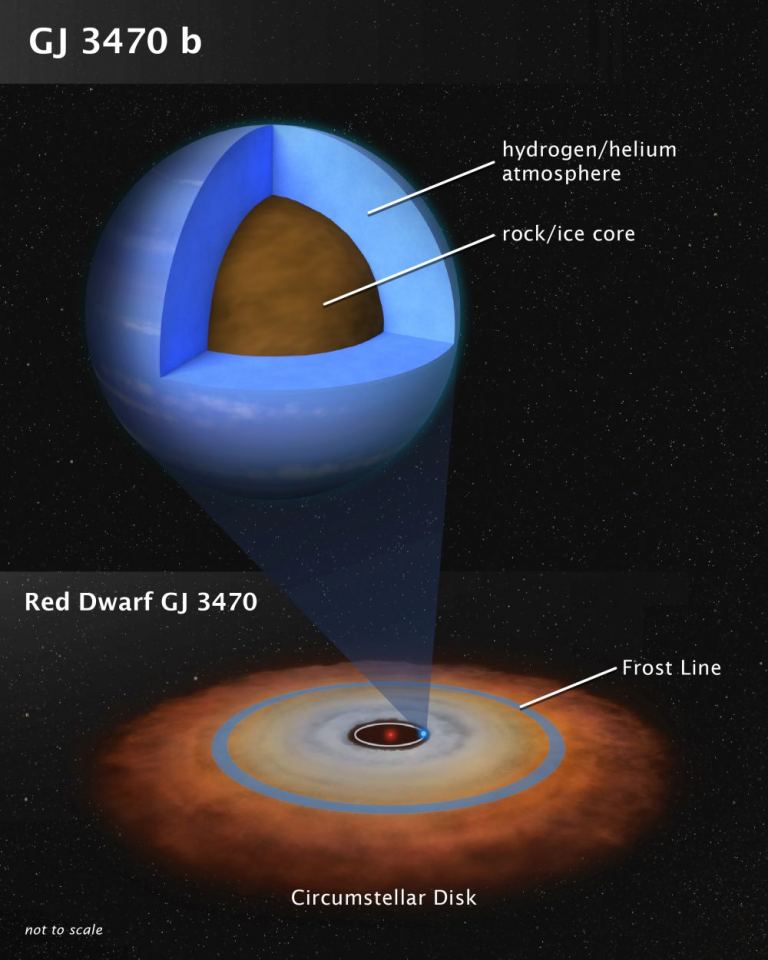
Discovered in 2012, GJ3470b is a “mini-Neptune” planet orbiting a red dwarf star called Gliese 3470, 100 light years from our Sun. Occupying an orbit some 6 million km (3.7 million mi – roughly one-tenth of the distance between the Sun and Mercury) from its parent, the planet has a mass of around 12.6 Earths.
None of this is particularly unusual; as I’ve noted in past Space Sunday articles, M-type stars are the most common type of star in the galaxy, and mini-Neptune type planets account for around 80% of the exoplanets discovered to date. Nevertheless, recent studies have revealed GJ3470b to be a very unique world.
GJ3470b, its atmospheric composition, and its relative location to its parent star. Credit: NASA, ESA, and L. Hustak (STScI)
The presence of an atmosphere around the planet was detected fairly soon after its discovery and prompted astronomers to take a prolonged look at it. To do this, they combined the Hubble and Spitzer space telescopes to examine the planet’s atmosphere for a total of 20 transits in front of its parent star.
These observations, using the light of the star passing through the planet’s atmosphere during the transits, allowed the astronomers to gather data on the composition of GJ3470b’s atmosphere. What was discovered came as a huge surprise.
It has been expected that the observations would reveal an atmosphere somewhat similar to Neptune’s, but such was the depth to which they could measure, it quickly became clear that GJ3470b has an almost pristine atmosphere of hydrogen and helium surrounding a large solid core.
The presence of hydrogen and helium may not sound too unusual – after all, the four gas giants of our solar system have atmospheres largely made up of those two gases. However, they also have amounts of other, heavier elements – methane, nitrogen, oxygen, ammonia, acetylene, ethane, propane, phosphine, etc., – none of which showed up in any of the spectral analyses performed by Hubble and Spitzer. This makes GJ3470b’s atmosphere closer in nature to that of the Sun or a star than it does to a planet, leading to it being dubbed “half-planet / half-star” in some quarters, and making it the most unique exoplanet yet discovered.
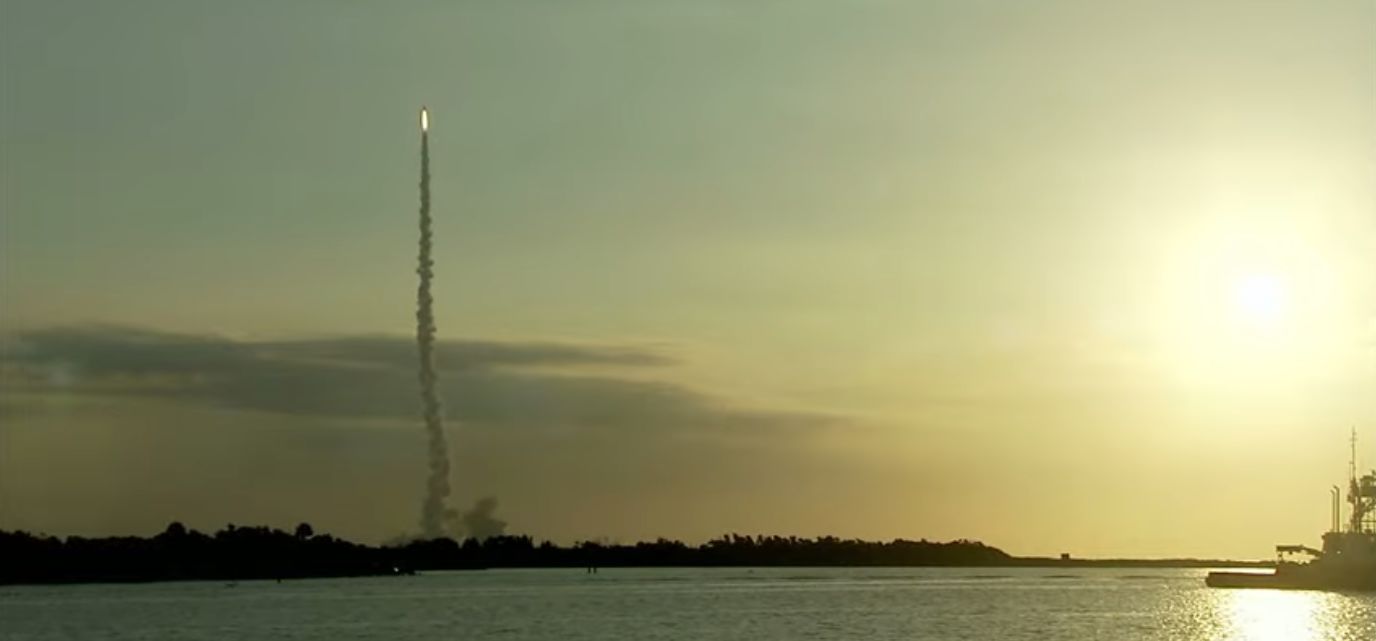
A stunning timelapse view from the beaches of Florida as the Falcon Heavy STP-2 rocket arcs across the sky. Credit: Alex Brock
On Tuesday, June 25th, SpaceX launched their third Falcon Heavy Booster. Called STP-2, the primary aim of the mission was to help qualify the Falcon Heavy for US Department of Defence launches – but that didn’t stop it being the most ambitious mission for any SpaceX launch vehicle to date.
Carrying a total of 24 separate satellites into orbit, the vehicle had to deliver its payload to three distinct orbits around Earth, which in turn required the core stage of the rocket to fly fast enough to make its planned recovery at sea potentially problematic, while the upper stage had to make four individual engine burns – the most ever by a SpaceX launch vehicle.
Lift-off came at 02:30 ET, the rocket powering away from Kennedy Space Centre’s Pad 39-A. As a night-time launch, the flight provided a stunning view of what is called the “Falcon nebula”. This where, after the two Falcon 9 booster stages have separated from the core of the rocket, they flip themselves over while still increasing their altitude, and re-fire their engines to slow their forward momentum in order to start their descent back for a landing at Cape Canaveral Air Force Station. Together with the core booster’s motors still operating at full thrust, their exhausts can create a majestic pattern in the sky. In this case, given all of the three Falcon 9 boosters had been pushed to the limit, the vehicle was much higher in Earth’s rarefied atmosphere and this resulted in the boosters creating a remarkable pattern of colours against the night sky.
The “Falcon nebula”: the colourful plumes from the two Falcon 9 booster stages as they fire their motors in a “burn back” manoeuvre, with the core stage going at full throttle towards the bottom right. Credit: Alex Brock
Both of the Falcon 9 booster stages successfully completed their burn-back manoeuvres and made perfect landings at Cape Canaveral Air Force Station, just south of NASA’s Kennedy Space Centre. It had been hoped that the core stage would make it three-for-three by landing on one of the company’s two Autonomous Drone Landing Ships, parked some 1,200 km off the Florida coast. Unfortunately, such was the speed of the stage, it overshot the landing ship and crashed into the sea, smashing itself to pieces.
However, the loss of the core stage wasn’t the end of the good news for SpaceX. The upper stage continued on into orbit, successfully deploying its entire payload safely. And while it is said that re-naming a vessel can bring bad luck, that didn’t prove the case here, as the company’s high-speed chase vessel Go Ms Tree, which had previously been called Mr. Steven, finally and successfully caught one of the flight’s two payload fairings as they made a return to Earth.
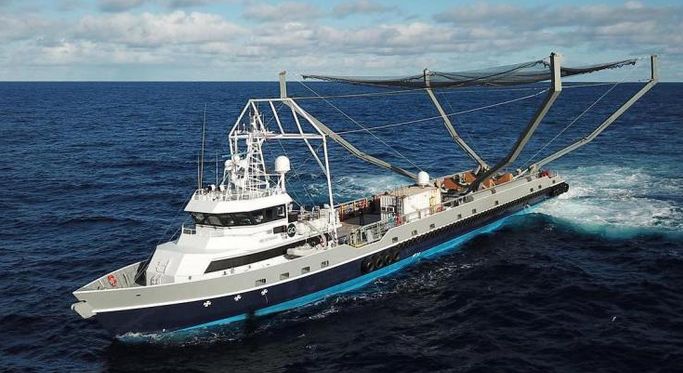
Sea trials: the 62 m (205 ft) long Go Ms. Tree (formerly Mr. Steven), leased by SpaceX and converted to “catch” payload fairings in the huge net suspended over the stern deck, made its first successful catch with the STP-2 mission. Credit: Teslarati / SpaceX / Sea Tran
These where the two large “clamshells” that encase the payload during the flight through the denser part of Earth’s atmosphere. When the rocket’s upper stage is high enough, these are jettisoned and – in traditional flights – allowed to burn-up in the Earth’s atmosphere. However, at US $6 million a throw (a cost that has to be passed on to customers), SpaceX prefers to try to recover their payload fairings when they can. This means the fairing use their shape to ease their way into the denser atmosphere before deploying parachutes, to land – and float – on the sea, but the company would prefer to keep them away from the corrosive influence of salt water.
Enter Go Ms Tree. Equipped with a large net over its stern deck, the ship is designed to move at speed under the flight path of returning fairings and snag them in the net. Six prior attempts to achieve this either failed or were abandoned, but on June 25th, the ship did successfully capture one of the returning fairings, although the second still had to make a splash down.
A Dragonfly for Titan
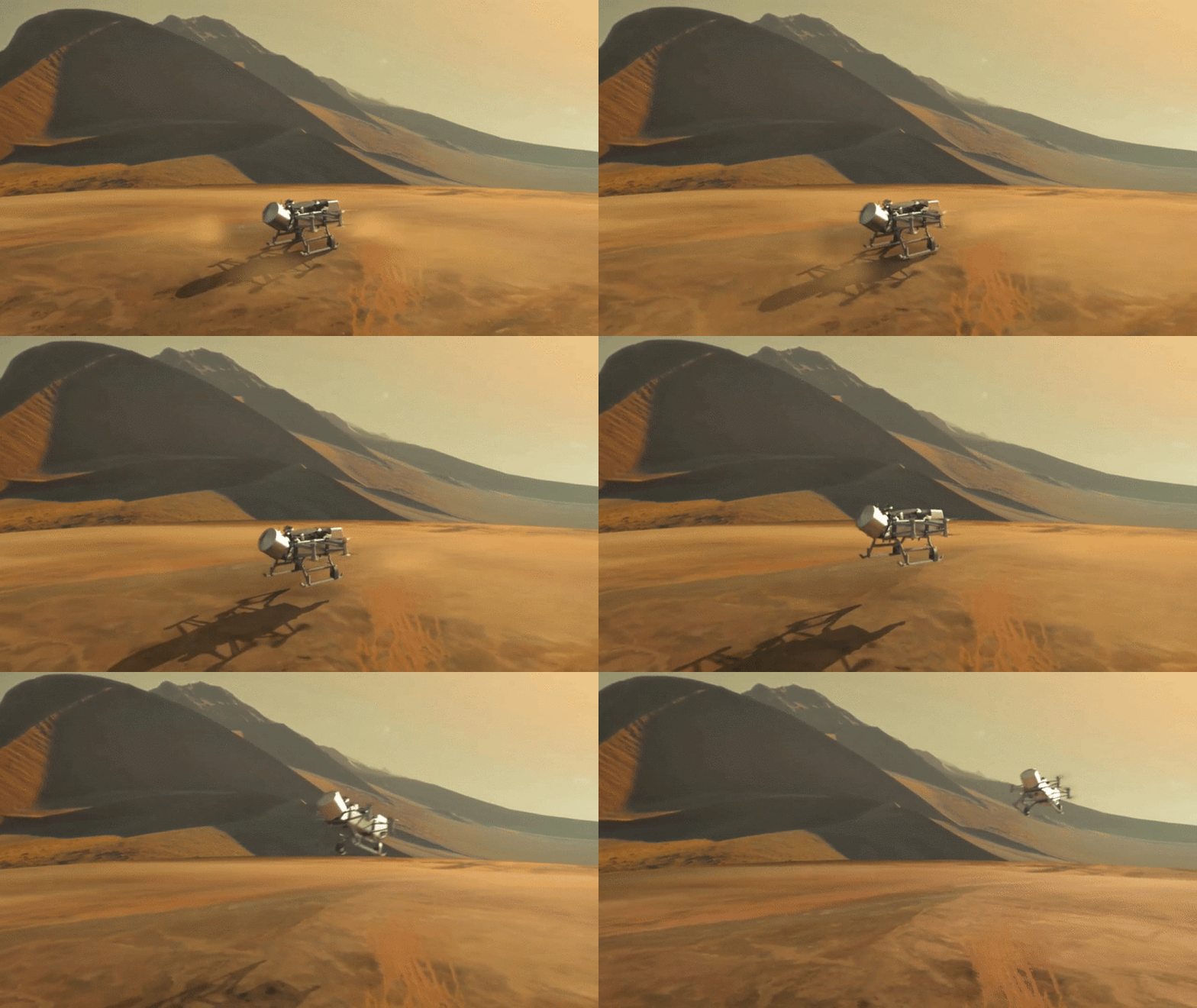
In December 2017, I wrote about a proposal to fly a nuclear-powered dual-quadcopter drone on Saturn’s moon, Titan. One June 27th, 2019, NASA confirmed the mission – called Dragonfly – has now been officially selected for flight in what will be a tremendously ambitious long-duration mission, due to commence in 2026.
Titan is the only celestial body besides our planet known to have liquid rivers, lakes and seas on its surface, although they contain hydrocarbons like methane and ethane, not water. Nevertheless, they sit beneath a dense atmosphere which has commonalities with primordial atmosphere of Earth and which is rich in complex organic chemicals there such as tholins and polycyclic aromatic hydrocarbons, so these lakes and rivers could contain all the building blocks of life.
NASA Dragonfly: flying on Titan
Measuring 3 metres (10 ft) in length, Dragonfly is not s small vehicle. Designed by Johns Hopkins’ Applied Physics Laboratory (APL), it is intended to be a be a highly capable vehicle capable of carrying a full suite of science experiments while completing multiple flights on Titan. While the focus of the mission will be to try to determine how far prebiotic chemistry may have progressed there, the vehicle will carry a range of instruments as well, some of which will include:
DraMS (Dragonfly Mass Spectrometer), to identify chemical components, especially those relevant to biological processes.
DraGNS (Dragonfly Gamma-Ray and Neutron Spectrometer), to identify the composition of surface and air samples.
DraGMet (Dragonfly Geophysics and Meteorology Package), suite of meteorological sensors and a seismometer.
DragonCam (Dragonfly Camera Suite), a set of microscopic and panoramic cameras to image Titan’s terrain and landing sites that are scientifically interesting.
While the mission will launch in 2026, it will take almost eight years to get to Titan, arriving in 2034, when it will become the second vehicle to visit the moon’s surface after Europe’s Huygens lander, which travelled to Saturn and Titan as a part of the Cassini mission.
An artist’s impression of the Teegarden’s Star planetary system might look like when observing it from the “far side” relative to our own Sun (shown in the background and inset). Credit: University of Göttingen
Two Earth-sized planets have been found orbiting a star 12.5 light-years from our own, adding to the catalogue of exoplanets located in our own cosmic back yard.
The star in question is Teegarden’s Star, a M-type red dwarf, the most common type of star in our galaxy, and therefore the most frequent type found to have planets and planetary systems. However, Teegarden’s Star is a little different to other red dwarfs we’ve observed with or without planets. For a start, despite being only a short cosmic stone’s throw from Earth, it is incredibly dim – so dim that we didn’t even notice it until 2003. Not that that in itself is usual, it’s believed that the space around us for a distance of about 20 light years could have many dim red dwarf stars hiding within it, simply because this region of our galaxy seems to have a much lower density of such stars than we see elsewhere.
What makes Teegarden’s Star odd in this respect is that it wasn’t found as a result of a search for such nearby dim red dwarfs, but because astronomers tripped over it whilst reviewing data originally gathered in the 1990s by the Near-Earth Asteroid Tracking (NEAT) project. In fact, the star is actually named for the head of the review team, Bonnard J. Teegarden, an astrophysicist at NASA‘s Goddard Space Flight Centre. The star is also somewhat unusual in that it has a large proper motion (approximately 5 arcseconds per year), marking it as one of seven stars with such large proper motions currently known.
Observations of the star made in 2010 by the Red Optical Planet Survey (ROPS) suggested the star might have at least one planet orbiting it, but the data was insufficient to draw a definitive conclusion. However, in June 2019, and after three years of verifying their data, scientists conducting the CARMENES survey at the Calar Alto Observatory announced evidence of two Earth-mass exoplanets orbiting the star within its habitable zone.
A star and its planet moving around a common centre of mass. Credit: wikipedia / “Zhatt”
The planets were detected using the radial velocity method (aka Doppler spectroscopy), also informally referred to as the “wobble method”. Putting it simply, a star with planets doesn’t simply spin on its axis with the planets whizzing around it. Rather, the mass of the planet(s) works against the mass of the star, creating a common centre of mass which, although still inside the star, is sufficiently removed from its own centre to cause the star to effectively rolls around it (see the image on the right).
This means that when seen from Earth, there are times when the star can seem as if it is moving “away” from our telescopes, signified by its light shifting to the red end of the spectrum. Equally, there are other times when it appears to be moving “towards” us, signified by its light shifting to the blue end of the spectrum. It is by observing and measuring this visible Doppler shift that tells us there are planets present. In all, this method of stellar observation has accounted for almost one-third of all exoplanets found to date.
The key point with this method of observation is not only does it allow astronomers to locate planets orbiting other stars, it actually allows maths to be applied, allowing the number of potential planets to be discerned, their distance from their parent star and important factors such as their probable mass, which in turn allows their likely size and composition to be estimated.
In the case of Teegarden’s Star, the data indicates the two planets orbiting the star – called Teegarden’s b and Teegarden’s c respectively – have a mass of around 1.05 and 1.1 that of Earth each, suggesting they are probably around the same size as one another and comparable to Earth in size. Teegarden’s b, the innermost planet, orbits its parent every 4.9 terrestrial days, and Teegarden’s c every 11.4 terrestrial days.
An artist’s impression of the Teegarden’s Star system, as seen from “above”. Credit: University of Göttingen
The combined mass of these planets, coupled with the amount of Doppler shift exhibited by Teegarden’s Star has led to some speculation there may be other, larger planets orbiting much further out from the star. Such planets would be hard to locate because Teegarden’s Star is so dim when observed from Earth, astronomers cannot rely on the transit method – where large planets passing in front of their parent star can cause regular dips in its apparent brightness – to identify their existence.
However, what is particularly interesting about Teegarden’s b and c is their location relative to their parent, and the nature of Teegarden’s Star itself. The latter is a particularly cool and low-mass red dwarf, with just one-tenth of the Sun’s mass and a surface temperature of 2,700°C (4890°F). This means that at their respective distances, both planets are within the star’s habitable zone – and may well have atmospheres.
The two planets resemble the inner planets of our solar system. They are only slightly heavier than Earth and are located in the so-called habitable zone, where water can be present in liquid form.
– Mathias Zechmeister, University of Göttingen, Teegarden planetary team lead
This latter point – the existence of atmospheres around both planets – has yet to be proven. As noted previously in these articles, M-type stars are actually not nice places; when active (and Teegarden does seem to be well past its active stage) in their youth, they can be prone to violent irradiative outbursts which could both strip away the atmospheres of any planets orbiting them over time and irradiate the planets’ surfaces. And even if the planets do have atmospheres, their close proximity to their parent likely means they are both tidally locked with their same face towards it. This is liable to make them pretty inhospitable places and potentially prone to extremes of weather.
But there is one other interesting point to note here. While Teegarden’s Star may well be dim to the point of being practically invisible when viewed from Earth, the same isn’t true the other way around: our Sun would be a bright star in the skies over Teegarden’s b and c. What’s more, the angle of our solar system to those worlds (practically edge-on) means that if we were to imagine one of them having an intelligent, scientific race, they could easily detect the planets orbiting our Sun using the transit method of observation, and could probably deduce up to three of the innermost planets might be capable of supporting life.











 Inara Pey: Living in a Modemworld