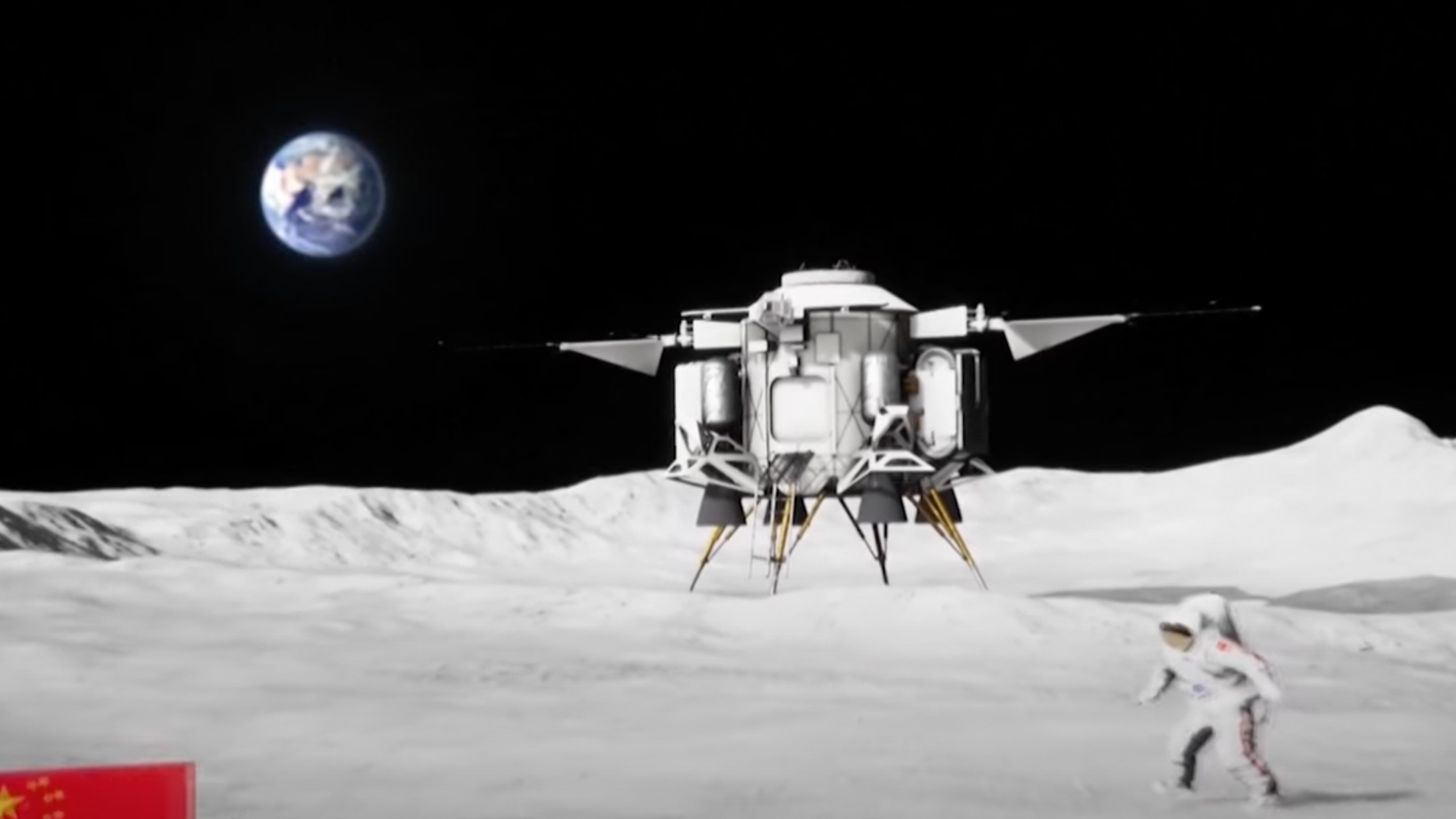
Space Sunday: Starliners and samples

An artist’s rendering of a CST-100 Starliner capsule and service module in low Earth orbit. Credit: NASA / Boeing

Monday, May 6th 2024 should hopefully mark the start of a new phase of crewed space launches from US soil when the long-overdue NASA Crewed Flight Test (CFT) of Boeing’s CST-100 Starliner lifts-off from Canaveral Space Force Station and heads for the International Space Station (ISS).

As I’ve noted in these updates, the Starliner is one of two commercial vehicles specifically contracted by NASA to handle crew transfers to / from the ISS (the other being the SpaceX Crew Dragon), under the the Commercial Crew Program (CCP). Like Crew Dragon, it comprises a reusable capsule powered and supported by an expendable service module. Like both NASA’s Orion capsule (which is somewhat larger) and the Crew Dragon (which is somewhat smaller), the Starliner is also capable of other missions to low-Earth orbit outside of its primary NASA function.

A comparison between NASA’s Apollo and Orion capsules, together with the commercial vehicles from Boeing (CST-100) and Dragon (SpaceX) – all seen without their service modules. Credit: G. De Chiara

Capable of carrying up to seven people (the general crew complement for an ISS Expedition crew rotation) – although normal operations will see it carry four at a time -, Starliner is designed to be used for 10 flights with a 6-month turn-around time. The system was first unveiled in 2010, and was intended to build on Boeing’s experience with NASA and the Department of Defence; with the company confident the vehicle could be flying by 2015 were NASA to fund it forthwith. However, as NASA did not grant a contract (US $4.2 billion) until 2014, the first flight (+ vehicle certification) was pushed back to 2017 – although development work on the vehicle continued between 2010-2014 due to funding via NASA’s Commercial Crew Development (CCDev) contract.

However, as as I’ve again charted in these pages, the programme has been beset with issues – many of them to Boeing’s complete embarrassment. Over confidence on Boeing’s part saw the initial uncrewed test flight(OFT-1) delayed and delayed, finally taking place in December 2019. Post-launch a number of software errors were found, including an 11-hour offset in the vehicle’s mission clock, which resulted in an over-use of propellants and leaving the vehicle unable to rendezvous with the ISS. To further software errors were detected during the flight, either of which might otherwise have resulted in the complete loss of the vehicle.

As a result, a second Orbital Flight Test was required, to be undertaken at Boeing’s expense. Again the company was bullish about things, stating they could complete it in 2020, despite NASA requesting some significant updates to the docking system (which were further exacerbated by COVID, admittedly hardly Boeing’s fault). As a result, the launch pushed back to August 2021, and things went sideways.

somehow, Boeing managed to assemble the vehicle, ship it to Canaveral Space Force Station, have ULA integrate it into its Atlas V launcher, roll it out to the pad and then realise 13 propulsion system valves were stuck in the wrong position. Rather than scrub the mission and roll the vehicle back for a complete check-out and repair, Boeing then tried to carry out a fix on the launch pad, and when that failed, at the ULA Vertical Integration Facility (VIF). Only after this (somewhat risky) options failed, did the company return the spacecraft to the factory for proper remedial action – only to then enter into an embarrassing attempt to blame-shift with propulsion system supplier Aerojet Rocketdyne.
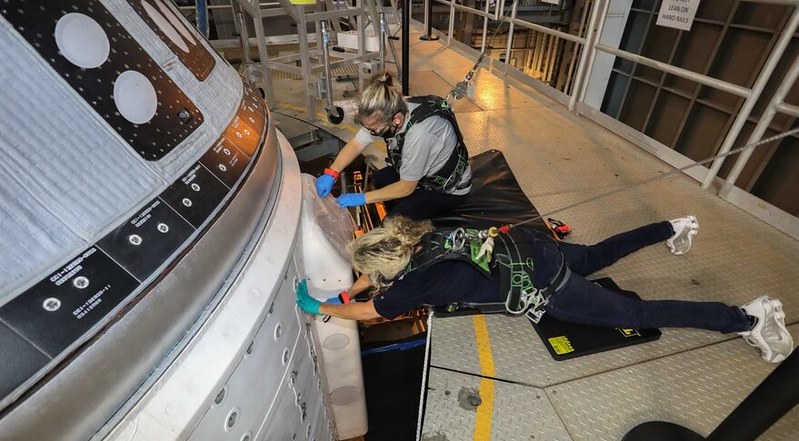
August 22nd, 2022: harnessed against the risk of a fall down the side of the booster, Boeing technicians attempt to repair 13 propulsion valves in the OFT-2 Starliner vehicle from the High Bay of the ULA Vertical Integration Facility at Canaveral Space Force Station. Eventually, the vehicle had to be unstacked and returned to the factory for repairs. Credit: NASA

As a result, OFT-2 did not take place until May 2022, and whilst largely successful, the flight saw issues with both the Orbital Manoeuvring and Attitude Control System (OMACS) and Reaction Control System (RCS). Even so, the flight was seen as meeting all of NASA’s requirements and Starliner was cleared for a crewed test flight (CFT), initially scheduled for early 2023,  only for more issues to cause it to be pushed back. Chief among these were problems with the parachute harness linking the capsule to its descent parachute and also – most worryingly – the discovery that flammable tape had been used with electrical wiring in the vehicle (a contributing factor to the tragedy of the Apollo 1 fire in 1967). The need to subject the parachute harness to upgrades and testing, and to go through the capsule inch by inch and replace the flammable tape knocked any hope of a 2023 CFT launch on the head, and it was pushed by to April / May 2024, with May 6th eventually being selected for the launch day.

For the last couple of weeks, final preparations for the launch have been taking place at both Kennedy Space Centre, where the 2-person crew have been in pre-flight quarantine (with the exception of the pre-flight team assigned to them) so as to avoid either contracting any communicable illness which might be passed to the crew on the ISS; and at Cape Canaveral Space Force Station, most recently with the roll-out of the Starliner vehicle Calypso atop its Atlas V launch vehicle.
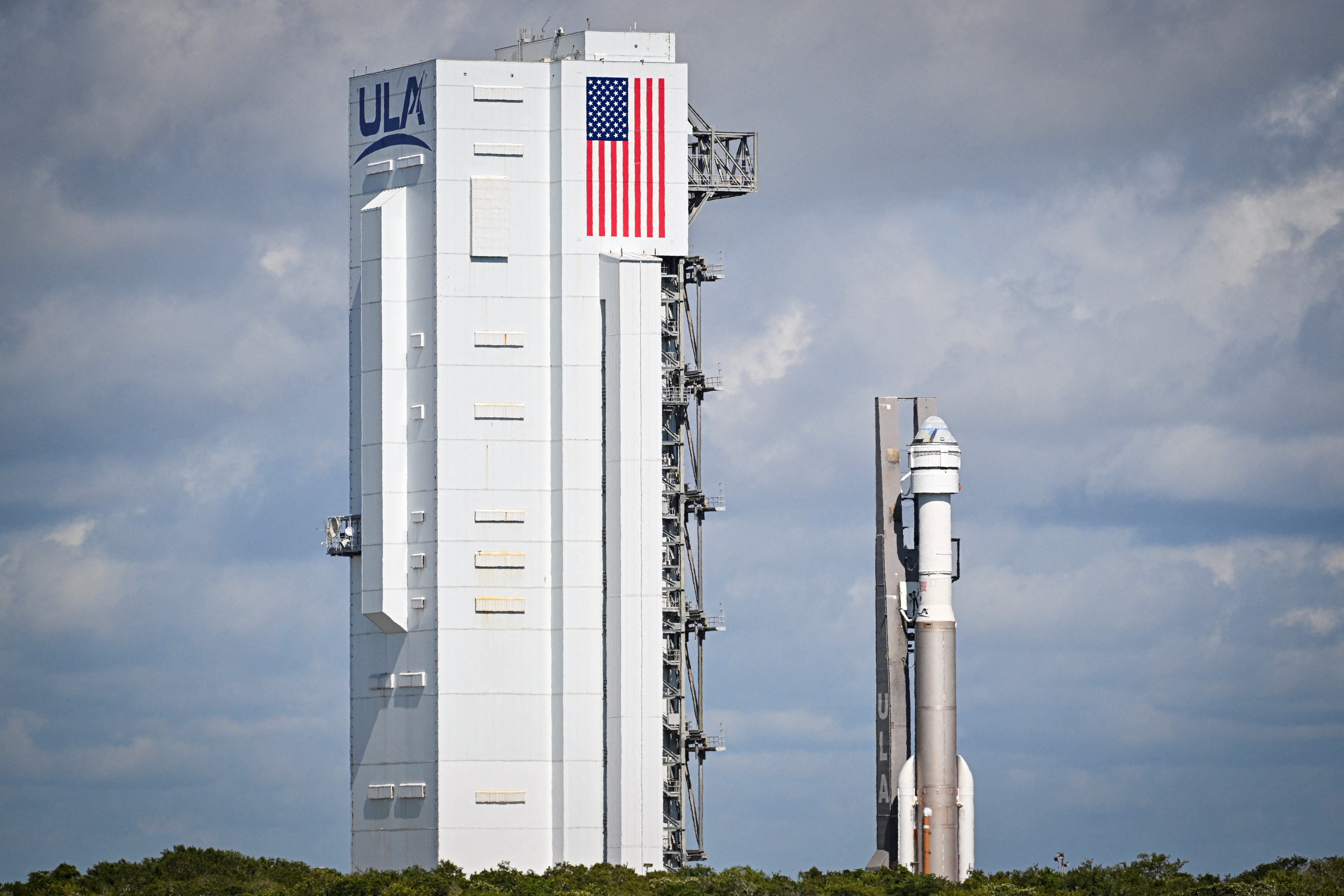
The Boeing Starliner Calypso departs United Launch Alliance’s Vertical Integration Facility atop a ULA Atlas V rocket on May 4th, 2024, heading for Space Launch Complex 41 (SLC-41), Canaveral Space Force Station, in anticipation of its crewed launch on May 6th, 2024. Credit: Miguel J. Rodriguez Carrillo / AFP via Getty Images

The launch will mark the first used of the human-rated N22 variant of the Atlas V, and the first time any variant of the Atlas family of launch vehicles has lifted humans to space since the days of Project Mercury in the 1960s. The launch will also mark the first crewed launch from Cape Canaveral since Apollo 7 (October 1968). The mission is scheduled to last 6 days, with the crew flying the vehicle to a rendezvous and manual docking with the ISS, where they will remain for several days prior to undocking and making a return to Earth and touch down on land (Starliner does not make the more usual – for US crewed capsules – ocean splashdowns, instead using propulsive braking and an airbag, both of which operate in the last second prior to the vehicle landing, to cushion the crew).

Whilst a manual rendezvous and docking with the space station is a major goal for the mission, CFT-1 is also about getting a hands-on view of the vehicle’s capabilities and flight systems, together with an overall assessment of its human factors and handling during dynamic events (e.g. launch, docking, atmospheric re-entry and landing). For this, the crew selected for the mission are highly qualified test pilots turned astronauts in the form of mission Commander Barry “Butch” Wilmore, a Captain in the US Navy NASA, and Pilot Sunita “Suni” Williams, also a Captain in the US Navy.

Whilst Starliner is designed to be lifted to orbit from a variety of launch vehicles – ULA’s Atlas V and Delta IV and SpaceX’s Falcon 9 – all of its completed and planned NASA crew flights will be atop the N22 crew-rated version of the Atlas V. Credit: ULA

Wilmore has spent a total of 178 days in space, flying both the space shuttle (STS-129) in the Pilot’s seat, and on the Russian Soyuz vehicle, which he used in 2014 to reach the ISS as a part of the Expedition 41/42 long duration station crew. As a fleet pilot, he gained over 6,200 hours flying a range of jet fighter and interceptor aircraft and making 663 at-sea landings aboard multiple US aircraft carriers. He also flew 21 combat missions during Operation Desert Storm. As a test pilot, he was heavily involved in the certification of the T-45 Goshawk trainer (a US version of the venerable British Hawk trainer) for carrier flight training, and served as an instructor for both US Navy fixed wing aviators and pilots training at the US Air Force Test Pilot School.

Williams served in the US Navy flying rotary aircraft, flying with Helicopter Combat Support squadrons. She flew missions during Operation Desert Shield, and was a senior pilot-in-charge of a detachment of Navy helicopters flying relief and rescue missions following Hurricane Andrew in 1993. She is qualified as a pilot, a test pilot and an instructor pilot on over 30 types of rotary wing aircraft, including helicopters and the likes of the V-22 Osprey.
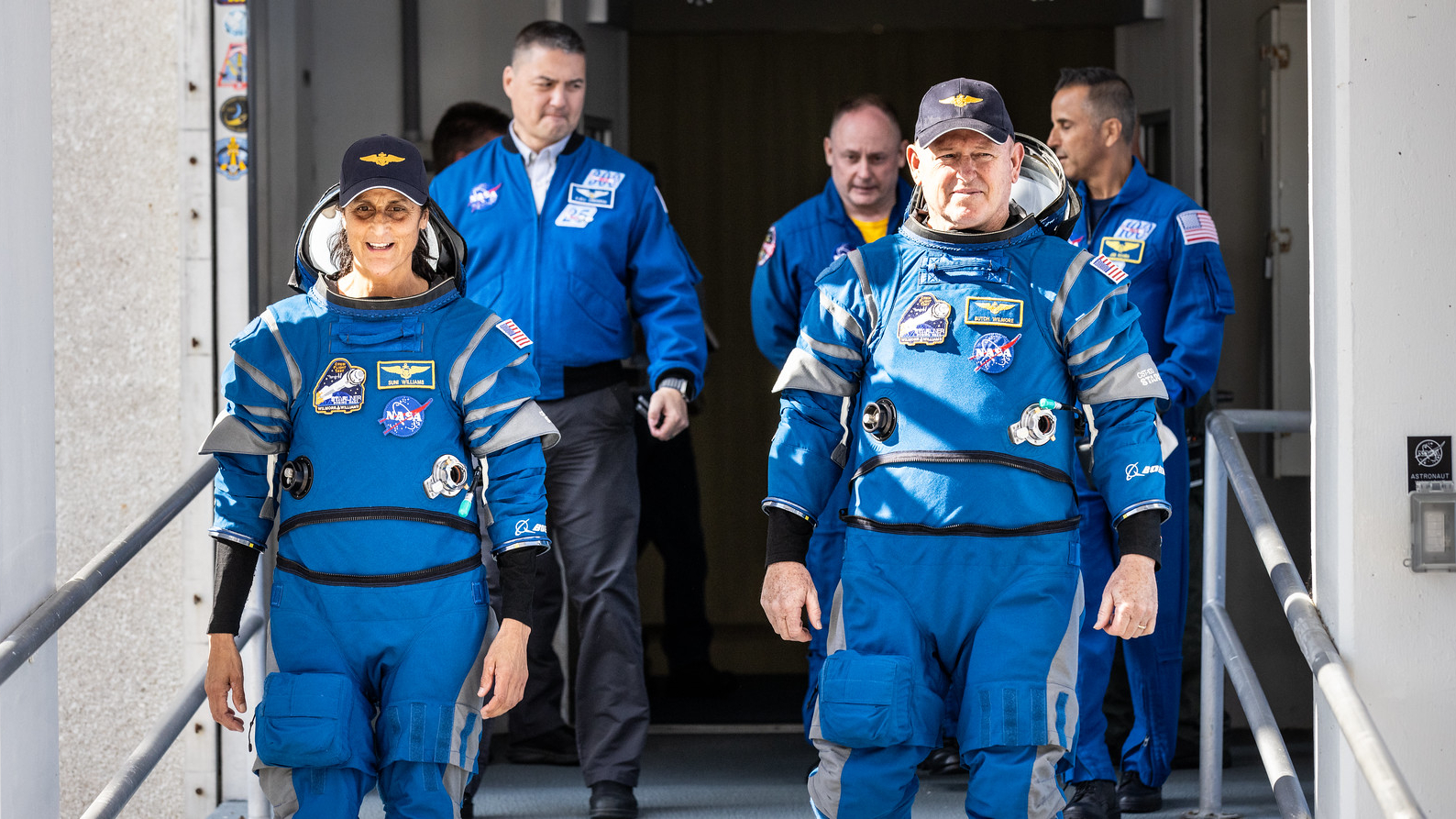
NASA’s Crew Flight Test (CFT) astronauts Sunita “Suni” Williams and Barry “Butch” Wilmore (right) exit the Neil A. Armstrong Operations and Checkout Building at Kennedy Space Centre wearing the Boeing Starliner pressure suits on Friday, April 26th, during a mission dress rehearsal. Credit: NASA / Frank Micheaux

As a NASA astronaut, she has flown in space no fewer than six times, for a total of 321 days 17 hours in space, 50 hours of which were spent carrying out 7 EVAs outside of the space station, marking her as one of NASA’s top five most experienced EVA astronauts. She was also the first person to run a marathon in space, officially participating in the 2007 Boston Marathon. She did this using a treadmill and bungee cords to hold her in place, completing the run distance in 4 hours 24 minutes – during which time she actually circled the Earth 3 times! She took part in the same marathon again in 2008.

Providing CFT-1 is a success and meets all of its goals, it will clear the way for crewed flight operations using Starliner to commence in 2025. No date has been set for the first operational flight, Starliner-1, but it is due to launch a 4-man crew of NASA astronauts Scott Tingle and Michael Fincke, Canadian astronaut Joshua Kutryk and Japanese astronaut Kimiya Yui on a planned 6-month stay at the space station. Once operational Starliner will fly annually on ISS missions from 2025 through 2030, splitting operations with Crew Dragon.

Whilst Starliner can – like Crew Dragon – be used for other orbital mission types, Boeing stated recently that it currently has no plans to start operating the craft commercially. However, the company is a partner in the Blue Origin-led Orbital Reef commercial space station project. This is due to commence orbital operations in the late 2020s, and Starliner is the designated crew vehicle for operations and crew flights relating to that station.
Continue reading “Space Sunday: Starliners and samples”

Space Sunday: Rocket Lab, Voyager, Hubble and SLIM

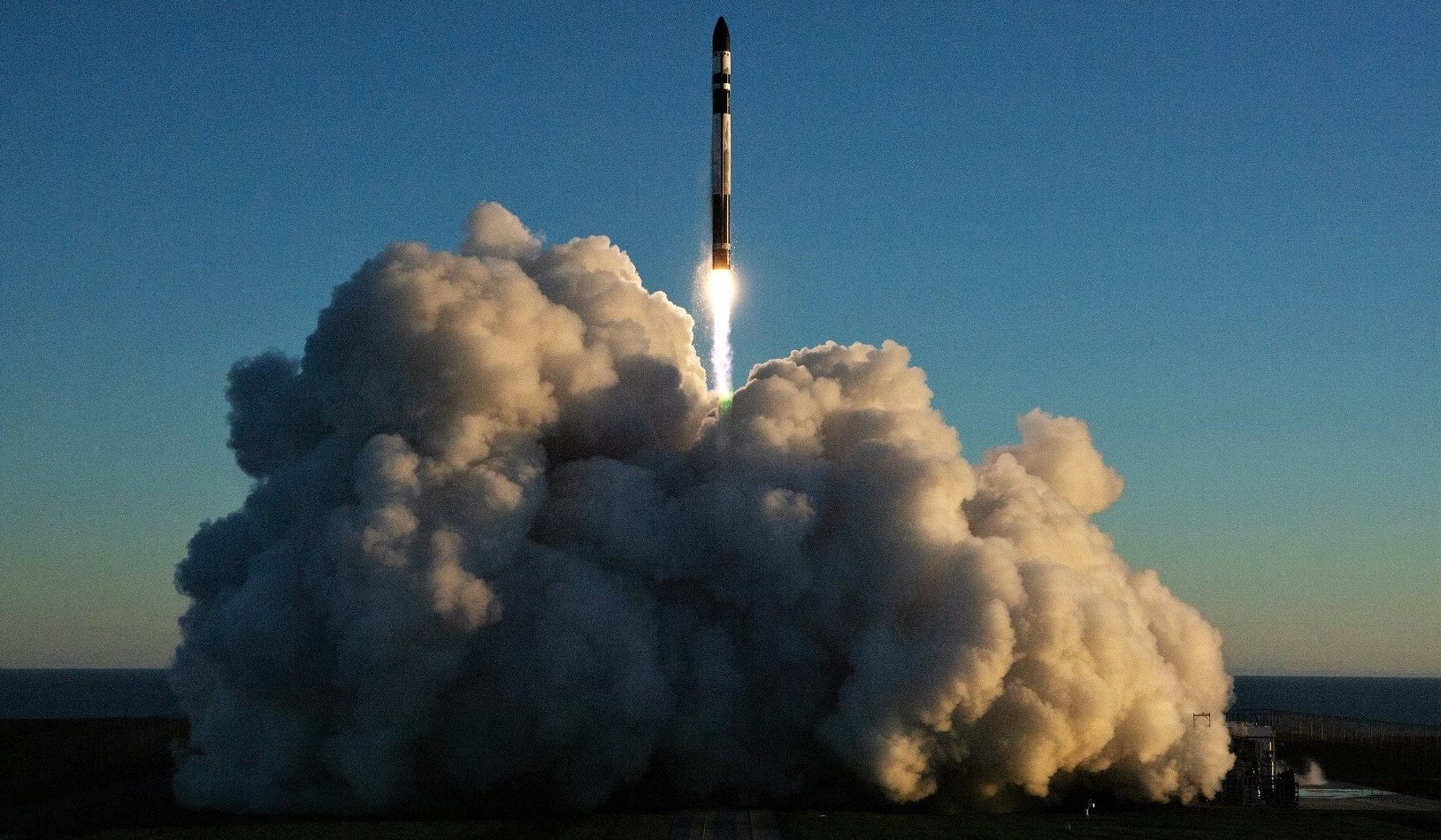
June 29th, 2019: Rocket Lab’s Electron Rocket rises from Launch Complex 1 on the Mahia Peninsula of New Zealand North Island at the start of the mission Make It Rain. Credit: Rocket Lab

Rocket Lab, the New Zealand / US commercial launch provider, is gradually increasing the annual launch cadence of its Electron rocket, as the company continues to garner a solid reputation as a provider of a reliable launch platform whilst also building-out other aspects of its business.

Founded in 2006 in New Zealand by entrepreneur Peter Beck, Rocket Lab initially developed the  Ātea (Māori for “space”) sub-orbital sounding rocket, which made its first (and only) flight in 2009 with the Manu Karere or “Bird Messenger” mission. Although a sub-orbital class of rocket, the  Ātea -1 nevertheless pushed its upper stage and payload beyond the von Kármán line, the arbitrary “boundary” between the Earth’s atmosphere and space sitting at 100 km altitude (although the Earth’s atmosphere actually extends – albeit tenuously – far further than this), technically making Rocket Lab the first private company in the Southern Hemisphere to reach space.

The company started developing Electron Rocket after being awarded a 2010 US Government contract to study the use of a small-scale launch vehicle specifically geared towards servicing the developing cubesat market – a contract which in part lead to the company relocating to the United States in 2012-13 and taking up residence in California, with its New Zealand operations becoming a wholly owned subsidiary of the US business.

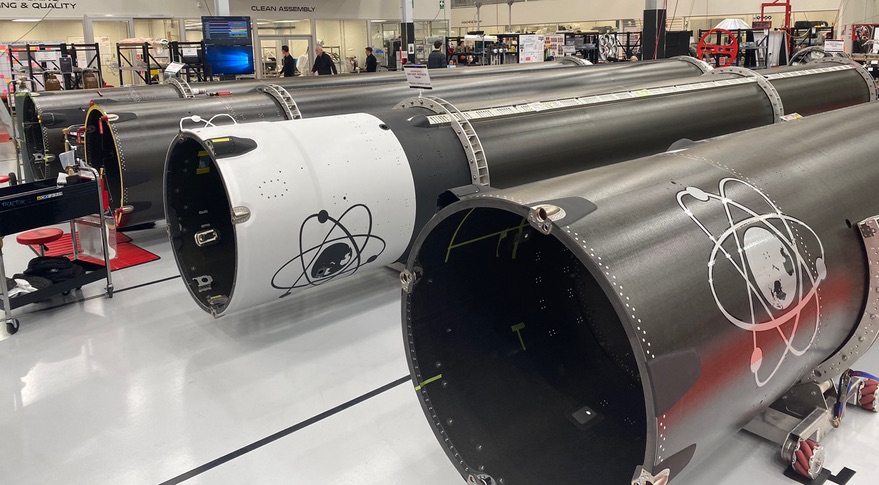
Electron Rocket on the production line in 2020. The one with the Electron logo on a white background was an Electron core stage outfitted to test systems to aid in the recovery of boosters following splashdown. Credit: Peter Beck

A two-stage rocket standing 18 metres tall, Electron made its first flight in May 2017. This did not go as planned and no payload was carried, justifying the mission’s name:  It’s A Test. However, the next flight (the first of three in 2018), called Still Testing, successfully delivered a payload of cubesats to orbit, whilst the next flight, called It’s Business Time saw the commencement of commercial launch operations. At the time of writing, Electron has clocked up an impressive 42 successful flights and payload deployments out of 46 launches, with customers paying between US $5 and $10 million per launch.

While this launch rate perhaps doesn’t sound like a lot when compared to SpaceX and its Falcon family, it needs to be remembered that while much is made of the annual volume of Falcon launches, less than 25% of them are actually directly revenue generating commercial sector launches; the vast majority (an average of 60% per year for four years) have been Starlink launches, for which SpaceX absorbs the cost (approx. US $40 million a launch) for no revenue, with a further 15%+ being far more lucrative US-government related launches. By contrast – although the margin of revenue over cost is much smaller, Electron should almost double Falcon’s 4-year average of commercial launches (13.25 per annum)  in 2024, if all 21 of its commercial launches are successful (the company also has 4 government contracted launches to complete in 2024 as well).

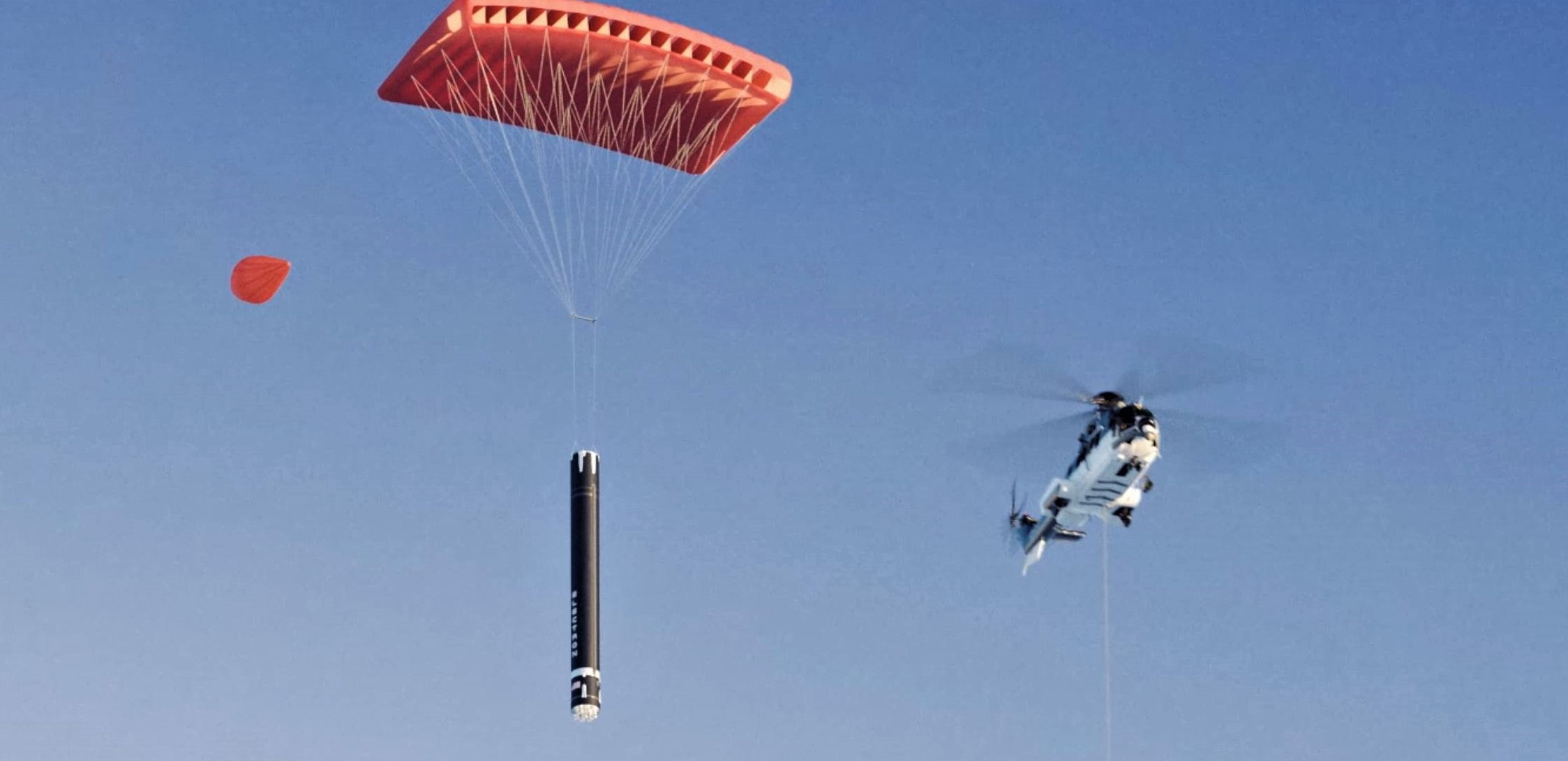
For a time Rocket Lab toyed with (and tested) the idea of plucking Electron core stages out of the air using a helicopter and a drag line designed to snag the line between the booster’s drogue and main parafoil as it descended towards a splashdown. This idea, whilst promising, was abandoned. in 2021. Credit: Rocket Lab

Currently, Electron is not reusable, making its launch costs higher than they might be. However, the company is looking to change this by recovering spent Electron first stages after splashdown and then refurbishing and reusing their nine Rutherford motors – the rocket motors being the most expensive element of the launch vehicle. The first re-use of a refurbished Rutherford motor took place in 2023, with Electron’s 40th flight, the the company is now building on this.

As well as commercial launch customers, Rocket Lab has garnered US government contracts from NASA, the National Reconnaissance Office and the United States Space Force, with the latter in recent months awarding the company contracts worth some US $547 million to develop and launch satellites as a part of the US military’s Proliferated Warfighter Space Architecture (PWSA), a constellation of satellites from a number of suppliers which provides  communications, information gathering, target tracking, etc., to the US military in battlefield and tactical / logistical operations. In addition, Rocket Lab has provided both its US and New Zealand launch services to other governments as well, including France, South Korea and the Australian government.

Nor is the company resting on its laurels with Electron. Despite once saying he would eat his hat if Rocket Lab ever moved towards making a reusable launch system  – his belief being that if the engines could be recovered and reused, that was enough – in March 2021 Rocket Lab announced they were to commence work on a medium-lift (8 – 13 tonnes payload range) launch vehicle.

Called Neutron, the reusable vehicle was introduced to the world on March 1st, 2021 in a video which saw Peter Beck keep his promise: he ate his hat (or some of it, at least).

Neutron – unlike SpaceX’s Starship / Super Heavy – has been designed from the ground-up to meet the needs of a number of existing government and commercial markets: the growing smallsat constellation market (which in and of itself is perhaps increasing more issues they it is potentially solving); medium payloads to LEO, SSO and also to geostationary transfer orbit (GTO – e.g. to other planets); and human space flight. It will achieve all of this in a novel approach.

Classified a 2-stage launch vehicle, Neutron will not have a conventional upper stage. Instead, the payload booster and payload will be contained inside the first stage. After passing through the majority of the atmosphere and entering a post-engine shutdown ballistic flight, the upper portion of the Neutron will open to eject the payload. Once the latter is clear, Neutron will use its thrusters to flip itself away from the “upper” stage, allowing the latter to fire its motor and push the payload on to its assigned orbit. Other factors then come into play – such as the shape of the Neutron, the re-use of at least one of its motors, etc – that will allow the rocket to make a propulsive return to launch sight descent and landing.

The advantages of this approach are multiple. Incorporating the upper stage into the rocket means that it can be smaller and lighter, as it does not require the additional structural reinforcement needed for it to be the fist of the rocket as it punches its way up through the atmosphere. Similarly, the integration of the protective payload fairings into the main rocket both increases the overall structural integrity of the vehicle and means they are not simply thrown away during a launch, removing the cost of a brand new set of fairings with each launch.

A rendering of Rocket Lab’s Neutron Rocket. Credit: Rocket Lab

However, there are also potential issues with the approach which Rocket Lab will have to demonstrate they can address. For example, human-rated vehicles generally require  means by which a crew can be hauled clear should the rocket malfunction. Clearly, if you are carrying your crew inside the rocket to start with, then getting them out of it will take longer that simply blasting them clear with powerful motors, as can easily be done when they are sitting at the pointy end of the rocket.

Currently, the first Neutron flight is targeting a late 2024 launch – which is an ambitious target for a project only announced in 2021, and which requires not only the development of the launch vehicle, but its propulsion system and fabrication facilities. As such, whether Rocket Lab achieve it or not is still open to debate.

The engine for Neutron is called Archimedes engine, and it is being built by Rocket Lab at their facilities in California. Primarily constructed using 3D printing, nine Archimedes motors will power the Neutron core stage with a further motor powering the “upper” stage.

Meanwhile, ground was broken for the rocket’s production facility in April 2022 at the  Mid-Atlantic Regional Spaceport (MARS) within NASA’s Wallops Flight Facility on the eastern coast of Virginia, USA – the MARS spaceport being the base of operations for Neutron, with no plans (at present) to launch the vehicle from New Zealand or elsewhere.

In addition to launch vehicles and satellites, Rocket Lab also produces the Photon satellite bus, designed for a variety of uses, including lifting satellites to their assigned orbits and providing power and propulsion for interplanetary payloads.  Photon is an attractive vehicle for government space agencies and the private sector, as it can be flown on a variety of launch vehicles and can utilise a wide range of rocket motors, such as Rocket Lab’s other engines, the Curie and HyperCurie and those from third-party suppliers, engine selection being based on mission requirements.

As such, while Rocket Lab might be small (literally and figuratively) when compared to SpaceX’s Goliath, it is (a bit like David was in that particular fight) the one to keep an eye on.

NASA: Voyager 1  and Hubble – Good News / Bad News

After a five month period of anxiety in which the spacecraft has been sending gibberish back to Earth, NASA’s Voyager 1 spacecraft, the most distant human-made object from Earth so far made, has resumed sending understandable engineering data.

As I’ve been covering in these pages, Voyager 1 started sending this gibberish since mid-November 2023, although it has remained fully capable of receiving and acting upon instructions from Earth. This resulted both in a suspension of the spacecraft’s science activities and an inability for engineers to determine the vehicle’s overall operational state.

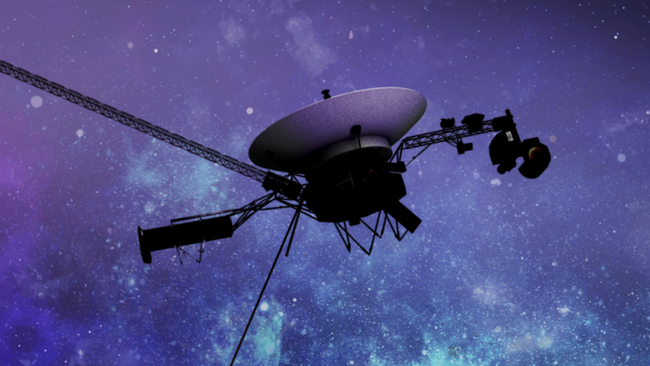
An artist’s rendering of Voyager 1 in interstellar space. Credit: NASA / JPL

Since then, investigations initially narrowed the potential issue as lying with one of two systems: the spacecraft’s telemetry modulation unit (TMU), responsible for sending data to Earth; or the flight data subsystem (FDS), responsible for the actual packaging of that data ready for transmission to Earth. Further work determined the issue as lying within the FDS, although exactly what has gone wrong remained a puzzle.

Then, and as I reported in March (see:  Space Sunday: starships, volcanoes and Voyagers), an engineer from NASA’s Deep Space Tracking Network (DSN), which handles all communications with NASA’s multiple deep-space missions, noticed something odd about some outlier data the communications received from Voyager 1 – it did not appear to be gibberish. Digging deeper, he realised it was actually a complete dump of the FDS’s memory.

This allows engineers to determine a single memory chip within the FDS has failed, corrupting about 3% of the system’s memory; just enough for the data packaging operation to be thrown into disarray and result in gibberish. The cause identified, the problem became how to fix it.

The most obvious means to doe so would be to tell the spacecraft not to use the corrupted memory for data processing. However, that required instructing the FDS to use other memory space – and there wasn’t a single address space in the system large enough to match the corrupted memory and manage its own data processing. As a result, the engineers broke the problem down into a series of steps.

The first step was to updated the FDS software so that the system could take the data normally handled by the corrupted data so that it could be handled through several other parts of the FDS memory, and without messing up any of the other data they had to manage. This recoding was carried out during March and April, and on April 18th, 2024, the updated software was sent to Voyager 1. Then came a nigh-on 48 hours wait for a response: it takes 22.5 hours for a signal from Earth to reach Voyager 1, which then has to execute the code, carry out the instructions related to it, and send a reply – requiring another 22.5 hours to reach Earth.

If the engineers were correct and the update correct, then the response from Voyager 1 should be an engineering update on its overall status. On April 20th, that’s exactly what the mission team at NASA’s Jet Propulsion Laboratory received, and for the first time and for the first time in five months, Voyager 1 weas once again communicating with meaningful data.

Engineers and flight team members responsible for Voyager 1’s operation respond to the confirmation that data received from the spacecraft on April 20th, 2024 confirms their initial attempt to correct a data communications issue has worked. Credit: NASA/JPL

The next steps in the process are to ensure that all science data can be similarly re-routed through the FDS to avoid the corrupted memory sent to Earth without anything becoming confused, and then finally to ensure the faulty memory is completely ignored by all FDS processing and by any of Voyager 1’s systems that interact with the FDS. These steps are expected to take several more weeks. Nevertheless, the fact that Voyager 1 is once again “transmitting in the clear”, so to speak, is welcome news.

Unfortunately, things are not so good with the Hubble Space Telescope (HST), with NASA reporting it is again experience issues with its gyroscopes for the second time in the last six months – and the problem appears to lie with the space gyro that had problems in November 2023.

The gyroscopes are used to precisely point the telescope at targets and hold it steady during imaging. Originally, HST used 3 pairs of gyros, which were periodically swapped-out during servicing missions. However, the last time all six gyros were replaced was during the last servicing mission of 2009 – since the retirement of the space shuttle, NASA has not had the means to safely carry out such a mission, and in the intervening time, three of the gyros have failed completely.

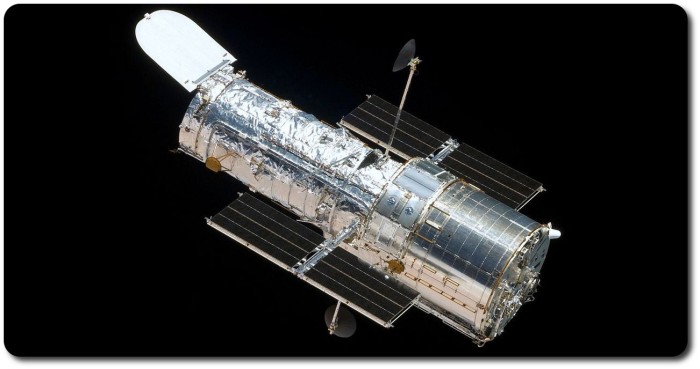
The Hubble Space Telescope (HST) as seen from the departing space shuttle Atlantis, flying STS-125, the final HST Servicing Mission, in 2009. Credit: NASA

Such failures are the result of wear and tear affecting wires less than the width of a human hair and called flex leads which pass through the gyros carrying power and data. As the gyros operate, these flex leads well, flex; but they also slowly corrode as a result of this flexing and can eventually break. One sign of this possibly occurring can be seen when a gyro starts to show power fluctuations. This happened during the past week, causing the gyro to enter a “safe” mode.

As a result, and after allowing the telescope to enter a contingency mode were it can – at reduced capability – function on just two gyros for a few days, on Sunday, April 28th, 2024, NASA completely paused the telescope’s science operations in order to more fully investigate the gyro’s problems in order to try to determine if it is about to suffer a flex lead failure, or whether there is another cause of the gyro’s woes, as was the case in November 2023.

If it turns out the gyro cannot be safely restored to an operational state, NASA has indicated it will switch Hubble over to operating on just a single gyro – permanently degrading its capabilities – in order to hold the second functional gyro as a reserve against any further gyro failure.

Japan’s Moon Sniper Wakes Up – Again

As I’ve previously reported in these pages, Japan became the fifth nation to successful land a spacecraft on the Moon when its Smart Lander for Investigating Moon (SLIM – also called “Moon Sniper”) arrived on the lunar surface on January 19th, 2024. Unfortunately, the craft arrived upside down, as confirmed by images returned by one of the two micro-rovers deposited on the lunar surface as a part of the mission (see: Space Sunday: a helicopter that could; a lander on its head and  Space Sunday: More Moon (with people!) and a bit of Mars) – although precisely why it did has not been 100% confirmed.

Despite this, the vehicle was able to complete the majority of its science mission before being put in a dormant state with the onset of the long lunar night. At the time – the start of February – it was not anticipated that the craft would survive the 14 terrestrial day period without sunlight to warm it and provide energy to power its batteries. But it did; as it started to receive sunlight once more in late February, it called home.

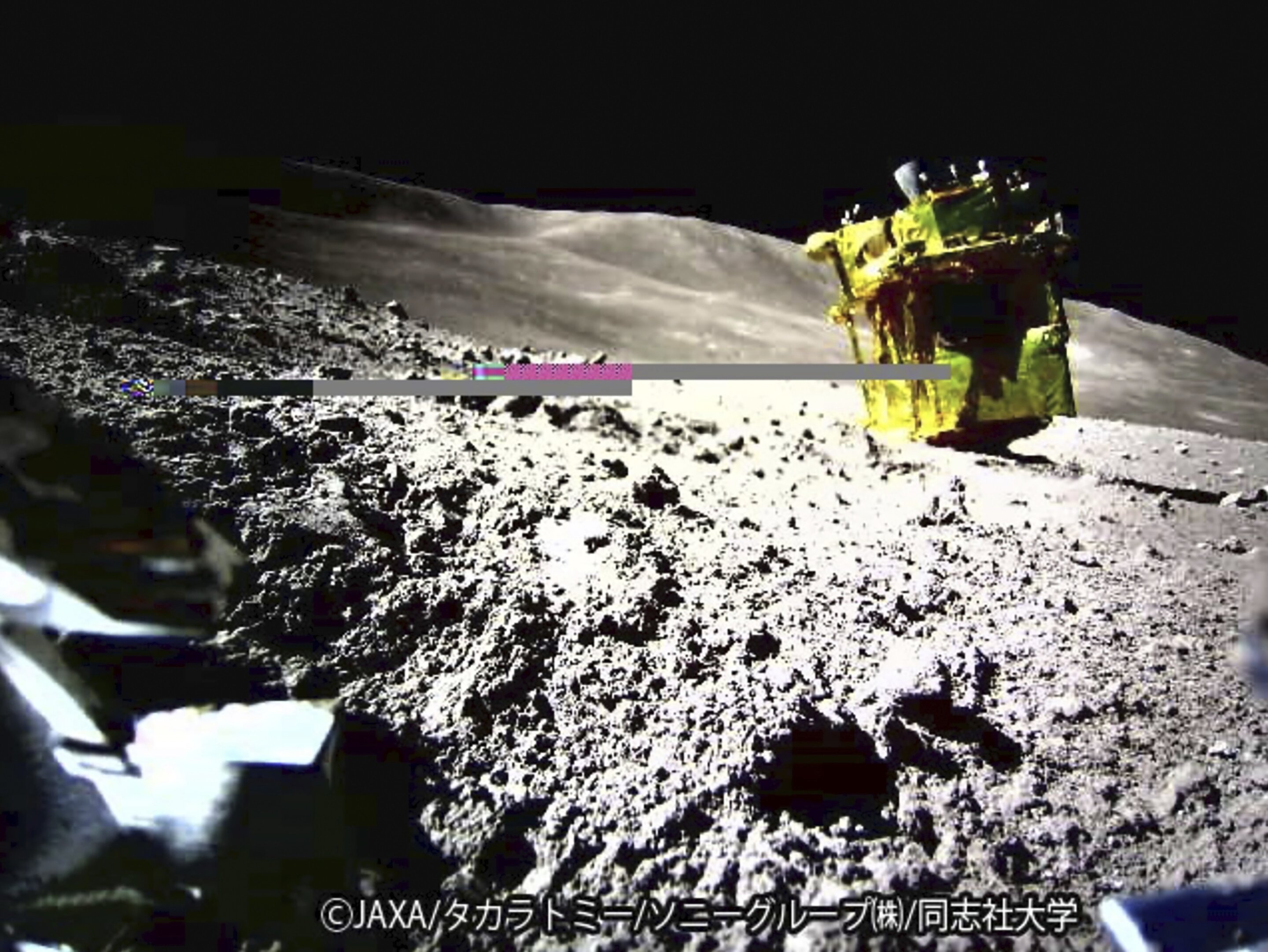
Japan Aerospace Exploration Agency (JAXA) released this image, captured by the LEV-2 mini-rover, of their SLIM lander upside down on the Moon. Credit: JAXA

Whilst the team responsible for the spacecraft had hoped this might be the case, they were unable to get the vehicle to resume science operations and, after a further 14 terrestrial days of sunlight, SLIM went back to sleep for a second night. This time, it was not expected to wake up and the mission team disbanded – only to come back together in March 2024, when SLIM did indeed wake up as it received daylight, and started ‘phoning home and sending images, which it continued to do until night came yet again.

This time, the mission team were sure the vehicle would not call home once sunlight had returned to its landing spot and once again, they’ve been proven wrong. SLIM again ‘phoned home on April 24th, 2024, although it is unclear whether or not the mission team have been able to re-establish any of the vehicle’s science gathering activities. Even so, that the craft has thus far survived three long lunar nights again proves Japan’s prowess with their space technology.

Space Sunday: flying on Titan; bringing home samples from Mars

A 2021 rendering of NASA’s Dragonfly octocopter vehicle, now set to head to Titan in 2028. Credit: NASA / JHU/APL

NASA’s ambitious plan to fly a robotic vehicle on a moon of another world is to go ahead after receiving official confirmation in April 2024. With its cost now set at some US $3.35 billion, double its initial price estimates – largely the result of the COVID pandemic derailing the vehicle development process in 2020/21 -, the vehicle – called Dragonfly (as is the overall mission) is intended to have a 10-year primary lifespan, with 3.3 years of that time spent flying around and studying Saturn’s largest moon, Titan.

Dragonfly is a spectacular science mission with broad community interest, and we are excited to take the next steps on this mission. Exploring Titan will push the boundaries of what we can do with rotorcraft outside of Earth.

– Nicky Fox, NASA associate administrator, Science Mission Directorate, Washington D.C.

Titan is a unique target for extended study for a number of reasons. Most notably, and as confirmed by ESA’s Huygens lander and NASA’s Cassini mission, it has an abundant, complex, and diverse carbon-rich chemistry, while its surface includes liquid hydrocarbon lakes and “seas”, together with (admittedly transient) liquid water and water ice, and likely has an interior liquid water ocean. All of this means it is an ideal focus for astrobiology and origin of life studies – the lakes of water / hydrocarbons potentially forming a prebiotic primordial soup similar to that which may have helped kick-start life here on Earth.

Using a vehicle that is in situ on the surface of Titan is vital, because the moon’s dense atmosphere obscures its surface across many wavelengths, making it exceptionally hard to definitively identify the specific combinations of hydrocarbon materials present across the moon’s surface without getting very up close and personal. To do this, Dragonfly will be a unique rotary vehicle, one a good deal heavier and more complex / capable than the Ingenuity drone flown on Mars (which was an extraordinary flying vehicle – and now static weather station – on Mars).

The brainchild of Jason W. Barnes (University of Idaho) and  Ralph Lorenz (Johns Hopkins University Applied Physics Laboratory – or JHU/APL), Dragonfly is being developed for NASA by JHU/APL, with Elizabeth “Zibi” Turtle, a planetary scientist at JHU /APL serving as the mission’s principal investigator.

The craft is designed as an octocopter – an aerial vehicle with four pairs of contra-rotating rotor blades. Each pair of rotors will be powered by its own electric motor, and the craft has been design to withstand either the loss of a single rotor blade or the completely failure of and one motor powering a pair of blades. It will have an on-the-ground mass of around 450 kg (compared to Ingenuity’s 1.8 kg), and will use a mix of nuclear and battery power.

A large lithium-ion battery will provide direct power to the vehicles flight and navigation systems and to this science suite. It will provide sufficient power for the craft to travel up to 16 km on a single charge at speeds of up to 36 km/h, with a maximum airborne time of around 30 minutes per flight, and an estimated maximum altitude of 4 km – although generally the craft will fly much lower than this. The battery will be supported / recharged by a Multi-Mission Radioisotope Thermoelectric Generator (MMRTG), which will also be used to provide heat to the vehicle, particularly during Titan’s night periods when it is behind Saturn relative to the Sun, and which lasts for 8 terrestrial days. The MMRTG will additionally provide power to the vehicle’s science instruments during the night periods, allowing them to work whilst the vehicle waits out the night in order to resume flying in daylight..

Dragonfly’s remarkable flight capabilities – speed, altitude, single flight distance – are made possible by Titan’s environment: the moon’s low gravity (around 13.8% that of Earth and dense atmosphere (around 1.45 times that of Earth’s) mean that the flight power for a given mass operating on Titan is around 40 times lower than on Earth, so the vehicle can have a fairly significant mass which can be lifted by relatively low-mass, low-power motors.

A Dragonfly testbed article undergoing flight trials

The vehicle will fly a primary science suite of four packages, comprising:

  • DraGNS (Dragonfly Gamma-Ray and NeutronSpectrometer): comprising  a deuterium-tritium Pulsed Neutron Generator and a pairing of a gamma-ray spectrometer and neutron spectrometer to identify the surface composition under the vehicle.
  • DraGMet (Dragonfly Geophysicsand Meteorology Package): a suite of meteorological sensors including a seismometer.
  • DraMS (Dragonfly Mass Spectrometer): a mass spectrometer to identify chemical components, especially those relevant to biological processes, in surface and atmospheric samples.
  • DragonCam (Dragonfly Camera Suite) is a set of microscopic and panoramic cameras to image Titan’s terrain and scout for scientifically interesting landing sites.

Samples of surface material for examination by the science packages will be obtained using two coring drills and hoses mounted within Dragonfly’s skid, per the video below.

Further, the vehicle will be equipped with a fully autonomous flight and navigation system capable of flying it along a selected flight path, making its own adjustments to account for local conditions whilst in flight, and with sensors capable of record potential points of scientific interest along or to either side of its flight path, so the information can be relayed to Earth and factored into planning for future excursions. Flights over new terrain will likely be of an “out and back” scouting nature, the craft returning to its point of origin, allowing controllers on Earth to plan follow-up flights to locations along the flight track, taking into account any points of interest noted by the vehicle.

Currently, Dragonfly is targeting a July 2028 launch, although the launch vehicle itself has yet to be announced. It will take seven years to reach Titan, mostly likely using several gravity-assist manoeuvres around Earth to slingshot itself on its way. In this, it will be the first dedicated mission to the outer solar system not to flyby / utilise Jupiter whilst en route, as the planet will not be within the mission flight path.

On arrival at Titan, and following separation from the cruise stage that would keep it both powered and warm during the trip from Earth, Dragonfly will enter the moon’s atmosphere atop a 3.7 metre diameter heat shield, and under a protective back shell. Once in the atmosphere, a single drogue and single large main parachute will be deployed to slow the vehicle’s descent until it reaches an altitude at which the parachute is released and Dragonfly can drop clear of the back shell, enabling it to start its motors and make a first landing on Titan.

A 2017 rendering of Dragonfly’s arrival on Titan. Credit: NASA / JHU/APL

In this, the landing site for the mission has already been selected: the edge of a prominent and dark region of Titan called Shangri-La, thought to be an immense sand sea of dark, carbon-rich material.

Specifically, Dragonfly will touch down in a dune field close to the relatively young Selk impact crater, which will be the vehicles first science study location, as it contains strong indications that it was once home to deposits of liquid water (and is now surrounded by ejecta that includes water ice) and contains tholin organic compounds. After this, Dragonfly will move on into the Shangri-La, carrying out exploratory flights of up to 8 km at a time and gathering samples for analysis from diverse locations.

NASA Re-Re-Rethinks Mars Sample Return Mission

NASA is now officially seeking both internal outside support for its much-troubled Mars Sample Return (MSR) mission.

The goal of returning samples of surface and sub-surface material from Mars to Earth, where it can be subjected to much more intensive and multi-disciplinary study than can be achieved via in-situ robotic explorations, has long be sought. For NASA, the last 20 years have seen numerous ideas put forward for gathering and returning such samples from Mars, all of which have ended up being cut down in their prime due to matters of cost and stringent curbs on the US space agency’s budget – sending a vehicle to Mars with the express intent of obtaining, storing and then returning samples to Earth not being the easiest of mission profiles to plan, let alone achieve.

However, in the lead-up to the Mars 2020 mission, featuring the rover Perseverance, NASA and the European Space Agency (ESA) signed a letter of intent to jointly develop a sample return mission based around the concept of the actual sample gathering being carried out by Perseverance and deposited on the surface of Mars for collection “at a future date”. The operation to start depositing groups of these samples actually started on December 21st, 2022, with a total of 10 sample tubes being deposited relatively close together on Mars by Perseverance.

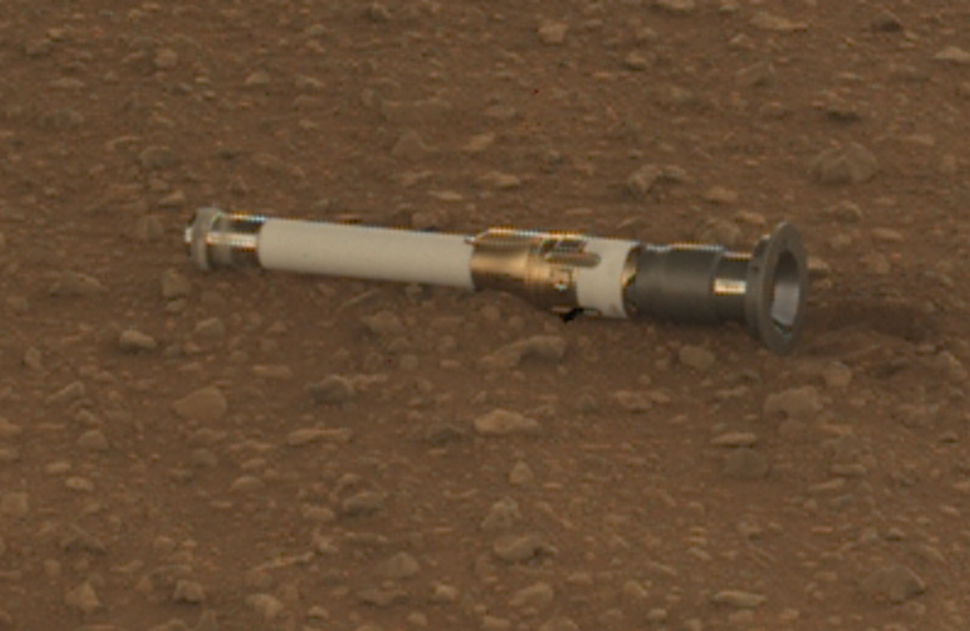
Resembling a Star Wars light sabre in an image obtained by the WATSON imager on Perseverance’s robot arm, this was the first of the sample tubes to be “dropped off” by the Mars 2020 rover (December 21st, 2022), marking the start of an initial operation to place 10 such sample tubes in a cache for collection by some future Mars Sample Return mission. Credit: NASA

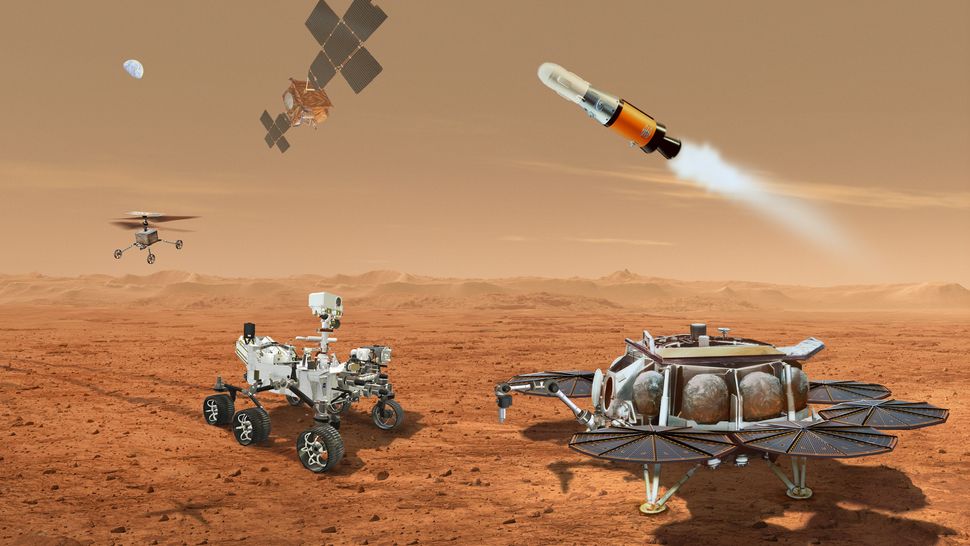
Whilst this approach negated the need for the MSR to actually collect and store samples itself – in theory simplifying the mission parameters – actually settling on a final design for the mission proved difficult. By 2021, the “optimal” approach was seen as being a mission involving four unique vehicles in addition to the Mars 2020 rover. These were:

  • A NASA- built Mars lander / launch platform.
  • A NASA-built Mars Ascent Vehicle (MAV) with a specialised sample containment unit, and carried within the lander.
  • A European-built “fetch” rover with its own dedicated lander, designed to land ahead of the NASA lander and go find the sample tubes deposited by Perseverance, bring them to the NASA lander and transfer them into the sample containment unit in the MAV.
  • A European-built Earth Return Vehicle (ERV) designed to arrive in Mars orbit and await the arrival of the NASA-built MAV from the surface of Mars. This would then capture the sample unit (about the size of the basketball) after the latter had been released by the MAV, secure it and the samples inside itself and then make the return trip to Earth.

So, yeah; “simples” – not. The mission included, as identified by independent review board (IRB) charged with reviewing the mission for its overall cost-effectiveness and feasibility, no fewer than eight “break the chain” (and cause the mission to fail) first-time challenges, including the fully robotic collection and transfer of samples, the first automated launch of a vehicle from the surface of another planetary body, the first fully autonomous orbital rendezvous between two vehicles (the MAV and the ERV), and the first “pitch and catch” transfer of a sample package. However, despite this and concerns over the estimated mission cost rising to around US $4 billion, the IRB green lit the mission.

The MSR mission concept as envisioned in 2021 / early 2022 and featuring the ESA-built “fetch” rover (minus its lander).  Credit: NASA / ESA

 By July 2022, the complexities of the mission had been more fully realised, so efforts were made to “simplify” it. Specifically, the ESA “fetch” rover was eliminated from the mission – but was supplanted by the use of two Ingenuity class Mars helicopters. Fitted with wheels, these would also be delivered to Mars by the NASA lander carrying the MAV, and once there, they would fly and land in close proximity to sample tubes deposited by Perseverance, then drive up to them, pick them up and fly them back to the lander for transfer to the MAV, with the rest of the mission remaining the same.

The 2022 MSR update, with the ESA “fetch” rover removed from the mission, and replaced by two Ingenuity-class  helicopters (only one shown), which would be delivered to Mars by the NASA MSR lander and tasked with recovering sample tubes deposited by the Mars 2020 Perseverance rover. Credit: NASA / ESA

However, while this removed the need for an entire rover and lander, and meant that effectively, NASA would have two further helicopters on Mars with which they could carrying out other missions once the sample tubes had been delivered to the MAV, it didn’t actually do much to reduce complexity or mission cost – which threatened to rise to around US $8 billion.

To offset this, the planned mission time frame was revised from around 2030-31 to the mid-to-late 2030s, allowing the mission cost to be spread across a greater number of NASA fiscal years. However, by mid-2023, it was widely recognised that the mission would probably exceed the US $8 billion estimate and peak at perhaps as much as US $11 billion – gaining the mission a lot of opposition on Capitol Hill. Suggestions were made to push the mission time-fame out further, with the lander / MAV / helicopter element not launching until the early 2040s.

By mid-2023, the mission had been further revised in order to try to reduce complexity and costs. Under the new proposal, none of the sample tubes thus far used and deposited on Mars for collection by Perseverance would actually be recovered (about 24 of the 43 total). Instead, all of the remaining tubes (16 of which have yet to be used, as of the time of writing) would be retained on the rover. Then, on the arrival of the MSR lander / MAV combination, Perseverance would rendezvous with them and load its supply of sample tubes directly into the MAV’s sample capsule for onward transfer to the ERV and a return to Earth. Whilst this would limit the selection of samples compared to gathering them from the various caches the rover had made on the surface of Mars, it did both simplify the mission – NASA only having to fly the MAV-carrying lander – whilst ensuring ESA’s involvement was not wasted, as they would still supply the Earth Return Vehicle.

The 2023 MSR update, with Ingenuity class helicopters removed and showing the Perseverance rover directly transferring sample tube to the sample capsule of the MAV, eliminating the need for intermediary vehicles. Credit: NASA / ESA

Despite this, over mission complexities and the need for the development of two entirely new classes of robotic spacecraft (the MSR lander-come-launcher for the MAV, and the MAV itself, complete with its sample storage / containment system) meant NASA would still be looking at around a minimum US $8 billion cost – and if the timeframe for the mission were to be extended into the early 2040s, inflation would likely push the final price back up towards the US $11 billion figure.

As a result, and with NASA’s budget already being severely stressed for the 2024/25 period, the agency finally admitted defeat with its more grandiose MSR plans, and on April 15th, 2024, the US space agency issued a statement indicating it is now looking “outside the box” for the means to carry out a Mars sample return mission in a cost-effective manner and within a reasonable time-frame (i.e. before the end of the 2030s). To this end, the statement calls on all NASA centres involved in Mars exploration to work together in order to develop such a mission, whilst also indicating the agency will seek proposals for potential mission architecture from the private sector.

Currently, NASA itself has admitted it does not have firm ideas on how mission costs can be reduced, but is determined to see the sample return mission take place, viewing it as a vital precursor to any attempt at a human mission to Mars. Thus, the process for redeveloping plans and ideas is expected to run through until the latter part of autumn 2024.

Space Sunday: starships, volcanoes and Voyagers

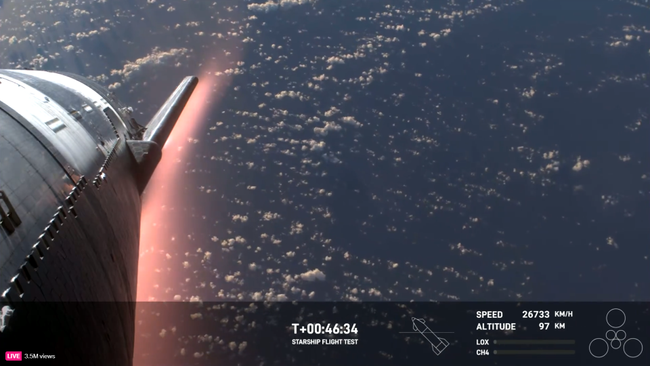
Plasma starts to form around the Starship’s thermal protection system as the vehicle starts to re-enter the denser part of Earth’s atmosphere, March 14th, 2024. Credit: SpaceX

Thursday, March 14th, 2024 saw SpaceX attempt the third Integrated Flight Test (IFT-3) of its massive Starship / Super Heavy launch system after the Federal Aviation Administration (FAA) granted a limited launch license to the company on March 13th.

Despite SpaceX and its followers hailing the first two launch attempts as “successes”, the short-order loss of both vehicles within 4 minutes of the launch of IFT-1 and which either vehicle achieving its core milestones in IFT-2, meant that both of those flights were extremely limited in their “success”. As a result of both, SpaceX spent considerable time reviewing the launch profile for the vehicles and making changes and improvement to both the Starship craft and Super Heavy. These resulted in IFT-3 being a broadly successful – although the loss of both vehicles at different points in the flight meant it was not an unqualified success.

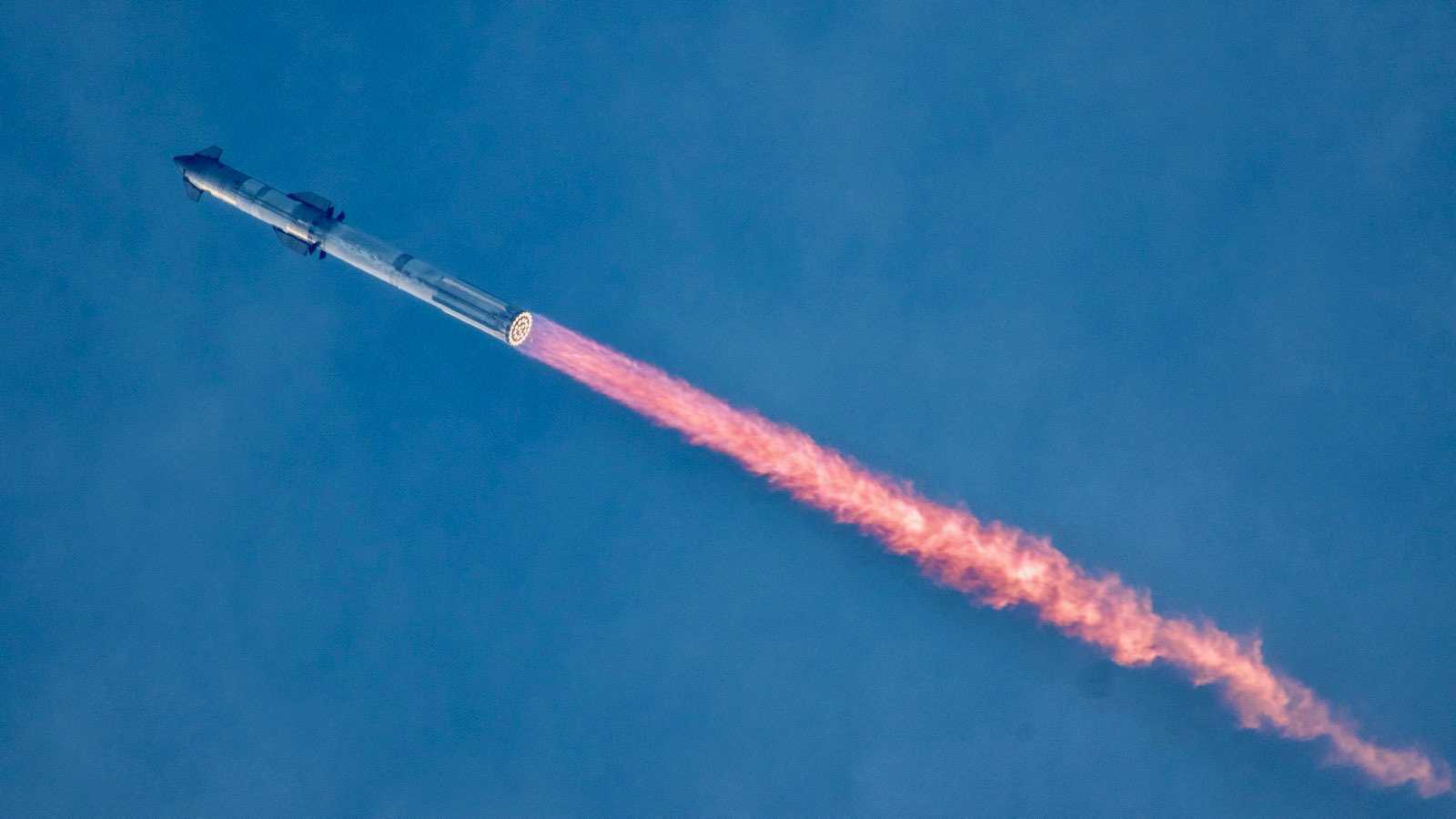
Following lift-off at 13:25 UTC, with an initially perfect firing of all 33 Raptor engines on the booster, the stack of rocket and starship passed through Max-Q, the period where both experience maximum mechanical stresses as they ascend through the atmosphere, within the first minute of flight.

A clean burn: all 33 Raptors are at work as the IFT Starship / Super Heavy combination move towards Main Engine Cuto-Off (MECO). Credit: SpaceX

Even so, at 2:42 into the flight, the engines on the booster shut down and two seconds later, the starship upper stage ignited all six of its engines in a “hot staging” manoeuvre, separating from the booster after the engines had fired. This went a lot smoother than evidenced in the second launch attempt in November 2023, and the booster was this time able to change direction and execute an successful “boost back” burn – using the motors to kill its ascent velocity and push it back towards the launch site.

However, it was during the boost-back that possible hints of engine issues appeared: several of those recording and reporting on the launch noted that some of the engine exhaust plumes were tinged green, indicative of one or more engines consuming itself (green indicates the copper used in the engines is being consumed), a long-term issue with the Raptor 2. Nevertheless, the booster successfully re-oriented itself and started a planned engine-first descent towards the Gulf of Mexico and a splashdown.

For this to happen, the booster needed to slow itself by a further re-lighting several engines in a braking manoeuvre roughly a kilometres above the water. Whilst three engines did ignite, two immediately failed, and the vehicle was destroyed less than 500 metres above the Gulf – although it is not clear if the flight termination system was triggered or the booster blew itself apart. At the time of destruction, it was travelling with sufficient velocity to hit the water at 1,112 km/h.

A successful hot staging: with the super Heavy booster engines still glowing brightly, the Starship vehicle separates and moves away, the shockwaves of its exhaust ringing both vehicles after a successful engine start-up while still attached to the booster. Credit: SpaceX

Starship went on to achieve orbit, on course for a splashdown in the Indian Ocean. Travelling at around 240 km above the Earth, the vehicle carried out a test of the “Pez dispenser” payload bay door – a slot in the vehicle’s hull at the base of the payload bay and specifically designed to eject Starlink satellites (these being almost the only payload for Starship at present). Also tested was a so-called “propellant transfer” test, shunting a small amount of liquid oxygen between the vehicles’ main and header tanks.

However, SpaceX cancelled the vehicle’s planned de-orbit burn with one of its Raptor engines and instead allowed the vehicle to “go long”, continuing along its orbital track until gravity until drag caused it to re-enter the  denser part of the atmosphere for a hoped-for splashdown. In the event, and following an initially very successful re-entry, the vehicle broke apart at an altitude of around 65 km.

The orbital flight segment of the test was impressive whilst also raising questions as to Starship’s future orbital flight dynamics. Notably, throughout its half orbit of the Earth, the Starship was in a state of continuous “bbq roll”, that is, spinning around its longitudinal axis (and making it seem like the Earth was constantly looping around it on videos). Such rolls are not uncommon on space vehicles when in sunlight, as they help spread the thermal load of the Sun’s heat over the vehicle’s outer skin, preventing uneven heating (or overheating).

In the first few seconds of flight: not the white ice enveloping the Super Heavy booster and the back of Starship -the result of the hulls of both forming the outer walls of their cryogenic tanks and being so cold frost ice forms on the metal, indicative of its poor thermal regulation. Credit: SpaceX

In this respect, Starship is especially vulnerable to such thermal stresses: it is completely reliant on cryogenic propellants which tend to revert to a gaseous state (and require venting to prevent tanks being over-stressed), and it is made of stainless steel, and extremely poor thermal insulator. This is compounded by the fact that the hull of the vehicle is also the the outer surface of the propellant tanks, so outside of the thermal protection system (TPS) tiles coating one side of the vehicle and designed to protect it during re-entry in to Earth’s atmosphere, there is next to no thermal insultation between the vehicle’s propellant reserved and the Sun, thus leaving rolling the vehicle as the simplest means of regulating internal temperatures.

Even so, the rate of roll, combined with its continuous does raise questions: was the rolling seen on this flight simply an overly precautious desire to limit thermal blooming inside the vehicle, or will it be part of starship SOP in the future. If the latter, then there are going to be some significant issues to address (how are to starships supposed to pump propellants being them in they have to roll like this once mated and the fuel to be transferred from one to the other is being exposed to a severe Coriolis effect as a result of the spin? Was the spin in this instance the cause of the planned de-orbit burn being cancelled because a smooth flow of propellants to the motor to be fired could not be guaranteed?

That said, the vehicle did perform its own mini “propellant transfer”, pumping a small amount of liquid oxygen between its own tanks. However, the overall value of this test is perhaps not as significant as some SpaceX fans have stated, given it is a long way short of the 100+ tonnes of propellants at a time that will need to be transferred between vehicles when it comes to sending the proposed Starship lunar lander to the Moon .

But leaving such thoughts aside, the one undoubted spectacular element in the flight were the initial phases of re-entry into the denser atmosphere, when cameras mounted on the vehicle’s control surfaces were able to video the build-up of super-heated plasma around the craft as it slammed into the atmosphere. While this has been filmed from within various space vehicles (Apollo, shuttle, etc.), this is the first time (I believe) it has ever been recorded from outside the vehicle going through re-entry.

Another unique element of the vehicle demonstrated prior to re-entry was the use of vented gas as a means of controlling the vehicle’s orientation. As noted above, cryogenic fuels tend to “boil off” and turn gaseous unless kept perfectly chilled. This gas must then be vented in order to prevent it becoming too voluminous and rupturing its containment tank (hence why rockets using cryogenic fuels are constantly venting gasses prior to launch following propellant loading & then having to be constantly “topped off”). However, rather than just letting go of this gas in space as they do on the ground, SpaceX channel it through a series of “cold thrusters” around the starship vehicle, enabling them to use the vented gas to “steer” the vehicle, avoiding the need for more traditional (and mass-using) thrusters systems requiring their own tanks of hypergolic propellants or gas.

While overall successful, the loss of both vehicles does mean a mishap investigation overseen by the FAA has been triggered, which may delay the planned launch of another test flight originally targeted for just a few weeks time. Even so, SpaceX are to be congratulated with the results overall, carrying the company as they do a modest step forward in the system’s development.

Continue reading “Space Sunday: starships, volcanoes and Voyagers”

Space Sunday: landing humans on the Moon and an ISS taxi

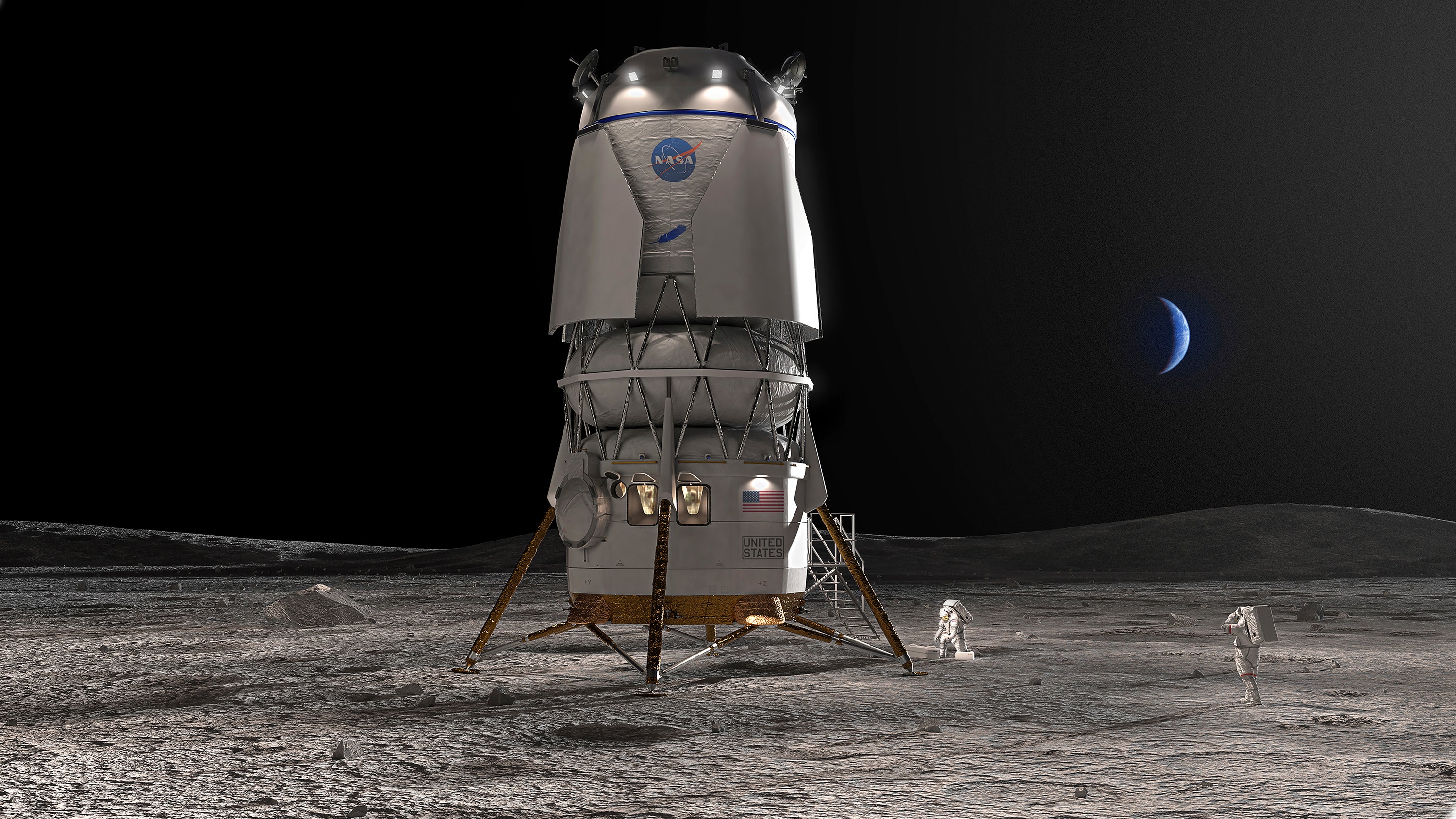
First to the Moon with Artemis: could Blue Origin (left) beat SpaceX (right) in delivering a US crew to the surface of the Moon this decade – and perhaps even eliminate SpaceX from the running? Credits: Blue Origin and SpaceX; images not to scale

The latest hype cycle about Elon Musk’s Starship / Super Heavy is starting to ramp in the lead-up to the next “integrated flight test” (IFT) of the system (SpaceX stopped calling them “orbital flight tests” aft the first one spectacularly firecrackered less than 4 minutes into the flight), and the second one fared somewhat better, prior to the booster and the starship both going the same way in separate explosions. As usual, the hype is being led by Elon Musk, stating that the third attempt could come on March 14th, 2024.

The Federal Aviation Administration (FAA) investigation into that mishap – actually led by SpaceX (as tend to generally be the case) – closed at the end of 2023; however, the closure did not mean SpaceX would be granted a license for resuming launches. That was dependent upon the company completing all identified remedial / corrective actions the FAA felt required in light of the mishap report. As of the end of February, 2024, it was not clear if all such action points had been addressed. However, SpaceX have renewed preparations for the next launch from the Starbase facility at Boca Chica, Texas.

If this third flight – regardless of when it takes place – does in fact deliver a starship test vehicle to orbit, it will be the first genuine success of the launch attempts thus far (whilst SpaceX fans might have lauded the first two attempts as successes, the fact remains that if ULA, NASA or any other company had seen their vehicles similarly destroyed, their flights would have been seen as abject failures), it is merely the smallest of steps SpaceX is committed to taking if it is to meet its obligations to NASA in providing the agency with a lunar lander vehicle in a timely manner – or at all.

As a quick recap: unlike Apollo, NASA is not relying solely on “in-house” designed hardware and systems for their return to the Moon, but are utilising private sector capabilities as well, theoretically on a fix-price basis. In particular, they have turned to the private sector for the development and operation of their Human Landing Systems (HLS) – that’s lunar landers to you and me.

Originally, two major teams of companies bid for the contracts for NASA’s first HLS systems, one led by Blue Origin (with Lockheed Martin) and one by Dynetics. SpaceX jumped into the proceedings very late in the process with a very questionable proposal to use a modified version of their Starship vehicle, and not only walked off with the contract under somewhat extraordinary decision-making at NASA, actually ended up as the sole contractor, despite NASA stating two contracts would be awarded.

Whilst one element of this 2021 graphic are outdated (the SpaceX Boca Chica facility very much does exist), the overall flight outline it presents is correct in terms of the number of flights required to get a single SpaceX Starship HLS to the Moon – as confirmed by NASA in November 2023. Credit: Blue Origin

That was in 2021. Since then, SpaceX has failed to achieve every single milestone Musk has set for Starship development, leaving a lot for the company to achieve if they are to meet NASA’s goal of delivering two people to the surface of the Moon and returning them safely to the surface of the Earth by late 2026 / early 2027. In particular, they need to not only get a Starship into orbit, they must:

  • Show they can launch a starship / super heavy combination not just once, but multiple times – and show they can actually capture them again on landing at the launch site without actually having them fall short or even crash into the launch / recovery tower.
  • Demonstrate this can be done over multiple launches in a relatively short time frame (e.g. at least once a day) without incident.
  • Develop, test and prove capabilities to deliver large payloads (100 tonnes) of cryogenic propellants to orbit and transfer them between craft with minimal boil-off, and again do so up to 14 or 15 times.
  • Carry out two demonstration flights of the HLS vehicle in orbit, one uncrewed and the other crewed.

Given the company’s rate of progress thus far, a 2 to 2.5 year time frame to complete all this is, frankly, liable to be well beyond SpaceX’s capabilities; particularly when you consider that in a Twitter Spaces meeting in December 2023, SpaceX personnel engaged in the HLS development programme admitted they hadn’t even started to conceptualise the crew facilities and support systems the vehicle must carry. Add to that the fact that the only actual hardware under development are both coming in part from NASA: the elevator needed to get the crew down and up the 30 metres of spacecraft and the lunar surface and the docking mechanism to allow the Orion crew vehicle to transfer crew from itself to the lander, once in lunar orbit.

And that’s not me saying it subjectively; Musk himself has stated Starship HLS will take around another 5 years to be realised. That’s 2029, and the time frame of the Artemis 5 mission. Hence why Jim Free, the man at NASA charged with overseeing the Artemis programme, is talking more and more robustly about bypassing SpaceX altogether in terms of that first crew landing. And there is a strong contender to take SpaceX’s place to take over the primary slot: Blue Origin.

Whilst smaller than the 40-tonne Blue Moon 2 crew lander, the Blue Moon 1 cargo vehicle will be capable of delivering up to 3 tonnes to the moon, and utilises the same propulsion unit (a single Blue Origin BE-7 engine as opposed to 3 on the crew lander), navigation, power systems and precision guidance and landing capabilities. Credit: Blue Origin

One of the original bidders for the first HLS contract, Blue Origin were awarded a contract to develop NASA’s “sustainable” lunar lander in May 2023 (the “sustainable” term a tacit admission by NASA that the SpaceX design, with its maximum 2 landing capability and the need for as many as 15 support launches to get it to the Moon is entirely unsustainable). Since then – and allowing for the fact they continued to develop their lander idea between 2021 and 2023 in the form of a cargo variant (“Blue Moon 1”) which shares several significant systems as the crewed lander proposal (“Blur Moon 2”), including navigation and landing systems, propulsion module / landing legs and power generation – the Blue Origin design is potentially far ahead of that of SpaceX.

Specifically, Blue Original have already delivered to NASA a walk-through mock-up on the lander’s pressurised module, allowing NASA engineers and astronauts to properly determine how the module should be laid out, workspaces and living areas be defined, and where and how all the required internal systems and services should be best installed.

In addition, the development of the cargo lander has reached a point where Blue Origin has announced it plans to send the lander to the Moon at its own expense, with the first taking place in 2025. Whilst these will deliver science payloads to the Moon, their primary goal will be to check-out those same navigation, propulsion, power and landing systems that will be used on the crewed lander, thus demonstrating their fitness for purpose (and flight readiness).

Given all this, and the pace of development at Blue Origin, it is possible their Blue Moon 2 lander system could be ready to fly in late 2027 – still outside of the NASA time frame, but likely well in advance of SpaceX’s HLS. This is something Free has openly acknowledged, expressing the point of view that if SpaceX isn’t ready, not only will they be held accountable for failing to meet their contract, the Artemis 5 mission featuring the first use of Blue Origin’s lander could be brought forward as the first Artemis crewed landing mission, and Artemis 3 shuffled back.

That said, the Blue Origin / Lockheed approach must clear some of the same hurdles as face by SpaceX in order to be able to perform crewed landing on the Moon. These include developing the means of transferring cryogenic propellants between spacecraft, and limiting propellant boil-off. However, the overall scale of operations is much smaller: Blue Origin and Locked are only dealing with tens of tonnes of propellant transferred in relatively small quantities (but stored in lunar orbit for a much longer period), rather than up to 1000-1200 tonnes for Starship HLS. This means that a Blue Origin lander only needs a single refuelling launch to see it through a number of lunar landings / lift-offs, not anything between 10 and 15 required by Starship HLS requires.

The Blue Origin / Lockheed approach to Artemis 5. Left: two New Glenn rockets place Lockheed’s cislunar transporter and a propellent carrier into LEO. After docking, the transporter pushes the carrier to a NRHO around the Moon. A third New Glenn launches the Blue Moon 2 lander (uncrewed) to NRHO, where it rendezvous with the transporter / carrier and takes on the fuel required to land on the Moon and lift off. Assuming Gateway station is operational, the lander docks there and waits a crew to arrive via Orion. Surface crew then use the lander to reach the Moon and return to Gateway (or dock directly with the Orion vehicle), returning to Earth in Orion. The lander performs an automated rendezvous with the transporter / propellant carrier and refuels, then awaits the next crew. The transporter can also return to Earth orbit to drop-off used tanks and pick up new ones. Credit: NASA / Blue Origin / Lockheed

Another critical aspect of the Blue Origin lunar capabilities is to enter service this year: the New Glenn rocket. Capable of delivering 45 tonnes to low Earth orbit and smaller payload out as far as Mars, New Glenn will enter service in August of this year, its maiden flight being to launch NASA’s EscaPADE spacecraft to Mars. With the lunar missions, it will be lifting the cislunar transporter (under development by Lockheed Martin) and the fuelling / refuelling tank the mission will require, as well as the lander itself. Providing there are no issues with the August 2024 launch, New Glenn should have an established track record by the time Artemis 5 is ready to fly.

This gives rise to the possibly that NASA might, if Blue Origin and their team are ready, simply drop the SpaceX option altogether. Why have a non-sustainable, complex lander system utilising a vehicle inherently unsuited to the task, when there is a sustainable, proven vehicle already doing the work? The issue here would be one of when such a decision should be taken. NASA has already contracted SpaceX to the tune of close to US $3 billion for Starship HLS – and has precious little to show for it; given the contract negotiated between SpaceX and a former NASA deputy administrator who might be said to have been overly biased towards SpaceX (the company now employing her as a senior executive), it is hard to know what, if any, penalty / get out clauses might have been written-in.

Blue Moon 2 will stand 16 metres tall – just under one-third the height of SpaceX Starship HLS, allowing the crew to reach the lunar surface without the need for complicated external elevators, as will as a much lower centre of mass for greater stability on landing. It will also be capable of supporting up to 4 people for 30 days at a time on the Moon. Credit: Blue Origin

That said, there are those – such as NASA’s own Office of Inspector General and the federal Government Accountability Office (GAO) – who feel that the Artemis programme is inherently too costly to be sustained beyond the currently defined missions (Artemis 3 through 9), and that it might be too costly to even go beyond Artemis 5 or 6. As such, a move to cut (and perhaps reclaim) costs associated with the system that is somewhat questionable in its ability to meet the requirements placed on it, and which could be redundant by the time it is ready, might go some way towards NASA demonstrating it really is trying to manage its costs effectively.

Continue reading “Space Sunday: landing humans on the Moon and an ISS taxi”

Space Sunday: More Moon (with people!) and a bit of Mars

The February 24th, 2024, Chinese state media broadcast formally announcing the naming of the vehicle classes that will fly taikonauts to the Moon. Credit: CCTV

The China’s Manned Spaceflight Agency (CMSA) has revealed the names and preliminary drawings of the vehicles China plans to use to deliver its own astronauts – called taikonauts in Chinese – to the lunar South Polar Region.

For their human missions to the Moon, China is going the “easy” (that is, largely tested) way. No complicated drives to HALO orbits around the Moon and high-risk approaches such as 14 refuelling flights for the lunar lander after it has reached Earth orbit just so it can get to the Moon (yes, I’m looking at you, NASA – chuck the SpaceX idiocy, will you, please?). Instead, China is going a-la Apollo, using a two-ship system.

Chinese next-generation crewed spacecraft mock-up with its solar panels in the stowed launch position, displayed at the National Museum of China, September 2023. Credit: Shujianyang

The first of these has been in development for a while, and has been referred to in the past as China’s “next generation crewed spacecraft” designed to replace the Soyuz-inspired Shenzhou vehicle the country currently uses to reach low Earth orbit, as well as forming a basis for excursions further afield – such as to the Moon.

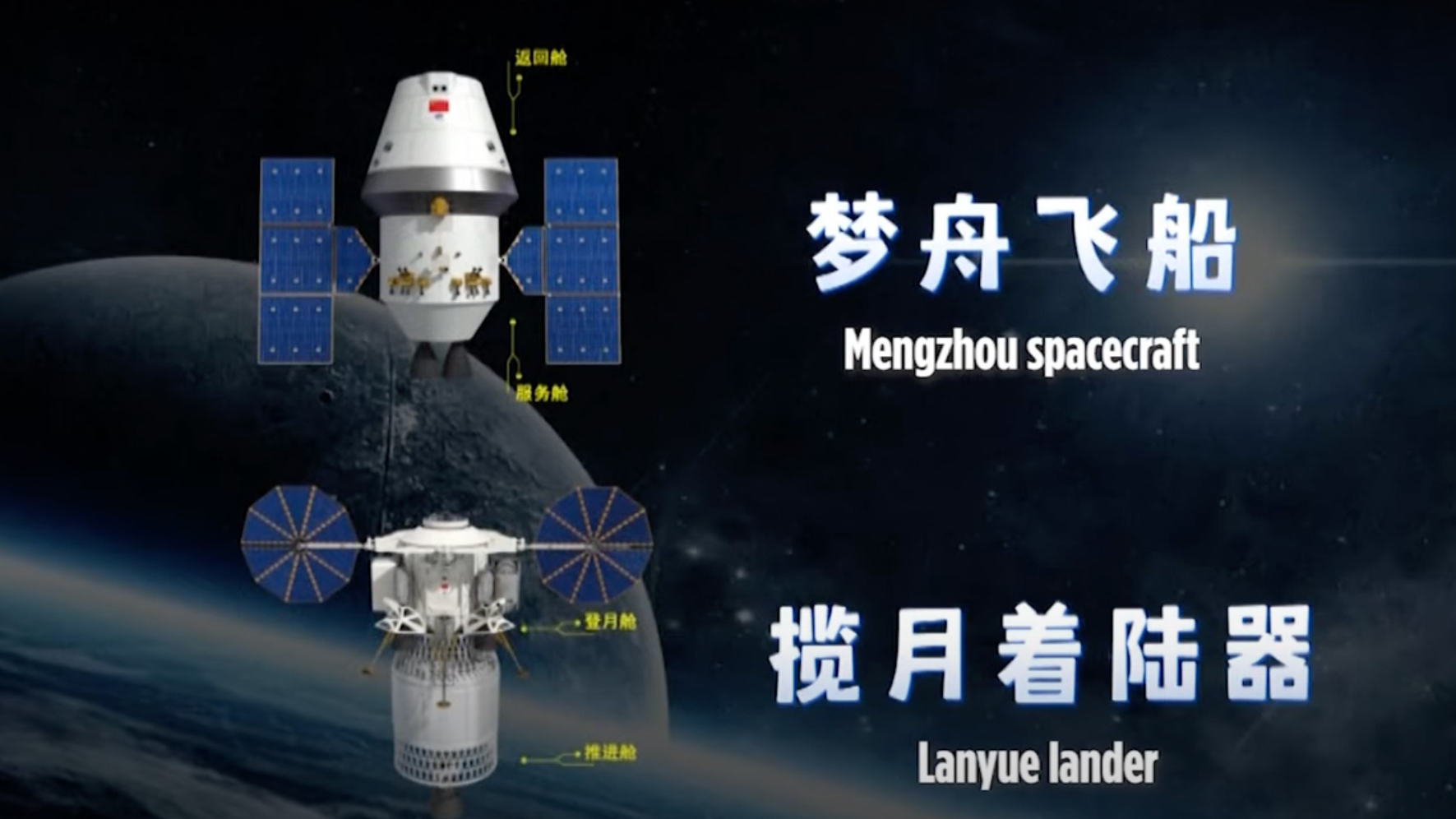
As announced by via Chinese state media on February 24th, 2024 during the Lantern Festival – the last day of traditional Chinese new year festivities and which takes place, appropriately enough during a full Moon -, the new class of crewed space vehicle will now be called Mengzhou (“Dream Vessel”). The name was selected after China held a national competition to name the programme, and is in keeping with the naming convention for its orbital classes of space vehicle (e.g. Shenzhou and Tianzhou).

Mengzhou is a two-stage craft comprising a useable capsule system capable of seating up to six taikonaut, and an expendable service module providing propulsion, power and life support. The vehicle’s overdesign is fairly advanced: a scale model version of the capsule was flown in space in 2016 on a mission designed to provide engineers with the data they required to finalise the capsule’s overall design and flight characteristics.

A second flight in 2020 using a full-scale proof-of-concept vehicle used to evaluate vehicle avionics, orbit performance, new heat shielding, parachute deployment and a cushioned airbag landing and recovery system. Currently, the first crewed test flight of the craft in either 2026 or 2027.

Four lunar missions, Mengzhou will fly with a crew of three and extended life support capabilities and additional supplies. It will be joined on missions by the Lanyue (“embracing the Moon”) lander. This again borrows somewhat from the Apollo missions of the late 1960s / early 1970s, being a spindly-legged craft built around a squat crew compartment supporting (initially) two taikonauts. Like the Apollo lunar lander, the craft is two staged; unlike the American lunar lander – which landed on the Moon fully intact, with the lower (“descent”) stage becoming a launch pad for the upper (“ascent”) stage for getting the crew back up to lunar orbit – Lanyue will use the same stage for both the landing and ascent phases of a mission.

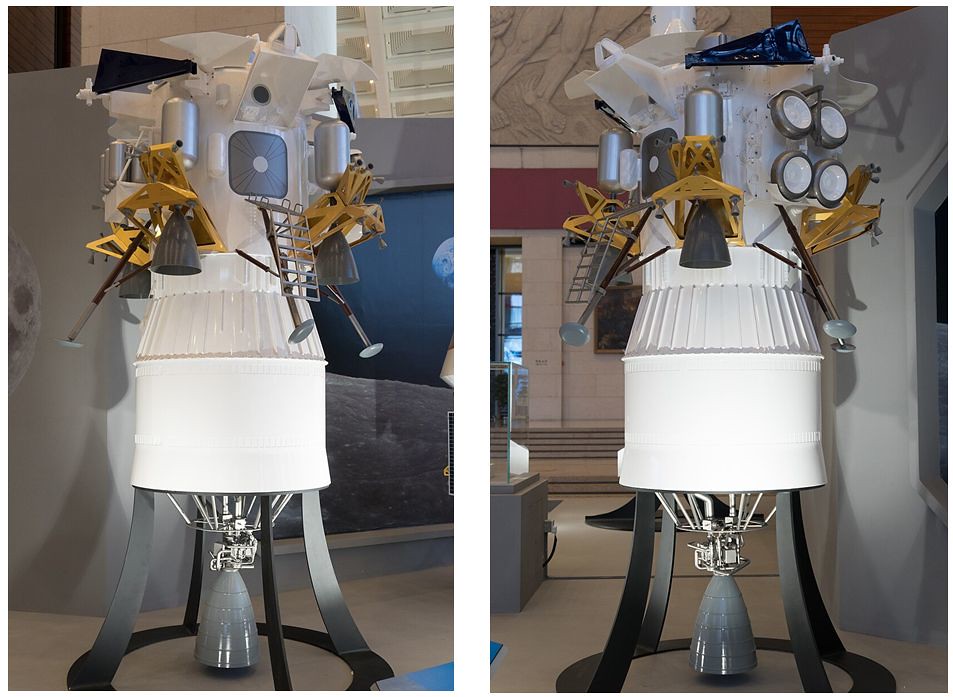
Two views of a mock-up of a Lanyue lunar lander (top) mated to its large propulsion module. The black panels at the top of the lander are its solar panels in their stowed configuration. Note the collapsed rover vehicle mounted on the lander in the right-hand picture. Credit: Shujianyang

The second stage of the vehicle will be a propulsion module which will power the lander to lunar orbit and then “park” it there. The crew will then travel to lunar orbit aboard a Mengzhou vehicle and dock with Lanyue. Two will transfer to the lander vehicle and undock to use the lander’s propulsion module to decelerate out of lunar orbit and into a descent towards the surface. Once the descent commences, the propulsion stage will be jettisoned to crash on the Moon, while the lander/ascent stage will continue on to a soft landing.

Information on how long a time the initial crews will spend on the Moon is unclear, as the details thus fair released are ambiguous in their interpretation. For example: the term “six hour stay” is used, but both in terms of the complete surface mission and in reference to crew EVA time. Most analysts in the west believe the first missions will equate to the stays of Apollo 11 and Apollo 12 – so “six hours” refers to actual EVA time -, with subsequent missions staying for increasingly extended periods, up to the limitations of the lander in terms of consumable supplies.

Artist’s illustration of a Chinese astronaut on the moon. Credit: CCTV

Plans for Lanyue include the provision of a collapsible rover vehicle of a similar nature to the Apollo Lunar Rover, and several models of the lander show the rover stored on its flank. However, it is not clear if it will be part of the first landing(s) or a subsequent addition to missions.

For lunar missions, both Mengzhou and Lanyue will be launched by China’s upcoming Heavy Lift Launch Vehicle (HLLV) Long March 10. Due to make a maiden flight possibly as early as the latter half 2025, this booster is an evolution of China’s Long March 5, and is slated to be able to deliver up to 70 tonnes to LEO or send up to 27 tonnes on its way to the Moon. As noted above, each lunar mission will comprise two Long March 10 launches, one for the lander vehicle and its propulsion module, and one for the crewed vehicle. In addition and when used on Earth orbital missions, elements of the Long March 10 might be evolved to be reusable.

Currently, China is looking at 2030 for their first crewed landing on the Moon, with subsequent mission intended to establish a research outpost in the lunar South Polar Region. From around 2034/35 onwards, China claims this outpost will be expanded into a permanently occupied base open to all countries joining its International Lunar Research Station Cooperation Organization (ILRSCO), seen as a direct alternative / “competitor” to the American-lead Artemis Programme.

One Lander Goes to Sleep, Another Unexpectedly Awakens

They are in many ways the joint tale of two lunar landers, both of which suffered mishaps as they arrived on the Moon, and both of which have nevertheless met the majority of their mission expectations.

Japan’s SLIM

On January 19th, 2024, the Japanese Smart Lander for Investigating Moon (SLIM – also called “Moon Sniper”) arrived on the lunar surface – upside down (see Space Sunday: a helicopter that could; a lander on its head). Despite this, the landing meant Japan had become only the fifth nation to successfully land a vehicle on the Moon after America, Russian and India, and the mission carried out most of its assigned science despite being inverted, prior to the long lunar night (14 terrestrial days long) settling over it.

Japan Aerospace Exploration Agency (JAXA) released this image, captured by the LEV-2 mini-rover, of their SLIM lander upside down on the Moon. Credit: JAXA

Lacking sunlight to provide energy for its batteries, the chances of SLIM making it through the long, cold night were low, but the mission team at JAXA, the Japan Aerospace Exploration Agency, powered-down the craft ahead of night arriving in the hopes its batteries might retain sufficient power to keep the electronics warm until the Sun rose over the landing site once more.

On February 25th, this optimism was rewarded: following sunrise over SLIM, the team were able to establish contact – albeit it intermittently. Attempts were then made to resume some of the lander’s science work, notably with the multiband spectroscopic camera (MBC). Unfortunately, these were unsuccessful, mission engineers believing MBC may have suffered damage as a result of the extreme low night-time temperatures.

Attempts to engage the system were abandoned on February 29th when, with night again approaching, SLIM was once again ordered to go to sleep in the hope its batteries will again see it through to the next lunar midday period in the latter part of March, when the sunlight will again be directly on its solar array.

Continue reading “Space Sunday: More Moon (with people!) and a bit of Mars”