Lab offers snapshot “tiling” fix

Update: The tiling fixing reached the SL viewer in December 2012, and has subsequently been incorporated into the majority of TPVs. Please refer to your preferred TPv developer for information on the fix (MAINT-628), if unsure.

The ongoing issue with taking high-resolution snapshots resulting in “seams” appearing in captured images may have a final fix on the way.

The issue was initially reported in JIRA MAINT-628 at the end of 2010, and has impacted viewer releases since then, becoming the subject to intense investigation by users and LL alike. The problem has tended to make itself known when taking images at a higher resolution than that of your monitor, resulting in lines breaking-up the captured image, as shown below.

The problem (image courtesy of Dil Spitz)

In reporting the fix, which has a couple of limitations, Runitai gave the following update on the JIRA:

Runitai Linden added a comment – 18/Jul/12 1:57 PM

Fixed in viewer-cat

Fix was to use a large render target for snapshots that are larger than the window, but only when lighting and shadows is enabled. Screen space effects will still show seams when lighting and shadows is disabled.

If the graphics card is unable to allocate a single render target large enough for the high res snapshot, the old method of tiling is still used. On my GTX 580, I could take artifact-free snapshots up to 3500 pixels wide, but could not allocate a full set of render targets at 4000 pixels wide, so the old method is used.

Changes involve an invasive set of changes to LLRenderTarget, so QA should be careful to check various shadow modes, ambient occlusion, depth of field, and anti-aliasing with lighting and shadows enabled. Running with Debug GL enabled will likely cause a crash now when taking high-res snapshots (expected and acceptable behaviour), since the driver reports “out of memory” when trying to allocate a large render target. When Debug GL is not enabled, the viewer handles this error condition gracefully and continues to function.

The code is in a changeset, and will be going through LL’s QA testing. If all goes well, it will hopefully progress through viewer release cycle soon.

CCIG: Calling builders and devs

As I’ve previously reported, the informal Content Creation Improvement Group this week had its second meeting, the majority of which revolved around mesh deformation and the available / potential options.

While the current emphasis on mesh is understandable given all that is going on, the focus of the group shouldn’t be thought of as being “only” about mesh. As I commented in my piece announcing the group:

 It is intended for developers and content creators alike, with the aim of providing a collaborative atmosphere which will allow members to discuss features, workflows, and modifications with the aim of enhancing content creation for everyone on SL. As such, the focus of the new group will be:

  • To provide a forum in which content creators can voice their ideas and / or concerns about the overall state of content creation in SL
  • Encourage the spread of knowledge about content creation methodologies and tools
  • Suggest / discuss new ways to facilitate content creation in SL (including the use of new tools or possible improvements to the viewer)
  • To provide a focal-point where content creators can have questions answered and issues highlighted that might otherwise go unanswered in other user groups.

This being the case, Geenz Spad, the CCIG’s chair is keen to see more participation in the group from TPV developers – to whom he put out a request in this week’s TPV/Developer’s Group meeting – and from content creators and builders from across the grid, “It would be nice to have some feed back on other content creation issues that don’t necessarily centre on mesh,” he commented to me immediately prior to the TPV/Developer’s meeting on Friday, “I’m sure there’s plenty of builders who’d like some progress in making their workflows easier as well.”

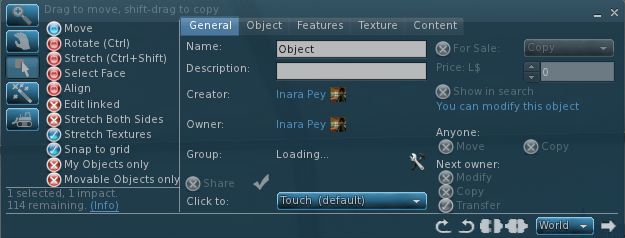
One potential area for discussion is that of the build floater. This has already received various degrees of attention within various TPVs, with some adding extra tools and capabilities (such as the prim alignment tool) others even giving it a complete overhaul in terms of presentation. Capabilities such as pathfinding, which sees an additional information panel added to the Build floater, stand to make it even more crowded. So there is a question to be asked as to what might be done to update / improve the floater in order to provide better access to tools and options – and this potentially falls into the remit of the CCIG.

The current official build floater (l) and the Pathfinding build floater (r)

Of course, TPVs are free to determine how they wish to develop floaters, etc., for their audience – and they do take a lot of feedback from users in doing so. But the CCIG offers an opportunity for developers and creators to work together on ideas and to develop proposals that can be fed back to Linden Lab and possibly influence their thinking on things – and even help them determine what needs to be done in order to make the tools and floaters with the viewer more accessible and user-friendly.

Given the CCIG is still formulating itself, now would be an ideal time for builders and creators who haven’t previously attended meetings to pop along and get a feel for what is going on.

There is a wiki page which contains the meeting agenda and links to meeting transcripts. If there is something specific you would like to see discussed, drop Geenz Spad a line in-world to have it added to the agenda. Meetings themselves take place every Tuesday at the Hippotropolis Auditorium in SL, commencing at 15:00 SLT. See the links below for more details.

Related Links

A new TuTORial from Torley Linden!

So, I log on to my You Tube account, take a look at my subscriptions, and what do I find?

A video from Torley!

I don’t seem to have the old SL video links box appearing on my SL account dashboard, so no idea if that has gone or the page simply isn’t loading correctly & whether the video is listed there.

But a video TuTORial from Torley! Yay!

Is this a resumption of Torley’s excellent work? And if so, and assuming the lack of video lists on my Dashboard isn’t a glitch – can was have them back on the Dashboard page as well as on the YouTube channel, please, LL?

LL revises SL age verification

Note: On the basis of comments received, I’ve added links to past articles on age verification that will hopefully provide additional context.  

On Monday July 9th, Linden Lab made substantial revisions to the SL Age Verification system.

The Changes

The Age Verification section of the Dashboard Account services has been removed, and the Age-restricted Content section of the SL Knowledge Base has been revised. The key change is that the ability to access adult content is now determined on the basis of the date-of-birth a user supplies during the account sign-up process, as the Knowledge Base article makes clear:

“When you register for Second Life, you provide your birth date, because you are required to be at least 16 years old. If you are 13-15 years old, you may be allowed if you are restricted to the estate of a sponsoring organization. For more information, see Teens in Second Life.

“To access adult content, you must be at least 18 years old.”

Age Verification: the old (l) and gone from the new (r)

These changes mean that age verification is now the de facto means of determining a user’s ability to access adult content – the “either / or” link with having payment information on file (PIOF) is broken. While land holders can still additionally control access to their land by restricting it to those with PIOF, the new policy makes it clear that they must set access to those aged 18 or over if they have any adult content:

“Limiting land access by age

“Estate and parcel owners of adult-rated regions must limit access to Residents who are 18 years of age or older. Underage Residents are blocked from entry and receive a notification to this effect.”

In line with this,changes have been made to both the ESTATE tab in the REGION / ESTATE floater and to the ABOUT LAND floater in the latest Beta and Development viewer releases (and may already be in some recent TPV updates) – expect to see the changes in all viewers in the near future.

How the About Land floater has been updated to reflect the new policy. As it was (top) and as it will shortly appear in viewers (bottom)  – from the latest SL Dev viewer

At the same time, the land maturity ratings have been updated to replace references to age verification with the term “at least 18 years old”. Users must still set their content preferences within the viewer in order to access all land ratings – again providing their date-of-birth allows them to do so.

Issues

Following the change, users immediately began experiencing issues with accessing adult-rated land, with some finding they could now only set viewer preferences to GM where they were once GMA, others apparently finding they were unable to access adult content where they once could and so on. Reasons for the problems are unclear – but they were enough for LL to issue a Grid Status update on the 9th as more issues were reported:

“Age Verification Error

“[Posted 2:40pm PDT, 09 July 2012] We are aware that there are some issues with trying to access restricted areas of the grid.  We are looking into the cause and expect this issue to be resolved by the end of the day.  In the meantime if you need assistance with verifying your age, please contact support.”

Whether the situation was the cause of the “unscheduled maintenance” which commenced not long after is subject to speculation. Currently, it is unclear as to whether all issues have been properly resolved.

Commentary

User issues aside (and without trivialising them), this would appear to be an attempt to streamline the age verification process and make it less user-intrusive (using sign-up DoB rather than asking users to manually verify). Some of the thinking here may also be that under-18s could be signing-up under supervision (parental / teacher), so removal of the Age Verification option from the account dashboard does remove the temptation for young minds to alter things after-the-fact.

What is regretful is that Linden Lab has made no formal announcement on the change ahead of time. There was (again) nothing on the blogs or posted (so far as I can tell) to the forums. Thus, users have been left to either stumble on the changes by studying the Knowledge Base or through a head-on collision with problems resulting from the change, leaving them confused and not a little upset / angry.

Related Links

With thanks to Nyll Bergbahn. 

AvaCon declines SLCC 2012

Update July 11: Fleep Tuque has posted commentary on the SLCC situation. The post is not an official commentary on the situation from AvaCon, but Fleep does have a valid perspective on matters, having been on the board of AvaCon and worked on previous SLCC events. Some may not agree with her views, but even if this is the case and some feel a need to respond, I would ask on her behalf that they do so reasonably and politely. 

There has been much speculation on Twitter and in blogs recently as to what is happening vis-a-vis this year’s Second Life Community Convention (SLCC), originally slated to take place in Boston.

SLCC events are usually held in August each year and have been organised by AvaCon on behalf of Linden Lab. I managed to cover SLCC 2011 in some measure last year and had been one of those looking forward to this year’s convention. However, with August fast approaching and no news from AvaCon or Linden Lab, speculation was rising that the event would not be taking place.

Today AvaCon have spoken up on the matter, posting a statement on their blog which reads in part:

Due to changes in the terms of the contract offered by Linden Lab this year, AvaCon has declined to organize a Second Life Community Convention in 2012.  We continue to pursue our overall mission and are focusing our attention on other activities and events that promote the metaverse.

Doubtless there will be much speculation as to what the changes to the contract may have been and why AvaCon felt unable to agree to them. But for now, and unless another organisation is willing to step into the breach and organise something at a later date, it would seem as though SLCC-2012 is officially dead. Whether this is true for SLCC as a whole, remains to be seen.

With thanks to Crap Mariner.

Metareality discusses the “RedPoly” approach to mesh deformation

Note this is a 2-page article. Use the page numbers at the end of the piece to page back and forth.

Today’s Metareality podcast covers, as usual, a lot of topics, including Cloud Party and, more particularly the possible alternative approach to mesh deformation as proposed (or possibly re-proposed, given LL apparently looked at the same idea last year) by RedPoly, and which I covered in an earlier report this week.

The panel for this panel for this week’s show comprised Kimberly Winnington, aka Gianna Borgnine in-world and Karl Stiefvater, Qarl Fizz in-world, who were joined by Cyclic Gearz  and Geenz Spad.

While you can hear the broadcast in full over at Metareality, here’s a transcript of the discussion around the alternative means of mesh deformation.

[02:47] Gianna Borgnine (GB): So what is this new deformer, and how is it different? … For what I understand it works on bone definitions, is that right?

Geenz Spad

[03:07] Geenz Spad (GS): Well, basically yes, it uses several unused bones in the avatar skeleton … I guessing were used at some point to calculate the bounding box of the avatar on the server for collisions or similar. So, that’s mostly what it seems to be right now.

[03:30] Qarl Fizz (QF): I can probably add some more, but I should also specify that this is complete speculation because I haven’t had a chance to dig in … It seems like, yes, for the purposes of physics and maybe other stuff, at one point the Lindens had this approximation system put in so that when you dial your avatar sliders around, they have a basic gist of what your avatar looks like. And someone came up with the idea of using this information to do the deformation instead of the actual morphs themselves.

[04:10] GB: So, Cyclic, maybe you could answer this best: what about this is so appealing to the content creators?

[04:15] Cyclic Gearz (CG): Well, from my perspective, well, I make furniture mostly, but I still know a lot about design and stuff …  And all my designer-friends who make clothes … and part of the most difficult and annoying process is having to make five separate sizes currently, because at the moment that’s the best option for attracting the most customers – having more sizes that fit more bodies – if they have a deformer that works as is, and they do the work outside of Second Life, it reduces the workflow, it reduces the time to make new things; [it] means that they can get more stuff out and therefore more customers are happy.

[04:55] GB: So my guess is, I mean I talked to a few different people and got a few different opinions, and it was interesting to see the different sides and probably the only person I talked to … who wasn’t as thrilled about it, other than some of the developers I talked to, was Maxwell Graf, who is always looking to get rid of extra sizes, so I thought he would be excited! But for him, one of the big things was that it still felt like so much extra work because now he’s back to weight painting, which is something he was trying to get away from with Qarl’s deformer … But the thing that, as a person who does not make mesh fashions … Right now at least, you’re sort-of weight painting, but you’re painting blind, because you have to upload it to see the effects of what you did. Is that right?

Avastar in use

[06:06] CG: Sometimes; it depends on how you make your mesh. For instance, with blender you can get a plugin which you can pay for called Avastar by Gaia Clary. That is a really good way of seeing what your weight painting does and has an affect. You can also get a free burn file for Blender which is called The Avatar Workbench, also from Gaia Clary, where it has got all the bones and stuff and you can see what it’s supposed to look like. But you do sort-of have to guess … if you’re not versed in mesh or anything like that, and weight painting at all, it can be quite daunting. So from that perspective, not having to weight paint would be better for newer creator, because they’d be able to build something in blender or a different commercial program and not have to weight painting, because that is really horrible stuff! But … I do think people need to learn these skills, because the skill you learn for making 3D in Second Life can be applied in real life for big jobs … you could go into the games industry making models and stuff; but if you can’t weight paint, you’re out of luck!

[07:22] GS: Personally, I used to be an artist before I was programmer, and 3D animation was something I was always very interested in, and I definitely know the pains of having to go through and paint a variety of different vertex weights for different bones and things like that. And one thing that seemed interesting to me to the new approach to a deformer that works across all viewers that support mesh is that … you have 20-something bones you currently have to rig if you really want something that really looks good and really deforms well on most avatars with regards to just an avatar moving around; now you have all these additional bones you now have to worry about. That really seems to be the biggest drawback here. Granted, there are ways to mitigate this, and as I was saying on Monday, someone should find a better workload for this if it’s really going to be a viable solution.

[08:19] GB: Which made you really unpopular…!

[08:23] GS:  (Wryly) yes, because I’m a terrible person for suggesting something rational here, I guess!

[08:49] QF: So, I don’t know actually how this works, so may be you can help me, Geenz. So, what I said is true, right? These are like pseudo joints that the visual params modify to kinda …

[09:09] GS: … Kind-of get an idea of how big the collision capsule server-side should be – that’s what I’m guessing, you know? I could be wrong.

[09:12] QF: but you can’t visualise these in Blender at all, can you?

[09:18] GS: You pretty much have to manually add them currently.

[09:20] QF: So there’s no good way to … like Cyclic was saying, painting weights is hard, but you’re painting weights for … totally blind, right?

[09:33] GS: The worst part is here … there’s no guarantee that these will actually stick around in future versions of Second Life. I mean for all we know, after RedPoly outing it, Linden Lab may remove it in X number of months or they may keep it just because they’re afraid people began making content – and we know linden Lab’s policy on content breakage – So its either they’re going to break it now, or they’re not going to break it because people are going to make content with it. Danger of content breakage, here we go!

[10:10] GB: Well, Linden Lab is going to have to weigh-in at some point, because as it stands right now, it doesn’t deform around breasts or saddlebags or anything, so they would have to add in order to make it work right, right?

[10:23] GS: And on top of that, from what I can tell, the skeleton that’s being used is mostly just a rough approximation of the avatar itself in terms of its shape. That’s all you’re really going to need if you’re going to calculate a bounding box or a bounding capsule or something like that.

Continue reading “Metareality discusses the “RedPoly” approach to mesh deformation”