Designing Worlds has announced a special programme to discuss the recent Linden Lab Terms of Service changes. The changes, which first appeared on August 15th, have led to concerns over the extent to which they require the granting of non-exclusive rights over content uploaded to the Lab’s services, as listed in Section 2.3 of the updated Terms.
The Design Worlds programme will be recorded on Tuesday October 29th, and will feature a special panel of representatives from across the creative sphere including artists, writers, designers, the legal profession and representatives of the United Content Creators of SL.
Not all of them may necessarily hold the same views – as Designing Worlds points out, while some see the changes almost entirely negatively, others see them as perhaps opening the door to potential new markets for their digital creations, and believe that the Terms of Service (possibly in an amended form) are the way forward. So the debate may well be interesting in the spread of views and comments.
As a part of the programme, Designing Worlds want to hear from the greater SL community. It doesn’t matter if you’re a creator within SL or a consumer (or both). If you have a question about Section 2.3 and how it may affect your business or your in-world time in general; if you’d like clarification on what it all means or how and where you might be affected; Designing Worlds invite you to e-mail them with your question, or leave it as a comment below the programme announcement on their website, and they’ll endeavour to put it before the panel.
On October 18th, Jessica Lyon poked me about an upcoming blog post she was preparing for Firestorm which would make mention of a 64-bit Windows build, offering me the opportunity to talk to her about it ahead of the announcement going public.
At the time, my schedule was such that I couldn’t get back to Jessica immediately, so by the time we did get things worked out, the official blog post announcing both the team’s immediate plans for their next release and the arrival of 64-bit flavour of the viewer had been published. However, this didn’t stop me from taking the opportunity to sit down with Jessica and members of the team at the Cheeky Tiramisu Café late one afternoon in order to find out more about the promised “Firestorm 64”.
Meeting with some of the team: Miro (centre-left), Lassie, Ed, Whirly, and Jessica.
64-bit versions of SL viewers have been in demand for a considerable period of time. There has been some degree of resistance to them in the past, although there are a number of developers and self-compilers who have produced their own 64-bit versions of one viewer or another. The resistance has been for many reasons; Windows viewers are already Large Address Aware, for example, allowing them to use the additional memory common to computers using the 64-bit version of the operating system, thus helping to negate one of the biggest reasons for developing a 64-bit build.
Given that 64-bit builds have been seen as potentially problematic in the past, I started by asking what had prompted the Firestorm team to decide to go ahead with one.
“Our Windows 64-bit code was developed by Nicky Dasmijn as a sort of side project she wanted to do to scratch an itch she had,” Jessica informed me. Nicky, who started-out contributing code to the project, is now the project’s Lead Developer. Sadly, she’s also a little camera-shy as well, and managed to successfully escape my conversation with the team, hence why her profile picture appears here.
Nicky Dasmijn – Firestorm’s Lead Dev and Win 64-bit coder
Jessica went on, “None of us were expecting her to drop the code into the repo when she did; but since she did, and since we had already decided to do a public beta, I figured, ‘Why not? Let’s get it out there in alpha form to see public reaction, and to see what the cost versus benefit might be’, neither of which we know for sure yet.”
I noted that when discussing 64-bit viewer builds at a recent Firestorm Q&A, there were concerns from the team about potential issues with maintenance, such as bugs and additional regressions, and for how it might negatively impact support were they ever to try for 64-bit viewer versions. I wondered what else had changed, other than Nicky working on the code herself, to persuade the team to push ahead on the 64-bit front.
“The expectation is that the 64-bit version won’t have different bugs than the 32-bit,” Jessica replied. “In fact the hope is that it may have better performance and fewer crashes, which if true, should actually take some load off our support team. But we don’t know for sure as we’ve only tested it on a dozen or so computers.”
Miro, Lassie and Ed
I wondered if trying to offer a 64-bit version of a viewer might be the proverbial catch-22 / can of worms situation: the viewer needs to be put to public use in order to see what the response to it is like, but if it is put into public use, it’s going to be awfully hard to prevent it becoming an accepted and expected version of the viewer.
“Well, the feedback will determine whether we move forward with it, but I think chances are good,” Jessica said, before giving me a wry smile, “As for the can of worms; yes, we’ve opened it, and we’re not going to be able to get those worms back in it now. Folks are going to want it, many will want it even if there is no noticeable benefit.
“But other TPV’s are also working on 64-bit windows too, I spoke to Latif [Khalifa] from Singularity and found out he also has coded up Windows 64-bit for them. So to add another metaphor to the mix: the cat is out of the bag, and x64 for Windows is going to happen with or without us, and due to user demand it will likely become a standard presence going forward.”
Update October 26th: As noted in the comments, it appears that the new client may be using the OnLive streaming service / application. This has been reported in a recent comment on the forum thread linked to in the article, and also in a further thread on the subject.
Linden Lab has been issuing an e-mail to a limited group of users inviting them to sign-up to be a part of a beta test for a Second Life client for mobile devices.
The e-mail, which has been popping-up in user’s in-boxes for the last day or so, reads:
We’re looking for enthusiastic beta testers to evaluate a version of Second Life designed for mobile devices.
Sound interesting? Then simply…
Visit [link removed] to create a FREE account with <link removed to be safe>, then
Visit [link removed] to complete a 5-minute questionnaire
You have to finish both steps to be considered for the beta.
We’ll email those selected when the program begins and check in periodically over the next couple of months to get their feedback.
This is your opportunity to be among the first to try a new mobile version of Second Life, and we hope you’ll help us to make it a great product with your input.
Thank you for your consideration!
Linden Lab
Some concern had been raised on the SL forums as to whether the e-mail was genuine or not. While some were able to confirm it was indeed genuine. However, just to be clear, I contacted Peter Gray, the Lab’s Director of Global Communications, and to ask whether the Lab would be prepared to point to any specific platforms they’re looking at (iOS, Android, Windows Mobile, etc). He replied saying:
The email you’re referencing did indeed come from Linden Lab. The originating address is related to the system used to send the messages out, and there was initially an unfortunate problem with links, which has since been resolved.
It’s too soon to share details about this service that would bring Second Life to mobile devices (as you can see, we’re beginning a limited beta test), but we’re hoping that with the help of some enthusiastic beta testers, things may progress to a point where we can share more information with the community at large soon.
Do note that the beta programme is via invitation only; there is no public sign-up page available – so don’t go looking for one! Also, not all of those responding to the e-mail will necessarily be selected to participate in the programme.
Lumiya for Android has been the ground-breaking mobile client for Second Life and OpenSim since its launch at the end of 2011
Getting SL onto a mobile device has been a much demanded option. As I reported in April 2012, Comverse had a stab at getting SL onto the iPhone back in 2008, complete with graphics. Back then, it required an intervening server in place and didn’t get too much further than an initial proof-of-concept.
However, mobile devices have come some way in terms of power and capbilities, although until now all moves in the mobile arena have been left to third-parties, with text-focused clients such as LittleSight and Mobile Grid Client on the Android platform, and Pocket Metaverse on iOS, and of course the incredible Lumiya for Android with its rich graphical capabilities and which I routinely cover in these pages.
It’ll be interesting to see exactly what the Lab have put together, and the code they’ve used – home-built, or perhaps using something like Unity3D? Time will tell!
Update October 28th: Transcripts from the panel are now available on this blog.
Update: The slides for Agenda’s presentation are now of a much higher quality (with thanks to Agenda in making them available outside of SL), and there is a link to a higher-quality video now included in the Related Links.
On Saturday October 19th, a panel of legal experts – real-life attorneys – sat down at the Rose Theatre, Angel Manor in Second Life to discuss the August 15th changes to the Second Life Terms of Service, address questions on the matter and remove some of the FUD which has built-up around the subject.
In attendance were Agenda Faromet, who in real life is an attorney specialising in privacy and internet law operating out of San Francisco, Tim Faith (SL: Yoss Kamachi), a Maryland attorney with a strong background in IT and who deals with matters related to copyright, IP, trademark, etc., and Juris Amat, a Massachusetts bar member who runs the Virtual Intellectual Property Organisation (VIPO). All three are members of the SL Bar Association, based in-world at Justitia.
In all, the session lasted just under three hours, with initial presentations by Agenda Faromet and Tim Faith (Juris Amat had difficulties attending the first part of the session). Tis was followed by a question-and-answer session moderated by Maxwell Graf, with Kylie Sabra relaying Juris Amat’s replies via voice.
A video of the session is available on-line, and there will be transcripts made available through other channels. What follows here are a series of audio files, which have been broken down from the main meeting for ease of listening, together with accompanying notes.
Agenda Faromet – Presentation (14 minutes)
This slideshow requires JavaScript.
Slideshow created from images courtesy of Agenda Faromet
Tim Faith (26 minutes)
Tim provides an overview of the SL Bar Association, before going on to talk about his own background. He then discusses copyright law and the concept of moral rights, both with regards to the United States and the rest of the world, providing an overview of terms such as “original work” and “exclusive rights” in terms of copyright, some of the general limitations on copyright exclusivity, how creativity itself can generate exclusive rights. He explains some of the natural and unavoidable complications of dealing with copyright in Second Life due to the nature of the platform, where almost every interaction impinges on matters of copyright, and why both Second Life could not exist if exclusive rights were absolute and why exclusive rights are limited through the likes of fair use / natural expiration.
He then covers why most licences used within Internet-based services are two-way, and need to be, and how Second Life might be said to differ from other on-line services such as Facebook, due to the ability of users to conduct user-to-user business. Finally he explains why people need to understand what their rights under copyright are, and to understand what might be being signed-away in accepting any contract; statements like “I clicked without reading” aren’t a defence – the legal system isn’t going to coddle people for not knowing their rights.
Looking at the Law (8 minutes)
Agenda and Tim discuss concerns arising from the Section 2.3 call by Linden Lab to “otherwise exploit in any manner whatsoever, all or any portion of your User Content (and derivative works thereof”, and the concerns that people have that this might allow the Lab to claim rights over such derivative works, whether or not they have been uploaded to Second Life. Includes a discussion unconscionability (procedural and substantive) and contracts of adhesion, and how they might apply to the ToS, together with and overview of changes to Californian law relating to arbitration agreements which may limit legal recourse.
Question and Answer Session
This has been broken into four parts for ease-of-listening. Questions for each part are given in text together with a times stamp for when they are asked / answered. Kylie Sabra substitutes for Juris Amat (who was unable to use voice) during the answers.
The Q&A session is split into four recordings, again for ease-of-listening. Each is given with the questions asked in the recording (and as entered into local chat during the meeting), so that readers can ascertain the order in which they’d like to listen to proceedings, should that have particular questions to which they’d like to hear answers.
Questions – Part 1 (23 minutes)
If the licence to LL stops being perpetual and irrevocable, wouldn’t that break people’s inventories and even content?
Is the ToS an attempt to place all of LL’s services under one document? Is this wise, given Google’s failure to do the same?
Has anyone talked directly to Linden Lab about its desire to expand licensure to other virtual worlds explicitly?
Does this not seem like a preparatory move prior to some kind of large-scale shift, either part of an exit strategy, a selloff or transfer of content (such as from marketplace to Desura)?
Are these current terms not technically illegal from a federal and international perspective, if for no other reason than the agreement was done under a certain amount of duress?
[11:10] Why shouldn’t creators be freaked-out by the “sell / resell”? – Includes discussion of the Visual Artists Rights Act.
[21:12] Does the new TOS apply only to items uploaded after you agreed to it? Or all your items from before also?
Qarl Fizz, formerly Qarl Linden, and Karl Stiefvater, former co-host (or at least resident guest) in the Metareality podcasts and also responsible for initially coding the mesh deformer, has announced he has “deleted” his region in Second Life. He explains why in a blog post which appeared on October 16th.
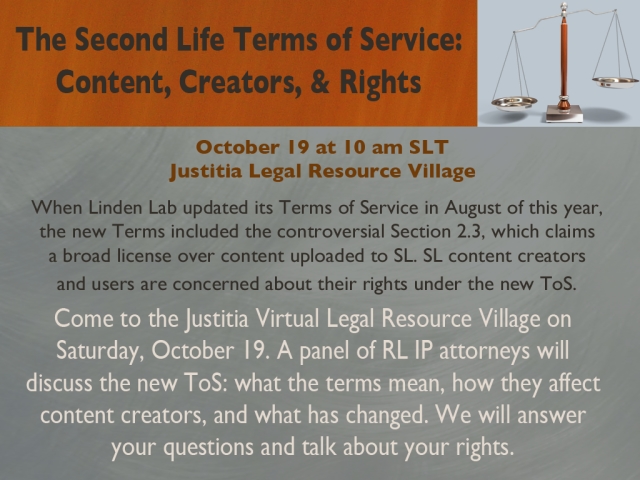
Following the concerns raised over the 15th august changes to Linden Lab’s Terms of Service (ToS), and specifically Section 2.3 therein realting to rights granted to Linden Lab in respect of user-generated content uploaded to their platforms, products, and services, a panel of real-life legal experts is to meet in open forum to discuss the changes, and concerns held by creators within Second Life.
The panel has been organised by Vaki Zenovka, who is a real-life attorney, who announced the meeting on her blog on Tuesday October 15th thus:
Please join me (as my alt, Agenda Faromet), Tim Faith, and VIPO’s Juris Amat — all of us IP attorneys in real life — as we discuss the latest changes to Second Life’s Terms of Service. We’ll take a close, detailed look at exactly what the controversial section of the new ToS means, how it affects content creators (and regular users), what changed from the old terms, and why people are so upset. More importantly, we’ll answer your questions and discuss how the Terms of Service affects your rights now and in the future.


 Inara Pey: Living in a Modemworld