The main reason for the warning is as a result of the recent Adobe security breach which resulted in the details of some 152 million Adobe users accounts – almost four times the amount admitted to by Adobe for incidents in October.
The blog post from the Lab carries the title Keep Your Account Secure – Never Reuse Passwords, and reads:
A recent security breach at Adobe gave hackers access to private information for users of Adobe sites and services. This included Adobe passwords, email addresses, and password hints. Second Life has not been compromised, but, this is a good reminder that it’s important to never use the same password for Second Life that you use elsewhere.
If you have reused your Second Life password on other services, particularly if you used it for an Adobe service, you should change it immediately.
After every large breach, fraudsters search for users who reuse their passwords on other sites, so if you use the same password for Second Life and other services, your Second Life account could be at risk if one of those other services suffers a security breach.
Anyone who has used their Second Life password with other on-line services may wish to consider taking the advice and changing their passwords as a precaution and for peace of mind.
It’s been several months since the release of the last Dolphin viewer update (March 2013). This means the viewer is lagging behind many of the 2013 updates from the Lab, including things like Server-side Appearance, materials, etc.
Lance Corrimal, the man behind Dolphin is not unaware that this is the situation. His real life this year has been such that it has required almost all of his attention (including starting a new job which sees him travelling and away from home a lot of the time), all of which has limited the time he can devote to the viewer, as much as he’d like to be able to do so.
In July and August he gave a couple of short updates on his situation, which I also passed on through these pages, and on November 22nd, he posted a further update on the Dolphin website, which reads in part:
I am not exactly happy about what I have to announce here, but this is how it is going to be:
The next Dolphin Viewer is not going to be around any time soon.
I have looked at the mess that my current state of the sources would produce, and I have (finally but far too late) come to this decision:
I will start from scratch.
Right now, taking the current Dolphin Viewer source and just “shoe-horning” in everything new from the official sources produces a terrible mess that does not compile cleanly, let alone works. Besides, the last Dolphin Viewer has a quite large number of features that don’t work any more, due to changes that the Lab has made in the meantime, temp uploads being one of them.
So, I’ll basically have to reinvent everything. That will of course take some time. I’m guessing “several months” right now, not the least due to the fact that with my new job that I have been doing since April, I’m travelling a lot, so I’m not even home all that much. I’ll see how much I can do on my company laptop.
I will go back to my usual “release early, release often” policy, as soon as I have something that is properly branded as Dolphin Viewer and has more to offer than just the name. I will plan to release at least a public beta as soon as I have something.
This would suggest that an updated Dolphin viewer is unlikely to emerge before the end of the year, and that we may be a few months into 2014 before one does. However, the upside of this is that Lance is not abandoning the viewer, which has enjoyed a loyal following. Patience remains the order of the day as he tries to balance the demands of real life and Second Life on his time.
One additional consequence of everything going-on for Lance right now is that he plans to eventually stop building / providing openSUSE rpm packages for some of the other third-party viewers; as he notes himself, he just can’t seem to pack more than 24 hours into a day.
Further news / updates from Lance will be reported as they become available.
The major topic of conversation during the course of the week has been the Lab’s announcement that they have released a new project viewer which can be used to make suitably rigged mesh garments deform to match an avatars shape as it is adjusted using the viewer Edit Shape sliders. It does so by using a modified version of the avatar skeleton and collision bones, as I was able to preview just before the project viewer was launched.
Rigged mesh deforming to changes to the pectoral sliders in the Fitted Mesh project viewer
Since the Lab’s announcement, the response from various sections of the community have been mixed. Some have welcomed the new with open arms; some have questioned the overall flexibility of the solution compared to others, some have regretted the “loss” of the deformer and some have reacted in outright hostility towards the Lab.
In terms of the technical aspects of the solution, Karl Stiefvater (Qarl Fizz), who coded the mesh deformer, took time out to leave a comment on STORM-1716, the JIRA for that project, which reads:
Several people have asked me – this seems like the best place to answer.
LL’s assessment here is mostly good. In almost all situations, the simplest solution is the best one – and collision bones are indeed MUCH simpler than the mesh deformer. As I see it, collision bones have two downsides: 1) they are substantially harder to use for the person creating the garment and 2) probably don’t track as well to the avatar shape.
In the end, the evaluation must be made by the content creators who use the tool.
I will reiterate that the two-year delay and refusal to communicate are unacceptable.
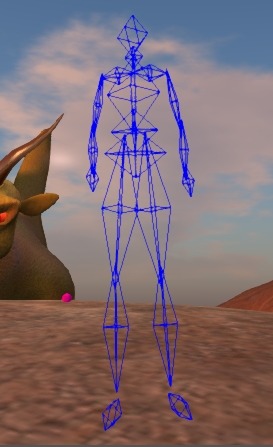
Avatar collision bones (image courtesy of Gaia Clary)
This would seem to be a reasonable assessment. The use of collision bones is technically easier and, as noted elsewhere, is less reliant upon a large amount of code being added to the viewer which then needs to be managed and maintained as the viewer evolves, but it does have some drawbacks.
Commenting further on the subject in the Metareality podcast on Friday November 22nd, Karl added:
It [the avatar skeleton] already had a bunch of these bones in it for collisions. I have never, ever notices that someone shoots a bullet at me, and my avatar is fat, it actually hits me as if I were fat … It’s incredible that they put that kind of detail into it ten years ago. But, OK, they did. So my feeling – just to head-off any drama – is that it’s a nice solution. It is definitely a simpler solution, which is preferred in all software engineering, and probably all of life.
He went on to reiterate the fact that a downside of the approach is that it can making creating and rigging mesh garments harder, although as William Reed Seal-Foss observed:
Well, speaking from an artistic standpoint … and knowing how to rig, that’s already not fun, and it’ll make it more not fun, but it’s not going to be like you have to learn to do something new.
Pressed on the matter, Karl reconfirmed that while the Fitted Mesh approach may have weaknesses, he does feel that it is a good solution, noting, “Obviously, I’m invested with the one that we did, but this is good. This is good,” before also noting that as a technically simpler approach, Fitted Mesh is likely to hold-up better over time when compared to the deformer.
This still leaves the question as to whether personality may have played a part in the Lab’s decision. In the podcast, Kimberley asks Karl outright if he believes this to be the case, and he indicates that he believes so, stating, “I heard back from two different people inside the lab that told me that Linden Lab would never accept my code.” One would very much hope that matters weren’t influenced on the basis of personality; but the fact that the Lab previously rejected code from Karl for reasons which appeared tenuous at the time, would seem to be point to there being an issue of some description.
The debate over the pros and cons of each system will doubtless carry on in some quarters, as will the theories as to why one was selected over the other. In the meantime, feedback on the Fitted Mesh viewer is being generated and the Lab is working on updates. In terms of the technical aspects / limitations of the system, it remains to be seen how they may impact things. As it is, the approach has arguably been used to good effect by the likes of Redgrave and other designers and has proven popular among consumers. Hopefully the same will prove to be the case as this solution proceeds through to a release status and as it is adopted by third-party viewers.
Most people are already aware that Linden Lab are working to integrate the Oculus Rift headset, and are also probably aware that at the start of 2013, Simon Linden did some initial work in enabling the Leap Motion controller to work with Second Life with very basic movement / action controls.
Simon’s work was not a part of any official project, but acted as a proof-of-concept as to what might be achieved using Leap Motion as an alternative means of avatar control to the keyboard / mouse, and he made the code available for anyone wishing to make use of it.
Since then, other have looked into the use of Leap Motion, with perhaps Draxtor Despres being the most noticeable of late, after he recently produced a video showing his work in SL / Leap Motion connectivity through the use of the GameWAVE software application which can be obtained from the Leap Motion Airspace online app store.
Now it looks as if Leap Motion integration into Second Life may become part of a combined project featuring Linden Lab, third-party viewer and open-source developers and Leap Motion themselves.
A surprise guest at the Third-party Developer meeting on Friday November 22nd was a representative from Leap Motion. However, as he was unable to speak due to voice issues, Oz spoke on his behalf, revealing that the company is very interested in having their controller “well-integrated” into the viewer.
“So they have been very gracious and provided us with some controllers to play with,” Oz informed those attending the meeting. “And they’re prepared to provide consulting and help for people who want to do it.”
As the Lab is already running a number of viewer-related projects (not all of which have yet been revealed), they are hoping the open-source / TPV developers will be willing to work on the project in order to get code contributed and integrated into the viewer.
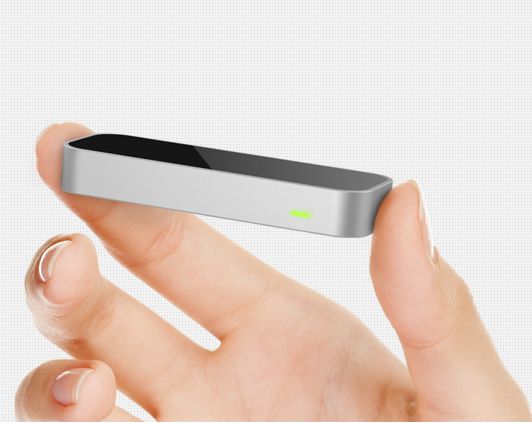
It is hoped that the Leap Motion device can be “well-integrated” into the SL viewer (image courtesy of leapmotion.com)
Whether the work will build on Simon’s initial proof-of-concept or form a totally separate project is currently unclear at this point, but at least the Lab have the code should it prove useful in giving the work an initial boost.
There is no official timescale for the project as yet, however developers who are interested in being involved are encouraged to contact both Oz Linden at the usual e-mail address, and the Leap Motion rep.
November is half-over and once again it’s time for the end-of-year Premium membership promo from LL – and Premium gifts make something of a seasonal return.
As usual, the offer is 50% off of membership for those upgrading, but only if they opt for the Quarterly billing plan, and the discount is applied only to the first quarter billing period.
There is also an e-mail circulating to users about both the promotion and the gifts. I’m still not clear why, whenever the upgrade promos are run my main account (which is Premium) gets the invitation to “upgrade”, while my Crash Test Alt account never does (and it has a separate e-mail address, so it’s not like I’m confusing the two), but hey-ho.
The image accompanying the Premium promotion e-mail
The Premium gift is designed to be of a festive spirit featuring a range of items, notably twelve empty cubes textured as gifts, together with teddy bears last seen in the SL10B premium gift vendors, now attired for Christmas; a thanksgiving candle; a Christmas candle; a poinsettia; “high” (26 LI) and “low” detail (15 LI) versions of an Xmas tree; and a Christmas wreath.
I’ll leave it to others to comment on the gift set. Instead I’ll just mention that the Premium promotion started at 00:01 on Thursday November 21st and runs until 00:01 on Wednesday 1st January 2014 (although at the time of writing, the small print of the upgrade page itself quotes the offer period as ” starts Friday July 26, 2013 at 12:01AM (PST) and expires Sunday August 11, 2013 at 11:59pm (PST)”. Oops.).
If you’re interested, I offered some thoughts on the matter a couple of years ago, and which probably still holds true today and might be worth reading before making the jump.
Some confusion occurred recently after some SL users started reporting they were receiving requests from Linden Lab for tax information, specifically to fill-out IRS form W9, Request for Taxpayer Information. The news of the e-mails sparked a discussion on the SL Universe forums, where opinions as to the cause of the e-mails was somewhat split, with some concerned as to why this should be happening and what it might mean, and others seeing it as a matter of routine.
On Tuesday 19th November, Linden Lab moved to try to clarify matters, issuing a blog post entitled Required Tax Documentation, which reads in full:
The Internal Revenue Service (IRS) requires Linden Lab to collect and retain Form W-9 (for U.S. residents) and Form W-8BEN (for non-U.S. residents) at certain transaction volumes. If you reach the transaction threshold and we do not have your completed and signed W-9 or W-8BEN on file, we are required to withhold funds from your account (at the current rate of 28% of your gross amounts received). Additionally, for U.S. residents with 200 or more transactions with a total amount in excess of $20,000 in a calendar year, we are required to file a Form 1099-K with the IRS reporting those transactions for that year.
If you are required to submit a W-9 or W-8BEN form to us, we will email you before the end of the year with instructions on how to do so. Please follow the instructions to complete and submit the required Form W-9 or W-8BEN within thirty (30) days of receipt. You will only need to complete this paperwork once unless your information changes from year-to-year. If you do not receive an email from Linden Lab, we do not need you to complete these forms.
While the blog post is welcome, some confusion and concerns remain.
One key area of confusion is exactly what constitutes a “transaction” – is it related solely to cashing-out from Second Life, or is it based on the number of user-to-user transaction through the LindeX (i.e. the number of L$ sales a person makes per amount of L$ they offer on the LindeX? Or is it somewhere in between?
A potential cause for concern is that many people cash-out via PayPal, and are also required to fill-out the requisite forms mentioned by Linden Lab, so there is an understandable level of worry as to the risk of double reporting. While this is not strictly Linden Lab’s issue, it is nevertheless a genuine cause for concern.
It has been suggested that one way to clear-up some of the confusion and concern might be for additional explanation to be given through the likes of a Knowledgebase article linked to the entry on account balances and withdrawals. Another alternative might be through an official wiki article dealing with tax liabilities as a whole, much as there are similar entries dealing with matters such as European VAT.
 Following-on from their reminder / warning about purchasing L$, the Lab has issued a warning about keeping SL passwords secure.


 Inara Pey: Living in a Modemworld