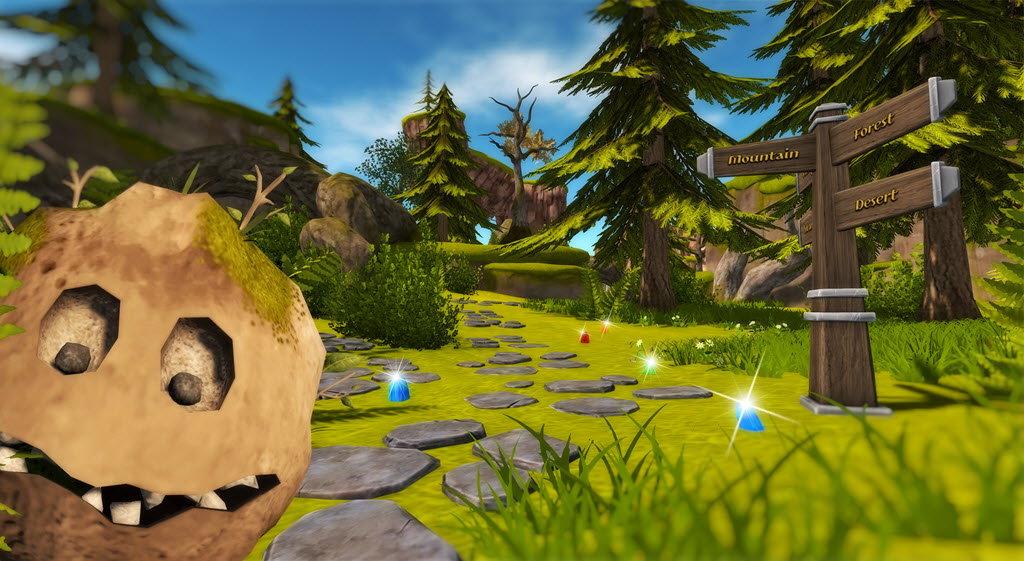
The re-vamped Linden Realms and rock monsters. Credit: Linden Lab
During the Content Creation User Group meeting on Thursday, November 29th, Oz Linden announced that Linden Lab will be open-sourcing the code used within the Linden Realms game to content / experience creators.
The aim of the move is to make the code available to (Premium) users wishing to build interactive experiences / games within Second Life, so they might study it, re-purpose elements from it, and even critique it.
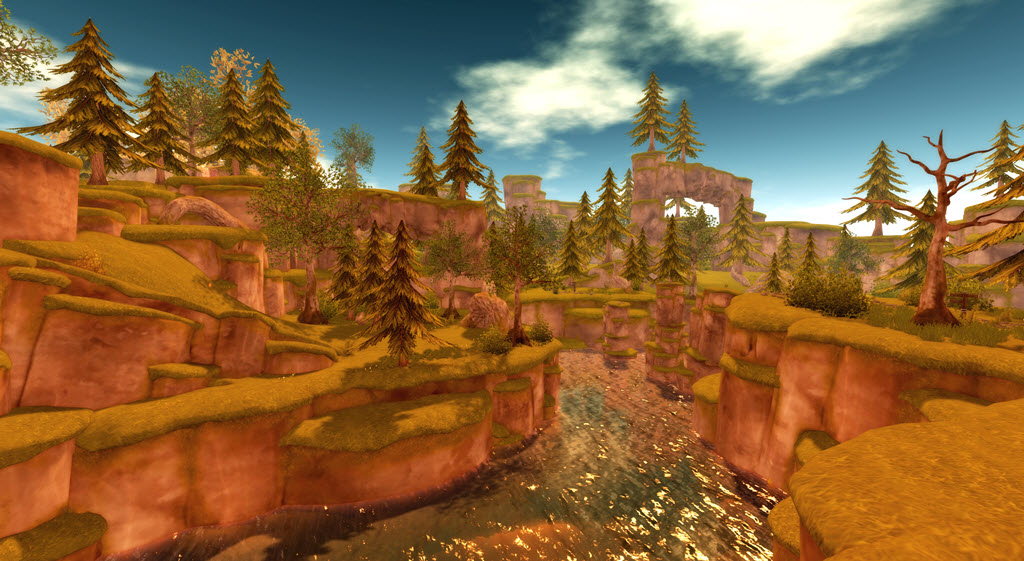
The release, when it is made, will be of the latest iteration of Linden Realms, which was updated in October 2018 to provide a completely new look and offer a broader range of game elements. It is also supported by end-user documentation on how to play the game, which might also be useful to experience creators in generating their own supporting end-user games.
Making content like this available to a wider audience is something that has been requested on numerous occasions during Content Creation meetings. The move also fits into the broader pattern of the Lab involving creators and users in the development of capabilities within Second Life – as Vir Linden noted during the meeting when Oz made his announcement. Given that the code is to be open-sourced, it means that updates and improvements to it – or new capabilities / options added to it – could be contributed back to Linden Lab, and thus to others building experience-based games.
Part of the re-vamped Linden Realms. Credit: Linden Lab
The move is also potentially in keeping the Lab’s hope to increase the Second Life user-base. Games are an obvious means of attracting new users to a platform, and providing the means for creators to develop and run more comprehensive games using mechanisms that both work and which can potentially be extended and enhanced. Coupled with the means to bring users directly into said games – such as by the new user API and / or Second Life Place Pages (although the latter do perhaps require further enhancements themselves to be more practical) – they might come to assist in attracting new users. Time will tell on that.
It’s not clear exactly when the code will be made available; as Oz linden noted, it requires careful checking to avoid the risk of code that could be exploited to the detriment of Second Life. Hopefully, there will be an official blog post when the code is made available to all.
On Thursday, November 29th, 2018, the serving committee of the Linden Endowment for the Arts gave notices that the LEA will be undergoing restructuring, which will include – for the initial part of 2019 – the closure of the 20 Artist In Residence (AIR) regions currently held by the LEA (LEA 10 through 29).
The core part of the announcement reads as follows:
Come January 1st 2019, the Linden Endowment for the Arts, known as the LEA, will be temporarily closing its Artists in Residence regions (LEA 10 – 29) to allow for a major restructuring.
Over the last seven years, these regions have been open for artists who apply to build their dreams, each for a six month grant. We have seen many great installations here – and some that have attracted controversy.
The nine Core regions (which include the Theatre, the Sandbox and Photohunt) will remain for the present, and short-term grants will still be available in these regions for community-inspired arts projects.
Discussions between the present Committee and Linden Lab about the future form of the LEA are ongoing, but it is anticipated that there will be a new organising committee when the AiR regions re-open.
While it is undeniable the LEA has done a huge amount of good for art and artists in Second Life, particularly those who would not otherwise be able to amount large-scale events, it has also not been without its own controversy and for – in some circles – gaining a reputation for being something of a “star chamber” in terms of the committee’s method of operation.
For example, in 2013, just 18 months after the LEA was formed under the tenure of Mark Kingdon as the Lab’s CEO, the former Community Manager, Mark Viale, was forced to step-in after public concerns and reported irregularities with how the LEA was being run. That resulted in the formation of the LEA Committee bylaws. Intended to offer transparency, the bylaws perhaps resulted in the opposite by allowing what were effectively closed-door meetings, few of which generated public transcripts or notes. The bylaws themselves became in part a subject of controversy in 2015, when they were quietly removed from the LEA website when the committee of the time was challenged under them, after a committee member griefed an art gallery (for the record, the bylaws can still be seen via the Wayback machine).
Second Life 1999 / 2017 – The Story – LEA 25, 2017 – read more here
Given this, some might feel reviewing and revitalising the LEA is something that is well overdue; a view I would share. I would certainly hope that any new committee – allowing for any ideas Linden Lab may have – that may be formed, should the LEA continue, would seek to better engage with the broader arts communities across Second Life, and seek to go about its work with greater transparency with meetings and through the keeping of public records.
In the meantime, those wishing to apply to use one of the core regions, which are available for 3-month grants (longer by arrangement) can do so via the LEA Core Sim application page.
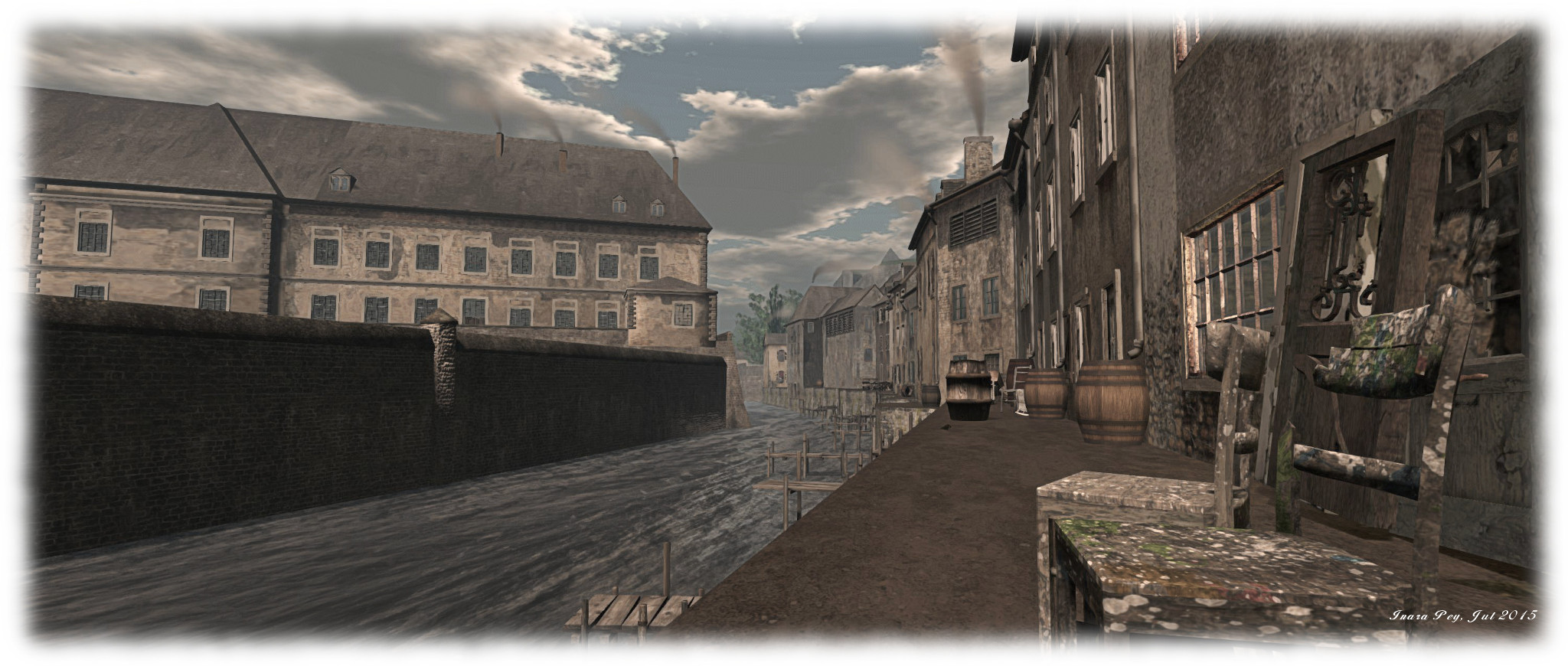
In July 2015, I wrote at length about Pfaffenthal 1867, a 5-region role-play environment and historical project accurately recreating the City of Luxembourg, circa 1867, and founded by Second Life resident Hauptmann Weydert (Weydert), also known as Pit Vinandy in the physical world.
At the time of my 2015 article, Weydert / Pit and his team were very much focused on the immersive opportunities presented by their environment. Thanks to the fledging work Linden Lab carried out in trying to bring Oculus Rift compatibility to Second Life, Pfaffenthal 1867 was at that time featured as an exhibit hosted by the Luxembourg City History Museum, which gave visitors the opportunity to visit and explore the virtual recreation of Luxembourg using the Oculus Rift or via desktop.
In this, the exhibition was part of a broader outreach by the group, with Pit also hosting workshops on virtual environments involving the general public and schools, in association with the Fortress Museum in Luxembourg and the Luxembourg National Museum of History and Art.
I mention all of this because at the start of November, 2018, I dropped into a new experience in Sansar. Called simply 1867, it is the work of Pit and his team, working under the VR Creative banner, presenting both the next step in Pfaffenthal 1867’s development and an opportunity to renew and further the work in presenting immersive, educational historical recreations to the public.
It’s an ambitious project – possibly the most ambitious experience yet attempted on Sansar. The aim is to make full use of Sansar’s massive 4km on a side virtual space and offer a fully immersive historical environment for both social and educational use, with high-resolution topographical maps being used to build-out the experience in stages.
Despite being in the early stages of development – many of the buildings that have been placed are little more than blocks awaiting surface detail (or complete replacement) – 1867 is already being promoted to the people of Luxembourg.
Since the start of November, for example, the project has been the focus of a series of weekday sessions at the Forum Geesseknäppchen, a campus occupied by a number of academic institutions in Luxembourg City. As reported by one of the city’s daily newspapers, the Lëtzebuerger Journal, the sessions are intended to encourage local interest in, and potential involvement with, the project, and will continue through until December 14th, 2018.
“We clearly see this as a collaborative project that is about to gradually create this world of 1867,” Vinandy emphasises. Therefore, he expects a strong participation as soon as the project is publicly available. In addition, he hopes for a lively participation of home owners and companies who want to see their part of the city represented.
In this, 1867 doesn’t sound that different from the public outreach undertaken with Pfaffenthal 1867, however, the opportunity to present richer, more immersive educational opportunities as well as a social VR experience is very much the driving force behind the Sansar development, again as the Lëtzebuerger Journal notes:
Vinandy sees particular interest for students, students and historians who can fully immerse themselves in the past “For example, we want to specifically invite teaching staff to take their school classes on a journey through time,” he says.
– Virtual Time Travel, Lëtzebuerger Journal, November 2nd, 2018
In order to focus on the project – and as revealed by Jo Yardley in a tweet while I was working on an earlier draft of this article (one pending an opportunity to chat directly with Pit about both 1867 in Sansar and the wider work of VR Creative) – Pfaffenthal 1867 is to be shut down in its entirety from Monday, November 26th, 2018.
This news has been greeted with some surprise, given that Sansar itself has yet to gain lot of capabilities needed for it to become a more rounded immersive experience – such as richly interactive non-player characters or working forms of transport such as trains, horses that can be ridden and boats, all of which would certainly enrich a setting like 1867. However, these will come in time, and it is going to take time to properly build-out 1867. As such, I doubt the lack of such capabilities or the lack of period clothing are really issues for the project’s development – although the lack of them could initially discourage Second Life users who have engaged in Pfaffenthal 1867 from dipping more than a toe into Sansar and 1867.
What might be of greater concern is how well such a vast setting loads at the client end as it starts to be fleshed-out to the level of detail found in Pfaffenthal 1867 in Second Life. With some quite modest experiences in Sansar already being quite hefty in download size and load time, something on the scale of 4km on a side could prove to be a significant challenge unless Linden Lab have some clever means of more pro-active steaming and loading / caching still to come.
But, time will tell on that. In the meantime, if you have enjoyed previous visits to Pfaffenthal 1867 and would like to say farewell before it vanishes, can do so between now and Monday, November 26th, 2018. For those in the Second Life 1867 group, and who missed the in-world announcement, there will be a farewell party on Saturday, November 24th, starting at 10:00 SLT, at Café Neuen.
I’ll also hopefully have more on the 1867 project in Sansar as the work progresses, including the outcome of that conversation with Pit.
As always, please refer to the server deployment thread for the latest news and updates.
On Tuesday, November 20th, the SLS (Main) channel was updated with server release 18#18.11.09.521593, previously deployed to the RC channels and comprising internal fixes.
There are no planned deployments to the RC channels.
Due to the Fact the Lab is closed from Thursday onwards, it is unlikely there will be any deployments in week #48 (commencing Monday, November 26th).
SL Viewer
The Love Me Render RC viewer updated to version 6.0.1.521759 on November 20th, bringing it to parity with the Animesh release viewer.
Currently, the rest of the viewers in the official pipeline remain unchanged. Given this is US Thanksgiving week, the remaining viewers due an update for parity with the current release viewer may not be issued until week #48.
Current Release version 6.0.0.520636, dated October 18, promoted November 14. Formerly the Animesh RC viewer – NEW.
Estate Access Management (EAM) RC viewer, version 5.2.0.520057, September 28.
BugSplat RC viewer, version 5.1.9.519462, September 10. This viewer is functionally identical to the current release viewer, but uses BugSplat for crash reporting, rather than the Lab’s own Breakpad based crash reporting tools.
Project viewers:
Environmental Enhancement Project (EEP) viewer, version 6.0.0.521803, November 16.
Bakes on Mesh project viewer, version 5.1.10.520711, October 29.
Linux Spur viewer, version 5.0.9.329906, dated November 17, 2017 and promoted to release status 29 November – offered pending a Linux version of the Alex Ivy viewer code.
Obsolete platform viewer, version 3.7.28.300847, May 8, 2015 – provided for users on Windows XP and OS X versions below 10.7.
EEP
The next EEP function to see light of day should be llReplaceAgentEnvironment, that should allow an experience to override any environment setting currently being used by an avatar within that experience.
General News
Thanksgiving – Support Closed
Concierge Phone Support, Billing Phone Support, and Live Chat Support will be closed on Thursday and Friday, November 22nd & 23rd in observance of the US Thanksgiving holiday. Ticket submission will remain available, and support services will resume Saturday, November 24th, at 06:00 PST / SLT.
Winter Wonderland and 5 Weeks of Gifts
Winter Wonderland, the five-region activities area designed by Linden Lab and the LDPW, has reopened for the holiday season,, and the Lab is using it as the first swap on a gift hunt, which itself features the return of the Swaginator. Find out more via Grab Your Winter Swaginator & Collect Exclusive New Gifts!
Anmesh Halloween boogie, October 2017, Courtesy of Alexa Linden
On Wednesday, November 14th, Linden Lab announced the official release of Animesh, with the promotion of the Animesh viewer as the de facto release viewer.
Animesh has been in development for about a year, and like Bento, has been a collaborative effort between Linden Lab and Second Life content creators. Essentially, it allows the avatar skeleton to be applied to any suitable rigged mesh object, and then used to animate the object, much as we see today with mesh avatars. This opens up a whole range of opportunities for content creators and animators to provide things like independently moveable pets / creatures, and animated scenery features.
Alpha flipping: use of multiple mesh models to achieve a sense of movement by rapidly cycling through them via script, revealing and then hiding each one in sequence – in this can giving the illusion the squirrel climbs and swings from the bird feeder
One of the potential advantages with Animesh is that it might help eliminate the need to “alpha flipping” across multiple versions of a mesh creature in order to simulate its movement.
To explain: if you right-click and edit animated mesh creatures in SL, you’ll see that they can appear to have multiple parts, most of which are invisible. When they are active, a script renders then sequentially, causing each of the models to be rendered in turn before hiding it again using an alpha mask.
Like a set of flip book drawings, this gives the illusion of movement: be it a sheep or horse or cow raising and lowering its head to appear as if it is grazing, or a rabbit hopping back and forth over the ground, or simply mimic the movement of legs as an animal wanders along a pre-determined path. As long as the script is cycling the motion is repeated.
The problem with alpha-flipping is that is can be render intensive, impacting viewer performance, so the hope is – and as well as bringing other benefits – Animesh will, over time, hopefully encourage creators to switch away from alpha flipping methods of animation.
Animesh also includes the ability to attach a single object to an avatar (or two, if you are Premium) which can then behave independently of the avatar. Quite how this will be used remains to be seen – but again, one obvious option is more render-efficient pets, or perhaps an animated item of clothing that simulates being blown by the breeze, and so on. Another potential is with things like avatar tails – while Bento also allows for items like these, the use of an Animesh with its own skeleton could avoid potential conflicts when trying to use two Bento items that use the same set of bones in the avatar, and so conflict with one another.
There are some initial limitations with this release of Animesh. As a couple of quick examples: when it comes to pets, for example, because rigged mesh is used, it’s not possible to simply put a pet on the ground after carrying by using Drop so it can run around – you have to go via Detach and inventory. Also, there is no avatar shape associated with Animesh at present, which may limit its adoption for use with NPCs, as there is no real ability to custom body shape and size (the addition of a body shape to Animesh, and the ability to modify it via the sliders is being considered for a future Animesh project).
Animesh Resources
To help people get started with Animesh, there is already a range of available resources, including:
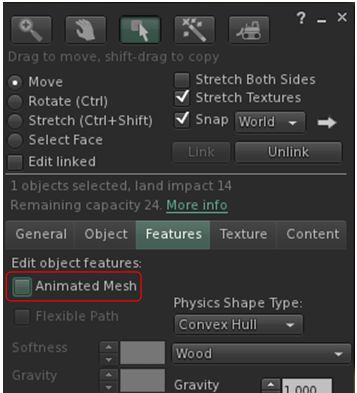
Rigged mesh can be set to be used as Animesh through the Build / Editor floater
In particular, the user guide and test content offer the best way of getting started with Animesh for those who haven’t tried it thus far.
Again, Animesh isn’t just for content creators: it has been designed such that just about any Rigged mesh can be converted to Animesh directly from the Build / Edit floater. Do be aware, however that simply converting an object will not cause it to start animating – you’ll obviously need suitable animations and a script to run them.
Like any other object utilising animation, this is done by adding the animations and scripts via the Edit > Contents tab for your converted object. If you’re not a scripter / animator, you can still use the Animesh test content and have a play around with things.
Quite where Animesh will go will be known in time – even at the Content Creation User Group meetings some fairly imaginative use-cases were being pondered by some (using Animesh in vehicles for animating wheels, for example). To try to help users find Animesh content, the Lab note they’ve created a new Marketplace category – Animated Objects – but going on a brief parse through what’s there already, this may need some form of curation if it is to be for Animesh – several of the items I notes didn’t appear to be Animesh – so be sure to read descriptions carefully and perhaps check in-world as good start to appear.
As with all things, Animesh can be subject to bug and issues, and Whirly Fizzle has created a JIRA filter for Animesh for easy tracking of known issues. If you do hit upon a bug or issue, do be sure to raise a Jira report and label it for [Animesh].
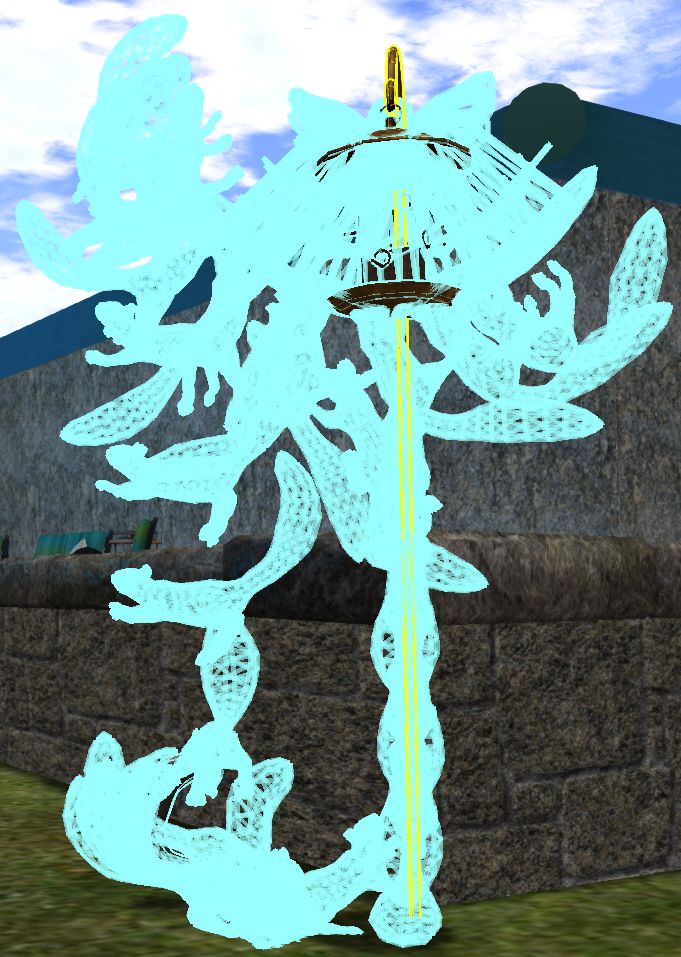
A razzle of raptors? Animesh used to animate rigged mesh raptors from Linden Lab
The next in the Lab’s in-world Town Hall series, featuring Director of Product, Grumpity Linden, Technical Director Oz Linden, and Senior Director of Product Operations, Patch Linden, will take place on Thursday, November 15th, 2018 at 10:00 SLT (18:00 GMT / 19:00 CET). The event will take place at the Town Hall meeting regions, with the landing point URLs as follows:
Selected questions from the Town Hall meeting forum thread (now closed) will be put to Grumpity, Patch and Oz during the session, and there may be an opportunity to ask questions from the audience, if time permits.
All things being equal, I hope to have a summary of the session up after the event, which will be similar in nature to my summaries of 2018 Town Hall meeting – see here for the September Town Hall with Ebbe, as an example.




 Inara Pey: Living in a Modemworld