On June 16th, I reported on the announcement that the first set of last names for the Premium Names Changes capability would be “retired” (i.e. removed from the list of options) at the end of Wednesday, June 24th, 2020.
Those names: Alpaca, Covfefe, Damballar, Float, Jazzhands, Mainsail, Nimble, Piggins, Plumday, and Yeetly – have all now gone from list of available last names.
They have, as of Thursday, June 25th, 2020, been replaced by a new set of names that have been added to the list of available last names. These are:
In addition, and as announced by Linden Lab at the launch of the above last name options, there are three additional last names added to the list to mark Second Life’s 17th anniversary theme. These are:
Wayfarer – Rover – Wanderer
These three names will only remain available through until the name round of updates, at which time they will be retired.
Name Changes was introduced in April 2020, providing Second Life Premium subscribers with a fee-based ability to change both the first name and last name for their avatar / account. If you are unfamiliar with the capability, you can read more here: Second Life: the return of last names, and some notes.
Katie Dey (l) released Dancing, a track from her new album myData on June 24th, 2020, which uses a machinima recorded in Second Life, filmed by Devi McCallion (r)
An album-length exploration of a long-distance relationship that unravels into an epic about love, connection, and all the strange, unruly factors that surround those things, from capitalism to sex to internet servers.
However, what is particularly interesting about the album is that the first track to be released from it on June 24th, 2020, and entitled Dancing, features a music video shot entirely in Second Life.
The video has been written and directed by another indie pop singer, songwriter and producer, Devi McCallion – perhaps most famous for her association with Black Dresses – with the assistance of Sofa (yogurt 200). Both the song – seen as something of a “striking new sound” for Dey – and the the video, are already garnering a positive response.
I’ve no idea if Katie Dey is a regular Second Life user, but she certainly appears familiar with some of the technical challenges in producing a video of this kind, commenting to D’Souza that:
This video was made entirely in Second Life, and I hope when people watch it they think about just how much work it would take to do that. If you’ve ever played that game you know how difficult it is to even control the camera, let alone create a whole world, with such incredible characters, such breathtaking cinematography.
Created remotely, across countries, in a pandemic, on a dying laptop, their lives in utter chaos, the world in chaos… I hope people cry about these beautiful characters, and then cry about the beautiful humans that put so much love and care into creating them. Anyway, the song is about dancing. Like, metaphysical dancing, I guess.
Video maker Devi McCallion, however, does appear to be something of a Second Life user. In May 2020 she hosted her own first-ever DJ set in-world, which can be seen on her You Tube channel, and some of her other videos contain elements that may have been filmed in-world as well.
I reached out to Brett Linden to enquire if Linden Lab were in any way involved in the video’s development – but it was apparently produced entirely independently.
I would love to say that we were involved, but we weren’t! It was completely organic and a pleasant surprise to us.
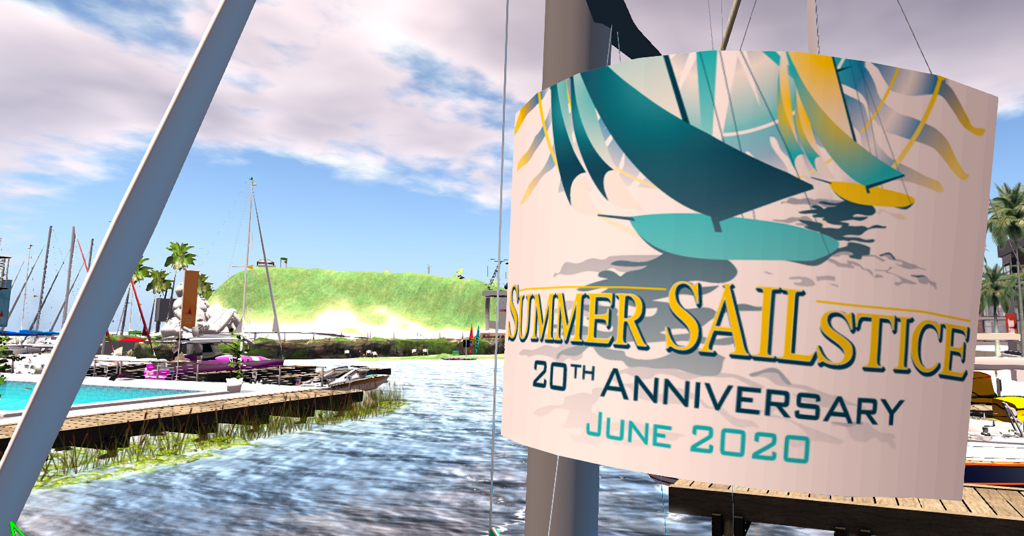
One real-world event is still going ahead this year – one that can make fairly good use of social / physical distancing – is the annual Summer Sailstice, which marks its 20th anniversary in 2020. However, because the SARS-CoV-2 pandemic can sill have an impact on sailing in the physical world – particularly for crews who may not all be in the same household – a special partner event is also being held in Second Life.
Coordinated by Second Life resident and sailor in both the physical and virtual realms, Dale Irata, and involving the Second Life sailing community, under the banner of Sailors in Second Life, the in-world event has offered physical world sailors an open invitation to come in to Second Life and share a weekend’s sailing and events at marinas across the grid and within popular sailing areas such as North Sea and Blake Sea – and the Second Life sailing community can get involved as well.
The Sailstice Expo Centre
To help engage sailing enthusiasts from the physical world to both understand Second Life and potential get involved in the virtual event, a number of on-line resources have been made available over the last couple of months, including:
The core event – as with the physical world one – takes place on Saturday, June 20th. However, supporting it in-world an in-world exhibition celebrating 15 years of sailing and boating in Second Life, featuring trade stands by some of the platform’s top marine designers and brands. Having opened on June 13th, the expo run through until Sunday, June 21st.
Folkboat racing: one of the many forms of sailing in Second Life
The events scheduled for Saturday, June 20th comprises (all times SLT):
Time
Event
Location
24-hours
Camping event – rez your boat for free all weekend
The Novice Regatta is especially for new SL sailors, and a free boat – the brand new Bandit 22 LTE – will be provided for eligible sailors! You won’t be on the course with folks who’ve been here before, so come out and have a really fun time! More details can be found in the SL Novice Regatta web page.
Follow the links above the event schedule for more information.
Names Changes, launched in April 2020, as most user know, is the ability for Premium users to select a first name / last name combination that’s to their liking and use it as their avatar / account name.
Under the system, first names are free-form, whilst last names are selected from a list – as used to be the case when first name / last name combinations were a basic part of the Second life sign-up process through until mid-2010.
Since the introduction of this Premium option (which you can read about in Second Life: the return of last names, and some notes) users have been asking when and how frequently the list of last name will be updated.
Linden Lab have remained somewhat vague on this latter point, although they have noted that names are liable to swapped out on the basis of how popular / unpopular they prove to be. That is, if a name is so popular it reaches a certain level of use or fails to reach a certain level of use within a given time period defined by the Lab, they would be “retired”.
On Tuesday, June 16th, the Lab announced that some of the last names made available in the first batch made available at the time the capability was launched have been determined to fall with one or other of these two limits, and so will be “retired” from use as from Thursday, June 25th, 2020.
Anyway wishing to make use of these names should now do so before the end of Wednesday, June 24th. Those who have already opted to use any of these names will obviously retain them. I assume replacement names will be made available / announced either at the time these names are retired, or shortly thereafter.
In terms of how popular the capability has been, the official blog post notes only that the response thus far has been “mostly positive”, although feedback at various meetings has suggested the response has been more poplar than the blog may suggest.
Earlier this month, I wrote about Professor Tom Boellstorff, and his move to teaching his course from the state-of-the-art Anteater Learning Pavilion at the University of California, Irvine (UCI) and into Second Life, as a result of the university’s desire to move classes on-line due to the SARS-CoV-2 pandemic (see: Tom Boellstorff: teaching digital culture in Second Life).
As noted in that article, Tom has been teaching a course entitled Digital Cultures (Anthropology 128C), utilising facilities he constructed at Anteater Island, where the students could study collectively and in working groups and also relax and socialise if they so wished.
Around 35 students participated in the course, and as a part of their work, they split into six research groups each one of which selected a specific aspect of digital culture they wished to study. Two of the groups focused on dating apps, one group studied ranking in League of Legends; one group studied the use of TikTok for education; one group studied fashion influencers on Instagram; and one group studied social interactions through virtual spaces an video games, using Animal Crossing as a reference point.
On Tuesday, June 9th, 2020, the six groups were at Anteater island, where they presented the results of their work. I was one of several Second Life users invited to attend the session (as well as it being generally open to all), and I hopped over in advance of the presentation to take a quiet look at the work and chat with Tom and the students.
Professor Tom Boellstorff (Tom Bukowski in SL) on the right, with student HannahUrban
Needless to say, it was an incredibly challenging quarter for everyone. Learning Second Life was a challenge for them (we also used Zoom), but of course the big thing was all of the difficulties due to the pandemic, from friends and family losing jobs, to working from their homes or apartments, to the isolation and dislocation. Then on top of that is now the George Floyd protests, in which many of the students have been taking a creative and active role.
So they are exhausted beyond belief, but also have done amazing work. We were originally going to have a room on campus where the groups could show off their research to anyone who wanted to come see. That can’t happen, so we’re doing it in Second Life instead!
– Tom Boellstorff (Tom Bukowski in Second Life) commenting on the course
and the move to using virtual / on-line tool sets
Student Michael Shaneman from “Group 5” studying socialisation via virtual spaces and video games, setting up his group’s presentation area.
The students I chatted all indicated they found the experience of using Second Life (none were already familiar with it) to be positive, if at times a little frustrating. Part of the latter was due to the need to look outside of the platform for some collaborative tools such as Google Docs, and part of it was down to UCI mandating the use of Zoom, which encouraged some students to step back from using SL, despite Zoom’s own lack of capabilities, such as break-out rooms.
The presentations themselves were conducted by the students in voice, using web media through a main board, with some of the groups also providing additional infographic boards in their presentation areas. Within each group, students took turns in introducing their project before walking through their methodologies – including direct interview with subject matter specialists, Q&A sessions with users and observational methodologies and then moving on to discuss their findings.
Some of the latter proved interesting. Those studying influencers, for example, noted that while followers tended to be aware they were being manipulated into potentially making a purchase, they nevertheless tended to more actively engage with an influencer and one another to form more of a community when the influencer would be more authentic in their views, outlook and appearance- and this has in turn started to alter how sponsors and brands respond to / use influencers.
Presenting findings in-world
Similarly, the group studying TikTok highlighted the fact that while it is a recent application intended for entertainment, it has taken root among “informal” educators – those wishing to pass on information / offer a means to impart information – due to its exceptional ease of use and its brevity of video length, the latter of which encourages a precise focus on a subject / message, whilst making the information easy to digest on the part of watchers. They also noted that the platform’s unique approach to interaction and feedback had also served to increase its popularity.
For me, the study looking at virtual spaces and video games as a means of social interaction was the most fascinating. Framed in terms of the pandemic, it really underlines the extent to which perceptions are being changed in terms of how video games with social aspects and virtual spaces can offer beneficial ways for direct, positive interaction between friends and between family members forced apart by the needs of physical distancing, helping to potentially open a new era of communication / interaction.
What was particularly impressive about this entire process is just how well it appears to have worked. From initial need to move to on-line teaching, through the creation of Anteater Island without overly disrupting the students work, through to enabling the study groups to function and bring together a set of engaging and informative presentations, the entire process itself is perhaps a case study in the making – and as I’ve noted, Tom has plans for just that, and I hope to be able to bring word on it in due course.
In the meantime, Anteater Island will remain open for visitors for the next several months, and the students have been invited to add more material if they wish. For those so interested in education in SL, it’s a worthwhile visit, as is following the links below.
My thanks to Tom for keeping me informed on things, and my congratulations to all the students involved in these studies.
Since that first article, I’ve provided a number of updates on the development, including that the client will be for both Android as well as iOS, and speaking at the Web User Group meeting on Wednesday, June 3rd, 2020, Keira Linden – who is the Product lead for the client – provided and update on process, the core points of which are bullet-pointed below.
iOS Client:
The iOS version is now in a closed alpha featuring some residents.
In keeping with the Lab’s plans, this version offers the ability to communicate via IM, and has a basic Friends listing.
Further updates will follow – the next being the addition of Abuse Reporting support and improved management for the Friends list.
Once the Lab believe the client has an initial set of functions to make it useful as a communications tool, it will will move to a beta phase and made available to a wider cohort of users for further testing.
Android Client:
Work is progressing, but it will take time for it to reach a point where it is ready for testing.
When it is ready, it will likely follow a similar Alpha / Beta test process to the iOS version.
General Capabilities
Note: this is a reiteration of notes from earlier updates on the SL Mobile client.
It should initially be regarded as more of a communicator / companion app than a fully-rounded client.
The initial intention for the client is to provide users with a means of maintaining basic contact with other users whilst away from their main means of accessing Second Life.
As such, it will support logging-in to Second Life services to support IM and group chat support. However:
It will not initially present you with an in-world location, nor will your avatar rez in-world, it will not not support local chat nor any form of world rendering.
Capabilities such as having an in-world rezzing location, the ability to chat locally, support for scene rendering will be added over time.
However, in terms of any in-world rendering, this will not be part of any initial released (in the meeting it was described as “not even Soon™”), as LL are focused in just trying to get the basic app available to users as soon as reasonably possible.
All information I’m able to provide through this blog, including future updates can be found under the SL Mobile tag, and can be accessed directly from the top menu options:
SL → User Group & Viewer → Viewers → Android & iOS and then selecting either:




 Inara Pey: Living in a Modemworld