As I’ve noted in various pieces in this blog, whilst the physical transition of Second Life services from dedicated hardware operated directly by the Lab in a co-location facility to running those services within an Amazon Web Services (AWS) environment was completed at the end of December 2020, work on the project continued through 2021 in refining how the various services run within the AWS environment and in work leveraging the better capabilities Amazon provide – hardware configurations, monitoring tools, etc., – to improve the performance of SL’s services.
Towards the end of that year in particular, the simulator engineering team was focused on what has been referred to as the “tools update” which, among other things, should bring improvements in the area of scripts, potentially allowing more scripts within a simulator to run per cycle, and even return some time to the simulator for other processing. It’s work that I’ve referenced in my own Simulator User Group (SUG) summaries and which has, more particularly, been moving through the simulator update process over the past few weeks to the point where it is now grid-wide.
Given this, on Thursday, March 20th the Lab officially blog on the update (as Monty Linden stated would be the case during the Tuesday, January 18th SUG meeting), the core element of which reads:
The release also includes a modernization of our compiler and supporting runtime. Newer tools allows for better code generation and awareness of modern CPU designs.
While the news is mostly good, a word of caution that with more scripts running, other areas of the simulation environment may be driven harder. Scripts that were already approaching throttles or other limits may find a throttle engaged; this also applies to remote services accessed via llHTTPRequest. We do see the possibility of revisiting these throttling limits as a result of these improvements. They could see higher request rates as scripts perform more work.
We hope that you enjoy the additional script performance for your regions. Anecdotes from region owners on the RC channels before release were generally positive. We are keeping an eye on the data with expectations that these improvements are here to stay. We hope that as the regions improve performance you will find ways to create and explore in ways that you could only dream of before.
Note the emphasis on the middle paragraph has been added by myself.
The blog post also outlines further updates to SSL support within the simulator hosts (simhosts), including all SSLv3, TLS 1.0, TLS 1.1, and related ciphers being deprecated for llHTTPRequest, llRequestURL, and llRequestSecureURL functions – although these changes do not affect log-in services, so users should not see any of the issues witnessed with the recently TLS changes to the login services.
Please read the full official blog post for complete details and context.
Logos via Linden Lab and High Fidelity respectively
Following the announcement that High Fidelity, the company co-founded by Philip Rosedale in 2013 and after his departure form Linden Lab, has invested money, patents and staff into the latter, the news hit a lot of on-line tech publications and even the Wall Street Journal – creating a buzz around Second Life that has so far, if we’re honest, somewhat eluded the Lab in the wake of all the broader “metaverse” chatter that has been going on.
Of these articles, the most detailed came via GamesBeat / VentureBeat (by the ever-informative Dean Takahashi), c|net and The Wall Street Journal (the latter via Archive to avoid the paywall)¹ that added butter to the bread of the original announcement, which I’ve summarised below, and which gave me further pause for thought.
To deal with the bullet point takeaways first:
The patents transfer from Hi Fi is for distributed computing, and include “moderation in a decentralised environment patents.”
In all some 7 members of the Hi Fi team will be moving to work alongside the Second Life engineering team, effectively increasing it by around 20%.
The move will mean that around 165 people will be working on Second Life and Tilia.
Two elements of the work Hi Fi staff will be involved in are:
SL’s “social aspects”, given as “avatars and digital marketplace”. I assume the former is a reference to things like “avatar expressiveness”, on which more below. And the latter potentially greater accessibility to SL’s Marketplace by users using mobile options, etc.
Oberwager also indicated that Hi Fi’s work will be to assist LL in developing “the tools to make virtual economies work” and a concept for “underpinning FinTech to metaverse” – which I assume is a reference to involvement in Tilia, per my original speculations on the investment.
Separate to its involvement with LL, High Fidelity will continue to develop its spatial audio capabilities, which have already been licensed by a number of other companies.
In terms of SL itself:
2020 still seems to be the platform’s most robust year, with the economy put in terms of a US $650 million GDP, with 345 million annual transactions (virtual goods, real estate, and services) and US $80 million cashed-out.
The platform boasts more than 1.6 million transactions per day and generates 1.8 billion messages (presumably user-to-user and Group IMs) per month.
Second Life won’t be moved to support VR headsets any time soon, simply because the latter need much more time to mature, both in terms of their technology and their market reach; something Rosedale believes (and I’d agree, for whatever that is worth) is unlikely to be reached in the next 5 years. However, once SL itself is more performant and better placed to naturally leverage VR hardware.
In terms of my own speculation, this primarily arise – and rather belatedly, given my own previous coverage of High Fidelity in this blog – as a result of a comment from Philip Rosedale in the piece by Dean Takahashi:
The tech changes are all about communication,” Rosedale said. “I don’t think it’s about pixels. I don’t think it’s about radical richness. I don’t even think it’s all about 3D. I think the problem and the opportunity is communicating with people in a naturalistic way where I can interview you.
We already know from Linden Lab’s own review of 2021, which includes a bullet list of deliverables planned for 2022 – that “avatar expressiveness” to Second Life that will bring “camera-based gestures and movement to your avatar for a whole new level of interaction and connectedness”. This is something that marries up to Rosedale’s comments above. More particularly, it is something High Fidelity started to develop back in 2014, when the company was working on its own decentralised virtual spaces – even producing an informal video that helped demonstrate that early work – and which I’ve embedded below.
Yes, the avatars are someone cartoonish is looks, but this work was carried out in Hi Fi early days and before their avatars developed into something SL users might find more appealing, so don’t get too hung up on that fact.
What’s important is to note that how the avatars (faces and hand movements) reflect those of the people behind them. Take, for example, Emily’s face as she emotionally responds to the lyrics she is singing, and the way Ryan’s avatar (with the beard) makes eye contact with viewers as it looks directly out of the screen, and they way his eyes / head naturally move as he also addresses Chris and Emily who are sharing the same office space with him – plus the capture of his real-time hand-clapping at the end of the song! (And as a total aside specific to SL “old timers”, not that the guy providing the backing vocals is none other than Andrew Meadows (once (and again….?) aka Andrew Linden.)
If this capability could be brought into Second Life – and again, I have no idea how much further down the road Hi Fi got in developing / enhancing it and am aware that SL presents a range of its own technical challenges (range of mesh heads, rigging /weighting, etc.) – then clearly, it could offer considerable depth to avatar interactions for those who would care to leverage them. Take the SL live music scene, for example, and the potential for performers to add gestures to their music and (like Emily) have the emotions in singing transferred to their avatars. (I’ve also submitted a question on this subject for consideration in the upcoming Lab Gab session with Brad Oberwager and Philip Rosedale.)
There is a lot more that might be unpacked from these articles – such as the idea of a “decentralised environment” and what that might mean for thing like SL and mobile device access, and a lot to chew on regarding SL’s approach to virtual spaces and how it stands apart from the recent headline-grabbers like Facebook / Meta. Some of these comments should give comfort to those concerned about matters of privacy and the like, and Rosedale at least has carried his view on things beyond talking to journalists, embodying them in some of his tweets.
Given what is available for consumption between the three articles, I would recommend a reading of all three rather than having me drone on further here, or dilute the core speculation I wanted to put forward as a possibility. As such, I’ll leave you to peruse them in your own time, if you’ve not already done so.
While there were other articles on the announcement, most were either baseline reproductions of the original press release (with a sprinkling of commentary in some cases) or re-treads of one of these three pieces.
Logos via Linden Lab and High Fidelity respectively
Update: January 26th: this piece contains speculation (emphasis intentional) about High Fidelity’s spatial audio capabilities playing a future role in Second Life. Commenting on this at the Concierge and Land meeting, Wendi, Izzy and Vix Linden commented that they are unaware of any plans to move in this direction (or discussions on the same), and that for at least the foreseeable future, voice audio within SL will remain with Vivox. Comments can be found on this video (direct timestamp).
On Thursday, January 13th, Linden Lab officially announced that High Fidelity Incorporated was now an official investor in the company.
For the few who may not be familiar with High Fidelity, it is a company co-founded in 2013 by Philip Rosedale, one of the co-founders of Linden Research (Linden Lab), and who had initially departed Linden Lab in a hands-on leadership capacity in 2008, prior to severing all ties (management and board) in 2010.
The news came via an official press release from both parties, and also via blog post from the Lab to users – of which more at the end of this article.
Originally founded to build a distributed, VR-centric virtual worlds / virtual environments platform, High Fidelity was an interesting concept that attracted considerable inward investment (rounding-out at some US $73 million), and provided numerous innovative and unique features and capabilities. However, despite that investment, the support of luminaries such as Tony Parisi, the co-creator of the VRML and X3D ISO standards for networked 3D graphics, and numerous efforts to encourage the use of it (such as a US $15,000 “STEM VR Challenge”), the platform developed by High Fidelity failed to gain broad traction, Thus, in mid-2019, the company announced it would be pivoting its business to focus on a virtual workstation / environment that would allow people to work collaboratively whilst geographically separate (see: High Fidelity Changes Direction: the Reality of VR Worlds Today (& Tomorrow) and High Fidelity Changes Direction (2)).
Then, in December 2019, the company indicated a further change of direction to focus on a (then) unnamed new project, which was eventually revealed to be a new immersive spatial audio capability, which appears to form a part of the structure of High Fidelity’s investment in Linden Lab, as the official press release notes:
The deal includes a cash investment and distributed computing patents. Members of High Fidelity’s metaverse team are joining the company, and Philip Rosedale, who is a founder of both companies, is also rejoining Second Life as a strategic advisor.
Philip Rosedale: inwards investment to LL via High Fidelity and a Strategic Advisor role with LL
It’s interesting to note that the press release does not indicate any potential board / direct management role for Rosedale – although I’ll be watching the Lab’s management page to see if it is updated subsequent to this announcement.
Certainly, that he, and other members of the High Fidelity team are joining Linden Lab might suggest High Fidelity’s audio capabilities could be playing a role in SL’s future – and it cannot be denied that a rich, immersive spatial voice audio could help SL better serve existing audiences – such as those in the educational sector – and potentially increase the platform’s appeal among potential audiences. I’m also curious as to whether such a capability might be used in overhauling SL’s other audio capabilities, such as through the introduction of audio materials and surfaces. Perhaps time will tell on that.
Another aspect of High Fidelity that might be of relevance – although this is again highly speculative on my part – is whether or not the work and IP the company put into developing their own commerce and micro-transaction system might have a bearing on SL and (more specifically) Tilia Pay.
Obviously, given his work in establishing and running Second Life – a decade of being away not withstanding – and in formulating and developing High Fidelity both initially as a content platform / virtual spaces environment and more latterly as a potential business tool, Philip Rosedale potentially has a broad enough view of digital spaces, coupled with a direct hands-on approach with software development that could be of significant benefit to Second Life as a it does seek to grow its audience(s).
Outside of what this means directly for SL / Tilia (and for the longer-terms futures of Linden lab and High Fidelity as a whole – e.g. future merger, allowing for respective investors?), this announcement is interesting for a handful of minor points.
The first is that When High Fidelity was being established, Linden Research was one of its early investors, albeit it (according to Ebbe Altberg) on a relatively small scale. The second is that Linden Lab’s Executive Chairman, Brad Oberwager, has been friends with Philip Rosedale for a long time (he has described Rosedale’s wife as one of his closest friends), and they appear to have like minds and approaches to things. Thus, Rosedale’s return in the role of a “strategic advisor” would seem to be a natural fit in helping to leverage / define SL’s development and potential future directions.
Finally, the announcement that Rosedale will be joining Linden Lab as a “strategic advisor” (note: not as the “new CEO” as I’ve already seen flying around in one in-world group) actually marks his second “return” to a hands-on role at the Lab. In 2008, he handed the CEO reins over to Mark Kingdon (“M Linden”) – although for a while he retained had Board position albeit while working on other business ideas such as Coffee and Power – but then returned to the role on an interim basis for several months in 2010 following Kindgon’s departure and pending the arrival of Rod Humble as the de facto CEO at the end of that year.
Lab Gab Special
To mark Rosedale’s return to the Lab, and hopefully discuss more of what his and High Fidelity’s involvement with Linden Lab means for Second Life, etc., the Lab will be running a special edition of Lab Gab towards the end of January 2022, and – as per the official blog post – the event will be open to questions from Second Life users.
The show will feature both the Lab’s Executive Chairman, Brad Oberwager (Oberwolf Linden) and Philip Rosedale, and questions can be submitted via this form, prior to midnight (SL time) on January 16th, 2022.
Tuesday, December 7th, 2021: Linden Lab have announced a forthcoming change to e-mail notification preferences in respect of the receipt of Group notices received via e-mail when users are not logging in to Second Life.
To quote the blog post in part:
We will soon be adding an option to email notification preferences. Currently, you can choose to receive IMs in your email when you are not logged in to Second Life. There will now be an additional setting that controls whether you receive Group notices in e-mail.
We are rolling this change out in stages. If you change your settings, it may be up to two weeks before it takes effect.
The default for the new setting affecting Group notices will be OFF. If you wish to receive Group notices in email, you will need to visit the web page and opt in.
This change is motivated by feedback from our community as well as residents frequently marking Group Notice emails as spam. We want emails to our residents to be as relevant and useful as possible.
The ability to opt-in to receiving Group notices can be found on your account dashboard at secondlife.com (there is a direct link provided in the official blog post), under Account → Change Email Settings.
Note that this is an option subject to multi-factor verification when accessing it, and the option includes a check box and dedicated Save button that must be clicked in order to update any changes, as per the image below.
As from December 15th, 2021, anyone wishing to receive Group notices as e-mails when they are not logged-in to SL will have to explicitly update their account e-mail options in order to do so
Finally, and as per the comment in red on the Change Email Setting page, and the note within the official blog post, this option must be checked by anyone who wishes to continue to receive Group notices via e-mail when not logged in to Second Life, from December 15th onwards. Also note:
From December 15th the IM’s to e-mail preferences setting within the viewer will no longer be valid; only the web page options will work to change these preferences. Until the option is removed from the viewer, attempts to use the Preferences option to change the setting will return an IM directing users to the web page).
This change does not see any change in the current cap on IMs-to-e-mail caps. However, if Group notices are set to off (the default), the cap should only apply to off-line IMs, rather than counting both IMs and group notices.
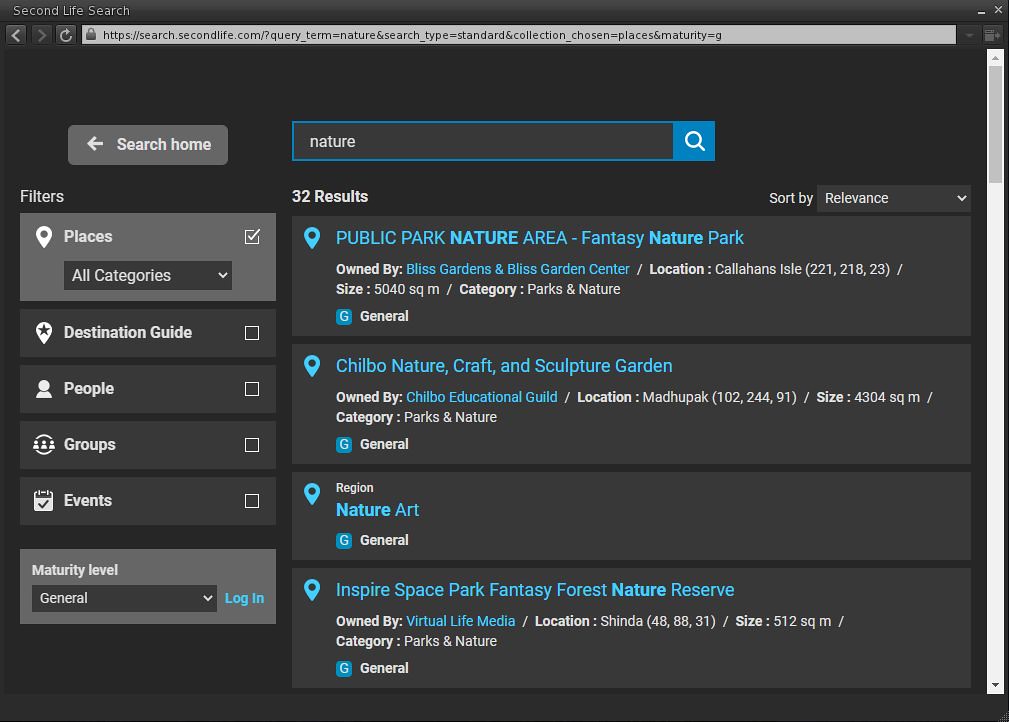
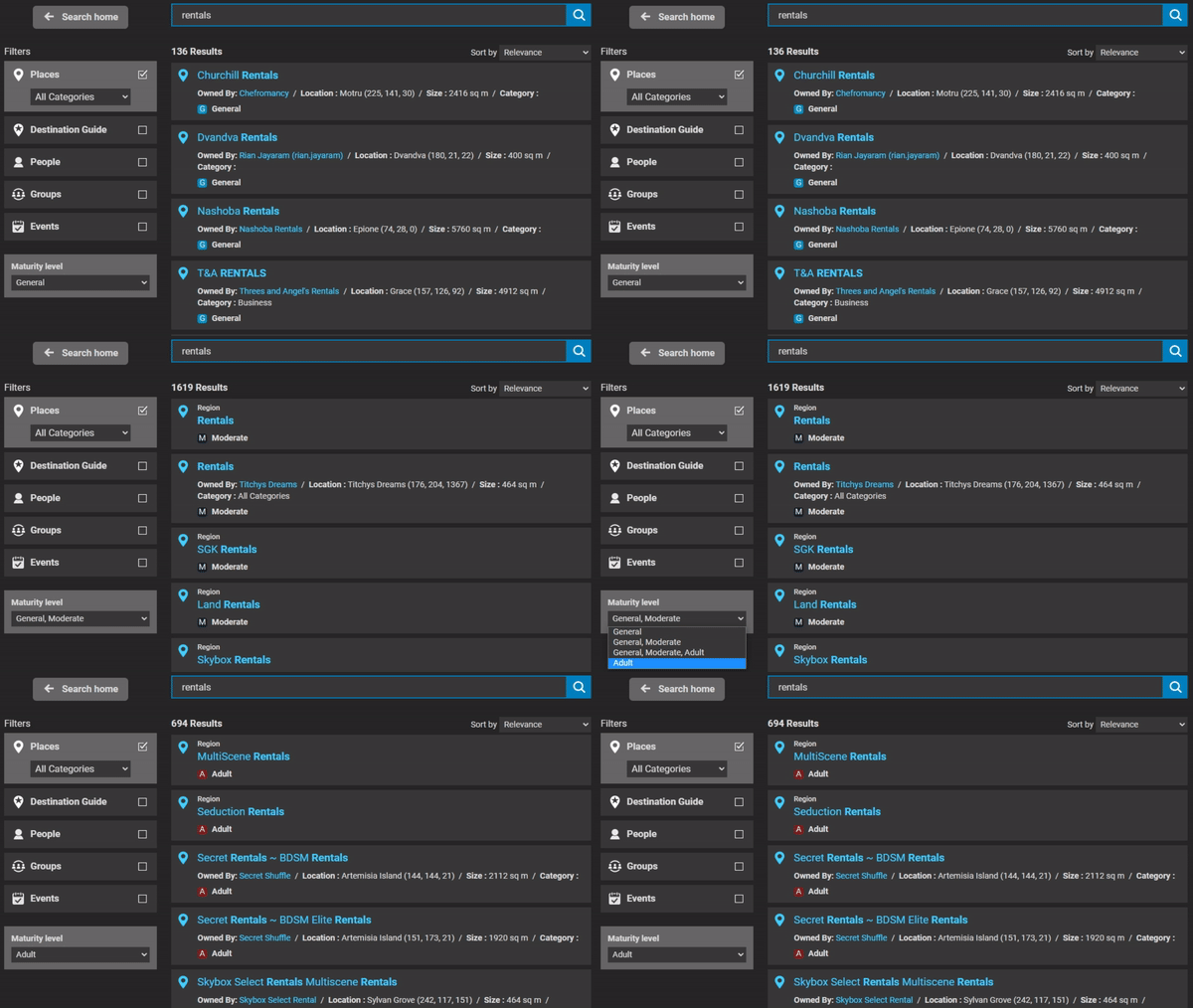
On Monday, November 22nd, 2021, and following on from comments made by Reed Linden at the November Web User Group meeting, Linden Lab launched the new look for Second Life Search (as seen both via the web and in the viewer). The launch was accompanied by a blog post – New Look for Search – that outlined the update, with several screen shots of various aspects of search return displays, etc., and a resident-launched forum thread discusses the changes.
Before going any further, it is important to note a couple of points, even though in general terms they have been noted:
This is an update to the web pages / style sheets defining how search and search results are displayed. It does not mark any changes in how the actual search algorithm works – so things like relevancy in search results, etc., will not be altered or improved as a result of this facelift.
However, a further overhaul of search which does include tightening the algorithm and improving results / relevancy and general performance will be initiated in 2022. This will apparently utilise third-party Search tool development expertise external to LL in an attempt to get a “first class” search implementation.
I’ll admit my first reaction on seeing the new search home page, both in the viewer and on the web page was, “ugh!” It was a shock to see the minimalism of Flat Design, even though this has been common to operating systems for a good while now, and has been something LL has started pushing towards. Frankly, it is not something I personally like as I find it bland and, in some executions, not particularly intuitive. However, if LL do want to make their product more in-line with current aesthetics with operating system and application design, and if they are serious about making SL more accessible through mobile / portable devices as well as modern desktop operating systems, then the move is understandable.
I’m not going to comment too much on functionality here, simply because this is a makeover, not a change in quality of returns of searches, etc. I’ll save such comments until after the complete overhaul of Search has been completed. So here are some fairly basic thoughts on the visuals.
Search in the Viewer benefits from not displaying the Classifieds (unless scrolled to via the bottom bar), but suffers from a lack of immediately-visible results
Home Page
Pros:
Looks clean, options easy to identify, and the colour change when and option is selected is good approach for those who may have visual impairments that make seeing checks in boxes difficult.
The left-side tabulation for high-level search categories is better than the old drop-downs, with the tailored options for each category are a further good moves.
Cons:
A terrible waste of space in the banner area, which is particularly noticeable when viewing Search within the viewer. Frankly, the SL logo looks as if it is about to be swallowed by the Great Charcoal Void.
Do the left sidebar tabs really need to be so broad, given the font size and the depth of each tab?
Results Listings
Pros:
Much better listing layout and improved readability. The left-side tabs are useful to have, together with Maturity ratings.
Changes impacting the list of results (such as changing the Maturity rating) are responsive and obvious.
As a largely legacy search user when it comes to search places, I’m not sure if the linking to Place Pages for additional information is new or not, but if it is, then it’s a good move even if Place Pages are drastically under-utilised and in need of Lab TLC.
Tucking thumbnails into the result title helps to compress the amount of space taken by individual results.
Search page responsiveness on actions appears good
Cons:
The last point made, the number of results displayed before scrolling is required is an annoyance, and something of a step back. Yes, individual items in a set of returns are a lot more readable, thanks to a larger, cleaner font, but this does come at a price.
In this, the fixed column width with two sidebars also doesn’t help. Why not make Classified part of the left sidebar below the items already there? Or make them a toggle off / on option so the display area for results could expand sideways and allow for a few more results to be displayed before scrolling becomes necessary?
There are also some informational elements lacking (such as traffic); should they return, this could further impact the number of returns.
General Thoughts
At the end of the day, any UI change is going to cause consternation of varying degrees and for a variety of reasons: most of us are prone to react negatively to changes we perhaps hadn’t been expecting; plus we all tend to consider ourselves armchair UI experts. Search is a particularly emotive subject as it is a tool that is especially important to some for their business, etc., and thus doubly hard to balance out to satisfy all needs. As a more “casual” user of Search, and spending a good portion of the day playing with it, I can live with the shortfalls and can appreciate the improvements, and will await further changes to see how things fair.
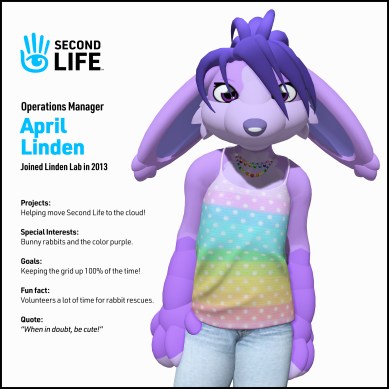
April Linden’s info page in the SL17B “Meet the Lindens” campaign designed to provide SL residents with short profiles on 47 Lab employees who volunteered to take part. Image courtesy of Linden Lab
November 5th 2021 finds me an unhappy / happy bunny Second Life bunny supporter.
Unhappy, because the day marks the last working day April Linden has with Linden Lab, and the grid will be the poorer for her departure. Happy, because the day marks the start of a new chapter in her life and career.
For those (can there be any?) unfamiliar with April, she has, for the last seven years, been a member of the Lab’s Engineering Team, the group of engineers responsible for keeping the servers that run all of SL’s various services purring (or grinding) along.
For the last few years she has been managing that entire team – and has used that position to keep Second Life users informed of all that goes on – the good and the bad – with SL’s servers and systems. In this regard, she has been our Number One Gridbun – so called because of her instantly-recognisable purple bunny avatar.
I’m the manager of the Second Life Operations team! It’s my team that helps keep the servers that run Second Life running. It’s my job to make sure they’re well fed, have the coolest toys, and know that going on vacation is okay!
– April Linden, in her official profile
With some 20 years experience in systems engineering environments, April was one of the many Lab employees who came to the company by way of first being a resident user of Second Life. Her attraction to the platform came via the empowerment it gives people to express themselves positively in a variety of ways. For April this was both the freedom to create (she had her own regions as a user), and – perhaps more importantly – because Second Life gave her the opportunity to undertake self-exploration in a safe, open environment without fear of repercussion, as she noted in 2018:
I come from a background – well, I’ll just be frank, where LGBT issues were not to be discussed, and it was through Second Life that gave me the power and the anonymity and the courage, really, to learn more about myself. And Second Life gave me the power to make my life so much better.
– April Linden
In this respect, April is a living example of the Lab’s recognition and support of people’s right to positively express themselves within an environment that embraces diversity.
April probably came to the notice of many Second Life users through her informative and insightful blog posts that would explain What Went Wrong and Why (what I call her W4 blog posts) after significant issues.
The bunny and the wizard: April Linden poses with her former boss, Oz Linden for an SL16B session
Reporting on technical issues and resolution had always been somewhat spotty where the Lab was concerned. During the “old, old” days of the Second Life website and blog, updates were fairly frequent – potentially due to the need for “Black Wednesdays”, when the grid would be down for between 6 and 8 hours on that day for deployment purposes (and often longer if things did go sideways). However, some time around 2008/9, communications became somewhat splotchy across the board, and technical updates a rate thing. Frank Ambrose (F.J. Linden) attempted to reverse this, up until his departure from the Lab at the end of 2011, but it was not until April took up the mantle once more that we were given informative and engaging blog posts on W4 situations.
And I really do mean informative and engaging – April has a way with words coupled with a deep understanding of the hardware and architecture running Second Life that she could communicate what had happened and what had been done to both rectify a situation and to try to prevent its recurrence in a way that many, many, users came to appreciate. So much so that, after particularly disruptive events, the first question that tended to be asked at User Group meetings tended to be, “Will April be blogging about what happened?”
In this respect, April did much to follow through on the re-opening of Lab / user communications initiated by Ebbe Altberg after he took over as the company’s CEO, and helped give users the confidence that communications really were opening up after a noticeable period without them.
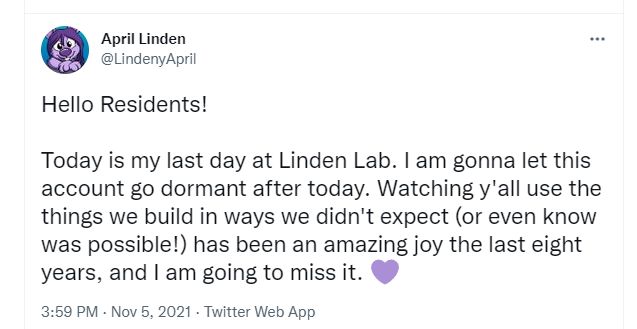
April’s farewell announcement
Most recently, April has been key to leading the Engineering Team through out Project Uplift – the work to lift, transition and place all of SL’s complex systems and services from a dedicated operational environment and into “the cloud” and Amazon AWS hardware and infrastructure. With the completion of the physical moves, she and her team have been engaged in the post-uplift work to better bed systems into their new environment and leverage new monitoring and engineering capabilities offered by AWS.
April announced her departure via Twitter, and the news was immediately responded to with a wave of well-wishing mixed with regret at see her leave the Lab. And it its true, April will be missed – not just because of her blog posts, but also because of her bright outlook and irrepressible positivity. Whoever takes over from her has some awfully big (bunny) shoes to fill.
To April, I can only repeat what I said in my own reply to her tweet – that I wish her every success with her new career path and all the very best for the future. BUT – I’m not going to say “goodbye”, as I’m absolutely sure that she’s find the time to remain a part of Second Life as an active resident.
 As I’ve noted in various pieces in this blog, whilst the physical transition of Second Life services from dedicated hardware operated directly by the Lab in a co-location facility to running those services within an Amazon Web Services (AWS) environment was completed at the end of December 2020, work on the project continued through 2021 in refining how the various services run within the AWS environment and in work leveraging the better capabilities Amazon provide – hardware configurations, monitoring tools, etc., – to improve the performance of SL’s services.






 Inara Pey: Living in a Modemworld