Rodvik shares – and so do I

So here we are in October, and we have the news that the simulator software is undergoing some kind of “critical software upgrade” that is affecting all channels and could see a higher than usual number of restarts over the course of the next week. At least updates on this are being pushed out via Twitter and the Grid Status pages (rather than it being one or the other in a lot of instances of late).

As I’ve been away for the last few days sunning myself and enjoying Swiss hospitality, I’ve no idea as to whether LL have finally recommenced in-world announcements where they know that restarts, etc., are going to impact object rezzing, transactions and so on. If they haven’t, it’s really about time they did.

LL CEO Rod Humble

We also have Rodvik sharing a post as a follow-on from comments relating to the platform made earlier this year, and which is intended to “Update you on each area and share with you our plans for the remainder of the year”.

Certainly, there were some tidbits – but I couldn’t help reading some elements of the post with a sense of disappointment at what was left unsaid.

Let’s take the items Rodvik discusses in order:

Viewer Usability

The two modes (Basic and Advanced) to be merged “soon” allowing changes made to the Basic mode to be integrated into the Advanced mode. Precise details are scant, but Rodvik specifically mentions avatar and camera movement. Ergo, expect to see the Basic mode “click to move” and perhaps the “goto” movement options appearing in the Advanced mode.

One would hope, as well, that the HOW TO button finds its way into the Advanced mode – and has potentially been extended to cover other important functionality, a point I’ve touched on in the past.

How To: cue-card style help in Basic mode: soon to be seen in advanced? One hopes so

At SLCC 2011, Rodvik indicated that the Sidebar’s days were numbered – and it would probably be a better than even guess that this is what he is referring to when he states, “After these modes are merged and deployed, you can expect us to release an improved UI into the Viewer”. I’ve little doubt the improved UI will see other nips and tucks made – but  anyone interpreting this as meaning the V2.x/3.x UI is “going away” or going to receive anything approaching a major revamp … is most likely going to be disappointed.

Mesh

This was the real eye-opener statement in the most negative sense. “Thankfully this massive feature got deployed on time”. Hardly the best opening line to describe what is supposedly one of the biggest changes to SL’s capabilities. Rather than championing a new and exciting medium, this reads almost as if Rodvik is saying, “Thank God that’s over!”

It is certainly an odd statement to make given LL went to some lengths to avoid being tied-down to any precise dates. Even the May “mesh roadmap” was so full of caveats and warnings one fully expected mesh to slip beyond the broad deadline of “the end of August” for full deployment.

Yet now it would appear that – as I’ve commented upon in the past where LL is concerned – dates were the driving factor in the deployment, not matters of usability. How else can one explain deploying a mesh upload dialogue which was, by LL’s ownadmission at the time, as much a cause for confusion as anything else when it comes to trying to optimise mesh for SL use?

Beyond this, there is the fact that we know from Charlar that mesh in SL is due at least one more “non trivial” update – possibly before the end of the year. Whither then, is the pointer towards this in Rodvik’s comments?

True, in the context of this post, he’s not directly talked about the future of mesh in the past, but that doesn’t mean he cannot give at least a hint that LL are striving to overcome shortfalls and issues. Even something like, “We are working on a series of updates to improve how mesh objects are uploaded to SL, and how you can better understand their resource impact, and we’ll be blogging about that soon,” would be better received than what amounts to something of a brush-off – especially for those suffering under LL’s refusal to respond to the likes of JIRA SH-2374.

Improved Service

This was more honest: improvements have been made, but more investment is needed and will be given. This is good news all around. Of greatest interest to me was the comment relating to revised policies. At SLCC 2011, Rodvik hinted that things could soon get particularly unpleasant for griefers in-world. At the time, I got the impression he wasn’t just talking about deploying tools estate owners could use to handle griefers directly. Are we about to see a revised ToS that also makes the consequences of anti-social behaviour in-world a lot clearer to all?

Better Customer Value

This came across as a very self-congratulatory pat on the back. Frankly, I’m not sure it is due. It is good to see LL moving to make Premium accounts more relevant and attractive – but much more needs to be done in this area before LL can really start to feel good about things. This is particularly true with regards to re-engaging with people like myself; those who were Premium members but who “downgraded” to free accounts.

Rodvik, stipends here don’t cut it – I don’t particularly care if I get “most” of my subscription back in stipends (assuming I pay annually, that is) – I’d still be spending $24 (incl VAT, thank you) a year to enjoy what I already have. Nor does anything else currently on offer present anything approaching a “must have” factor for me – and I’m not alone in this. You need to give more thought to making Premium attractive to your established user base.

Shiny New Things

This section offered perhaps the most interest. At SLCC 2011 (again), Rodvik made mention of the introduction of NPCs – Non-player characters with whom it would be possible to interact with to a degree, and which can be set to perform specific tasks.

While bots, etc., have been possible within SL, they’ve tended to rely on a mis-match of enabling technologies: external data servers in some cases, or heavy reliance on server-side scripting resources (such as with many breedables) that draw down the anger of those impacted by such entities.
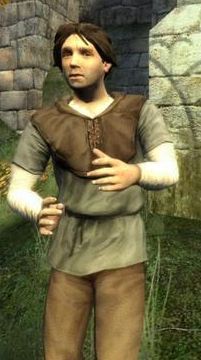
NPCs: New opportunities

Second Life itself actually had the capabilities to manage artificial life at one time – specifically plants and animals. Whether or not this capability is being revamped and re-introduced into the platform or not is really beside the point (although if it is there and is robust enough, making use of it would seem to make sense).

What is important is the fact that a massive capability is going to be added to the platform that could have a huge range of potential applications in-world. NPCs alone – human, alien, animal – have a wide range of applications in the likes of role-play and so on. As Rodvik states in his post: imagine a town filled with NPCs going about their “business”, allowing for a certain degree of interaction and so on, generating enormous depth to any gameplay or role-play environment.

Nor does it end there – assuming it can be done robustly and intelligently – the opportunities for using such “artificial life” capabilities has implications well beyond those of gameplay, many of which fall into the realms of education and practical research. Self-navigating agents? The avenues for schools and educational institutions to engage in things like robotics are simply mind-boggling.

Native AI in SL: potential educational / research / modelling benefits beyond RPG

According to Rodvik, we can expect some of these new capabilities to commence testing in December of this year, although (wisely) no roll-out data has yet to be pinned to the wall. Given the impact and benefit such capabilities could bring to Second Life, I really hope that LL strive for two things:

  1. Make sure the capability is properly developed and implemented – sorry, but at the end of the day, mesh came across as a half-arsed implementation to many, and I’d suggest further that it is a practical demonstration why (again) the push, test, polish, test, polish approach can actually do SL as much harm as it can potentially do good.
  2. They openly engage with a wide range of potential “beta testers” from within and without the SL community to ensure as wide as possible spread of potential use cases are identified and catered for and are the determining factors as to when the functionality is rolled out. Let’s not have the calendar again dictating what can and cannot get done in the “first release”, because many using SL already equate “first release” with, “That’s all LL are prepared to do”.

Just how bad is a 650-region loss?

Last week an article appeared in New World Notes (NWN) which seemed intent on giving the impression that Second Life is in a state of terminal decline. The headline proclaimed: “Second Life Has Lost Over 650 Sims & $1 Million in Yearly Revenue in 2011; This is Why SL Can’t Survive as a Niche”, followed by a comment that, “The only future for Second Life is several millions of users, or none at all”.

Provocative reading perhaps; but how reasonable is it to make such assertions?

Well, first and foremost, I don’t dispute the figures in terms of region losses or potential revenue drop. They’ve been taken from Tyche Shepherd’s excellent Grid Surveys, which week-by-week look at the overall status of the grid in terms of regions, private and mainland. Rather, I tend to find the conclusions the author draws from Tyche’s figures to be somewhat questionable.

The Ebb and Flow of the Statistical Tide

Let’s try to put things in a little perspective, starting with two points in particular:

  • 650 regions is around 2.6% of the total land mass
  • Linden Lab has an inward flow of revenue of some $75 million a year. As such, $1 million amounts to a 1.3% drop in that revenue. All things considered (economic climate, etc.), that’s not an horrendous drop.

Now let’s take a look back at private regions in SL over the last three years (a not unreasonable time-frame in business terms).

  • 2009:
    • Jan-May SL suffered a loss of 1095 private estates during the first 5 months (from 22406 to 21311); no doubt fuelled in part by the OpenSpace fiasco
    • June-December: SL grew to 24033 private estates, an increase of 1627 regions over the start-of-year
  • In 2010:
    • SL grew by 6% overall in terms of regions
    • 44% of this growth lay in private regions, representing an overall growth of  3% for private regions
  • In 2011:
    • Jan-Aug: 2.6% loss of private estates
    • A potential 3.9% loss by year-end.

In other words, in 2009, private regions on the Grid grew by some 7.26% over the start-of-year figure, despite an initial loss of some 4.88%. In 2010 it grew by a further 3% in private regions.

So while a current 2.6% drop is cause for some concern – it’s not yet drastic. Even if the shrinkage continues through to the year-end (as seems likely, given Tyche’s latest figures), and yields a potential 3.9% drop in private regions, the situation still would not be terminal.

Recession does Nasty Things

There is another factor to consider here. Right now, we’re in the midst of a prolonged global economic downturn. The longer it goes on, the deeper it bites into people’s disposable income. A prudent observer of the current decline in private regions in SL would consider it possible – likely, even – that the recession is responsible for at least some of the shrinkage we are currently seeing. One sees little sign of this in the NWN article.

But downturns don’t last forever (or if this one does, we’ll all have a lot more to worry about than Second Life). Therefore (and while past performance may not always be indicative of future growth), it is no unreasonable to suggest that once the economy does start to improve, people will again have more disposable income they can put towards Second Life, and this is likely to result in an improved demand for land as a result and at least slow – if not reverse – the current trend in private region losses.

Alternatives

Nor do Linden Lab need to convert anywhere near 400,000 users to Premium membership in order to recoup falling land tier income (even should this be necessary), as the NWN article also dramatically suggests.

Right now, Linden Lab generates some 20% of its income – $15 million – through non-land related activities. As such, it only needs to increase that $15 million revenue by some 10% to help offset the losses experienced to date – a not impossible figure.

There have already been a couple of small moves in this direction; we’ve seen the introduction of upload fees charged for mesh imports and a push to generate more Premium memberships. While the former might not have a significant impact in the scheme of things, the same is not necessarily true of the latter. Were Linden Lab to offer a Premium membership package that gave clear and significant benefits to those already engaged in Second Life (rather than just new users, as seems to be the case with the current offering), then the potential uptake could be significant – and relatively rapid.

Beyond this is the fact that Linden Lab doesn’t necessarily have to look at Second Life to recoup “lost” revenue. The company is shortly to launch new products into the marketplace. While details have yet to be released, it is unlikely Linden Lab will do so without the means to leverage them into revenue.

True, the results may not be immediate (depending on how these new products are to be monetized and how they are received by the world at large). However, that the company is launching new products means that it will be less dependent solely on Second Life for revenue. An optimist might even speculate that as a result, Linden Lab might have a greater degree of freedom to better restructure / improve the Second Life platform.

Nor should these products be classified (/dismissed?) as some form of “SL Light”, again as New World Notes suggested.* To quote Rod Humble himself in reference to this idea: “I never said a lite version. I said and I mean new products which are in the area of shared creative spaces. or social creative tools or user-created virtual worlds/places if you prefer”.

Where is Everybody?

Truth be told, there is one figure that gives continued cause for concern for many within Second Life – and it is not region counts; it’s user concurrency. This has been in a steady state of decline for the last three years. In her end-of-year summary in 2010, Tyche Shepherd estimated that SL’s average concurrency levels equated to just 1.57 avatars per region. That’s an awful lot of empty space.

Now to be fair, the New World Notes article I refer to at the top of this piece does indicate that Linden Lab needs to do more to get people involved in Second Life – even if it does over-egg things by putting the figure in the “millions”. And keeping on the side of fairness, Linden Lab have themselves indicated that they are working on the means to get people directly involved in in-world activities (i.e. content creation, engaging in the economy as consumers, etc.) a lot sooner than is currently the case. However, one has to admit that it would be nice to see some practical outworking of these ideas before the year’s end. Even a gentle increase in user concurrency that can be sustained for more than a few months would be good news for just about everyone involved in SL.

Niche isn’t Bad

Finally, and in turning to the claim that SL cannot survive as a niche, one has to ask, “Why not?”. The fact is that Second Life has survived for some 10 years as niche product, and has managed to generate a tidy revenue stream for Linden Lab that has made them “Very profitable”, to use Rod Humble’s words, in the process. Get the flow of people into SL right and the mechanisms of engagement in place, and there is no reason why it cannot continue to do so and enjoy practical growth.

This is not to say that things won’t have to change in time; the reality is that Second Life and Linden Lab will be facing challenges in the coming years that may yet force significant changes to aspects of how things are run (such as, ironically, land tier). However, these needn’t necessarily be negative – although they will need to be planned for and carefully executed.

And what is so bad about being niche anyway? Many a company and product have enjoyed long and fiscally healthy times being precisely that.

—–

*Hamlet has pointed out that his article drew the distinction between any new products and SL; as such, I’ve amended this piece and apologise for any upset caused.

Re-entering the RedZone: the JLU

Controversy has recently been growing (yet again) around the so-called Justice League Unlimited within SL. This is a group of self-styled “law-enforcers” that has long been active in-world, supposedly protecting the innocent against dirty wrong-doers, with their avatars garbed in comic book superhero outfits.

Leaving aside their explicit violation of a certain comic book publisher’s IP rights – this group has long had a less than stellar reputation, and is not above overlooking inconveniences to their “duty” such as the Second Life Terms of Service. Evidence is now emerging that the JLU are (again / continuing to be) involved in RedZone-like data-gathering – and going a lot further in the process by attempting to put together dossiers on anyone in-world they consider a “threat”.

Avril Korman has written an excellent piece on the JLU’s activities, and it is a recommended read. For those that feel the same level of concern for the JLU’s activities as they did with RedZone, there is also an on-line petition aimed at Linden Lab to have the JLU’s activities properly scrutinised. You may also wish to consider adding your own e-signature.

Additional Reading

Update – 2nd September

More reasons to feel positive about SL

It’s nigh-on two weeks since SLCC 2011, and I’m still on something of a buzz about Second Life.I’ve already given four reasons why I’m excited about the platform once more, in which I focused on in-world aspects. Here are some more, broader, reasons.

Rod Humble

LL CEO Rod Humble

Yes, I know I come off as something of a fangirl; but the fact is that in eight short months, Rod Humble has more of a positive impact on Linden Lab than perhaps either of his predecessors had for the period between late 2007 and January 2010, something I’ve commented upon in the past.

But since March, we’ve seen it reinforced in so many ways that Rod Humble has a clear and constructive vision for Second Life. Yes, there are still issues to be addressed in a number of areas, but in the last few months it’s been pretty evident that Rodvik has been gradually refocusing Linden Lab and laying good foundations for both technical and progressive growth in Second Life and the Lab. The re-worked sign-on process, the split with the Viewer modes that allows for faster development of new user-friendly functionality via the Basic mode, introducing the release, test, polish, test, polish approach to features and capabilities which – while frustrating at time – is starting to yield benefits.

He understands the need for both bringing-in new user and  the twin needs to  bothengage / retain them and to maintain engagement and enthusiasm for the platform among existing users. As we move into the latter half of the year, he’s indicated the focus will shift more towards the latter (engagement / retention), with more “polish” plus things like and overhaul of Premium Accounts to offer users more “at no extra cost”. We even have the promise of a significant marketing campaign through the end of the year / early 2012. These are all things to welcome.

Lindens are getting engaged in the platform

We’ve all complained about the lack of any real in-world Linden presence for a long, long time. That’s changing.

Members of the Product Team: Gez, Esbee and Durian (with Pete Linden or the right)

I’ve personally spent time in-world in the mesh sandboxes on the Main grid with both Dan Linden and Charlar Linden (even if I did confuse him 🙂 ). More importantly, the Product Team have been involved in  in-world building, developing a game-based experience to help them understand the tools and limitations of in-world content creation.

Change in Philosophy

As Mark Viale (Viale Linden) said, there is a change in philosophy at Linden Lab – they’re looking to work more with the user base and “bring forward” communities and events and make sure they have good visibility through the likes of the new Viewer 3 log-in screen (which is being offered to TPVs to increase the visibility – hopefully they’ll take it up). We also have the opening of communications channels once more – e-mail addresses are front and centre, people are responding to IMs once more. We also have new and useful wiki portals being written that information the availability of information.

Within the Destination Guide, there is now the opportunity for communities and users to carry the message of Second Life out to the world through the Create Ad widget, while LL themselves are starting to work with communities to leverage awareness of Second Life – such as through the use of Machinima via YouTube, etc. All of this is very positive in terms of raising the visibility of SL as a vibrant platform.

The is something of a roadmap

Of course, there is still much to be done – and bringing-in users alone is not going to keep Second Life afloat, much less growing; Gwyneth Llewelwyn holds up a cautionary hand in this regard. However, when you look back just twelve months, just about the only thing we heard from LL was the need to bring users in – nothing else. That has now changed. Thought around retention and engagement is being put into the mix – and starting to be translated into positive actions.

…But one still cannot help but feel that there is a roadmap there, even if we’re not privy to all of it. This is actually a good feeling to have – and while many of us likely won’t feel comfortable with things until we see the in-world economy growing once more, and things like concurrency improve – it’s actually nice to be able to feel things are moving in the right direction, not only with technical aspects, but also within LL itself.

The promise of prims

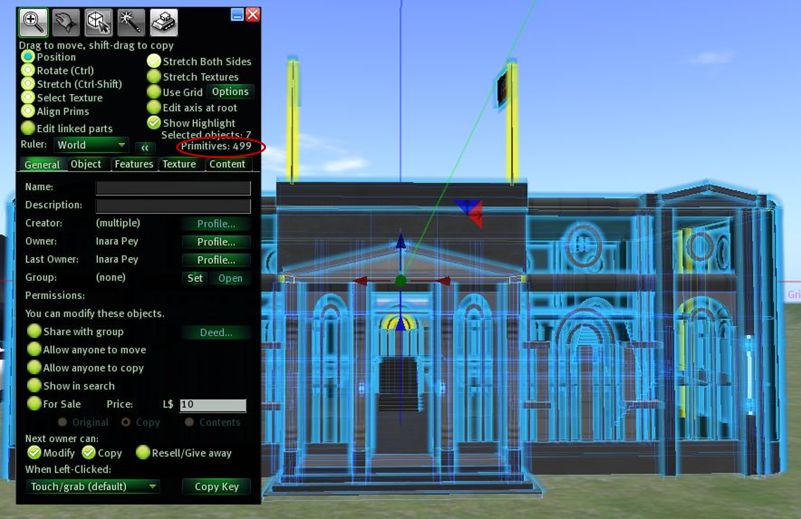
Alongside the arrival of mesh comes the new maximum size for native prims: 64m. It’s been somewhat overlooked in the rush to welcome mesh, but for many, it is something that has been looked forward to perhaps more than mesh itself.

Let’s face it, even with the availability of mega prims, building in-world has been hampered with the restrictions placed on prim sizing in Second Life; so the arrival of the new upper sizing limit of 64m is a popular move.

I’ve already written on the new size, and the fact that it means that many mega prims under the new upper limit can be treated as “natively-rezzed” prims (although there are some exceptions) – but it’s worth restating that far from going away with the arrival of mesh, prims look as though they are really about to come into their own.

  • For those that have shunned mega prims entirely (possibly out of concern as to whether or not LL might rescind their use at some point)  can now re-work as they wish and economise their builds
  • Those who have used megas can also rebuild, particularly replacing those megas that have been created using skew, and which can cause prim drift issues in linksets. Even where megas have been used, they can still lead to comprimises due to the limitations placed on them in terms of sixing (even with the ability to cut & slice them), so there is potentially a lot to gain through re-working current mega-based builds.
Even builds using mega prims benefit

There is additionally the promise that prims themselves are to become the focus of a new “directed experience” for users entering Second Life, as the ability to create and collaboratively build within Second Life is recognised by Linden Lab as a tremendously powerful and attractive aspect of the platform.

Prims are also important because not all of us are going to be entirely comfortable around trying to get to grips with mesh – and even if we get over the various technical hurdles and get to grips with the technology needed to do so, there is still no guarantee we won’t end up stymied when it comes to getting stuff from a particular application outside of Second Life and actually in-world in such a way that it is efficient enough resource-wise to be viable.It is therefore important that we continue to have an avenue for creative expression.

So, yes, let’s all welcome mesh and hope it achieves what is hoped; but at the same time, let’s not forget the humble prim. I’ll leave you with a little video from Phaylen Fairchild, created for SL8B, and which perfectly frames the magic that prims have brought us over the years.

Four reasons why I’m excited about SL again

I’m feeling excited about SL again. It’s a novel experience after the last two or so years of feeling like I’m frequently shaking my head or burying my face in my hands so often.

It really started when Rod Humble started to make his presence felt. One could not help but feel that here is a man who – even if he claims he doesn’t understand Second Life – actually groks the potential of the platform on many levels. Since January, we’ve seen substantial progress on numerous fronts. True, it hasn’t always been quite what we wanted, or perhaps as far as we’ve wanted – but the positive results are undeniable in a number of areas. There may still be an almighty pile of things still sitting in the To Do box at the Lab, but no-one can hand-on-heart deny considerable effort has been put into trying to directly address matters of usability on a number of fronts, and to examine issues around user engagement and retention.

SLCC saw a round of talks and panels of Linden Lab staff that did much to reinforce the feeling that the Lab is back on the right track. What particularly excites me, are three things that have, I think, the potential to radically transform SL, and one that looks like it’s going to get some overdue focus. Namely:

  • Mesh
  • Gaming mechanics
  • Non-player characters (NPCs)
  • Prims

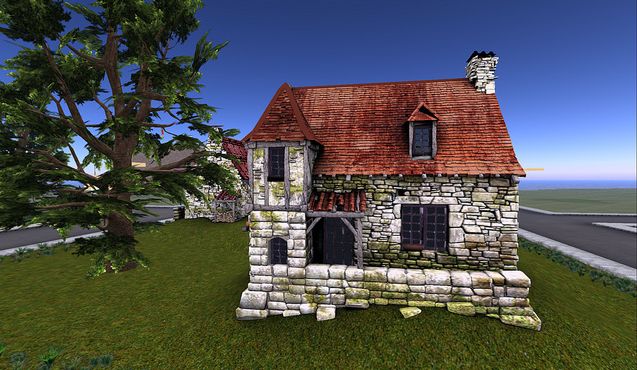
If we’re honest, the first iteration of mesh is already here; the capability is rolling-out across the Main grid, the code to support it within the Viewer is now at Beta and is available in at least one third-party Viewer with others set to follow, and mesh creations are slowly beginning to appear.

Mesh: opportunities

True, what we’re getting in the first release may not be what everyone wants, and there has been much angst on the technical side about the capability to produce SL-efficient mesh objects. It’s also fair to stay that it may not initially be as well-suited to some areas of content creation as it is to others. However, Linden Lab are aware of many of the issues (real and perceived) and are working towards trying to resolve those that they can over time. As Charlar Linden himself said at SLCC 2011, there will at some point be at least one “non-trivially sized” set of improvements to mesh to follow-up the initial roll-out.

But the fact is, doubts and angst aside, mesh can be transformative within Second Life on many levels beyond “traditional” content creation, for example:

  • It potentially offers new and previously unseen opportunities for creative collaboration as sim owners, groups and even businesses work with 3D artists to generate totally new and unique experiences within Second Life
  • It potentially takes the opportunities for practical prototyping to new levels, and well beyond anything that can be achieved with prims, something that might open the doors to other forms of collaborative efforts in both education and business
  • It can clearly bring an entirely new dimension to art within SL, be it static, mobile or through the lens of a camera; offering new ways for artists to express themselves visually both in-world and elsewhere.
Using gaming mechanics

Gaming mechanics also opens the door to many new possibilities, depending upon how they are implemented. At SLCC 2011, Gez and Esbee Linden gave a demonstration of the kind of thing LL staff have being playing with in order to better understand the mechanics of creation and the capabilities and limitations of SL, and how game-like mechanics might be used to enhance the SL experience. Even in a “rough” form, the results shine a light on a lot of potential, as Gez himself commented at the convention:

Second Life itself is not a game.  However, you can make some great games inside of Second Life, and you can use game mechanics, and game tutorials, and game systems to help people become more engaged and comfortable in Second Life.”

It’s amazing to think of the opportunities that the considered implementation of game-like tools, mechanics and controls could bring to Second Life. Just consider role-play quests (as a single example) wherein there’s no need to don a HUD or faff with notecards – everything can be done immersively on-screen, via simple prompts or icons and using intuitive controls such as point-and-click and / or point-and-drag.

NPCs: New opportunities

Non-player characters (NPCs) offer a similar means for new an immersive interaction within a virtual world that potentially goes beyond the use of bots / scripted agents, as they could run without being attached to logged-in accounts. Little wonder, then that UK-based Daden Ltd., has been working on just such a capability for OpenSim, as Maria Korolov reported in Hypergrid Business this week.

NPCs can be applied to a wide range of uses within SL. Here’s just two:

  • Within training simulations, where they can add depth of experience for trainees and perhaps be programmed to react a number of different ways as a result of interactions with trainees, making training simulations a lot more dynamic
  • Within role-play environments, where they could be used to provide help and guidance to players, or present threats that need to be dealt with and so on, adding to the immersive experience in ways that again go beyond the use of account-based bots. And that’s just scratching the surface of opportunity.

Combined with the use of gaming mechanics, NPCs stand to give Second Life a new dimension in terms of the way people can engage with various offerings within SL, as well as providing those seeking to provide immersive experiences with a raft of new tools and opportunities.

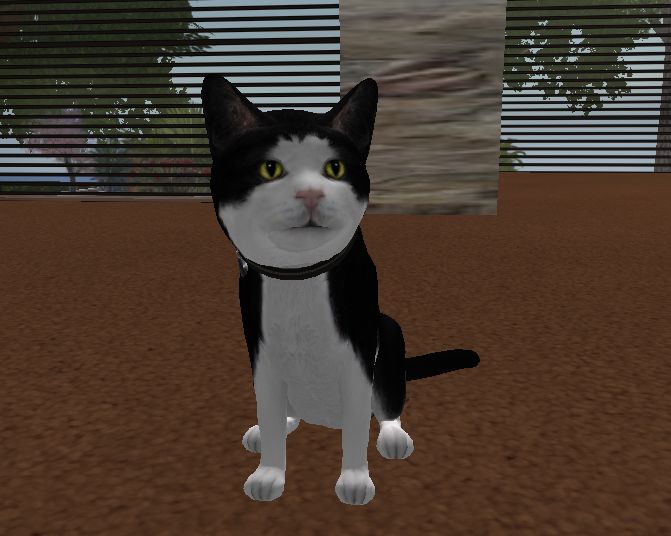
NPC coding and Mesh…new opportunities for pets?

Even in more mundane settings, NPC capabilities could be used to create, say, the “next generation” of pets beyond the likes of Stitch on the left here; able to both interact and react to avatars and their environment beyond the current limitations seen in pets at present.

Finally, there is the humble prim. Even if you’re not enamoured with any of the above, there is no need to worry, as it seems new life is to be breathed into the prim – and possibly the tools we have to manipulate it.

Not only is the new 64m upper size limit coming into effect with the release of mesh, but it seems that prims are to become central to a “directed experience” in the future aimed encouraging people coming into SL to engage in the process of content creation and the collaborative opportunities offered by in-world building. From the way Durian described it, this “direct experience” will be one of a number that the Lab is considering as ways of further user engagement with Second Life, and having a focus on prims and in-world creation is perfectly aligned with Rodvik’s view that Second Life is a shared creative space.

That prims should get additional attention is only right and proper – they may not be perfect, but they offer a lot of opportunities for those without deep-seated artistic and technical skills (i.e. me), to get a lot of fun and enjoyment out of SL. In this respect, it was very pleasing to see members of the LL product team engaging so much with the tools themselves in an effort to better understand them and – perhaps – start looking at ways and means to improve them down the road.

So, yes, I’m feeling pretty positive about Second Life and the future. The road ahead may be a little bumpy, and not everything is going to happen at once, or – again – necessarily as some of us might like it to happen; but the promise is there – and the Lindens themselves seem as determined as the rest of us to make it real.