What is Linden Lab’s role?

On May 4th, there was a lively Twitter discussion about many things SL, during which, Tateru Nino asked the following question:

@InaraPey @isfullofcrap Question. Should Linden Lab Rule, or should it Protect and Serve? Where do you see it on that continuum now?

This lead to a further discussion on just what people felt LL’s role should be. Given that the company itself has seemingly been trying to move itself more into the realm of service provider more than anything else, I suggested that Provide and Inform might be a better means of describing LL’s role.

I’m uncomfortable with the idea of “ruling” – although that is at times how LL appears to be operating (and outside of questions of ToS and arbitration*) – as that implies an autocratic approach completely devoid of any form of interaction with the user community, and if we’re honest, that’s actually far from the case. Yes, LL frequently suck in the manner in which they go about things, and they may not do things quite as we would like; but they are not entirely autocratic in nature. Were this otherwise, it’s doubtful we’d have the likes of third-party Viewers, nor would we have the likes of sim “donations” to the likes of the Linden Endowment of the Arts.

Similarly, I don’t think Protect and Serve entirely fits the bill because “protection” is something Linden Lab should be doing (and is, for the most part) as part and parcel of providing the Second Life platform, while “serve”, while warranted in terms of customer service potentially puts the shoe a little too much on the other foot when compared to Rule. Again, I’m not saying that Linden Lab has got either “protection” or “service” right, rather that both should be intrinsic to how they go about running Second Life.

Which brings me to Provide and Inform. I settled on these because to me, they are pretty much the two foundations upon which and service-oriented company should establish itself. “Provide” in this regards is pretty much self-explanatory; “Inform” brings us back to the issue of communications, which as we’ve again see this week is an area where Linden Lab pretty much sinks itself once again.

Much has been said in the intervening time between Tateru posed her question and I gave my initial response; some of it – such as today’s Metareality podcast for example, covers much of what I’ve been slowly cogitating over the last week and slowly forming into words for this post (so much so that I’ve actually thrown a large part of this post into the bin).

However, I’m not intending to turn this into another post on LL’s failure in communications (that may well come later, depending on what happens through today). What I am aware of is that even provide and inform is not entirely sufficient in defining what the Lab should be about, as both tend to perhaps point to an outward flow, rather than something more bi-directional in nature.

So, at the risk of appearing to be jumping on Tateru’s bandwagon with her recent, and excellent post / question relating to Linden’s Lab’s message, I’m going to throw this question out to the wind and see what comes back:

How do you – as succinctly as possible – see the Lab’s role, and how would you sum it up into a suitable expression?

*ETA as I totally forgot to ensure that remained after editing this piece. Mea culpa.

Something is rotten in the state of Battery Street

Alex Hayden carries an interesting blog post today. It appears that, for a limited time period, Linden Lab are offering “Starter Homes” to SL users.

No, not “Linden Homes”, available to Premium Members only, but “Starter Homes”, available to anyone who wants them.

The LL email on Starter Homes

For anyone who has chosen a Linden home, the e-mail will appear very familiar: an introductory graphic leading to a web page where you can select your home from a range of options or, if you prefer, an empty lot of land.

Options

The promotion actually started on April 19th, and runs for the month through until May 18th. So what are LL doing? Going into competition with themselves? Are these some kind of “next generation” Linden Home being offered on the basis that after 15 days you must up to Premium to keep yours?

No and no.

The truth is revealed in the offer small print:

Linden Lab is sponsoring the Start Home Program, which will be operated and supported by Anshe Chung Sims. You acknowledge that if you agree to participate in the Starter Home Program, in addition to the Linden Lab Terms of Service you also agree to be subject to the terms of service required by Anshe Chung sims. After 15 days you decide whether you want to keep your home or not. If you do want to keep it you will need to pay for it pursuant to the applicable terms of service. If you don’t want to keep it you won’t be billed for it.

Yup, Linden Lab are “sponsoring” ACS; which, when you look at it, is mind-boggling in itself – but I’ll refrain from digressing… I’ll also avoid re-treading ground Alex covers so well.

One cannot actually blame ACS for this per se – unless some form of unequal leverage was brought to bear on Linden Lab in order for the “sponsorship” to be initiated, as least.

The problem here is, as Alex points out, LL’s willingness to start playing favourites, and in the process, tilt the board in favour of one reseller.

Over the last couple of years, Linden Lab has been trying to repaint itself as a service provider. Well, this is all fair and good, but as Crap Mariner pointed out via Twitter, in the service provisioning business, one does not advantage one reseller over another. Yet that is precisely what LL are going here. Whether or not they opt to repeat the “offer” down the road, it still results in a very unpleasant taste in one’s mouth at the thought of the market being so blatantly manipulated.

Of course, LL may feel justified in doing so inasmuch as there is little their other resellers can do. Their power is limited, and their finances are almost completely locked-in to SL. Again, as Crap observes:

This has been pretty much an ace-in-the-hole for Linden Lab in many respects, and doubtless a comfort blanket for them when they do opt to start tinkering around with more than the technical aspects of their service. Which is not to say that at some point it won’t come back to bite them on their collective arse.

In his piece, Alex asks, “How can you justify sponsoring the Starter Home Program and yet not sponsor a collection of Sims so that the Annual SL Birthday Celebrations can take place?”

Well, the answer is simple. This sponsorship programme carries the promise / potential of financial gain to Linden Lab; providing sims for SLB doesn’t, period. If this scheme is successful, ACS may well end-up ordering additional regions to handle the demand. And if they do, who is to say other estates, their feathers ruffled, won’t be offered a piece of the action as well. As such, the Lab may again feel perfectly justified in poking their collective mitt into things. It doesn’t, however do much for the growing number of SL users who, like Alex, are feeling as if they are being treated as little more than a commodity ripe for the financial picking.

The offer also raises some wider questions as well, such as what prompted the deal in the first place?

  • Is it that estate owners are growing increasingly jittery over region losses, and have been demanding LL “do something” (and, however much we’d like it to be, simply “lowering tier” isn’t going to be seen as a “safe” option within the Lab). If so, this approach is still decidedly one-sided, unless offered month-on-month to other estates, which is hardly likely to happen
  • Is it that LL themselves are worried about the continuing decline in regions and, having seen that the “Land Sale” from last year failed to achieve long term benefits (although the immediate benefits cannot be denied), they are desperate to try something else in the hope of hitting upon a magic formula to recover “lost” revenue?
  • Or is it, again as Crap wryly observes, “merely” the case that “ACS may be squeezing Rod’s nuts”?

You decide.

There’s another aspect to this as well. A month ago, Rod Humble made a big play about talking community and getting back to the family / frontier “feel” of Second Life. In it, he said, “I will be kicking off another monthly roundtable (probably Monday) to chat about getting that family/frontier feel back with an eye to some area-like project,” [my emphasis]. Shortly thereafter, this promised “round table” morphed into “closed door” discussions. Now I may be doing Rod Humble a great disservice here in linking the two – and if I am, I’ll say here and now, I’ll have no hesitation in apologising openly – but, if this arrangement has anything whatsoever to do with developing “some area-like project”, then I’m fast losing faith in what is going on at Battery Street.

With thanks to Alex Hayden for his kind permission to re-use screen captures from his blog.

AO, AO, it’s off to walk we go…

AOs – Animation Overriders – have been part and parcel of Second Life since not long after the dawn of time (or at least not long after someone figured out how to lose the duckwalk by one means or another).

Today, AOs are a fact of life in SL and come in many forms: some just handle the “basics” – walks, sits, stands; others combine functions, providing a one-stop solution for walks, sits, stands, dances, poofers and other little toys. Most run through scripted HUDs, some run via the client itself. Some handle just one set of animations, some can be configured with multiple sets of animations, driven by notecards; some even allow drag-and-drop. Beyond this there is a whole range of scripted attachments which may also contain a wide variety of animations, often for specialised use, but which also might contain walks, sits, and the like. Finally, and most recently, we have the rise of client-side AO systems, some of which have differing capabilities to one another.

It’s a bewildering plethora of approaches – although in the case of HUD systems and client-side AOs, most use the same core system of animation interpretation, the famous ZHAO (2) format.

As to advantages and disadvantages, all systems suffer from them to one degree or another. Client-side AOs for example, can override scripted animations, resulting in an avatar appearing to jerk around or behave strangely as the two animation clash.  Some AOs can be script-heavy – at least in terms of the number of scripts they contain; this can lead to finger-pointing by those with an eye on public or client-side script counters, regardless of how  efficient the scripts may actually be in terms of resource use.  Recent developments in Client-side AOs mean that drag-and-drop is fully supported – no need to send time and effort configuring notecards; the downside is, each TPV supporting the system tends to require a dedicated set of links within your inventory – so if you do swap between Viewers (using one for RP, another for photography, for example), then this can become a source of annoyance.

Now it appears that Linden Lab are considering the question of AOs, and whether to develop an approach of their own. This has been hinted at in the number of user group meetings, and is now the subject of debate over on the SLU forums.

Some have taken LL’s interest – expressed through Oz, as a sign that the Lab are looking towards a client-side implementation of some form of AO (perhaps animation controller  might be a better description) with the Viewer. However, as Adeon Writer notes in opening the discussion, LL have both the client and the server at their disposal, so are relatively free to approach the issue from any number of angles without being exclusively tied to a client-side solution.

A variety of ideas have been suggested in the SLU thread – some of which run very close to capabilities found in the latest client-side AO system; whether this is because people are happy with that system and wish to see it replicated, or whether it is because some are unaware of the client AO capabilities, is unclear. One idea that has gained support is for having a “wearable” attachment that allows animations to be associated with specific avatars have also been put forward (so you have one associated with your “normal” avatar, another if you have a “pixie” avatar, another for your “tiger” avatar, and so on), with an edit capability similar to any other wearable editor.

The problem here, of course, is that not only are there many potential routes towards a solutions – there is also the veritable minefield LL must tread simply due to the widespread use of scripted AOs and HUDS.  If they are seen to be doing anything that is  perceived to be about to “break” or “compete” with existing content, regardless of how wrong such perceptions might be, they are liable to find themselves being chased up a tree faster than a cat with an oversized dog on its tail…

Those at the Lab are obviously aware of this and it’s liable to be a reason why the matter hasn’t been dealt with before; despite claims to the contrary, the Lab is actually loathe to knowingly break content. It’s also most likely why Oz is taking time to understand the flavours of client-side AO used by TPVs in order to find out what works, what doesn’t, and how LL can work alongside existing HUD systems.

However you look at it, it is fair to say that something needs to be done to improve the current means by which AOs – client-based or HUD-based work. Neither is, from the perspective of the new user, a particularly elegant solution and requires something of a learning-curve in order to understand. Developing an alternative that is both easy to grasp, and which offers a high level of functionality for the sophisticated user, however, isn’t going to be a simple matter – if only because we all have differing needs from an AO, and the needs of the novice user don’t always sit well with the needs of the seasoned user.

For my part, I long ago gave up the use of an AO HUD in favour of a client-side solution, as the latest AO found in most v3.2-based TPVs offers me the greatest flexibility, occasional clashes with scripted animations notwithstanding. However, I do have the advantage in having several pre-prepared ZHAO-2 notecards, so switching over to (and switching between) client-side AOs is relatively simple. Given that the AO also supports multiple configuration cards, switching between sets is also easy. Which is not to say this approach is perfect; two of my irritations with it remain:

  • There’s the aforementioned inventory bloat when dozens of duplicate links are added to my inventory each time I opt to use an AO notecard with a Viewer equipped with a client-side AO
  • There is no persistence between relogs when running multiple AOs – the client will default to the first AO notecard / set in the list, regardless as to whether I’ve set a default or not.

Personally, I’d like to see a well-implemented animation control system from LL; they have the resources at their disposal to develop something that works fast and well and can meet the widest range of requirements from ease-of-use through to minimal resource demands. Perhaps even one that is extensible and takes into account purpose-based uses such as within combat environments (although that might well tread on a lot of toes). It’s not going to be an overnight thing – again, full kudos to Oz for feeling matters out on the technical side. It’ll be interesting to discover what – if anything – does develop down the road, and whether we will see anything emerge from LL in terms of AO system development / implementation.

SL9B: end of an era?

Linden Lab have issued a call to help with SL9B celebrations, which reads in part:

Second Life’s 9th Birthday is coming up in June! This year it’s all about you — the denizens of the grid, the sultans of Second Life  and connoisseurs of creativity— and we want to highlight the many unique and innovative ways the community has made Second Life their own.

This year we will focus the spotlight on community events.  No one throws a better event or party than the Second Life community! If you’re having an event to celebrate Second Life turning nine, we want to know about it!

On the surface, this sounds great – until one realises that what is in fact being announced here is effectively the end of an era.

In previous years, Second life’s birthday has been marked through a coming-together of the community as a whole on a set of regions supplied by Linden Lab, to create a glorious theme park of builds and ideas created around a central theme, and in and around which parties and celebrations can be held. While not always free from controversy and acrimony, this approach provided a focal point for events and activities marking SL’s birthday, and helped to bring together residents from across the grid.

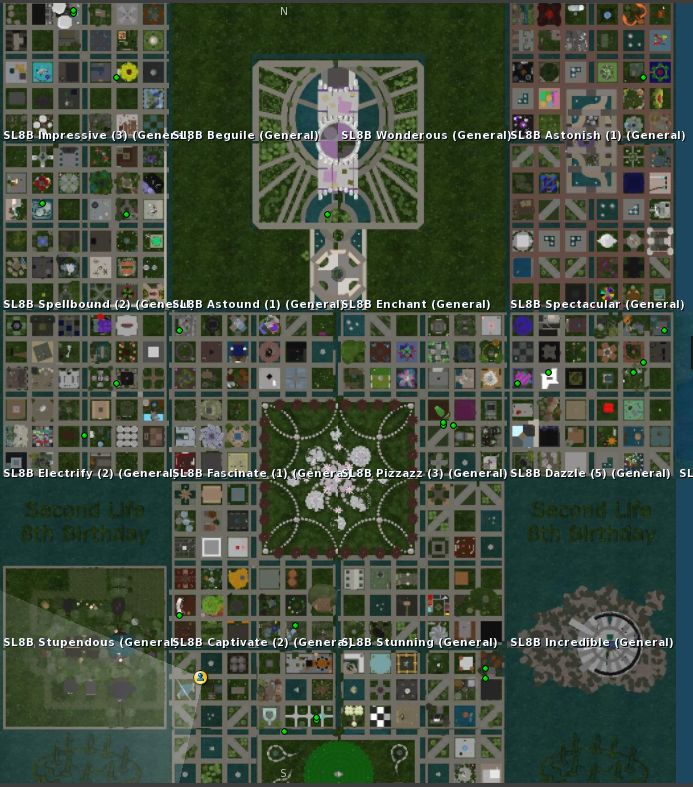
SL8B sims – not this year

Well, not any more.

Hidden within this announcement is the fact that this year there will be no large-scale provisioning of regions by LL; no central place to explore (lag and all) and see builds great and small and enjoy the thrill of celebration and discovery.

And this is a shame.

The SL8B events have traditionally been a marvellous way for the many talents and groups across SL to showcase their work, their talent and their vision. It’s hard to see how such an infinite diversity of ideas and vision can be replicated through a process of complete de-centralisation; one cannot imagine sim / estate owners  / groups developing large-scale builds specifically for SL9B, especially with so broad a theme as has been offered.

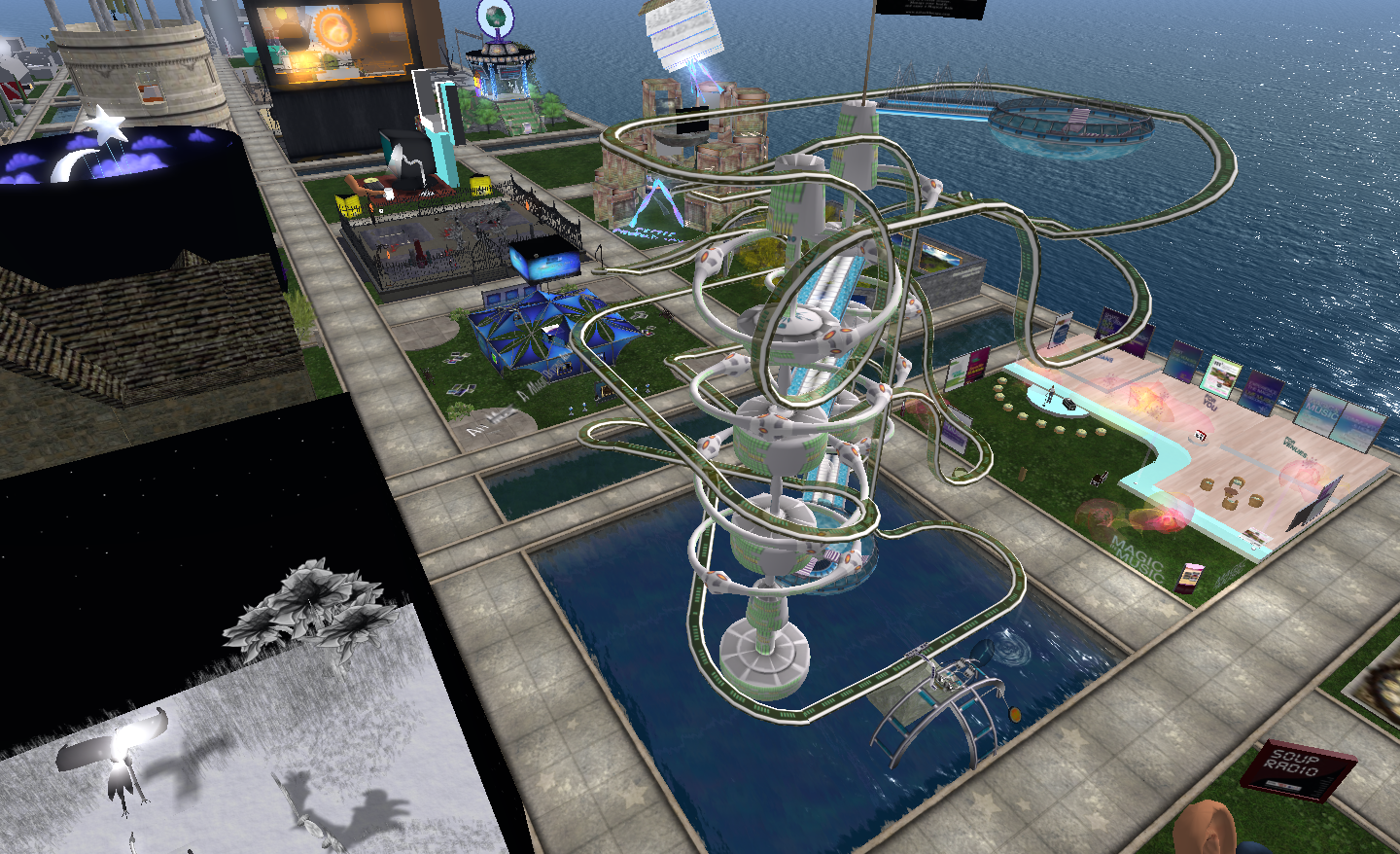
NY HealthScape roller coaster, SL8B – just one of the amazing and informative builds

I’ll personally miss the great gatherings like SL8B and its predecessors. I’ll miss the ability to wander through sim after sim of incredible builds, meeting talented content creators and designers and learning about the unique work of groups such as NY HealthScape.

Why LL have chosen to go this route is hard to fathom. Certainly, as mentioned above, previous SLB events haven’t been entirely free from controversy or headaches – but such upsets have rarely intruded into people’s overall enjoyment of the events themselves, and it is fair to say that where drama has occurred, it’s been somewhat confined to those involved, going largely unnoticed among those from across the grid who have attended events within the SLB sims and spent time exploring the exhibits.

As it stands, this announcement in some way reads less like a call for celebration and more like a renouncement of involvement in a key event in SL’s annual calendar.

And at the risk of repeating myself, that’s a shame.

When putting the “lab” back into “Linden Lab” might need more consideration

The recent Marketplace issues are not precisely news any more. LL are working to resolve matters, but in the meantime are coming under increasing backlash from users as in response to the overall management of the situation, both in terms of the manner in which the company has handled open communications with merchants on the matter and in the way the Marketplace as a whole has been handled over the years – which frankly, has been far from stellar.

My thoughts on LL’s handling of communications on the core issues is a matter of record here. Others feel the same way, so much so that a vexed comment from Sera Lok on Twitter lead to a response from Rodvik:

On the one hand, the honesty in Rodvik’s response is to be applauded. Free from BS, it speaks to the heart of the matter in many respects. However, it has to be said that one apology via Twitter isn’t actually enough.

Not One-off

The problem here is that the current Marketplace issues are not a one-off situation; the fact is that the Marketplace as a whole has effectively lurched from controversy to controversy ever since XStreet, its progenitor (so to speak), was purchased by Linden Lab back in January 2009. Indeed, some of the problems being experienced today are as a result of issues relating to the re-coding / relaunch of XStreet as the SL Marketplace back in 2010, as LL themselves note in updates to their forum posts on problems.  As such, it has caused merchants and SL commentators to give voice to the widespread sense of frustration many feel towards LL and their management of updates and changes:

And herein lies the rub: one can well understand the managing, maintaining and updating a beast such as Second Life, which has had an organic growth over its 10-plus years of life,  to be nothing short of a major headache. It’s a difficult and complicated monster to control without sometimes breaking things; but the same cannot be said of SLM. This is a product that was originally purchased  as XStreet in a reasonably robust and working form, thus LL had no reason to rush through its redevelopment  and implementation  – yet that appears to have been precisely what happened in the drive to replace XStreet with SLM.

There can be no excuse here: the entire process appears to have been mishandled from start to finish, frequently with deadlines seeming to come ahead of consideration as to whether code was ready and often missing critical functions.  Even the recent roll-out of Direct Delivery trod this all-too-familiar route; while merchants openly pleaded with the Commerce Team not to roll out DD without ANS (Automated Notification of Sale) with some even posting precisely why ANS is vital to many merchants. Yet, when launched, DD brought with it the statement that ANS would be enabled in “next couple of weeks” (a time frame which itself, unsurprisingly, has slipped given the ongoing problems).

“Putting the Lab back into Linden Lab”

In a recent interview with Games Industry,  Rod Humble indicated that one of his goals from the start of his tenure as CEO was to “put the ‘lab’ back into Linden Lab”. Well, the mark of a good lab is its ability to rigorously apply robust and consistent processes and procedures to the work it carries out. At the moment, particularly with reference to the company’s management of the Marketplace, it would appear that much more needs to be done before the “Lab” is anywhere near being back in “Linden Lab”.

While it is very good to know the team is “crunching hard” to resolve issues, one very much hopes that the outcome will be more than a simple “fix it and move on”, leaving the door for the same mistakes to again be made in handling future Marketplace updates. Rather, one hopes that a long, objective look will be taken as to how things are being managed and the necessary checks and balances implemented to ensure that product roll-outs are no longer subject to the poor level of quality that  – as Tateru points out in her Tweet – users have been forced to expect and accept over the years.

Related Links

Last Names: don’t over-cook the baking

Daniel Voyager pointed me towards a Profile feed post from Rodvik on the situation relating to the return of last names. On his feed, Rodvik writes:

Quick update on last names. Just fyi the team here has been working on solutions for this and it is taking longer than we thought. identity is important so we want the ability to have that wonderful shared experience the old last name system had but also not lose sight of the fact that many people really do not want a name given to them, they want freedom to define their identity, finally we want to consider adding meaningful things like titles etc that can be awarded by the community or some other methods. Anyway bit more complicated than initially thought but progress is being made. Will have a baked plan sometime in February we think.

First off, kudos on looking to make the system as free as possible to allow people to define their own name & help create their on-line identity – or indeed, for those established elsewhere with the freedom to bring their established on-line persona into SL if they so wish. Excellent move, and what a lot of us had been hoping for.

However, I have to admit to going “tilt” in reading the middle part of the update, specifically: “We want to consider adding meaningful things like titles, etc., that can be awarded by the community or some other methods.” From both the responses to his post  and the discussion thread started as a result of it, it seems I’m not alone in this reaction.

To be fair, it is far too soon to comment in-depth on the idea of “community awarded” titles as we have no idea as to what LL are considering – and it should be noted that there is also the get-out clause of “or some other methods” within the statement. However, one cannot help but feel something of a cold shiver of dread on reading anything to do with titles, etc., being conferred within Second Life. Many are already disheartened by what they see as the “gamification” (hideous word) of Second Life over the last 12 months – and something like this, if not handled very carefully could well end up pushing people towards even greater disillusionment.

As it is, Groups, etc., are fully able to confer titles, etc., upon members, and people themselves can opt to take a title for their own through the mediums of either their own group or through the use of Display Names. As such, one has to wonder at the value of broadening this to a “community-based” experience – and precisely what “community” we’re talking about here.

I’d still like to hear more on the subject – if only to feel some of the iciness I feel towards it thaw a little. As it is, and granted I have nothing more to go on given the lightness of detail in Rodvik’s comment, I cannot help but nod when I read Innula Zenovka’s reply, vis:

To my mind, the people considering this would do better concentrate on how to sort out what happens when several people want the same name.

This is not to say I think the folks at LL aren’t considering such a situation; rather that I’d just rather they consider it in preference to hanging a lot of gaming-like bells and whistles on what should otherwise be a “relatively” straightforward task (please note the quotes, I’m not underestimating the technical elements, titles or no titles!) that otherwise stands to gain LL a lot of user goodwill once reinstated.

In other words, Rodvik – it’s good to hear you’re all busy baking plans, but please, don’t go and over-cook things for the sake of it, OK?