September LL Zoom call: an update on Second Life

On Thursday, September 25th, 2025 Linden Lab held a further Zoom Call with bloggers and content creators to and update on SL and respond to questions.

The following is summary of the meeting; however, as my aide mémoire audio recording of the meeting refused to play back in full post-meeting, some of the Q&A elements of meeting are absent.

Table of Contents

Note that the order of topics does not necessarily reflect the order in which they were discussed.

New Option for Premium Plus Subscriptions

  • Due to be launched in October 2025, “Premium Plus, no Stipend” is a new option being added to Premium Plus to reduce the annual cost of this subscription level whilst retaining all of the “physical” benefits.
  • This option removes the Stipend and sign-up bonus from Premium Plus, reducing the annual cost by US $105.12 (+ any applicable taxes).
  • For full details, please see: Coming Soon: new option to reduce the cost of SL Premium Plus subscriptions.

Support Update

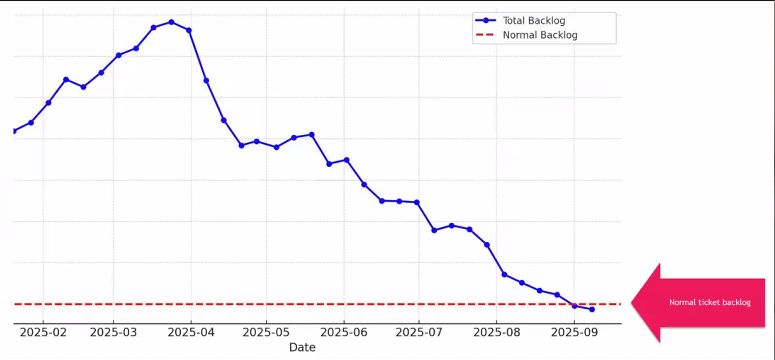
  • Backlog of tickets for support & trust and safety now down to “normal” levels.
  • Processes for helping users / responding to issues have been streamlined, and further staff have been recruited into the support and trust and safety teams.
  • The focus now is now maintaining the faster turn-around and keeping users satisfied with responses.
  • Support may be expanded in certain areas in the future – this is currently TBA.
The support ticket backlog as of September 2025

SL Viewer Summary

  • A note on the faster release cadence and the highlighting of new features – such as Inventory Favourites with the 2025.07 viewer release.
  • A note that the next release (2025.08) is focused on native Apple Silicon support, which should see a good performance boost for Mac users on that OS, particularly those on newer hardware.
  • Viewer notes and features are covered in my SL Viewer Summaries, Content Creation UG meeting summaries and Open Source Development UG notes (formerly the TPVD developer meeting).

SL Mobile, Project Zero and the New User Experience

Mobile and Zero: Incoming Users

  • The Lab estimates it is now able to get around 10x the people to try SL on mobile / Zero than had previously been the case.
  • This is allowing LL to try small, fast experiments with new users to help them get them started, such as with the on-going current focus on helping new users to dress / customise their avatar.
  • One of these is a new “helper” island where new users can go to for help (e.g. in dressing / customising their avatars, and Project Zero (viewer-in-a-browser). Zero is already geared for this.
  • The aim is to fully on-board new users ASAP to get them engaged.

Retention and Experiments

  • Despite the rise in initial engagement with new users trying SL via Mobile and Project Zero, overall retention of those users is still proving hard – the current figure is only around 7% of those coming into SL are actively being retained.
  • Some of the experiments mentioned in the meeting have involved dropping new users into established locations and hubs, rather than welcome hubs.
  • It was noted by meeting attendees that some of these experiments have not always gone well.
    • One cited example was the use of Ahern, which has become a hang-out for established users, many of whom have been witnessed as harassing and being abusive towards incoming new users.
    • Part of the problem here is that mentors were not aware of these switches / experiments, and so could not attend to provide support.
    • The use of Ahern in particular has now ceased as a result of this feedback.
    • It was further noted that LL are planning to involve mentors in future experiments.
  • The observation was made that established users who are already invested in the platform (as those at Ahern causing trouble appeared to be) and who spend time denigrating / insulting / trolling new users to the point of driving them away is somewhat self-defeating, in that it potentially damages SL’s ability to grow / remain viable as a product through the acquisition of new, engaged users.

User / Community Involvement

  • The question was asked if LL could offer incentives to those users (e.g. club owners) and communities able to demonstrate a track record of being able to attract new users and convert them into retained users.
  • It was pointed out that there is the Second Life Creator Partnership Programme, which includes the potential for incentives to communities, etc, and which includes things like Community Gateways.
  • Brad Oberwager offered a challenge – those who can develop and demonstrate a means of converting new users to retained users through their own means should contact the Lab to discuss ideas and possible incentives.

An Update from Linden Lab

On Thursday, July 24th, Linden Lab held a Zoom Call with bloggers and content creators to provide a series of updates and take questions on a number of initiatives, changes and issues that have been the subject of recent discussion through forums such as the Zoom Calls, and recent announcements made through the likes of the Meet the Lindens sessions at the SL22B. Table of Contents

The following is an attempt to summarise the discussion and questions raised. Note that the order of topics does not necessarily reflect the order in which they were discussed..

Support: Status and Ticket Backlog

  • Most support issues have a 72-hour (3 business days) SLA for turnaround, with some priority items having a 12-hour or 24-hour (1 business day) turnaround SLA.
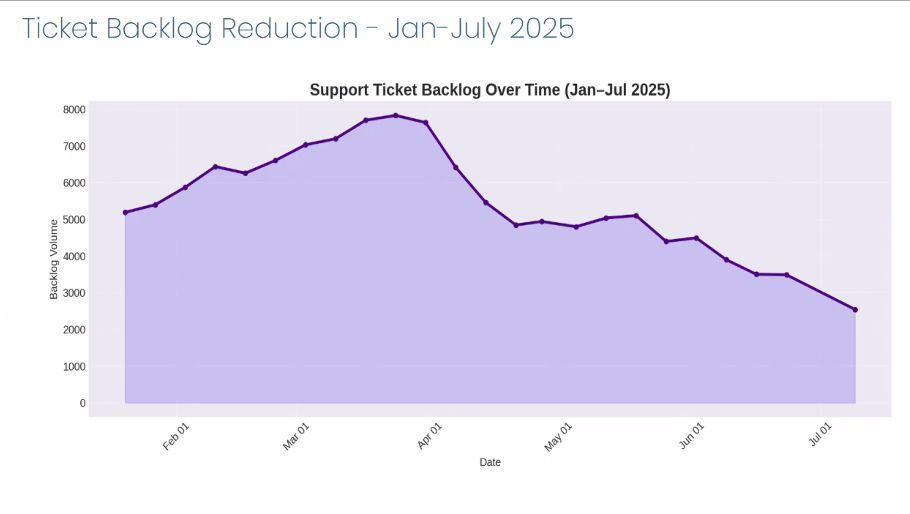
  • This includes carrying a “balance” forward of around 1000-1500 tickets
  • There has been a significant backlog of tickets due to things like the support reorganisation in late 2024, but the number of outstanding tickets is being brought down, per the graph below.
Graph supplied by Patch Linden showing the declining in the size of the support ticket backlog
  • In addition, and as Patch indicated at SL22B, weekend support hours have returned, so there is now 7-day a week support from 06:30 through 15:30 SLT.
  • In addition, new in-world support and Discord support options are in development and should be announced soon.

Tilia/Thunes and Pay-outs

  • Recap of the reason for the sale (completed in June, see: LL completes Tilia sale to Thunes: What you need to know). In short, Tilia as a Fintech operation was taking up too much time for LL to effectively manage and build.
  • As anticipated, there were some issues with pay-outs for some immediately following the completion of the sale; however, the majority of these should now be sorted out.
  • Whether the sale will potentially increase / decrease the time taken to complete pay-outs depends on a number of factors:
    • When LL moved to offering real-time pay-outs, Second Life became the target for attempts at fraud by outside forces, and the Lab wasn’t quick enough to catch all cases.
    • Ergo, before moving back towards real-time pay-out, the Lab is now focused on the issue of account security at their end of things.
    • Additionally, LL is looking to Thunes to be able to offer more pay-out options to SL creators, some of which might also reduce the times taken to receive money.
    • However, time frames for introducing the latter are a matter for Thunes, not LL.

Linden Dollar Exchange Rate and the Economy

Concerns have be raised about the recent increases in the Linden Dollar exchange rate (roughly a 5% increase thus far over the course of 2025), with questions on whether the Lab will intervene / cap the increase, and whether the increases were due to user behaviour or system tweaks.

  • The LindeX operates entirely independently of Linden Lab on an open order book basis: anyone can participate in placing buy / sell orders, with matching engine determining which orders can be fully or partially filled. There is no direct intervention by the Lab.
  • One of the negatives of the open order book mechanism is that it is subject to the laws of supply and demand: if the supply of Linden Dollars exceeds the demand for them, the LindeX is going to move.
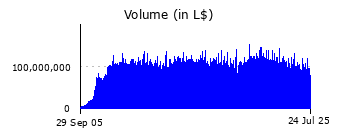
  • LindeX volumes, 2005-2025

    Whilst the 5% increase thus far over the course of 2025 is concerning:

    • It is perhaps not excessive when seen in terms of the economic disruption going on in the world at large.
    • Across 20 years of history, the LindeX has actually been remarkably stable (see: LindeX Exchange: Market Data and click on the All option beneath the graphs at the top of the page), particularly when compared to more recent crypto-currencies – or even when compared to natural inflation in the real world.
    • In this latter respect, SL might be seen as a city which, for 20 years, has seen almost zero inflation.
  • Quantitatively, the LindeX should have been moving at a rate of around 2% a year, forcing creators to periodically adjust their prices. Had this happened, it would have become the norm, and no-one would have been alarmed at the current increases.
  • That this hasn’t happened is largely down to market sinks – actions that cause Linden Dollars to “disappear” from the LindeX.
    • This tends to happen when the Lab accepts L$ as a payment for something that does not have a real-world cost associated with it (so the Lab does not make money on the L$, nor does it lose money in providing the service for which the L$ payment is made). When this happens, it can cause the supply of Linden Dollars to be reduced, boosting demand.
  • In the years prior to the COVID pandemic (i.e. 2017-2020), the number of sinks had been decreasing, causing the LindeX to rise. However, during the pandemic, demand for L$ rose exponentially, reversing the trend completely. Since COVID the trend has reversed once more, with supply again outstripping demand and leading to the current volatility.

What Can Done?

  • The Lab could directly intervene and change how the LindeX operates, either by becoming a market maker, or pegging the market rate for L$.
    • Neither option is seen as optimal for various reasons (e.g. the perception that LL is now manipulating the market to their benefit; the potential for increased fees to be charged, etc.).
    • However, the market maker is an option the Lab could possibly experiment with alongside the open order book in the future.
  • Currently, two potential actions are in development at the Lab. These are focused on the supply side of things with the aim of alleviating some of the current upward trend. Neither option was specified in the meeting, but one is liable to be launched in the near future, while the other is more medium-term.
  • Longer-term, the solution is seen as redressing the supply and demand balance in favour of the latter. There are two primary ways of doing this:
    • Find the means to introduce more sinks into the market, so that L$ can be “taken out of circulation”.
    • Stimulating demand for L$ – most particularly through bringing more active users in to SL so they engage in the economy (see below for more on this), and through short-term promotions such as the April 2025 50-hour reduction in L$ buy fees.
  • In terms of providing more sinks for L$, the Lab is open to suggestions from the user community at large on how this might be achieved – however, a sink only works if it involves no base cost to Linden Lab. For example:
    • While paying for a subscription (Plus, Premium, Premium Plus) using L$ might some like a sink, subscriptions have a base cost for LL, which is covered by the revenue LL obtains through the fiat money subscription fee. So if L$ are used instead, that revenue is removed and in order to recover it, LL must sell the L$ back into the market, keeping them in circulation and eliminating the sink.
    • The above is also true to ideas such as allowing region holders to pay for multiple regions using L$.

Platform Growth Initiatives

This was both an update on the impact of Project Zero (the viewer in a browser) and SL Mobile in bringing-in new users – and how established users can help with this.

  • Both Project Zero (viewer in a browser) and SL Mobile, together with new on-boarding initiatives and advertising has seen a month-on-month grow in the number of people trying SL over the last three months.
  • This has resulted in a tenfold increase in the number of people trying out Second Life than has historically been the case.
  • However, this is only translating to around a twofold increase in the number of retained users (those logging-in to SL repeatedly over a 30-day period) – or approximately 1 in every 100 who try SL for the first time.
  • While the Lab is trying to improve on this by directing incoming new users to meaningful locations, they are seeking help from users and creators.
  • If creators (e.g. content creators, region holders, etc) / communities can create in-world locations specifically to engage with and encourage new users to become more involved in Second Life, LL is willing to work with those creators / communities to drive incoming traffic to those locations.
  • Those interested in partnering in this way should apply to join the Creator Partnership Programme.
  • As a part of this, LL will also work closely with the creators on these new user experiences / flows to help understand what is working and what is not, where new users might be getting frustrated (and possibly leaving), how to address this, provide relevant stats on all of this, etc. The overall aim being to help iterate and build experiences and processes that result in more new users becoming more fully engaged in SL.
  • For the Lab, the focus is on trying help new users get to grips with the basics – how to dress and customise their avatars – rather than the more esoteric aspects of SL (e.g. managing land and / or Groups).
  • There are some general things existing users can do to help new users.
    • This could be as simple as engaging with them in conversation, to the likes of clubs and stores not blocking access to accounts under a certain number of days (30, 60, whatever).
    • Yes, the latter may mean having to deal with trolls / idiots, on throwaway accounts – but there are tools to help with this, and making new users feel more welcome as they hop around SL trying to find places they might enjoy (and spend L$) than making them feel utterly unwelcome.

Copyright and IP Infringements

A number of meetings with content creators earlier in 2025 raised the issues of copyright / IP infringement, content ripping, and similar (some based around the appearance of a viewer that had a focus on content ripping).

  • In response to the concerns, LL has been pro-active in trying to address the “top” problems with content theft, with those doing so receiving “more than nasty letters”, and as a result departing Second Life.
  • This was supported by the opening of a special support channel to respond directly to matters of content theft.
  • As a broad indicator of the change, the number of reports of content theft (not DCMA filings, which tend to remain constant) has fallen from around 300 per year to just 27 since the new measures were introduced earlier in 2025.
  • Content creators at the meeting largely agreed with the Lab’s point of view, confirming that some of the more notorious content thieves have not gone from SL, and the aforementioned content ripping viewer appears to now be blocked.
  • It is acknowledged that this likely does not eliminate all content ripping completely from SL, but should be taken as indicative that LL and their legal team are not prepared to be complacent on the matter.

A short look at the refreshed Second Life web-based join flow

The refreshed Second Life web account sign-up page with the new splash image backdrop

Linden Lab has recently refreshed the Second Life web-based new user sign-up flow at join.secondlfe.com in order to offer incoming new users a smoother, easier experience when using the web sign-up process. Some of this incorporates work carried out with Project Zero – the viewer in a browser – and the new sign-up flow applies to both the viewer and Project Zero.

Key elements of the update include:

  • An image backdrop for the account creation page.
  • Quality of life updates to make it clear what information needs to be entered and when a mistake is made; use of a clearer font, etc.
  • There is no longer an avatar picker for those pointed to the viewer download workflow; instead, after completing the account creation page, new users are directed to download and install the viewer.
  • On logging-in through the viewer, a new user will be automatically assigned an initial avatar from the Avatar Welcome Pack, and desktop version of the Avatar Picker deployed to Project Zero (see here for more) is automatically displayed to allow for avatar customisation.
  • The web join flow still offers a random chance of a new sign-up being directed towards accessing SL via Project Zero rather than being asked to download the viewer.
The refreshed Second Life web sign-up goes from the account creation page directly to either the viewer download page (displaying the SL Mobile options) or to the Project Zero page

Further it should also be noted:

  •  These changes do not apply to the sign-up flow for SL Mobile, although that sign-up process has been updated independently of join.secondlife.com.
  • The reason for removing the Avatar Picker from the web workflow was because data showed that a lot of new sign-ups were spending a significant amount of time actually in the avatar picker and customising their avatar, and then not actually going on to actually log-in to Second Life, so was seen as a blocker to getting people in-world.
  • All incoming new users are given the same avatar (I’m not sure if the selected avatar is periodically rotated), which can be interesting.

The Avatar Picker / Avatar Welcome Pack

As noted, the Avatar Picker – reference to as the Avatar Welcome Pack – is an idea that originated with Project Zero, and is now offered through the official viewer (and those TPVs that have adopted the 7.1.15.15596336374 – 2025.04.01 code base) with some tweaks – such as being presented as a floater within the viewer, and not having the Avatars toolbar button as is the case with Project Zero.

New users installing the release viewer for the first time should find the Avatar Picker open by default after logging-in, with the avatar tab displayed.

The Avatar Picker / Avatar Welcome Pack floater and tabs. Note: due to a known issue, only the female outfits are currently only presented  / available (and Male clothing folder in the Library is empty)
  • Clicking on one of the six avatar images within the tab will automatically apply that avatar.
  • Clicking the Clothing tab with display the available outfits. Clicking on the image of an outfit will apply it to the currently-selected avatar.
    • Note: The update was deployed with a known issue that only the female outfits from the Avatar Welcome Pack are available in the system library. This is being addressed.
  • Selecting an avatar or outfit from the Avatar Picker will add the associated folder(s) to the Clothing system folder in Inventory.
  • If the floater is closed, it can be accessed again via the Avatar menu → Avatar Welcome Pack…, which replaces the old Choose Avatar option.
The Avatar Welcome Pack menu option

Personal Feedback

This is not intended to be an in-depth analysis of the now flow, but I have some general observations.

  • Overall the changes make for a smoother on-boarding, even allowing for the viewer having to be downloaded and installed (if the user is pushed through that flow).
  • This is very much assisted by taking the avatar customisation process out of the sign-up process, which as noted above, had become a bottleneck.
  • The avatar picker is fairly intuitive, but could perhaps benefit from some tool-tip prompts.

There are some areas of concern:

  • Each time the Avatar Picker is used, it generates a completely new folder for the selected and / or selected outfit within the Clothing system folder in Inventory. Whilst this is not directly visible to new users who might not be aware of Inventory to start with, it does potentially lead to a lot of duplication and additional inventory bloat.
  • There is now two very different and completely incompatible “starter avatar” systems still within the viewer:
    • The creator-supplied Avatar Welcome Pack (which I believe will be expanded upon).
    • The Senra avatar system.
  • Fortunately, the Senra system is fairly well buried within the system library; however, the majority of in-world information at places like the Welcome Hub, and resources on-line, such as the Second Life University videos focus on Senra. Hopefully, if both systems are to be run side-by-side, this balance will be redressed.
Senra at the Welcome Hub – but no Avatar Welcome Pack guidance as yet
  • The fact that the same avatar from the Avatar Welcome Pack is given to all incoming users means that the various spawn points where new users arrive can end up looking like a beam-in point for a gathering of clones.

This last point is really trivial to a point, but it does make arrival points for new avatars look and feel a little odd. As to the rest, nothing is impossible to correct – and much of it is hopefully already on LL’s radar; with limited resources, updates to all aspects of a process can take time, some of which can be spent engaged in testing and revising basic ideas and approaches.

Overall, the refresh to join.secondlife.com comes over as positive, and helps to bring the viewer and Project Zero a little closer together for those who might use both.

Dreamer’s Landing: a community supporting new users in Second Life

Dreamer’s Landing, February 2025

Update, March 27th: Dreamer’s Landing is being overhauled and is currently closed. 

Co-founded by Ⱥvalon Bouvier and Fire (Fire3850), I first dropped into Dreamer’s Landing in mid-December 2024, drawn by the concept of a setting which brings together both those new to Second Life and those engaged with the platform in order to foment a sense of community, learning, encouragement and support, in which new users gain a better foothold in-world, from being able to find a free home through to having the opportunities for direct mentorship and to engage in social events – users can even apply for jobs within the setting.

At the time of my first visit, there was still work going on setting-up parts of the region, so I had intended to hop back again at the start of the New Year and take a detailed look at Dreamer’s Landing; unfortunately, things being what they were, I didn’t manage to do so until later January – so my apologies to Fire, Avalon and their team for the delay in getting this article put together.

Our mission at Dreamer’s Landing is to provide housing, mentorship and community to new and experienced SL members, where everyone contributes and respects the people within the community. We do this by attracting seasoned residents who want to create community and mentoring.

– Dreamer’s Landing Mission Statement

Dreamer’s Landing, restaurant – February 2025

Occupying a Full private region utilising the Land Capacity bonus offered by Linden Lab, Dreamer’s Landing is not currently a part of the Lab’s Community Gateway programme, as re-launched in 2017. This is primarily because it is more a “next step” community for new users rather than a place for leaping in from sign-up and getting started; however, it does have links with several community gateways, including the Lab’s own welcome hub, where such on-boarding does occur. By keeping a little apart from the usual mix of on-boarding, focused learning (mixing self-learning with mentor support) found within “traditional” Community Gateways, Dreamer’s Landing is able to focus more on personalised support built around the overall sense of community.

In addition, Members of the team may have their own homes within the community and are very much a part of social activities; thus, the sense of friendship and community is further fostered, and this helps lower any embarrassment newer users might otherwise feel when it comes to asking questions / seeking assistance. Within this, Dreamer’s Landing wraps within itself the concept of paying forward; new users obtaining a home within the region are asked to give a little back to the community in support of others, as Avalon noted to me.

We have about 12 mentors at the moment who are volunteering to spend time with our new residents, and we have onboarded 14 new residents so far, hopefully giving them all a lift up to their new life in SL. Part of the project is that we encourage new users to give back by becoming greeters at the Landing Point or by contributing directly to the rest of the community here. We also try to encourage them to discover things they’d like to do in-world. 

– Avalon Bouvier, co-founder, Dreamer’s Landing

Dreamer’s Landing, February 2025

The Landing Point is located on the ground level of the region, which has been attractively laid out in a style of 18th and 19th century French metropolitan architecture, with some Greco-Romano touches. A region surround offers a sense of greater space, whilst the region as a whole mixes community spaces, a small business district, gardens, and residential rentals, all brought together by cobbled avenues and boulevards. As well as the gardens and parks, copses of trees and the waterway cutting through the region help to avoid any sense of the setting being overcrowded.

The residential properties here are kept to the outer edges of the region to offer those renting them with a sense of personal space. If I understand things correctly, these units – taking the form of large classical French townhouses as might be found in Paris – are available to volunteer mentors and new users who wish to remain a part of the community.

The Landing Point sits within the small business district with boutique-style shops focused on fashion, couture and avatar customisation, together with gallery spaces to introduce newcomers to SL’s art scene, and similar.  It is rounded-off by the local café,  which joins with the dancing / music / games square towards the centre of the setting, the restaurant to east with its outdoor terrace / dance area build over the waters of a small cove, and the pool, spa and beach to the south-west as the major event and activity spaces.

Dreamer’s Landing – new user homes, February 2025

Getting around the ground level is easy enough on foot, but the various areas are also linked by the Dreamer’s Landing teleport system which also provides access to the region’s sky platforms. These include:

  • The Education Centre – where classroom lessons can be obtained for those who prefer them, together with self-help guides (touch the bookcases), and residents can apply for volunteer and paid jobs within the community (ads for these can also be found on the ground level). This level also includes the Dreamer’s Landing passport centre and a gifts centre to help new users to get started.
  • The Sandbox – where community members can unpack boxed items they have obtained, practice building, etc., and where community paintball games might be held.
  • The Walk-in Closet – offering space for users to sort their inventory, try outfits, learn about (and purchase) web-based inventory management systems, change their appearance / adjust the positioning of non-rigged attachments  and try them out with various poses, etc., with with the assistance of others or in private changing facilities if they prefer.
Dreamer’s Landing – Education Centre, February 2025

And of course there is the new user free housing. This takes the form a chalet-style housing spread over a sky platform with light landscaping, with personal touches added by the Dreamer’s Landing team, such as a sign welcoming incoming users to their new home and small outdoor community spaces as well.

We currently have 24 free homes for new residents, with about half occupied. Each house is supplied with furnishings and décor, and have an additional 50 LI for personal use. However, if someone wants to have the supplied furniture removed, they can, and that will give them up to 100 LI for personal use. Houses are generally supplied for a two-month period to help people get started, although this might on occasion be extended according to circumstance.

– Fire3850, co-founder, Dreamer’s Landing

Dreamer’s Landing – new user homes, February 2025

From my multiple visits to Dreamer’s Landing, I can personally attest to the friendliness and helpfulness of the folk at Dreamer’s Landing – both established and those who are more recent to Second Life and have volunteered to help within the community. If you know of any recent arrivals to Second Life who are looking for somewhere they might initially treat as home and be among a helpful community – be sure to direct them towards Dreamer’s Landing. Further information on the community – including the schedule of events and entertainment – can be found at the Dreamer’s Landing website.

SLurl and Links

Checking out the Second Life Community Exhibition

Second Life Community Exhibition (SLCE), January 2024

On Tuesday, January 30th, 2024, Linden Lab announced the opening of a major new addition to their Welcome Hub / Motown Experience gateway, which itself opened in June 2023, as I wrote about in Linden Lab and Motown: a new approach to user on-boarding in Second Life.

The new addition – called the Second Life Community Exhibition (SLCE) – is designed to occupy north-west corner region of the nine-region Lab-managed estate, replacing what had been the laser tag area. However, at the time of writing it was limited to a smaller area extending outward from the main Welcome Hub region, between the Motown and and shopping regions. In terms of it’s purpose, it is intended to do exactly what the name suggests: provide active communities within Second Life with the opportunity to promote themselves to both established users visiting the Welcome Hub and its associated regions as well as to incoming new users arriving at the Hub.

Following the design design aesthetic of the Welcome Hub, the Community Exhibition area currently has room for some 32 community displays, with eleven occupied for the opening. According to the official blog post on the Exhibition, the displays will be cycled between communities as time goes on, in accordance with the response of new users to the various displays when visiting the exhibition – a statement which tickles my curiosity as to how such “resonating” will be measured (purely on the basis of the number of teleports from any supplied portal? If so, what about those displays providing access by giving landmarks or HUDs?).

Second Life Community Exhibition, January 2024

The ten communities initially presented comprise: Boystown (LGBTQ+ friendly), Drivers of SL (hosts of the famous Grid Drive events, as well as helping to represent sailing and flying in SL), Virtual Ability Inc., Non-Profit Commons, Club Furzona (Furry community focused on music, writing, animation and 3D modelling amongst much more), BURN2 (the unofficial virtual celebrations marking the physical world Burning Man traditions), plus four well established communities offering people both a sense of community and a place to live: Bay City, the Caledon community and estate, the Confederation of Democratic Simulators (CDS) and (my “home town” of) Second Norway.

Linden Realms is also represented, although it’s hard to consider it a “community” in the traditional sense. However, of all the Linden games introduced into Second Life, it does seem to be the one with the most enduring popularity, and it certainly offers the potential for new users to make friends whilst racing around and collecting gems, so its inclusion shouldn’t be sneered at.

Second Life Community Exhibition, January 2024 – expansion area for further community displays

Nor are these merely static informational areas – the aim is to both promote communities to Second Life residents and bring residents into the communities. As such, and as indicated earlier in this piece, each participating community is expected to provide some form of access into their community / experience, be it via teleport portal or HUD landmark giver, etc. In addition, communities can provide links to other resources they might have – websites, Discord channels, etc., – and displays / exhibits can utilise multi-media, etc.

Communities wishing to join the Exhibition can do so via the SLCE application form, which includes general guidelines on requirements / expectations. As to the rest, I’ll leave it to Strawberry and Patch Linden to discuss, via the Lab Gab recording below.

Overall, this would appear to be a good initiative – outreach to new users (and even existing users) is something communities and groups within Second Life can find difficult, so providing what is very much a “doorstep” opportunity to reach people through a  physical resource like this is something a broad cross-section of communities and groups could find beneficial, allowing for acceptance and length of time(s) featured within the Exhibition space.

SLurl Details

Looking at the Second Life Senra avatars

via Linden Lab

On Tuesday, August 1st, 2023, Linden Lab officially announced the release of the first of the Senra brand of starter avatars for Second Life. The announcement came perhaps a little later than had been planned – at SL20B, Patch Linden indicated the hope was to launch them in July – and more than a year since they were initially previewed at the SL19B event in June 2022.

Of course, the release of new “starter” avatars for Second Life is nothing new; there have been several such releases over the years – some of which have been covered in these pages. However, particular excitement  / interest has surrounded the Senra project, because it is the first time LL has developed a start avatar making full use of “modern” capabilities within Second Life, including the use of mesh bodies and heads, the rigging and animation capabilities presented by the extended “Bento” skeleton and capabilities such as Bakes on Mesh.

More particularly, the Senra avatars are coupled with a new approach to introducing new users to their avatars and to customising them, using a web-based process integrated into the overall New User eXperience (NUX), which commences with the sign-up process and continues through to bringing new users into Second Life via Welcome Hubs and Community Gateways.

The Senra folders in the System Library

Sadly, I’ve been unable to test this customisation process myself, so for that, I’ll have to direct you to the Second Life University video released alongside the formal announcement (and embedded at the end of this article). What I will say about it is that it is very mindful of that used with Sansar. Whether this is a result of taking lessons learned and replying them or purely coincidental, I’ve no idea; but if it is a case of the former, then I say good on LL for doing so, as the Sansar system always came across as easy-to-use.

For those who wish to try the new avatars directly, then as the official blog post notes, they can be obtained via the System Library. However, and if you have not yet done so (and while it may well be obvious to most) – do be sure to copy the folders from the Library into your inventory.

While it is possible to Add / Wear items directly from the Library, this will result in them being copied to your inventory anyway – but rather than remaining together, they’ll simply be placed in the system folder corresponding to their item type (eyes, shape, object, skin, tattoo layer…) thus scattering them throughout your inventory, rather than keeping them all nearly together.

This initial release for Senra – emphasis here because again, it is important to note that work on further avatars in the range, including anthro, are in development, as per Patch Linden’s comments at SL20B – is referenced as “Beta”; in other words, while it is officially released, feedback and lessoned learned from it will be applied to the new versions of Senra avatars as they are released.

In the meantime, this “beta” comprises two avatars: Jamie (female) and Blake (male).

In keeping with most avatar bodies and heads, they are supplied Copy / No Transfer + No Modify, and each, as supplied with this release, comprises:

  • A separate body and head. Both use the standard SL avatar UV Map using the universal channels and are fully BoM. Thus, they are reasonably compatible with most skin, tattoo and clothing layers.
  • A total of six shapes, skins (from bleached to really dark) and nail layers, eight eye colours and nine hair styles (a mix of hair objects and tattoo hairbases).
  • An identical range of clothing (tops, bottoms, skirts, etc.) for each avatar, sized to suit their basic shapes & with alpha layers for the fuller body forms.
    • Note that free additional colours of some clothing can be found at the kiosks within the SL Welcome Hubs (at the Avatar area inside the Second Life Academy).
  • A basic, HUD-style animation system with single-click stop / start capability.
The Blake and Jamie starter avatars

I don’t want to go overboard in discussing these avatars in detail; we’ll all form our own opinions on them over time – and there are others far better qualified to dig down into them than I. As such what I have to say here is somewhat subjective and intentionally limited.

The splitting of the avatars between head and body – given they were originally described as “all-in-one” back around the time of SL19B – is a good move. It allows those transitioning from these avatars to third-party options to split the expense (and learning curve) in doing so over an extended period (e.g. purchase a body first, get used to using it + its HUD, then later decide on a head), rather than having to do everything at once.

Whilst six shapes are provided, these actually split between three body sizes (which for ease of reference, I’ll call “thin”, “medium” and “broad”), and two facial feature shapes (again for ease of reference: “thinner” and “fuller”) to provide two broad sets of appearances: the “thinner” face with each of the three body sizes (shapes 1 through 3), and the “fuller” face with the three body sizes (shapes 4 through 6).

What a difference a skin makes. Left: Jamie with her default shape 4 and skin 4 (l) and the same shape with the skin supplied with the Monique starter avatar (r)

Some have critiqued the avatars  – notably the female – for not supporting heeled shoes. While Patch has indicated this may be added as an option in the future, not doing so actually makes sense in the context of new starters: have to reference a HUD system and find the option to angle the foot for a specific hell height isn’t entirely intuitive when the aim is to keep things as simple as possible.

For me, the weakness visual part of these avatars les with the skins, which lack a degree of depth and  – for Jamie at least – could have been much improved by the simple application of decent makeup in the texture, as demonstrated in the image above, which uses one of the older starter avatar skins suppled by LL (“Monique”).

Again, I can understand LL wanting to minimise items they provide so as to keep the door as open as possible for third-party content creators to join the Senra ecosystem; but surely something a little more attractive could have been provided for new users when it comes to Jamie;  something which lets them feel there avatar is at least reasonably attractive when compared to others. As it is, the blandness of the Jamie skins could leave those using it like they must immediately start spend, spend, spending to “get up to par” with others – or (as bad) feel their avatar is inadequate.

Additional Senra avatar items can also be found at the SL Welcome Hubs

My other niggle is with the animation system; I cannot fathom why LL felt a need to change a term that has been in use for almost as long as SL has been around (Animation Override). True, “Animation Controller is a more accurate term, but it still runs contrary to accepted terminology and could led to some confusion for new users – which Senra is supposed to minimise. Also, could not the animations be a little smoother or more natural?

With regards to third-party creators entering the Senra eco-system, applications for the Senra SDK, intended to allow them to obtain the SDK and do so opened a little ahead of the formal release of the avatars via a forum thread announcement.

This has prompted a lot of feedback related to the design and construction of these avatars which I’m far from technically competent to comment on. However, my own rough-and-ready comparisons using the Improve Graphics Speed floater – whilst not totally ideal in making such comparisons – suggest that overall, these avatars are not that bad when compared to other systems in terms of their overall load, even if they are perhaps not the most efficiently made.

The Jamie head (top) compared with the Lelutka Simone head (bottom, minus its separate eyes and teeth). Note the comparative faces / vertices  / VRAM counts which allow for a number of calculations by which to compare the two heads

The thread on the license agreement has also led to a degree of discussion on the extent of the requirement laid out in the agreement and its associated documents. I don’t want to drag this article out further by diving into things here, but I would say that some of the concerns raised (e.g. LL not allowing content for other head / body ecosystems) is born of a misunderstanding of Senra’s function (the system is for those new to SL and intended to offer a simplified road into avatar customisation – and providing multiple items for multiple bodies or heads could confuse new users), and a degree of over-wrought mistrust of LL born of a misapprehension around legal terms. However, for details, I’ll leave it you to to follow the thread and draw your own conclusions.

Conclusion

As with all avatar systems, Senra has its positives and negatives. What these are seen as will largely be a matter of personal experience and subjective analysis by most – as is the case with some of my comments here. As such, I’ll just close with a handful more of personal observations:

  • Are the Senra avatars an improvement on the “classic” ranges of starter avatars – absolutely.
  • Could the possibly be better? Well, most likely, yes. The devil is in the details, and I do feel this skimp on the most important detail – the skins.
  • Would I personally use one? No. But that’s because I have two bodies and four heads to play with on my main account and two heads and a body on my alt account, and they are more than enough.
  • Would I suggest friends still firmly glued to the the system avatar give Senra a go and see what they can make of them, mix and matching with items already in their inventory? Absolutely.