Space Sunday: of Artemis and Administrators

November 16th, 2022: the Space Launch System (SLS) rocket lifts-off on its maiden flight, lifting an uncrewed Orion MPCV capsule on the Artemis 1 mission to test the latter on an extended flight to cislunar space and back to Earth. Credit: Joel Kowsky

NASA has announced the push-back of Project Artemis missions in the continuing efforts to return to the Moon with human missions, and with the announcement has come renewed calls for the cancellation of the Space Launch System rocket.

During a December 5th, 2024 briefing, NASA management confirmed that Artemis 2 – the mission to fly a crew of four around the Moon and return them to Earth – will now not occur until April 2026, slipping from the target launch month of September 2025. As a result, the first attempt at a crewed landing under the project – Artemis 3 – has been rescheduled for a mid-2027 launch.

The most significant reason for delaying the missions relates to issues with the primary heat shield on the Orion MPCV (multi-purpose crew vehicle). As I’ve reported in these pages, this heat shield suffered greater than expected wear and tear during the unscrewed test of Orion on a flight around the Moon in December 2022 – something first release to the public in detail in May 2024.

The Artemis 2 crew (l to r: Canadian Space Agency astronaut Jeremy Hansen and NASA astronauts Christina Koch, Victor Glover, and Reid Wiseman) outside the Astronaut Crew Quarters inside the Neil Armstrong Operations and Checkout Building during an integrated ground systems test at Kennedy Space Centre, September 20th, 2023. Credit: Kim Shiflett

More recently, NASA has indicated that it has identified the root cause of the issues, with comments at that time appearing to suggest part of the solution might involve charges in the construction of the heat shield itself, particularly as the October 2024 update on the issues, Lori Glaze, acting deputy associate administrator, NASA Exploration Systems Development Mission Directorate indicated that while NASA were confident about the cause, as the heat shield for this mission “is already built”, the agency was at that time unsure as to how best to protect the crew during the critical re-entry into the Earth’s atmosphere at the end of the mission.

For assorted reasons, the Orion capsule operates differently to the Apollo Command Module capsule. As it returns to Earth at a high velocity than Apollo, the Orion vehicle does not perform a single re-entry into the atmosphere as Apollo did; instead, it performs what is called “skip guidance”. This involved dipping briefly into the upper atmosphere and using it to reduce speed, prior to making a final re-entry.

The overall goal of this approach is to allow the Orion vehicle to experience somewhat lower temperatures (although still in the order of around 2,700oC) during its “proper” re-entry, than would otherwise be the case were it to simply slam into the atmosphere a-la Apollo and use the friction of that re-entry to slow itself.

A view of the heat shield used on the Orion vehicle during the Artemis 1 mission. The scoring and surface damage to the surface of the heat shield was expected as a part of the ablative process during atmospheric re-entry. However, the large areas of deeper pitting and cratering – called “char loss” – were not. Credit: NASA

However, following the investigations into the excessive pitting (called “char loss”) seen with the heat shield used with Orion on Artemis 1, was an unforeseen result of the skip guidance approach.

While the capsule was dipping in and out of the atmosphere as part of that planned skip entry, heat accumulated inside the heat shield outer layer, leading to gases forming and becoming trapped inside the heat shield. This caused internal pressure to build up and led to cracking and uneven shedding of that outer layer.

– NASA Deputy Administrator Pam Melroy, December 5th, 2024

During the briefing, it was confirmed that no significant redesign of the heat shield is required to overcome this problem; rather the re-entry trajectory for all Artemis crewed missions must be altered in order to minimise the char loss seen with Artemis 1 (remembering that while severe, the damage done to the heat shield in that mission did not reach a point of threatening the overall integrity of the Orion capsule).

For Artemis 2, engineers will limit how long Orion spends in the temperature range in which the Artemis 1 heat shield phenomenon occurred by modifying how far Orion can fly between when it enters Earth atmosphere and lands.

– NASA Artemis FAQ, December 5th, 2024

While an adjustment to the mission parameters is not as drastic as having to build an updated version of the heat shield, it does still require significant computer modelling, updates to flight software on Orion and a re-training of the Artemis 2 crew so they are familiar with the new flight envelope, control protocol and dealing with any alarms / emergencies during the revised re-entry phases of the mission. Hence pushing back Artemis 2 until early-to-mid 2026.

While this does have a knock-on effect for Artemis 3, other factors have come into play which have also contributed to the delay in that mission; some of which many observing Artemis and the choices made (myself included) have long anticipated.

Whilst announced on December 5th, 2024, slippage of the Artemis 3 mission to land a crew of two on the surface of the Moon was seen as inevitable by many thanks to the slow development of the SpaceX HLS vehicle the sheer complexities of the launch system on which it depends. Credit: SpaceX

Chief among these is the fact that the SpaceX Human Landing System (HLS) vehicle – a modified SpaceX Starship just wasn’t going to be ready for use in 2026; in fact, there is much to suggest the vehicle will not be ready for any planned 2027 launch of Artemis 3, and that a more reasonable expectation for any Artemis 3 launch would be late 2028, earliest.

However, there are some other factors involved in the Artemis 3 delay; given the changing dynamics and plans for Artemis lunar missions, there is a requirement to make improvements to Orion’s on-board environmental systems. These will not take as long as getting the SpaceX Starship system to the point where it can properly carry out the roughly 12-16 launches required just to get the HLS vehicle to the Moon (leave alone actually construction and testing of the lunar landing vehicle ahead of and use by the crew), but they are a issue which need to be factored into the mission delays.

“Scrap SLS”

The December 5th Artemis announcement saw a further renewed expectation of, and calls for, the cancellation of NASA’s Space Launch System (SLS).

The largest calls for this have come from the SpaceX fan community who frequently (and unfairly) compare the cost of SLS to that of the SpaceX Starship, although there have also been repeated concerns raised from within the US government, such as buy the Government Accountability Office (GAO) and NASA’s own Office of Inspector General (OIG) that the overall cost of SLS is entirely unsustainable.

The core stage of the first SLS rocket to fly being moved between facilities at NASA’s Michoud Assembly Facility in New Orleans in January 2020, as part of preparation for it to be loaded onto a shipping barge for transport to Kennedy Space Centre, Florida. Credit: NASA

In particular, the latter offices note that SLS launches will cost around US $2.5 billion each. This includes all elements of a vehicle and the facilities required to launch it – the rocket, its boosters, the re-usable Orion crew vehicle + its service module, the cost of all launch support facilities, etc., together with the cost of future enhancement to the system, such as the Exploration Upper Stage (EUS) which will allow SLS to carry even heavier payloads to orbit. The cost per launch also takes into account the on-going expenditure in developing the system (US $26.4 billion, 2011-2023). As such, and while by no means cheap, its high cost is perhaps better understood.

However, cost isn’t actually the issue here. Rather it is capability. Simply put, there is no other launch system available that is either capable of launching a crewed Orion vehicle to the Moon or rated to do so.

To get to the Moon, the 26.52-tonne Orion and its European Service Module require an additional booster to send them on their way to the Moon. Currently, this booster is the 32.74 tonne Interim Cryogenic Propulsion System (ICPS) for the Space Launch System. It is the only human-rated upper stage capable of boosting the Orion+ESM mass to the Moon and it is only designed to be used by SLS.

The Interim Cryogenic Propulsion Stage (ICPS) of the SLS – a crucial component in getting Orion to the Moon. Credit: NASA

And therein lies the rub; whilst people have been bandying ideas of “alternatives” to SLS around like sending human-rated payloads to the Moon is akin to playing with Lego  – just stick the bits together you need and away you go, this just isn’t the case.

For example, Falcon Heavy might well be able to lob Orion+ESM+ICPS to LEO off its own back when used in fully expendable mode, a) it must be rated for human flight first; b) it will require significant, potentially costly, and certainly time-consuming, modifications to its core stage and (likely) to the ICPS. These latter points remain true even if the launch is split (e.g. one vehicle to launch Orion+ESM and a second to launch ICPS), which would allow the core and booster stages of Falcon Heavy to be recovered.

And while a split launch might also allow the use of Blue Origin’s New Glenn as an alternative to Flacon Heavy, (a) and (b) remain constraining factors. This is also true of another idea: launching Orion + ESM on New Glenn and then use the Centaur stage of ULA’s Vulcan-Centaur as the kick stage to send them on to the Moon after a rendezvous and docking. But again, again, Centaur is not human rated, and Orion+ESM are not designed to be used with Centaur off-the-shelf. Also, Neither system (nor the ICPS for that matter) are designed for the necessary kind of on-orbit rendezvous and docking, thus, these proposals all add complexity to each and every mission.

An artist’s impression of an Orion vehicle and its European Service Module attached to the ICPS of a Space Launch System, as they orbit Earth. Credit: NASA

This is not to say such alternatives cannot be made possible; it isn’t even necessarily (in the face of SLS launch costs) how much they will cost to bring about; it is the time they would require in order to become feasible, particularly in adapting the disparate system (Orion+ESM (and possibly the ICPS) and Falcon Heavy and/ or New Glenn, and / or the Centaur upper stage) to all play nicely together and reach a point where human missions using them can start. I would venture to suggest reaching such a point in the 2-2.5 years between now and the launch of any Artemis 3 mission (the SLS for Artemis 2 having already been fabricated + currently undergoing assembly / stacking at Kennedy Space Centre) probably isn’t that realistic.

And time is the critical issue here; no programme or project is really “too big to fail”; the more the time frame for Artemis and getting humans back onto the surface of the Moon get repeatedly drawn out (+ the more it is seen to be sucking up available budgets), then the greater the risk an administration and / or Congress could pull the plug to cut losses.

Which is not to say NASA and its incoming new Administrator shouldn’t take a good look at alternate strategies over SLS (and potentially even Orion); rather, they should have a very good game-plan and very realistic numbers on how to proceed and make good on their lunar aspirations before they simply yank out the plug on SLS.

Isaacman Nominated as New NASA Administrator

On December 4th, 2024, the incoming Trump administration announced its choice for the post of NASA Administrator: Billionaire Jared Isaacman, the founder of Shift4, a Payment financial technology company he founded whilst just 16 and which he turned into a multi-billion dollar success.

Jared Isaacman in the cockpit of one of his just fighters

Passionate about flying and (at least) the human exploration of space, Isaacman is a qualified jet fighter pilot (although has not served in the US military), operating one of the largest fleeting of privately-held jet fighters through another of his ventures, Draken International, a company contracted to provide pilot training to the United States armed forces. He also flies as a part of the Black Diamond Jet Team air display team, and as a solo air show pilot flying a MiG-29UB. And if that weren’t enough, he set a world record in 2009 for circumnavigating the world in a light jet (a Cessna Citation), taking just less than 62 hours to complete the flight, operating the aircraft with two others.

In terms of space activities, his is best known for leading the Inspiration4 private mission to space in 2021, and more recently, the first in a series of planned Polaris missions to orbit, Polaris Dawn, which saw him become the first private citizen to complete what is called a SEVA – or stand-up EVA -, partially-exiting the Crew Dragon space vehicle, a feat also completed by SpaceX employee Sarah Gillis in the same mission.

All of this has resulted in many responding to his nomination as positive movet – and again, some circles see it as a sign that SLS will likely be cancelled: Isaacman has been a strong critic of the system, and clearly leans towards more partnerships such as the one directly benefiting SpaceX. Indeed, his closeness to SpaceX and the fact he has consistently refused to reveal his own financial ties to he company has already caused some concern on Capitol Hill.

Isaacman has also used his position as an “independent space entrepreneur” to call into question NASA pursuing similar deals it has made with SpaceX with other commercial entities, such as Blue Origin. In particular, he is highly critical of NASA working with Blue Origin to develop the latter’s alternative – and potentially more practical / cost-effective and certainly more sustainable – Blue Moon family of lunar landing vehicles, openly stated he “doesn’t like” the fact NASA awarded a second contract for reusable human and cargo lunar landing systems.

Given this, some senators are concerned over questions of Isaacman’s overall neutrality when it comes to NASA contracts, and have indicated this is liable to factor into any confirmation hearings involving him.

Space Sunday: big rockets and (possible) ISS troubles

A shot from the “flap cam” on Starship, showing the Super Heavy immediately after separation during IFT6. Note the residual gases burning within the hot staging ring. Credit: SpaceX

The sixth integrated flight test (IFT-6) of the SpaceX Starship / Super Heavy behemoth took place on Tuesday, November 19th, 2024, and proved to be perhaps the most successful test yet of the system, even though the core aspect of the first part of the flight didn’t occur.

The vehicle lifted-off from the SpaceX Starbase facility at Boca Chica, Texas at 22:00 UTC. All 33 Raptor-2 engines on the Super Heavy booster ignited, and the massive vehicle lifted-off smoothly. All continued to run, and the initial phases of the flight passed without incident: the vehicle passed through Max-Q, reached Most Engines Cut-Off (MECO) at 2 minutes 35 seconds, leaving it with just three motors running.  Seven second later, hot staging occurred, Starship firing all 6 of its engines and then separating from the booster.

Starship IFT6 rising from the launch facilities, November 19th, 2024. Credit: Redline Helicopter Tours

This was followed by the booster flipping itself onto a divergent trajectory to Starship and re-igniting the ring of 10 inner fixed motors to commence its “boost back”: gradually killing it ascent velocity and bringing it to a point where it could commence a controlled fall back to Earth, and then a powered final descent into being caught b the Mechazilla system on the launch tower, as seen during the October flight.

However, during the boost-back, the call was made to abort the attempt at capture, and to instead direct the booster to splashdown in the Gulf of Mexico. The booster then went through a nominal descent, dropping engines first (and causing them to glow red-hot during the compression of air inside their nozzles, despite the fact none were firing).

Booster in the water: seconds after splashdown, a single motor still running, the Super Heavy booster sits in the Gulf of Mexico. Credit: SpaceX

At just over 1 km altitude, the 13 inner motors did right, all of them firing for some 7 seconds and reducing the rocket’s descent from 1,278 km/h to just 205 km/h. At this point nine of the ten motors on the inner fixed ring shut down, with one appearing to run a second or so longer. When it shut down, there was a belch of flame of the base of the booster, which might indicate an issue.

Nevertheless, the three central motors continued to operate, gimballing to bring the booster to a vertical position and a brief hover right above the water before cutting off and allowing the rocket to drop end-first into the sea. Remaining upright for a moment, the booster then started to topple over. However, as the live stream cut away at that point, it was down to other camera to capture the subsequent explosion due to water ingress around the super-hot engines, etc., which destroyed the rocket.

“There’s the kaboom!” Shots from onlookers demonstrating that 13 super-heated engines and their plumbing and residual gases in propellant tanks don’t play nice with cold sea water, as the Super Heavy booster explodes

The Starship vehicle, meanwhile, made it to orbit and continued on over the Atlantic and Africa to  the Indian Ocean, where it went through its de-orbit manoeuvres.

Whilst in the coast phase of the flight, the vehicle had been due to re-ignite one of its vacuum engines to demonstrate this could be done in space. This occurred at 37 minutes 46 seconds into the flight, the motor running for about 4 seconds. Although brief, the re-light was a milestone – Starship will need the capability while on orbit in the future.

A camera in Starship’s engine bay captures the steady firing of one of its vacuum Raptor-2 motors during the flight’s orbital coast phase. Credit: SpaceX

The Starship’s return to Earth was anticipated as being potentially “whackadoodle”, and subject to possible vehicle loss. This was because SpaceX had removed elements of the thermal protection system designed to protect the vehicle from burning-up during atmospheric re-entry.

The purpose in removing tiles from the vehicle was to expose parts of the hull where, if Starship is also to be “caught” by the Mechazilla system on its return to Earth, it will need exposed elements on the side bearing the brunt of the heat generated by re-entry into the atmosphere, and SpaceX wanted data on how the metal of the vehicle held-up to being exposed to plasma heat, particularly given the previous two flights had seen plasma burn-through of at least one of the exposes hinges on the vehicle’s aerodynamic flaps.

The leading edge of a flap show clear signs of impending burn-through during re-entry – but the damage is a lot less than previous flights. Credit: SpaceX

As it turned out, the vehicle managed very well during re-entry; there was a significant amount of very visible over-heating on the leading edge of a flap, but even this was less than seen in IFT4 and IFT 5. It’s not clear as to how much damage the exposed areas of the vehicle suffered were TPS tiles had been removed, but given the vehicle survived, any damage caused was clearly not sufficient to compromise its overall integrity.

The drop through the atmosphere was visually impressive, the flight so accurate that as the vehicle flips itself upright at less than 1 km above the ocean, the landing zone camera buoy anchored ready to record the splashdown can clearly be seen. Immediately after entering the water, the Starship toppled, bursting into flame – but this time not immediately exploding.

After fling half-way around the world, the Starship vehicle is about to splashdown just a handful of metres from the camera buoy (arrowed, top right)at the landing zone. Credit: SpaceX

Whilst a booster catch might not have been achieved, IFT6 can be classified a success. All criteria but the catch of the booster was achieved, and even though the later was lost as a result of a forced splashdown, the successful diversion of the booster to do so demonstrates an ability for SpaceX to divert a vehicle away from a landing tower in the event of an issues with the tower – providing said issues are spotted earl enough.

The flip side of this is that it exposes an inherent weakness in the system; the reason for the abort was that the actual launch of the vehicle had caused damage to the launch tower and its communications systems, calling into question its ability to make the catch. Tower / launch stand damage has been a recurring theme with Super Heavy launches, although the degree of damage caused has been dramatically reduced.

The moment before splashdown, as seen from the Starship flap cam (l) and the remote camera buoy (r). Credit: SpaceX

Even so, the fact that comms systems could be KO’d reveals how vulnerable the system is to a potential loss of vehicle (and the knock-on impact in terms of “rapid reusability”), particularly if there is no close-at-hand and available launch / catch tower available to take over the role. And while this abort was called when the vehicle was still 87 km altitude, with lots of time to bring it safely into a splashdown, can the same be said if an issue occurs when the vehicle is just 13 km above ground? Or ten? Or two? Or if the malfunction occurs in the final engine burn?

ISS Reports “Toxic Smell” and Atmosphere Scrubbed

Update: Several hours after this article was published, NASA issued a statement on the event described below.

Reports are surfacing of possible toxic contamination board a resupply vehicle at the International Space Station (ISS). Initial news on the situation was broken by the highly-reliable Russian Space Web, operated by respected space journalist and author, Anatoly Zak, but that the time of writing this piece, western outlets had not reported the story, which is still breaking.

On November 21st Russia launched the automated Progress MS-29 resupply vehicle to the International Space Station (ISS), carrying some 2.487 tonnes of supplies, including 1.155 tonnes of pressurised supplies, 869 Kg of propellants; 420 kg of water and 43 kg of nitrogen gas.

Cosmonauts Ivan Vagner and Alexei Ovchinin monitor the automated approach and docking of Progress MS-29 at the Poisk module of the Russian section of the ISS. The majority of Progress dockings are automated, but members of the crew are on hand to manually intervene if required. Credit: Roscosmos / NASA

After being placed in an initial parking orbit, the vehicle rendezvoused with the ISS on November 23rd, manoeuvring to dock with the zenith port of the Poisk module (mini research module – MSM 2), attached to the Zvezda main module of the Russian section of the station. Following docking, the vehicle was secured and the pressure between the module and Progress vehicle pressurised to allow the hatches between the two to be opened.

However, the hatch to the Progress has to be immediately closed due to a “toxic smell” and a potential contamination hazard in the form of free-floating droplets. Following the securing of the hatches, NASA’s flight controllers apparently ordered the activation of the Trace Contaminant Control Sub-assembly (TCCS) in the International section of the ISS, a system designed to remove traces of potential airborne contaminants, effectively scrubbing the atmosphere in the ISS, with the Russian crew activating a similar system within the Russian section for around 30 minutes, with the cosmonauts themselves donning protective equipment (as reported last week, the main hatch between the two sections of the station is now kept shut due to a continuous leak of air through the Russian Zvezda module).

Progress MS-29 approaching the ISS, November 23rd, 2024. Credit: Roscosmos

The cause of the smell and the overall status of the MS-29 vehicle have yet to be determined; this is a developing story.

New Glenn Gets Ready

Blue Origin is approaching a readiness to launch their new heavy lift launch vehicle (HLLV), the New Glen rocket.

Earlier in November I reported on the new rocket’s first stage being rolled from the Blue Origin manufacturing facilities at Kennedy Space Centre to the launch preparation facilities at Space Launch Complex 36 (SLC-36), Cape Canaveral Space Force Station. These facilities already held the rocket’s upper stage, which had undergone a series of static fire tests of its motors whilst on a test stand at the pad earlier in the year.

Integrating the first and upper stages of the first New Glenn rocket to fly. Credit: Blue Origin

Since the arrival of the 57.5 metre long first stage at the integration facility at SLC-36, Blue Origin engineers have been preparing the vehicle for launch. By November 14th, the first and second stages of the rocket has been integrated with each other, and worked moved to integrating the payload and its protective fairings to the rocket.

Originally, the inaugural flight for the massive rocket – capable of lifting up to 45 tonnes to low Earth orbit (LEO) – was to have been the NASA EscaPADE mission to Mars. However, due to complications, the flight will now be the first of two planned launches designed to certify the system for the United States Space Force’s National Security Space Launch (NSSL) programme. The payload for the flight will be a prototype of Blue Origin’s Blue Ring satellite platform, a vehicle capable of delivering satellites to orbit, moving them to different orbits and refuelling them.

The fully assemble rocket, two stages plus the payload and its protective fairings, backs towards launch pad SLC-36, Cape Canaveral Space Force Station, November 21st, 2024. Credit: Blue Origin

On November 21st, the completed rocket – over 80 metres in length – rolled out of the integration facility and delivered to SLC-36, where it was raised to a vertical position, mounted on the 476-tonne launch table designed to support it and keep it clamped to the pad.

The actual launch date for the mission has yet to be confirmed, but it will see the company both launch the rocket and attempt to recover the reusable first stage, called So You Think There’s a Chance? Following separation from  the upper stage of the rocket, the first stage will attempted to make and controlled / power decent to and landing on the Blue Origin’s Landing Platform Vessel 1 (LPV-1) Jacklyn.

The New Glenn rocket mounted on its 476-tonne launch table at SLC-26, November 21st, 2024. Credit: Blue Origin

Artemis 2 Vehicle Progress

Even as NASA’s Space Launch System (SLS) continues to face a potentially uncertain future due to its per-launch cost, the second fully flight-ready vehicle continues to come together at NASA’s Kenned Space Centre in readiness for the Artemis II mission.

The mission, which is targeting a launch in late 2025, is due to carry a crew of four – Reid Wiseman (Commander); Victor Glover Pilot; Christina Koch, flight engineer and Jeremy Hansen (Canada), mission specialist – on an extended flight of up to 21 days, commencing with the crew aboard their Orion Multi-Purpose Crew Vehicle (MPCV), being placed in low Earth orbit, prior to transiting to a high Earth orbit with a period of 24 hours.

The Artemis II mission profile – click for full size, if required. Credit: NASA

Once there, they will carry out a series of system checks on the Orion and its European Service Module (ESM), as well as performing rendezvous and proximity flight tests with the rocket’s Interim Cryogenic Propulsion Stage (ICPS), simulating the kind of rendezvous operations future crews will have to do in order to dock with the vehicles that will actually carry them down to the surface of the Moon and back. After this, the crew will make a trip out and around the Moon and back to Earth.

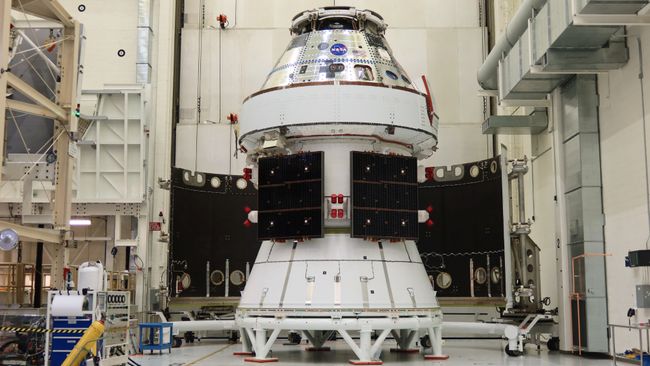
The Orion capsule for the mission is nearing completion, with core assembly completed and the internal fixtures, fittings and systems on-going. Earlier in November 2024, and sans its outer protection shell and heat shield, it was subjected to a series of pressure tests to simulate both the upper atmosphere and space to ensure it had no structural integrity issues.

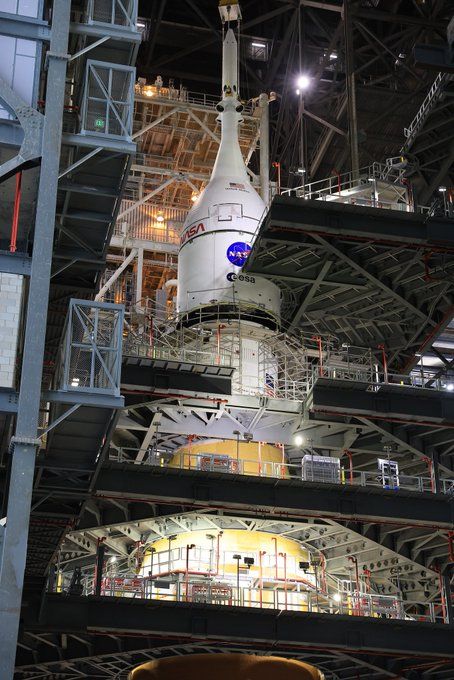
The core stage of the Artemis II SLS rocket, complete with its four main engines, inside NASA’s gigantic Vehicle Assembly Building (VAB). One of the base segments of a solid rocket booster (SRB) can be seen in the background. Credit: NASA

Meanwhile, the SLS vehicle itself has commenced stacking. The core stage, with is massive propellant tanks and four RS-25 “shuttle” engines, arrived at the Vehicle Assembly Building (VAB), Kennedy Space Centre, in July 2024, and since this has been undergoing much work whilst still lying on its side.

More recently, work on stacking the two solid rocket boosters (SRBs) developed from those used with the space shuttle, that will help power it up through the atmosphere has also commenced.

A crane inside the VAB prepares to lift one of the SRB motor sections and its assembly gantry, ready to place it on the back of a transport vehicle. November 13th, 2024. Credit: NASA

The SRBs comprise 5 individual segments which need to be manufactured and then bolted together, prior to being filled with their wet cement-like solid propellant mix. The base segments of these boosters include the rocket motor and guidance controls, and on November 13th, these were rolled into the Vehicle Assembly Building on special transport / stacking gantries. Over the next several months, the two SRBs will be assembled vertically in one of the bays within the VAB, and then loaded with their propellant and capped off.

Once the SRBs are ready and their avionics, etc., checked out, the core stage of the SLS will be hoisted up into one of the VAB’s high bays, moving to a vertical orientation as it does so. It will then be lowered between the two SRBs so that they can all be joined together. After this the ICPS will be moved up into position and mated to the top of the core stage of the rocket, and then work can commence stacking the Orion and its ESM and their launch fairings.

The SRB motor and its mounting gantry on the transporter, ready to be moved to the VAB bay where stacking can commence, November 13th, 2024. Credit: NASA

Whether or not Artemis II makes its planned late 2025 launch (no earlier than September) is open to question; currently, NASA has yet to fully complete the work on ensuring the already manufactured heat shield for the mission’s Orion vehicle is fit for purpose, per my previous report on heat shield issues.

Space Sunday: 1,000 sols and counting

NASA’s Perseverance Mars rover using the WATSON camera mounted on its robot arm to take this “selfie” showing the rover’s camera mast looking at WATSON and the Ingenuity helicopter sitting on the surface of Mars after being dropped there by the rover. This image was r=taken on the 46th sol of the mission (April 6th, 2021). Credit: NASA/JPL/ASU/MSSS

1,000 Martian sols ago, two further ambassadors from Earth arrived on the Red Planet, winched safely down onto the floor of Jezero Crater by a hovering “skycrane”. Since then, both have performed their work near-flawlessly over a period of almost 3 terrestrial years – one doing do for far, far longer than its designers and operators had ever hoped. They are, of course, the Mars 2020 mission rover Perseverance and its companion “Mars Helicopter” Ingenuity.

The mission actually arrived on Mars on February 18th 2021, but the passing of 1,000 sols (as the local Martian day is called) is an excellent opportunity to review the Mars 2020 mission as a whole, and look to the future.

Ingenuity had a planned mission duration of 90 terrestrial days during which it was expected to be able to make up to five flights; no-one really knew how well the craft’s batteries, electronics and mechanical systems would stand up to the hostile conditions on Mars once operations got underway. But as of December 2nd, 2023, the 1.8 kg drone has complete 64 flight and clocked up just over 2 hours of airborne time. In doing so, it has proven that entirely automated flight on other planets without direct human control is possible, and that a small, camera-equipped aerial vehicle can work in tandem with ground units to help reconnoitre potential routes of exploration and identify potential points of scientific interest.

Perseverance, meanwhile, has spent the intervening time studying an ancient river delta within the crater, believed to have formed as water poured down from the plains above early in Mars’ history, depositing clays and other minerals as they gradually flowed outwards and eventually gave rise to a lake within Jezero. The primary mission for the rover has thus far been to explore the delta and seek both evidence of past habitability and search for actual biosignatures indicative of past life. In doing so, Perseverance has gathered 23 air and soil samples, some of which may be returned to Earth in a future (if controversial, in terms of NASA funding) sample-return mission.

In this false-colour image of Jezero Crater, the river that once broached the crater walls and carried water into its basin to form a shallow lake can be seen on the left, with the river’s delta clearly visible on the crater floor. The colours are intended to highlight different mineral deposits within the delta, with green representing the widespread carbonates. Most recently, Perseverance has been exploring the green-tinted area above the main river channel. Credit: NASA/JPL/ASU/MSSS

The data gathered by the rover confirms that Jezero Crater – originally formed some 4 billion years ago via an asteroid impact – was subject to multiple periods of flooding which took place over an extended period commencing several hundred million years after the crater was formed. These periods of flooding initially gave rise to the deposition of sandstone and mudstone in the crater, suggesting a modest lake was created. Later, this lake underwent a more sustained period of cyclic flooding and evaporation, giving rise to the deposition of salt-rich mudstones as the waters expanded and contracted.

At its peak, it is believed the lake was perhaps 35 kilometres in diameter and 30 metres deep. Later, as Mars’ climate became more erratic, the crater was subjected to sudden, violent bursts of flooding from above, with large rocks and boulders from outside of the crater being deposited within it by repeated flash floods before the lake – and all surface water on Mars – slowly vanished, being lost to space through evaporation as the atmosphere was lost, or ras a result of it retreating underground, where it froze.

Of the samples gathered and studies by the rover’s on-board science lab, many carried tantalising markers which might be associated with the formation of basic forms of life. These include carbonates, minerals that form in watery environments often favourable to the development of organic molecules (although the molecules themselves could be the result of either organic or inorganic reactions within the water). The rover has also found quantities of fine-grained silica and deposits of phosphate, both of which have been rich in carbonates, and which are respectively known to both preserve fossilised microbes and help microbes kick-start their life processes here on Earth – although evidence of them doing the same on Mars remains elusive.  Some of the carbonate-carrying phosphates have been found to contain iron, something again associated with life here on Earth.

December 2023 is a key month for Perseverance, as it brings to a close the rover’s fourth science campaign within Jezero Crater and the start of a new endeavour. Commencing in 2024, Perseverance will follow the course of the river bed back towards the crater wall – a distance of around 4 km – to where mission personnel believe they have located an “easy” climb up the crater walls and which intersects the river’s channel at its lower end.

This image of Jezero Crater, captured by NASA’s Perseverance rover, shows the potential route (yellow line) that the robot may take to the crater’s rim. Credit: NASA/JPL/ASU/MSSS

Climbing the crater up to the plains above will expose Perseverance’s science instruments to bedrock and material even older then the outflow plain it has thus far studied, allowing it to reach back to the time the crater was formed. Along the way it will be able to both study the changing rocks and any atmospheric changes as it climbs upwards. As well as analysing the rock samples it gathers, the rover will also store some in the remaining 13 sample tubes contained in its belly, allowing them to be cached together with some of the remaining tubes of material gathered from the crater floor so that an alternate collection of samples can await the arrival of the still-to-be-fully-defined sample return mission, should landing within Jezero itself prove too difficult for the proposed lander part of the mission, and the samples cached there are abandoned.

 Video Promotes Rosalind Franklin

If fortune favours the unfortunate, the next rover to trundle across the surface of Mars will be Europe’s long-awaited Rosalind Franklin. Originally called the ExoMars rover, this vehicle has suffered a number of setbacks during its 20 years in development and pre-flight hell. However, (and touching large amounts of wood, given I have something of a loose association with the mission), things are currently on course for an October 2028 launch, that the European Space Agency felt confident enough to release a new promotional video showcasing the mission.

Some 60% heavier and slightly larger than NASA’s Mars Exploration Rovers Opportunity and Spirit, the European rover is, like them, solar-powered. It also shares a similar mission arc as both of the MER rovers and the nuclear-powered Curiosity and Perseverance: to locate evidence for water on Mars and seek out evidence for past signs of life. However, in one respect its mission does differ, as Rosalind Franklin will also focus seeking evidence for current microbial life on Mars.

To assist with the latter, the rover will be equipped with a drilling mechanism capable of reaching up to two metres beneath the planet’s surface – far beyond depths so far plumbed in the search for evidence of Martian microbial life – with the samples gathered then put through extensive study and analysis by the rover’s multiple science systems.

The landing site for the mission is Oxia Planum, a region located between two outflow channel systems: Mawrth Vallis to the northeast and Ares Vallis to the southwest. Scientists believe this region will contain remnants of the planet’s wetter past, increasing the potential for finding evidence for past or even current microbial life on the planet. Once there – the flight to Mars will take almost exactly 2 years, courtesy of the capabilities of its launch vehicle – Rosalind Franklin will travel up to 70 metres a day when on the move, with an overall primary mission expected to last some 7 months.

Voyager 1 Hits Problems

Humanity’s first interstellar ambassador, Voyager 1, is now just over 47 years into its voyage and more than 162 AU (or 24 billion kilometres) from Earth – and like all of us as we grow older, it is increasingly showing signs of its age. Already, the more energy-intensive science instruments on the lonely spacecraft have been shut down, and engineers have had to repeatedly work their way gingerly around assorted problems the craft has encountered; such is the distance separating vehicle and home planet that even the tiniest errors risks breaking all communications.

An artist’s impression of a voyager probe in deep space. Credit: NASA

Most recently, Voyager 1 has started having issues with two key systems: the Flight Data System (FDS) and the Telemetry Modulation Unit (TMU). The latter is responsible for transmitting to Earth data on the spacecraft’s condition, orientation, etc., together with information from its operational science instruments, and receiving and managing communications from Earth. The data it sends is gathered by the three computers of the FDS, which combine everything obtained from the other instruments and sub-systems into a single package for the TMU to send. Except recently, all the TMU has been sending is a repeating pattern of meaningless binary, although it has continued to act on messages from Earth.

It had been thought the problem lies with the TMU itself, but after careful and painfully slow diagnoses (round-trip communications between Voyager 1 and Earth are on the order of 45 hours); the problem was found to be within the FDS. Over the weekend of December 9th/10th, mission engineers ordered the FDS to perform a sequential restart, which it was hoped would kick-start the system into once again passing meaningful data to the TMU. It didn’t.

Created using NASA’s Eyes on the Solar System, this image shows what it might be like to look back at our solar system from 162 AU

So currently, Voyager 1 remains capable of receiving commands from Earth, but it cannot provide any understandable feedback on whether anything succeeded, or what systems are trying to report back through the FDS. As such, the Voyager mission team have indicated it will take several weeks to formulate a new plan of action in order to try to resolve the problem.

Spaceplanes, Spaceplanes

Both the United States and China were due to launch their highly secretive, automated “spaceplanes” this past week – although as it turned out, only one of them actually did so.

The United States X-37B programme had been due to commence its seventh mission – and the fourth flight of the 2nd of the two X-37B craft the US Space Force and US Air Force jointly operate – on December 14th. It was to be the first flight of the craft atop a SpaceX Falcon Heavy, seen as offering the craft the ability to fly missions at much higher orbits than can be achieved using its over launch vehicles – the ULA Atlas V 501and the Falcon 9 Block 4 -, potentially allowing for more flexible and even longer-duration on-orbit operations.

The USSF / USAF X-37B (vehicle 1), shortly after its return to Earth on November 22nd, 2022, following a 908-day orbital mission. Credit: US DoD

The cause of the delay has not been stated, but appears to have been called by SpaceX rather than the US DoD, and following the postponement, the Falcon Heavy was removed from Pad 39A at Kennedy Space Centre. At the time of writing, no revised launch target has been announced.

China, however, so no such delays in the third flight of its Shenlong “Divine Dragon” spaceplane, which lifted-off from the Jiuquan Satellite Launch Centre on December 14th, as planned, using a Long March 2F booster.

Little is actually known about the Chinese vehicle – although there is an emerging consensus that it is potentially similar in overall size and form to the US X-37B. The craft first flew the craft in September 2020 and then was launched a second time in August 2022 – this mission lasting for 276 days, which is still a small fraction of the time the US craft tends to spend in orbit (908 days on its last mission). That said, the second Shenlong mission did cause surprise and concern in the west when it apparently launch / placed / jettisoned something into space  – China has remained tight-lipped as to what it was.

An artist’s rendering of what the Chinese automated space plane might look like. Credit: Erik Simonsen / Getty

No information on the flight or its potential duration has been given by the Chinese authorities, with the official statement post-launch something of a laconic repetition of the announcements which followed the first two flights of the vehicle.

The test spacecraft will be in orbit for a period of time before returning to the domestic scheduled landing site. During this period, it will carry out reusable technology verification as planned to provide technical support for the peaceful use of space.

– Official and bland Chinese statement following the latest Shenlong launch

That both vehicles were originally intended to launch so close together is not a coincidence. The USSC/USAF has been very open in its desire to learn more about the Chinese vehicle’s purpose and capabilities – and the China probably likewise want to know more about the American vehicle. Thus, having them in space at the same time allows the two nations to observe one another’s craft via Earth-based means and – perhaps – mimic the manoeuvrings of one another’s vehicles.

Space Sunday: lunar delays and planetary dances

The Peregrine Mission One lander on the surface of the Moon, as imaged by Astrobotic Technology, the company responsible for the lander’s design and construction. Credit: Astrobotic Technology

America’s return to the surface Moon as a part of government-funded activities will start in earnest over Christmas 2023, with the launch of the NASA-supported Peregrine Mission One and the Peregrine lander, built by Astrobotic Technology, which will take to the sky on December 24th, 2023 atop a Vulcan Centaur rocket out of Cape Canaveral Space Force Base, Florida.

Originally a private mission, Mission One qualified for NASA funding under the agency’s Commercial Lunar Payload Services (CLPS) in 2018, effectively making it the first lander programme funded by NASA under the broader umbrella of the Artemis programme. In this capacity, the mission will fly 14 NASA-funded science payloads in addition to the original 14 private payloads planned for the mission.

The mission will be the inaugural payload carrying flight for the Vulcan Centaur, with the lander arriving in lunar orbit after just a few days flight – but will not land until January 25th, 2024, the delay due to the need to await the having to wait for the right lighting conditions at the landing site.

I’ll have more on this mission closer to the launch date, but in the meantime, as the Peregrine Mission One launch date is getting closer, the date for America’s return to the Moon with a crewed mission is slipping further away.

The Peregrine Lander (r) will mark the first flight of United Launch Alliance’s (ULA) new Vulcan Centaur launch vehicle (l). Credits: ULA and Astrobotic Technology

In terms of the Artemis crewed programmed, there have been a number of flags raised around the stated time-frame for Artemis 3, the mission slated to deliver the first such crew to the surface of the Moon in 2025, over the past few years. These have notably come from NASA’s own Office of Inspector General (OIG), but similar concerns have also started to be more openly voiced from within NASA.

These concerns largely focus on whether or not SpaceX can provide NASA with its promised lunar lander and its supporting infrastructure in anything like a timely manner, given that SpaceX has yet to actually successfully fly a Starship vehicle. In this, the awarding of the lander vehicle – called the Human Landing System (HLS) in NASA parlance – to SpaceX, who propose using a specialised version of the Starship vehicle, was always controversial. For one thing, Starship HLS will be incapable of being launched directly to lunar orbit. Instead, it will have to initially go to low Earth orbit and reload itself with propellants – which will also have to be carried to orbit by other Starship vehicles.

Infographic produced by Blue Origin highlighting the likely launch requirements for a Starship HLS. Credit: Blue Origin

At the time the contract for HLS was awarded (2021), competing bidders Blue Origin noted that according to SpaceX’s own data for Starship, a HLS variant of the vehicle would require the launch of fifteen other starship vehicles just to get it to the Moon. The first of these would be another modified Starship designed to be an “orbiting fuel depot”. It would then be followed by 14 further “tanker” Starship flights, which would transfer up to 100 tonnes of propellant per flight for transfer to the “fuel depot”. Only after these flights had been performed, would the Starship HLS be launched – and it would have to rendezvous with the “fuel depot” and transfer the majority of propellants (approx. 1,200 tonnes) from the depot to its own tanks in order to be able to boost itself to the Moon and then brake itself into lunar orbit.

Despite such claims being made on the basis of SpaceX’s own figures, SpaceX CEO Elon Musk pooh-poohed  them, claiming all such refuelling could be done in around 4-8 flights, not 16. Despite their own OIG and the US Government Accountability Office (GOA) agreeing with the 16-flight estimation, NASA nevertheless opted to accept Musk’s claim of 4-8 launches, going so far is to use it in their own mission graphics.

A NASA infographic showing the Artemis 3 mission infrastructure. Note the (optimistic)  6 Starship launches required to get the SpaceX Starship HLS to lunar orbit. Credit: NASA/SpaceX

However, the agency appeared to step back from this on November 17th, 2023, when Lakiesha Hawkins, assistant deputy associate administrator in NASA’s Moon to Mars Programme Office, confirmed that SpaceX will need “almost 20” Starship launches in order to get their HLS vehicle to the Moon, with launches at a relatively high cadence to avoid issues of boil-off occurring when storing propellant in orbit.

Now the US Government Accountability Office (GOA) has re-joined the debate, underlining the belief that SpaceX is far from being in any position to make good on its promises regarding the available of HLS. In particular the report highlights SpaceX is still a good way from demonstrating it can successfully orbit (and re-fly) a Starship vehicle, and it has not even started to demonstrate it has the means to store upwards of 1,000 tonnes of propellants in orbit, or the means by which volumes of propellants well above what has thus far been achieved can be safely and efficiently be transferred between space vehicles, and it has yet to produce a even a prototype design for the vehicle.

Nor does the report end there; it is also highly critical of the manner in which NASA has managed the equally important element of space suit design, firstly in awarding the initial contract for the Artemis lunar space suits to Axiom Space – a company with no practical experience in spacesuit design and development –  rather than a company like ILC Dover, which has produced all of NASA’s space suits since Apollo; then secondly in failing to provide Axiom with all the criteria for the suits, necessitating Axiom redesigning various elements of their suit to meet safety / emergency life support needs.

As a result, the GAO concludes that it is likely Artemis 3 will be in a position to go ahead much before 2027; there is just too much to do and too much to successfully develop for the mission to go ahead any sooner. In this, there is a certain irony. When Artemis was originally roadmapped, it was for a first crewed landing in 2028; however, the entire programme was unduly accelerated in 2019 by the Trump Administration, which wanted the first crewed mission to take place no later than December 2024, so as to fall within what they believed would be their second term in office. Had NASA been able to stick with the original plan of 2028, there is a good chance that right now, it would be considered as being “on target”, rather than being seen as “failing” to meet time frames.

Hubble Hits Further Gyro Issues

On November 29th, 2023, NASA announced that the ageing Hubble Space Telescope (HST) had entered a “safe” mode for an indefinite period due to further troubles with the system of gyroscopes used to point the observatory and hold it steady during imaging.

In all, HST has six gyroscopes (comprising 3 pairs – a primary and a back-up),with one of each pair required for normal operations. To help increase the telescope’s operational life, all three pairs of gyros were replaced in the last shuttle mission to service Hubble in 2009, and software was uploaded to the observatory to allow it to function on two gyros – or even one (with greatly reduced science capacity)  should it become necessary.

Today, only 3 of those gyros remain operational, the other three having simply worn out, and on November 19th, one of those remaining 3 started producing incorrect data, causing the telescope to enter a safe mode, stopping all science operations. Engineers investigating the issue were able to get the gyro operating correctly in short order, allowing Hubble to resume operations – only for the gyro to glitch again on November 21st and again on November 23rd, leading to the decision to leave the telescope in its safe mode until the issue can be more fully assessed.

The Hubble Space Telescope. Credit: NASA

The news of the problems immediately led to renewed calls for either a crewed servicing mission to Hubble or some form of automated servicing mission – either of which might also be used to boost HST’s declining orbit. However, such missions are far more easily said than done: currently, there isn’t any robotic craft capable of servicing Hubble (not the hardware or software to make one possible). When it comes to crewed missions, it needs to be remembered that Hubble was designed to be serviced by the space shuttle, which could carry a special adaptor in its cargo bay to which Hubble could be attached, providing a stable platform from which work could be conducted, with the shuttle’s robot arm also making a range of tasks possible, whilst the bulk of the shuttle itself made raising Hubble’s orbit much more straightforward.

Currently, the only US crewed vehicle capable of servicing HST is the SpaceX Crew Dragon – and it is far from ideal, having none of the advantages or capabilities offered by the space shuttle, despite the gung-ho attitude of many Space X supporters. In fact, it is not unfair to say that having such a vehicle free-flying in such close proximity to Hubble, together with astronauts floating around on tethers could do more harm than good.

A further issue with any servicing mission is that of financing. Right now, the money isn’t in the pot in terms of any funding NASA might make available for a servicing mission – and its science budget is liable to get a lot tighter in 2024, which could see Hubble’s overall budget cut.

Continue reading “Space Sunday: lunar delays and planetary dances”

Space Sunday: happy 65th, NASA!

The NACA and NASA “meatball” logos. Credit: NASA

On October 1st, 1958 the National Aeronautics and Space Administration officially commenced operations, just two months after then-President Dwight D. Eisenhower signed the US National Aeronautics and Space Act into law.

NASA’s birth essentially arose out of what would become known as the “Sputnik crisis”. In October 1957 Russia launched Sputnik 1, the world’s first artificial satellite. Worse, just a month later, they launched Sputnik 2, which not only carried a living animal into orbit (the dog Laika, doomed to expire in orbit as the technology did not exist for the craft to re-enter the atmosphere and land safely), it demonstrated Russia had a launch system vehicle could be used relatively rapidly. This put US space launch efforts – activities largely split between the three branches of the military – into something of a tailspin, with the realisation that any civilian / science space programme could not be reliant on competing military programmes.

To this end, it was decided to place military space development under the auspices of a new agency within the US Department of Defense: the Advanced Research Projects Agency (ARPA – now the Defence Advanced Research Projects Agency, or DARPA), which was also charged with managing all aspects of emerging technologies research as they related to military use. Meanwhile, civilian space research would be placed in the hands of a new agency, with the National Advisory Committee for Aeronautics (NACA) charged with coming up with a structure for that organisation.

A replica of Sputnik-3 on display at the U. S. S. R. Industrial Exhibition, 1958, held in Moscow. The 4-metre long, 1.3 tonne spacecraft was 100 times the mass of its American counterpart, Explorer-1, and its launch and that of the earlier Sputnik-1 and Sputnik0–2 missions did much to speed the creation of NASA. Credit: Pathé News

Further haste was given to the need to determine the best direction of the US civilian space programme in May 1958, when Russia launched Sputnik-3 to mark the International Geophysical Year. Massing 1.3 tonnes, or 100 times that of the US satellite launched 3 months earlier with the same goal, Sputnik-3 demonstrated Russia had a payload to orbit capability well beyond anything within the United States, and a technical capability to fly large suites of science instruments on a single vehicle (12 instruments in the case of Sptnik-3).

In being instructed to study options for a new civilian space agency, the NACA was uniquely placed. Founded in 1915, it had (at that time) been at the forefront of aviation development in the United States for more than forty years, and following the end of the Second World War, it had become increasingly involved in aerospace research. For example, NACA was responsible for the initial design concept of what would become the X-15 hypersonic aircraft after developing and flying a number of supersonic craft during the early 1950s, and worked with the US Air Force to develop the vehicle from 1954 through until the establishment of NASA in October 1958.

A 1952 photograph of the NACA High Speed Test Force at Edwards Air Force Base during flights of the Douglas D-558-2 Skyrocket, the first aircraft to exceed Mach 2.0 (November 1953). Credit: Armstrong Photo Gallery.

After due consideration, NACA submitted a report and after reading it, James Killian, the then-chair of the Science Advisory Committee realised that NACA was not only well-placed to recommend what form the new space agency should take, it was ideally placed to become the foundation of the new organisation, informing Eisenhower via a memorandum the to Eisenhower stating the new agency should be formed out of a “strengthened and re-designated NACA, a going Federal research agency with 7,500 employees and $300 million worth of facilities” and which could expand its role “with a minimum of delay”. His suggestion was accepted and incorporated into the National Aeronautics and Space Act.

As a result of the decision to transition NACA into NASA, the new agency was able to hit the ground running, gaining three major research centres – Langley Aeronautical LaboratoryAmes Aeronautical Laboratory, and Lewis Flight Propulsion Laboratory, and the NACA budget and staff. In the months immediately following NASA’s establishment, those elements of the US Army and US Navy trying to build and operate orbital rocket systems were transitioned over to the new agency (including the US Army team utilising Wernher von Braun and other former German rocket engineers), together with the California Institute of Technology’s Jet Propulsion Laboratory, which has become world-famous as the developmental and mission operations centre for the majority of NASA’s robotic deep space missions.

As a part of its very first research activities, NASA took over the hypersonic X-15 programme mentioned above, overseeing all 199 flights of that craft along with the US Air Force. At that time NASA came into existence, the NACA and the USAF had been collaborating on the idea of extending the X-15 into an orbit-capable vehicle to be launched vehicle a family of modified missiles, thus allowing the US to gain valuable insight into the design requirements and operating nature of space-capable aircraft, which were even at that time being seen as the future of manned spaceflight.

Conceptual illustrations of the X-15B orbital vehicle with various launch options, and (r) the X-20 Dyna-Soar. Credit: Mark Wade

In particular, the USAF was keen to gather data to help with a  concept for a multi-role “space glider” which would evolved into the X-20 Dyna-Soar project of the early 1960s (although this was ultimately cancelled in 1963). However, NASA’s new leadership preferred a more cautious approach to putting men in space, determining primates should be flown first and recovered for post-flight study. Therefore, the X-15B concept, with its need for a skilled pilot at the controls, was rules out in favour of the less capable but easier to fly Mercury capsule. Thus was NASA’s manned spaceflight programme born.

Today, whilst still a relatively small organisation in terms of manpower when it comes of federal agencies (the Federal Aviation Administration, for example, numbers 48,000 employees to NASA’s 18,000), and with a modest budget (less than US $26 billion from the US mandatory federal budget of US $4.1 trillion – which admittedly and conversely is still around 4.5 times more than the FAA’s), NASA is an incredibly diverse and far-reaching organisation.

NASA’s rarely-noted administration headquarters at 300 E Street SW, Washington DC. Credit: NASA (1997)

Not only does it manage all of America’s civilian space activities through ten major research and operations centres across the United States (as well as numerous smaller facilities and centres), it continues to carry out wide-ranging aeronautical research and development in what is a continuance of the cutting-edge work started by the NACA more than 100 years ago.

In addition, NASA is involved in R&D and operations across many disciplines and areas of research, including communications; vehicle and transportation safety; environmental monitoring (climate and weather in partnership with the National Oceanic and Atmospheric Administration (NOAA); pollution control, environmental management, global land use, deforestation monitoring, agricultural monitoring, etc (much in partnership with the US Geological Survey, or USGS); research into alterative and sustainable energy systems; nuclear research; multiple avenues of general science research as they pertain to the planet and to healthcare; and in promoting education, science, mathematics and the harnessing of technology through a range of STEM initiatives in the US and around the world.

So, happy anniversary NASA. You may be at retirement age in human terms – but here’s to many more!

Updates

OSIRIS-REx Samples

Previously on Space Sunday (as they say on TV shows) NASA’s ORISIS-REx mission returned to Earth samples captured from 101955 Bennu, a carbonaceous near-Earth asteroid. As we left that story, the sealed capsule containing the estimated 250 grams of material was pending a transfer to NASA’s Johnson Space Centre (JSC), Texas.

The first glove box unit at the ARES facility, JSC, purpose-built to handle the disassembly of the ORISIS-REx sample return capsule so that the samples of asteroid Bennu it contains can be removed for examination and analysis. Credit: NASA / Robert Markowitz

That transfer occurred on Tuesday, September 26th, 2023, with the sample capsule being airlifted from the US Army’s Dugway Proving Ground in Utah, some 31 kilometres from where it landed, to Ellington Field Joint Reserve Base near Houston, Texas. From here the special transpiration container with the capsule inside was move by road to the Astromaterials Research and Exploration Science (ARES) centre at JSC.

ARES is home to the world’s largest collection of “astromaterials” (samples returned from space), and is usually the first US centre to examine such samples brought to Earth by US space missions. As such, it is the ideal permanent home for the OSIRIS-REx samples, and will be the centre that carries out an initial sample analysis and then divvy it up for distribution to research centres around the world and to museums.

How it should have gone – the OSIRIS-REx TAGSAM “touch-and-go” mechanism recovering samples from the surface of asteroid 101955 Bennu in 2020. As it turned out, the asteroid’s surface was so brittle, the sample head and arm smashed through it to a depth of around 50cm.

Continue reading “Space Sunday: happy 65th, NASA!”

Space Sunday: the return of OSIRIS-REx

The OSIRIS-REx Sample Return Capsule (SRC) in the landing zone at UTTR, September 24th, 2023. Credit: NASA TV

On September 8th, 2016 at 23:05 UTC, an Atlas V 411 rocket lifted-off from Space Launch Complex (SLC) 41, Cape Canaveral Air Force Station (now Space Force Station). Launched by United Launch Alliance (ULA), the rocket carried aloft NASA’s Origins, Spectral Interpretation, Resource Identification, Security, Regolith Explorer (OSIRIS-REx), an ambitious mission to study a carbonaceous near-Earth asteroid and obtain as large a sample of material as possible for a return to Earth.

More recently, on September 24th, 2023, the mission achieved its goal, returning an estimated 250 grams of material – four times the minimum amount scientists hoped to obtain at the start of the mission – from the 500m diameter asteroid 101955 Bennu. It is not the first mission to return a sample of material from an asteroid; Japan holds that record with its Hayabusa and Hayabusa-2 missions. The first rendezvoused with asteroid 25143 Itokawa in 2005, the second with asteroid 162173 Ryugu in 2018; however, given both these missions returns a total sample cache of under 6 grams, OSIRIS-REx is the most successful to date.

A ULA Atlas 5 launches OSIRIS-REx on its way to a rendezvous with asteroid Bennu

Over the intervening seven years since its launch and return, OSIRIS-REx completed a round-trip journey of some 6.4 billion kilometres. Along the way it performed a fly-by of Earth some 12 months after launch, allowing it to enter an orbit around the Sun from which it could intercept Bennu. This passage around the Sun allowed OSIRIS-REx to past through the Earth-Sun Lagrange L4 position, where it performed a search for a class of near-Earth objects known as Earth-Trojan asteroids. Whilst no previously unknown asteroids were located during the 11-day survey in February 2018, the exercise yielded valuable data on vehicle manoeuvring for the kind of precise imaging required on reaching Bennu.

As it approached OSIRIS-REx Bennu in late 2018, OSIRIS-REx was able to observe Jupiter, adding to his science mission, prior to entering an initial orbit at the start of December 2018. It then spent most of the month generally characterising the asteroid, detecting hydrated minerals in the form of clay across the asteroid’s surface, suggesting it was once a part of a larger object rich with frozen water, offering a further pointer to how life-forming minerals and water may have been carried to Earth and the inner planets.

On December 31st, 2018 OSIRIS REx closed to just 1.75 km above Bennu’s surface, allowing it commence an extensive remote mapping and sensing mission which allowed the science team to identify potential areas which might be suitable for gathering one or more samples. In reaching that altitude, OSIRIS-REx set a new record for the closest distance any spacecraft has orbited a celestial object, beating ESA’s Rosetta mission’s orbit of 7 km around the comet 67P/Churyumov–Gerasimenko.

In all, 14 months were spent carefully surveying Bennu, allowing for potential sample-gathering sites to be identified, with the spacecraft closing to just 1 km above the asteroid, breaking its own record and allowing a final survey of the four preliminary landing sites so a final selection could be made. In the end, a site dubbed “Nightingale”, a fairly open shallow depression on the asteroid’s surface, was selected, and the mission moved to the rehearsal phase.

Image sequence showing the rotation of Bennu, imaged by OSIRIS-REx at a distance of around 80 km. Credit: NASA Goddard

In order to collect samples, OSIRIS-REx had to make physical contact with the asteroid in a “touch and go” (TAG) manoeuvre. This would see the spacecraft deploy a robot arm underneath itself. Called the Touch-And-Go Sample Arm Mechanism or TAGSAM, this spring-loaded arm carried a camera system and, on its end, a sample gathering system. The craft would then use its thrusters to gently push itself down towards Bennu, bringing the sample head into contact with the asteroid’s surface.

At this point, several things would happen in rapid succession: the springs in the arm would absorb the spacecraft’s motion, allowing it to maintain contact for a second or two as a jet of inert nitrogen would be directed at the surface under the sample head in order to blast material up into it while Velcro-like rings on the end of the head would snag dust particles and the like. Then, as the springs in the arm recoiled under the mass of the spacecraft and very gently push it back away from the asteroid, allowing a Mylar cap to close over the sample head, trapping whatever had been captured inside the head. Finally, once the spacecraft was sufficiently clear of the asteroid – 40m or so -, OSIRIS-REx would fire its thrusters an position itself back in orbit a few hundred metres above the asteroid, where the sample gathering operation could be assessed for success and from which, if required, a further attempt made to grab material.

A computer simulation of OSIRIS-REx making contact with asteroid Bennu. Credit: NASA

All of this was obviously quite complex – and due to the the delay in communications between vehicle and Earth, had to be carried out entirely autonomously. Hence the rehearsal phase of the mission. These were carried out in April and August 2020, with the first bringing the craft to within 65 metres of the sample site and the second stopping just 40 metres above it. Both saw the craft go through all phases of the TAG operation, sans actually touching the asteroid, with a small burst from the thrusters substituting from the recoil of the TAGSAM springs to push it away from the asteroid once more. Both rehearsals were flawless and paved the way for the first – and only, as it turned out – sample gathering attempt.

Continue reading “Space Sunday: the return of OSIRIS-REx”