Space Sunday: Martian quandaries, universal epochs and Jovian journeys

"Yellowknife Bay" a region examined by the Curiosity Rover in 2012/13 indicated that a lake was once present in Gale Crater. However, the same rock has revealed that potentially, there was not sufficient carbon dioxide present in the atmosphere to help keep the water unfrozen
“Yellowknife Bay” a region examined by the Curiosity Rover in 2013 indicated that a lake was once present in Gale Crater. However, the same rock has revealed that potentially, there was not sufficient carbon dioxide present in the atmosphere to help keep the water unfrozen. Credit: NASA

Mars scientists are wrestling with a problem. Ample evidence says ancient Mars was sometimes wet, with water flowing and pooling on the planet’s surface. Yet, the ancient sun was about one-third less warm and climate modellers struggle to produce scenarios that get the surface of Mars warm enough for keeping water unfrozen.

A leading theory is that ancient Mars had a thicker carbon-dioxide atmosphere forming a greenhouse-gas blanket, helping to warm the surface. However an analysis of data from NASA’s Mars rover Curiosity, suggests that even 3.5 billion years ago there was too little carbon dioxide present in the Martian atmosphere to provide enough greenhouse-effect warming to prevent water freezing.

The source of these findings is the very same bedrock in which the rover found sediments from an ancient lake in which microbes might have thrived. When analysing the bedrock, Curiosity detected no carbonate minerals, leading to the conclusion that Mars’ atmosphere was almost devoid of carbon dioxide when the lake existed 3.5 billion years ago. And that’s a quandary for scientists.

Curiosity took this selfie while at "Yellowknife Bay" in 2013 whilst gathering rock samples for analysis. Note that while the shadow of the rover's robot arm can be assn, the arm itself is blanked from the images purely as a result of the angles used in individual shots and the way the images have been stitched together to provide a view of the rover
Curiosity took this selfie while at “Yellowknife Bay” in 2013 whilst gathering rock samples for analysis. Note that while the shadow of the rover’s robot arm can be seen, the arm itself is blanked from the images purely as a result of the angles used in individual shots and the way the images have been stitched together to provide a view of the rover. Credit: NASA

“We’ve been particularly struck with the absence of carbonate minerals in sedimentary rock the rover has examined,” Thomas Bristow, the principal investigator for Curiosity’s Chemistry and Mineralogy (CheMin) instrument,  the primary source of the analysis work. “It would be really hard to get liquid water even if there were a hundred times more carbon dioxide in the atmosphere than what the mineral evidence in the rock tells us.”

In water, carbon dioxide combines with positively charged ions such as magnesium and ferrous iron to form carbonate minerals, and CheMin can identify carbonate if it makes up just a few percent of the rock. Yet Curiosity has made no definitive detection of carbonates in any lakebed rocks sampled since it landed in Gale Crater in 2012. However, other minerals – magnetite and clay minerals – not only indicated in the same rocks indicate the ions needed to form carbonates were readily available, they also provide evidence that subsequent conditions never became so acidic that carbonates would have dissolved away over time.

The dilemma between a warm, wet Mars and the lack of carbonates has actually been growing for years. For two decades researchers have been using spectrometers on Mars orbiters to search for carbonate that could have resulted from an early era of more abundant carbon dioxide in the atmosphere, only to find far less than anticipated. Yet clues such as isotope ratios in today’s Martian atmosphere continue to indicate the planet once held a much denser atmosphere than it does now, which has largely been seen as being rich in carbon dioxide. Thus, a paradox has arisen.

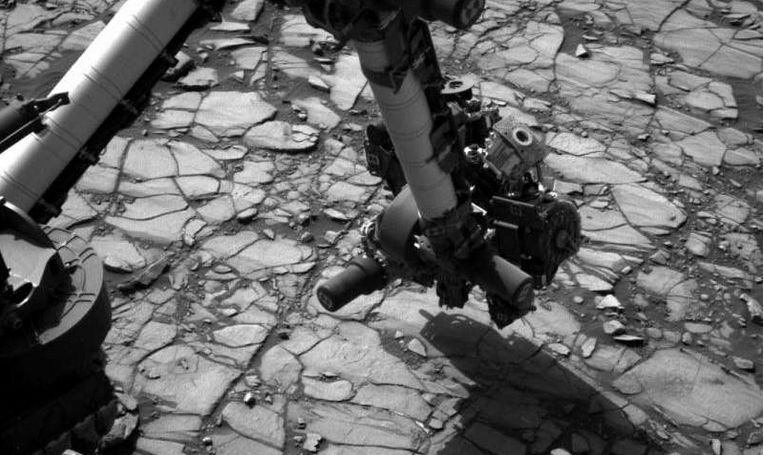
Curiosity uses a spectrometer on its robot arm to check a rock dubbed "John Klein" in "Yellowknife Bay" for its suitability as a drilling target, January 25th, 2013. The drill itself can be seen on the robot arm's "hand", pointing up and to the right
Curiosity uses a spectrometer on its robot arm to check a rock dubbed “John Klein” in “Yellowknife Bay” for its suitability as a drilling target, January 25th, 2013. The drill itself can be seen on the robot arm’s rotating “hand”, pointing up and to the right. Credit: NASA

It had been thought that the lack of evidence for carbonates when seen from orbit could simply be the result of  dust covering them, or the carbonates having moved underground. Finding them would thus resolve the paradox and reveal what had happened. However, the Curiosity results tend to overturn this idea. Simply put, the rover has failed to detect carbonate minerals precisely where they should be located, within rocks formed from sediments deposited under water.

“This analysis fits with many theoretical studies that the surface of Mars, even that long ago, was not warm enough for water to be liquid,” said Robert Haberle, a Mars-climate scientist at NASA Ames. “It’s really a puzzle to me.”

One idea put forward is that perhaps the lake was never a body of open water, but was covered in ice. The problem with this idea is none of the expected evidence for an ice-covered lake, such as large and deep cracks called ice wedges, or “dropstones,” which become embedded in soft lakebed sediments when they penetrate thinning ice, have been found. Thus, scientists have a lot of head scratching and theorising to do in order to make sense of the dilemma.

Traversing Mars with Curiosity

A simulated Curiosity rolls over the "Naukluft Plateau" in this still from Seán Doran's video simulation of the rover's traverse
A simulated Curiosity rolls over the “Naukluft Plateau” in this still from Seán Doran’s video simulation of the rover’s traverse. Credit: Seán Doran

Ever wondered what it would be like to witness Curiosity trundling across the surface of Mars? Seán Doran has. What’s more, he’s been putting together animated films using Digital Terrain Model (DTM) data from the HiRISE imaging system on NASA’s Mars Reconnaissance Orbiter together with photomosaics of images from the rover, and combining them with a drivable correctly scaled model of the rover to provide movies of Curiosity as it rolls across Mars.

Continue reading “Space Sunday: Martian quandaries, universal epochs and Jovian journeys”
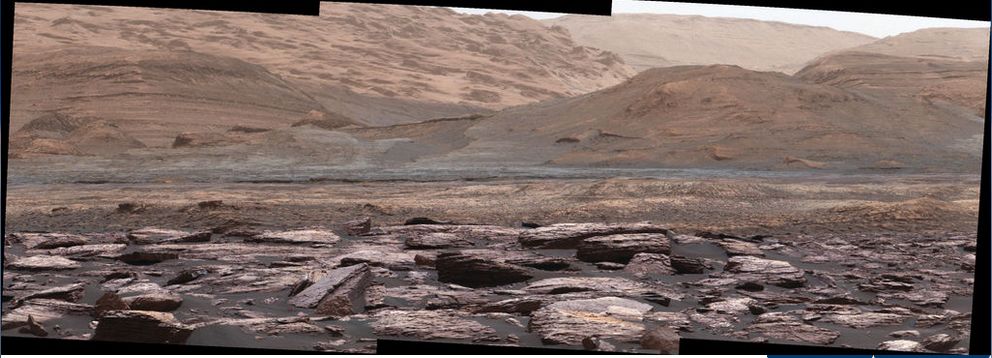
Space Sunday: Curiosity, Dragon, Juno and James Webb

A mosaic of Mastcam images captured by NASA's Curiosity rover on November 10th, 2016 (Sol 1,516), showing the lower slopes of "Mount Sharp". Variations in the rocks colour hint at the diversity of their composition. The purple tone of the foreground rocks has been seen in other rocks where hematite has been detected. Winds and windblown sand help to keep rocks relatively free of dust which would otherwise obscure their colour differentiation. These images have been white balanced, so the scene appears as it would under typical Earth daylight conditions
A mosaic of Mastcam images captured by NASA’s Curiosity rover on November 10th, 2016 (Sol 1,516), showing the lower slopes of “Mount Sharp”. Variations in the rocks colour hint at the diversity of their composition. The purple tone of the foreground rocks has been seen in other rocks where hematite has been detected. Winds and windblown sand help to keep rocks relatively free of dust which would otherwise obscure their colour differentiation. These images have been white balanced, so the scene appears as it would under typical Earth daylight conditions. Credit: NASA/JPL / MSSS

For more than a year now, NASA’s Mars Science Laboratory rover, Curiosity, has been slowly climbing the lower slopes of “Mount Sharp” – more formally called Aeolis Mons, the 5 kilometre (3 mi) high layered deposit extending off of the central peak of Gale Crater. Whilst still on the lower slopes of the mound, the rover has already found minerals absent from lower levels within the crater, and these, together with the ample evidence for water once having existed in the crater, further point to Mars perhaps having once been habitable.

Details of the latest findings from Curiosity were presented at a meeting of the American Geophysical Union (AGU), which commenced on Monday, December 12th, in San Francisco. Making the presentation were members of the current MSL science team and its former principal investigator, John Grotzinger, – the Fletcher Jones Professor of Geology at Caltech.

Mineral veins are an important way to study the movements of water within a location, as they are result of cracks in layered rock being filled with chemicals that are dissolved in water. This alters the chemistry and composition of rock formations, providing vital clues on the prevailing conditions around the time they were deposited.

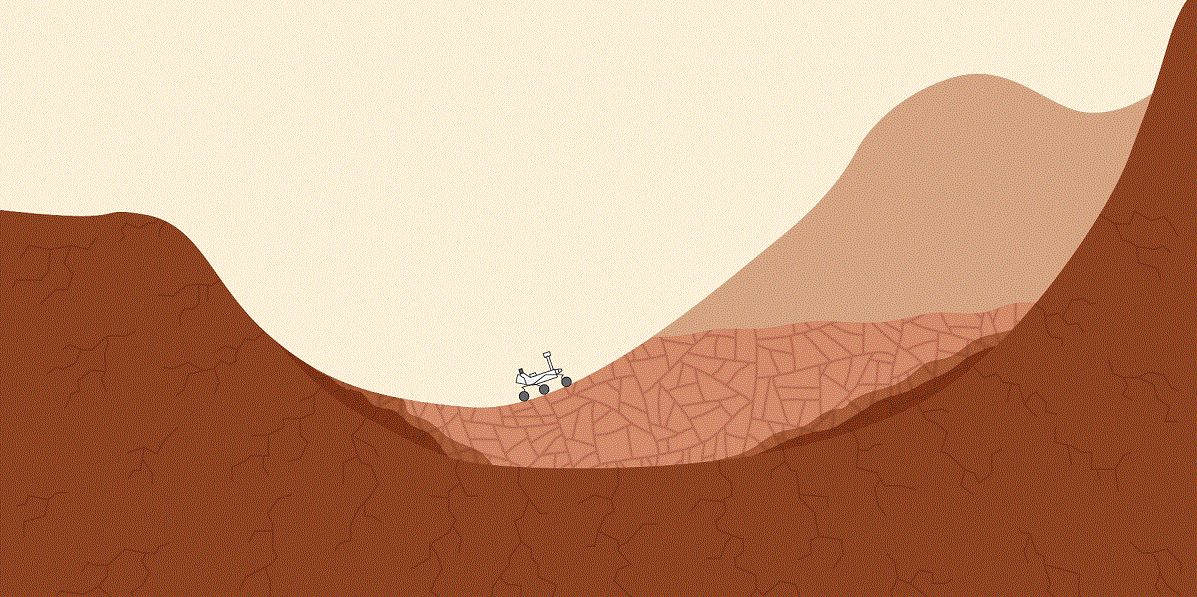
An illustration shown Gale Crater today, with the crater rim (l) and the central impact peak (r), against which "Mount Sharp" rises, which Curiosity climbing its lower slope (obviously not to scale). Credit: NASA/JPL
An illustration shown Gale Crater today, with the crater rim (l) and the central impact peak (r), against which “Mount Sharp” rises, which Curiosity climbing its lower slope (obviously not to scale). Credit: NASA/JPL

In the case of the slopes most recently examined by Curiosity, the science team have found that hematite, clay minerals and boron are more abundant than has been found in the lower, older layers. These point to a complex environment where groundwater interactions led to clay-bearing sediments and diverse minerals being deposited over time, effectively creating a “chemical reactor” which, although no actual evidence for Martian microbes having existed within the minerals has been found, still creates an environment which may have been beneficial life.

“There is so much variability in the composition at different elevations, we’ve hit a jackpot,” Grotzinger said during the presentation. “A sedimentary basin such as this is a chemical reactor. Elements get rearranged. New minerals form and old ones dissolve. Electrons get redistributed. On Earth, these reactions support life.”

As Gale Crater might have looked billions of years ago, showing how the circulation of groundwater led to chemical changes and mineral deposits. Credit: NASA/JPL

The increasing presence of hematite found by the rover as it continues up “Mount Sharp” suggests both warmer conditions and more interaction with the atmosphere at higher levels. In addition, the increasing concentrations of hematite, relative to magnetite at lower levels further suggests that iron oxidisation increased over time, creating the “chemical reactor” Grotzinger referenced: the loss of electrons through the oxidisation process can provide the energy necessary for life to sustain itself.

Another ingredient increasing in recent measurements by Curiosity is the element boron, which the rover’s laser-shooting Chemistry and Camera (ChemCam) instrument has been detecting within calcium sulphate mineral veins. Boron is famously associated with arid sites where much water has evaporated away. However, the amounts found so far are so minor, they make it much harder to determine the environmental implications of their presence.

Currently the team is considering at least two possibilities. In the first, the evaporation of the lake thought to have once existed within Gale Crater formed a boron-containing deposit in an overlying layer, not yet reached by Curiosity, then water later re-dissolved the boron and carried it down through a fracture network into the layers the rover is currently investigating, where it accumulated along with fracture-filling vein minerals. In the second, changes in the chemistry of clay-bearing deposits, such as evidenced by the increased hematite, affected how groundwater picked up and dropped off boron within the local sediments.

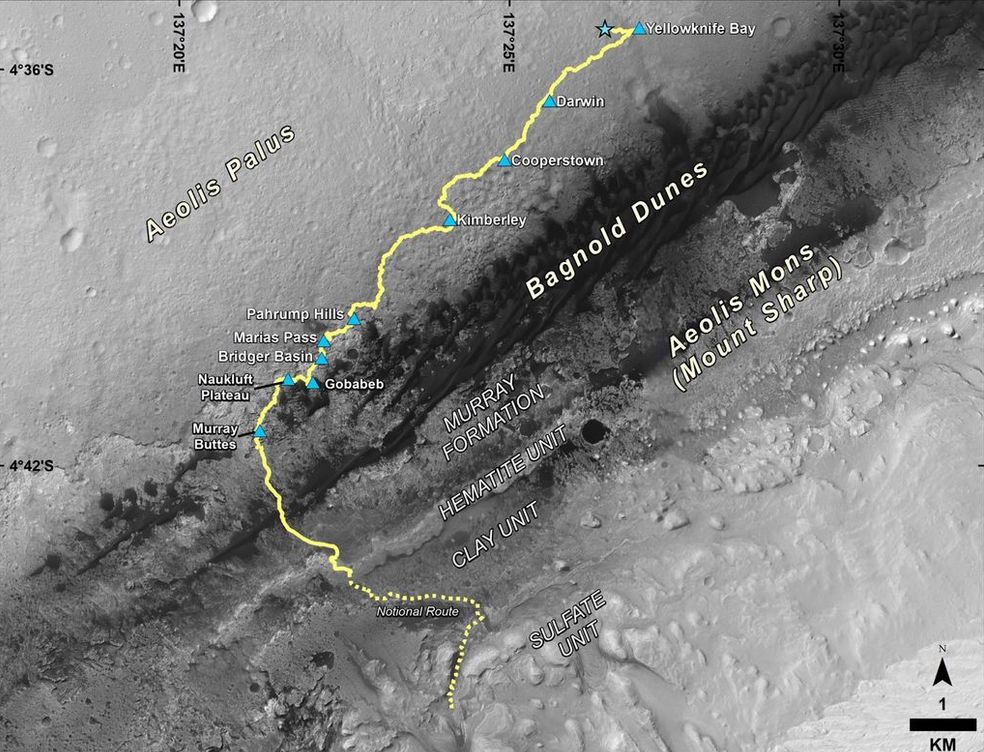
Curiosity's 4-year, 10 kilometre (6.2 mi) Trek from its landing sight (the blue star), through the Yellowknife Ridge area, keep to early findings by the rover, then down along the foothills of "Mount Sharp" to the climb up the mound's lower slopes. The blue triangles denote way-points on the route, where science work was carried out
Curiosity’s 4-year, 10 kilometre (6.2 mi) Trek from its landing site (the blue star), through the Yellowknife Ridge area, key to early findings by the rover, then down along the foothills of “Mount Sharp” to the climb up the mound’s lower slopes. The blue triangles denote way-points on the route, where science work was carried out. The images of Gale Crater and “Mount Sharp” are composed of high-resolution images obtained by the HiRISE camera aboard the Mars Reconnaissance Orbiter. Credit: NASA/JPL / MSSS

Continue reading “Space Sunday: Curiosity, Dragon, Juno and James Webb”

Space Sunday: from Earth orbit to Pluto, via Mars

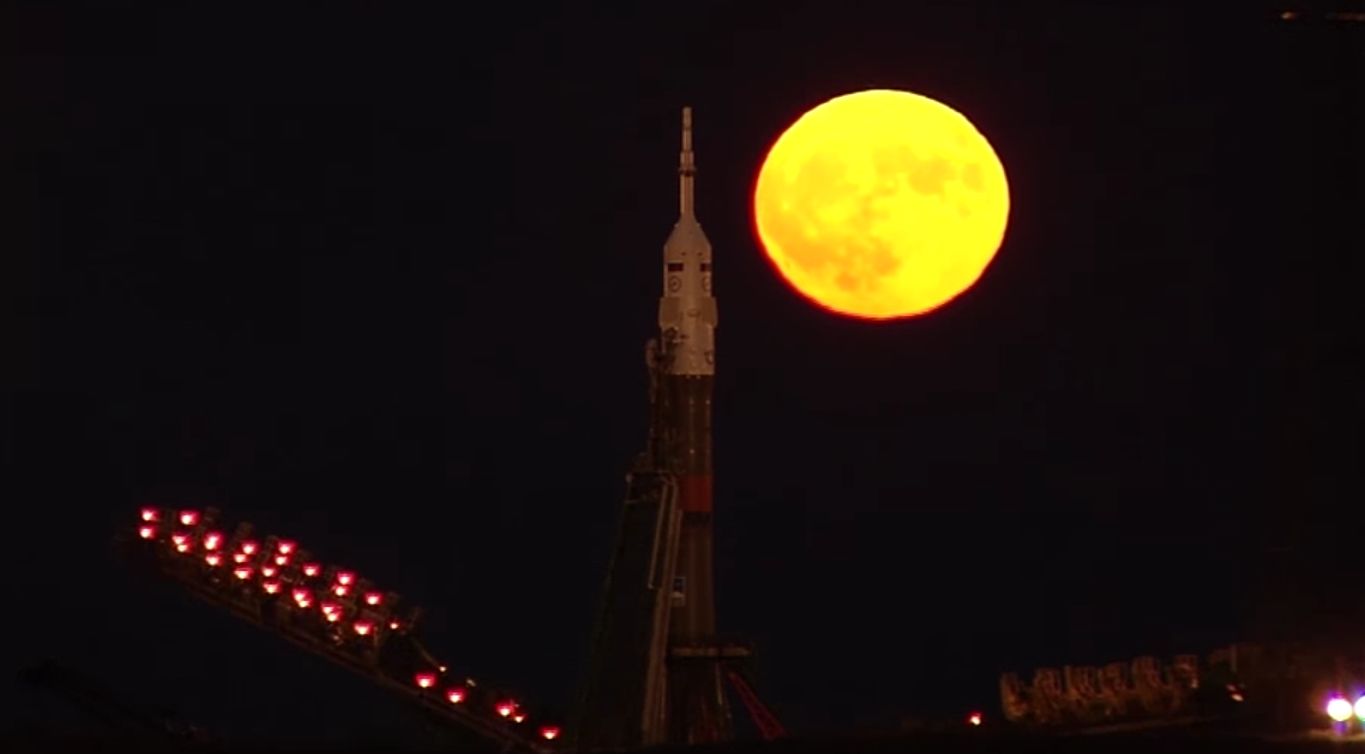
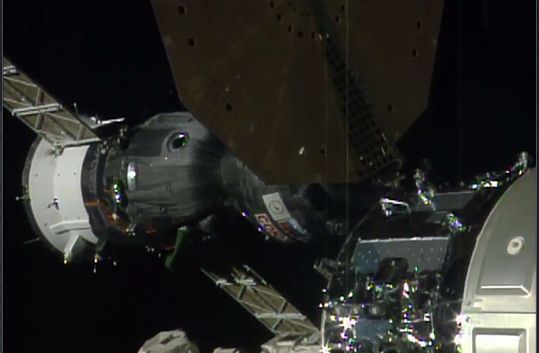
The "supermoon" of November 14th rises over the MS-03 spacecraft the Baikonur Cosmodrome in Kazakhstan, where it was being prepared for launch to the International Space Station
The “supermoon” of November 14th rises over the Soyuz MS-03 spacecraft the Baikonur Cosmodrome in Kazakhstan, where it was being prepared for launch to the International Space Station. Credit: NASA

The second of the three so-called “supermoons” which see out 2016 produced some dramatic photographs and video from around the world. Perhaps one of the most stunning  came from cameras at the Baikonur Cosmodrome in Kazakhstan, monitoring Soyuz MS-03 as it stood on the pad at Launch Complex 1.

As I noted in my last Space Sunday Report, a “supermoon” occurs when the Moon is both full and at perigee – the point in its orbit when it is closest to the Earth as it travels around our planet in an elliptical orbit. Such events occur around every 14 months, and can see the Moon appear to be 14% bigger than its average size in our sky, particularly when seen low on the horizon.

The “supermoon” of November 14th was special because the Moon was about at its closest point to Earth in its orbit – “just” 356,509 kilometres (221,524 miles) from us and the Earth / Moon system is approaching the time of year when it is closest to the Sun (which will occur on January 4th, 2017), thus making the full Moon “extra” bright for those who were able to see it. The next time this will occur will be in 2034. However, December 14th will see another “supermoon”, albeit one at a slightly greater distance away from the Earth, so those who missed November’s – weather permitting – may still get to see one before the year is out. In the meantime, here’s NASA’s footage from Baikonaur  – the film obviously speeded-up 🙂 .

Soyuz MS-03 lifted-off from Baikonur on Friday, November 18th, carrying aloft Russian cosmonaut Oleg Novitskiy, American astronaut  Peggy Whitson and rookie French astronaut Thomas Pesquet. It successfully docked with the International Space Station on Saturday, November 19th, marking the start of the Expedition 50/51 mission aboard the station, the crew sharing space with the Expedition 49/50 crew of mission commander Shane Kimbrough of NASA and Russian cosmonauts Sergey Ryzhikov and Andrei Borisenko, who have been aboard the station since October and who are due to return to Earth in February 2017.

For Whitson, this is a double first: she is the oldest woman to ever fly to the ISS – she will celebrate her 57th birthday in orbit – and, come February, she will be the first woman to command the space station for a second time in its 16-year operational history, having already become the very first woman to take command during Expedition 16 in 2007. She is also NASA’s most experienced female astronaut, with nearly 377 days logged in space, including six space walks totalling 39 hours 46 minutes. By the time she returns to Earth, she will have spent more time in space than any other US astronaut, surpassing the 534-day record set by Jeff Williams in September 2016.

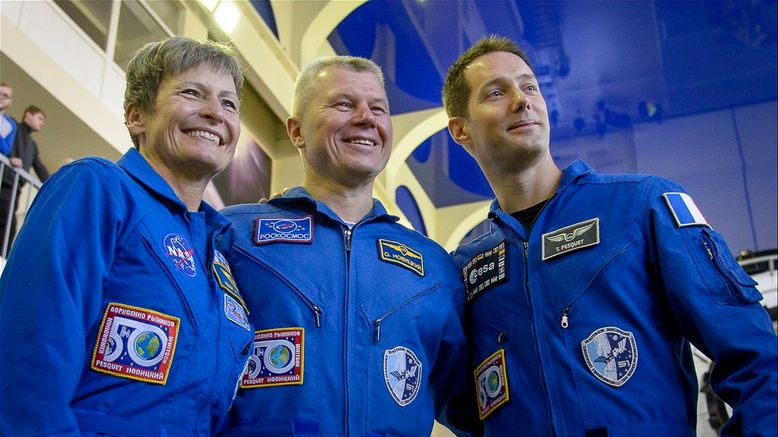
Peggy Witson with Oleg Novitsky and Thomas Pesquet posing for photographs prior to launch. Via: Peggy Whitson
Peggy Witson with Oleg Novitskiy and Thomas Pesquet posing for photographs prior to launch. Via: Peggy Whitson

During their time aboard the station, Whitson, Novitskiy and Pesquest will conduct hundreds of experiments and studies in biology, biotechnology, physical science and Earth science. A particular focus will be recording how lighting impacts the overall health and well-being of station crew members, and how the microgravity environment in orbit affects tissue regeneration in humans and the genetic properties of space-grown plants.

The crew carry with them some special meal time treats as well. Taking a leaf from British astronaut Tim Peake’s book, Pesquest requested fellow countrymen and renowned chefs Alain Ducasse and Thierry Marx develop a special menu for the crew. Highlights include beef tongue with truffled foie gras and duck breast confit.

Soyuz MS-03, piloted by Oleg Novitsky, closes for a docking with the Russian-built Rassvet module on Saturday, November 19th. In the foreground is the Cygnus resupply vehicle which recently arrived at the space station, together with one of its circular solar power arrays
Soyuz MS-03, piloted by commander Oleg Novitskiy, closes for a docking with the Russian-built Rassvet module on Saturday, November 19th. In the foreground is the Cygnus resupply vehicle which recently arrived at the space station, one of its circular solar power arrays partially blocking the view of the incoming Soyuz. Credit: NASA

“We have food for the big feasts: for Christmas, New Year’s and birthdays. We’ll have two birthdays, mine and Peggy’s,” the Frenchman said at the astronauts’ last press conference before the launch.

Pesquest,  a former commercial airline pilot with Air France, is also set to offer some entertainment for the crew: a keen musician, he’s taken his saxophone to the ISS. As part of his work on the station, he has special responsibility for the Proxima research programme of 50 experiments developed by the European Space Agency and the French national space agency, CNES. The programme’s name was suggested by 13-year old Samuel Planas from Toulouse, France, following a nationwide competition among school children. It is taken from Proxima Centauri, with the X in the name both representing the unknown, and the fact that Pesquest is the tenth French astronaut to fly in space.

Oleg Novitskiy, a 45-year-old lieutenant colonel in the Russian Air Force, is also on his second mission aboard the ISS, having previously served as the Soyuz TMA-06M commander during the flight to the ISS, and as the station’s flight engineer during Expedition 33/34. He has spent 143 days 16 hours and 15 minutes in space.

Continue reading “Space Sunday: from Earth orbit to Pluto, via Mars”

Space Sunday: mesas, dunes NEOs, comets and launches

A dramatic look back: in the foreground is the lower slope of one of the "Murray Buttes", in the far distance the tall peaks of Gale Crater's huge rim. One of the final images taken by Curiosity from within the region of the buttes on Thursday, September 8th, the rover's 1,454 sol on Mars. Credit: NASA/JPL / MSSS
A dramatic look back: in the foreground is the lower slope of one of the “Murray Buttes”, in the far distance the tall peaks of Gale Crater’s huge rim. One of a series of images taken by NASA’s Curiosity rover on Thursday, September 8th, the rover’s 1,454 sol on Mars. Credit: NASA/JPL / MSSS

NASA’s Mars Science Laboratory rover, Curiosity, has said “farewell” to “Murray Buttes” in a stunning series of images, as it continues its climb up the slopes of “Mount Sharp”, a massive mound of deposited material located at the central impact peak of Gale Crater.

The mesas of “Murray Buttes” mark the upper extend of the transitional “Murray Formation”, where the material deposited during the earliest centuries of “Mount Sharp’s” formation merge with the rock comprising the crater floor. Curiosity has been passing by the area of the buttes for a little over a month now, carrying out examinations of the rock surface and gathering samples of mudstone for analysis.

Murray Buttes with the faint outlines of Gale Crater beyond, as images on Thursday, September 8th 2016, by NASA's Curiosity rover during its 1m454 sol on Mars. Credit: NASA/JPL / MSSS
“Murray Buttes” with the faint outlines of Gale Crater beyond, as images on Thursday, September 8th 2016, by NASA’s Curiosity rover during its 1,454 sol on Mars. Credit: NASA/JPL / MSSS

Believed to be the eroded remnants of ancient sandstone that originated when winds deposited sand after lower “Mount Sharp” had formed, the buttes rival anything of a similar nature found on Earth in terms of dramatic looks and structure. So much so that while we’re hardly likely to see Clint Eastwood ride his horse around the base of one, they would nevertheless fit neatly into a Sergio Leone western.

Several of the pictures – mosaics of images captured by the rover which have been white-balanced to match typical Earth daylight lighting conditions and then stitched together to offer complete scenes – reveal the deeply layered nature of the sandstone, sandwiched in what is referred to as “cross-bedding”. This indicates that the formations are the result of both wind deposition of material and then wind erosion, further confirming the idea that “Mount Sharp” was initially formed as a formed as a result of Gale Crater once being home to a great lake, before the waters receded and wind action took over.

A closer view of the layered nature of the sandstone deposits forming "Murray Buttes", showing the "cross bedding" of the layers, indicative of the role that wind played in their deposition / formation. This picture comprises a mosaic of images captured by Curiosity rover on Thursday, September 8th, 2016 during its 1,454 sol on Mars. Credit: NASA/JPL / MSSS
A closer view of the layered nature of the sandstone deposits forming “Murray Buttes”, showing the “cross bedding” of the layers, indicative of the role that wind played in their deposition / formation. This picture comprises a mosaic of images captured by Curiosity rover on Thursday, September 8th, 2016 during its 1,454 sol on Mars. Credit: NASA/JPL / MSSS

The images were taken as Curiosity traversed the base of the final butte, where it gathered a final drilling sample on September 9th. On completion of the sample-gathering, the rover will continue farther south and higher up Mount Sharp, leaving these spectacular formations behind.

Curiosity's route up the slopes of "Mount Sharp". Credit: T.Reyes / NASA/JPL
Curiosity’s route up the slopes of “Mount Sharp” – click for full size. Credit: T.Reyes / NASA/JPL

The Sand Dunes of Shangri-La

On September 7th, NASA issued a video showing the latest radar images captured by the Cassini probe of the surface of Saturn’s largest moon, mighty Titan. The data was gathered as the probe swept by the huge moon – which is blanketed by a thick atmosphere and is known to have lakes and rivers of liquid hydrocarbons on its surface – at a distance of some 976 km (607 mi) on July 25th, 2016 – one of the closest passes over the moon the vehicle has ever made.

Because of the moon’s thick atmosphere, conventional camera systems cannot be used to probe Titan’s mysteries, so Cassini uses a radar system to “map” surface features in black-and-white. Of particular interest to mission scientists during the July 25th flyby was a dark patch along Titan’s equator, previously images by the radar system at much greater distances and dubbed “Shangri-La”. And area which revealed itself to be – in part – a region of linear dunes, mostly likely comprised of grains derived from hydrocarbons that have settled out of Titan’s atmosphere, and which have been sculpted by Titan’s surface winds. Scientists can use the dunes to learn about winds, the sands they’re composed of, and highs and lows in the landscape.

Also captured by the radar is an arena dubbed “Xanadu annex”, believed to be an out-thrust of chaotic terrain from a region dubbed “Xanadu” just to the north of “Shangri-La”. First imaged by the Hubble Space Telescope in 1994, just before the Cassini / Huygens mission was launched, “Xanadu” and its annex are thought to be remnants of the moon’s icy crust before it was covered by organic sediments from the atmosphere.

OSIRIS-REx Lifts-off as an Asteroid Sweeps By Earth

On Thursday, September 8th, NASA successfully launched OSIRIS-REx on a 7-year trek to reach asteroid Bennu, where it will gather surface samples and return them to Earth for analysis. The mission, which I previewed in my last Space Sunday report, lifted-off flawlessly from Space Launch Complex 41 at Cape Canaveral Air Force Station at 19:05 EDT, atop its Atlas V booster at the start of a journey which will carry it a total of 7.2 billion kilometres (4.5 billion miles).

The Atlas V booster carrying OSIRIS-REx shortly after lift-off on Thursday, September 8th. Credit: Ken Kremer

Witnessing the launch was principal investigator Dante Lauretta, from the University of Arizona. “I can’t tell you how thrilled I was this evening, thinking of the people who played a part in this,” he said following the launch.

“This represents the hopes and dreams and blood, sweat and tears of thousands of people who have been working on this for years.”

The mission will gather samples from the surface of the asteroid – a remnant from the formation of the solar system – and will also map Bennu’s orbit around the Sun and the influences affecting it.

This is because the asteroid is a near-Earth object (NEO): an asteroid which periodically passes across Earth’s orbit around the Sun, and can come very close to our planet whilst doing so. So close, in fact, that some estimates of Bennu’s future orbit suggest it will collide with Earth towards the end of the next century.

Continue reading “Space Sunday: mesas, dunes NEOs, comets and launches”

Space Sunday: exoplanets, dark matter, rovers and recoveries

An artist's impression of Proxima b with Proxima Centauri low on the horizon. The double star above and to the right of it is Alpha Centauri A and B. Credit: ESO
An artist’s impression of Proxima b with Proxima Centauri low on the horizon. The double star above and to the right of it is Alpha Centauri A and B. Credit: ESO

On August 15th, I wrote about rumours that an “Earth-like” planet has been found orbiting our nearest stellar neighbour, Proxima Centauri, 4.25 light years away from our own Sun. The news was first leaked by the German weekly magazine, Der Spiegel, which indicated the discovery had been made by a team at the European Southern Observatory’s (ESO)  La Silla facility – although ESO refused to comment at the time.

However, during a press conference held on August 24th, ESO did confirm the detection of a rocky planet orbiting Proxima Centauri. Dubbed Proxima b, the planet lies within the so-called “Goldilocks” habitable zone around its parent star – the orbit in which conditions are “just right” for the planet to harbour liquid water and offer the kind of conditions in which life might arise.

Comparing Proxima b with Earth. Credit: Space.com

The ESO data reveals that Proxima b is orbits its parent star at a distance of roughly 7.5 million km (4.7 million miles), at the edge of the habitable zone, and does so every 11.2 terrestrial days and is about 1.3 times as massive as the Earth. The discovery came about by comparing multiple observations of the star over extended periods using two instruments at La Silla to look for signs of the star “wobbling” in its own spin as a result of planetary gravitational influences. Once identified, ESO called on other observatories around the world to carry out similar observations / comparisons to confirm their findings.

Although the planet lies within the “Goldilocks zone”, just how habitable is it likely to be is still open to question. Stars like Proxima Centauri, which is roughly one-seventh the diameter of our Sun, or just 1.5 times bigger than Jupiter, are volatile in nature, all activity within them entirely convective in nature, giving rise to massive stellar flares. As Proxima-B orbits so close to the star, it is entirely possible that over the aeons, such violent outbursts from Proxima Centauri have stripped away the planet’s atmosphere.

Proxima Cantauri compared with other stellar bodies - and Jupiter (Credit: Space.com)
Proxima Cantauri compared with other stellar bodies – and Jupiter. Credit: Space.com

In addition, the preliminary data from ESO suggests the planet is either tidally locked to Proxima Centauri, or may have a 3:2 orbital resonance (i.e. three rotations for every two orbits) – either of which could make it an inhospitable place for life to gain a toe-hold. The first would leave one side in perpetual daylight and the other in perpetual night, while the second would limit any liquid water on the surface to the tropical zones.

Nevertheless, the discovery of another world in one part of our stellar backyard does raise the question of what NASA’s upcoming TESS mission might find when it starts searching the hundreds of nearby stars for evidence of exoplanets in 2018.

Juno’s Second Pass Over Jupiter

NASA’s Juno space craft made a second successful close sweep over the cloud-tops of Jupiter on Saturday, August 27th to complete its first full orbit around the planet. Speeding over the planet at a velocity of 208,000 km/h (130,000 mph) relative to Jupiter, Juno passed just 2,400 km (2,600 miles) above the cloud tops before heading back out into space, where it will again slowly decelerate under the influence of Jupiter’s immense gravity over the next 27 days, before it once again swing back towards the gas giant.

“Early post-flyby telemetry indicates that everything worked as planned and Juno is firing on all cylinders,” said Rick Nybakken, Juno project manager at NASA’s Jet Propulsion Laboratory, as telemetry on the flyby started being received on Earth some 48 mins after the flyby, which occurred at 13:44 UTC.

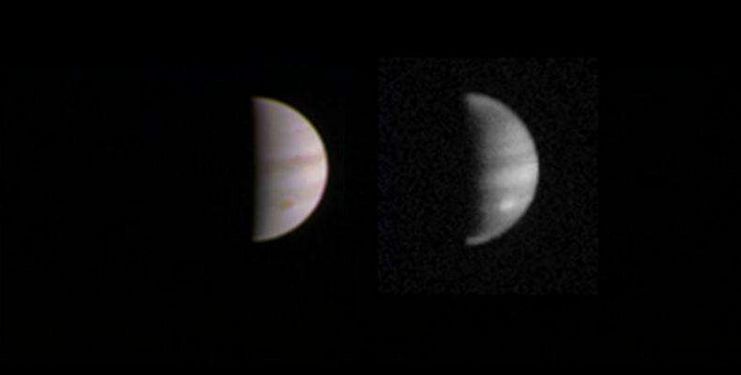
A twin view of Jupiter captured by Juno on August 23rd, when the spacecraft was some 4.4 million km (2.8 million miles) from the gas giant and approaching Jupiter to complete its first full orbit. On the left is a colour image from JunoCam, on the right an infra-red image Credit: NASA/JPL-Caltech/SwRI/MSSS
A twin view of Jupiter captured by Juno on August 23rd, when the spacecraft was some 4.4 million km (2.8 million miles) from the gas giant and approaching Jupiter to complete its first full orbit. On the left is a colour image from JunoCam, on the right an infra-red image. Credit: NASA/JPL / SwRI / MSSS

All of Juno’s science suite was in operation during the passage over Jupiter’s clouds. However, due to speed at which the gathered data can be returned to Earth, and given it cannot all be relayed in one go or necessarily continuously, it will be a week or more before everything has been transmitted back to Earth. Nevertheless the science team are already excited by the flyby.

“We are getting some intriguing early data returns as we speak,” Scott Bolton, principal investigator of Juno from the Southwest Research Institute, stated. Some of that data included initial images of Jupiter captured as Juno swept towards the planet during the run-up to periapsis. “We are in an orbit nobody has ever been in before, and these images give us a whole new perspective on this gas-giant world,” Bolton added.

Continue reading “Space Sunday: exoplanets, dark matter, rovers and recoveries”

Space Sunday: of Martian and lunar robots, distant worlds and ET

CuriosityAugust 2016 sees NASA’s Mars Science Laboratory rover Curiosity rack up four (terrestrial) years of operations on the surface of Mars.

The rover marked this anniversary rather quietly, by preparing to take further rock samples, this time from a target dubbed “Marimba”. Once gathered, the samples will be subjected to on-board analysis by Curiosity using the compact laboratory systems contained the rover’s body.

The sampling take place as the rover is engaged in a multi-month ascent of a mudstone geological unit as it continues its climb towards higher and progressively younger geological areas on “Mount Sharp” (more correctly, Aeolis Mons), which will include some rock types not yet explored.

August 2nd, 2016 (Sol 1,418)T: the Navigation Camera (Navcam) on Curiosity's mast images the rover's extended robot arm over a section of the "Marimba" target rock, ready to use the wire brush mounted on the "hand" at the end of the arm in order to scour surface material which otherwise might contaminate and samples gathered from the rock, prior to the rover taking a drilling sample. Credit: NASA/JPL / MSSS
August 2nd, 2016 (Sol 1,418)T: the Navigation Camera (Navcam) on Curiosity’s mast images the rover’s extended robot arm over a section of the “Marimba” target rock, ready to use the wire brush mounted on the “hand” at the end of the arm in order to scour surface material which otherwise might contaminate and samples gathered from the rock, prior to the rover taking a drilling sample. Credit: NASA/JPL / MSSS

In the meantime, examining the samples gathered from “Marimba” will allow a direct comparison with mudstone samples gathered further down the slopes of “Mount Sharp” and from the flatlands of Gale Crater. This will enable scientists to  build a more complete picture of the mineral and chemical  environment the rover is travelling through, and so further understand the general conditions which may have once have existed within the crater.

Goodnight from a Lunar Jade Rabbit

China has finally bid farewell to Yutu (“Jade Rabbit”, named for the companion to the Moon goddess Chang’e), its first lunar robotic explorer, after 31 months of surface operations.

The little solar-powered rover arrived on the lunar surface as part of Chain’s Chang’e 3 lander / rover mission on December 13, 2013, and was deployed from the lander some  7.5 hours after touch-down.

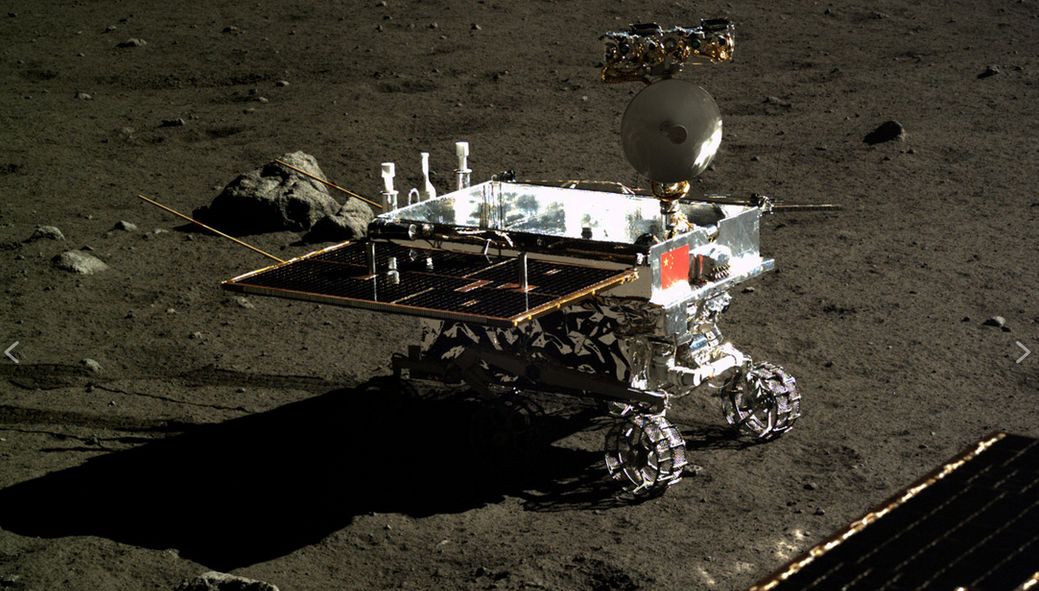
Yutu as imaged from the Chang'e 3 lander (part of the solar pnael from which can be seen in the lower right corner). Credit: National Astronomical Observatories of China
Yutu as imaged from the Chang’e 3 lander (part of the solar panel from which can be seen in the lower right corner). Credit: National Astronomical Observatories of China

However, due to the vast temperature differential experienced between the sunlit and shadowed parts of the rover at the time of the landing, operations didn’t commence until December 21st, when the rover was uniformly lit by the Sun. It’s first activity was to drive part-way around its parent lander and photograph it. After this, the rover travelled some 40 metres (130 ft) from the lander to commence independent science operations studying the lunar surface.

Yutu was designed to operate for just three months and travel up to 10 km (6.2 mi) within an area of 3 square kilometres (1.2 sq mi). Following its expose to the first 14-day long lunar “night”, the rover resumed operations in January 2014. However, as the second lunar night period approached (lasting 14 terrestrial days), the rover suffered a glitch in its drive mechanisms, leaving it susceptible to the harsh cold of the night-time, and on February 12th, following its second Lunar night, the rover was declared lost … only to resume communications with Earth within 24 hours.

Since that time, although immobilised, the little rover has maintained almost regular contact with Earth, but with each night period taking an increasing tolls on its systems. Even so, its continued survival gained it a huge and loyal following on the Chinese micro-blogging site, Weibo, where in a leaf firmly pulled from NASA’s book of social media engagement, Yutu had a first-person account.

It was via that social media account that Yutu’s final demise was announced, as if from the rover itself, on August 2nd 2016:

This time it really is goodnight. There are still many questions I would like answers to, but I’m the rabbit that has seen the most stars. The Moon has prepared a long dream for me, I don’t know what it will be like – will I be a Mars explorer, or be sent back to Earth?

The message gained a huge response from the rover’s 600,000 followers, and the Chinese space agency officially confirmed the rover had “died”, on Wednesday, August 3rd.

Continue reading “Space Sunday: of Martian and lunar robots, distant worlds and ET”