The independent author whose muse is Second Life

Maxwell Grantly is a non de plume for an anonymous school teacher, living in a small seaside town on the east coast of Great Britain. Although he has written many free short stories, he does not consider himself an author. He simply writes just because he enjoys doing so (and for no other reason.)

So reads the Profile summary of, well, Maxwell Grantly, a Second Life resident living in England, and who has a remarkable talent for creating illustrated short stories and graphic novels using Second Life as the environment to create his main character and the medium by which he creates the illustrations for his stories.

Timothy tortoise finds himself in an alternate universe when he unwittingly embarks on a Big Adventure

I confess that Maxwell’s work had actually slipped right past me, and quite possibly might have remained out-of-sight to me had it not been for Charlie Namiboo circulating information on his latest book, Timothy’s Big Adventure which is currently available free-of-charge for 5 days on Amazon for download on the Kindle reader or similar devices, and computers with the Kindle Reader app installed.

The book follows the adventures of Timothy tortoise, who lives with a little boy called George, who lives with his parents in a small house “many miles from anywhere” (photographed in Frisland) and is too young to go to school. Timothy is somewhat envious of George’s fast-paced and, to Timothy’s way of thinking, exciting life. However, all that changes when Timothy falls through a hole and finds himself in an intergalactic adventure in another universe.

Timothy’s Big Adventure is the kind of short story which harkens back to childhood memories of bedtime stories; indeed, the book itself makes excellent material for such a setting if you have small children of your own. The plot is uncomplicated, easy-to-follow and the illustrations, created using characters and settings from inside Second Life, are delightful.

As well as Timothy’s Big Adventure,  Maxwell has written longer, more complex pieces, such as his Fingers stories, set in New Babbage, which follow the adventures of a young pick-pocket, Edward “Fingers” Croydon, abandoned to the streets of that town whilst very young.

Maxwell admits that he doesn’t actually write first and foremost with children in mind; his stories take a form that he is prone to enjoy, and he views some of the concepts then can enfold as being perhaps more suitable to older children and perhaps adults, rather than being purely for bedside story enjoyment – although he does acknowledge that this is those with younger children might well enjoy reading them to their kids.

As well as telling stories of adventures and intrigue, Maxwell’s books also touch  – albeit perhaps in a very subtle manner – on what might be terms social issues from the periods in which they are set. The Fingers stories, for example, deal with matters of Victorian street urchins and how social care was more a matter for philanthropists (real or apparent) rather than the state.

Likewise, Jack and the Space Pirates touches on child labour: the story’s hero is Jack, is employed to “creep into the tiny gaps gape between the timbers” of space ships to apply the tar need to keep “space out” – a job which sounds akin to the Victorian use of children as chimney sweeps because of the ability to worm their way up flues, or in earlier times, to clean out the spaces behind tightly-packed spinning jennies at the start of the industrial era. Sprocket and the Sparrow carries a more obvious message on the importance of conservation, but it is one that is again imaginatively told.

Some of Maxwell's titles available through Amazon as e-books
Some of Maxwell’s titles available through Amazon as e-books

Again, this is not a deliberate approach on Maxwell’s part; but it does form a natural element in his creative process, as he explained in a recent interview with Writing.com.

“When I write, I just want to tell a good story,” he said. “I feel that it is a basic feature of every human being to be creative. Some people find their creativity in their hobbies, art, dance, music; other people find a release for their creative spirit by consuming the creativity of others. I find that the production of stories is a great release that allows me to be creative, simply for the joy of doing so. Sometimes a fable or lesson might arise naturally from the plot but, when it does, it is often unintentional. I would like to think that, when a reader browses through my work, they are able to enter a magical world of suspended belief and join me in my bizarre world of fantasy, if only for a brief moment.”

Lief's Quest
Leif’s Quest

Another aspect to the appeal with these books  is the care with which the illustrations have been composed; facial expressions have been deliberately selected, for example, to help give even passing characters their own personality – and I admit to smiling at both the astronaut’s expression and choice of words “Yikes!” on being confronted by the lizard aliens!

There’s also a richness to Maxwell’s use of genres; while the Fingers series and Jack are most assuredly Steampunk in setting, his stories involving the elven children Maxwell and Skippy are equally assuredly rooted in fantasy, as is Leif’s Quest, which also has more of a graphic novel look to it.

While the scenes depicted in the stories are located in Second Life, encompassing places as diverse as Frisland, Calas Galadhon, Escapades (and one of Loki Eliot’s magnificent steam-powered airships is Jack’s rewards in Jack And the Space Pirates), New Babbage and other locations, it would be a mistake to say the stories are about Second Life – and it shouldn’t be for a moment considered that they are. Again, that’s not Maxwell’s intent.

Instead, what we do have is another example of how rich and diverse a place Second Life can be when it comes to inspiring our imaginations and for acting as a springboard for our creativity. These are imaginative stories, and I found myself getting drawn into them as I read them in turn.

If you have young(ish) children of your own and are looking for a range of bedtime stories with which to entertain them, or if you want to read adventures of a different kind, I have no hesitation in recommending Maxwell Grantly’s books. They are available on Amazon worldwide – just search for “Maxwell Grantly”, and are offered as e-books on either the Kindle PC app or via the Kindle Cloud.

Additional Links

The majesty of creation in Second Life

Angel Manor: the subject of a beautiful new video by its creator, Kaya Angel

Kaya Angel is one of Second Life’s most respected builders, and his Angel Manor estate is rightly admired across the grid both as a build in its own right and as a venue for art, fund raising events and a more. I

As a designer / builder, Kaya naturally turned to emerging capabilities to further enhance his commercial and commissioned work, and to enhance Angel Manor itself – so much so, that I keep reminding myself I’m overdue for a visit in order to write an update to my March 2013 piece on the manor, as so much has changed since then.

In celebration of the manor, and to demonstrate just how immersive Second Life can look and feel, Kaya has produced a new 6-minute video entitled Second Life: A different perception, which has been drawing widespread praise from all who have seen it and is without a doubt, simply superb.

Marvellously edited, matched to an excellent soundtrack, this is a film which can hardly fail to evoke a feeling of wonder, joy and pride in the heart of anyone who has invested time and energy into Second Life. If ever there was a banner by which we can proclaim to the world just what is possible within SL for the creative mind, then this film is it.

Kudos, Kaya, and thank you.

with thanks to the G+ pointer from Whirly Fizzle.

The tables turned: Drax as the interviewee

We’re used to Draxtor Despres being the interviewer, engaging with guests from all backgrounds and interests through the Drax Files Radio Hour and coaxing those spotlighted in his World Makers series to talk about their virtual and physical lives.

Bernard Drax, aka Draxtor Despres, offering his thoughts on Second Life, VR and the future

However, while attending the SVVR Conference in April to moderate the Creating the VR Metaverse panel, Drax found the tables turned on him when interviewed by Kent Bye, who runs the Voices of VR Podcast series. These are short, punchy podcasts lasting around fifteen minutes on average, with Kent doing just enough questioning to steer the conversation and to provide interesting and often thought-provoking feedback from his guests.

His interview with Drax appeared on July 8th; Drax poked me and a number of others about it when it appeared, and it is a jolly good listen.

From covering his work in SL with his documentaries and podcast series, Drax goes on to talk about his own initial involvement in Second Life. This actually surprised me somewhat; not so much because of how he became involved in SL, but because in listening to the interview, I realised that despite our own long-distance chats about Second Life, the World Makers video series, and so on, he and I had never really talked about our personal experiences in getting involved in the platform.

With the introductions over and done with, the conversation moves on to matters of identity, with Drax expressing his fears about people’s freedom to identify themselves as they wish – as is the case with Second Life – should the likes of Facebook move into the virtual world space. It’s a view he’s expressed before through the likes of some of the Drax Files Radio Hour podcasts. I admit that I don’t entirely see things the way he does.

If nothing else, Facebook can quite easily datamine users, track their activities, etc., without necessarily forcing them to only use their wallet IDs within any virtual environment Facebook / Occlus VR might create. They can get whatever they need through the sign-up process, howsoever users go on to identify themselves within the environment.

Darx as we see him in Second Life
Drax as we see him in Second Life

To me, the bigger issue lies not in how operators of virtual environments might try to enforce issues of identity from the outset within their environments.

Rather it lies in reconciling what amounts to two opposing views held by the potential users of such virtual spaces: those who see freedom of self-identification as a strength and virtue within a platform, and those who see such freedom of self-identification as inherently “creepy” and suggestive that such spaces are “untrustworthy”, decreasing their willingness to become involved in them.

As I pointed-out in discussing the mainstream market and the Lab’s “next generation” platform, finding a middle ground where both of these viewpoints are comfortably addressed may not be easy. As such, when it comes to matters of identity, it may come down to the expectations of those using a virtual world / environment far more than those provisioning it.

The subject of identity also encompasses ruminations on our relationships with our avatars, and here I fully understand Drax’s comment on his relationship with his own alts: while they serve a purpose, they’re not “him”. I empathise entirely, as I feel much the same about my own alt; so much so, that I wrote she’s not me on that very subject. While it doesn’t enter into the interview, there is an interesting additional question about how we identify with our primary avatars.

We often point to the financial investment we make in our avatar as a reason for not settling in other virtual worlds; But, for those who do have a very close identification with their avatar in a particular world, might that focus be as much of a reason for not settling elsewhere as any financial expenditure on that avatar?

In the latter half of the interview, Drax turns slightly prophetic – remembering that the interview was recorded well before news of the Lab’s “next generation” platform entered the public domain. He points to the fact that in many respects the Lab have the track record to be perfectly placed to lead the train in any resurgence of virtual worlds because they have the technical experience, and they are used to dealing with a large and diverse population and providing the kind of environment and capabilities that people find attractive. So attractive I’ll go on to say, that we all prefer to stick with it even amidst all the grumbling directed at the company for perceived ills and mistakes. Raising these points leads Drax to wonder what the Lab might have up its sleeve – a question duly answered at the end of June.

Despite Drax commenting on his celebrity status, this is actually a great vox populi interview, in that he is very representative of all of us who use SL, his own standing as a “known” figure in-world notwithstanding. his answers to the questions Kent pitches are well-rounded, informative and well-considered. His enthusiasm for the medium, and for exploring it is infectious; even his rapid-fire departure to go grab another SVVR attendee for an interview of his own cannot fail to raise a smile on the listener’s lips.

Related Links

Second Life happiness

JupiShinn is a friend who enjoys video art and new media. He recently invited me to participate in a music video he was working on, but schedules didn’t match-up. Which is a shame, as the finished piece is really good, and I would have been honoured to have been a part of it.

But just don’t take my word for it – catch the video yourself – and if you like it, leave a comment on JupiShinn’s YouTube version or over on the version he has on his flickr stream.

Loki’s The Lost Virtual World

Lokli Eliot pinged me earlier in January about a video he was putting together called The Lost Virtual World, which is an examination of Second Life, VR, the media’s falling in-and-out of love with both, and something of a historical look at Second Life’s (and Linden’s Lab’s) development. The formal announcement of the video’s realse came via Loki’s blog and episode 3 of The Drax Files Radio Hour.

Carefully complied from a range of videos and interviews, Loki’s piece, at 37 minutes in length is a goldmine of information, skillfully crafted to present a very clear message, encompassed, to a degree, in the opening titles.

From Alice in Wonderland, by way of the 2014 Consumer Electronics Show in Las Vegas,  the video flows gracefully into interviews featuring noted faces behind the development of SL, and touching upon some of the highs and low of the platform, the controversies which have courted it (witness Philip Rosedale’s public declaration on the subject of land “ownership” in Second Life – wonder if the company still rues the day he uttered those words?). At the same time it casts a wider net over the past, present and future of VR as whole and offers succinct précis of the media’s love affair with both.

The beauty of this piece is that while there is a carefully structured narrative throughout, it is also presented largely free from any bias an audio track might otherwise supply; even the on-screen text restricts itself to factual comments, rather than attempting to steer the viewer’s thoughts. This allows each clip to speak for itself while also building on the central theme. This in turn deepens aspects of the video’s impact, particularly in the clips featuring events and faces from SL’s past. Recalling those events from SL’s history and seeing faces now long departed from this virtual realm evokes very personal memories, which further help the video resonate more personally than might otherwise be the case.

And because of this, I’m going to stop here and not analyse things further, as I don’t want my own thoughts intruding into yours as you watch the film. Instead I’ll say only this: get yourself a drink, settle comfortably in your chair, and enjoy.

(And a very nice use of elements of the TRON soundtracks as well!)

Return of the Silent Peacock

MPC-5c
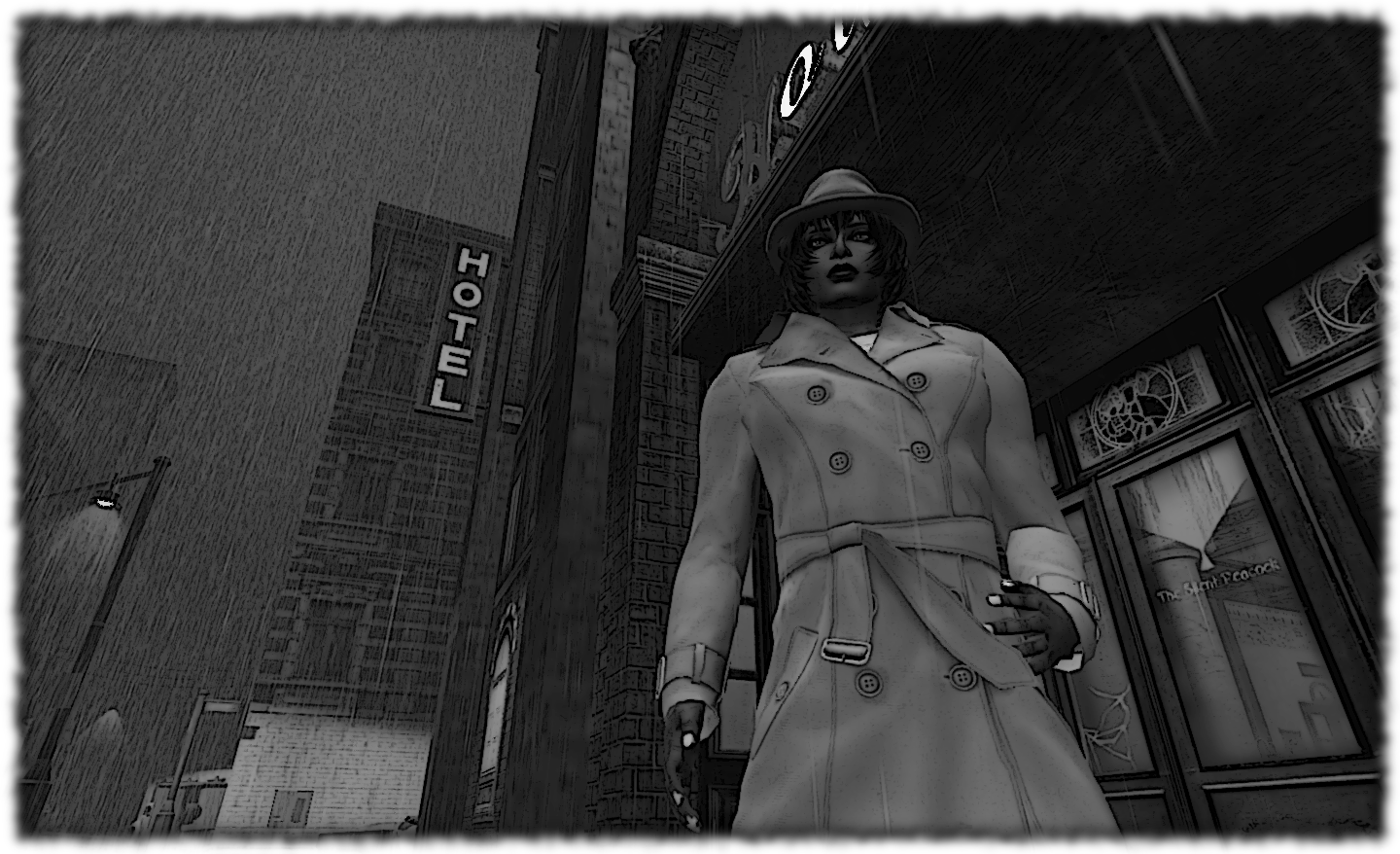
I was sharing a personal moment with Jack D when the ‘phone rang. It was the Governor’s aide. Another 15 people had gone missing from Room 326 at the Silent Peacock Hotel & the Governor wanted me down there. Funny how I’m always wanted when things can’t be handled through the proper channels. But then, that’s the nature of my work. Bullit’s the name. Traci Bullit, and PI work is my game; you want it found, I’ll find it – for L$100 a day plus expenses. Grabbing my hat and coat and pausing only long enough to pick-up Mr. Redemption on the way out, I headed downtown.
By the time
The Silent Peacock Hotel. I thought the place had been condemned and pulled down after the last time 15 people disappeared from Room 326. But when I got downtown, there it was, like a corpse raised from the dead, the same broken sign above the front doors winking at me through that same hard rain that marked the last time I’d been here. Turning my collar against the downpour, I crossed the street, the strangest feeling of deja-vu haunting my steps…
Room 326
Room 326 hadn’t changed either. The same fading wallpaper and same tired carpet. The same smell of stale cigarettes and that cheap cologne popular with so many male members of the city’s constabulary. I flipped open the file a local gumshoe had left behind and started reading the notes. Fifteen people missing. All of them from this room, and all of them with the door to the corridor outside firmly locked, and no sign of forced entry or struggles. File in hand, I headed back downstairs.
It
It was still raining when I stepped outside, so I rolled the file up and tucked it into an inside coat pocket, where it would be safe, right alongside Mr. Redemption, who was cosied in his holster under my right arm. The case had many familiar hallmarks as the last time mystery had roomed at the Silent Peacock. But my gut was telling me that things wouldn’t be a simple open-and-shut retread. Somewhere out in this rain-sodden city were answers, and I was going to find them. And somehow, I knew I wasn’t going  to be the only one doing so…

Yes, Madpea are back with another of their grid-wide hunts and this time, for the first time ever, they are re-running a hunt they’ve already featured in-world: that of Room 326, which ran back at the start of the year, and is making a return by popular demand, this time sponsored by NY Healthscape.

With fifteen people missing, it’s time for you to turn sleuth and follow the clues in this point-and-click grid-wide mystery and find out what really happened in Room 326. Fifteen envelopes must be found and collected if you are to reach the final gameplay area where – as the immortal line goes – “all will be revealed” and you will be rewarded with 15 high-quality prizes.

The hunt is open now, and runs through until August 31st. So, if you fancy you can beat “Traci Bullit” in solving the clues, get yourself over to Mad City, and pick-up a game HUD from the entrance to the hotel (L$150) and make your way to Room 326 so that the game may truly be a-foot! Full instructions on using the HUD are available on the Madpea blog.

If hunts aren’t your thing, Mad City offers the in-world shopper with streets to roam and shops to browse, while beyond it lay the streets of New York and the home regions operated by NY Healthscape, all of which offer places to discover and things to do.

Related Links