Metareality discusses the “RedPoly” approach to mesh deformation

Note this is a 2-page article. Use the page numbers at the end of the piece to page back and forth.

Today’s Metareality podcast covers, as usual, a lot of topics, including Cloud Party and, more particularly the possible alternative approach to mesh deformation as proposed (or possibly re-proposed, given LL apparently looked at the same idea last year) by RedPoly, and which I covered in an earlier report this week.

The panel for this panel for this week’s show comprised Kimberly Winnington, aka Gianna Borgnine in-world and Karl Stiefvater, Qarl Fizz in-world, who were joined by Cyclic Gearz  and Geenz Spad.

While you can hear the broadcast in full over at Metareality, here’s a transcript of the discussion around the alternative means of mesh deformation.

[02:47] Gianna Borgnine (GB): So what is this new deformer, and how is it different? … For what I understand it works on bone definitions, is that right?

Geenz Spad

[03:07] Geenz Spad (GS): Well, basically yes, it uses several unused bones in the avatar skeleton … I guessing were used at some point to calculate the bounding box of the avatar on the server for collisions or similar. So, that’s mostly what it seems to be right now.

[03:30] Qarl Fizz (QF): I can probably add some more, but I should also specify that this is complete speculation because I haven’t had a chance to dig in … It seems like, yes, for the purposes of physics and maybe other stuff, at one point the Lindens had this approximation system put in so that when you dial your avatar sliders around, they have a basic gist of what your avatar looks like. And someone came up with the idea of using this information to do the deformation instead of the actual morphs themselves.

[04:10] GB: So, Cyclic, maybe you could answer this best: what about this is so appealing to the content creators?

[04:15] Cyclic Gearz (CG): Well, from my perspective, well, I make furniture mostly, but I still know a lot about design and stuff …  And all my designer-friends who make clothes … and part of the most difficult and annoying process is having to make five separate sizes currently, because at the moment that’s the best option for attracting the most customers – having more sizes that fit more bodies – if they have a deformer that works as is, and they do the work outside of Second Life, it reduces the workflow, it reduces the time to make new things; [it] means that they can get more stuff out and therefore more customers are happy.

[04:55] GB: So my guess is, I mean I talked to a few different people and got a few different opinions, and it was interesting to see the different sides and probably the only person I talked to … who wasn’t as thrilled about it, other than some of the developers I talked to, was Maxwell Graf, who is always looking to get rid of extra sizes, so I thought he would be excited! But for him, one of the big things was that it still felt like so much extra work because now he’s back to weight painting, which is something he was trying to get away from with Qarl’s deformer … But the thing that, as a person who does not make mesh fashions … Right now at least, you’re sort-of weight painting, but you’re painting blind, because you have to upload it to see the effects of what you did. Is that right?

Avastar in use

[06:06] CG: Sometimes; it depends on how you make your mesh. For instance, with blender you can get a plugin which you can pay for called Avastar by Gaia Clary. That is a really good way of seeing what your weight painting does and has an affect. You can also get a free burn file for Blender which is called The Avatar Workbench, also from Gaia Clary, where it has got all the bones and stuff and you can see what it’s supposed to look like. But you do sort-of have to guess … if you’re not versed in mesh or anything like that, and weight painting at all, it can be quite daunting. So from that perspective, not having to weight paint would be better for newer creator, because they’d be able to build something in blender or a different commercial program and not have to weight painting, because that is really horrible stuff! But … I do think people need to learn these skills, because the skill you learn for making 3D in Second Life can be applied in real life for big jobs … you could go into the games industry making models and stuff; but if you can’t weight paint, you’re out of luck!

[07:22] GS: Personally, I used to be an artist before I was programmer, and 3D animation was something I was always very interested in, and I definitely know the pains of having to go through and paint a variety of different vertex weights for different bones and things like that. And one thing that seemed interesting to me to the new approach to a deformer that works across all viewers that support mesh is that … you have 20-something bones you currently have to rig if you really want something that really looks good and really deforms well on most avatars with regards to just an avatar moving around; now you have all these additional bones you now have to worry about. That really seems to be the biggest drawback here. Granted, there are ways to mitigate this, and as I was saying on Monday, someone should find a better workload for this if it’s really going to be a viable solution.

[08:19] GB: Which made you really unpopular…!

[08:23] GS:  (Wryly) yes, because I’m a terrible person for suggesting something rational here, I guess!

[08:49] QF: So, I don’t know actually how this works, so may be you can help me, Geenz. So, what I said is true, right? These are like pseudo joints that the visual params modify to kinda …

[09:09] GS: … Kind-of get an idea of how big the collision capsule server-side should be – that’s what I’m guessing, you know? I could be wrong.

[09:12] QF: but you can’t visualise these in Blender at all, can you?

[09:18] GS: You pretty much have to manually add them currently.

[09:20] QF: So there’s no good way to … like Cyclic was saying, painting weights is hard, but you’re painting weights for … totally blind, right?

[09:33] GS: The worst part is here … there’s no guarantee that these will actually stick around in future versions of Second Life. I mean for all we know, after RedPoly outing it, Linden Lab may remove it in X number of months or they may keep it just because they’re afraid people began making content – and we know linden Lab’s policy on content breakage – So its either they’re going to break it now, or they’re not going to break it because people are going to make content with it. Danger of content breakage, here we go!

[10:10] GB: Well, Linden Lab is going to have to weigh-in at some point, because as it stands right now, it doesn’t deform around breasts or saddlebags or anything, so they would have to add in order to make it work right, right?

[10:23] GS: And on top of that, from what I can tell, the skeleton that’s being used is mostly just a rough approximation of the avatar itself in terms of its shape. That’s all you’re really going to need if you’re going to calculate a bounding box or a bounding capsule or something like that.

Continue reading “Metareality discusses the “RedPoly” approach to mesh deformation”

Qarl updates on the mesh deformer

Qarl Fizz (Karl Stiefvater) has provided further commentary and feedback on the developing mesh parametric deformer project via a You Tube video. In it, he specifically addresses a number of questions and concerns, as well as providing further explanation on the current alpha of the deformer and how things are developing, and why some options and ideas are unlikely to make an appearance in the first release of the code (but may appear down the road).

Providing Feedback

Initially, feedback was requested via the deformer JIRA. However, given some of the issues raised as to the appropriateness of discussions on the JIRA, Qarl suggests that future comments on this video and the project in general should be made directly to his website for the time being.

Here’s the video in full:

Mesh, maths and the mainstream

Nalates Urriah carries interesting news from Charlar Linden by way of the Mesh User Group, in that:

  • Some 55% of SL users are running Viewers capable of rendering mesh
  • Some 18% of regions on the main grid now have mesh objects rezzed in them.

Nalates speculates the data may have been gathered before Phoenix gained its mesh capability. If this is right, then it would put those using mesh-capable viewers in the majority for somewhat longer than has been thought to be the case (given mesh capability has been growing across both V3 and V1 based viewers since September).

However, it is the second figure that attracted my attention. On the one hand, it suggests mesh is gaining traction, but on the other, it hasn’t been the hit Linden Lab may have been anticipating.

It is certainly true that overall take-up has been slow in terms of mesh objects becoming more and more apparent on the grid (although telling them apart from anything else without detailed inspection is admittedly becoming harder and harder with the rise of mesh-capable Viewers).

One of the reasons for this is likely to be the fact that, like it or not, there are technical issues surrounding mesh as currently implemented. Some of these are doubtless down to the complexities of having to shoehorn mesh rendering and support into SL’s existing architecture without actually breaking bits of it completely. However, the fact that there are issues has tended to lead to proclamations that mesh is “impractical” on a broad range of uses where this is actually far from the case.

Mesh palm: 9 prims

One example of this is with trees and plants. Back when mesh was still in Beta, a content creator posted an article about being unable to create a tree in mesh without the PE (Land Impact as it is now) being in the 500-600 prim range. This was seized upon by some  – and is still cited today – as “proof” that mesh doesn’t work. The fact that there are examples of trees with a PE/LI down in single figures is simply brushed aside; I’ve actually had a post where I pointed this out dismissed as “politically motivated”!

Similarly, people insist that houses cannot be made in mesh without incurring massive Land Impact values. This again isn’t strictly accurate. Sure, there are houses that incorporate mesh  that hit a Land Impact of 350-400 – but then, there are also prim builds of equitable size, and intended for the same parcel size, that also hit the same LI values.

And, like it or not, mesh can compete with builds of more modest prim footprints. Take the example below; it has an overall land Impact of 91 fully furnished. The house structure itself, textured beautifully, has a LI of just 29.

Partial mesh house by Novocaine Islay, as seen through a mesh-capable Viewer (l) and non-mesh Viewer (r) to demonstrate it is mesh. total Land Impact: 91 prims with furnishings

Elsewhere, mesh clearly does bring with it benefits that are obvious to grasp. Furniture is one such area, where prim counts can easily equal or better than prim or prim/sculptie equivalents and give a greater level of detail, even allowing for the complexities of including scripts and animations – as the two examples below pulled from the Marketplace demonstrate.

Tiki Tattoo Rotan sofa (l): seats 5; 59 animations 7 prims with shadow effect; Rustica Gothic chair (r) 11 animations, shadow effect, 2 prims

However, the flipside of this is that, in fairness, there are areas where mesh is an unsuitable option, simply because it does incur higher “prim counts”, or can have unforeseen consequences. Ergo, its use is going to remain limited.

Take the aforementioned tree; it may well be possible to develop a beautifully detailed palm tree for just 9 prims. It’s quite a modest count – but it’s still a poor proposition when you can get three sculpted palms trees with shadows for just two prims; and people really aren’t going to be bothered about the underlying resource cost of the latter, because it’s not something that can be readily seen.

It is also somewhat impossible to stretch and resize mesh objects without ending up with some alarming results on the Land Impact scale. Again, this tends to rule out mesh for applications where resizing is required – such as the supply of in-world building component sets.

So yes, there is a case to answer for mesh at times being “impractical”. But this has perhaps been over-emphasised in some respects, and may well be a contributing factor – albeit a small one – for the slow take-up of mesh.

However, there is a much more direct reason as to why mesh would appear to be struggling to gain a more secure foothold in SL. It is this: creating mesh can be a nagging discomfort in the region of one’s posterior.

It’s Not Easy Being Mesh

For many well-versed in in-world content creation, the making mesh objects feels like something approaching alchemy. There are new tools to learn – Blender, Wings 3D, Maya or whatever you opt to go for. People who are perfectly conversant with gluing prims together can find these pretty mind-boggling to understand (as I know from experience).

Then there is the whole process of optimising a creation for in-world use and getting it uploaded. A creator-friend of mine who is working with mesh described this as akin to a visit to the dentist: it has to be done, but it’s generally far from pleasurable.

So for many, the creation of mesh objects isn’t the same as creating with prims; the fun element is removed, and the whole thing just becomes hard work to the point where it may well be felt that it simply isn’t worth the hassle.

It also can’t be denied that the tool set is lacking, and this doesn’t help. Most of us are by now familiar with the concept of a parametric deformer, which should help with the matter of mesh clothing. However, such a tool could have had far wider implications for mesh had one been implemented as a part of the overall mesh roll-out – such as overcoming resizing issues, as Drongle McMahon points out in the mesh section of the technology forum. 

Obviously, as I mentioned above, some of the issues around mesh creation are most likely imposed upon us by SL’s existing architecture. As such, it’s actually unfair to blame LL where this is the case. However, it’s probably equally fair to say that other issues, such as failing to include deformer tools, are down to management decisions which have potentially damaged the take-up of mesh and for which LL must shoulder the blame.

Perhaps the Real Question is, “What is meant by 18%?”

However, I actually have a more fundamental issue with the 18% figure. It’s simply so nebulous, it’s meaningless.

Great, so “18% of all regions have mesh objects rezzed in them”. But, um, what exactly does this mean? How is it qualified? Were I, for example, to be the first person to rez a single mesh object – say an armchair – in my home, would that tip my home sim into the “18% of all regions”? If so, then the value of this figure is drastically diluted.

Also, how does clothing and avatars meshes and avatar accessories (hair, attachments, etc) factor into this? These would appear to be by far and away the most popular mesh items available on the SL Marketplace, yet Charlar’s figure would suggest they are  excluded from any calculations, as they aren’t technically “rezzed on” a region, but rather “worn” by the avatar in question. So it is possible that in practical terms, mesh take-up may actually be greater than appears to be the case.

Thus, on these figures alone, it’s hard to define mesh as a “success” – or even, allowing for the questions around the 18% figure – “mainstream” – and please note I’m deliberately ignoring the comment on mesh sales Nalates also lists. This is again a generic statement; that “sales have doubled” is meaningless without some figures behind it.

However, it would equally be wrong to dismiss mesh as a “failure” on the basis of these figures, simply because they are so very nebulous and vague – at least where percentages of regions and doubling of sales are concerned.

All that really can be determined is that mesh continues to exist in something of a limbo, together with a speculation that it is possibly doing less well than LL had been hoping. Certainly, it’ll be interesting to see how the figures look and another two or three months’ time – and how they are presented.

Mesh parametric deformer: the who, what, why and where

As currently implemented, mesh presents a number of problems for those wishing to design or wear mesh clothing. As anyone who has designed or purchased mesh clothing is aware, getting it to fit our avatar shapes in all their rich variety is no easy task. Purchasers can only modify the clothing to a limited extent before they may have to start modifying their shape to fit the clothes, while clothing designers are faced with no alternative but to provide outfits in a range of sizes and / or with various alpha layers to hide body part that might otherwise show through the mesh clothes and ruin their appearance. Hardly ideal situations.

Because of these issues, Maxwell Graf presented a means by which mesh clothing could be made to fit any avatar shape through the development of a Viewer-side parametric deformer. He even opened a JIRA on the idea which gained a lot of support from designers and consumers alike. Sadly, after showing a considerable amount of interest in the idea themselves, Linden Lab downgraded the JIRA  to a status “Someday / Maybe”.

While not actually killing-off the idea, the downgrading did mean that any potential solution defined by the Lab would not be forthcoming while they dealt with other, more pressing issues – and even then, they might not commit resources to development of a solution at all. When the downgrading occurred, it was widely reported – but there the matter might have rested were it not been for a comment made by one Karl Stiefvater, better known to many at one time as Qarl Linden.

“Anyone wanna fund an ex-linden to do it?”

Qarl made this apparently throw-away comment on the NWN blog. Cutting a long story short, the comment caught Maxwell’s attention and started a series of wheels turning. As a result, the Mesh Parametric Deformer Project was born, wherein if $5400 could be raised, Qarl would produce code to a given requirement that would provide a compromise solution to the clothing issue, and this code would be made available for adoption into SL Viewers. The project was set-up with the aim of raising the funding in 60 days, or of rolling forward until such time as this target was reached.

As it turned out, the project didn’t require even the initial 60 days; the target figure was achieved on the 24th October, just 20 days after the project was first announced.

However you look at it, this is an impressive achievement – and one which may have far wider implications for code and Viewer development in the future. So – whither next for the project?

Before answering that question, let’s deal with the issue of precisely what a parametric deformer is. Speaking recently on Designing Worlds, Maxwell Graf described it thus:

“[It’s] an invisible ‘cage’ that hovers slightly above all of the different points of your body in Second Life. What would happen is, when you put on an item of clothing that is made up of mesh polygons, it would slightly shrink-wrap to fit that cage, and the cage in turn would keep it a specific slight distance away from your body at all times, no matter where your body happens to move. The end effect of this would be that it would appear that whatever clothing you put on would shrink to fit your shape, no matter what that shape happened to be.”

This, he goes on to explain, solves a number of problems for both the user and the creator, “Primarily, the cage deformer, in a single layer, will make your clothing fit from a user standpoint, hopefully without an alpha map.

“From a creator standpoint, it will eliminate the need to do multiple sizes. It will [also] give you the option of rigging and adjusting the weights on your clothing or not – because this feature will be able to be turned on and off. So, if you still want to rig items you can, but if you don’t want to learn how to do that, and it’s extremely difficult to sort through all that, then you don’t have to.”

Maxwell Graf, speaking recently on Designing Worlds

Of Code and Viewers

The code itself applies to the Viewer – there is no additional code required at the server end of things. As such, the completed code will be available to any Viewer that wishes to include it.

However, this project should not be seen as a group of users getting fed-up with Linden Lab and marching off to “do their own thing”; nor should it been seen as some kind of “rival” to any potential Linden Lab may consider either now or in the future. Quite the opposite, in fact, as Max explained. “This isn’t something we wanted to make [into] some kind of statement like, ‘Oh, well if you won’t do it, we’ll do it without you!’ or anything like that.

“This was more a case that we understand that [LL’s] resources are limited, and quite honestly that stability is an issue with the [official ] client … But it’s also important that if the possibility existed to do this project and to move forward with it, then it could benefit everybody, and that was really the goal here.”

Mesh: can be messy

In other words, the project is being undertaken with the full knowledge of Linden Lab. Indeed, such is the openness surrounding it that the Lab have stated that, in lieu of them being able to identify an alternative solution they would wish to pursue, and providing the code Qarl develops does precisely what it is intended to do and he’s prepared to sign a Code Contribution Agreement (something Qarl has stated he would be OK with), they would be willing to consider adopting the completed code into the official Viewer.

That’s quite a positive piece of feedback. Of course, it doesn’t in any way guarantee LL will adopt the code, but the offer is certainly better than a flat-out refusal to have anything to do with it.

In fact, looked at objectively, the project is actually a win / win situation for the user community and the Lab. The user community stands to get something that is viewed as a major barrier to the more widespread adoption of mesh. LL stand to get the solution for, potentially, a fraction of the cost it might have otherwise cost them to develop internally.

As such, Qarl is the ideal candidate for the work. for a start, he is a known quantity within Linden Lab, having worked for them. He is also respected with the user community as a whole, and is known for bringing us the sculpty. Perhaps most importantly, he was the man who worked on the initial development of mesh rendering capability within the platform. He therefore brings a lot to the table in terms of his knowledge and abilities.

Not Just Second Life

But it is not just Second Life that will benefit from the development of a parametric deformer – and we mustn’t lose sight of this fact.

OpenSim has an SL-compatible implementation of mesh that was recently released in version 0.7.2. Like Second Life, this implementation suffers from the same issues around the creation and use of mesh clothing.

Given this, it is obvious that having a deformer available within the Viewer has enormous relevance to the OpenSim community, something that has been recognised by SL and OpenSim developer Judsen Jonstone, who has been working with Max and Qarl to engage the OpenSim community in the project. These efforts have resulted in a number of contributions for the project coming from the OpenSim community.

So the Money is In; Where Next?

Now the money has been raised, the way is clear for the work to commence. I asked Max when this was likely to be, if it hasn’t already happened, and whether he and Qarl had discussed a schedule.  “I think he will start immediately if he hasn’t already,” he replied, “He seemed pretty familiar with this type of feature, and that will make things easier.”

If all goes according to plan, the code itself will be written and available in four or so weeks. What happens after that is pretty much down to those Viewer developers that decide to adopt the code. This means that while it is hoped the code will start to appear in Viewers sooner rather than later, it’s not going to suddenly materialise overnight.

However, TPV support is as critical for the project as getting the code written, as they are more likely to be in a position to immediately adopt the code once it is available. With this in mind, I asked Max if there has been any feedback from TPV developers about the work. “Some of them are chomping at the bit for this just like I am!” he replied, “I know Phoenix, Exodus and Singularity developers have [all] expressed interest in it, and there’s the OS Grid as well.”

It Doesn’t End There

But it doesn’t just end with the adoption of this particular iteration of the code by the Viewer community. What is being delivered will allow you to wear a single layer of mesh clothing that will “shrink-to-fit”.

But what if it were possible to have a multi-layer deformer that allowed multiple items of mesh clothing to be worn, with each successive layer conforming not only to your shape – but also to the mesh clothing beneath it?

This would allow you to wear mesh pants, tops jackets, all of which would shrink to fit your shape and one another without any bits of clothing or your body “poking through” the layer(s) covering them. Indeed, with such a multi-layer approach, You could even wear a new mesh avatar – robot, gorilla, whatever is out there – and the mesh clothes you wear with your “normal” shape would instantly “fit” over the avatar shape when worn with it. Each layer would instantly and properly conform to whatever lay beneath it.

Exciting idea, isn’t it?

Well, this could well be the next step for the deformer. Whether it in fact happens depends upon how well-received the initial single-layer solution is received. “The layered/hierarchy system is something that would definitely be a second stage for this, though how readily that will be done depends on how this first one goes,” Max said in confirmation of this. “I do know it will be easier once the first system is in place, but not sure if its something that can just be easily dropped into place or what that will require.”

Should the decision be taken to go ahead and enhance the deformer in this way at a later date, then a new project will be established. However, until that decision is taken, Max requests that people stop making contributions to the current project because the goal has been reached.

When considering the future, it’s impossible not to speculate – as some already have – as to whether this might mark the start of a new approach to developing specific features for the Viewer environment, with other attempting the funded route.However, Max is clear that he hopes this isn’t the case. “I don’t think that this should set a new precedent or become the accepted standard for feature development;” he informed me, “We shouldnt have to pay for features like this as a rule. In this instance, however, I think it was a viable solution.”

Positive Reflection

Whatever the future – both in terms of what happens with regards to enhancing the parametric deformer once delivered, or on the subject of the funding of specific Viewer enhancement projects – one thing remains undeniably clear. Raising $5400 in just 20 days is remarkable; something Max himself is keen to acknowledge as we wrap our conversation. “I think this is a great statement by the community that we want to see SL continue to evolve into something more usable, and we want to help push mesh to be what it can be,” he said. “This is a positive reflection on how much we as a community really want to see mesh become more accepted here.”

For my part, I can only agree, add my congratulations all who have contributed to the project. Every who has should feel justifiably proud of their involvement. Kudos to all, and I look forward to reporting on he the work progresses in the coming weeks. I’d also like, in closing, to thank Maxwell Graf for his time and input in making this article possible, and also thank Saffia Widdershins and Elrik Merlin for contributions to this article for their permission to use material first broadcast in Designing Worlds.

Mesh Land Impact now official

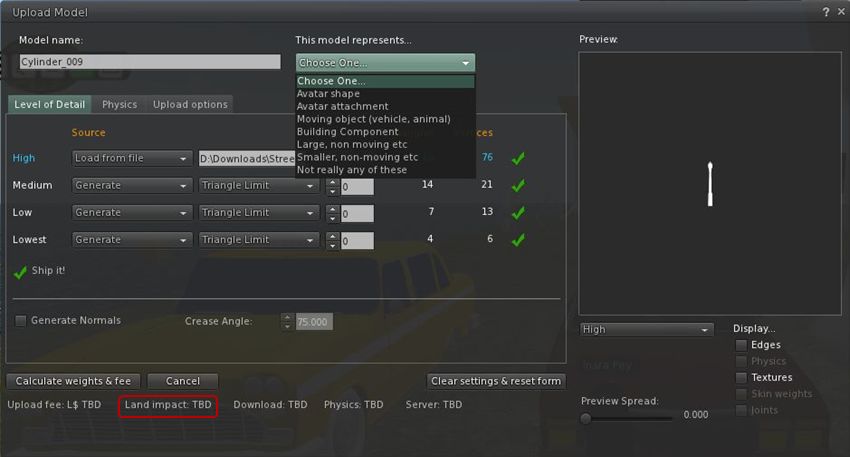
With all the excitement over the new UI reaching the Development Viewer code, it’s been easy to overlook the fact that the last few days saw the latest release of the Viewer, which includes the new mesh uploader floater, and sees prim counts and prim equivalency replaced with Land Capacity and Land Impact.

The new uploader floater provides improved capabilities for adjusting and optimising mesh objects prior to upload.

Mesh uploader floater – note Land Impact towards the bottom

Land Impact is introduced alongside the more familiar upload weights (Download, Physics, Server) in a new blog post from the Lab.

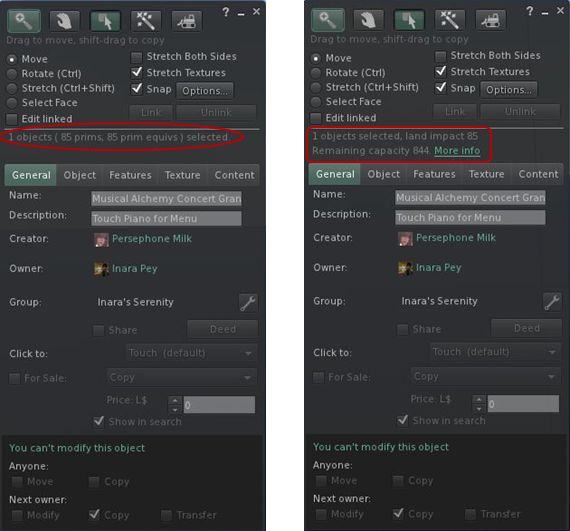
Land Impact itself can be seen in the Build floater, as shown in the image below, which compares how objects are now displayed (right) compared to how we’ve seen them in the past (left).

Land Impact (right) Replacing the Prim and PE values with a single figure

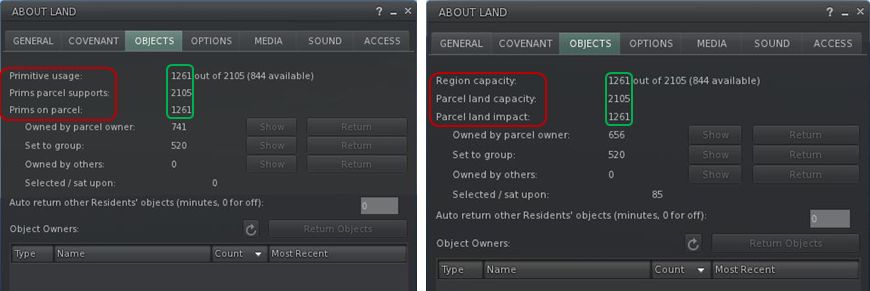
Similarly, the Land Capacity can now be seen under OBJECTS in the About Land floater, with the old (left) and new (right) shown below.

Land Capcity in ABOUT LAND (right) – replacing prim counts (left)

I’ve got a more extensive post on these changes, which includes a look at other options as well. With the changes now firmly in the Viewer release code, expect to start seeing Capacity and Land Impact in the About Land and Build floaters of your preferred V3-based TPV in the very near future.

In the meantime, for those trying out the latest Viewer release, be aware that there are upload issues with it that some people are experiencing, and a JIRA has been opened (SH-2595).

Mesh and the Beta grid

There are now numerous tutorials on creating mesh objects in the likes of Blender for upload to Second Life; however, getting everything just right with mesh objects, their LODs, textures, etc., isn’t easy. The unwary might even end up sending a little too much uploading and adjusting items. To this end, it is best to use the Beta grid (also known as Aditi or the Preview grid) to work on models until you’re satisfied, and then upload them to the Main grid.

As many have never logged into the Beta grid, here’s some simple instructions and pointers.

Note that this article assumes you are certified for mesh uploads on the Beta grid (if you are already certified on the Main grid of uploads, you may still need to re-certify yourself on Aditi (with thanks to Opensource Obscure for the reminder)).

Updating Your Beta Grid Account

If you have not logged-in to the Beta grid in a while, the chances are your account information (including your inventory data) is going to be stale. If you already have items in your inventory you wish to work with, this may be an issue. So the first step may well be to refresh to Beta grid details. This is done quite easily:

  • Change your login password:
    • Go to your Dashboard at http://www.secondlife.com
    • Click on the down arrow button in the ACCOUNT window near the top left of your Dashboard
    • Click on CHANGE PASSWORD
    • Set a new password for yourself and SAVE it – remember this will be immediately applied to all your SL log-ins, including the Viewer
  • Wait 24 hours.
  • Log into the Beta grid.

Logging-in to Aditi, the Beta Grid

If you’ve never logged-on to the Beta grid before, there are some additional steps to complete, depending on whether or not you have the grid selection option displayed on your Viewer’s log-in screen.

Notes

  • Obviously, as we’re talking specifically in relation to mesh, remember to use a Viewer with mesh upload capabilities
  • If you opt to use the official Mesh Development Viewer, you will, by default, be logged into the Beta grid (unless you change the grid selection option).

Displaying the Grid Selection Option

  • Start your Viewer.
  • If the grid selection option is displayed, continue with Logging-in to Aditi, below
  • To display the grid selection option:
    • Display your Viewer’s preferences (Me -> Preferences in the case of Viewer 3 or use CTRL-SHIFT-G)
    • Access the ADVANCED tab
    • Make sure SHOW GRID SELECTION AT LOGIN is checked
    • Click on OK to close the Preferences floater.
Displaying the grid selection option

Logging-in to Aditi

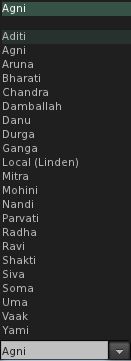
  • With the Viewer log-in window displayed, click on the grid selection arrow to display a list of available grids (see right)
  • Click on ADITI for the Beta grid
  • the log-in splash window will change to display the fact you have selected the Beta grid
  • Log-in using your avatar name and password as you would with the Main grid
  • You should be logged into one of the Beta grid welcome areas
  • Note you will have a L$ account balance, which is not transferrable to the Main grid!

Where to Work

As with the Main grid, the Beta grid is host to a number of sandboxes. Some of these are for general use, some are for very specific purposes; the majority have rules assoicated with them, again as with the Main grid – and you should, as always, familiar yourself with the rules and things like return times in order to avoid upsets.

While mesh is enabled across the Beta grid, there are a number of dedicated mesh sandboxes (SLurl). These tend to have the most recent releases of the server-side code related to mesh, and while they can be crowded at times in turns of the amount of items to be found on them, they tend to present the best place to work.

How Do I Preserve Upload Settings between Grids?

The Viewer should save all settings you use with a model, so when you log-in to the Main grid and select the model for upload, your settings for the model should appear in the upload floater.

What Else?

The following Linden Lab resources may be of additional assistance: