
NASA and its partner, the German Aerospace Centre (DLR) finally have some good news about the Heat Flow and Physical Properties Package, or HP³, carried to Mars by the InSight Lander: they’ve made some progress towards perhaps getting moving again.
As I’ve noted in past Space Sunday articles, the experiment has been a source of consternation for scientists and engineers since InSight arrived on Mars in November 2018. Following the landing, HP³ was one of two experiment packages deployed directly onto the surface of Mars by the lander’s robot arm. One of the key elements of the experiment is the “mole”, a self-propelled device designed to drive its way some 5m into the Martian crust, pulling a tether of sensors behind it to measure the heat coming from the interior of Mars.
After a good start, the probe came to a halt with around 50% of its length embedded in the soil. At first it was thought it had hit solid bedrock preventing further motion; then it was thought that the mole was gaining insufficient traction from the hole walls, on account of the fine grain nature of the material it was trying to move through. That was in February 2019.

Since then, scientists and engineers have been trying to figure out what happened, and how to get the mole moving again – because of the delicate nature of the sensor tether, the HP³ experiment couldn’t simply be picked up and moved to another location and the process started over. instead, various attempts were made to try to giving the mole material so it might gain traction.
Most of these revolved around using the scoop at the end of the lander’s robot arm to part-fill / part compress the hole created by the mole, the theory being that loose regolith would gather around the head of the mole and help it regain the necessary fiction to drive itself forward once more. Initially, some small success was had – until the mole abruptly “bounced” almost completely back out of the hole.
Further attempts were made to compress the ground around the hole, but all forward motion remained stalled, leading scientists to believe the mole had struck a layer of “duricrust” – a hard layer formed as a near the surface of soil as result of an accumulation of soluable materials deposited by mineral-bearing waters that later leech / evaporate away. These layers can vary between just a few millimetres to several metres in thickness, and are particularly common to sedimentary rock, which itself has been shown to be common on Mars.
The rub for the InSight mission is that if it is a layer of duricrust beneath the lander, it is impossible to tell just how thick it might be.

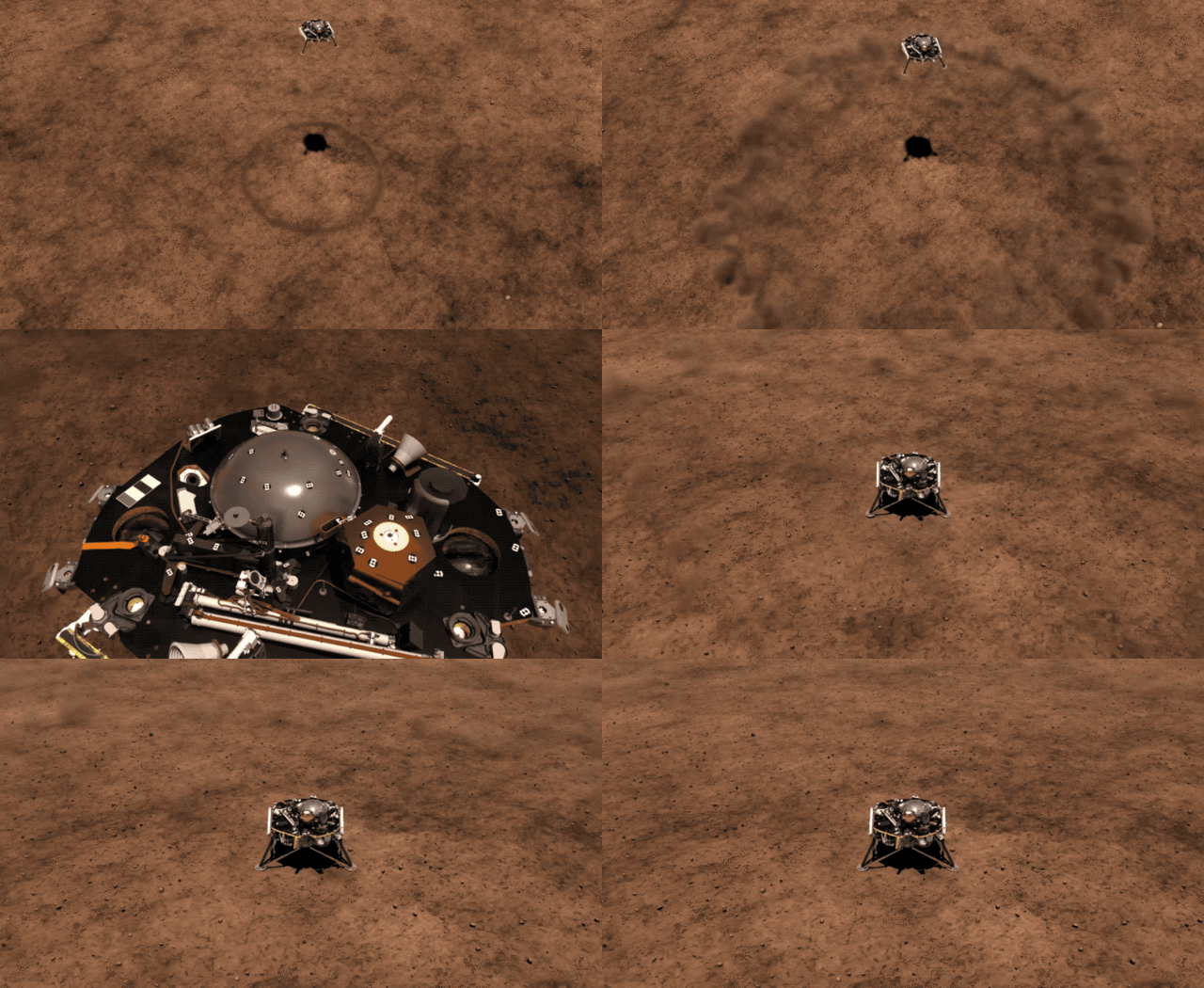
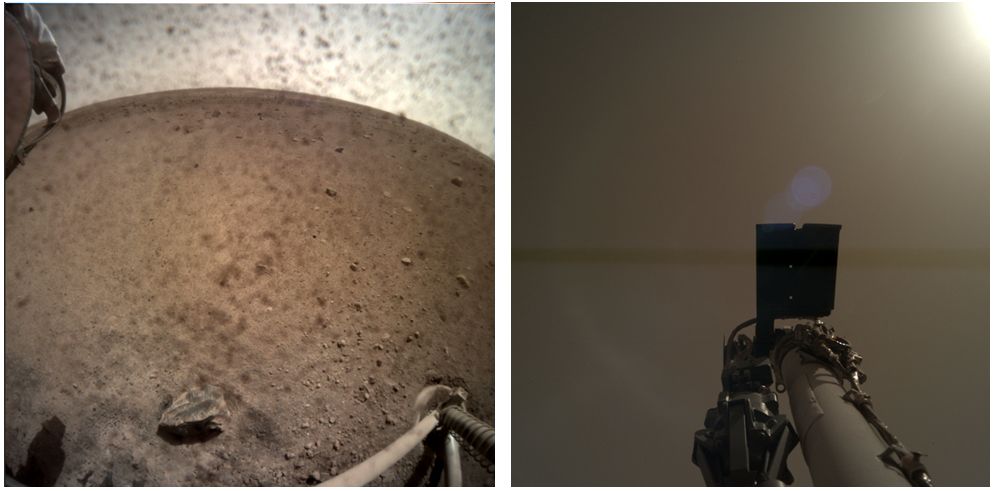
Earlier this year it was decided to use the scoop on the robot arm more directly, positioning it over the exposed end of the mole and applying pressure in the hope it could push the mole gently down into the ground in a series of moves that would allow the mole to get to a point were it could resume driving itself into the ground.
However, this approach has not been not without risk. The end of the mole has a “harness” – a connector for the tether, so the scoop has to be precisely positioned and any sort of pressure applied very gently and carefully to avoid any risk of slippage that might result in damage to the tether and / or harness and render its ability to gather data and information from the probe useless.
However, on June 3rd, NASA announced that a series of gentle pushes had resulted in the mole being completely below the surface, and with no apparent damage to the tether or harness. However, whether or not this means the mole is able to proceed under is own self-proplusion is unclear, as NASA noted in their tweet.
In all, the tip of the mole is now some 3m below the Martian surface. That’s deep enough for it to start registering heat flow, but to be effective, the mole still needs to drive itself down the full 5 metres. It is only at this depth that the mole and sensors can correctly start to measure the sub-surface geothermal gradient, and thermal conductivity, the two pieces of information required by scientists to obtain the heat flow from deeper in the planet. By studying the thermal processes in the interior of the planet, scientists can learn a lot about the history of Mars, and how it formed. They may also gain insights into how other rocky bodies formed.
Attempts have yet to be made to see if the mole can move under its own spring-driven propulsion, but for now NASA and DLR are rightly treating the current status of the probe as a victory. The tether harness at the end of the mole is undamaged, so if the mole can resume progress under its own power, there’s not reason why it shouldn’t start recording information.
Continue reading “Space Sunday: moving a mole and Planet Nine”





 Inara Pey: Living in a Modemworld