Getting RADical about REMs while Odyssey flips

The recent focus on the NASA / JPL Mars Science Laboratory mission has been on Curiosity’s soil sampling activities in the region of Gale Crater scientists have called “Rocknest”.  However, this is not all that the rover has been up to. Through the sample gathering operations, two other instruments have been hard at work, measuring and monitoring the environmental conditions around the rover. These are the The Radiation Assessment Detector (RAD) and the Rover Environmental Monitoring Systems (REMS) – each of which has been working away day and night since Curiosity first arrived on Mars.

RAD is particularly focused on the amount of radiation, both from the sun (solar radiation) and in the form of cosmic rays, reaching the surface of Mars. While Mars has an atmosphere, it is extremely thin and tenuous in comparison to that of Earth – at ground level it is about as dense as Earth’s atmosphere at an altitude of several miles. The Martian atmosphere is primarily carbon dioxide and it does not have any ozone layer. This, coupled with the lack of a strong magnetic field means that the surface of Mars is subjected to far higher levels of both solar and cosmic radiation than are experienced on Earth.

However, even though the atmosphere around Mars is tenuous, it is still enough to have an effect on incoming radiation, and RAD is designed to measure the levels of radiation common to the surface of Mars and, working with REMS, help give further insight into the processes which go into altering that radiation as it passes through the atmosphere. Both of these studies will in turn help scientists understand the impact incoming radiation is having on the local environment and increase out understanding of surface conditions on Mars in preparation for human missions there in the future.
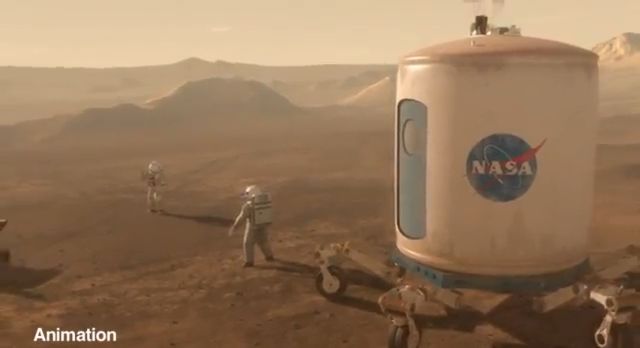
Curiosity: increasing our understanding of the Martian surface environment for future human missions

REMS is the rover’s meteorological station, comprising instruments mounted both on the body of the rover and on the forward mast. It is responsible for monitoring wind, pressure, humidity and temperature, and is being used to establish a track record of atmospheric conditions and changes experienced by Curiosity. Despite the wind measurement instrument on the rover’s mast being damaged during the landing phase of the mission – mostly likely due to a stone being thrown up by the Descent Stage engines and striking the instrument – REMS has been returning huge amounts of data about the Martian atmosphere, helping scientists develop a clearer understanding of the complex mechanics at work in the Martian atmosphere.

As mentioned about, the Martian atmosphere is largely carbon dioxide and very tenuous. Both of these points factor into large seasonal variances in the Martian atmosphere. Due to the tenuous nature of the atmosphere, temperatures are extremely low. During the colder winter months, these low temperatures cause a significant amount of the atmosphere to “freeze out” into the polar ice caps (most notably the southern polar cap, which is predominantly carbon dioxide ice).  In the southern hemisphere, the warmer temperatures, while still low by Earth terms, are enough for much of this carbon dioxide to sublimate into the atmosphere with the result that season changes can cause the Martian atmosphere to shrink / grow by some 30% through the course of a year.

These thermal processes also operate on a day/night cycle, and also affect the radiation signature being recorded by Curiosity’s RAD instrument. Essentially, what is happening is this: during daylight hours, the atmosphere heats up rapidly and expands, causing the atmosphere to “bulge out”. Convection currents cause the atmosphere to flow outwards from this bulge to equalise the pressure either side of it. This leaves the atmosphere below the bulge at a lower pressure than the air on the night side of the planet. As the day passes and the sun sets, the atmosphere cools and the bulge contracts increasing the surface air pressure beneath it.

The daily thermal cycle on Mars: by day, as the planet rotates, the atmosphere warms and expands. Air flows out from the heated “bulge” in order to equalise the pressure with the atmosphere around it, with the result that while the bulge causes a “thicker” atmosphere, it is one that is less dense and at a lower pressure than the air on the “night side” of the planet

Overall, this daily fluctuation can amount to a 10% variation in air pressure over the day / night cycle as measured by REMS. Taken alongside the RAD measurements, this has revealed an interesting correlation with the amount of radiation being measured around the rover. As the air temperature increases through the day and the atmosphere expands to lower the local air pressure, so to does the amount of radiation being measured by RAD increase. Then, as the temperature drops during the evening into night, so to does the atmospheric density and pressure increase – and surface level radiation doses fall, with between a 3% and 5% variation in radiation levels being recorded by REMS during a single day / night period.

A 5-Sol chart showing the relationship between radiation and air pressure during the day / night cycle. As the air is warmed during each day, so the air pressure drops (blue) and the amount of radiation being recorded (red) increases. As night draws is, so the blue line increases, indicating an increase in atmospheric pressure – and radiation levels drop

Please use the page numbers below to continue reading this article

Self portraits and when losing 40 minutes a day can mean the world

Curiosity is coming to the end of its time at Rocknest, the sandy area in Gale Crater where it has been sifting and examining soil samples and carrying out other experiments over the course of the last few weeks. Glenelg still remains the intended target for the rover, prior to it starting an exploration to the near-central mound in the crater NASA refer to as “Mount Sharp”.

Since my last update on 31st October, Curiosity has been using the Sample Analysis at Mars (SAM) instrument suite to examine the atmosphere in Gale Crate in greater detail. SAM is a remarkably flexible and complex set of instruments, able to analyse air and soil samples a number of ways.

Earlier in the mission, SAM was used to obtain an initial sampling of Martian air “inhaled” at Bradbury Landing. This was subjected to initial analysis by the instrument’s mass spectrometer. Over the last few days, Curiosity has used SAM to further sample the Martian Air, subjecting it to more detailed analysis using a Turnable Laser Spectrometer (TLS).

The TLS shoots laser beams into a measurement chamber which can be filled with Mars air. By measuring the absorption of light at specific wavelengths, the tool can measure concentrations of methane, carbon dioxide and water vapor in the Martian atmosphere and different isotopes of those gases.

This picture shows a lab demonstration of the measurement chamber inside the Tunable Laser Spectrometer, an instrument that is part of the Sample Analysis at Mars investigation on NASA’s Curiosity rover. This demonstration uses visible lasers – rather than the infrared ones on the actual spectrometer – to show how the lasers bounce between the mirrors in the measurement chamber. (Click to enlarge)

Methane is of particular interest to scientists as, while it can be produced by either biological or non-biological processes, it is regarded as a simple precursor chemical for life. SAM represents the most sensitive tool yet deployed on or around Mars which might be capable of detecting methane in the atmosphere. However, the task isn’t easy, as it is probable that if the gas does exist at all within the Martian air, it is liable to do so only in very light traces. Certainly, none wer found in the initial sample analysed by Curiosity’s TLS, as SAM TLS lead Chris Webster of NASA’s Jet Propulsion Laboratory (JPL) confirmed in a press conference I dialled-in to last week.

“Methane is clearly not an abundant gas at the Gale Crater site, if it is there at all. At this point in the mission we’re just excited to be searching for it,” he said. “While we determine upper limits on low values, atmospheric variability in the Martian atmosphere could yet hold surprises for us.”

Please use the page numbers below to continue reading this article

Aloha Rocknest!

The initial results from Curiosity’s first examination of soil samples (or more correctly, regolith samples), analysed by the Chemistry and Minerology instrument (CheMin) have been returned to Earth for evaluation.

CheMin took samples of the surface material gathered by the rover’s scoop and pre-processed (filtered for compositional size) using CHIMRA, which forms a part of the turret-mounted suite of instruments and systems on the rover’s robot arm, and subjected them to X-ray diffraction, which is regarded as the “gold standard” for understanding the mineral composition of soil and rock samples on Earth. CheMin marks the very first time such an analytical capability has been possible on the surface of another planet in the solar system.

The identification of minerals in rocks and soil is crucial for the mission’s goal to assess past environmental conditions. Each mineral records the conditions under which it formed. The chemical composition of a rock provides only ambiguous mineralogical information, as in the textbook example of the minerals diamond and graphite, which have the same chemical composition, but strikingly different structures and properties.

A graphic showing the first analysis of a Martian soil sample by Curiosity’s CheMin instrument. The sample was scooped on Sol 69 (October 15th 2012) and delivered to CheMin on Sol 71. By directing an X-ray beam at a sample and recording how X-rays are scattered by the sample at an atomic level, CheMin can definitively identify and quantify minerals on Mars for the first time. Each mineral has a unique pattern of rings, or “fingerprint,” revealing its presence. The colours in the graphic represent the intensity of the X-rays, with red being the most intense

Because of the ambiguity in chemical analysis, which has to date revealed remarkably uniform results from regions which are geographically very diverse over the surface of the planet, understanding the actual minerology of Martian soil has always been a mixture of scientific study laced with educated inferences, so CheMin is a major game-changer.

“We had many previous inferences and discussions about the mineralogy of Martian soil,” said David Blake of NASA Ames Research Center in Moffett Field, California, the Principal Investigator (PI) for CheMin. “Our quantitative results provide refined, and in some cases, new identifications of the minerals in this first X-ray diffraction analysis on Mars.”

Prior to MSL’s arrival on Mars, it had been long theorised that much of the surface material may well be of volcanic origin, particularly given the ample evidence of the planet having had an extremely active volcanic past.

Continue reading “Aloha Rocknest!”

Zapping, scrubbing, eyeing and digesting

Curiosity remains at Rocknest, carrying out further soil sampling operations.

With a sample delivered to the observation tray and then to CheMin on Sol 71, sample gathering resumed on Sol 74 (October 24th) with a fourth scoop of the sand-like material being gathered and examined via camera in preparation for it being delivered into the CHIMRA processing system for further cleaning operations.

The sample was transferred into CHIMRA, which is mounted on the robot arm of the rover (the sample scoop itself forming a part of the overall CHIMRA mechanism) on Sol 75 (October 21st). Further cleaning of the CHIMRA sieves and filters is required to ready them for the delivery of samples to the highly sensitive SAM (Sample Analysis at Mars) system aboard the rover itself. Because SAM is so very sensitive, it was determined to go ahead with further planned cleaning cycles despite visual examination of the scoop and the visible part of the CHIMRA inlet revealing them to be well coated in Martian material.

At the same time as sample gathering was underway, Curiosity continued to monitor its environment with the Radiation Assessment Detector (RAD), Rover Environmental Monitoring Station (REMS – the rover’s weather station) and Dynamic Albedo of Neutrons (DAN) instruments of its science payload.

The laser system on ChemCam was also used to zap the soil around the rover for analysis by ChemCam’s own spectrometer. One target in particular, dubbed “Crestaurum”, was struck 30 times by the laser on Sol 74, resulting in a dark pit some 3 mm (roughly an eighth of an inch) across being created in the target location, 2.7 metres (8 feet) away from the laser at the top of the rover’s mast. The shots themselves brought the total number of laser firings in the mission so far to a staggering 10,000.

Zapping the surface in this way vaporizes the material hit by the laser, allowing the ChemCam telescope system to images of the resultant plasma which can be fed via fibre-optics to ChemCam’s own spectrometer. Working in tandem with both the Chemistry and Minerology (CheMin) and SAM systems, which analyse surface samples directly, ChemCam provides a far broader range of data on soil composition, etc., for return to Earth than has previously been possible with rover missions.

Pew! Pew! Pew! ChemCam zaps the Martian sand at Rocknest. Before and after images capture by ChemCam’s Remote imager, showing the target area prior to being hit 30 times by the ChemCam laser, and the cratered result

Rather than discarding the fourth scoop sample following cleaning operations within CHIMRA, the sample was used for two further activities.

In the first, on Sol 77, around 20 grams of the material was delivered to CheMin for analysis, making it the second sample of surface material delivered to that system.

In the second, on Sol 78 and after CheMin had completed initial analysis of its new sample, a further measure of the material was delivered to Curiosity’s on-board observation tray for visual analysis.

Please use the page numbers below, to continue reading this article

When small and bright can get you discarded

Curiosity remains at Rocknest, its resting place for around the last couple of weeks, continuing with the scooping / CHIMRA / sample operations. When we last left the MSL rover at the end of my last round-up of news, command has been sent to Curiosity to prepare the way for a second sample scoop operation (Sol 65, October 11th).

Originally, the material from this scoop was earmarked for use in further CHIMRA cleaning exercises, designed to “scrub” the insides of the sample processing system clean of any remaining Earth-based contaminants, prior to samples being filtered through it ready for delivery to Curiosity’s on-board analysis systems.

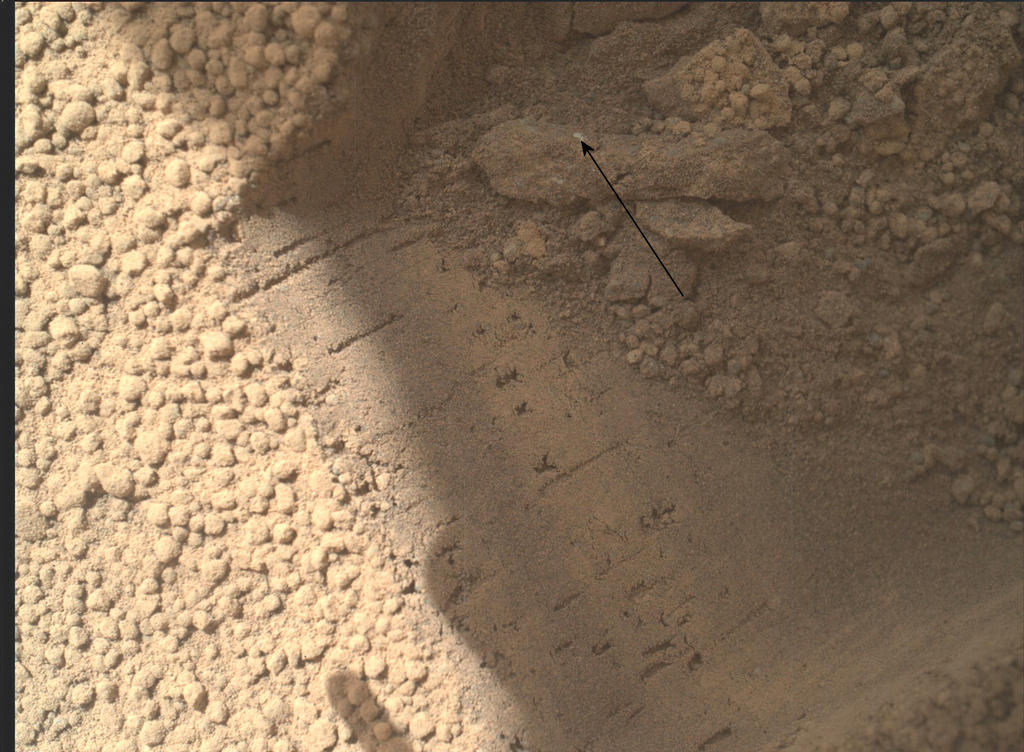
While a sample scoop of material was collected on Sol 66 (October 12th), operations were brought to a halt when images returned by the rover revealed a bright object – another possible FOD (Foreign Object Debris) within the hole created by the scoop when gathering the sample.

The potential FOD, imaged by the Mars Hand Lens Imager (MAHLI) within the scoop-hole from the second sample collection operation. This image shows an area some 5 centimetres (2 inches) across

As reported in my last update, a small, bright FOD was imaged close to the area of the first sample scoop, and after examination using MAHLI, the mission team determined it was most likely debris which had fallen from the rover itself – possibly a tiny fragment of wiring insulation which had originally fallen from the Descent Stage and lodged on the rover. Because of this, mission scientists were concerned that the object seen in the sample hole might be further debris from the rover itself and that some might have been collected by the scoop. It was therefore decided to abandon the sample on Sol 67, rather than risk having contaminants enter CHIMRA.

However, subsequent additional analysis of the object seen in the scoop hole showed that it was in fact embedded in the Martian soil, and therefore unlikely to have fallen from the rover. Closer examination of the ground immediately around the sample spots recorded more, and similar, bright objects, further pointing to the matter in the scope hole being of Martian origin.

These bright objects, possibly result of small pieces of material shearing apart to reveal their unweathered interior faces, will likely be the subject of further study, together with the original FOD seen on Sol 61. “We plan to learn more both about the spacecraft material and about the smaller, bright particles,” said Curiosity Project Manager Richard Cook of NASA’s Jet Propulsion Laboratory, Pasadena. “We will finish determining whether the spacecraft material warrants concern during future operations. The native Mars particles become fodder for the mission’s scientific studies.”

please use the page numbers, below left to continue reading this article

A spoonful of sand, a question over plastic and an unexpected finding

Not long after I Pressed my last MSL update, Curiosity went ahead and collected its first scoop of Martian sand.

The operation took place over the course of several hours on October 7th (Sol 61), gathered a scoopful of sand and powdery material from the sand ridge the rover had been examining at a location mission managers have dubbed “Rocknest”.

The operation was the first phase in a process which is designed to “clean” the Collection and Handling for In-Situ Martian Rock Analysis (CHIMRA) device mounted on the turret at the end of Curiosity’s robot arm (and which includes the scoop itself). The cleaning process is required to ensure that no contaminants from Earth remain in CHIMRA’s chambers so they do not adversely affect analysis when samples eventually reach the on-board SAM and CheMin instruments.

A Hazcam’s view: Curiosity scoops its first load of Martian surface material

The entire process was carefully monitored using several of Curiosity’s camera systems in order to confirm progress and to make sure everything was operating as expected. This made the gathering of the first scoop of material a protracted affair, with the Hazcams at the front of the rover being used to monitor progress from a low angle and both the Navcam and Mastcam systems imaging progress and results. Once the sample has been gathered, the turret was vibrated gently to level the material in the scoop and shake-off any excess.

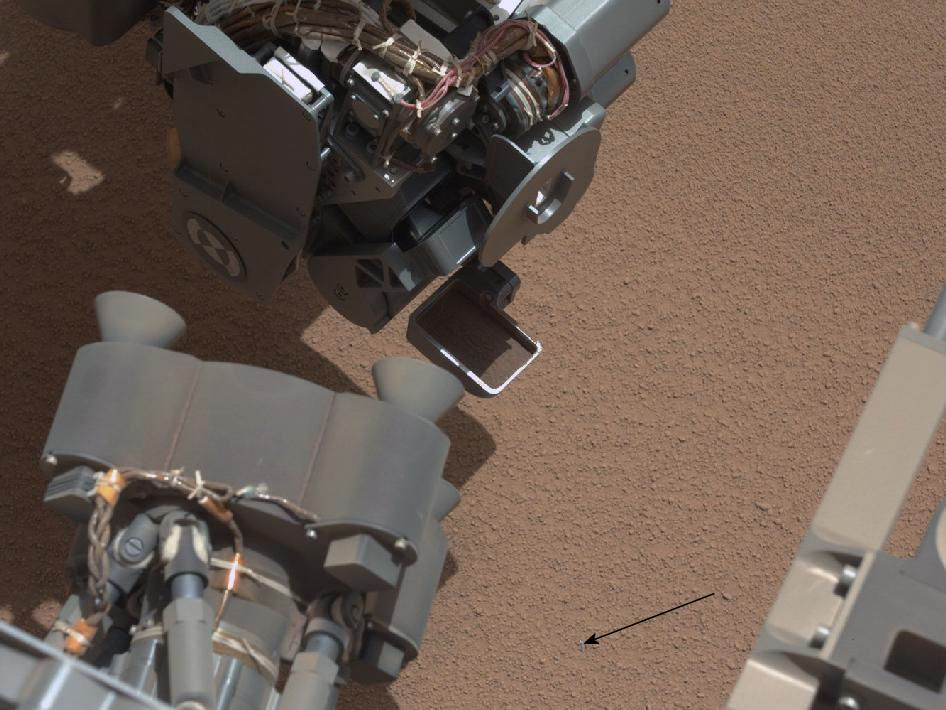
A Mastcam image of the scoop filled with material and (arrowed) the FOD – Foreign Object Debris – which halted scoop operations. For scale purposes, the scoop is 7 cm (2.8 inches) long, and 4.5 cm (1.8 inches) wide

It was an image from the Mastcam which brought a halt to operations, when a small, bright object was spotted. Believing the object might be something from the rover, mission managers decided to suspend the scoop operations and use the Remote Micro-Imager of the Chemistry and Camera (ChemCam) instrument to study the object in an attempt to ascertain what it might be.

Continue reading “A spoonful of sand, a question over plastic and an unexpected finding”