After extending the application period deadline from midnight SLT on the 19th February, the deadline has been moved to midnight on Sunday February 24th, the Linden Endowment For the Arts council has announced the successful applicants for the next round of the LEA’s Artist-in-Residence programme.
They are: Solkide Auer, Ambi bimbogami, Vaneeesa Blaylock, Marx Catteneo/Krakassus Jigsaw, uan ceriaptrix, Ole Etzel, Cica Ghost, Mac Kanashimi, Seraph Kegel, Ginger Lorakeet, Sowa Mai, Yooma Mayo, Johnas Merlin, Jack Mondegreen, Mantis Oh, Morlita Quan and Noke Yuitza, Sniper Siemens, thingiwishihadsaid, Betty Turead, and Newbab Zsigmond.
Standing on a part of AIR Round Three winner Chic Aeon’s excellent Machinima Open Studio Project – read my review here
Commenting on the applications for this fourth round in the AIRS programme, the LEA announcement reads in part:
The LEA received nearly 50 high-quality applications, and it was a difficult decision, but those selected submitted truly outstanding proposals that represent a diverse range of virtual art. While a handful are artists returning for a second round, the majority will be exhibiting at the LEA for the first time. Projects range from full-sim immersions, to innovative builds geared specifically for multimedia works such as sound and machinima projects.
The successful applicants now have up to four months in which to establish their installation, which must be open to the public for a minimum of two months during the six month run of the region allocation. It is anticipated that many of the works will open in advance of the four-month build deadline. All openings will, as usual, be announced in the LEA blog.
The Linden Endowment for the Arts has announced their choices for the 2013 Full Sim Art series, which will now run through until the end of April 2014.
The Full Sim Art series offers artists across the grid a full month’s access to an LEA region in which they can host a show of their choosing. As such, applicants receive:
A full, 15,000-prim region (inclusive of the media) – not all the prims have to be used!
The freedom to choose when to open the show to the public
Coverage within the LEA and UWA blog & potentially in any other blogs confirming their continuing support of the series
Access to regions will be granted to successful applicants on the first day of each month, and must end and be cleared from the region on the last day of the month.
The 2013-14 line-up, as announced by the LEA on Wednesday 27th February, comprises:
2013
March: Fuschia Nightfire, Fuschia’s Fantasy Fairyland
April: Krystali Rabeni,Virtually Real
May: paleillusion,Frozen in Time
June: Kalanglarik Tomorrow
July: Nino Vichan,Musical Tonalities & Colour
August: SerenVide, Hope Springs
September: Secret Rage,Connected by Commonalities
October: Rebeca Bashly,Key
November: Lilia Artis & Moeuhane SandalwoodThe Machine
December: Giovanna CeriseFisicofollia
2014
January: Gem PriezFractal Cathedral
February: Sea Mizin California Giant Redwood Forest
Originally schedule to close at Midnight SLT on the 19th February, the deadline has been moved to midnight on Sunday February 24th. The announcement of the extension reads in part:
While many well-known virtual artists have received grants, the LEA has also had the pleasure of hosting ‘younger’ AIRs and hopes to continue in that tradition. You need not have a great deal of experience, just some good ideas. The application is a bit more detailed to help guide you in thinking through your project, which we do expect at this point to be an idea in progress and not necessarily a portrait of the final result – more like a loose sketch! We also welcome applications from across the spectrum of the arts, for example performance groups that might want to embark on a bigger/longer term project than we can support at our performing arts space!
The LEA AIR programme seeks to promote and nurture the arts in Second Life, through providing limited term full-sim land grants to be used for creative projects and art installations over the course of a few months. Recipients can be individuals or groups interested in creating or curating art, or proposing cultural projects which would require/utilise a full-sim build and can be completed within the allotted time frame (5 months). The LEA is able to offer land grants through the generosity of Linden Lab.
Up to twenty regions, donated by Linden Lab and managed by the LEA, are generally offered under the land grant programme, and successful applicants will be granted the use of one full region for a period of six months. The region may then be used on an individual or group basis for such diverse activities as:
Full sim exhibitions and / or immersive installations
Curated projects, especially those which have a connection to physical exhibitions and events (augmented reality)
Applications are not limited to visual art but are welcomed from all areas of artistic expression, including performance, music, and film.
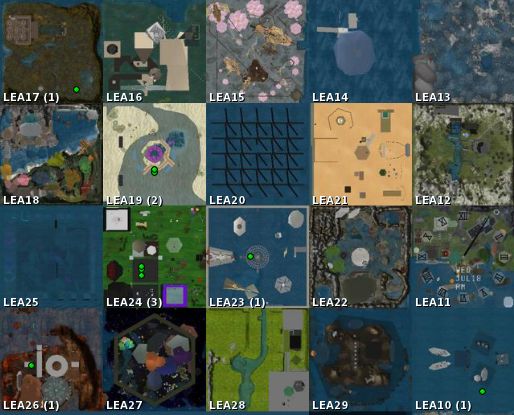
Land grant regions: LEA10 through LEA29
Preference is for submitted works to be original in nature, although curated projects may present extant works. Successful applicants will have up to four months in which to execute their build, and must have it open for public viewing for at least the last two months of the grant period. Artists may alternatively use the land for multiple exhibits, but it is imperative that projects will be ready within four months from acceptance, and this time-frame should be considered (and reflected) in applications.
So if you have not yet applied for the programme, there is still time to do so!
Key Dates
Applications open: February 5, 2013
Application deadline: February 24, 2013
Sim handover and public announcement: March 8, 2013
End of round: July 31, 2013
Applications forms can be found at the end of the LEA website announcement for Round 4, together with all other necessary information.
Teleports to the exhibits by the current Artists in Residence, which will be open until the end of the month, can be found at LEA 3.
In June 2012, I reviewed MetaHarpers’ The Inspiring Orientation, an installation intended to be part gallery, part orientation course, with various interactive elements intended to teach new users the basics of getting around in Second Life – walking, flying, chatting, using the camera, sitting, etc.
The original Inspiring Orientation – from the outside
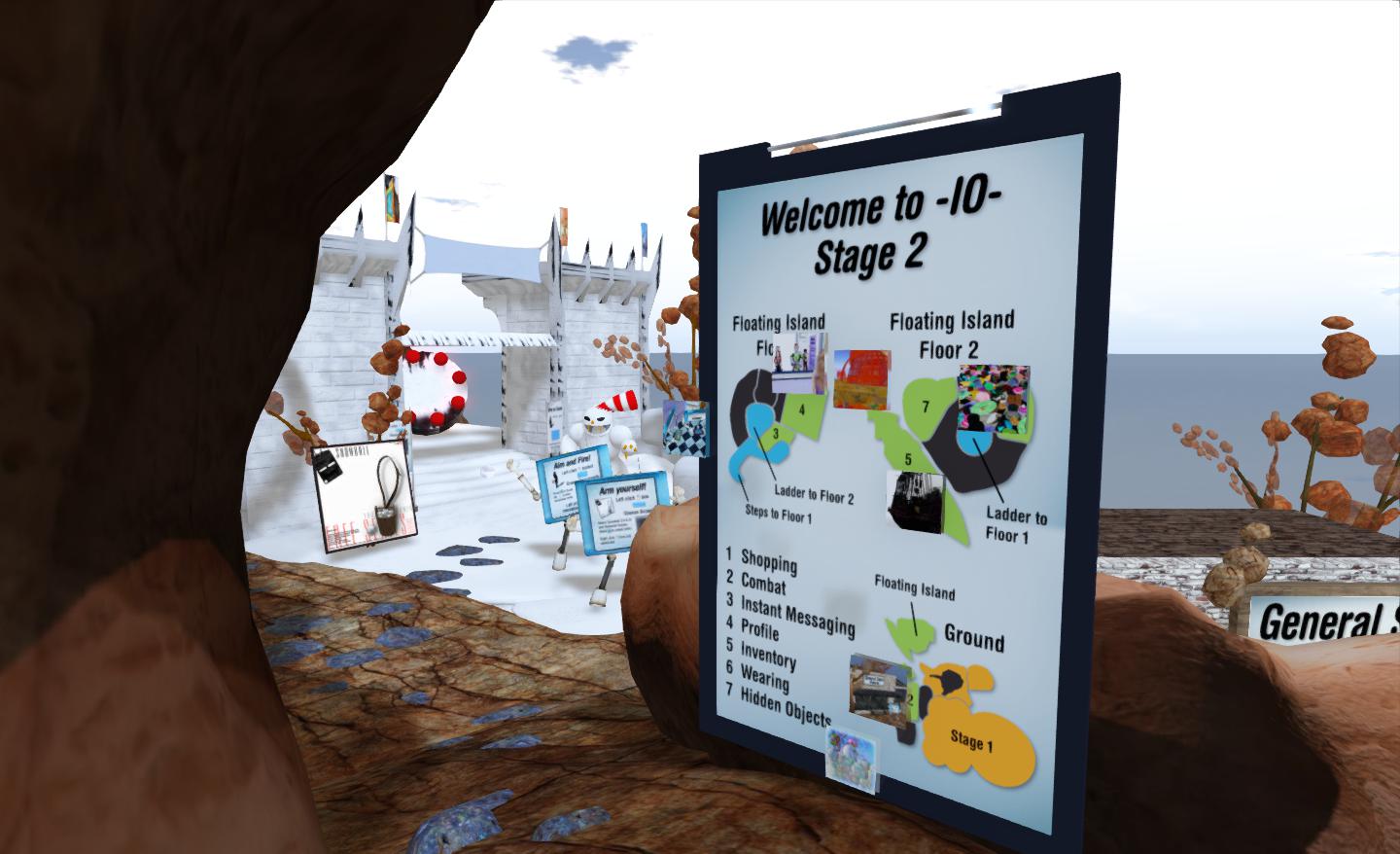
Opened to the public on February 5th, The Inspiring Orientation, Stage 2 now takes the concept a step further by providing additional interactive lessons covering such diverse subjects as in-world shopping, instant messaging, inventory management, profile creation, in-world combat and games, and exploration. At the same time, it revamps the original installation, and incorporates features such as media-on-a-prim. So what is it like?
On arrival, the installation appears familiar – the welcome area is the same as its first iteration, and the familiar tablet-like guides are still there. However, on stepping inside, it is clear things have been changed. Basic movement – walking and jumping – is quickly dealt with before moving onto the basics of camera control, which used to come somewhat later in the piece, and which is dealt with in a more compact manner. The rest of the initial elements of the piece remain largely unchanged until one arrives at the teleport portals, which in the original more-or-less marked the end of the process. While people can still teleport away at this point, a sign points the way to the new additions waiting to be explored.
Here people can learn about shopping, instant messaging, profiles, inventory (including attachments, clothing layers, etc), dealing with “hidden objects” and combat, all in discrete units linked by footpaths, chair lifts and ladders.
There are several routes around this part of the installation, which can lead to a degree of repetition in instructions (accessing inventory, for example). However, this is no bad thing in that it allows for easy re-caps on lessons and pointers.
The inclusion of combat options might at first glance seem a little odd, but it actually does make sense given that, while “Second Life is not a game”, many people actually do join SL in anticipation of engaging in roleplay (which can include combat elements) and engaging in combat-related activities (the dreaded zombie hunting beloved of the official SL promo videos, etc). Ergo, getting people started on how weapons, HUDs, mouselook, etc., all work within the realms of combat isn’t necessarily a bad thing.
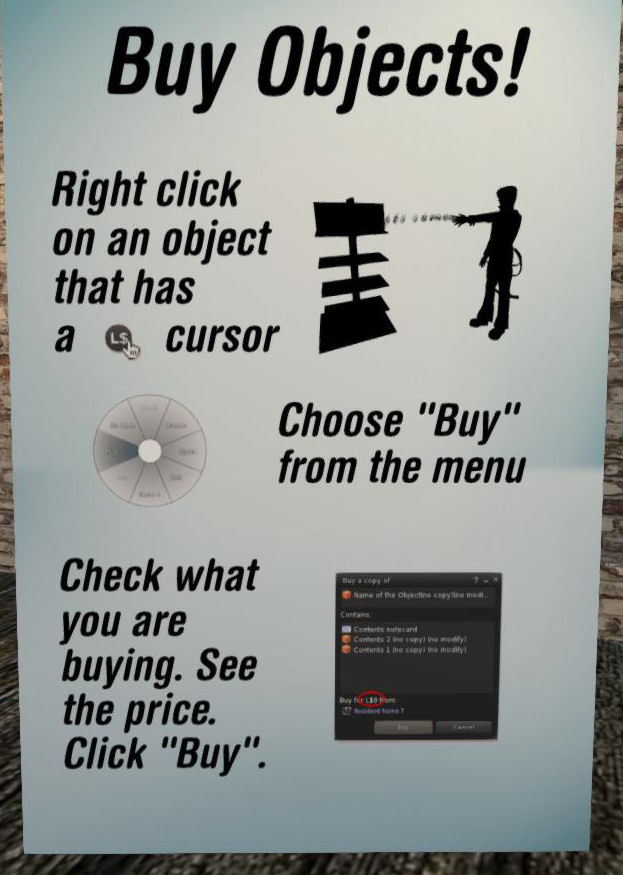
Whither the context menu?
The use of media-on-a-prim in the portal area, is both new and subtle. Drawing on the Destination Guide to provide a click-through list of destinations and descriptions related to the selected portal, it does much to present users with far more choice on where they go next, and on seeing where they are likely to meet other users.
That said, there are a few niggles with the update. Given this is an exhibition intended to demonstrate a new user orientation, the almost exclusive use of screen shots of a popular TPV is surprising. Yes, it may weel be the most popular viewer in use in SL, but given this is a new user experience, and presumably something the creators would hope users would encounter early-on in their explorations of Second Life, I can’t help but feel that there should perhaps be more emphasis on the official viewer – particularly as this is the viewer the majority of new users will initially be using when they log-into SL.
It could also be argued that other essentials are missed or given scant explanation as well – such as the Marketplace, the use of the world map, search and the concept of teleports (although teleports is touched upon throughout the exhibit, if not fully explained). However, the piece is a work-in-progress (the team behind it plan to move it to a location of its own at the conclusion of its time at the LEA), so these are matters which may still be addressed.
One thing that does still disappoint me with the update, though, is that it still fails to reference the viewer’s own means of providing help to users. The How To guide still goes unmentioned, as does the Help options in the menu. The How To guide is certainly worth a reference, given it forms an easy aide-mémoire to some of the lessons given during the orientation tour.
Some might argue that The Inspiring Orientation fails to offer any significant advantages over a more straightforward approach to user orientation such as that provided by the Phoenix Firestorm Support Region. In some respects, I’m inclined to agree; the latter has the beauty of keeping to a KISS approach which make progress perhaps seemingly less time-intensive. However, The Inspiring Orientation perhaps offers greater visual and aural stimulation, and thus may better hold a new user’s attention than a more traditional “walk-and-read” approach.
Whether it is viewed as a prototype / alternative approach to engaging new users and unlocking some of the mysteries of the viewer or whether it is seen purely in terms of an art installation which encompasses learning experiences, The Inspiring Orientation remains an interesting insight into how an engaging and interactive user experience might be built. As such, it has always made for an interesting visit, and the Stage 2 updates provide plenty of additional food for thought, particularly for those interested in the new user experience ethos.
This month sees the third round of the Linden Endowment for the Arts Artist-in-Residence programme drawing to a close. With applications for round 4 now open, I thought it time I caught-up on some LEA-related posts on various exhibits which have been in draft form over the past for weeks and got them blogged.
Given that science forms the basis for a large part of my non-SL posts here, I thought I’d begin with Kicca Igaly and Nessuno Myoo’s Danger in Evolution, currently on display at LEA27.
The artists describe the work, which comprises two separate but interlinked installations by each of them respectively, as:
The contradiction that is at the heart of any technological and scientific evolution when there is not growth, maturity and an awareness of value potential risks that this implies evolution in the life of everyone. Especially when interests of prevarication or economic, social, religious interests come into play.
It’s a dark piece – literally, given the recommended windlight settings and overall hue and tone of the builds themselves – which is both provocative and rich in imagery, challenging us to consider the ethical, moral and religious challenges, both positive and negative, inherent both in the pursuit of science and technological development.
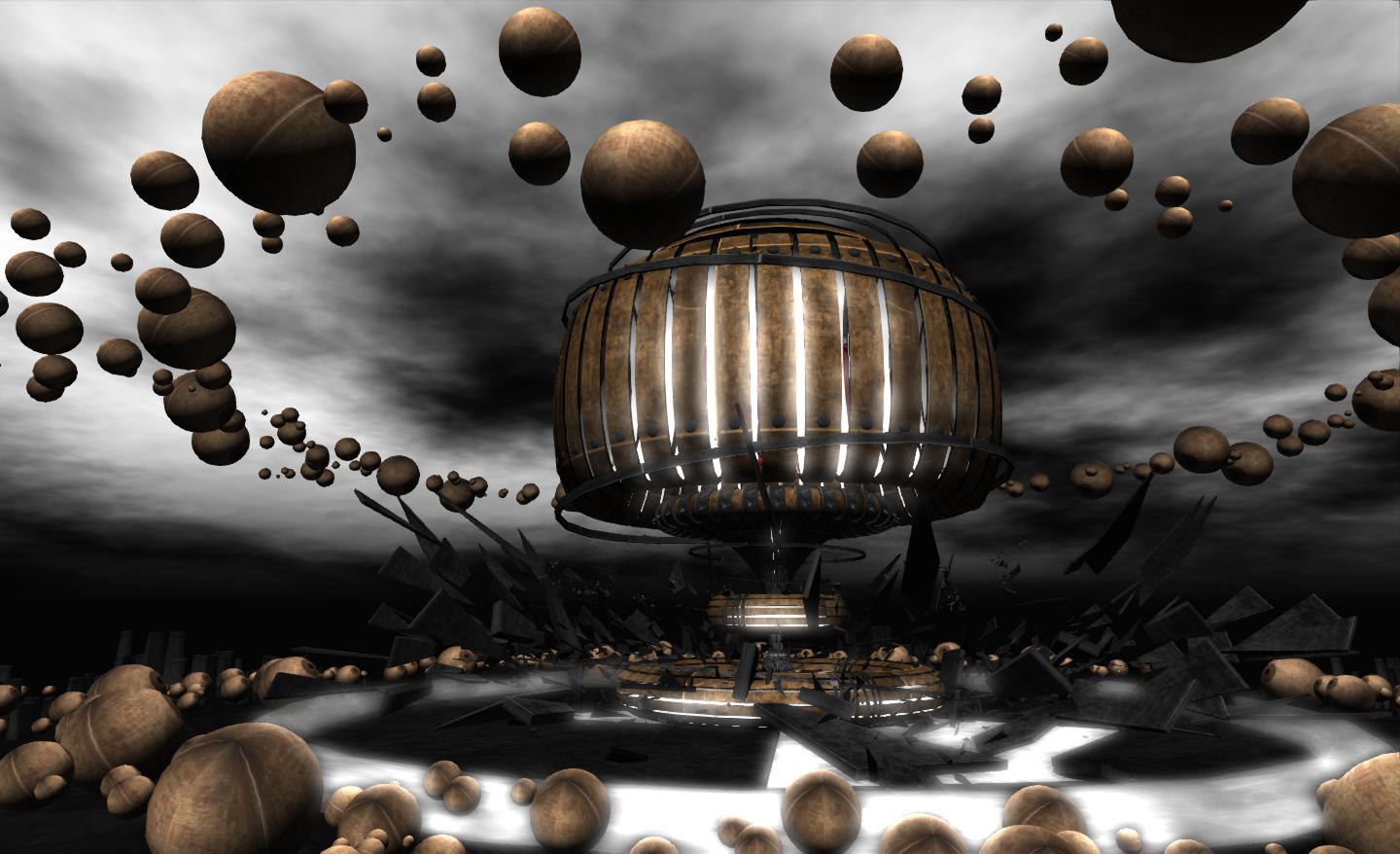
Nessuno Myoo presents us with a scene which is both chaotic and yet potentially joyful – a huge carousel-like ball on which people ride. From a distance all seems to be fun and laughter – but as one draws closer, it is apparent that this is not the case. Those riding the carousel are perhaps not really in control, but are perhaps trapped by the very thing they sought to create.
Closer examination still reveals that the carousel is far from innocent; at its heart lay a representation of of the atomic structure of uranium 235, of which the nucleus is that of “Little Boy”, the first atomic weapon ever used in anger, which exploded over the city of Hiroshima on August 6th, 1945. This brings the carousel’s design into sharp relief – it is in fact the mushroom cloud of a nuclear explosion, and thus the surrounding chaos can be understood, as can the myriad of eyes witnessing the scene.
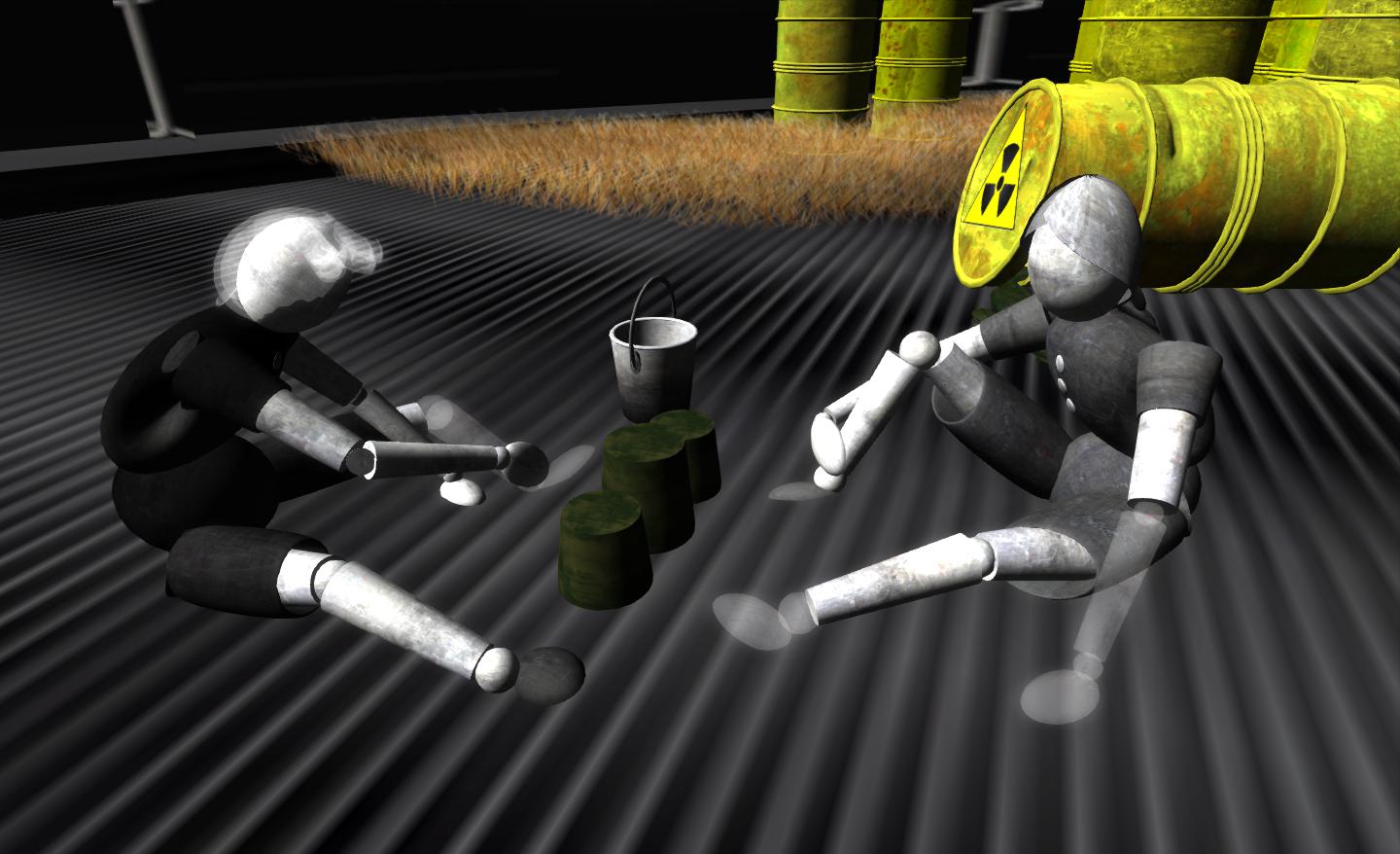
In her piece, Kicca Igaly continues the nuclear theme central to Nessuno’s work, as she presents a piece depicting nuclear research, wherein those performing the work are seemingly oblivious to the fact that while they have the benefit of every protection which can be afforded them in their work, the real nightmare is already out in the world in the form of nuclear waste which is poisoning the world, and ruining lives, as shown by the two children who innocently play with toxic waste, themselves seemingly oblivious of their own missing parts…
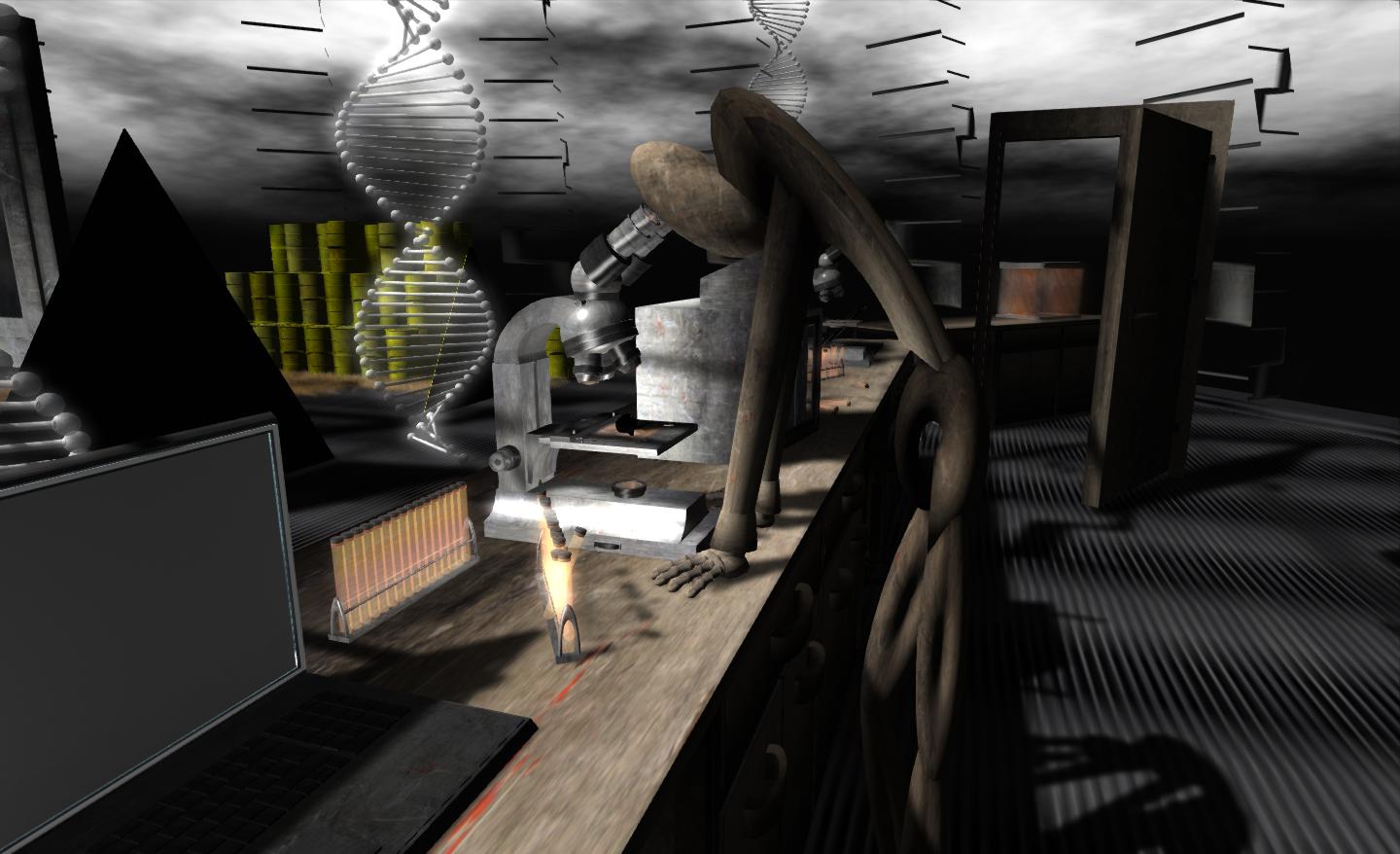
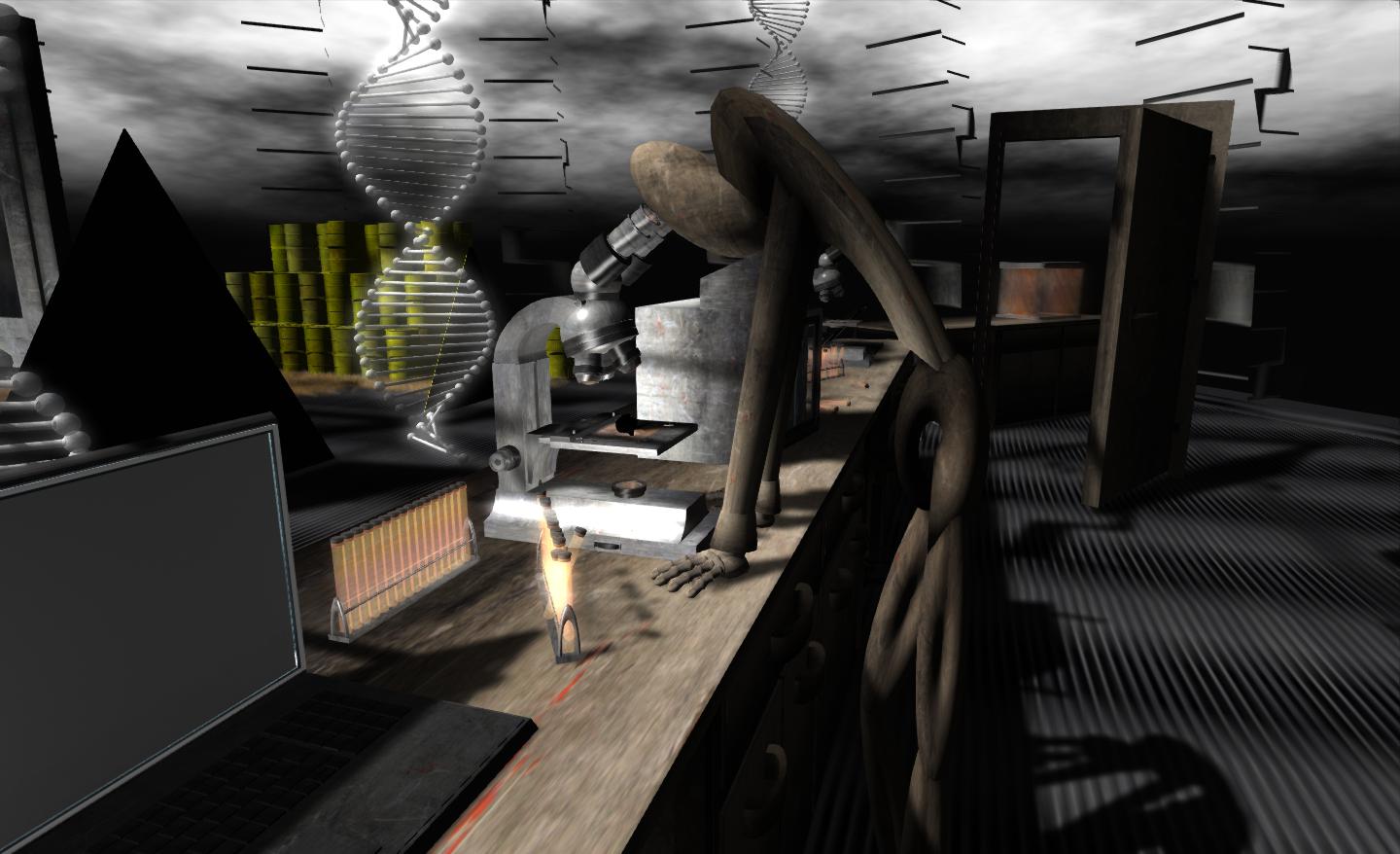
The children are perhaps a link into the second aspect of Kicca’s work, as she also presents a tableau depicting genetic research as a scientist, surrounded by models of DNA, peers steadfastly into a microscope. Will he find a new means of aiding the sick or overcoming sickness – or will his research result in further chaos and destruction? As Kicca notes, “The timing of the research are often too short to fully evaluate the consequences of what is produced afterwards. I wanted to emphasize in these scenes, that these aspects need to be taken into extreme account by researchers and by who finances them and often influence their activities, with cursory expectations. ”
Of course, scientific and technological advancement are often rarely without risk. That does not mean we should turn out backs on either – and neither Kicca nor Nessuno are implying we should. But we have reached a point in our own understanding of both science and technology where we do need to be more aware of both the broader potential and impact of scientific discovery and development. As such, we perhaps move to free ourselves from both the imperatives of financial gain arising from research and – equally – the religious ignorance which often prevails against the potential for life-saving / life-enhancing research and development, and look upon things in a broader light – particularly where our endeavours can have such a wide-ranging impact on both our evolution and on the world around us.
Danger in Evolution is a powerful, evocative piece, however one looks at it, both directly and indirectly. The imagery is both intense and also subtle, challenging us to consider matters of evolution, development, research and science from all parts. Walking through Nessuno’s part of the installation in particular, I could not help but hear Oppenheimer’s quote when looking back on the detonation of the very first A-bomb during the Trinity tests in New Mexico, when he referred to a passage from the Bhagavad Gita, “Now, I am become Death, the destroyer of worlds.”
This is also a piece that again demonstrates the sheer power of environments such as Second Life for staging immersive works of art which can so challenge our perceptions and thinking – and as such, it is not one to be missed.
On Wednesday February 6th, the Linden Endowment for the Arts announced the opening of applications for the fourth round of the Artist-in-Residence (AIR) programme. The announcement, as allows, reads in part:
The LEA AIR programme seeks to promote and nurture the arts in Second Life, through providing limited term full-sim land grants to be used for creative projects and art installations over the course of a few months. Recipients can be individuals or groups interested in creating or curating art, or proposing cultural projects which would require/utilise a full-sim build and can be completed within the allotted time frame (5 months). The LEA is able to offer land grants through the generosity of Linden Lab.
(image courtesy of LEA)
Up to twenty regions, donated by Linden Lab and managed by the LEA, are generally offered under the land grant programme, and successful applicants will be granted the use of one full region for a period of six months. The region may then be used on an individual or group basis for such diverse activities as:
Full sim exhibitions and / or immersive installations
Curated projects, especially those which have a connection to physical exhibitions and events (augmented reality)
Applications are not limited to visual art but are welcomed from all areas of artistic expression, including performance, music, and film.
Land grant regions: LEA10 through LEA29
Preference is for submitted works to be original in nature, although curated projects may present extant works. Successful applicants will have up to four months in which to execute their build, and must have it open for public viewing for at least the last two months of the grant period. Artists may alternatively use the land for multiple exhibits, but it is imperative that projects will be ready within four months from acceptance, and this time-frame should be considered (and reflected) in applications.
Key Dates
Applications open: February 5, 2013
Application deadline: February 19, 2013
Sim handover and public announcement: March 8, 2013
End of round: July 31, 2013
Applications forms can be found at the end of the LEA website announcement for Round 4, together with all other necessary information.
 After extending the application period deadline from midnight SLT on the 19th February, the deadline has been moved to midnight on Sunday February 24th, the Linden Endowment For the Arts council has announced the successful applicants for the next round of the LEA’s Artist-in-Residence programme.



 Inara Pey: Living in a Modemworld