Scylla’s study of the Virtual Toxic in Second Life

Kondor Art Square: Scylla Rhiadra – Virtual Toxic
Elven Years ago, I opened a new exhibit that tackled the subject of representations of gender violence in Second Life entitled Is This Turning You On? About a month and a half ago, Hermes Kondor asked me if I’d be willing to return to the subject of toxicity and hypocrisy within Second Life.  This exhibit is the result.

– Scylla Rhiadra, introducing Virtual Toxic

Thus reads the introduction to Virtual Toxic, what will be for some, an uncomfortable exhibition at the Kondor Art Square.

Without a doubt, whilst Second Life offers a lot that is positive in life – physical or virtual; however, it also attracts the more negative aspects of human behaviour. And while other platforms also suffer from their own forms of toxicity, negativity and hypocrisy, the fact that Second Life does offer the means for positive immersion leads Scylla to frame this exhibition around a central question:

Why do we persist in replicating the flaws and toxicity of our sublunary physical existence in the virtual world as well? We can literally fly here. Why then do we fetter ourselves to the dark places on the ground?
Kondor Art Square: Scylla Rhiadra – Virtual Toxic

Thus we are presented with a baker’s dozen of images that deal with what can be seen as the more toxic – or at least darker – attitudes that can be expressed through words and activities in-world.

Virtual Toxic starts in the north-east corner of the square with Imagine Dark, a piece that offers a narrative on the fact that in entering Second Life, we are presented with multiple opportunities for discovery and expression, light and dark – and ask the question as to which we might chose. From here, the remaining images progress clockwise around the edge of the square with the last sitting in the centre. Each has a particular focus on behaviours and activities that all have an uncomfortable edge to them – sugar daddy / baby girl role-play, direct violence, rape “play”, the objectification of the female, and more. Each comes with its own text element offering  either direct or narrative context.

Each image and its associated text is provocative in the statement offered for us to consider; statements that – due to the fact they are based on physical world situations, attitudes, outlooks, activities – obviously extend beyond the virtual and challenge us to think more deeply and broadly about how we interact with one another and why we might chose to engage in actions that are in the physical world abhorrent to us and / or why we opt to display toxic / hurtful attitudes towards others.

Kondor Art Square: Scylla Rhiadra – Virtual Toxic

The former of these aspects is duly noted in one of the three information panels on the exhibit in the centre of the square (Some Important Disclaimers), which should be read when visiting the exhibit. The latter is perhaps most clearly defined in the south-east corner of the square, and the pieces My Name Is… and Gaslit.

Within the former we see reflected the fact that there are some who have an unwillingness to view others as equals / individuals with thoughts, feelings, emotions, etc; the avatar stands with face blotted out by the word Whatever. It’s a term that can have both positive and negative implications – and here is the usage is reflective of the negative / passive-aggressive form (as in, “I don’t care about you or what you have to say or feel”). Gaslit, meanwhile, references our use of words to manipulate others into self-doubt or (possibly) taking an action they’d normally avoid.

Kondor Art Square: Scylla Rhiadra – Virtual Toxic

Offered for public consumption to overlap with the UN Women’s 16 Days of Activism against Gender-Based Violence Campaign, which draws to a close on December 10th, 2021, a campaign specifically focuses on violence and abusive acts against women (1 in 3 of whom, globally, will be subjected to violent abuse at least once in her life, with that abuse extending well into digital environments, as seen through the likes of Gamergate), Virtual Toxic is an arresting exhibition. However, it is not polemic; in asking its questions – most clearly exemplified by the 13th image, Why? at the centre of the art square – it invites us to view, read and consider what is presented without undue sway on the part of the artist.

SLurl Details

Sensual wings and written reflections in Second Life

Kondor Art Centre: Lika Cameo – One Thousand Wings

November 25th marked the opening of a new exhibition at the Kondor Art Centre, curated by Hermes Kondor, of a themed selection of images and words by Lika Cameo (LikaCameo) that is utterly extraordinary in its presentation of art, introspection / reflection and in its presentation style.

One Thousand Wings takes as its foundation, the major part of a quote from Virginia Woolf:

[Lock up your libraries if you like;] but there is no gate, no lock, no bolt that you can set upon the freedom of my mind.

– Virginia Woolf, A Room of One’s Own

Within that essay – the result of two lectures she delivered in October 1928 to the women’s constituent colleges of Newnham and Girton at Cambridge University, England – Woolf sought to explore social injustices and comment on women’s lack of free expression that existed at the time. This quote is joined by a verse by artist Erin Hanson:

There is freedom waiting for you,
On the breezes of the sky,
And you ask “What if I fall?”
Oh but my darling,
What if you fly?

– Erin Hanson

Kondor Art Centre: Lika Cameo – One Thousand Wings

While there are some core against various views Woolf expresses within that essay, Lika uses the quote from her essay, and the words by Hanson to explore what it means to freely express emotions in a century that has started to feel as if our freedoms are being increasingly being constrained by intolerance and when life has been constrained by a global pandemic, complete with a layering of what freedom means to her.

In doing this, Lika presents trios of avatar studies, all utilising the same pose and with a motif of wings, each piece finished individual to its partners. This approach leads to three images that, whilst all identical in terms of posing and motif, offer three pieces that offer a vastly different sense of depth, focus and emotions.

Accompanying them is a piece of prose  / blank verse (by either Lika or possibly Zakk Bifrandt, it’s not entirely clear) that offers an outlook / sense of emotion or thought that works to both complement and compliment the images.

Kondor Art Centre: Lika Cameo – One Thousand Wings

Complement, because the text can be taken as a whole with each version of the image and the trio as a whole, forming pairings with each image, working with the subtle differences in presentation and finish to tell a unique story of reflection / emotion. Compliment, because whether taken as pairings or as set of four panels, they together form a whole, works balancing image(s).  Each set of images is further reflected in animated double-sided panels that offer a further, changing take on the sets.

As expressions of freedom, these image carry a powerful metaphor in the use of birds and butterflies to express the freedom of thought taking flight, as captured in Erin Hanson’s words. As reflections of emotion and release in a time when were are under pressure to conform or keep our feelings under wraps, this is an incredibly powerful series of images. More particularly they stand as insightful, emotive reminders that it is so easy to become trapped within ourselves  – something that Lika expresses beautifully through her own words:

Often our thoughts tangle around the soul, forging our prisons, never grasping that we are always the key to our infinite free will.

Lika Cameo

Kondor Art Centre: Lika Cameo – One Thousand Wings

As demonstrations of art and how to use lighting, colour, tone and other post-processing techniques to impart a range of emotional responses to a single image, One Thousand Wings is equally as powerful an exhibition; and while I’ve oft said this – it is an exhibition that should be seen and appreciated.

SLurl Details

Suzen’s Illusion in Second Life

Kondor Art Garden: Suzen JueL – Illusion

Now open at the Kondor Art Garden, curated by Hermes Kondor, is Illusion, an exhibition of 2D art by photographer-artist Suzen JueL (JueL Resistance). It offers an engaging range of pieces that mix styles and ideas to present images that are visually engaging and carry with them strong narratives.

Within these pieces might we find photo-collages, measures of surrealism, expressionism and more; stories with an edge of abstraction and / or the broad strokes of impressionism, some of which sit as dream states in their form and colour. Primarily produced within Second Life and richly post-processed, these are pieces that also encompass elements and images drawn from the physical world.

An intriguing aspect of several of the pieces is that rather than using a traditional avatar, Suzen presents a mannequin-like personage that, while female in form, offers us – male or female – the opportunity for greater association with it, and thus themes and emotions contained within the pieces where it is used.

Kondor Art Garden: Suzen JueL – Illusion

With their focus on the mannequin presence, these particular images offer a sense of dual narrative. Backwards into Depths, for example offers the suggestion of taking a leap of faith. On the one hand, they colours stand in emphasis of the fact it is into the unknown we might jump whilst also presenting the sense of fear that such leaps often entail. Similarly, Monster at first seems to suggest the coming of a horror, a strange, looming creature that might well be in pursuit of us – but then on second look, it perhaps suggests we are the monster, looming forth to inflict something on the unwary.

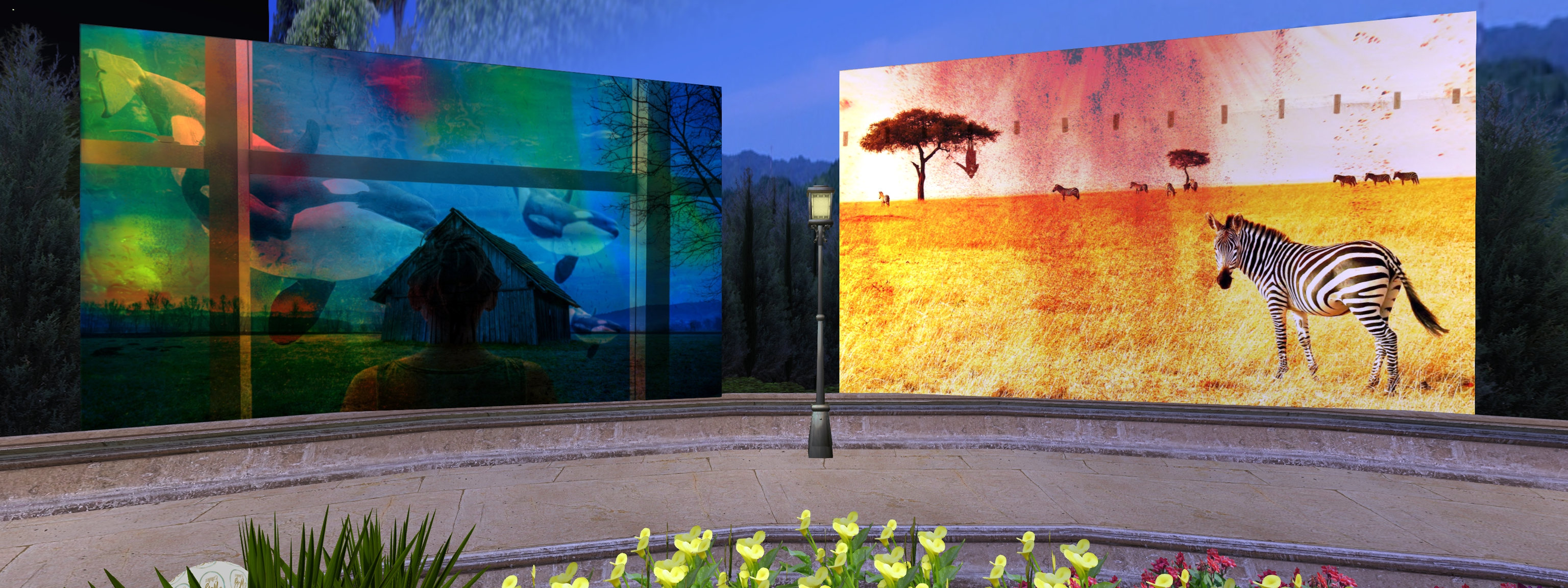
Elsewhere the narrative is more direct, as with Whale Dreaming, a marvellous photo-collage that folds into itself considered elements of surrealism, impressionism and realism. Beside it, Hanging with the Zebra similarly offers a mix of surrealism and over-exposed expressionism that holds the eye before the magnificent Elephant awaits to again offer use entwined stands of narrative.

In their mixing of styles, narrative, these are pieces that live up to the title of the exhibition. Each gives us an illusion to ponder, be it directly through the image (again, I’d point to the likes of Whale Dreaming) or in the manner in which meaning and narratives might be seen to be intertwined to hold our attention, making it an engaging and captivating exhibition.

Kondor Art Garden: Suzen JueL – Illusion

SLurl Details

Blip’s urban and industrial vision in Second Life

Kondor Art Centre: Blip Mumfuzz – Urban and Industrial Images

As an artist, Blip Mumfuzz is generally an improvisor; her images tend to come about as a direct result of her general interaction with the environment she is in, rather than conscious pre-planning of pieces. Initially becoming involved in SL photography as a means of cataloguing her grid-wide travels, she started to drift away from the more conventional angles and camera positioning common to such photography, her eye and camera becoming freer, allowing her to look not so much at any given focal point within her field of view and any object therein, but more towards the physical relationships of objects, one to one another.

This gave rise to a more spontaneous, visually engaging style of photography, one coupled with a lean towards finding subjects that feature bright and / or contrasting colours, which images often presenting their subjects – objects, landscapes, settings and avatars, from unique angles or unexpected perspectives. This is turn feeds into exhibitions of Blip’s art being wonderfully free-form and rarely bound by a single idea of theme or narrative.

Kondor Art Centre: Blip Mumfuzz – Urban and Industrial Images

Which is why, when Hermes Kondor approached her about mounting an exhibition of her more urban / industrial art, Blip was somewhat sceptical, feeling that focusing on a single theme would be too confining, limiting her to archival pieces and forcing her to avoid other themes and ideas often present within her work. However, Hermes persisted, and with the assistance of Naru Darkwatch, Blip accepted his request – and the result is both unique and remarkable.

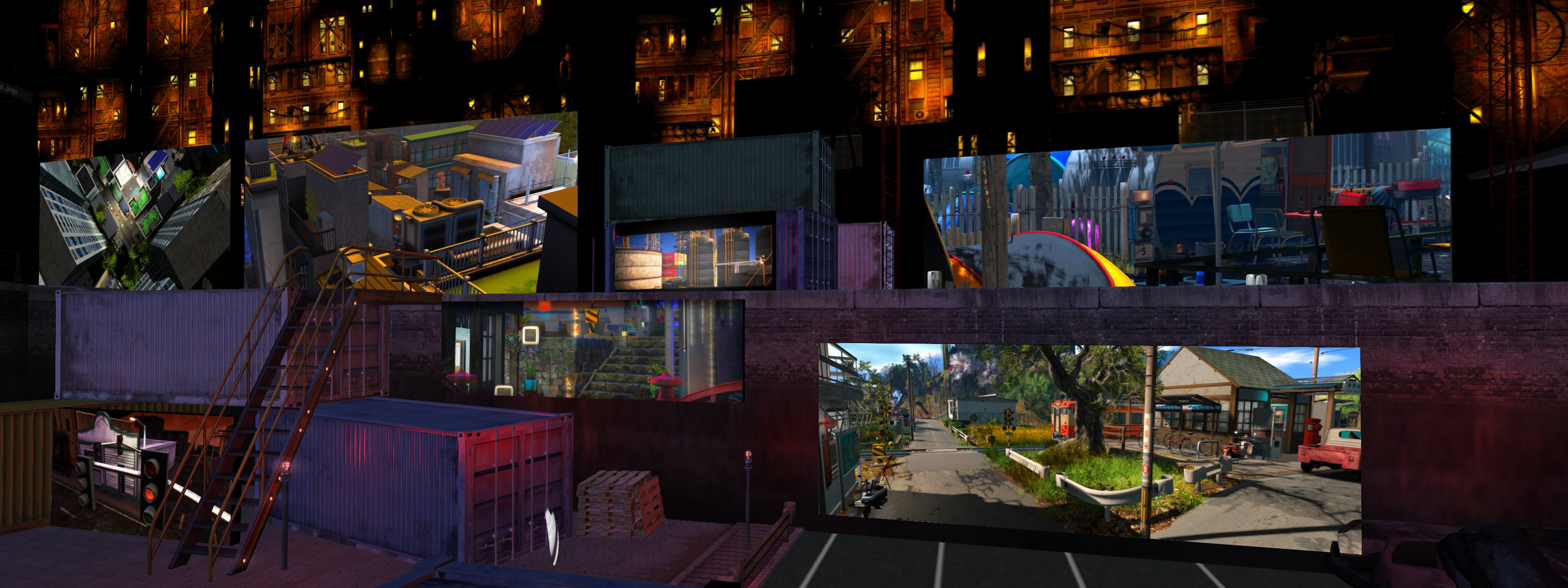
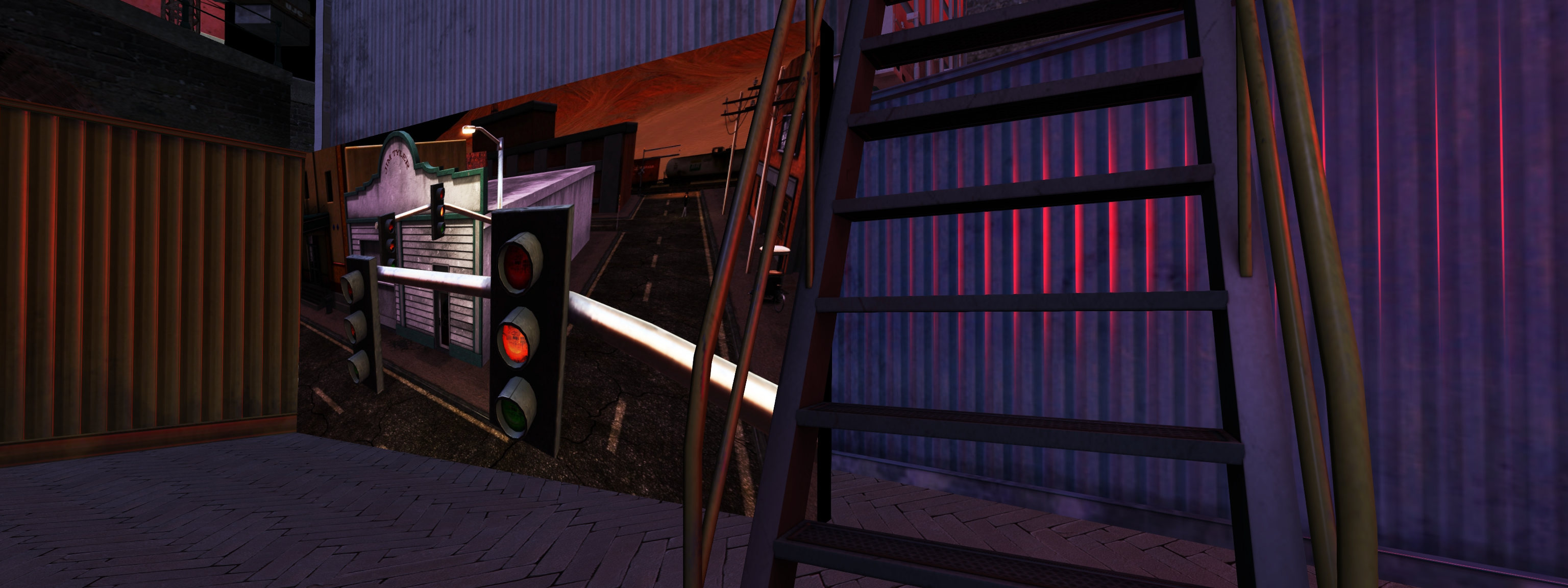
Urban and Industrial Images isn’t just an exhibition of Blips’ art, it is something of an immersive engagement with her work. Rather than merely hanging her images on the walls of a gallery space, she had the idea of presenting her work within a setting that reflects its nature. The result is an environment brought together by Naru as an industrial setting, split into two levels: an upper “street” level, where stand shipping containers, an office space and a backdrop of illuminated buildings suggestive of a larger town or city. The lower sits as a canal intended to bring barges and materiel to the city, and perhaps carry the detritus of industrial activities away – as with the barge sitting on the water.

Kondor Art Centre: Blip Mumfuzz – Urban and Industrial Images
Within it, Blip’s images have been laid out, some mounted in a manner so as to form a natural flow of the eye from backdrop into setting, others sitting within a building or mounted on the shipping containers, the back of a street sign, and along the deep walls of the canal. In this way, setting and art form a whole, allowing us not only to view Blip’s art, but to experience very much how she might see the scenes she comes across in her travels.

From the lower level, for example, a view of Tonarino is set beyond the arch of a bridge, the later curtailing our view, framing it to present it as a moment of motion rather than a photograph. Above it, meanwhile, the rooftops of Kekeland sit beyond the arm and jib of a crane as it raises a  girder, forcing us to consider the spatial relationship between image and crane – just as Blip does in observing the places she explores and the objects within them – as does the placement of images within the old office space at one end of the setting.

Kondor Art Centre: Blip Mumfuzz – Urban and Industrial Images

An engaging, engrossing exhibition, Urban and Industrial Images is an engrossing examination of the photographer’s art.

SLurl Details

Persona: emotions and self in Second Life

Kondor Art Centre Main Gallery: Hermes Kondor – Persona

Now open at the Kondor Art Centre Main Gallery is Persona, an intriguing selection of Second Life / Avatar-based images by the art centre’s owner and curator, Hermes Kondor. Intriguing, as that selection of images on display have apparently been selected by Janjii devling – although whether from Hermes’ existing collection of works or from a series of images specifically produced by Hermes with the intent to be used in this exhibition, I have no idea.

The 20+ images are a further tour de force of Hermes’ work as an artist. Each is a rich, digital collage study with an avatar focus. Either presenting a layering of colour or one if monochrome tones, each is a genuinely multi-faceted piece, a glimpse into a life offered through its layered, almost sharded finish, some of which offer a sense of the abstract, others touch upon the surreal, but each one carrying its own narrative. Collectively, these are all exceptionally tactile pieces – they draw out the desire to touch them as much as they call on us to study them and decipher their story.

According to the liner notes accompanying the exhibition, the narrative in each of these images is an intent to explore the idea of persona, the idea that we project facets of our personality depending on circumstance and audience. While this is very true as a theme within the images here, I found it to be somewhat too narrow a view, because while there is a projection of persona in these images, there is a far greater depth of emotion and a capturing of emotional expression.

Kondor Art Centre Main Gallery: Hermes Kondor – Persona

To be fair, this is touched upon within the liner notes, but it is this emotional expressionism that really comes to the fore in viewing the images. In some it is offered directly through the eyes of the subject in the image, or their expression(s), in others it is more subtle – such as the suggestion of music in Persona 091 for example. Of course, emotions and projection  / persona are inter-related, the one tends to give rise to the other; nevertheless so, allowing the mind to explore the former rather than attempting to define the latter – again for me – offered a richer experience.

These are also pieces that, whilst clearly the product of considered experimentation with software, the use of colour or tones, the structured nature of the layering within them, are obviously the result of a cartesian process, both on the part of the software itself (for obvious reasons), and the artist himself. This separates them from what we might regard as “traditional” abstract expressionism in works of art, which tends to be marked by a certain spontaneity, but it also offers a doorway into the medium of digital abstractionism  / abstract expressionism that has a unique richness of its own. Further, and in keeping with the works of Rothko, Newman and Still, these are pieces that carry a strength of symbolism that offers s further narrative avenue awaiting exploration.

Kondor Art Centre Main Gallery: Hermes Kondor – Persona

Evocative, rewarding, challenging and engaging, Personas offers multiple threads of exploration and interpretation. However, when visiting, I would perhaps suggest avoiding reading the posted curator and guest notes that sit on the gallery’s walls along with the images; not because they are in any way “wrong” or anything, but rather because doing so might constrain thinking around, and appreciation of, the images in their own right.

SLURL DETAILS

Get Out in Second Life

Kondor Art Square: Get Out by Loviathar Hellman & Moolfryt Klang
GET OUT is an invitation into turning your compy off, grabbing the first quite satisfying camera you can find and into getting down the street, breathing more or less fresh air and look at your surroundings with new eyes, a street photographer (amateur or not) eyes. Soon, you’ll feel overwhelmed by the duality you can find in a city: darkness and light, colours and grey tones, tradition and modernity, beauty and ugliness, life and death.

– Insane Focus (aka Loviathar Hellman & Moolfryt Klang)

These are the opening words Loviathar and Moolfryt offer as an introduction to their joint exhibition Get Out, which opened on August 19th, 2021. And as they go on to note, this is not a call to rebel  against common sense precautions in the face of the continuing SARS-CoV-2 situation, but rather a call to those who might spend a little too much time in front of the computer (/me coughs and avoids looking into the eyes of my reflection in the monitor) to take the proper precautions and then get out and spend a little time in the big, wide world – preferably with a camera in hand.

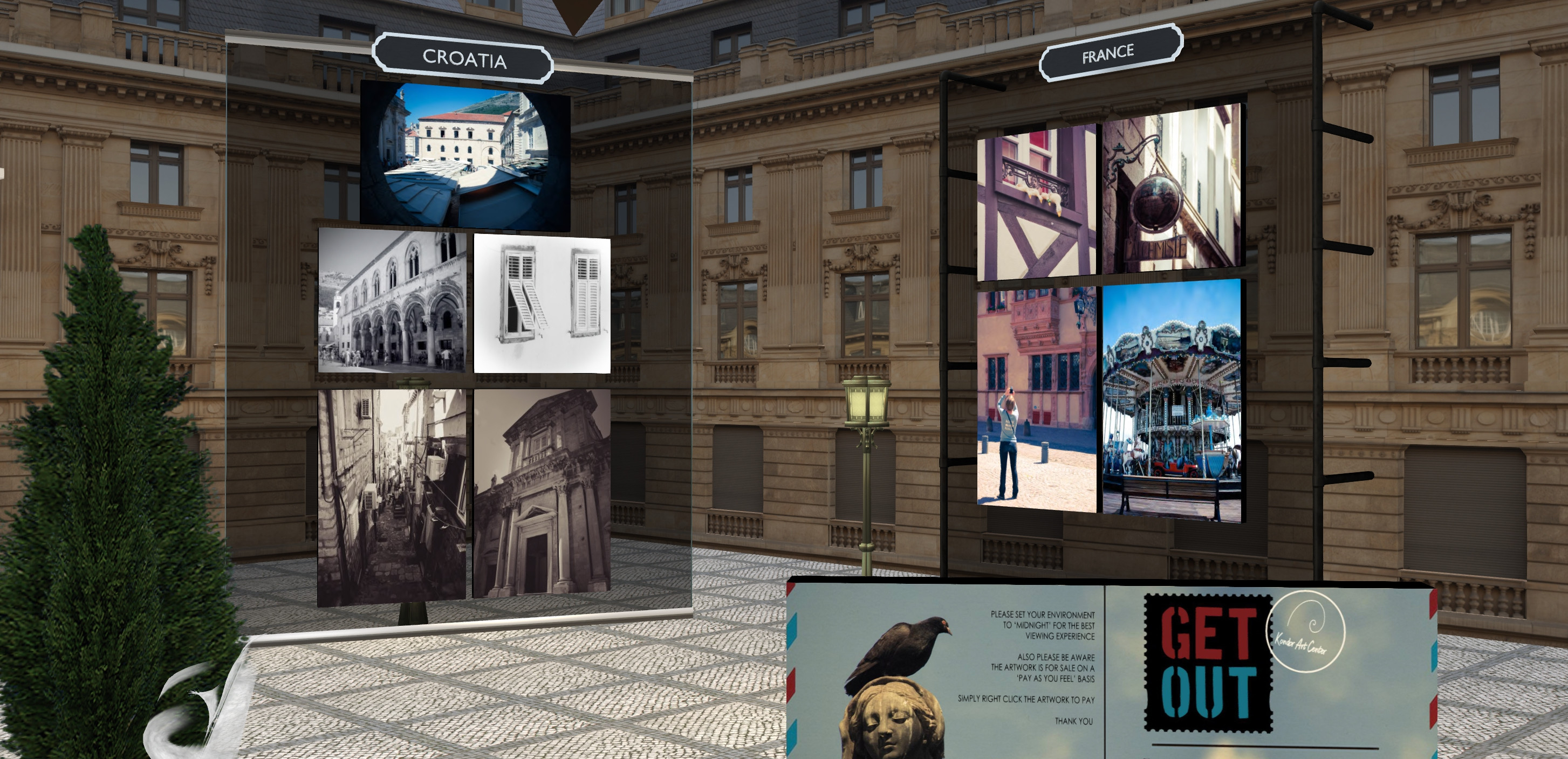
In this, Get Out leads by example. Occupying the Kondor Art Square in Second Life, it is a celebration on multiple levels. On the first, it is a celebration of the artists’ time spent visiting numerous locations across Europe from England through Belgium, France, Italy, Croatia, Bosnia-Herzegovina, Montenegro and Greece. On the second, it is a celebration of one of the most powerful genres of photography – street photography; a means to capture and document moments in time and place and the lives of people around the world as they go about their daily lives.

Kondor Art Square: Get Out by Loviathar Hellman & Moolfryt Klang

Thirdly, it offers a celebration of the world of photography, opening is it did on August 19th, 2021, World Photography Day.

It was on that date, back in 1839 that France took it upon itself to offer to the world the Daguerreotype process of photographic image development. Developed by Louis Daguerre, the technique (using a highly polished sheet of silver-plated copper mentioned) was not the first means to “fix” an image captured through a camera lens onto a medium – Daguerre actually built his technique on the work of his uncle, Nicéphore Niépce whilst others around the world were developing their own techniques – but it was the first publicly available technique of photographic image development, and in doing so, it started a movement that led directly to popular photography as we know it today.

Set out by country, some of the photos focus on a single centre (e.g. London in the case of the UK, Rhodos in the case of Greece) or two or more ports of call within a country (as with, for example, France and Belgium). The images presented are richly diverse in subject, tone and use of colour, each one fully capable of transporting its audience to the place it frames and the the glimpse of the story it has to tell, as well as allowing us to personally share in Loviathar and Moolfryt’s travels. All of them remind us of the power of the photographic lens to record a single moment of time and a unique perspective on that moment as seen through the eye(s) of the photographer; one that can be both deeply personal  and increasingly historical as time passes.

Kondor Art Square: Get Out by Loviathar Hellman & Moolfryt Klang

Get Out also reminds us that photography is open to all of us to try. Maybe we cannot all be a Dorothea Lange or a Lee Friedlander or a William Klein or an André Kertész – or a Loviathar or Moolfryt – and we might not be able to travel to distant towns and cities; but that doesn’t matter. The camera gives us the opportunity to capture moments across the very town we live in (and the opportunity to experience time away from the computer, as the exhibition’s intro notes). So why not go see Get Out and let it offer inspiration, then take the advice of the artists and take time away from the computer and get out and see what the streets around you have to say about themselves?

SLurl Details