Drune: a further visit in Second Life

Drune: East of Eden, November 2019 – click any image for full size

For the third time in 2019, I dropped into Drune, this time on the recommendation of reader Robin Lobo, although it is a place that has been getting a lot of attention of late due to a photographic competition that is running through until November 27th, 2019.

Designed by Zee9, we visited the region at the start of 2019 and then during the summer (see: Time at 2019-XS in Second Life, January 2019 and Drune IV: an Aftermath in Second Life, August, 2019), although Zee9’s designs go back beyond either of these dates. Throughout all of their iterations, Zee9’s builds have focused on a sci-fi / cyberpunk feel that incorporates certain key motifs drawn  – as the About Land description notes  – from the likes of Blade Runner and The Fifth Element, Neuromancer, and Altered Carbon.

Drune: East of Eden, November 2019

This latest iteration of the design is called Drune: East of Eden. Whether or not the title is a reflection of Steinbeck and the underpinning themes of his novel I’ve no idea, but given the dystopian state of human civilisation seen particularly within Blade Runner, and the novel’s examination of humanity’s capacity for self-destruction, the link would seem to perhaps be apparent.

Focused on a single, neon-lit street, complete with Spinner-style police cars buzzing and hovering around, the build perhaps leans more towards Blade Runner than the past two builds offered – although equally, there is less of a feel of the multi-level nature in the setting than previous builds that also move it a little away from that film. However, there are numerous nods and touches to a range of influences beyond the films named in the region description (one of the more obvious being Sulaco Corporation – a name that would seem to draw on the Alien franchise).

Drune: East of Eden, November 2019

There are familiar elements from earlier builds to be found as well – notably the subway that serves as the landing point, some of the vehicles, the little hovering robots, the night club and the bar. These help to give a sense of continuity to the setting that eases those familiar with some of Drune’s past iterations (such as 2019-XS) into this one, such that the feeling is not so much that this is not so much a new build, but another part of that city.

For me, the enclosing region surround give this iteration of Drune a depth perhaps lacking in some previous versions – and it is clear that Zee9 has taken a huge amount of care to ensure the the edges of the region break up the surround such that the high-rise buildings of the latter feel like a genuine continuance of the setting, adding to that feeling of depth noted above. It is as if one could walk through one of the road tunnels, the canyons between those skyscrapers would indeed lead to some of those past Drune designs, sitting as further outliers of the city.

Drune: East of Eden, November 2019

Always evocative, wonderfully thematic and rich in colour, Drune always offers a setting worth visiting and appreciating – and for photographers, the photo contest mentioned above gives an added incentive for visiting. Details can be found on an ad board in the landing point subway.

Recommended – and thanks to Zee9 for the chat.

Drune: East of Eden, November 2019

SLurl Details

Somewhere Else in Second Life

Somewhere Else BKLYN, November 2019 – click any image for full size

Somewhere Else BKLYN is a region design that’s be getting a lot of attention of late, offering as it does one of the more unique settings for Second Life photography.

Designed by Littlesquaw and ToXxicShadow, it presents an urban setting (the name suggesting it might be drawn from Brooklyn, New York), looking across a narrow stretch of water (the East River) towards the shining towers and sky scrapers of a city’s beating heart.

Somewhere Else BKLYN, November 2019

The region – a Homestead – offers its own high-rise buildings, but these are dwarves in comparison to those across the water, and they are sa lot shabbier. They form what appears to be little more than a thoroughfare for traffic that is busily trying to get among, or coming from, the gleaming spires of the city. Two busy roads run into the scene from a single bridge that reaches out towards the city’s promise of wealth and (literally) high life, the occupants of the vehicles cramming them perhaps unaware of the place they are attempting to drive through and the fact that it has life of its own.

Perhaps they prefer not to dwell on thoughts of those living in this seedier setting that sits between plush office and outlying suburban home. Which is a shame, as there is the promise of life all around in the side streets and alleys here; even if it does form a mixed bag.

Somewhere Else BKLYN, November 2019

Down one street, for example, sits an oriental market, complete with open air food stands where meat sizzles on hotplates above naked flames and seafood broils in a broth. Elsewhere, a sign sitting atop a building, but at a distant eye-level from the roads here offers the promise of Little Italy, while flashing neon signs entice with offers of food or other distractions.

This is a place where art comes in the form of wall-covering graffiti and where age is always apparent – not just because of the grime and stains of automobile exhausts and decades of wear-and-tear on road surface, sidewalk and building, but also in the way old-style wooden advertising hoarding rub shoulders with their more modern electric counterparts.

Somewhere Else BKLYN, November 2019

It’s clear that this is also a place of commerce – the subway station is proof of that, the maw of its entrance busy with the hustle of people coming and going; but it’s also clear that this is a place past its prime and wanting a little TLC: refuse lays piled here and there, some of the streets are littered and uncared for while poverty is embodied in the lone waterfront sentinel of a bag lady’s shopping cart laden with the bric-a-bric of things she has acquired and which to her offer a meaning for life.

Packed with detail larger and small, and given life through the  many characters to be found in its streets, Somewhere Else BKLYN offers an immersive environment (have your local sounds on) environment that is easy to explore and rich in opportunities of Second Life photographers.

Somewhere Else BKLYN, November 2019

SLurl Details

The growth of Bellisseria

Pootling through some of the new Bellisseria continent regions by rail

It’s been a few months since I last wrote about Bellisseria, the Linden Homes continent. At that time, the trailers and campers selection of homes had just been deployed – and proven as popular as the Traditional homes and Houseboat ranges before them.

Since that time, as has been reported elsewhere, the continent has been expanded with a lot of new regions slotting into the southern side to fill out much of the “missing parts” when compared to the SSPE “test continent” used to initially develop Bellisseria’s layout.

These new regions have dropped into Bellisseria fairly close to where my houseboat is located, and I’ve tended to take the occasional look at them as things have been under development (see A little Culprit Moonwalking in Second Life, for example). However, as this a is quiet Monday, I decided to drop in to the regions at a time when I’m unlikely to get in the way of the Linden Department of Public Works (LPDW) as they continue to build-out the regions with everything from landscaping though flora and infrastructure to the Linden Homes themselves.

The new regions bring together a mix of Houseboats, Traditional houses and Trailers and Campers

The majority of the regions continue with the current themes of Traditional, Houseboat and Trailers and Campers homes. This means – on the surface –  that the new regions could be dismissed as “more of the same”, but as my Monday trip through some of them – by rail and horse – shows that while they may contain the same types of houses, they have their own unique character and look.

Take, for example, the Bellisseria railway. While this was introduced with the release of the Trailers and Campers, the extension to the continent illustrates it in not to be restricted to regions containing these types of Linden Home – as has been hoped would be the case. Within the new regions, the tracks pass from “camping” regions into Traditional homes regions, and back into “camping” regions once more. Along the way the tracks also branch for what I think is the first time, presenting two potential rail routes through the regions, and one of the new Traditional homes regions has markings for what might be a more substantial station than seen elsewhere (or at least one directly served by road).

The new regions see the Bellisseria rail lines extend into Traditional house regions

Given the continued popularity of the Houseboat styles, it comes as no surprise that the coastal regions offer more moorings for houseboats – some of which have already been populated. But again in what might be an interesting turn where popularity is concerned, the new regions offer an extensive reach of the camping parcels along the coast, presenting people who like the Campers and Trailers with the opportunity to enjoy coastal living, rather than being restricted to just the banks of inland waterways and lakes.

The new regions also offer the first real “blending” of Camper and Trailer regions and Traditional House regions. Until now, the boundaries of the two have tended to be denoted by water. With these new regions, the two types of Linden homes draw together more naturally, sometimes with just low mounds between them, sometimes abutting almost seamlessly.

Trailers and Campers move to being along the coast with the new regions

There are perhaps one or two little things that it would be nice to see. The rail tracks for example run through the regions, passing Campers and Trailer and houses alike running over and under bridges and through deep cuttings; but there are are no tunnels – it would be nice to see one or two in the more hilly areas.

Similarly, while the Traditional house regions and the Trailer and Camper regions do more directly abut one another, the roads of the Traditional house regions and the tracks of the Camper and Trailer regions never actually come together; rather they each end abruptly with a stretch of grass between them, it would be nice to a a more natural joining, asphalt gradually giving way to a narrower, rutted track, for example. Or at least have a fence and (open) gate between them, rather than curbstones, footpath and pristine-looking grass.

Food for thought for Linden Lab, perhaps?

Visiting La Digue in Second Life

La Digue, November 2019 – click any image for full size

La Digue (“the dam”?) is a recently opened Homestead region offering numerous opportunities for photography and – with a little care – exploration.

Designed by Sablina, famous for producing the likes of La Virevolte (see here, here and here), Ponto Cabina (see here and here) and Field of Dreams (see here), this is a region caught in the changing of the seasons, the trees a mix of summer green and the reds, golds and brown of autumn. Beneath them, the land is cut by two large water channels that feed multiple smaller, canal-like channels that divide-up the land into a series of small islands and one large “central” land mass that also forms the landing point.

La Digue, November 2019

A large gatehouse stands atop the latter, standing guard over the region and is large island and watching over the landing point as it sits on the shingle shore. Surrounded by a sea of sun-dried grass, the gatehouse is one of a number of buildings within the region that collectively give it – along with its name – a feel for northern France (although one of the buildings is admittedly Tuscan in design).

Small bridges connect some of the smaller islands one to another, but to reach others some wading through the shallow channels between them might be required. With corn stalks and cattle grazing, the islands further suggest a rural setting.

La Digue, November 2019

To the north, a sender finger of land points westward and then turns south along a broader stretch of coast to a small railway station (sans tracks) looking out to sea whilst caught under its own rain storm. This crrokes streacth of road  and shoreline, coupled with the region’s name, brought to mind the long finger of La Digue du Braek, albeit without the sands on one side and the port of Dunkerque on the other. At the end of this the road, a bridge provides access to a small headland area where stands a lighthouse and work is apparently in progress building a sea wall.

However, what – for me – gives the region character is the broad north-to south channel that cuts through the region, separating the western run of road and its station from the rest of the region. This would appear to be a tidal run, given the dry stone wall supporting some of the land to one side. It is home to numerous wooden moorings alongside of which rowing boats sitting among the reeds and watery growths around the mooring piers.

La Digue, November 2019

This area in particular adds a huge amount of character to the region, rich in detail and photographic opportunity from pretty much any angle. Elsewhere throughout the landscape are further opportunities as well, but it tends to be the waterway that draws the eye and lens back to it again and again. The rowing boats, meanwhile offer numerous places for sitting and posing for photos or chatting.

More places to sit can be found across the region as well, from the little bar a short walk from the station, to benches and chairs, hay bales and more. Getting to some can be a bit of the aforementioned challenge, admittedly: some of the grass and other plants could do with being phantom – but this shouldn’t put people off exploring and wandering.

La Digue, November 2019

Sablina has a reputation for creating regions of beauty that capture landscapes in a most natural manner, and La Digue is further proof of this. It’s a place that invites wandering and spending time within it, the supplied sound scape rounding it out perfectly.

A region that has already caught the attention of photographers and artists, La Digue is not to be missed by Second Life travellers.

La Digue, November 2019

SLurl Details

  • La Digue (Sparrow Springs, rated Moderate)

Elvion expands in Second Life

Elvion, November 2019 – click any image for full size

Update, September 2021: Elvion has relocated and expanded – see Elvion expanded in Second Life.

We first visited Elvion, designed by BoZanoNL in February 2019, back when it was a quarter Homestead region. As I noted in Elvion: an elven sanctuary in Second Life, back then it offered the look and feel of a elven sanctuary, steeped in mystic magic and with little places for visitors to sit and spend time. More recently, the setting has moved to occupy a complete Homestead region, and in doing so has obviously expanded.

The move and expansion has perhaps lost some of the more “elven” elements from the former. However, the move has allowed for the creation of a more extensive, open landscape, rich for exploration, still with numerous places in which people are welcome to spend time.

Elvion, November 2019

Set under a bright sky suggestive of a crisp spring or autumn day, the region is largely open, rolling grassland, cut on its south side by a mountain range running west to east, largely separated from the rest of the region by a narrow water channel with its head as set of waterfalls at its western end. When seen from the north side of the region, these mountains give it added depth, assisted by a line of low hills running through the lowlands that naturally break the line of the mountains and make them appear further away.

The landing point for the region sits to the north-east on the grasslands. It sits along a cart track that runs part-way through the region, curling around the hills to curve north and east across the grasslands, two bridges allowing it passage over a bubbling brook until it meets the region’s hills and they turn north. It is at the landing point that visitors can review the region’s rules and can see that this is a horse-riding friendly region (for those with a wearable Animesh horse, or can join the region’s group for a L$500 and rezzing rights).

Elvion, November 2019

A further mark of the former Elvion was the wildlife – deer, herons, even bird calls, etc., – and this is very much carried over with the new setting, with horses joining the mix. All of the visible animals and birds are scattered across the region in a manner that makes coming across them both a natural experience when exploring and also opens up opportunities for photography.

As noted above, some of the more “elven” elements present in the former quarter homestead region space are now absent; however, there are some ornate arches to the south of the region tucked among the mountains there, but otherwise, the pavilions found in the former design are absent.

Elvion, November 2019

This doesn’t mean the region is bereft of structures, however. Towards the head of the waterfall-fed channel, for example, is a large cabin. Elsewhere there is a gazebo sitting amidst cherry blossoms that add to the more springtime feel to the region, and there are numerous hints of ruins to be found – one close to the landing point – all of which offer cuddle spots.

When wandering the region, and despite the lack of clear elven influences, I was still put in mind of scenes from Middle Earth – the mountains, when seen from a distance to me offered a hint of Tolkien’s Misty Mountains as perhaps seen from Rhudaur, while  – and albeit it somewhere else in Middle Earth entirely – the cabin, put me in mind of Beorn’s house (if without the associated gardens of the latter).

Elvion, November 2019

Like the cabin, the various ruins offer places for people to sit and talk and cuddle. Other sitting / cuddle points await discovery, including a wheelbarrow, a shoreline hut, the aforementioned gazebo, and various wooden decks. These all encourage people to spend time in the region, as does the potential for photography – landscape and avatar studies.

Rounded-out by a corner woodland setting with ruins of its own, the expanded Elvion offers a lot to visitors, making it an ideal an pleasing visit that build on the former quarter-region setting. I will confess that I did have some performance issues with shadows enabled whilst riding my Animesh horse, but just disabling shadows for the ride solved that problem, and the issue didn’t otherwise spoil my explorations on foot.

Elvion – November 2019

With thanks for the update on Elivon from Miro Collas.
A Miskatonic mystery in Second Life

A storm comes – and brings with it an assortment of nasties to plague Miskatonic

Currently open at Miskatonic County is Tales of Miskatonic County: The Perfect Storm. Described as “A Horror Survival Experience”, created by Rayden Evenstarr, Phoenix Sachin, Logan Porterfield and Tobiath Tendaze, it makes for an interesting if (for me at least) a slight confusing diversion.

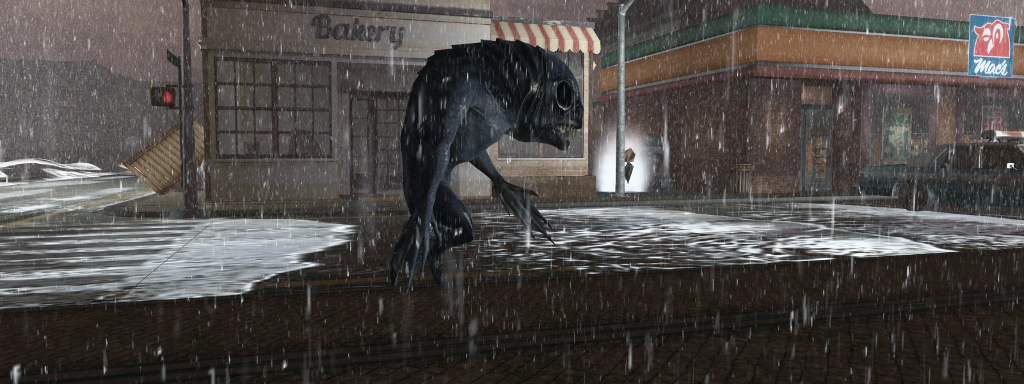
Using the Second Life experience system The Perfect Storm pitches you against zombies, lurkers, cultist gunmen, ghosts, creature of the deep and more in a battle to survive and to complete assorted quests. The latter range from killing some of the aforementioned monsters and creatures through to rounding up kittens or finding puppies – which makes for an interesting mix!

As you emerge from the theatre in Downtown Miskatonic, you find a town in chaos. Torrents of blinding rain obscure amorphous shapes lurking in the shadows. Telephone poles have been sent crashing to the ground in showers of sparks while trees fall upon cars and houses alike. Danger lurks in every alleyway, and you feel as though a thousand eyes are upon you.

Miskatonic is no ordinary town, and this is no ordinary Halloween. The day is October 31st, 1991. The day a ferocious storm system suddenly formed off the New England coastline. A storm system so large that meteorologists deemed it “The Perfect Storm.” The storm turned westward, moving against the jet stream, striking the coastline with a deadly storm surge and hurricane-force winds. Many old-timers of the region dubbed the storm “unnatural.”

– Introduction to ales of Miskatonic County: The Perfect Storm

The streets are lashed with rain – and home to things that creep and lurk

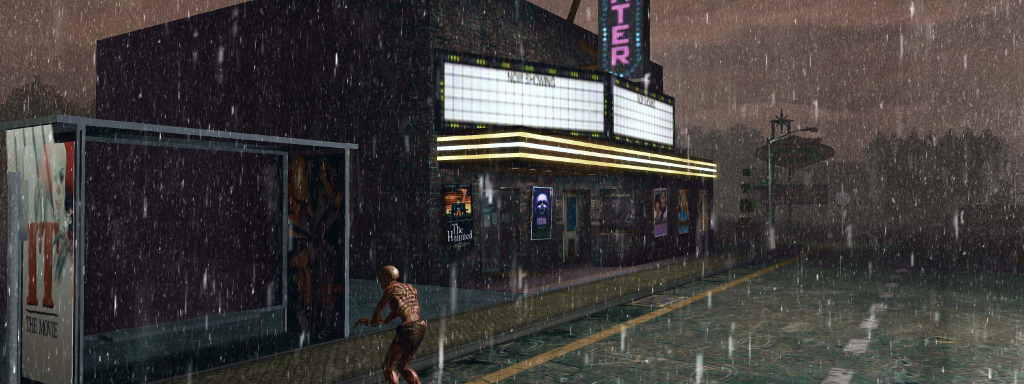
The adventure begins at the Miskatonic Theatre, where players pick-up the game HUD (and must accept the region’s experience in order to play – a one-time only requirement unless the experience is subsequently blocked), together with a magic ring and a pistol.

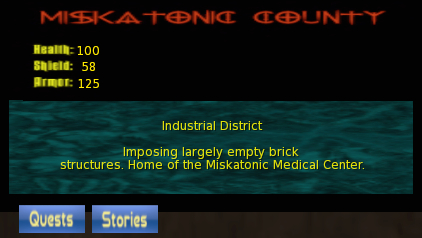
The HUD will auto-attach to the player’s screen under scripted control, and will auto-detach on departing the game. It acts as a relay to record your health, shield and armour, and as an information giver – prompts are displayed in the lower section of the HUD, and there are two buttons: Stories and Quests, of which more anon. The gun and ring are inventory objects and must be worn. The former is required to kill the nasties (you must be in Mouselook), and the latter helps “buff” your game stats.


The HUD provides health information (top), general information on your location (centre) and buttons to view your quests (if any are in progress) and any story fragments you’ve found

Outside of the theatre, the storm is in full force. The northern end of the town is subject to flooding from the storm’s surge, and rain is falling in heavy sheets across the rest of the landscape, with copious amounts of storm damage to be found in the streets.

You’ll need to be in Mouselook whenever you are outdoors, as this is where the nasties roam. You can switch back to third-person view when inside buildings to ease exploring them and interacting with things in them. Shooting the the nasties is a case of aiming the screen cursor at them and blasting away with left-clicks. Hits earn points and will eventually kill the nasty, earning you bonus experience points. However, be warned that they can strike back with claws, teeth, knives, hatchets and guns of their own, eroding your health, shield and armour.

Health can be restored by finding crafting stations and then rummaging for ingredients, then using the crafting station to make consumables and eat / drink them. These items are added to inventory for rezzing and can also be traded with other players, allowing those playing together to help one another. Consumables, once made, can be worn to consume or carried. Some will restore lost health / shields, some may only “buff” for a period of time.

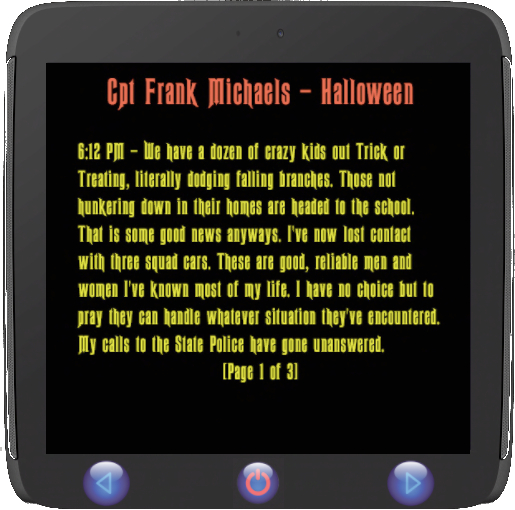
Quests and stories (shown) are displayed in a separate HUD panel by clicking on the Quest or Stories button on the main HUD

Quests are undertaken by finding non-player characters (NPCs) scattered within various locations. Clicking on them will open the Quest panel on your screen and display details of a quest for you to complete. click the “off” button on the panel to close it, and you can set out to complete the required task.

You can have up to four quests running simultaneously, and some will be auto-complete (achieve the goal and the quest ends), others will require you return to the Quest giver. A tally is kept of your progress, and I found this a little irritating, as each time I achieved a target in a quest, the panel would open, blocking part of my view and requiring I hop out of Mouselook to close it (ALT-click didn’t seem to work).

As well as quests, there are story fragments to be found scattered around – these take the form of books with hovertext floating above them. Clicking on a book will add the story fragment to your HUD – click the Stories button to open a panel listing the available stories, and click on the one you want to read by clicking on its title.

Should you find your health drops below 0, you will be incapacitated and transported to the Miskatonic Medical Centre. This restores your health and reveals one of the secrets of the experience: it exists on multiple levels stacked up one above the other through the vertical extent of the region. They are connected by teleports in the form road tunnels. Moving to each of them can earn experience points.

A creature of the deep roams Miskatonic

If I’m totally honest, I don’t entirely “get” the overall goal – other than survival (which may be the sole point) – but then, I’ve not progressed full through the entire experience. In this, the instructions and introduction are somewhat vague – and “emissary” is reportedly coming, but what / who that might be slipped by me. There is also reference to artefacts being stolen – but whether recovering them forms a part of any of the quests, I could say.

Perhaps the way to find out is to play for yourself?

SLurl Details