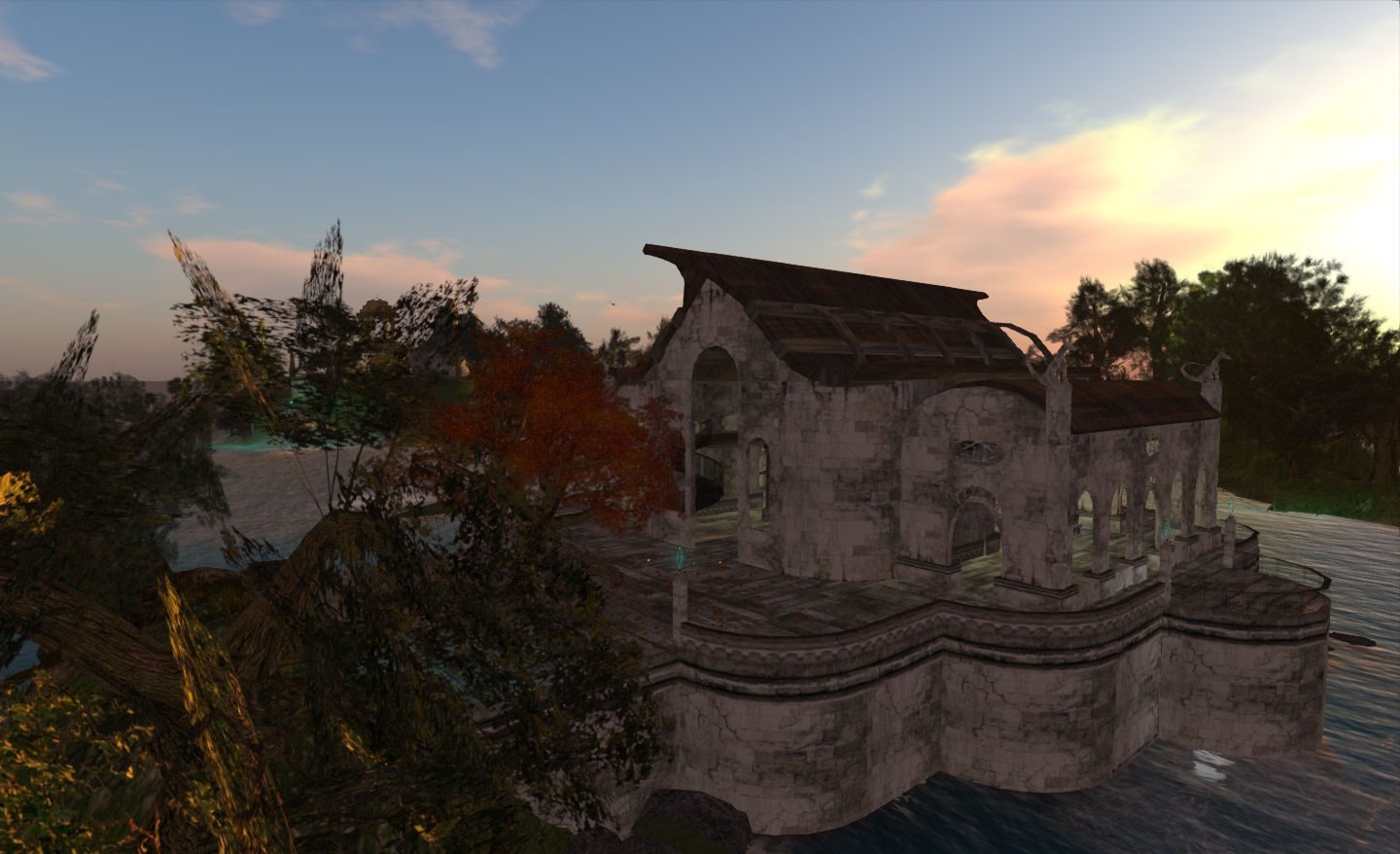
Update August 4th: the region containing the cathedral is no longer available.
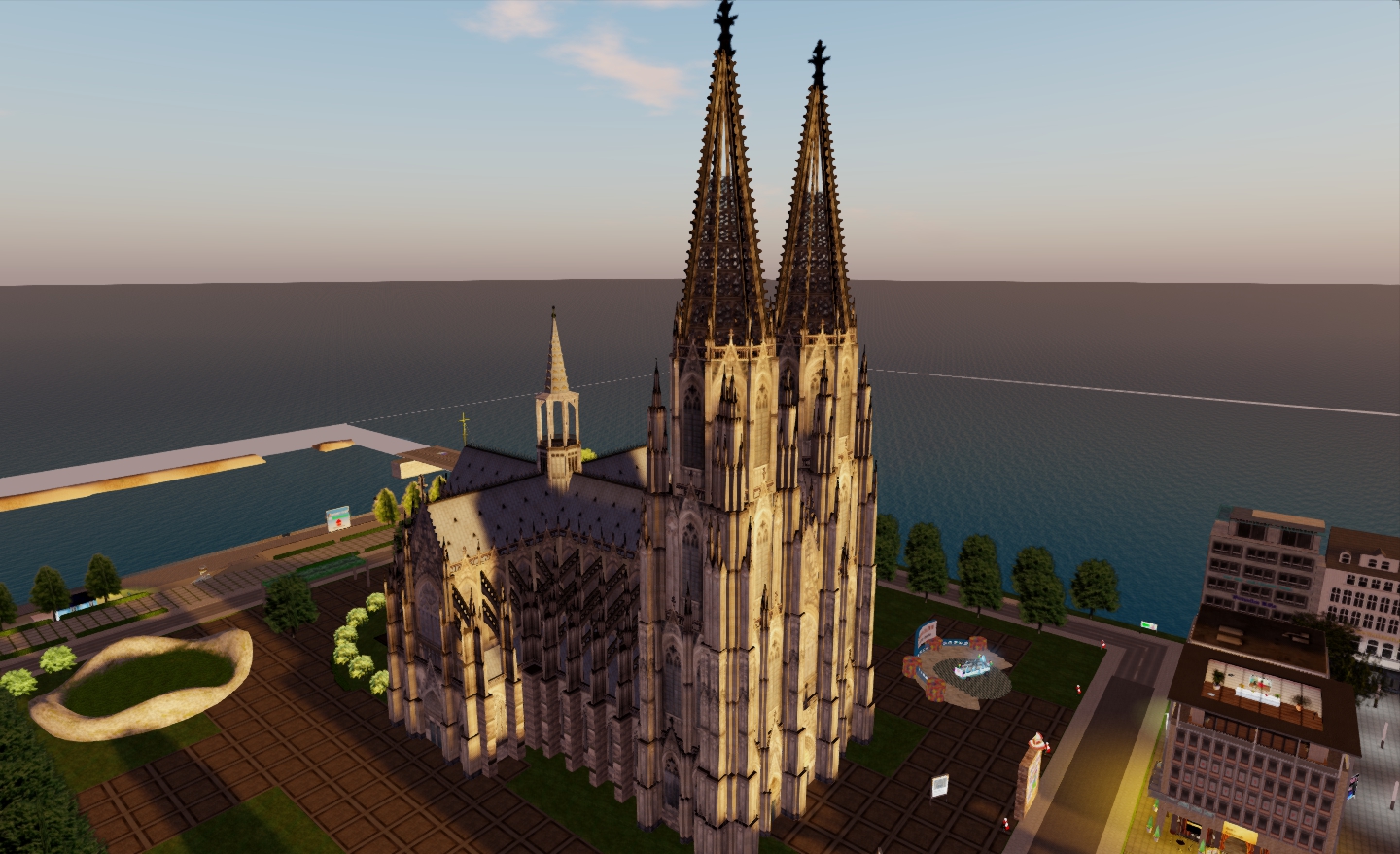
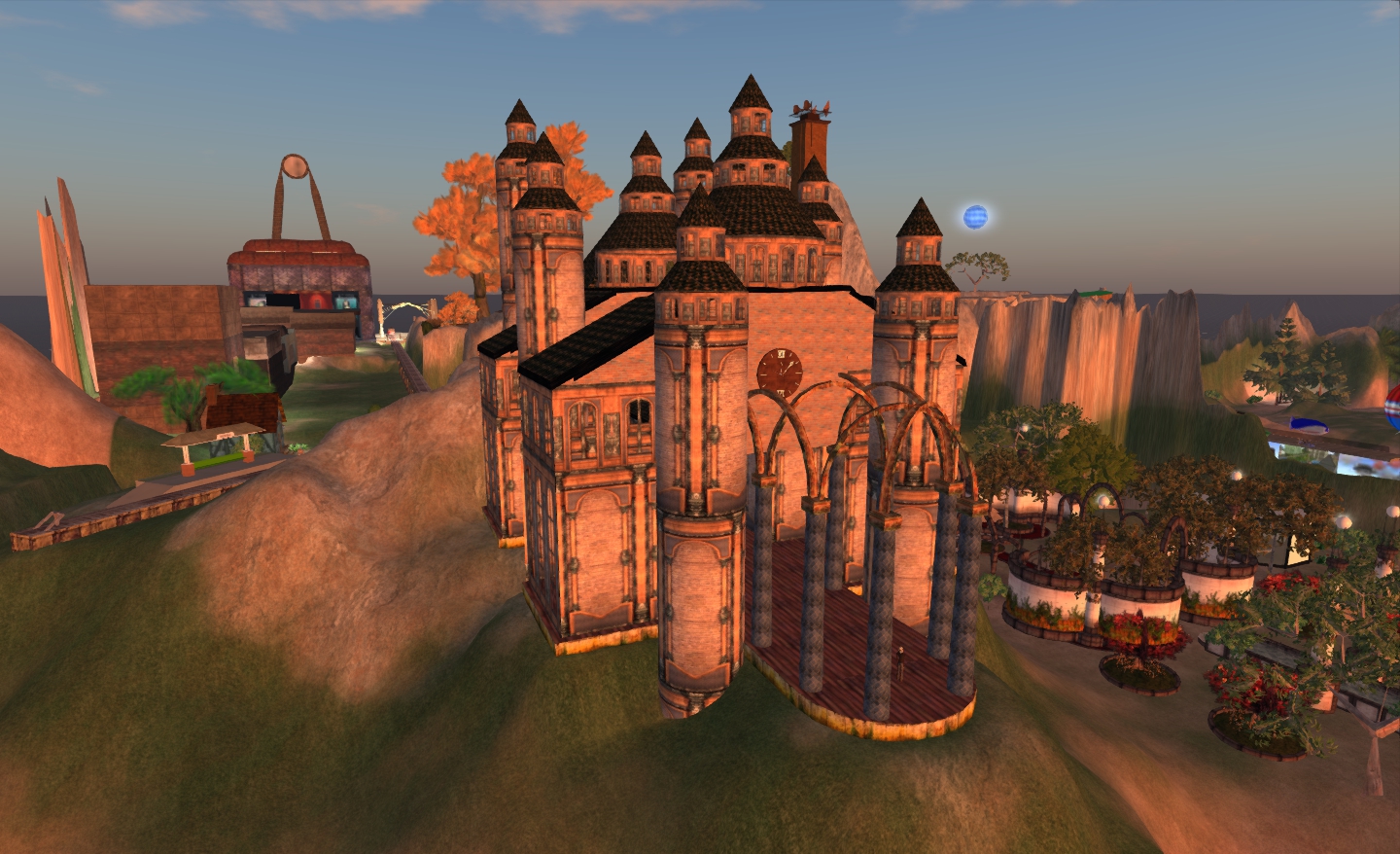
Working on Fallingwater put me in mind of some of the truly great builds in Second Life. One of the most famous is perhaps that of Cologne Cathedral / Kölner Dom. Taking up the majority of Koelner Dom (with the arrivals point on neighbouring Virtuelles Kolen), the cathedral is a powerful tour-de-force of what can be achieved in SL with patience, prims and high-quality texturing.
The build is the work of Seminal 3D, and has long been regarded as an example of what can be achieved architecturally within SL. The initial version of the cathedral opened in Second Life in 2007, and had the full support of the Cologne Cathedral Administration team from real life, and drew on the expertise of the Cathedral’s architect, Barbara Schock-Werner.
“Version 2.0” of the build has been underway since approximately late 2007, and I’m actually uncertain as to the overall status of things: there are still “under construction” signs to be found inside the build itself, together with notices outside relating to the renovations, but I’ve been unable to find any more recent news on the project than items dated mid-2011.
Nevertheless, the Cathedral is well worth a visit, particularly if you’re into photography in SL and / or are using a Viewer such as Niran’s or Exodus, which really bring the beauty of the build to the fore when using their enhanced graphics capabilities.
The magnificence of 13,000 well-ordered primsA beautiful use of textures captures many features of the original…which continues inside the build……and up to the ornate flying buttresses, seen here from one of the towers
There is sadly little in the way of internal details in the cathedral at present: the nave and transept columns are all present, as are most of the magnificent stained-glass windows, but of alter, seating, etc, there is nothing. It would be nice to see the inclusion of something like the Nave Organ, a 1998 addition to the original, perched high over the nave itself – but with the build apparently pushing the parcel limits, one can understand why such are not currently to be found.
The nave, looking east
Even so, for those that appreciate building and architecture in SL, as well as those who enjoy capturing the sights of SL in photos, Kölner Dom is worth your time for a visit.
Update:Enchanted Unicorn and Enchanted Swansong have been separated and extensively redeveloped and no longer appear as described here.
Enchanted Swansong and Enchanted Unicorn are described as “a magical atmosphere in SL where the forests are filled with fairy tale creatures and romance is always in the air” and where you can, “Live your dreams here in the land of the faeres.” They are operated by the Enchanted Unicorn group, with the larger, full sim of Enchanted Unicorn rated Adult, and the Homestead sim of Enchanted Swansong, created by Andrek Lowell, rated Moderate. Both are enchanting places to visit, especially for those into photography and / or romance.
Enchanted Swansong (foreground left) with Enchanted Unicorn beyond
Both regions use Windlight presets set to sunset, and I’d recommend that you keep these settings when visiting.
Enchanted Swansong is a tall, verdant forest within which wind water ways that run between tall trees and past candle-lit gazebos, the air filled with the rich sounds of nature. There are also green pools of water masquerading as lush grass – so be careful as to where you tread!
Walking through the trees, one does expect to come across a Mallorn tree or to hear soft, sweet elven voices singing in the distance – Enchanted Swansong has that kind of Tolkien-esque feel about it in places, even with some of the more ominous sounds audible from deeper in the woods.
Glades, gazebos and harps
If you are able to explore with shadows enabled – and particularly with a Viewer like Niran’s or Exodus with the “extras” active, exploring Enchanted Swansong gains an added depth as sunlight filters through the trees, and you path is dappled by shadows.
As you explore, you may come across a teleporter pad. Then leads the way up to the sky forest and the Roman baths, hidden overhead. For those romantically inclined, both offer quiet retreats in which to spend time. I particularly like the Roman baths, tucked inside a skybox; they remind me of a swimming pool at a country house hotel I like to frequent in summer here in the UK…
The Roman baths
Across the water to the west of Enchanted Swansong is Enchanted Unicorn, which also has a dedicated start-point. While still wooded, this is a very different enchanted land to that of Swansong. The music of the pan pipe hovers in the air together with birds’ songs and the sounds, perhaps, of spring; the trees are more varied and a greater feeling of faerie pervades the air. This is an adult region, and those of a sensitive nature should remember that fae nudity is accepted here. There are also gazebos, pavilions and tree houses where couples and friends can enjoy romantic trysts or meet for friendly conversation.
Like Enchanted Swansong, there is a teleporter to carry you skywards (or if you use the start-point, both around the sky and to the ground), which you can use to reach a ballroom, a club, hanging gardens and other delights.
The hanging gardens and Unicorn start-point floating beyond
Not everywhere may be reachable via teleport, however, so it’s worthwhile keeping your eyes open as you explore – there is a lot to find within Enchanted Unicorn both in the air and on the ground. One way to see more is to find the old white balloon and take to the skies, steering your way around the region while sitting in the basket admiring the view. Just be careful when sending the balloon home when you’re done as it requests – or you might end up standing on thin air!
Would you like to fly/In my lil’ white balloon…
The Enchanted sims make for a wonderful visit, regardless as to whether you’re into the fae scene or not – both are beautifully developed, and AliceDeejay Aya and Andrek Lowell have done a fabulous job in putting them together. Both are very photogenic and offer some wonderful opportunities for those key on SL photography. For those who enjoy faerie or are looking for romantic spots witin SL, or who simply enjoy exploring the sights of Second Life, Enchanted Unicorn and Enchanted Swansong together make a very worthwhile destination.
ballroom (l) and club, hovering over Enchanted UnicornEnchanted Unicorn as seen from Enchanted SwansongThe far pavilions – and nearby swing!
All images captured using Exodus 12.01.03(b), no post-processing applied. All images using deferred rendering, gamma correction, active depth of field. Tone mapping active in all but images (1) and (3).
Chestnut Rau is someone I respect very much and who knows her stuff when it comes to art in SL. So, when she makes a suggestion that I visit a sim in-world (as she did last year – shame on me for taking a while to get around to it), then I’ll sit up and take note.
Humanoid is one such place. The work of Wendy Xeno, it offers much to see and experience. Teleporting to the given landmark, you are asked if you’ll allow the region to control your Windlight settings – to get the maximum impact from the installation, you should. Also make sure sound is enabled.
Beneath you is a transcription that helps set the tone for your visit:
We never touch people so lightly that we do not leave a trace
Bach-ing at the doors
If you’re lucky on arrival, a cello plays JS Bach’s Unaccompanied Cello Suite No. 1: Prelude – and if you wish, you can try your hand playing it while considering where to go next (click the cello to start the music). Hearing this music did make me smile; I love the cello (though sadly cannot play it), and Bach’s Prelude is a favourite piece (and I’ve recently fallen in love with Steven Sharp Nelson’s upbeat version, wherein he plays eight cellos).
Around you stand nine doors, each of which leads the way to further explorations – although there are things to see around you on the ground before (or after) you do.
I opted to wander at ground level first, visiting the various islands, each with it own sense of solitude and peace, different ranges of thought and emotion stimulated by each one. For example, at one, I could think of nothing other than SL friends I like spending time with simply “being” and talking; at another, I found myself thinking of those in SL I have known and who have, sadly, departed from the virtual…
“Time present and time past”
The doors lead to more wonders to enjoy and experience – be they dancing together in some great hall, sharing a rowing boat on a moonlit night amidst glowing lilies, witnessing a circus or sitting in quite contemplation of a verse:
Only passions,
great passions,
can elevate the soul
to great things
“Are both perhaps present in time future”
I’m not sure why Burnt Norton sprang to mind while exploring the ground level areas (athough The Four Quartets is a favourite of mine); perhaps it was my overall frame of mind – or perhaps it was evoked by the scenes themselves. Either way, the lines did pop into my head, and they did – and do – seem appropriate.
“Other echoes Inhabit the garden. Shall we follow?”
Summer sun, autumn skies, the snows of winter – all sit behind the various doors – indeed, to say too much would be to spoil your explorations.
All snapshots in the article captured using Firestorm with default graphics settings & region windlight settings, with the exception of “Bach-ing at the doors”, wherein shadows were turned on.
A while ago now, Annon was recommended by a friend as being somewhere I should consider exploring. As I rounded-out 2011 with an exploration of Black Spot, another recommendation, I thought it would be good to resume my explorations in SL at the start 2012 by visiting another recommended destination.
Annon across the causeway – the monastery and castle
It is one of four sims owned and operated by Fallen Gods Inc., the others being Athan, Aear and Selidor – the last being home to the Fallen Gods store, owned by Alia Baroque. All four sims are Alia’s creations, and all are beautifully themed, presenting great opportunities to explore for romantics and photographers alike.
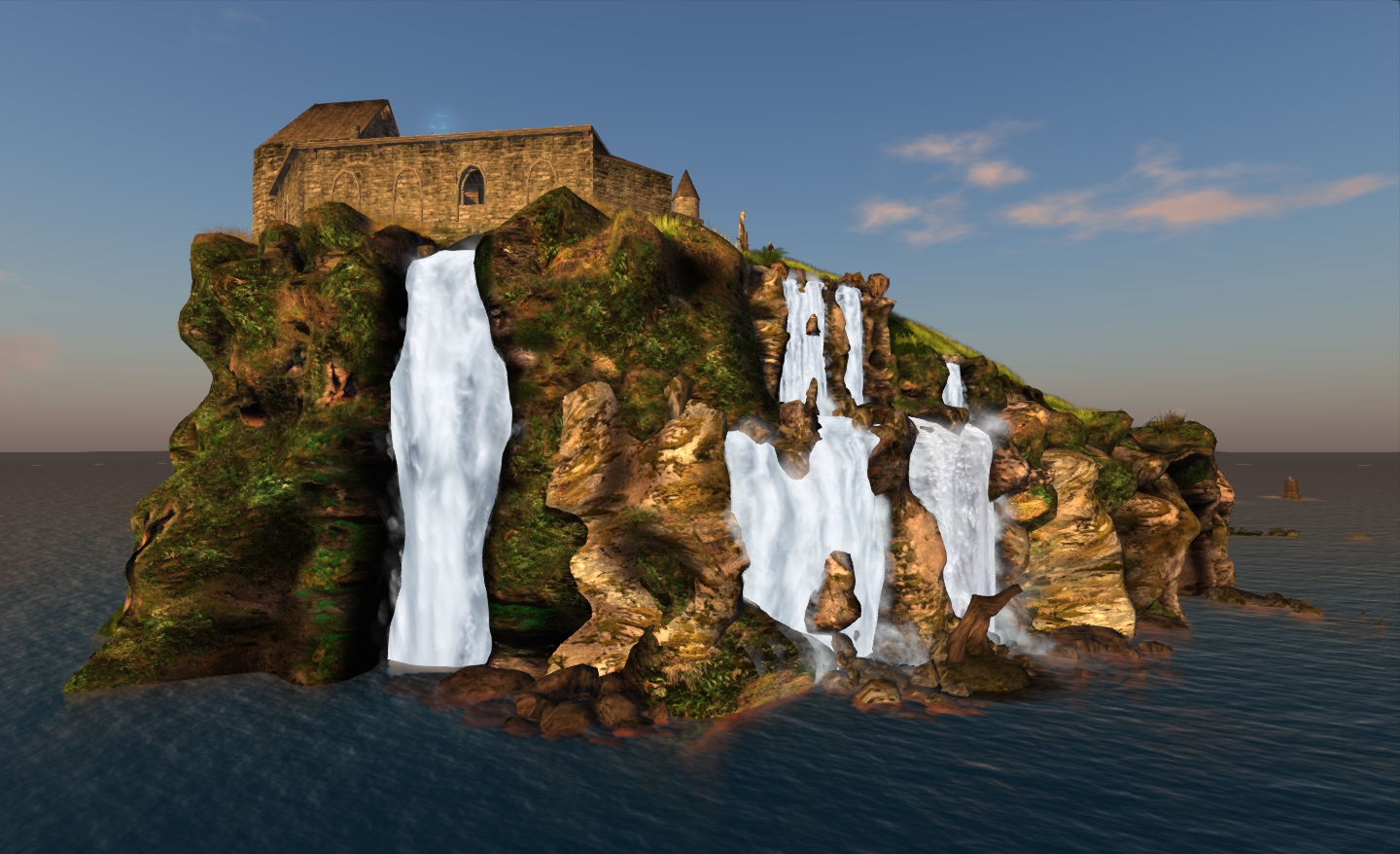
There are a number of arrival points within the estate; Annon’s brings you to a location just below a ruined monastary. Rezzing can take a little bit of time depending on your Viewer, but once complete, you can walk up to the ruins and explore them or admire the view across the water to the towers of an isolated castle, or out towards Athan to the south. Be careful when wandering the grounds immediately around the ruins – a lot of the rocks are phantom, so you can find yourself unexpectedly taking a rapid downward trip – especially near the waterfalls.
Annon: waterfalls and monastery ruins
The monastery stands on a lonely promontory, with a semi-submerged causeway leading south and to Athan, a group of small and large islands that can be explored, and which offer an assortment of places to visit – such as the “library / chapel” lying just to the east of the main island. This offers wonderful views across the water to the monastery and castle as well as offering a place to dance (to the music of a double choired harpsichord). Go downstairs and you can peruse the library or sit in quiet contemplation in the chapel-like area, or enjoy and sit and a chat.
From here, you can also take a rowing boat (by Lia Woodget wonder), and row your way around the sims. Using this to reach the castle will take you past the Pelican, one of Lia’s tall ships, which I imagined sailing aboard from Black Spot to Athan.
The “Pelican” sails …
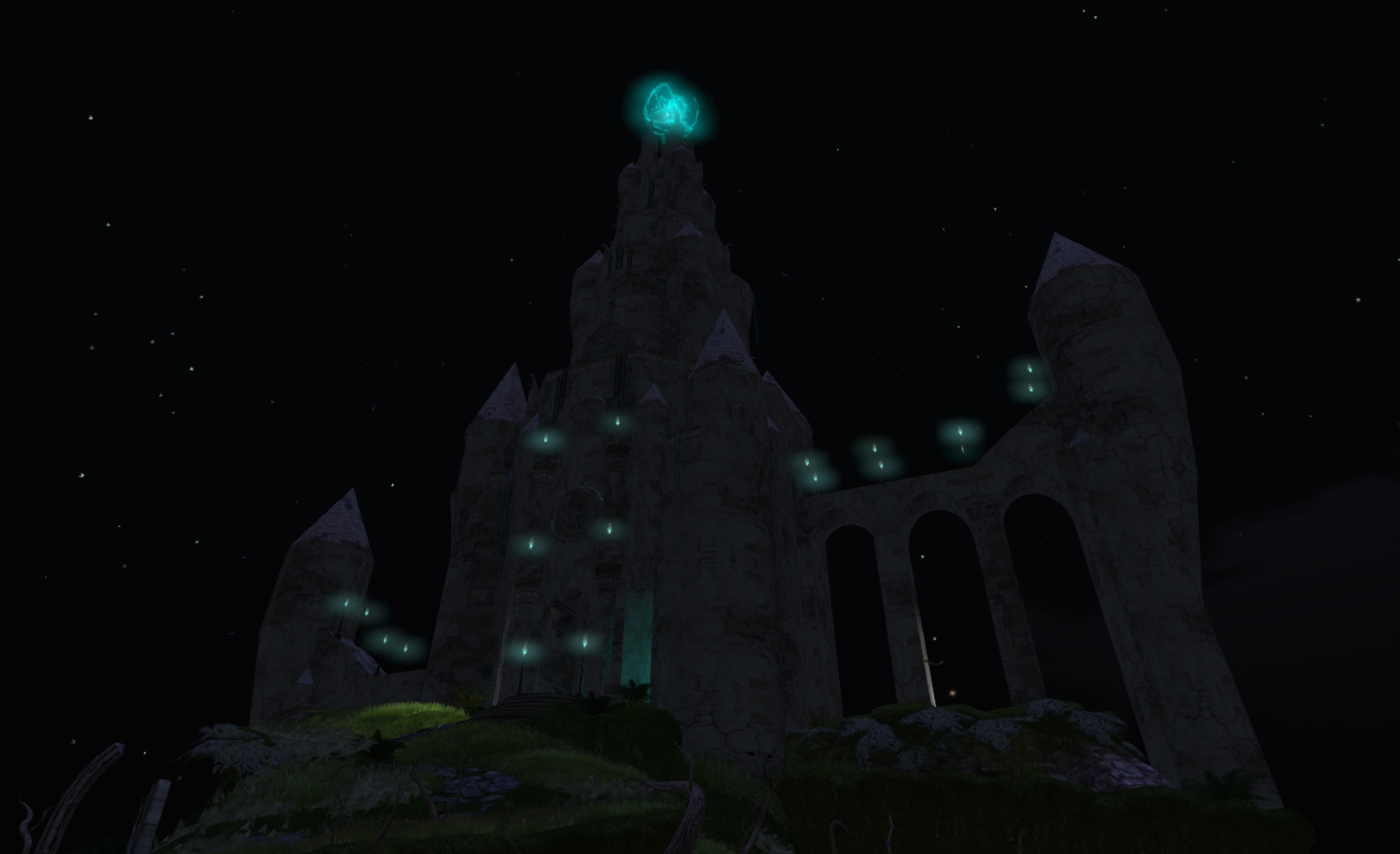
The castle itself is a little odd: tall and graceful with commanding views from the towers, it’s a little cramped on the inside in places, and the spiral and straight ramps can be a little tricky for those using the default camera settings. However, the upward climb is worth it for the photo opportunities (or you can cheat by camming 🙂 ).
Down below lay the dungeons, which appear to have been converted for use as a possible club area – at least according to the Destination Guide, although there are few overt signs that this is the case.
From here, even if you used a rowing boat to reach the castle, the only way back is to fly – which is a bit of a shame in some respects – rowing or sailing would be more fun. One way back is to fly over to the monastery promontory and then use the causeway to reach Athan; you may get a bit wet, but there are good opportunities for photography along the way.
The largest island on Athan similarly offers excellent opportunities for the photographer in amongst the trees and plants, and presents a pleasant walk as you progress south towards Selidor.
The castle by moonlight
At the north end of Selidor, a little to the east of the closest point between Selidor and Athan, you can grab a sailing skiff and explore – but be warned! The skiff has a habit of sinking out from under you if you stop at any point along the way!
Selidor is the home of the Fallen Gods main store, and the largest land mass in the group. The store itself is cleverly hidden, and the island is beautifully landscaped and terraformed in keeping with Annon and Athan, again offering a lot to see and enjoy.
Selidor cove
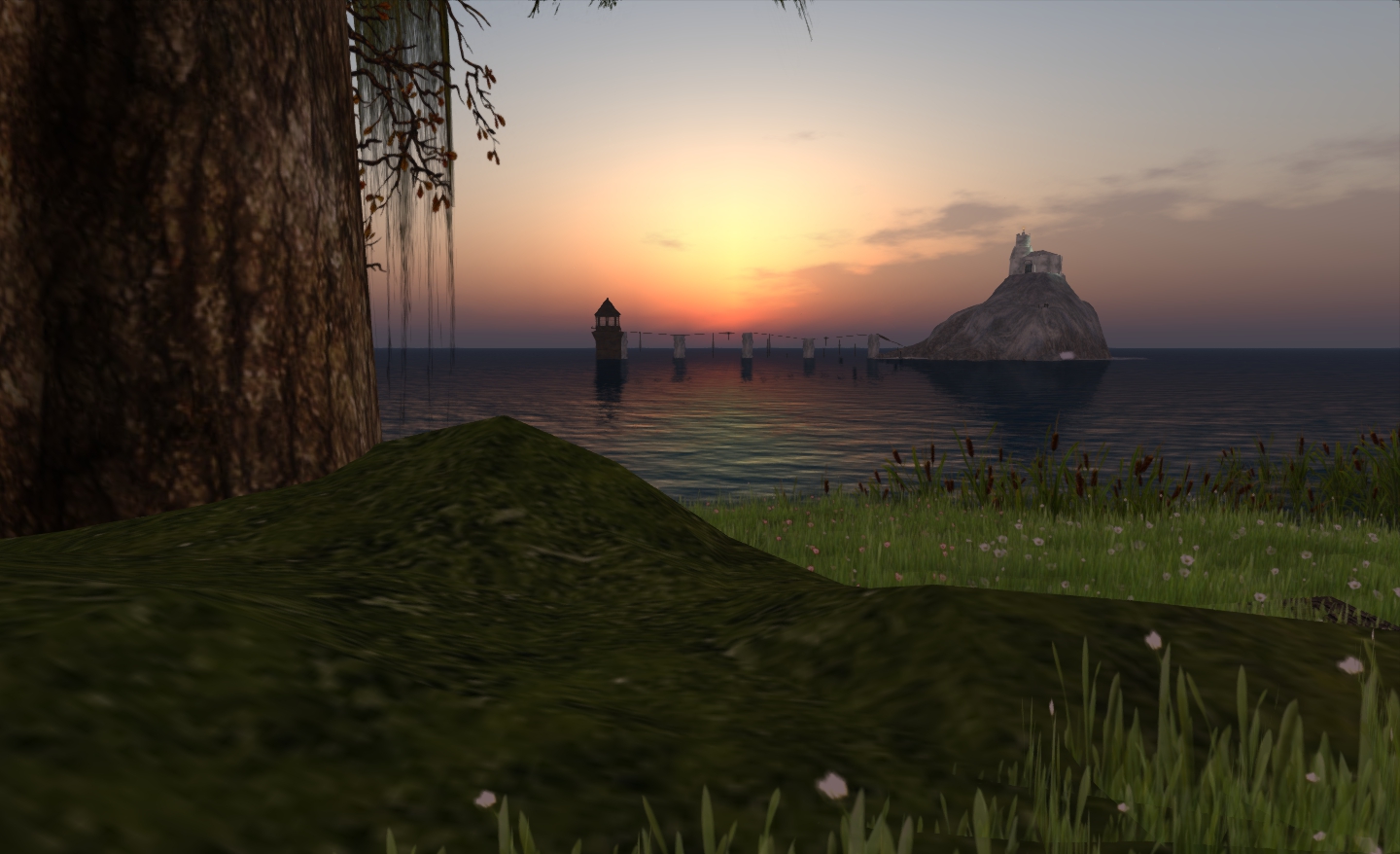
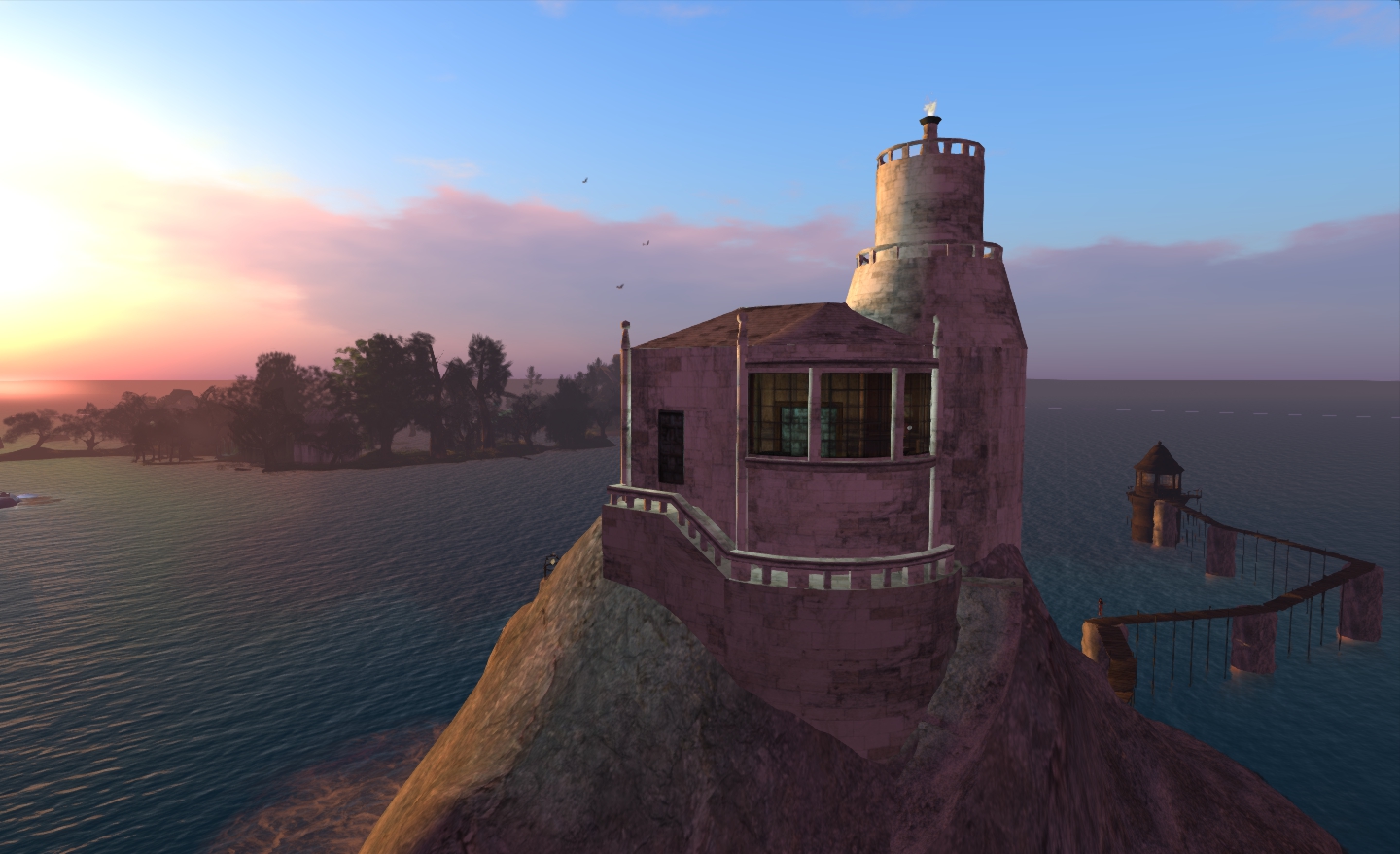
All-in-all, there is much to see across the sims – and I’ve not really mentioned the options for romantic dancing, such as out in the bay on Athan, with the lighthouse of Aear as a backdrop – or viting the lighthouse at Aear itself.
The lighthouse at Aear
For photographers in particular, there is a lot to recommend the estate – especially when you have the sun set to “sunset”, as I have for the majority of the pictures here. I would suggest exploring the regions with your sound turned on, as care has been taken to create a soundscape that gives an added depth to explorations.
It would be good to have more in the way of rowing / boating options to get about – flying seems to be cheating – but this is something of a minor complaint. When using both the rowing boat and the sailing skiff, I found the region crossings to be very smooth and painless (although neither type of boat was allowed into Aear).
I enjoyed my explorations, and will doubtless be back in the future.
There’s ship lies rigged and ready in the harbour
Tomorrow, for old England she sails.
Fair away from your land of endless sunshine
To my land of rainy skies and gales.
And I shall be aboard that ship tomorrow,
Though my heart is full of tears at this farewell.
-The Last Farewell – Whittaker & Webster
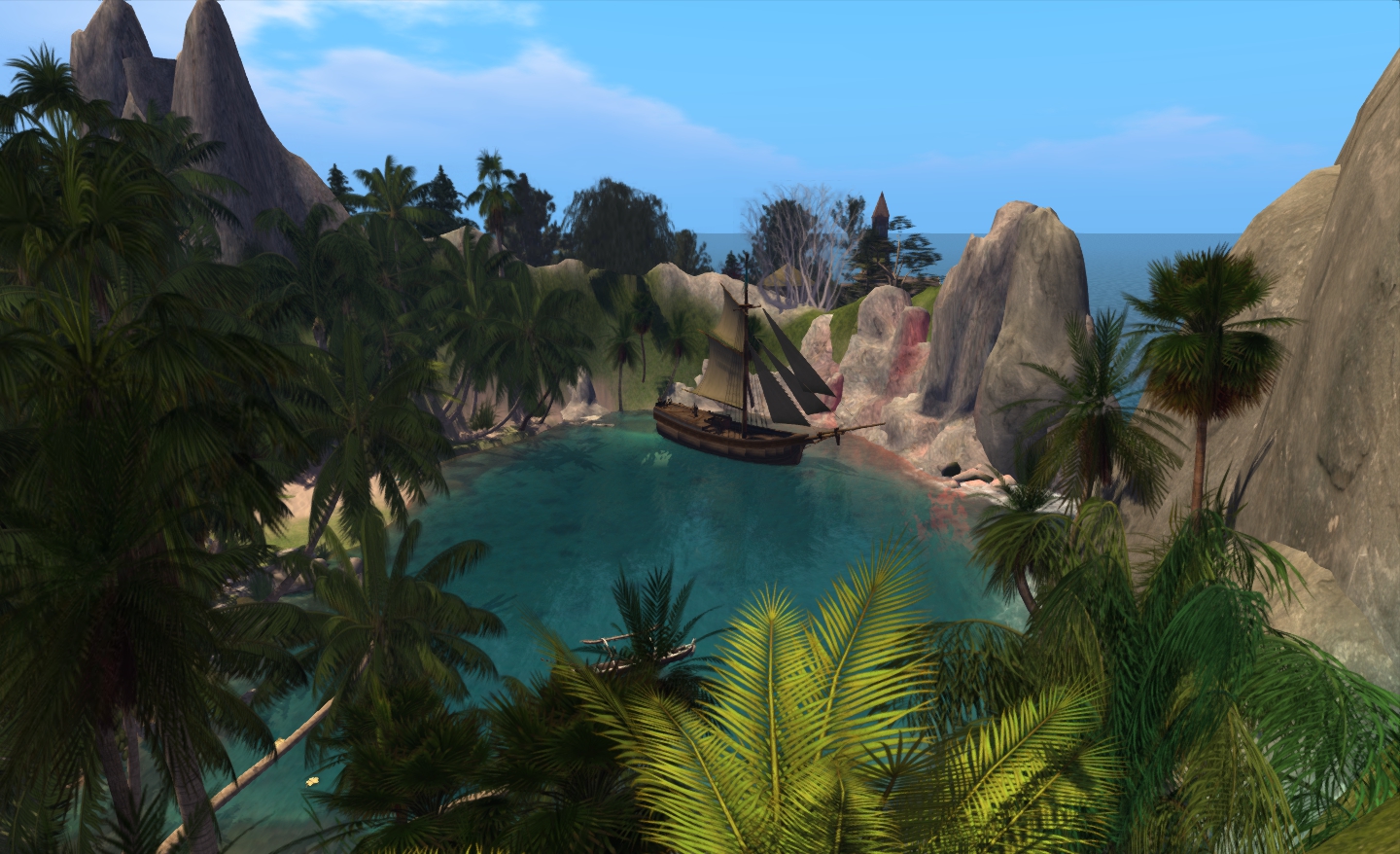
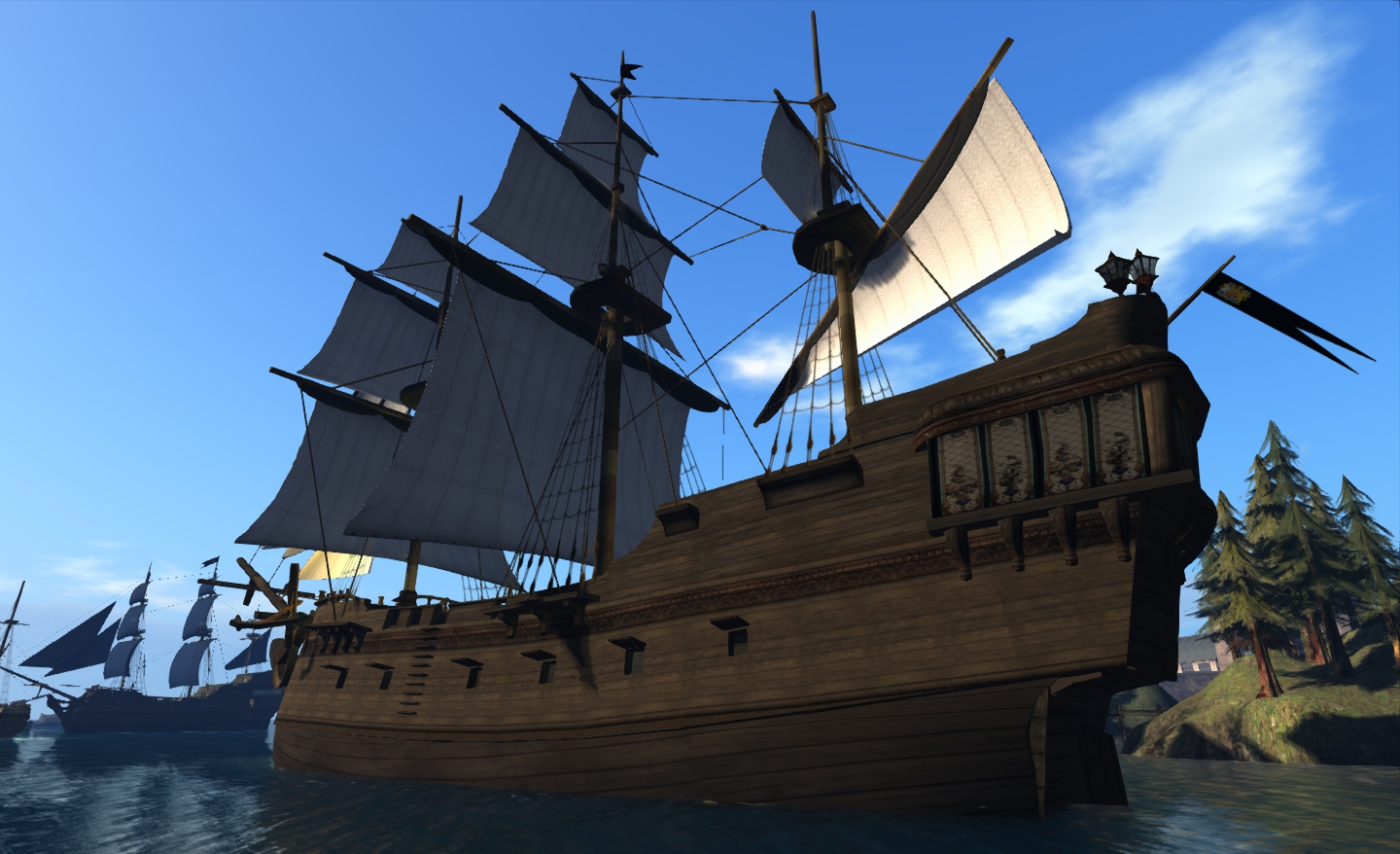
Since starting writing pieces on some of the places in SL I particularly like, I’ve had numerous suggestions and requests relating to places I might enjoy visiting. One such suggestion came from Ayesha Askham-Ezvalt, who pointed me towards Black Spot. As a lover of tall ships (albeit the clipper variety, admittedly), it was a place I had to visit.
Black Spot is one of three sims devoted to tall ships of the pirate / buccaneer type, the other two being Dead Man’s Chest and Ace of Spades. Black Spot and Dead Man’s Chest have been developed by Lia Woodget, with Ace of Spades developed by Giacobetta Oliva. All three form a common theme that showcases Lia’s tall ships and Gia’s tour systems, and you can wander around the ships, take a rowing boat between the various islands and explore Lia’s shipbuilding hideaway.
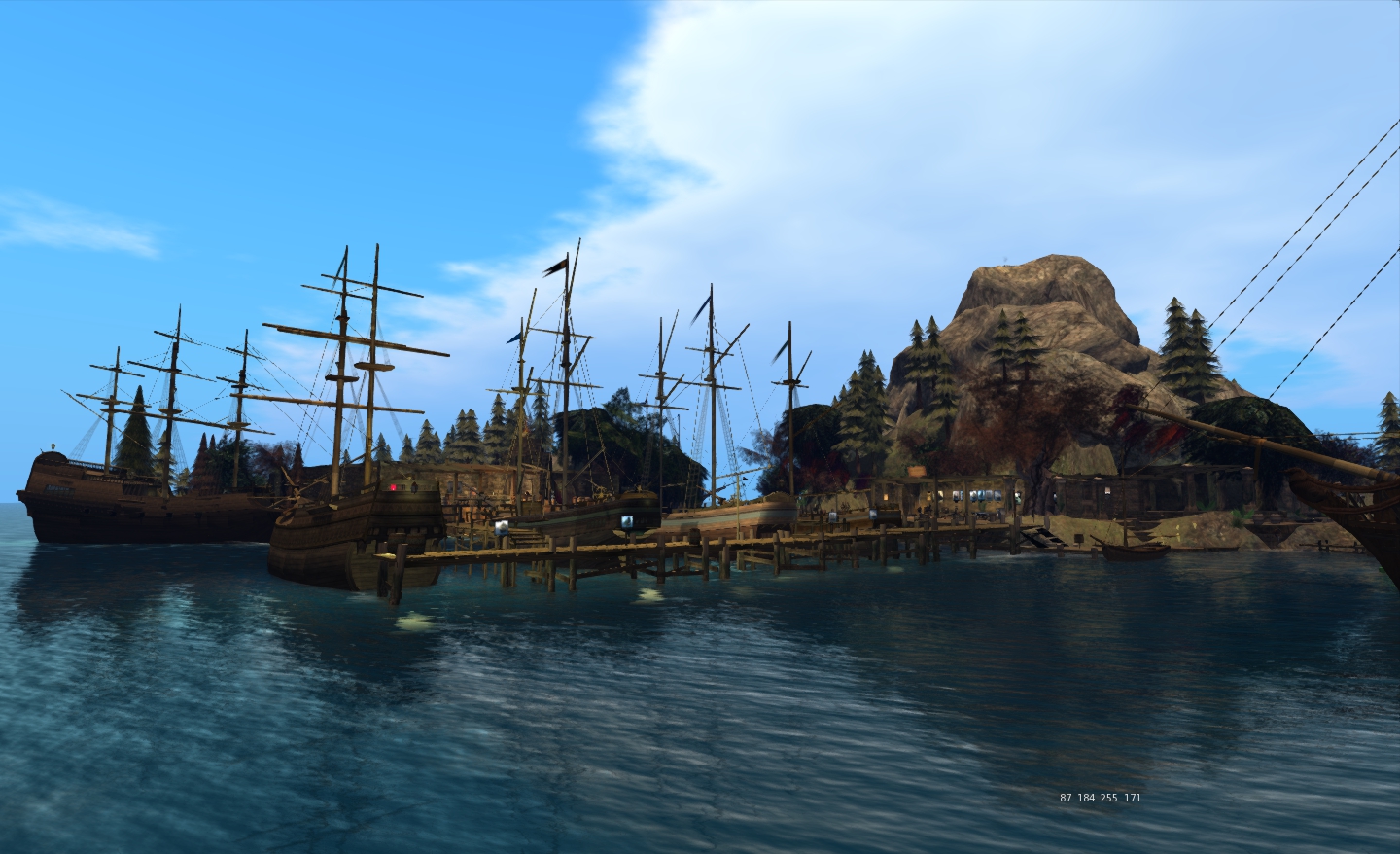
Black Spot harbour: “All I ask is a tall ship…”
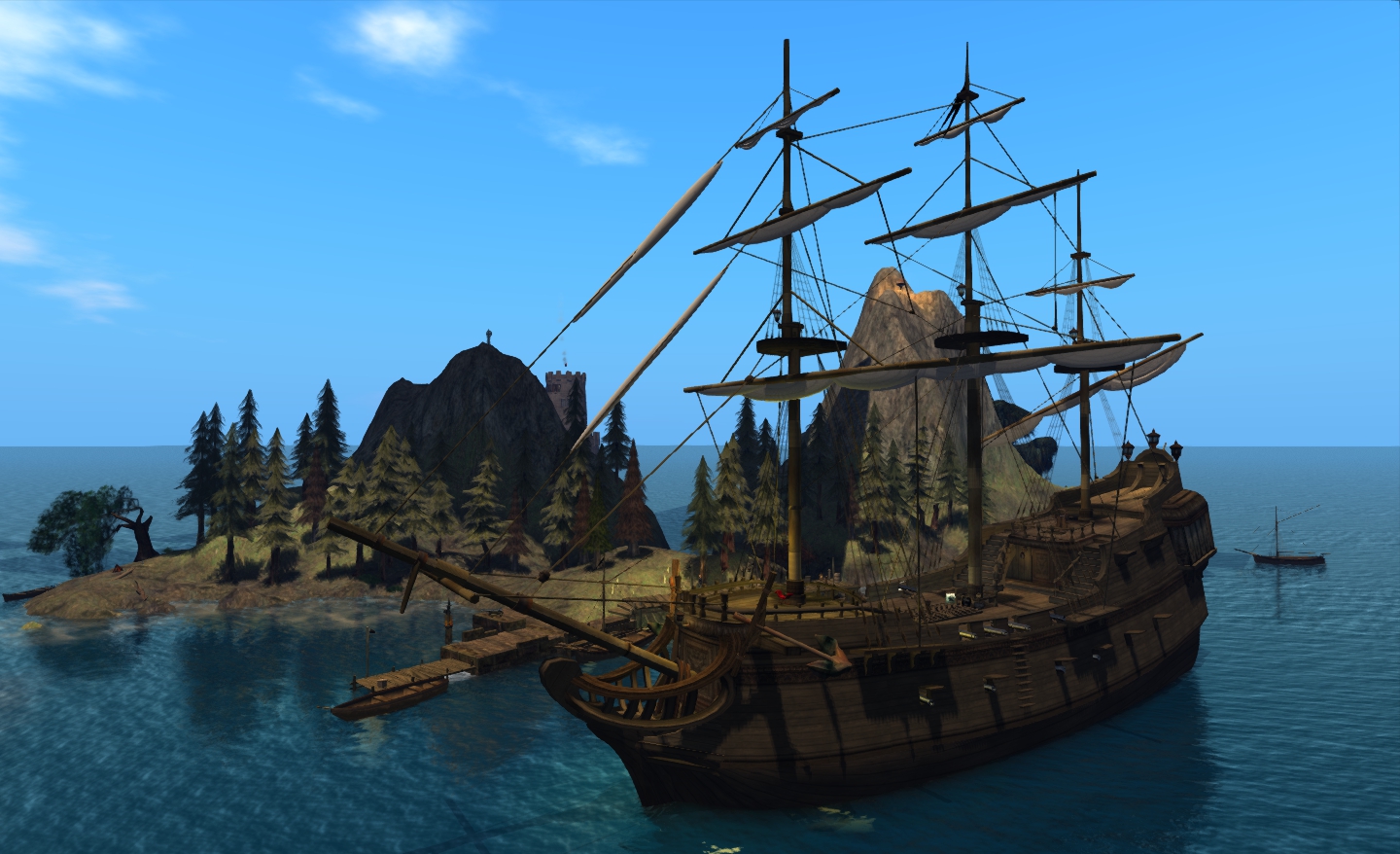
There really is a lot to explore and enjoy here; and Black Spot also makes for a quiet retreat set in the wide ocean. Lia has put a lot of attention on breathing life into the sims, with vessels anchored in the lee of the isles, tied-up alongside wooden quays, or sailing in on the tide.
The ships themselves are magnificent, the hulls and fittings beautifully detailed, and you can explore their decks in turn, decide if the sails should be furled or not, and – if you’re so minded – purchase a copy of any that are for sale. There is enough room below deck on the larger vessels to make them into a highly original home…
“And the wheel’s kick and the wind’s song and the white sail’s shaking…”
At the quayside on Black Spot island itself, you can explore the smaller vessels Lia builds, or walk around her slip, where another is under construction. You can also wander into the shipwright’s hideaway under the hill of the island, and explore the secrets it hides….
It is here that you can take a boat across the water to Ace of Spades, or you can walk through vaulted chambers, passing stacks of kegs full of rum…or are they full of gunpowder for the cannons outside? There are chests with gold coin scattered around them that leave you wondering whether this is a simple shipwright’s hideway and yard, or whether it really is the secret lair of buccaneers who roam the high seas, looking for unwary prey.
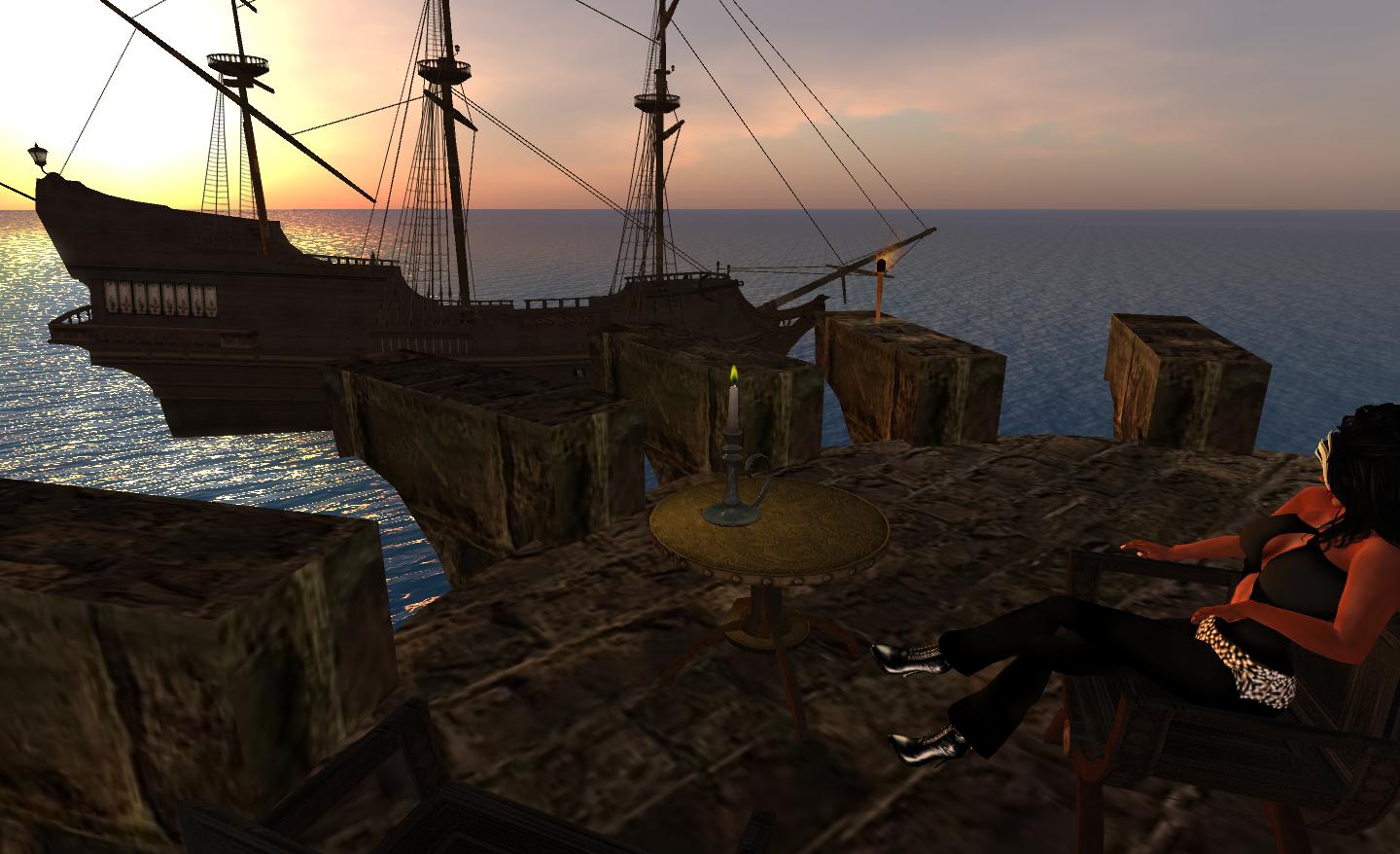
Walk on through dust-laden sunbeams as they fall through hidden windows and climb the stairs to discover books and charts, then up higher to stone turret overlooking the sea, and another ship as she sits at anchor – or is perhaps sailing on around the headland. Here you can sit alone or with a friend, watching as the sun sets out over the ocean, silhouetting the ship and carrying you back to bygone days.
“And all I ask is a merry yarn from a laughing fellow-rover, And quiet sleep and a sweet dream when the long trick’s over.”
Back in the cavernous hideaway, as I mentioned, you can find a skiff waiting to carry you across the water to Ace of Spades, and Gia’s island. Take a seat and enjoy a smooth journey as you slip out from under the protection of cavern and cove and across the sim boundary. Here stands and old fort, home to Gia’s tour systems – of which the row boats used to get around the islands are a part. Here, as well, you can take a larger skiff out under sail and tour the waters of the regions – but be wary of the sim boundary when you start out…and don’t spend too long on the water…you might find out how risky sailing can be!
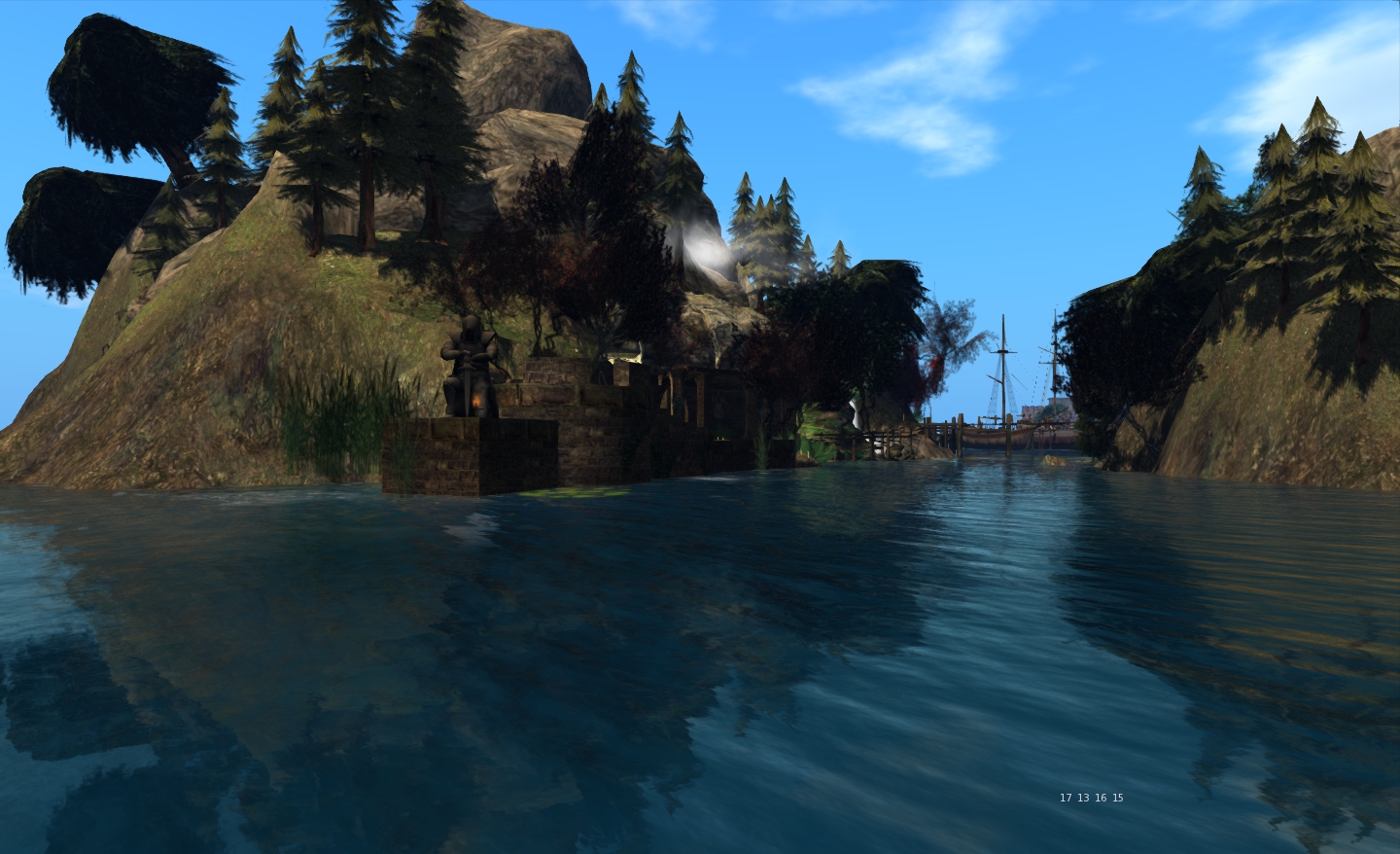
The narrows
If you prefer, you can use another of Gia’s rowboats to reach Dead Man’s Chest – or for the very daring take a ride around all three sims on a witch’s broomstick! However, this also may have its perils…particularly if someone has “parked” a ship along your line of flight…
Dead Man’s Chest is less tamed than Black Spot, the wooded isle offering natural vantage points to admire the harbour or look out over Captain Albus Weka’s fort and store. You can also board the mighty Elysium and wander her decks.
All-in-all there is a lot to see and enjoy when visiting Black Spot, and in some respects, I’ve just scratched the surface – so why not take a look yourself?
The past is really almost as much a work of the imagination as the future.
– Jessamyn West
There are times when we all mourn for the past; it’s a place, to paraphrase another saying, we cannot revisit, no matter how much we desire.
Except in Second Life.
Much has been written over the last twelve months about what has been lost in SL, regions, builds, places that stirred memories – and it is true that much has gone. But it is also true that much has been preserved and still stands today as living reminders of what Second Life was, how it began and how far it has come. Visiting them can be a magical mystery tour of delight.
Contained in a modest build, itself a reminder, perhaps of simpler times in-world, the SL Historical Museum is a goldmine of information and images that offer a unique look back to the earliest years of Second Life. Here are logs from town hall meetings (remember those?). There is also an archive of release notes from the early days which reveal a lot about Second Life’s development. Take these extracts from the release of version 0.2.0, on December 16, 2002:
For best performance, close other applications before running Second Life in order to free up your computer’s memory. If the computer runs out of memory, Second Life has a tendency to become unresponsive and you will move through the world in 10 second halting steps.
===Improved World Performance=== * Objects come in faster when you are flying.
===Avatar Enhancements=== * Avatar make-up can be applied during customization. * Underwear automatically removed when you swap outfits so no more unsightly incidences of cotton briefs peeking out from beneath your clothes. .
.
. * More reliable sitting behaviors. * When holding Alt key and moving camera, you can more easily zoom in on objects without losing focus on the object ? it?s magic!
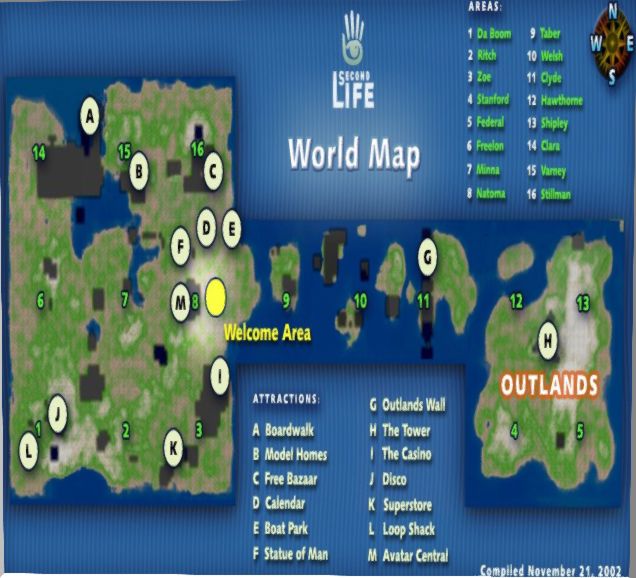
Within the museum you can also discover the meaning behind hippos! and how they became a part of the SL subculture (and still are, just try CTRL-SHIFT-ALT-H!). There is also a gallery of images from the early days – and some of them are real eye-openers. Take the World Map, for example.
Second Life circa November 2002
In the museum you can also find out what it was like to be a Primitar – there is actually a Primitar avatar, complete with HUDs, available, and learn about SL’s original taxi service and why i came into existence (and I have to admit, that’s a part of SL lore that had passed me by!).
The museum is associated with the SL Wikia (not to be confused with the “official” wiki), which provides further and deeper insight into the entire history of Second Life, including the development of avatars, the Viewer, and so on. It was actually through the Wikia that I became aware of the in-world museum.
Orientation Station
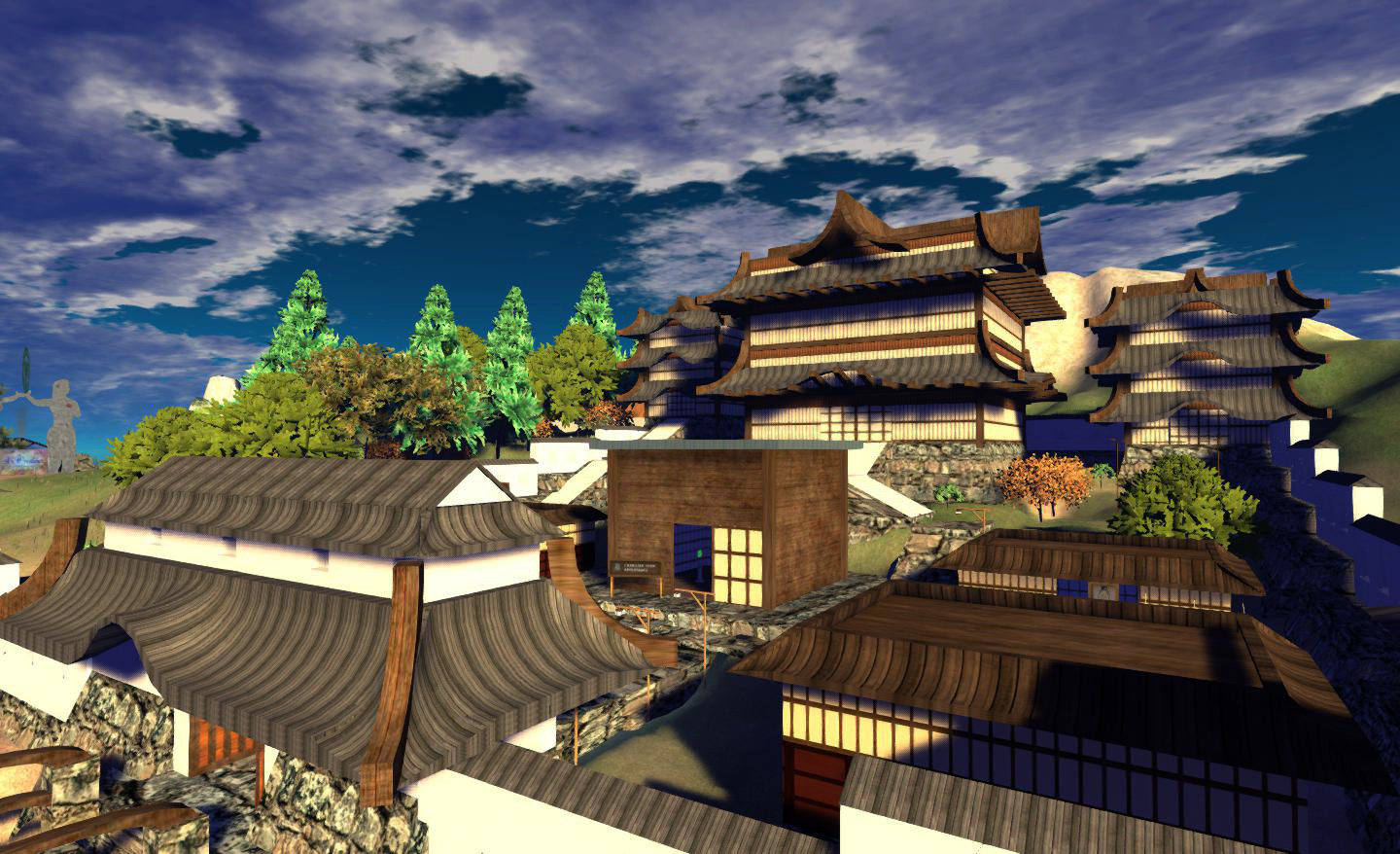
Before there was an Orientation Island or Welcome Island or parrots squawking at you, there was the Orientation Station where newcomers could discover and how and what of using Second Life. Created by Yuniq Epoch (who was also behind the original Yamato project), this Japanese castles provided information boards notecards and practices routines (such as putting a beach ball on a table) to help people get to grips with the fundamentals.
The information is now well out-of-date, but you can visit the Orientation Station at Dore – if nothing else, some of the images stand testimony as to just how far SL avatars have come, appearance-wise!
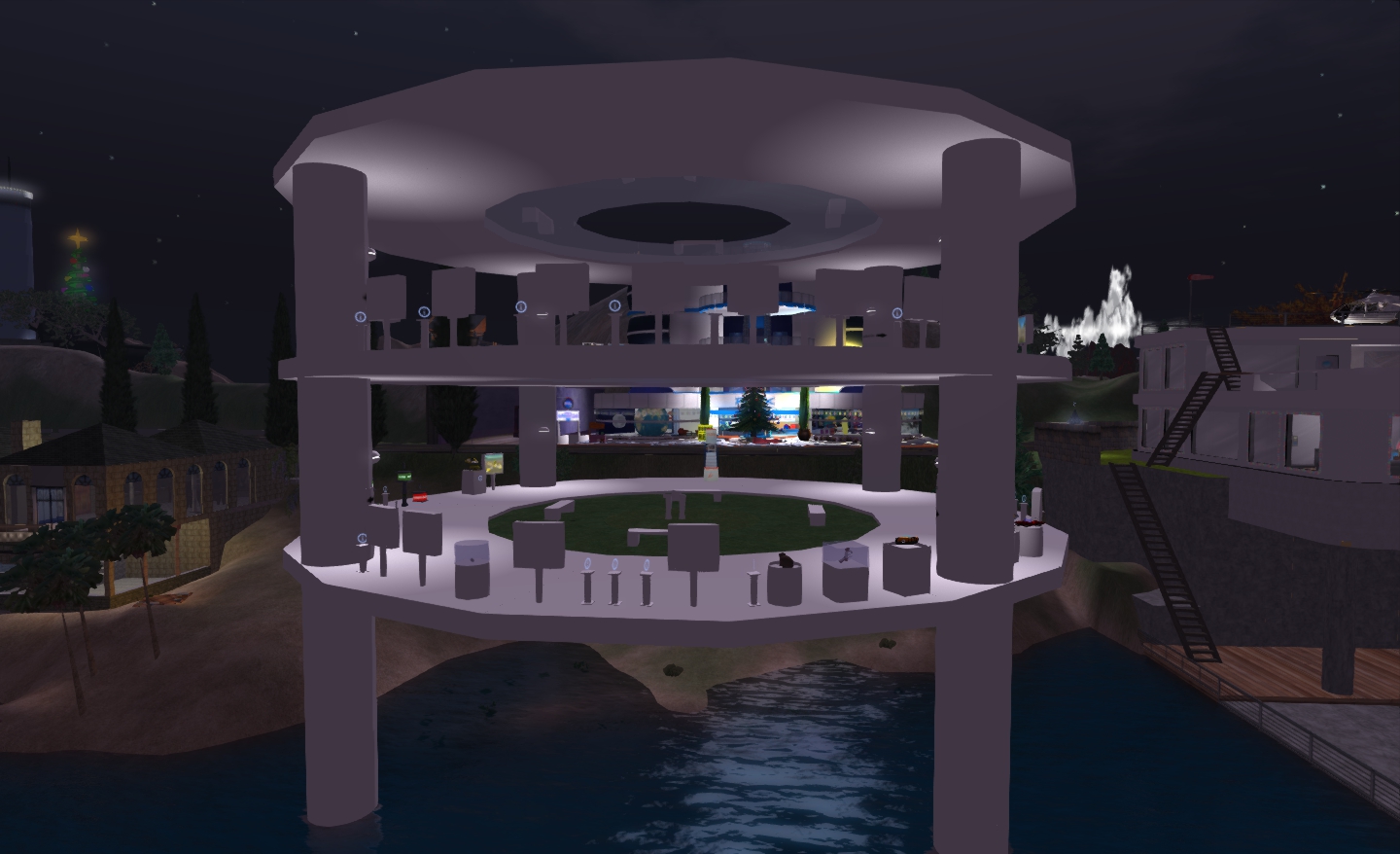
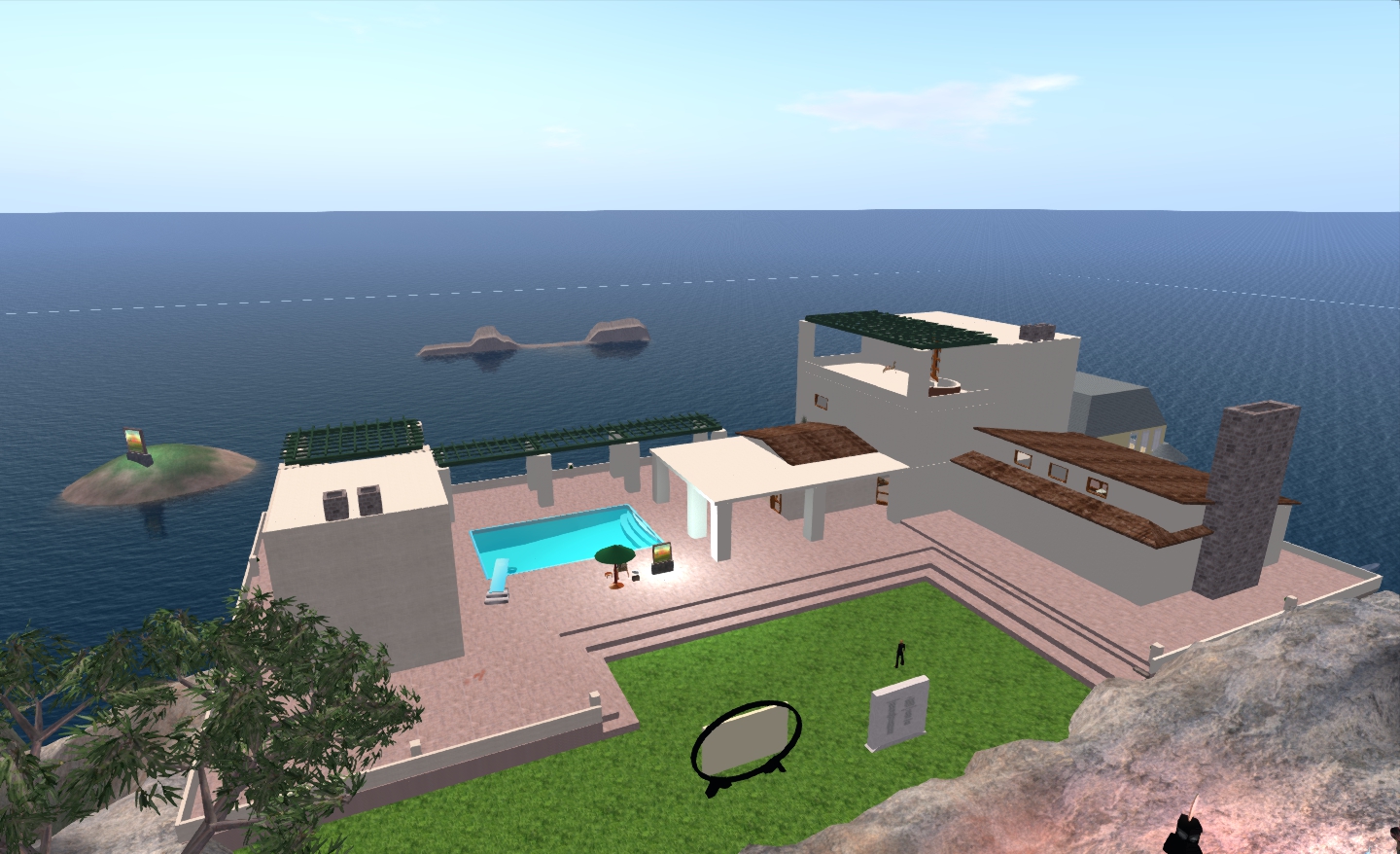
No trip into SL’s past would be complete without a visit to the home of SL’s mythical Governor. The mansion dates from 2002 and may well look utterly primitive by today’s standards, but back then it stood at the forefront of building techniques within SL.
Here there are no sculpties, no scripted doors (all doors that can be used stand conveniently ajar) and the textures are fairly basic. For those that worry about Land Impact and prim counts on houses today, the Mansion is an eye-opener, where every single step in a staircase is a prim, as is every single cross-member in a lattice roof. Windows are glass-less (although I have no idea as to whether this is because SL didn’t support transparent textures at the time, or simple to save on prims!) and the furniture simple in design.
In the basement are more pages from history – FAQ notecards from 2003, a time capsule stamped “Do not open till June 2004”. On the lawn in front of the mansion you can find a plinth naming some of the earliest Linden employees, including one “Hacker” Philip Linden, the much-missed Robin Linden and Cory Linden.
There is a fifth dimension beyond that which is known to man. It is a dimension as vast as space and as timeless as infinity.
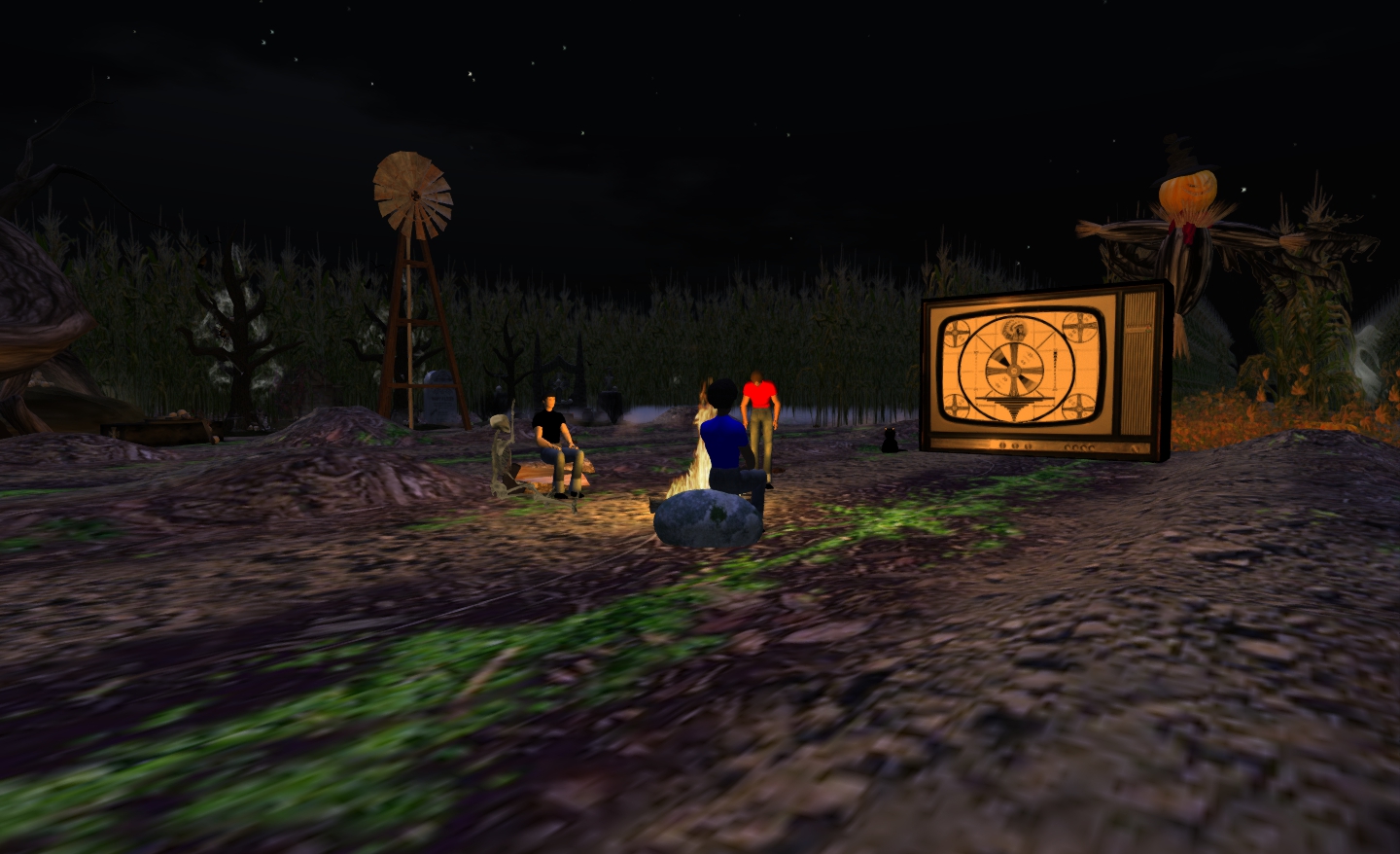
So opened the TV series The Twilight Zone – at least in part. It is from an episode of that series – It’s a Good Life – that SL’s most mythical destination was born: the Corn Field, a place where those avatars who had been bad would be banished to contemplate their wrong-doing.
The star-lit field of corn, cut-off from the rest of Second Life original existed in the Northwest corner of Orientation Island 1. Today, it has been recreated across four sims, all spookily identical, which you can wander through and meet the poor, lost souls.
Another example of early SL architecture – this one dating from 2004 – is Nephilaine Protagonist’s Mocha Cathedral. The simple, elegantly clean lines of the cathedral were of huge influence to other builders in 2004, especially those striving for a “real” look and feel to their work. Here you can wander through the cathedral, and if you are so-minded, light a prayer candle, naming it for whatever is in your heart.
There are several other examples of early SL to be found around the grid – Baffin Island, the Climbable Beanstalk, the Stillman Bears. Many may seem quaint by today’s standards, but as historical pieces, they help remind us just how dynamic Second Life is. If you have some time you’d like to spend exploring, why not take a dive into SL’s origins via the Destination Guide.