Taking an early winter’s walk

The Pines at Jacob's Pond, Jacob; Inara Pey, October 2014, on FlickrThe Pines at Jacob’s Pond, Jacob (Flickr)

I last visited The Pines at Jacob’s Pond in February 2014, when an early spring was in the air. Now, with many regions embracing an autumnal feel in keeping with the turning of the seasons in the northern hemisphere in the physical world, The Pines has embraced a wintry scene.

The Pines at Jacob's Pond, Jacob; Inara Pey, October 2014, on FlickrThe Pines at Jacob’s Pond, Jacob (Flickr)

The new scene brings with it a new design for the region. The lake is frozen, snow lies heavy on the surrounding farmlands and in the boughs of the trees; deer forage for grass and horses exhale colds of warm breath into the cold morning light.

The Pines at Jacob's Pond, Jacob; Inara Pey, October 2014, on FlickrThe Pines at Jacob’s Pond, Jacob (Flickr)

Dacotah Longfall, who designs Jacob’s Pond, offers a warm welcome to visitors arriving in the small cabin on the south side of the region, inviting them to enjoy her backyard – and noting that clothing is optional. With the snow on the ground and the misty look to the air, I’m not sure this is advisable!

The Pines at Jacob's Pond, Jacob; Inara Pey, October 2014, on FlickrThe Pines at Jacob’s Pond, Jacob (Flickr)

Snowy paths wind across the region, with lamplit bridges helping to guide the way over the frozen streams, guiding the way around the lake and to the barn, and to farmhouse up on the hill to the north. These don’t have to be followed, visitors can wander as they please, and – as ever – there are plenty of opportunities for photography.

All told this is a another delightful redressing of a region which never fails to please. It might seem a tad early for thinking about the depths of winter, but The Pines at Jacob’s Pond presents the perfect image of snow and crisp skies we probably all love.

The Pines at Jacob's Pond, Jacob; Inara Pey, October 2014, on FlickrThe Pines at Jacob’s Pond, Jacob (Flickr)

The Pines at Jacob’s Pond forms a part of the End of Time group of regions, if you’ve not visited the estate, I can only recommend that once you’ve explored The Pines, you pop across to Nu Haven, Tide, Eotia, Wabe, Crow, and Gyre. All make for wonderful exploration.

Related Links

More than Just Another Tequila Sunrise

Just Another Tequilla Sunrise, Isle of Love; Inara Pey, October 2014, on FlickrJust Another Tequila Sunrise, Isle of Love (Flickr)

I was led to Just Another Tequilla Sunrise by Kate Bergdorf, who mentioned it in her blog recently. A homestead region, it is currently painted in rich autumnal colours which make it an absolute delight to visit on these (for those of us in the UK at least), damp and dreary days.

The work of SL photographer Arol Lightfoot, the region’s name is a perfect reflection of its look and feel under the default windlight (although I admittedly used others when taking my own snaps).  Photographers are warmly invited to explore and take pictures, and Arol has created a Flickr group where images can be shared, if people wish.

Just Another Tequilla Sunrise, Isle of Love; Inara Pey, October 2014, on FlickrJust Another Tequila Sunrise, Isle of Love (Flickr)

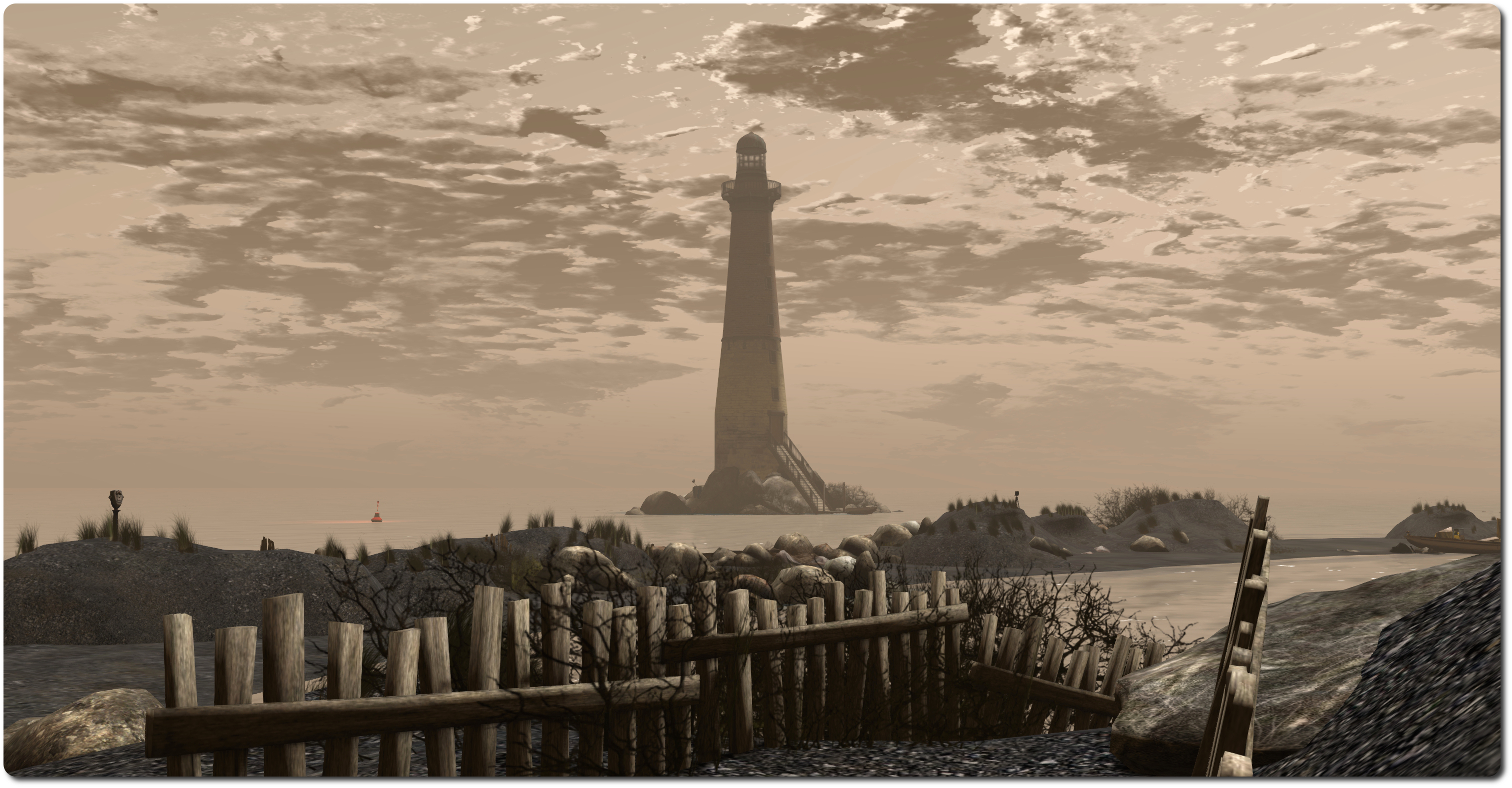
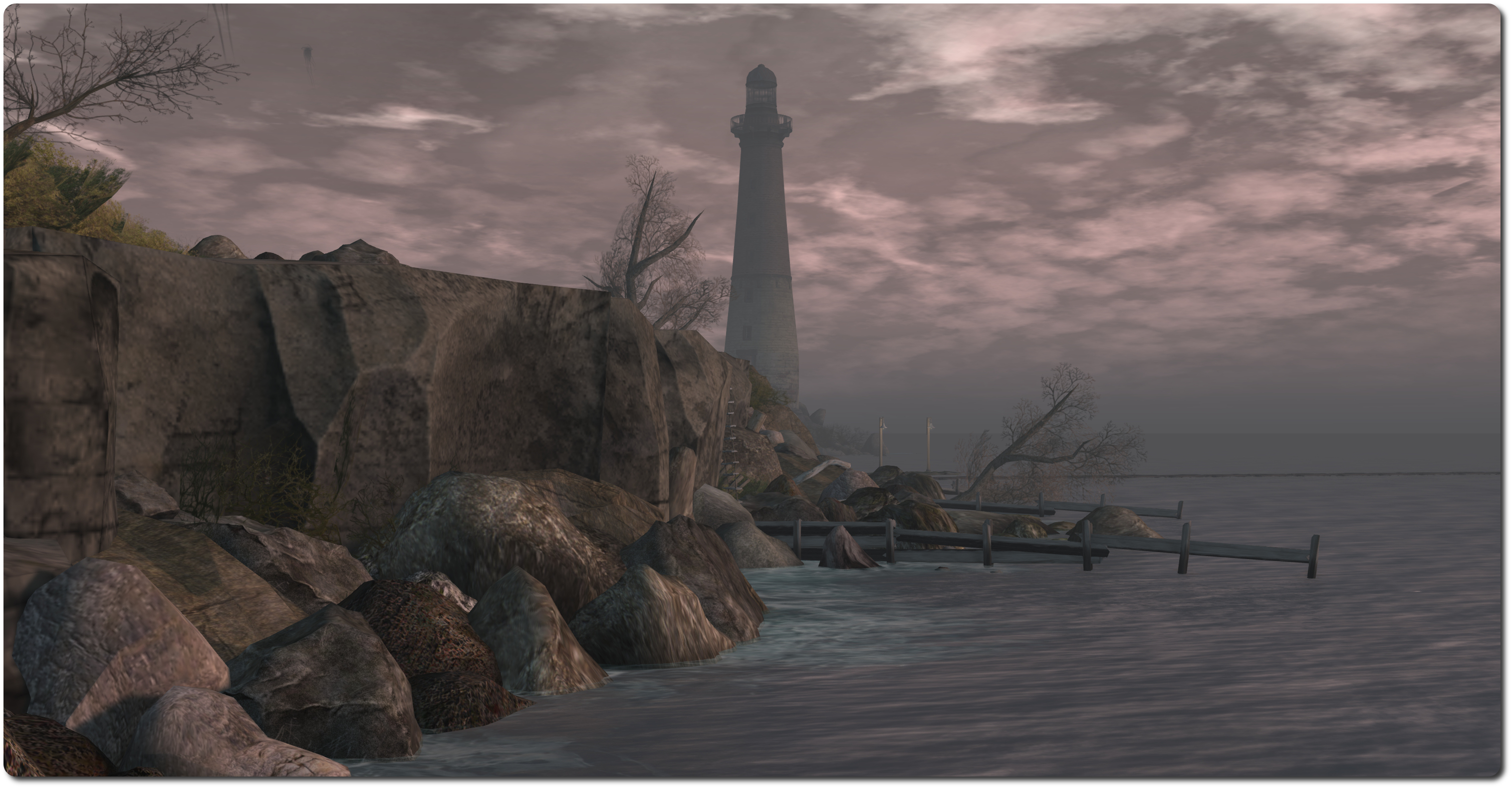
For those who explore SL a lot, there are a number of familiar motifs here – the offshore lighthouse, the craggy upthrust of a rocky plateau, the low-laying lands broken by bodies of water, the sweeping white curve of a beach… Which is not to say that Just Another Tequila Sunrise is in any way derivative; quite the reverse in fact. In a world where people are limited in how they can take an island 256 metres on a side and blend it into the surrounding sea, it is inevitable that regions come to share familiar elements while still retaining their own individuality from one another.

More than this, however, is the fact that such familiar elements within individual region designs help to give a feeling of continuity as one travels through SL. When encountered, they can help make individual islands feel as if they are different elements of the same country or coastline, rather than being individual places, more-or-less standing on their own.

Just Another Tequilla Sunrise, Isle of Love; Inara Pey, October 2014, on FlickrJust Another Tequila Sunrise, Isle of Love (Flickr)

Two areas of habitation mark the island. On the west sits a small farm, the ribbon of a lake reaching almost to the front door of the house. To the east, and built out over one of the two beaches, sits a wooden pier topped by a sun-bleached house. Between them the low-lying grasslands offer plenty of space to wander, with places for individuals, couples and groups to sit and enjoy the surroundings. Bridges, both stone and wooden, allow easy passage over the water, and a path cut into the rock guides those so minded to the top of the southern plateau.

With the sounds of nature throughout and birds wheeling overhead, Just Another Tequila Sunrise is, as noted above, an absolute delight to visit, and guaranteed to brighten the dreariest of days. Highly recommended.

Just Another Tequilla Sunrise, Isle of Love; Inara Pey, October 2014, on FlickrJust Another Tequila Sunrise, Isle of Love (Flickr)

Related Links

In the palace garden

Sansouci Park
Sansouci Park

Sanssouci Park is an airborne recreation of Frederick the Great’s 18th century villa-like summer palace, Sanssouci (from the French sans souci, “without worry”).

Located in Potsdam, Germany, the palace was the Prussian king’s summer retreat, and formed the centrepiece of a major series buildings, gardens, water features (not all of the latter successful) and parklands making up Sanssouci Park which Frederick the Great established and Frederick William IV later expanded. The palace, based on drawings by the king himself, was initially realised by Georg Wenzeslaus von Knobelsdorff, and is regarded as one of the most important work of Northern German rococo architecture, also referred to as “Frederician Rococo”, as developed by von Knobelsdorff.

Sansouci Park
Sansouci Park

The version in Second Life is the work of Claire-Sophie de Rocoulle (tjay007 Resident), who has sought to recreate the vineyard terraces, the facade of the summer palace (with a small interior set), together with some of the formal gardens. A small commercial area, screened from the gardens and terraces by trees and hedgerows offers a range of stores selling period items to suit the setting of the location, and under these is an exhibition hall providing more background information on the original palace and grounds, and the times in which it was built. Also on display here are photo comparisons between Claire-Sophie’s build and the original – which serve to show the care taken in trying to offer an accurate reproduction.

The garden is home of various role-play events suitable for the period of the park’s heyday (and which include balls, picnics, etc.). Information on specific events is available through the Sanssouci Gardens RP Group, while a note card giver located in the foyer area outside the exhibition hall outlines requirements for play – most of which appears to be casual. Those wishing to hold their own (presumably period) events on the park are invited to contact either Claire-Sophie or Sofia von Essen (HHdoctorRaven Resident).

Sansouci Park
Sansouci Park

For those who wish to explore the park in costume, free clothing and wigs are also available in the foyer area outside the exhibition hall, as is a teleporter to the Charlottenburg Palace ballroom, the venue for role-play balls.

If hunts are of interest to you, the park offers one of its own. Simply locate 15 of the jewels scattered around the garden and terraces to claim the prize. Those who enjoy a little fencing can also enjoy themselves in one of the shaded alcoves to one side of the gardens.

If you’re looking for an 18th century period setting for a photo shoot, or simply enjoy exploring historical recreations in SL, then a visit to Sanssouci Park might be worth your while.

Related Links

Wandering as colours turn to autumn

France Portnawak, Dreamland volcano; Inara Pey, October 2014, on FlickrFrance Portnawak, Dreamworld Volcano (Flickr)

It’s taken me a while to get a write-up on the current incarnation of Leica Arado’s France Portnawak finished; I only hope it’s not so late that the region undergoes a winter redesign!

The description for the place refers to it as “a paradise for lovers of nature and landscape!” – and that does much to sum-up the region, but also leaves a lot unsaid; as it is also a place of subtle art and artistry.

The landing point offers visitors bicycles or horses to explore the island, but while visiting, I much preferred to use my pedal extremities (or shanks’ pony, depending on the idiom you prefer with regards to bicycles or horses), and simply wandered on foot.

France Portnawak, Dreamland volcano; Inara Pey, October 2014, on FlickrFrance Portnawak, Dreamworld Volcano (Flickr)

The design of the place is a wonderful blending of sandy, almost tropical island, and the colours of autumn among the trees and flowers. A lagoon lies at the centre of the region, the low-lying island almost completely surrounding it.  The trees scattered across the encircling land are far more temperate than tropical land, and have the reds and golds of autumn mixing easily with greener boughs. Grass and sand vie with one another under the spreading shade of high branches, in places awash in the yellows and lavender of free-growing flowers and magic grass.

To one side of the island sits the square bulk of a private are gallery displaying 2D and 3D works from a number of SL artists – do keep an eye out for Cica Ghost’s enchanting stick figures flickering gently in various corners! Across the lagoon from this sits a little shanty shack, a home to someone, perhaps. Sheep and chickens roam outside, while  a glass of red wine on the table inside suggests whoever lives there isn’t far away, as does the cat,  waiting patiently just outside the door.

France Portnawak, Dreamland volcano; Inara Pey, October 2014, on FlickrFrance Portnawak, Dreamworld Volcano (Flickr)

There’s more to see out on the water of the lagoon, where lilies sit with translucent rocks, the latter shimmering with colour and almost entirely transparent under certain lighting. In the middle of the water, crystal-like steps lead up to a square platform offering four blanket-draped chairs in which to sit. This isn’t the only place to stop and relax; there are several spots scattered across the island where couples and groups can sit or dance, or the solo visitor can rest their feet.

Whether you visit France Portnawak on your own or with one or more friends, it is a beautifully idyllic setting, and wroth taking the time to wander and appreciate.

France Portnawak, Dreamland volcano; Inara Pey, October 2014, on FlickrFrance Portnawak, Dreamworld Volcano (Flickr)

Related Links

Exploring the Columbia River and points north

Columbia River
Sailing through the Columbia River gorge, Blake Passage

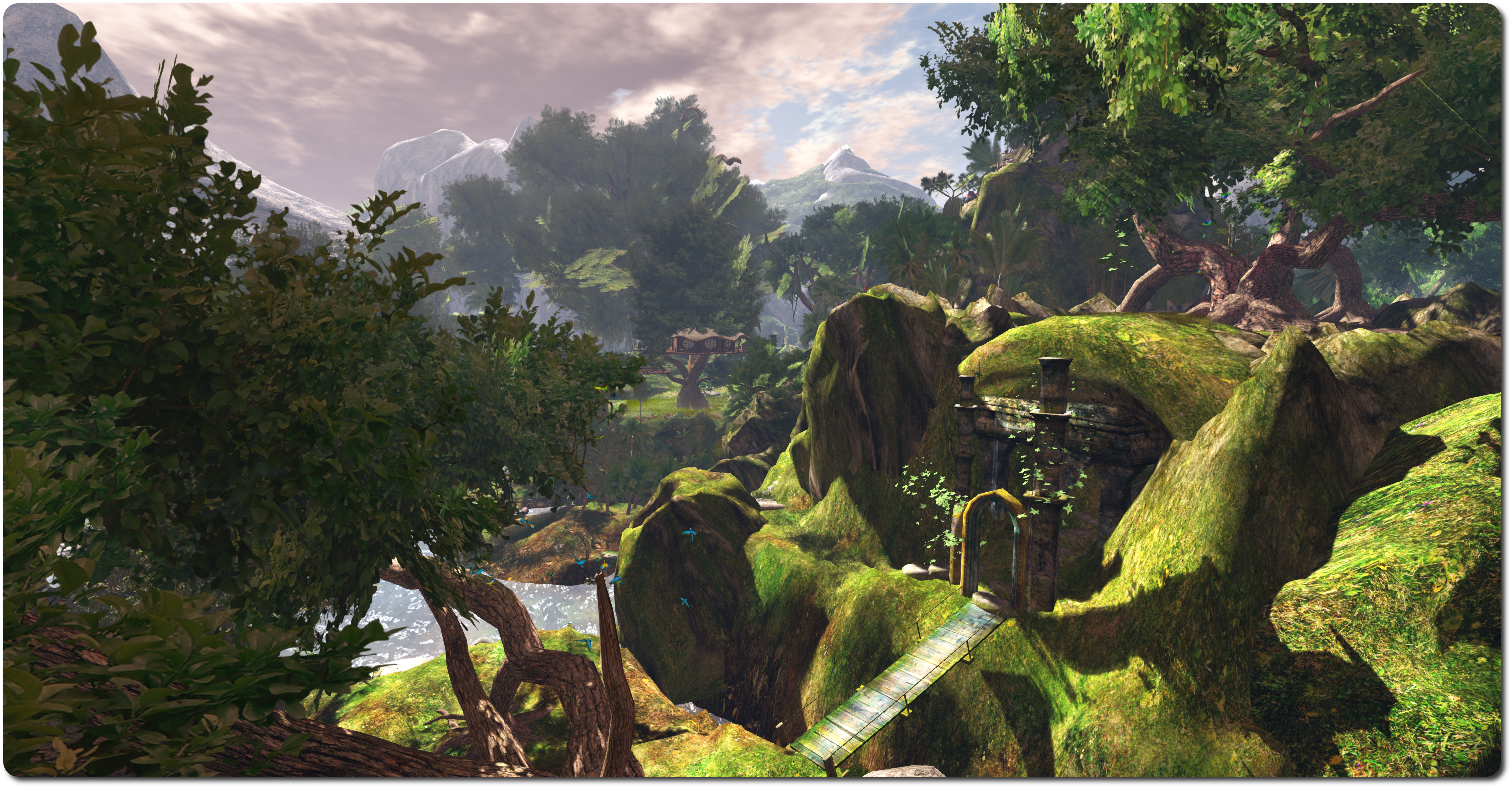
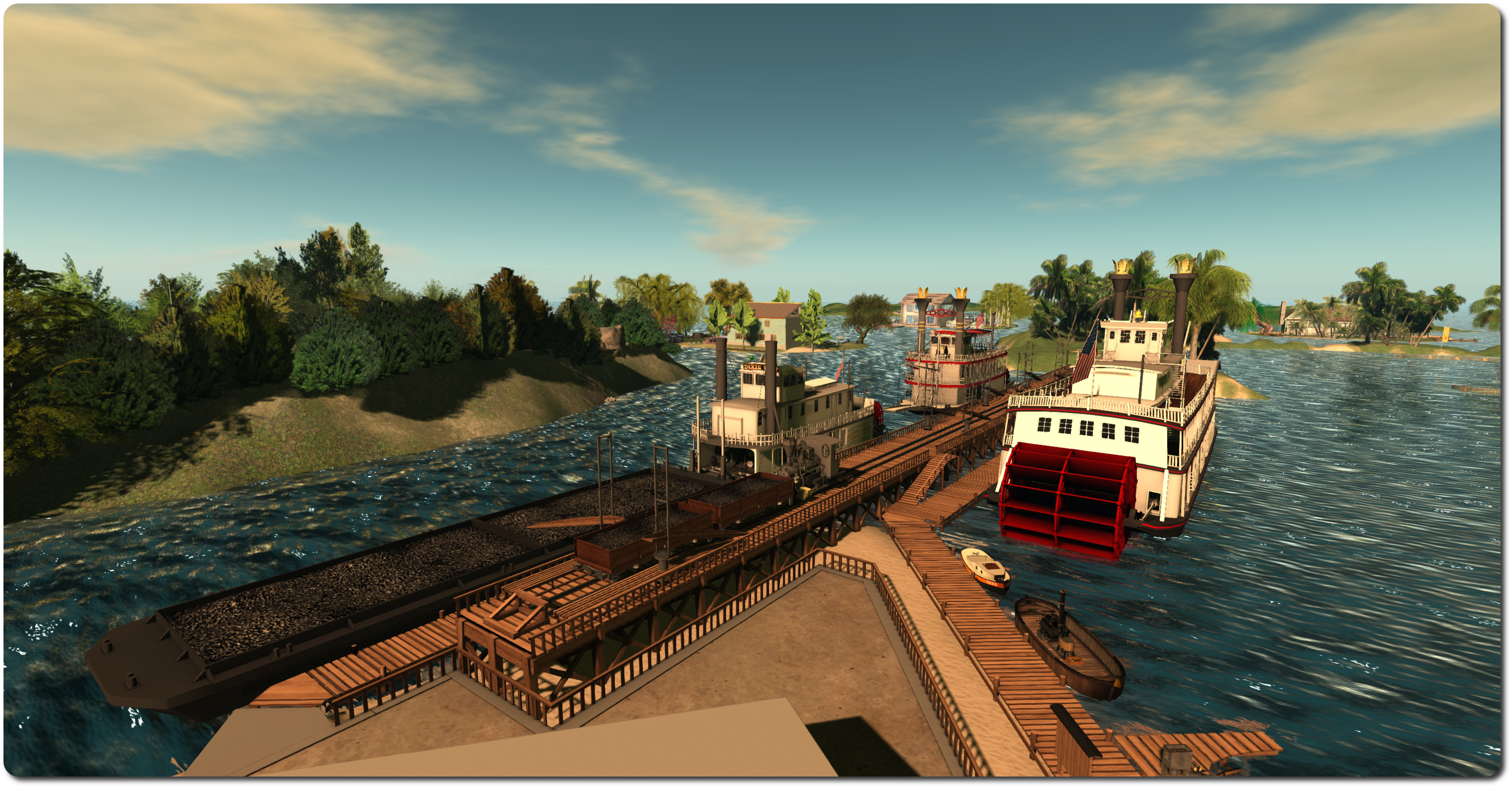
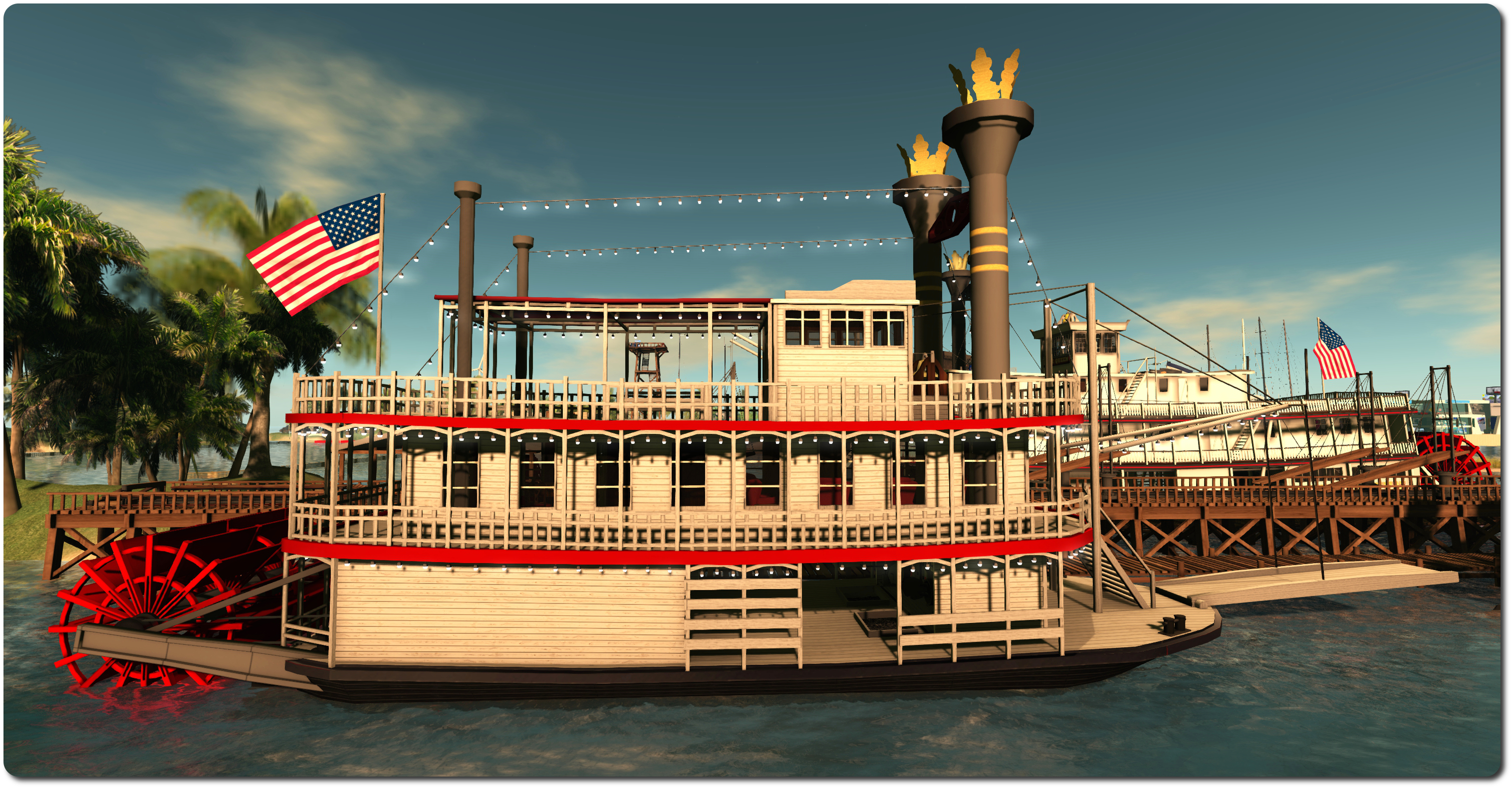
In June 2014, I was invited to take a sneak peek at a new expansion of the United Sailing Sims (USS) estates to the north of Blake Sea. The expansion, referred to as Blake Passage, and now pretty much complete, is themed after the Columbia River of the Pacific Northwest region of North America and offers a new area to explore by boat and plane. Given I did have my sneak peek back in June, and have since explored the area a number of times, I thought it high time I wrote about my little excursions.

The work has been carried out in two phases, the first part of which focused on recreating a part of the Columbia River itself, through the four regions of Columbia Bar, Columbia West, Columbia River and Columbia East. Running from east to west, these split the Blake Passage regions in two, forming a navigable channel through which boats must pass when travelling between the Passage and the USS regions sitting between it and the north side of Blake Sea.

Blake Passage
Heading into the currents at the west end of the Columbia River gorge, Blake Passage

When travelling to the gorge from the south, I suggest travelling via Dutch Harboor and Balboa Pacific before heading between the islands of Drakes Bay and cutting through the northwest side of Eureka Point into Walla Walla before turning due west into the river gorge at Columbia East. Or if you prefer, you can teleport to the Columbia East ferry point, and rez your boat there.

Sailing the regions is a pleasant experience; while the island are residential, they offer a picturesque backdrop when exploring. They’re all of a fair uniform size, offering comfortable space for those looking for a place to live which offers water access for sailing. The river gorge offers smaller parcels for rent, all of which also have waterfront access for mooring both boats and seaplanes, should you be looking for a place to live which offers the opportunity for boating.

Juneau regional airport and the White Pass railroad train

For pilots, Blake Passage includes Juneau Regional Airport, which offers both a tarmac runway and a seaplane lane and docks –  although traffic is restricted to smaller aircraft. At the front of the airport is a terminus for the White Pass railroad – named for the British Columbia / Yukon line of the same name, which can take passengers north and west to Blake Inlet. Those who like a long-distance trip can also use Blake Inlet to reach Inumiut, a stretch of open water connecting the Passage regions with the mainland coastline further west.

There is still some work going on to finish-up work in the expansion area, but if you’re looking for a new place to explore while on the water – or looking for a new airport to try-out if you’re a flyer (remembering the traffic restriction), the Blake Passage regions and Juneau airport may well be worth a visit.

Another view along the Columbia River gorge

Related Links

When you enter the Citadel, Who might you find?

Black Hole
Black Hole – The Citadel

A recent addition to the Photogenic section of the Destination Guide is The Citadel, billed as, “a time-plateau with a futuristic city overlooking a large desert. Filled with freebies, items to buy and places to explore, the Citadel is great for photos and role-play!”  – and I have to say that this description undersells things somewhat. Yes, there is a city overlooking a desert, and there are opportunities for role-play and photography – but there is also a lot more, much of it with a particular theme, hinted at in the words time plateau.

The landing point is inside a barn, around which the wind howls. Straw covers the floor and the slatted wooden walls don’t really do much to keep the wind-blown dust out. On the floor is the first clue as to the major theme of this region (assuming you haven’t already looked at the region description in the viewer’s top bar!) – although Whovians will likely recognise the barn as the scene of the meeting between three of the Doctor’s incarnations – that of the tenth (David Tennant) and eleventh (Matt Smith) with the “War Doctor” (John Hurt).

Black Hole
Black Hole – London

Step outside, and you are in a desert landscape, where the wind scoops sand into the air and billows it across the barren landscape, almost entirely denuded of trees and vegetation. Up on a high dune and above the worst of the winds, sits the Citadel of the Destination Guide entry’s title, englobed within a protective sphere, a composite tribute to the variety of designs denoting the Time Lords Citadel, as Laredo Lowtide, who operates the region with Kat Kassner, told me. The city entrance can be found at the base of the dune leading up to it, as can the crashed wreck of a Dalek space ship.

Teleporters hold the key to finding all the secrets with the region – and there are a number of them (teleports and secrets) to be discovered, including the interior of a Dalek ship travelling in deep space, and frozen garden (which again might carry echoes for Doctor Who fans), a lounge with a distinctly TARDIS-like design, and the route down to the ground.

Black Hole
Black Hole – Frozen in Time

Here sits a small section of a rather distressed London. The buildings are a mix of Tudor and Victorian (might I say Dickensian?), overlooked by the Elizabeth Tower, home to Big Ben, leaning  Pisa-like to one side, all of which makes for a typically Whovian mix to suggest that this London isn’t our London,

Central to the build is the Guy Fawkes Inn, a nod to the York birthplace of the infamous Gunpowder plot conspirator, and carrying a certain amount of dry humour: the headlines reporting on the Apollo 11 Moon landing take something of a dig at the modern love of a certain expletive, the bar menu reads as a list of possible fates for the unwary, and a chalk board outside the corner entrance carries a little nod towards the Hitch-Hiker’s Guide to the Galaxy.

Black Hole
Black Hole – Guy Fawkes

The presence of the Guy Fawkes Inn isn’t accidental. Just down the street, and close to another point of arrival, is the Guy Fawkes Exhibition. Here you can travel back in time to the year 1605, and, in the words of the old rhyme, remember, remember the fifth of November / Gunpowder, treason and plot.

This interactive tour, featuring audio elements, text, props and images, will guide you through the events both leading up and subsequent to, that fateful day. It’s a well-crafted exhibition, with the ground floor leading you through the hatching of the plot, revealing the conspirators and their aims. Upstairs, the aftermath of the plot is examined, with further historical context.  You can even meet Guido (Guy) Fawkes himself, and read a portion of his confession.

The Black Hole
Black Hole – The Citadel

“We used to run regions as more social spots but we don’t have the time these days, so we look to make spots people can be snap happy and wander,” Laredo said in explaining the reason behind the design.

I’d say they’ve succeeded very nicely. Whether you are seeking a photographic location, the potential for a little Who-related role-play (rezzing is allowed, but please do pick-up afterwards), want to learn a little more about a part of English history, or simply want to enjoy yourself exploring somewhere new and engaging, Black Hole offers you the perfect destination. Laredo tells me the current layout will remain pretty much as-is until at least the New Years, and that there may well be some seasonal updates towards the end of the year, making it a place worth popping back to as the festive season approaches!

Related Links