Walsh County’s changing seasons in Second Life

Walsh County, October 2020 – click any image for full size

When we first visited Walsh County, the Homestead region designed by Randonee Noel, back in August, it had not long opened. Following that visit, it got stuck in my list of places to write about, and so prompted a recent re-visit.

The region takes as its inspiration Walsh County, North Dakota,  a place that describes itself as “a land of prairies, croplands, river valleys, and rolling hills.” The primary source of income for the county comes from farming, predominantly small grain, cash crops, forage crops, together with beef, dairy cattle and swine. It’s the first of these – grain crops – is the focus for the region design.

Walsh Country, October 2020

Cupped within a region surround that folds itself into the the setting to give a look and feel of gently rolling prairies with distant hills, the region is given over to a broad field that takes up most of its area, bordered by a the dirt track of a public road along its southern edge, and cut by a farm track to the north. Within this expanse is a small pool of water and a single tree, what might be a mid-field picnic area extending a short distance outward from the tree’s leafy shade.

When we first visited in August, the region was in an early summer setting: a young crop covered the land in a green carpet, whilst a crop duster making periodic passes across the field, painting it in stripes of pesticide – or perhaps in fertilizer, if the aircraft was engaged in aerial topdressing.

Walsh Country, October 2020

Seeing the ‘plane repeatedly passing over the field immediately put me in mind of Cary Grant being buzzed by a crop duster in Hitchcock’s classic North by Northwest, and suggested plenty of opportunities for photographs playing homage to the movie. So much so, that I was surprised not to come across any in the region’s Flickr stream, which made me a little regretful of not producing such a photo myself 😀 .

That said, it is really small details – coupled with the open rezzing (with a 30-min auto-return limit) that meant people could make their own scenes within region – that made, and continue to make, the region so attractive. These range from the poses on things like the boards that cross the stream bordering the field, to the paper boats that periodically pass under it to float by the ducks paddling downstream, to the paper aeroplane that can be thrown into the air with a simple touch (“/3 stop” – minus the quotes – will settle it back on the ground), and more.

Walsh County, October 2020

Since that first visit, time has moved on; the crops have grown and and the harvest is due. And this has brought with it another touch with the region: the fact that it can change not only with the season, but also periodically. The harvester (complete with its own poses), for example, might on one day be engaged in cutting the crop, on another it may be off-loading its grain tank into a tractor-towed trailer, then on another – as with my most recent visit – sitting on the farm track waiting to commence work.

Other details have been added for the time of year as well – geese fly overhead, presumably getting an early start to a southern migration, whilst the little picnic area offers a touch of Halloween with a pumpkin patch. In another touch – which may have been there from the opening, and I simply don’t recall from our initial visit – a small family grave plot marks the fact that most of Walsh County’s farms are family-run.

Walsh County, October 2020

Engaging from the start, Walsh County presents – as numerous bloggers have already noted – an attractive offering for photographers and explorers to visit.

With thanks to Shawn Shakespeare for the original pointer to the region.

SLurl Details

Time Remains in Second Life

Time Remains, October 2020 – click any image for full size
Travel through Time along a beach side woodland.

So reads the description for Time Remains, the Hometead region held and designed by Aura (Akiko Tripsa). It’s a place we dropped into back in September (thanks, again, to the pointer from Shawn Shakespeare), but which I’ve just got around to writing about – so my apologies to Aura for the delay.

Time Remains, October 2020

Bracketed in a couple of corners by curtains of rock, the setting is generally low-lying and split into three islands, two of which lie to the east side of the region and run north-to south, separated by a narrow channel of water. The third occupies the south-western side of the region, a bay of restless water to its north.

A small south-facing headland on the southernmost of the east side islands is home to the landing point, a large gazebo offering group information and a nearby sign informing you that you’re about to enter someone’s dream. Pass through an arch beyond the sign, and you’ll find yourself in an area enigmatically called Past – the remaining islands forming Present and Future.

Time Remains, October 2020

To what these labels might refer is open to personal interpretation. Could they designed to trigger thoughts of our own lives and relationship? Are they more general labels simply to distinguish the three islands, or do they have more of a personal meaning for Aura? These are questions that visitors might ponder as they wander under the shade of trees, over the short grass and  along the occasional paved roads and paths.

Certainly, there is nothing specific is terms of décor that might tie one of the islands to its label – Present, for example, has a building that his hints of the 1960s and 70’s about it, while Future is firmly rooted in the décor found throughout all three islands. All of this adds to the enigmatic attractiveness to the region as a whole.

Time Remains, October 2020

Buildings lie scattered across all three islands, some in better condition than others. They all offer multiple places to hang-out when visiting, each uniquely dressed with its own identity. Some appear to  mix periods, as noted above, others lie as simple places to sit and cuddle with a few added accoutrements of comfort, still others of suggestions place places in regular use – artists’ corners and the like. All are engaging in their design and set out in such a way that even when two or three are gathered together, the spirit of privacy sits between them.

The beach mentioned in the About Land description skirts the edges of the two eastern islands, forming a ribbon along one and almost encircling the other. Comprising shingle rather than sand, it forms a natural edge to both islands that neatly separates their green coast with a colder cast of the waters around them without being too bright a marker of the division, as might be the case were it to be sandy in nature.

Time Remains, October 2020

While bushes may in places indicate set routes through parts of the islands, together with ladders focusing visitors towards certain points when move between different elevations in the slightly undulating landscape, this is really a place where the feet can pretty much carry you where they will.  This is turn allows for natural discoveries to be made along the way – such as the field of aged pianos – to be made quite naturally. Not even the short stretches of road and sidewalk found with some of the buildings demand people necessarily follow them. Thus, Time Remains invites open and free-form exploration, the individual buildings an locations found throughout not only offering places to sit and pass the time, but also for photography and posing.

Engaging, photogenic, rich in small details that catch the eye, Time Remains makes for an ideal visit for both the Second Life explorer and photographer.

Time Remains, October 2020

SLurl Details

The paths of Darkwood in Second Life

Return to Darkwood, October 2020

I’m actually not a great fan of the Halloween season. I’m not sure why; it’s just something that has never really held any significant appeal. However, within Second Life, there is one part of the spooky season (to use the overworked expression beloved of local news anchors on the TV) that I absolutely do enjoy each year – and that’s the annual Calas Galadhon Halloween region that Tymus Tenk and Truck Meredith put together as a creative tour de force for everyone to enjoy, both by exploring it and in attending the entertainments they and their team lay on throughout the month.

For 2020, Ty and Truck bring us Return to Darkwood, which takes as its foundation a theme we first saw in 2014 (see: Along the paths of the Darkwood, where the nightshade lay). However, I would suggest “return” is a bit of a misnomer, as it implies a revisit to a place seen before, and that is certainly not the case here: this is a wholly new take on the Darkwood theme. As such, I see it more of a continuation, offering us a further glimpse of a part of that realm that has – until now – remained hidden.

Return to Darkwood, October 2020

Occupying a  single region, Return to Darkwood brings us everything that makes Truck’s an Ty’s designs special. Exploration can be carried out on foot and there is the traditional tour  – this one via elven boat along the waterways of the wood and then through the air to reach (eventually) the events pavilion. Along the way there are numerous nods to the season, both dark and light, as well as touches of Tolkien, horror, dark fantasy and even The Scottish Play (in the form of three weird sisters who may well be asking one another, when shall we three meet again, in thunder, lighting or in rain?)

The landing point tells you all you need to know about exploring the region. Chief among these is that ALM should be used – but you can disable shadows  so as not to take a huge performance hit, as under the ambient lighting, these are simply not required for general appreciation of the setting (but can obviously used for photography). Do make sure local sounds are enabled, as once again there is a immersive sound scape to enjoy throughout the setting, whilst for those who like a little music, a carefully selected audio stream has been put together. Torches of the flammable and battery varies are also available (together with a backpack gift for Calas group members), but whether you need one of these or not is a matter of choice.

Darkwood, October 2020

From the landing point it is a short walk to both the start of the boat tour and the path that winds through the Darkwood realm. Which you take is up to you – but I do recommend taking both, if not necessarily back-to-back;  part of the joy with the Calas themed regions is they offer plenty of opportunities for return visits than can add to the experience.

Certainly, the boat tour will give you a feel for the region as it winds through the rivers and creeks of the land before finally taking to the air to offer a touch of Tolkien (“the eagles are coming!”) and eventually delivering you to the floating islands where the events pavilion resides. The ride takes about 30-40 minutes, so if you’re heading for one of the region’s music events, why not arrive early and use the tour to explore and ride up to the music?

For those on foot, the way is marked (mostly!) by a path that winds through the shadows of the the trees and over and under rock and across mires and mists, lit periodically by flaming torches with the route occasionally hinted at by sign-posts. How helpful these might prove to be is a matter of following them; while they might point the way, their notation tends to be variable – “?” for example, or “Don’t Get Lost” – all of which add to the fun.

Return to Darkwood, October 2020

Nor is the path necessarily direct; forks are to be found, some of which lead to major features of the Darkwood – such as the mouldering village on  the mire. Others, however might appear to offer a quick route through a spot – but as Tolkien once noted, short cuts can make for long delays, and at least one of these routes may have arachnophobes like me shivering and turning back or hurrying on as rapidly as possible!

Not that it is all darkness and scares. Like Mirkwood of The Hobbit, there is a tale to tell with the Darkwood, one that reveals it was once a brighter, more welcoming place. Within one clearing, for example, can be found memories of an elven presence: an ageing pavilion with a sculpture of elven lovers close to hand, while just beyond, light still pours forth from a symbol of hope which – for me at least – carries a wonderful mythological symbolism from Tolkien: the Earth cupped in Yavnna’s hands,  held aloft in light as the Ainur circle it and Eru Ilúvatar looks on.

Return to Darkwood, October 2020

Ultimately,of course, the aim is to reach the portal that will carry you up to the floating islands. To find that, all I’ll say is (and going totally off-topic to  quote Star Trek!) climb the stairs, Jim! (Hey, Star Trek isn’t so off-topic, remember Catspaw?!).  The portal will deliver those who find it a short walk to the pavilion proper, whilst for those arriving by the boat tour,the walk is a little longer – but it will carry you past the arrival portal, allowing you to easily hop back to the landing point and start explorations on foot if you wish.

Visitors to the Darkwood are encouraged to dress for a visit – although this is not an absolute requirement. The choices are many, from outright horror to fantasy to dark elves and drow to – as I witnessed during my return to take photos – characters from Tolkien and other fantasy works (seeing Balin the Dwarf exploring with Jon Snow close by was interesting!).

Darkwood Pavilion schedule of events

The schedule of events for Darkwood is above, and I’ve included a direct SLurl to the pavilion for those who wish to hop to an event and then explore afterwards.

SLurl Details

Enchanted Rock is rated Moderate.

Ruegen Island in Second Life

Ruegen, October 2020 – click any image for full size

Ruegen is a Homeland region designed by Andre Nalin (ReizWolf) we were pointed towards recently by Shawn Shakespeare. It takes its name – and is inspired by – Rügen, lying just off the coast of Germany’s Pomeranian coast in the Baltic Sea.

At some 926 square kilometres, Rügen is Germany’s largest island. – and as such, potentially a difficult subject to represent within the confines of the 65,536 sq metres that form the land area a single region. So rather than trying to model it in whole, Andre has used some of the features it is noted for as his inspiration, and created a sandy haven; an island clearly in more northern latitudes, and with features of its own to attract the eye.

Ruegen, October 2020

Rügen is particularly noted for its coastline, characterised as it is by numerous sandy beaches, lagoons, peninsulas, headlands, and inlets and bays that project into the island. Part of this coastline comprises the Jasmund National Park, famous for its vast stands of beech trees and chalk cliffs like King’s Chair. Awarded the status of a UNESCO World Heritage Site in 2011, it is one of the locations paid homage to within this build: a line of cliffs mark the region’s south side, topped by tall Scots pines.

I  can’t speak too much to the physical world Rügen as I only have Wikipedia and tourist sites to go by, so offering any real comparisons here would be a little pointless. However, this doesn’t matter, as the region’s design more than speaks for itself.

Ruegen, October 2020

The landing point lies on the east side of the island, just above a sweeping beach looking out over a cold blue sea – itself looking as one might imagine the Baltic to be. Two hills rise from behind this curving coastline, running to the west and another beach, a broad, shallow valley sitting between them. This valley is home to an ultra-modern house (a Cain Maven design that is eye-catching in its looks and has something of a Nordic twist to it).

Again, whether this is representative of the style of housing on the actual island is immaterial; it has a certain look to it that makes it a fitting subject for the region. It shares its space with a single greenhouse and a free-standing swimming pool that offers a break from the surrounding salt waters washing the coast. This house, looking down on the broad beach, is an automatic draw to the eye and feet, but I would note that while it appears to be open to the public, it sits within its own parcel, so could be private.

Ruegen, October 2020
Two other houses can be found on the island, both on the beaches. There’s a wooden house standing over the coastal waters as the beach curves around the north side of the island, whilst to the south, where the sands split into a small, shallow bay, there sits a thatched cottage watching over working fisher huts and a small pier with a fishing boat moored alongside.

Outside of these three houses, the only other buildings on the island are a little café, also built out over the eastern waters, a ruined beach house to the north and a little gazebo up on one of the hilltops. The rest of the island has been left wild and and open to exploration; the hilltops are crowned by trees (and a home to a camp site and deer), whilst the beaches offer multiple places to sit, some watched over by horses that graze on the tough grass that has pushed its way up through the sands.

Ruegen, October 2020

All of this makes Ruegen both easy on the eye and an easy, relaxing explore.

SLurl Details

  • Ruegen (Valium Sea, rated Adult)

Stopping by a Paradise on Sea in Second Life

Paradise on Sea, October 2020 – click any image for full size

Paradise on Sea came to our attention via Shawn Shakespeare (who has perhaps the most unique talent for finding regions that are open to photographing / writing about). A Full region held by Bellita (Belle Onedin), it offers a home for her SL business, Heart Poses located on a sky platform high above the region, and a ground level that is open for visitors to explore and appreciate.

Set in summertime, the region offers a warming visit for those of us sitting in the northern hemisphere, where the weather seems to have decided to skip autumn entirely, and settled on scowling, rainy, winter-like days. Given this lean towards summer, Paradise on Sea is a bright, lush setting, full of greenery and with flowers – wild or potted – in full bloom to offer bright splashes of colour against the rich greens.

Paradise on Sea, October 2020

Although offering the “on Sea” in its title, the region has the appearance of being located within a landlocked lake, verdant hills cut by a single  serpentine river surrounding its three islands. The largest of these, forming the bulk of the region, is home to the landing point – which is not enforced (in fact the coordinates found in About Land’s Options tab are actually off, and will drop you into the waters of the region’s east side) – is located in an old stone ruin that offers a teleport disk up to the Heart Poses store.

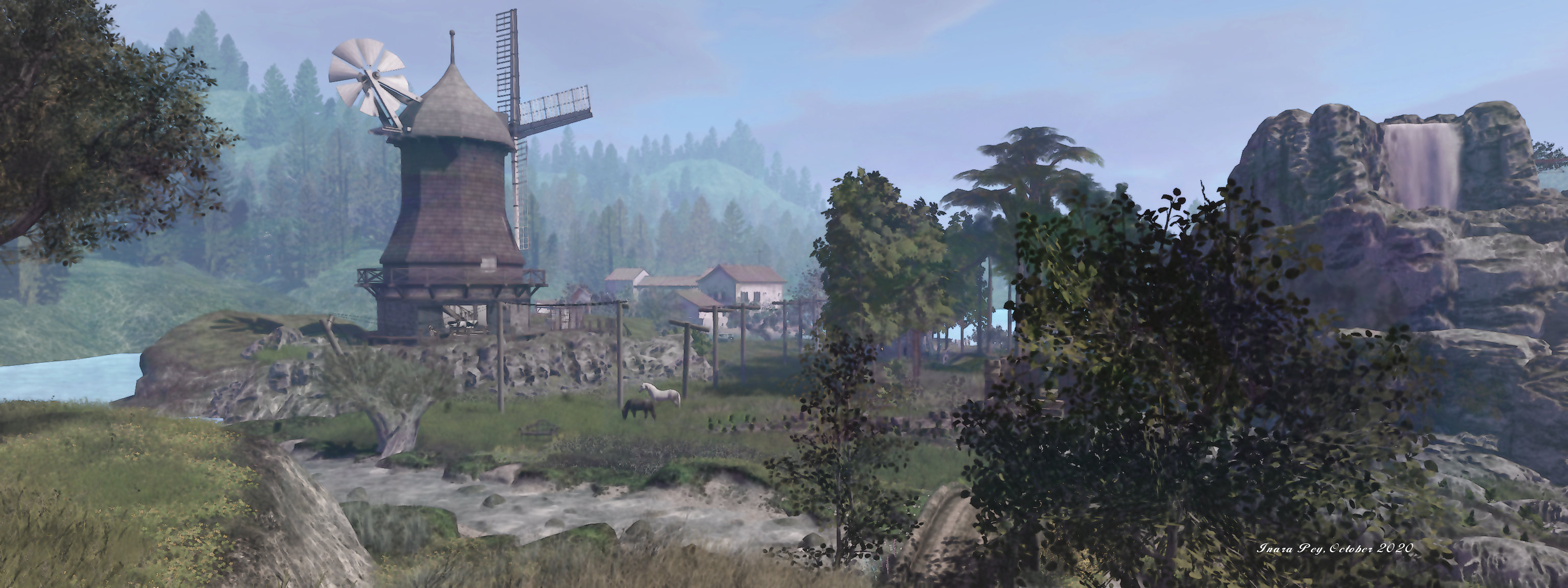
The landing point sits at the feet of a tall, blunt-topped peak of rock that rises from a broad base that mixes grassy slopes with pools of clear water fed from numerous falls that tumble from multiple points in its sheer faces. It’s a distinctive rocky mass, vying with the huge form of a wooden windmill sitting on its own rocky upland to the south, and a nearby cedar of Lebanon for recognition as the tallest object on the island.

Paradise on Sea, October 2020

From the landing point, a cobbled path points both north and south – the former direction leading to the open fields that wash tall grass around the base of the windmill’s rocky foundation, while the latter direction winds its way to the north side of the region and the shallow cove of a beach.

Here wooden platforms rise in individual tiers from the narrow lip of grass between the beach the the walls of the high peak, ladders linking them to provide the means to scale the heights, passing water that drops to feed the beach-side pools that don’t reach the lake but instead offer places for birds and ducks to take a drink. Climb the ladders and platforms, and they’ll take you to a point just below the summit where a hot spring resides – or for the daring, a hang glider can be launched for an aerial view of the region and its surrounds.

Paradise on Sea, October 2020

The windmill is not the sole building within the region: four houses await discovery by explorers, with three of distinctly Tuscan design, suggesting the region might be somewhere inland in central / northern Italy. Two of these are to be found on the smaller islands that lie to the north-west and on the east side of the main land mass. Both are furnished and offer much to see both indoors and in the grounds around them The third and largest a villa occupies a south-west headland that is just a jumble of rocks away from becoming separated from the rest of the landscape as it dominates the flat sandstone slab of rock on which it sits. Again furnished, and with an inviting courtyard within its walls, it calls to visitors to come and explore it.

A surfaced, single-tracked road curls outward from this villa’s humped bridge. Passing around the shoulder of the windmill’s table of rock, the road ends close by a gabled cottage with an air of rural France about, it neatly juxtaposed by the very British presence of an old red telephone booth facing it over a parked car. Sitting within its own gardens and grounds, this cottage lies just above the waters of the lake and shares its location with a charming little painter’s studio and a small houseboat linked to the land by a wooden pier and deck to offer something of a floating summer house.

Paradise on Sea, October 2020

This is a region packed throughout with detail and many, many opportunities to sit and relax as well as for taking photographs. As noted, all of the houses are furnished – as is the windmill, while the outdoor sitting spots can be found in their grounds or gardens, along the beach, up on the tall peak and elsewhere. Cars (roadworthy and not) add a further sense of human life to the setting, whilst the birds overhead and the horses in fields and close to houses add their mix of life and presence to the setting.

With so much going on within a region that uses the private region land capacity bonus, there is a lot for the eye – and the viewer – to take in, and it would be remiss of me not to note the fact that the volume of mesh and textures can take its toll on older systems, and disabling shadows for those that use them might be advisable when moving around. Nevertheless, Paradise on Sea is a rewarding and engaging visit, and photos taken within the region can be submitted to its associated Flickr stream.

Paradise on Sea, October 2020

SLurl Details

Dya’s Southern Twilight in Second Life

Dya’s Southern Twilight, October 2020

We received an invitation from Dya OHare to visit the latest iteration of her region builds, “We’re not so far from the Caribbean,” she said, referencing her last design I covered in these pages (see Dya’s Scent of the Caribbean in Second Life). “I’ve tried to show a bit of the Southern Life and I hope you like it.”

So off we hopped to see Dya’s Southern Twilight, a place that presents a rich mix of southern American life in the form of aspects of New Orleans together with sights that might be found in Mississippi and Louisiana. This sounds a lot to cover in a single region, but Dya does a good job of mixing multiple aspects of these states and the Crescent City, with touches that suggest the era of the 1930s-1940s – although it could just as easily be a modern setting.

Dya’s Southern Twilight, October 2020

The region is diagonally split by a river running from the north-east to the south-west, representative of the Mississippi itself. The landing point sides on the north bank of the river, on a road that serves a built-up area suggesting the older parts of New Orleans. Here can be found multiple places of business, side streets with cobbled surfaces and tram tracks, a place where street urchins play (or perhaps whisper plans to hop a tram whilst avoiding the fare), and an open air café awaits patrons.

Also to be found on this side of the river is a touch of the city’s French Quarter. This takes the form of a street overlooked by wrought iron guarded balconies draped with flags, with more fluttering from short poles leaning out from the railing tops. Lights strung across the street help illuminate it, together with the signs for the local bar and the hotel, whilst the end of the street is awash in colours that splashes over aged whitewashed walls from two tall street lamps.

Dya’s Southern Twilight, October 2020

This built-up area is bracketed by sights often associated with New Orleans in film and television: a paddle steamer moored on the river, and a cemetery complete with family mausoleums. For the romantics, one of the Crescent City’s white horse-drawn carriages sits at the roadside as well.

The south side of the river has a small harbour area that connects it to the north side with the assistance of a girder bridge of the kind seen along to Mississippi, but also opens out to contain a suggestion of the bayou, complete with trees rising from misty waters, with cabins potted in the open spaces.

Dya’s Southern Twilight, October 2020

Separated from the bayou by shrubs and dense foliage sits one of the grand old plantation houses associated with the southern states. Set back from the riverside road, it rises from the end of a long footpath, the front door open to invite visitors into the partially furnished interior. Horses graze in the field alongside the the house, whilst a tall hedge guards a small, neat garden to the rear, which also has access to a local beach.

Rich in detail with plenty to discover, appreciate and photograph, Dya’s Southern Twilight continues Dya’s tradition in creating engaging locations for people to visit.

Dya’s Southern Twilight, October 2020

Our thanks also to Shawn Shakespeare for the LM.

SLurl Details