Kintsugi: spiritual beauty and renewal in Second Life

Kintsugi: Spirited Beyond

Having recently opened in May 2020, Kintsugi: Spirited Beyond has been garnering a lot of attention – and rightly so; it is a place of serene beauty, lovingly created by NorahBrent and Zalindah.

Kintsugi (金継ぎ, “golden joinery”), also known as Kintsukuroi (金繕い, “golden repair”), is the Japanese art of repairing broken pottery by mending the areas of breakage with lacquer dusted or mixed with powdered gold, silver, or platinum, a method similar to the maki-etechnique. As a philosophy, it treats breakage and repair as part of the history of an object, rather than something to disguise.
Wikipedia

Kintsugi: Spirited Beyond

I include this description, because Kintsugi: Spirited Beyond grew out of a personal loss experienced by NorahBrent, as Zalinah notes in her profile:

Pulling her grief and transforming it into creativity was her only way of coping. She asked me to join her and I couldn’t resist.

– Zalinah

Kintsugi: Spirited Beyond

So it might be said that Kintsugi: Spirited Beyond that has a deep connection for both NorahBrent and Zalinah, and especially offers a means for Norah to mend her loss through creativity, making it a part of her personal expression, making it a part of who she is, rather than trying to disguise or hide it. This is turn gives any visit to Kintsugi a personal element, the visitor sharing not just in the creativity displayed in the completed region, but also in the healing process that is folded into its design and presentation.

The natural beauty of the region is evident from first arrival, but to help encourage exploration, a story as been added; those arriving are asked to find the nine spirits located throughout the setting, with each spirit found within a location: house, forest, water, garden, and more, there secrets revealed through local chat.

Kintsugi: Spirited Beyond

Thus, the best way to describe Kintsugi is as a subtle story told through a series of vignettes, each defined by a specific part of the region design, and knitted together as a whole by both the stories awaiting discovery and the natural flow of the landscape across the islands and water-borne elements reached via stepping stones that wind across the shallow, reflective waters that enfold the islands and their treasures.

The Japanese motifs found throughout the region  – Cherry trees, Torii gates, koi pond, raked zen garden, water lanterns and more – are used to marvellous effect, both adding to the spiritual feel to Kintsugi whilst also gently brushing it against the imagination sufficiently for the active mind to call forth stories of its own that might find a home here.

Kintsugi: Spirited Beyond

At the same time, there is much to capture and hold the attention of the more casual visitor: the natural beauty of the setting, the mystery of the deserted town on the high hill, the places to sit and appreciate each element within the region’s unfolding story. And obviously, there is much to commend the region to the eye and lens of the Second Life photographer.

Kintsugi is a truly bewitching setting, rich in detail and narrative, fully deserving of a visit. When you do, please consider making a donation at the landing point to help ensure its continued presence in Second Life.

Kintsugi: Spirited Beyond

SLurl Details

Second Norway: making the changes

Second Norway, March 2020

At the end of April I was able to confirm that Second Norway, after recent concerns about its future, would be continuing as a part of the Luxory Estates group, with Vanity Bonetto and her team taking over day-to-day management of things – land management and sales / rentals, etc., with Ey, Mialinn, SlaYeR, joining the Luxory team with responsibilities for the road and rail network, management of the Second Norway airport and for social / community elements within the estate. See: Second Norway: the future is bright.

In that article, I noted that as part of the change-over, there would be a certain amount of work being put into the estate, with the northern regions being re-worked to offer new island home spaces, together with a re-laying of roads and rail systems through the more connected regions within the estate.

Second Norway: one of the new islands, already occupied

So what has happened in the two weeks since the hand-over? Well, rather a lot. As Vanity noted to me as I dropped in to take a look at progress:

We are working our pixels off here!

The northern regions have now all been relaid to offer three or four islands apiece (although some have “mainland”elements running through them. These offer islands sized between (at the time of writing) 7,292 sq m through to 11,776 sq m (although there was one smaller parcel at 4,688 sq m still available). Prices for the parcels are in line with other Blake Sea estates, and can be found in the Second Norway sales office).

Second Norway: one of the larger island parcels awaiting occupancy

To the south, closer to the airport and the land around it, parcels with water and road access are in development, although it will be a while longer before these are ready of occupancy. At the same time, Ey and SlaYeR have been rebuilding the road and rail system, as Ey recently blogged:

We have been here before, SlaYeR and I. Hauling railroad tracks, getting them in place. Laying warm asphalt on new stretches of road. As the basic terraforming of the north-west is now done, the (rail)road guys can move in, as we have done many times before. New land will emerge connected to the road network. This is sort of back to the future for us.

  – Ey Ren, May 9th, 2020

Second Norway: the new waterfront district being developed by AustinLiam

South of the airport is a further development, this one being undertaken by AustinLiam, offering a working waterfront district, with further rental islands alongside of it.

Even with the work on-going, sales have started, and the new parcels are proving popular among former Second Norway renters who had to move out while the changes were made to the extent that Vanity informed me the Luxory land team are finding it hard to keep pace with demand. Despite all the changes, the open waterways have remained operational, and it’s possible to sail / motorboat around the new islands even while the work continues.

The rental islands come pre-formed and semi-landscaped with rocks and a small channel that cuts through one corner to provide a small, separate island reached via a connecting stone bridge. Moderate terraforming is allowed, providing that it is neither excessive nor spoils the overall theme for the estate – so no private mountains or fjords! Similarly, building and other structures must be in overall accordance with Second Norway’s temperate / northern latitude theme.

Second Norway: two more of the new rental islands, already occupied

There’s still a way to go with the changes, as both Vanity and Ey note; but considering it’s only been a couple of weeks since the hand-over occurred, a lot has been achieved, and it’s easy to see the Second Norway is well on the way to becoming a renewed community with a secure future that offers a lot to tenants and visitors alike.

Additional Links

Thermae’s gentle beauty in Second Life

Thermae, May 2020 – click an image for full size

Thermae generally refers to Roman imperial bathing complexes featuring heated baths and that also formed a centre for socialising among the better-off. Within Second Life, Sage Allegiere – famed for Gardens of Absentia (see: The Garden of Absentia on Second Life) – uses the name for another of her public region creations.

The name is not in any way inappropriate; this is a place where visitors can literally bathe in a creation that reflects nature at her best – although the major structure to be found on the main island might admittedly at first be taken for a spa or similar offering. The setting is that of group of temperate islands  – quite where is entirely up to the imagination – with the outlying isles protecting this, the innermost of the group, as it sits lower and perhaps otherwise more vulnerable to the winds and storms that might otherwise pass.

Thermae, May 2020

The landing point sits just off of the centre of the region, on the slopes of one of its highest reaches. An inlet cuts into the island on the far side of this hill, a balloon supported bridge crossing the landward end of the the gorge it forms. Down the slope from the landing point sit a cosy cottage with a wild flower garden guarded by a wrought iron fence. find the opening in  this fence and a gentle grassy path will take you down to a shingle beach, one of four scattered around the island’s coast.

Most of the island is crowned by young trees – although there are some that have reached maturity awaiting discovery along the ruggedness of the island’s back. In fact, so rugged is the island, that there are few laid paths – exploration is a matter of finding the lesser slopes in the grass that lead down and around the rockier parts of the island.

Thermae, May 2020

This means that finding your way around the island is a matter of careful exploration – and given there are multiple possible paths, this adds to the richness of discovery through exploration. One of these paths leads to a rock arch that also passes over the inland end of the southern inlet to join with the bridge mentioned above.

The path from here leads fairly directly to the large house mentioned above. Sitting on a high, flat table of rock, it has a open garden and an inner terrace. The garden is set as if for a party, the terrace as well, although at other times it might make for shaded conversations. Inside, the long rooms of the villa are comfortably furnished, one wing forming a lounge, the other a bedroom, the corner between them a rustic-style kitchen.

Thermae, May 2020

A second garden sits below this villa, nestled into the south-west of the island. Further around to the north, a second inlet has been formed as a result of water breaking out from a table under the the rocks to splash down over the rocks. A further shingle beach runs around the far side of this inlet, lanterns floating gently over it and the the bay formed by inlet and falls, although reaching it is a case of finding more of the paths running between the trees and the islands cliffs.

The north side of the island is home to another beach, a broad swathe of grass rolling down to it from the uplands of the island, suggesting water may have also once flowed down it to the sea.

Thermae, May 2020

Off the coast from this side of the island are three smaller isles that form a line running to the north-west. The outermost of these three looks to be a private home, so straying by air in that direction is perhaps bed avoided so as not to risk invading privacy. A further knob of rock to the north-east is home to a light house.

Sitting beneath a setting Sun, Thermae makes for a high photogenic setting with much to enjoy and plenty of places to sit, in gardens, on benches, on the water and under the trees. In all, a highly pleasing visit.

Thermae, May 2020

SLurl Details

  • Thermae (Thermae, rated Moderate)

A cosy coffee lounge in Second Life

Mediterraneo Coffee and Lounge Bar – May 2020 – click on an image for full size

Sitting just off the east coast of Nautilus and at the western each of the clustered private islands to be found there, sits the Mediterraneo Coffee and Lounge Bar, the creation of Franz Markstein. Occupying a quarter of a Homestead region, it is an attractive setting, accessible by both teleport and by air / water.

West-facing, the bar sits above a strip of beach amidst tropical greenery. High-ceilinged and with a small mezzanine, it has a light, airy look and feel, thanks to the floor-to-ceiling windows along the west side of the bar, while the mezzanine offers a more cosy retreat and seating area. Vines and greenery help to both break up the interior walls and also to give the bar a sense of oneness with the surrounding greenery.

Mediterraneo Coffee and Lounge Bar – May 2020

To the side of the main bar are three further rooms that sit as a smaller, cosy lounge, a little music room / gallery space and a library / study. They offer little getaways within the bar’s own sense of getaway.  For those who prefer an outdoor setting, there is both the beach and, between it and the bar, an overgrown but still comfortable garden, a bubbling brook tumbling down the rocks to one side and across the beach to the sea.

Mediterraneo Coffee and Lounge Bar – May 2020

Littered by the wrecks and ruins of boats, the beach offers several places to sit, from a look-out tower to deck chairs, all open to the sound of the surf washing up over the sands. At the north end of the beach and tucked below the rocks that hold up the bar, is a long wharf.

With auto return set to zero, this offers those coming by boat or float plane the opportunity to come alongside, enjoy the bar and its modest surroundings without the fear of their boat going poof and leaving them without the means to resume their water journey. A small fishing boat is moored at the wharf, but it still leaves plenty of room for others to come alongside, so long as they are not ridiculously big.

Mediterraneo Coffee and Lounge Bar – May 2020

One of the things that makes this bar particularly attractive to me is the manner in which it has been marvellously kitbashed by Franz, using a Funatik building as its base. This gives it an entirely unique styling and look that suits its location admirably, while the overall décor has clearly been considered to give the bar its sense of warmth despite its size.

Whether you arrive by teleport, boat or float plane, the Mediterraneo Coffee and Lounge Bar is a richly detailed delight to visit.

Mediterraneo Coffee and Lounge Bar – May 2020

SLurl Details

A tropical Lemon Bay in Second Life

Lemon Bay, May 2020 – click any image for full size

We first visited Lemon Bay in April 2020, although it’s taken a while for me to get around to writing about it. A homestead region and group design by SilentChloe, Unso Choche and Mirias, it is a rugged, tropical setting intended to be a photogenic hangout.

When I say “rugged”, I mean the region is set as tall, rocky table of land forming a roughly L-shaped island, the upright of which runs roughly south-west to north-east. Flat-topped, the island has at some point in the past been sliced into three plateaus by the sea, two narrow channels lying between the three parts, one of which has been around for so long, it has become silted with sand, helping to form one of the island’s two beaches.

Lemon Bay, May 2020

The table of rock that is left between these two gorges forms the island’s landing point. Almost uniformly flat, it is connected to the remaining two arms of the island by wooden bridges, while a single deck extends away from the south side cliffs to offer a grand – if giddying – view out over the sea and the sands below, a waterfall tumbling from a slit in the rocks under the deck.

Cross the bridge to eastern side of the of island, and the way becomes more shaded thanks to palm trees and Samanea saman, as the path leads the way to a rickety house sitting on an outcrop of rock that looks like it might, in time, break away from the rest of the island and into the waters below – which might explain how the small island that sits just off the north-west side of the main island may have come into existence.

Lemon Bay, May 2020

Quite how you reach this small island is a matter of choice  – swim or fly. It offers a beach hangout-out for those wishing to gather around a camp fire, and a little fisherman’s hut.

Prior to reaching the steps leading down to the deserted old house, a separate flight offers access to another wooden deck – one again built over a waterfall. This provides a view cross to the south and west to the second, and largest, arm of the island. Reached via the second bridge from the landing point, if offers several points of exploration. Just across the bridge and to the left of it, a path winds down to the southern beach and a route to a rocky pool which could be an ideal retreat if presented with one or two animations to allow people to sit on the rocks around it or cool themselves in the water. As it is, flagstones extend out over the water whilst a little shaded canoe does offer places for people to enjoy.

Lemon Bay, May 2020

Should the way down to the first beach not be taken, the way is open for visitors to either walk up to the island’s Idyllic bar as it commands the best view and offers a shaded retreat from the sun. Or, if preferred, visitors can follow the path around and below the island’s crown to where a path and steps hewn from the rock offer the way down to the sweeping curve of the island’s largest beach. This offers several places to sit and enjoy the Sun individually or as a couple, while a little sign presents the opportunity to go swimming (another sign for swimming sits on the smaller, south-side beach as well). For those willing to wander further around the headland, there’s a cosy little hideaway awaiting discovery.

Rich with waterfowl and birds, with sudden bursts of rich colour from plants (and parrots!), Lemon Bay is a place offering every suggestion of escape and relaxation. Rounded out with a warm sound scape, the setting is ideal for photography and for catching quiet times away from home.

Lemon Bay, May 2020

SLurl Details

Hotel Del Salto in Second Life

Hotel Del Salto, May 2020 – click any image for full size

Recently opened in Second Life is a new Homestead region designed by Jade Koltai. An experienced region designer in her own right, Jade also used to work with Serene Footman in producing some of the most extraordinary builds in Second Life based on physical world locations. With this latest build, she further demonstrates her skill in bringing places from around the globe to life in the virtual.

Hotel De Salto is a region based on the hotel located in San Antonio del Tequendama, Colombia some 30 km south-west of Bogotá. It sits alongside the Salto del Tequendama (Tequendama Falls),a 157m high waterfall that drops into a deep gorge.

Hotel Del Salto, May 2020

According to a legend of the Muisca people of the Andean plateau, the waterfall was created by Bochica, who used his staff to break the rock and release the water that covered the Bogotá Savannah. In their language, Chibcha, the name means “he who precipitated downward”, and stems from a further legend in which the Muisca were said to escape subjugation by the Spanish conquistadors by jumping off the falls to become eagles, flying to their freedom.

The hotel actually started life in 1923 as a mansion built by architect Carlos Arturo Tapias along French lines and intended to celebrate the wealth and elegance of the country’s elite. It continued in the role for several years, undergoing expansion which also saw it converted into its luxury hotel, which opened to customers in 1928.

Hotel Del Salto, May 2020

The hotel operated for 50 years, drawing tourists from across the world to it. Some were attracted by its unique views, others by a darker desire. Drawn by the tale of the Muisca legend of people leaping from the falls to become eagles, the broken-hearted came to the hotel to leap to their deaths from the cliffs beside it.

However, by the 1970s, the hotel was facing issues. Bogotá had grown exponentially in the intervening years, and without all the necessary supporting infrastructure; the result was much of the city’s raw sewage entered local river to make its way down to the Tequendama Falls and the gorge below the hotel, contaminating it. At the same it, an upstream hydroelectric dam was built on the main Bogotá River, which often starved the impressive falls of water, reducing them to trickling dribbles dropping into the gorge from above.

Hotel Del Salto, May 2020

These factors saw trade at the hotel decline from the late 1970s through until its closure in the early 1990s. For a brief time during the hotel’s decline there was talk of renovating it, but for come 15 or so years it was left to moulder in the high Andean forests and weather – a forbidden place, rich in legend.

Then in 2011 the National University of Colombia’s Institute of Natural Sciences joined with the Ecological Farm Foundation of Porvenir to launch extensive renovations of the hotel, turning it into a cultural museum. The first exhibition at the new museum, Caverns, ecosystems of the subterranean world, opened in 2013.

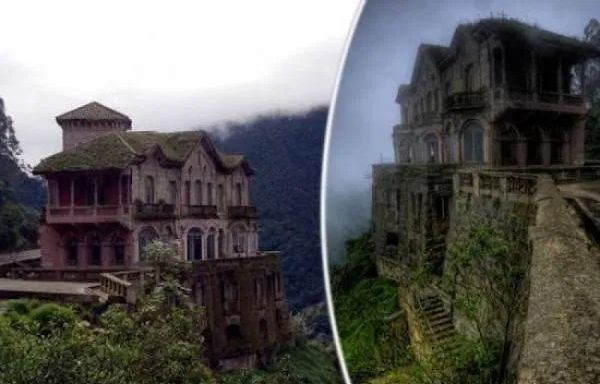
Two views of the Hotel Del Salto as it was while empty. Via moco-choco.com

For her build, Jade offers both a homage to, and interpretation of, the hotel during those years when it lay abandoned. As with the original, it sits atop a deep gorge, facing the Tequendama Falls on the region’s north side.

The shelf on which it sits is perhaps broader that that occupied by the actual Hotel Del Salto, which means some of the on-the-edge grandeur of the original is lost, but there is no mistaking the architectural style that has been captured by this interpretation.

Hotel Del Salto, May 2020

The building is overgrown, vines hanging within mouldy rooms like drapes, furnishings braking and rotting as a result of the humidity no doubt brought about by the heat and damp, the terrace around it broken and given over to weeds and 50’s style cars. Like the original, stairs descend the cliffs below the hotel, although these don’t pass any basement levels. Instead they provide access to a bridge spanning the gorge, and further stairs down to the floor of the gorge, where ancient ruins lay, offering the suggestion of a place perhaps once belonging to the Muisca.

Throughout the build can be found numerous platforms and seating points intended to provide places from which the hotel and the gorge with its falls – presented in full spate – can be appreciated. Adding to the setting are wheeling birds, a rich sense of forest, parrots and toucans,  while the sound scape gives incredible depth to the region’s visual splendour.

Hotel Del Salto, May 2020

Completed by a region surround that strongly evokes the Andean uplands of Colombia to provide the perfect backdrop, this is a build fully deserving of a visit and in spending time exploring.

SLurl Details